Overview of Public Health
Surveillance
2023-01-08
1
health officers
Outline
 Introduction
 Purpose of surveillance
 Types of surveillance
 Good features of good surveillance
 Integrated disease surveillance
2023-01-08
2 health officers
Session objectives
 At the end of this session you will be able to:
 Define surveillance
 List purposes of surveillance
 Describe the types of surveillance
 Mention good features of surveillance
 Discuss integrated surveillance system
2023-01-08
3 health officers
What is Surveillance?
Systematic collection of information on a
specific disease or other health-related event
Must occur on an ongoing basis with sufficient
accuracy and completeness for data analysis
Utilization of information for disease prevention
and control
# 1-4-4
2023-01-08
4 health officers
Purpose of surveillance
 To be able to identify diseases, injuries, hazards and
other health related factors as early as possible,
 i.e. prediction and early detection of outbreaks.
 To provide scientific baseline data and information
for priority setting, planning, implementing and
evaluating disease control program for both
communicable and non-communicable health
problems.
 To define the magnitude and distribution of diseases
by time, person and place dimension.
2023-01-08
5 health officers
Information cycle
 A surveillance system is an information loop
or cycle that involves:
 healthcare providers
 public health agencies
 the public
# 1-4-5
2023-01-08
6 health officers
Surveillance Terms
Universal case reporting – a surveillance
system in which all cases of a disease are
supposed to be reported
Sentinel surveillance – a surveillance system
in which reports are obtained from certain
facilities or populations
Laboratory-based reporting – a surveillance
system in which the reports of cases come
from clinical laboratories instead of healthcare
practitioners or hospitals
# 1-4-7
2023-01-08
7 health officers
Surveillance term…
Case definition – the clinical and laboratory
characteristics that a patient must have to be
counted as a case for surveillance purposes
Prevalence – the proportion of persons in a
population who have a disease or condition at
a given point in time
Incidence – the number of persons who newly
develop a disease or condition within a
specified period of time
# 1-4-8
2023-01-08
8 health officers
Types of surveillance
 The two common types of surveillance are passive
and active surveillance.

Passive surveillance
 Passive surveillance may be defined as a
mechanism for routine surveillance based on
passive case detection and on the routine recording
and reporting system.
 The information provider comes to the health
institutions for help, be it medical or other preventive
and promotive health services
2023-01-08
9 health officers
Passive surveillance...
 It involves collection of data as part of routine
provision of health services.
Advantages of passive surveillance
Covers a wide range of problems
Does not require special arrangement
It is relatively cheap
Covers a wider area
2023-01-08
10 health officers
Passive surveillance...
The disadvantages of passive surveillance
 The information generated is to a large extent
unreliable, incomplete and inaccurate
 Most of the time, data from passive surveillance is
not available on time
 Most of the time, you may not get the kind of
information you desire
 It lacks representativeness of the whole population
since passive surveillance is mainly based on health
institution reports
2023-01-08
11 health officers
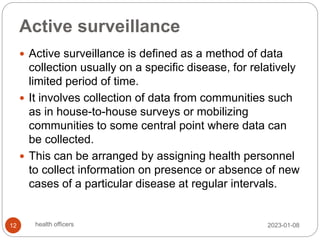
Active surveillance
 Active surveillance is defined as a method of data
collection usually on a specific disease, for relatively
limited period of time.
 It involves collection of data from communities such
as in house-to-house surveys or mobilizing
communities to some central point where data can
be collected.
 This can be arranged by assigning health personnel
to collect information on presence or absence of new
cases of a particular disease at regular intervals.
2023-01-08
12 health officers
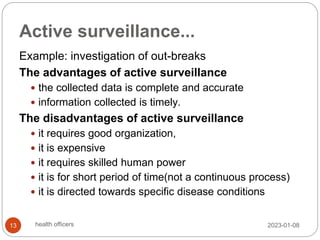
Active surveillance...
Example: investigation of out-breaks
The advantages of active surveillance
 the collected data is complete and accurate
 information collected is timely.
The disadvantages of active surveillance
 it requires good organization,
 it is expensive
 it requires skilled human power
 it is for short period of time(not a continuous process)
 it is directed towards specific disease conditions
2023-01-08
13 health officers
Active surveillance...
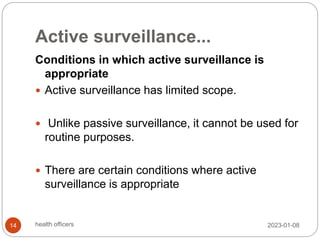
Conditions in which active surveillance is
appropriate
 Active surveillance has limited scope.
 Unlike passive surveillance, it cannot be used for
routine purposes.
 There are certain conditions where active
surveillance is appropriate
2023-01-08
14 health officers
Active surveillance...
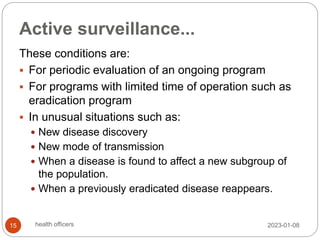
These conditions are:
 For periodic evaluation of an ongoing program
 For programs with limited time of operation such as
eradication program
 In unusual situations such as:
 New disease discovery
 New mode of transmission
 When a disease is found to affect a new subgroup of
the population.
 When a previously eradicated disease reappears.
2023-01-08
15 health officers
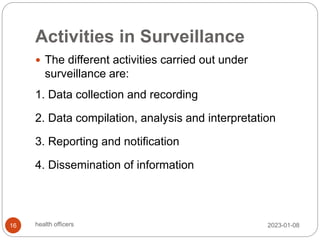
Activities in Surveillance
 The different activities carried out under
surveillance are:
1. Data collection and recording
2. Data compilation, analysis and interpretation
3. Reporting and notification
4. Dissemination of information
2023-01-08
16 health officers
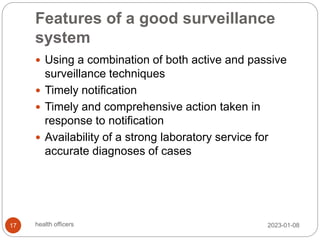
Features of a good surveillance
system
 Using a combination of both active and passive
surveillance techniques
 Timely notification
 Timely and comprehensive action taken in
response to notification
 Availability of a strong laboratory service for
accurate diagnoses of cases
2023-01-08
17 health officers
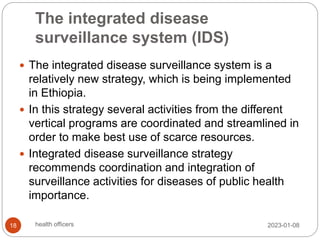
The integrated disease
surveillance system (IDS)
 The integrated disease surveillance system is a
relatively new strategy, which is being implemented
in Ethiopia.
 In this strategy several activities from the different
vertical programs are coordinated and streamlined in
order to make best use of scarce resources.
 Integrated disease surveillance strategy
recommends coordination and integration of
surveillance activities for diseases of public health
importance.
2023-01-08
18 health officers
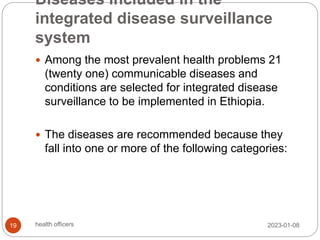
Diseases included in the
integrated disease surveillance
system
 Among the most prevalent health problems 21
(twenty one) communicable diseases and
conditions are selected for integrated disease
surveillance to be implemented in Ethiopia.
 The diseases are recommended because they
fall into one or more of the following categories:
2023-01-08
19 health officers
Diseases included in IDS...
 Are top causes of high morbidity and mortality
in Ethiopia (for example, malaria, pneumonia,
diarrheal diseases, tuberculosis, and HIV/AIDS)
 Have epidemic potential (for example yellow
fever and cholera)
 Surveillance required internationally (for
example plague, yellow fever and cholera)
2023-01-08
20 health officers
Diseases included in IDS...
 Have available effective control and prevention
interventions for addressing the public health
problem they pose (for example schistosomiasis,
onchocerciasis, trypanosomiasis)
 Can easily be identified using simple case
definition; and
 Have intervention programs for prevention, control,
eradication or elimination of the diseases (for
example EPI and Integrated Management of
Childhood Illness Strategy (IMCI)
2023-01-08
21 health officers
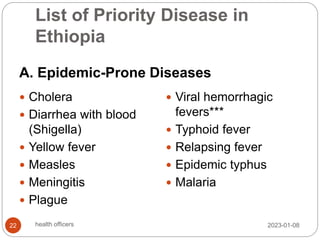
List of Priority Disease in
Ethiopia
A. Epidemic-Prone Diseases
 Cholera
 Diarrhea with blood
(Shigella)
 Yellow fever
 Measles
 Meningitis
 Plague
 Viral hemorrhagic
fevers***
 Typhoid fever
 Relapsing fever
 Epidemic typhus
 Malaria
2023-01-08
22 health officers
Priority Disease in Ethiopia...
B. Diseases Targeted for Eradication and
Elimination
 Acute flaccid paralysis (AFP)/ polio
 Dracunculiasis (Guinea worm)
 Leprosy
 Neonatal tetanus
2023-01-08
23 health officers
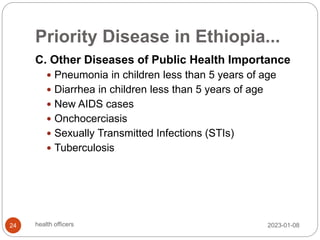
Priority Disease in Ethiopia...
C. Other Diseases of Public Health Importance
 Pneumonia in children less than 5 years of age
 Diarrhea in children less than 5 years of age
 New AIDS cases
 Onchocerciasis
 Sexually Transmitted Infections (STIs)
 Tuberculosis
2023-01-08
24 health officers
2023-01-08
25 health officers

survillance .pptx

  • 1.
    Overview of PublicHealth Surveillance 2023-01-08 1 health officers
  • 2.
    Outline  Introduction  Purposeof surveillance  Types of surveillance  Good features of good surveillance  Integrated disease surveillance 2023-01-08 2 health officers
  • 3.
    Session objectives  Atthe end of this session you will be able to:  Define surveillance  List purposes of surveillance  Describe the types of surveillance  Mention good features of surveillance  Discuss integrated surveillance system 2023-01-08 3 health officers
  • 4.
    What is Surveillance? Systematiccollection of information on a specific disease or other health-related event Must occur on an ongoing basis with sufficient accuracy and completeness for data analysis Utilization of information for disease prevention and control # 1-4-4 2023-01-08 4 health officers
  • 5.
    Purpose of surveillance To be able to identify diseases, injuries, hazards and other health related factors as early as possible,  i.e. prediction and early detection of outbreaks.  To provide scientific baseline data and information for priority setting, planning, implementing and evaluating disease control program for both communicable and non-communicable health problems.  To define the magnitude and distribution of diseases by time, person and place dimension. 2023-01-08 5 health officers
  • 6.
    Information cycle  Asurveillance system is an information loop or cycle that involves:  healthcare providers  public health agencies  the public # 1-4-5 2023-01-08 6 health officers
  • 7.
    Surveillance Terms Universal casereporting – a surveillance system in which all cases of a disease are supposed to be reported Sentinel surveillance – a surveillance system in which reports are obtained from certain facilities or populations Laboratory-based reporting – a surveillance system in which the reports of cases come from clinical laboratories instead of healthcare practitioners or hospitals # 1-4-7 2023-01-08 7 health officers
  • 8.
    Surveillance term… Case definition– the clinical and laboratory characteristics that a patient must have to be counted as a case for surveillance purposes Prevalence – the proportion of persons in a population who have a disease or condition at a given point in time Incidence – the number of persons who newly develop a disease or condition within a specified period of time # 1-4-8 2023-01-08 8 health officers
  • 9.
    Types of surveillance The two common types of surveillance are passive and active surveillance. Passive surveillance  Passive surveillance may be defined as a mechanism for routine surveillance based on passive case detection and on the routine recording and reporting system.  The information provider comes to the health institutions for help, be it medical or other preventive and promotive health services 2023-01-08 9 health officers
  • 10.
    Passive surveillance...  Itinvolves collection of data as part of routine provision of health services. Advantages of passive surveillance Covers a wide range of problems Does not require special arrangement It is relatively cheap Covers a wider area 2023-01-08 10 health officers
  • 11.
    Passive surveillance... The disadvantagesof passive surveillance  The information generated is to a large extent unreliable, incomplete and inaccurate  Most of the time, data from passive surveillance is not available on time  Most of the time, you may not get the kind of information you desire  It lacks representativeness of the whole population since passive surveillance is mainly based on health institution reports 2023-01-08 11 health officers
  • 12.
    Active surveillance  Activesurveillance is defined as a method of data collection usually on a specific disease, for relatively limited period of time.  It involves collection of data from communities such as in house-to-house surveys or mobilizing communities to some central point where data can be collected.  This can be arranged by assigning health personnel to collect information on presence or absence of new cases of a particular disease at regular intervals. 2023-01-08 12 health officers
  • 13.
    Active surveillance... Example: investigationof out-breaks The advantages of active surveillance  the collected data is complete and accurate  information collected is timely. The disadvantages of active surveillance  it requires good organization,  it is expensive  it requires skilled human power  it is for short period of time(not a continuous process)  it is directed towards specific disease conditions 2023-01-08 13 health officers
  • 14.
    Active surveillance... Conditions inwhich active surveillance is appropriate  Active surveillance has limited scope.  Unlike passive surveillance, it cannot be used for routine purposes.  There are certain conditions where active surveillance is appropriate 2023-01-08 14 health officers
  • 15.
    Active surveillance... These conditionsare:  For periodic evaluation of an ongoing program  For programs with limited time of operation such as eradication program  In unusual situations such as:  New disease discovery  New mode of transmission  When a disease is found to affect a new subgroup of the population.  When a previously eradicated disease reappears. 2023-01-08 15 health officers
  • 16.
    Activities in Surveillance The different activities carried out under surveillance are: 1. Data collection and recording 2. Data compilation, analysis and interpretation 3. Reporting and notification 4. Dissemination of information 2023-01-08 16 health officers
  • 17.
    Features of agood surveillance system  Using a combination of both active and passive surveillance techniques  Timely notification  Timely and comprehensive action taken in response to notification  Availability of a strong laboratory service for accurate diagnoses of cases 2023-01-08 17 health officers
  • 18.
    The integrated disease surveillancesystem (IDS)  The integrated disease surveillance system is a relatively new strategy, which is being implemented in Ethiopia.  In this strategy several activities from the different vertical programs are coordinated and streamlined in order to make best use of scarce resources.  Integrated disease surveillance strategy recommends coordination and integration of surveillance activities for diseases of public health importance. 2023-01-08 18 health officers
  • 19.
    Diseases included inthe integrated disease surveillance system  Among the most prevalent health problems 21 (twenty one) communicable diseases and conditions are selected for integrated disease surveillance to be implemented in Ethiopia.  The diseases are recommended because they fall into one or more of the following categories: 2023-01-08 19 health officers
  • 20.
    Diseases included inIDS...  Are top causes of high morbidity and mortality in Ethiopia (for example, malaria, pneumonia, diarrheal diseases, tuberculosis, and HIV/AIDS)  Have epidemic potential (for example yellow fever and cholera)  Surveillance required internationally (for example plague, yellow fever and cholera) 2023-01-08 20 health officers
  • 21.
    Diseases included inIDS...  Have available effective control and prevention interventions for addressing the public health problem they pose (for example schistosomiasis, onchocerciasis, trypanosomiasis)  Can easily be identified using simple case definition; and  Have intervention programs for prevention, control, eradication or elimination of the diseases (for example EPI and Integrated Management of Childhood Illness Strategy (IMCI) 2023-01-08 21 health officers
  • 22.
    List of PriorityDisease in Ethiopia A. Epidemic-Prone Diseases  Cholera  Diarrhea with blood (Shigella)  Yellow fever  Measles  Meningitis  Plague  Viral hemorrhagic fevers***  Typhoid fever  Relapsing fever  Epidemic typhus  Malaria 2023-01-08 22 health officers
  • 23.
    Priority Disease inEthiopia... B. Diseases Targeted for Eradication and Elimination  Acute flaccid paralysis (AFP)/ polio  Dracunculiasis (Guinea worm)  Leprosy  Neonatal tetanus 2023-01-08 23 health officers
  • 24.
    Priority Disease inEthiopia... C. Other Diseases of Public Health Importance  Pneumonia in children less than 5 years of age  Diarrhea in children less than 5 years of age  New AIDS cases  Onchocerciasis  Sexually Transmitted Infections (STIs)  Tuberculosis 2023-01-08 24 health officers
  • 25.