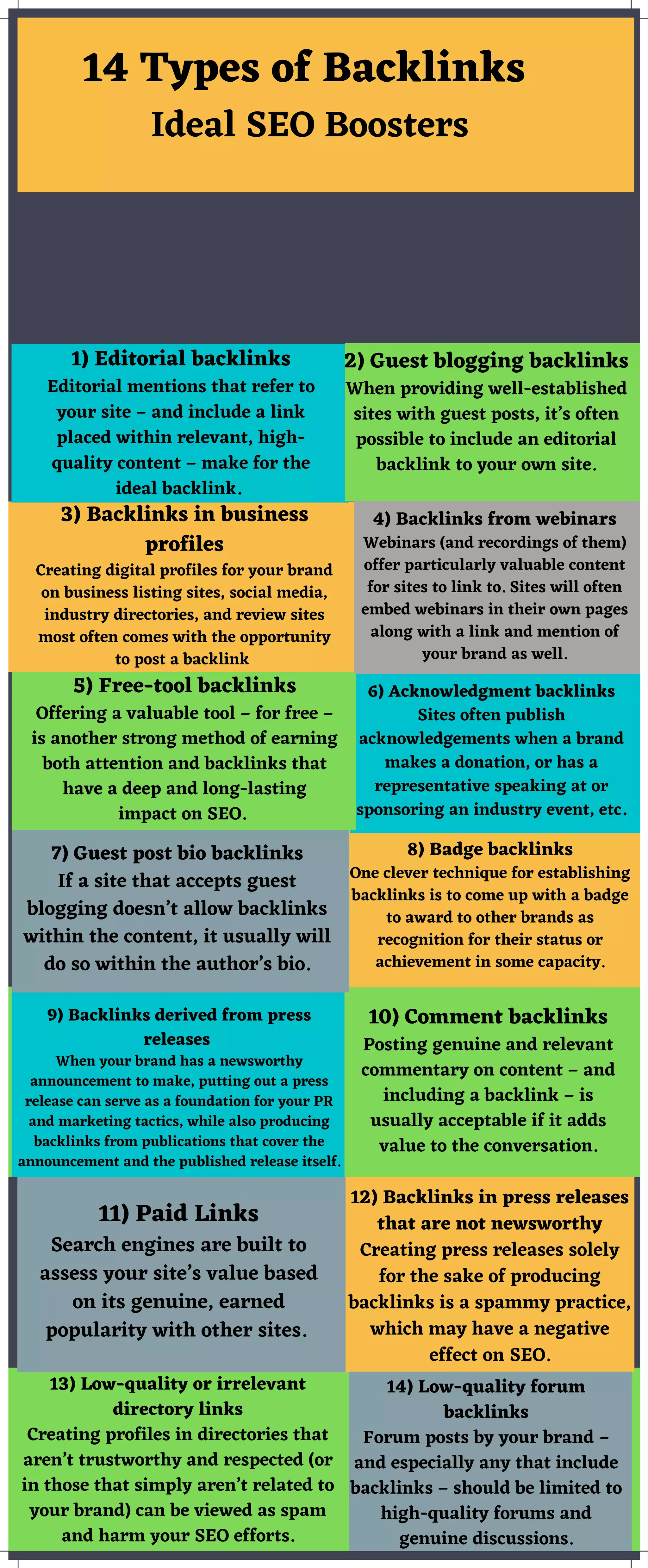
1) Editorial backlinks
Editorial mentions that refer to
your site – and include a link
placed within relevant, high-
quality content – make for the
ideal backlink.
2) Guest blogging backlinks
When providing well-established
sites with guest posts, it’s often
possible to include an editorial
backlink to your own site.
3) Backlinks in business
profiles
Creating digital profiles for your brand
on business listing sites, social media,
industry directories, and review sites
most often comes with the opportunity
to post a backlink
4) Backlinks from webinars
Webinars (and recordings of them)
offer particularly valuable content
for sites to link to. Sites will often
embed webinars in their own pages
along with a link and mention of
your brand as well.
5) Free-tool backlinks
Offering a valuable tool – for free –
is another strong method of earning
both attention and backlinks that
have a deep and long-lasting
impact on SEO.
6) Acknowledgment backlinks
Sites often publish
acknowledgements when a brand
makes a donation, or has a
representative speaking at or
sponsoring an industry event, etc.
7) Guest post bio backlinks
If a site that accepts guest
blogging doesn’t allow backlinks
within the content, it usually will
do so within the author’s bio.
8) Badge backlinks
One clever technique for establishing
backlinks is to come up with a badge
to award to other brands as
recognition for their status or
achievement in some capacity.
9) Backlinks derived from press
releases
When your brand has a newsworthy
announcement to make, putting out a press
release can serve as a foundation for your PR
and marketing tactics, while also producing
backlinks from publications that cover the
announcement and the published release itself.
10) Comment backlinks
Posting genuine and relevant
commentary on content – and
including a backlink – is
usually acceptable if it adds
value to the conversation.
11) Paid Links
Search engines are built to
assess your site’s value based
on its genuine, earned
popularity with other sites.
12) Backlinks in press releases
that are not newsworthy
Creating press releases solely
for the sake of producing
backlinks is a spammy practice,
which may have a negative
effect on SEO.
13) Low-quality or irrelevant
directory links
Creating profiles in directories that
aren’t trustworthy and respected (or
in those that simply aren’t related to
your brand) can be viewed as spam
and harm your SEO efforts.
14) Low-quality forum
backlinks
Forum posts by your brand –
and especially any that include
backlinks – should be limited to
high-quality forums and
genuine discussions.
14 Types of Backlinks
Ideal SEO Boosters

14 Types of Backlinks

  • 1.
    1) Editorial backlinks Editorialmentions that refer to your site – and include a link placed within relevant, high- quality content – make for the ideal backlink. 2) Guest blogging backlinks When providing well-established sites with guest posts, it’s often possible to include an editorial backlink to your own site. 3) Backlinks in business profiles Creating digital profiles for your brand on business listing sites, social media, industry directories, and review sites most often comes with the opportunity to post a backlink 4) Backlinks from webinars Webinars (and recordings of them) offer particularly valuable content for sites to link to. Sites will often embed webinars in their own pages along with a link and mention of your brand as well. 5) Free-tool backlinks Offering a valuable tool – for free – is another strong method of earning both attention and backlinks that have a deep and long-lasting impact on SEO. 6) Acknowledgment backlinks Sites often publish acknowledgements when a brand makes a donation, or has a representative speaking at or sponsoring an industry event, etc. 7) Guest post bio backlinks If a site that accepts guest blogging doesn’t allow backlinks within the content, it usually will do so within the author’s bio. 8) Badge backlinks One clever technique for establishing backlinks is to come up with a badge to award to other brands as recognition for their status or achievement in some capacity. 9) Backlinks derived from press releases When your brand has a newsworthy announcement to make, putting out a press release can serve as a foundation for your PR and marketing tactics, while also producing backlinks from publications that cover the announcement and the published release itself. 10) Comment backlinks Posting genuine and relevant commentary on content – and including a backlink – is usually acceptable if it adds value to the conversation. 11) Paid Links Search engines are built to assess your site’s value based on its genuine, earned popularity with other sites. 12) Backlinks in press releases that are not newsworthy Creating press releases solely for the sake of producing backlinks is a spammy practice, which may have a negative effect on SEO. 13) Low-quality or irrelevant directory links Creating profiles in directories that aren’t trustworthy and respected (or in those that simply aren’t related to your brand) can be viewed as spam and harm your SEO efforts. 14) Low-quality forum backlinks Forum posts by your brand – and especially any that include backlinks – should be limited to high-quality forums and genuine discussions. 14 Types of Backlinks Ideal SEO Boosters