TOPIC – PSUR
Presented By : Mr.Sourav Chander
Reg.no. 71910684
Under Guidance of : Ms.Jagpreet
kaur (ass. Proff.)
PSUR-Periodic
Safety Update
Report
CONTENT
• Periodic Reporting
• PSUR
• Major types of Periodic Reports
• Differences between PSUR and PADER
• Differences between PSUR and PBRER
• The frequency of these reports
• PSUR OBJECTIVES
• Principles of PSUR
• The content and format of PSUR
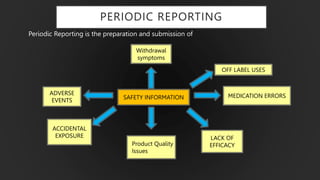
PERIODIC REPORTING
Periodic Reporting is the preparation and submission of
SAFETY INFORMATION
LACK OF
EFFICACY
MEDICATION ERRORS
OFF LABEL USES
Withdrawal
symptoms
ADVERSE
EVENTS
ACCIDENTAL
EXPOSURE
Product Quality
Issues
PSUR
SAFETY INFORMATION SUBMISSION OF
MEDINICAL PRODUCT on a periodic or timely
basis e.g
 Every year or
 every 3 months or
 every 6 months.
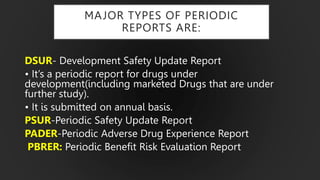
MAJOR TYPES OF PERIODIC
REPORTS ARE:
DSUR- Development Safety Update Report
• It’s a periodic report for drugs under
development(including marketed Drugs that are under
further study).
• It is submitted on annual basis.
PSUR-Periodic Safety Update Report
PADER-Periodic Adverse Drug Experience Report
PBRER: Periodic Benefit Risk Evaluation Report
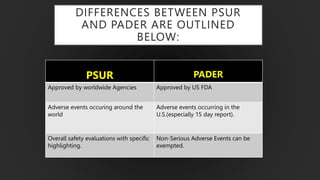
DIFFERENCES BETWEEN PSUR
AND PADER ARE OUTLINED
BELOW:
PSUR PADER
Approved by worldwide Agencies Approved by US FDA
Adverse events occuring around the
world
Adverse events occurring in the
U.S.(especially 15 day report).
Overall safety evaluations with specific
highlighting.
Non-Serious Adverse Events can be
exempted.
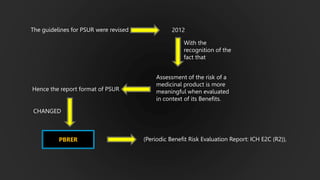
The guidelines for PSUR were revised 2012
With the
recognition of the
fact that
Assessment of the risk of a
medicinal product is more
meaningful when evaluated
in context of its Benefits.
Hence the report format of PSUR
CHANGED
(Periodic Benefit Risk Evaluation Report: ICH E2C (R2)),
PBRER
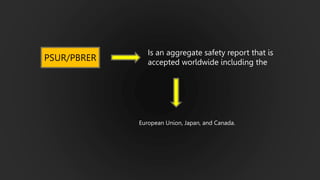
Is an aggregate safety report that is
accepted worldwide including the
European Union, Japan, and Canada.
PSUR/PBRER
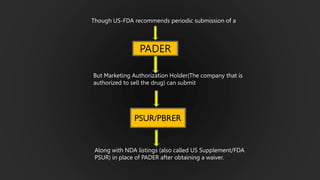
Though US-FDA recommends periodic submission of a
But Marketing Authorization Holder(The company that is
authorized to sell the drug) can submit
Along with NDA listings (also called US Supplement/FDA
PSUR) in place of PADER after obtaining a waiver.
PADER
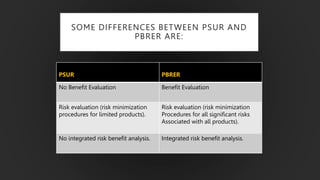
SOME DIFFERENCES BETWEEN PSUR AND
PBRER ARE:
PSUR PBRER
No Benefit Evaluation Benefit Evaluation
Risk evaluation (risk minimization
procedures for limited products).
Risk evaluation (risk minimization
Procedures for all significant risks
Associated with all products).
No integrated risk benefit analysis. Integrated risk benefit analysis.
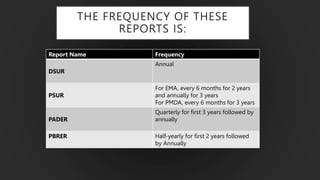
THE FREQUENCY OF THESE
REPORTS IS:
Report Name Frequency
DSUR
Annual
PSUR
For EMA, every 6 months for 2 years
and annually for 3 years
For PMDA, every 6 months for 3 years
PADER
Quarterly for first 3 years followed by
annually
PBRER Half-yearly for first 2 years followed
by Annually
PSUR
• PSURs are important pharmacovigilance documents
applying to drugs already approved for marketing-regularly
updating regulatory authorities on the worldwide safety
experience of approved drugs.
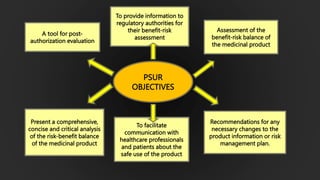
A tool for post-
authorization evaluation
PSUR
OBJECTIVES
Assessment of the
benefit-risk balance of
the medicinal product
Recommendations for any
necessary changes to the
product information or risk
management plan.
Present a comprehensive,
concise and critical analysis
of the risk-benefit balance
of the medicinal product
To provide information to
regulatory authorities for
their benefit-risk
assessment
To facilitate
communication with
healthcare professionals
and patients about the
safe use of the product
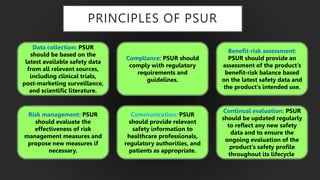
PRINCIPLES OF PSUR
Data collection: PSUR
should be based on the
latest available safety data
from all relevant sources,
including clinical trials,
post-marketing surveillance,
and scientific literature.
Continual evaluation: PSUR
should be updated regularly
to reflect any new safety
data and to ensure the
ongoing evaluation of the
product's safety profile
throughout its lifecycle.
Compliance: PSUR should
comply with regulatory
requirements and
guidelines.
Communication: PSUR
should provide relevant
safety information to
healthcare professionals,
regulatory authorities, and
patients as appropriate.
Risk management: PSUR
should evaluate the
effectiveness of risk
management measures and
propose new measures if
necessary.
Benefit-risk assessment:
PSUR should provide an
assessment of the product's
benefit-risk balance based
on the latest safety data and
the product's intended use.
THE CONTENT AND FORMAT OF PSUR
• The content and format of PSURs are specified in the
International Council for Harmonisation (ICH) guideline E2C(R2).
• It is a pharmacovigilance document that provides an evaluation
of the safety of a medicinal product over a specific period of
time.
• The PSUR is submitted by the marketing authorization holder
(MAH) to the regulatory authorities at defined intervals
THE CONTENT AND
FORMAT OF PSUR
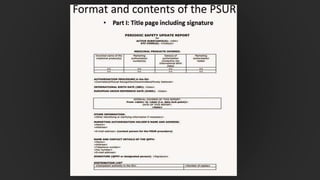
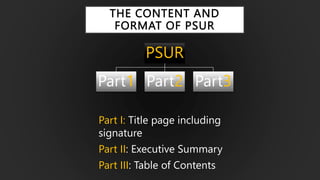
Part I: Title page including
signature
Part II: Executive Summary
Part III: Table of Contents
PSUR
Part1 Part2 Part3
PSUR TITLE PAGE
Name of the medicinal product(s)& substance
International birth date (IBD)
Reporting interval
Date of the report
Marketing authorisation holder details
PSUR EXECUTIVE SUMMARY
CONCISE SUMMARY OF CONTENT
Purpose to Provide
IMPORTANT INFORMATION
INCLUDE
 Medicinal products, therapeutic classes ,mechanism(s) of action,, indication(s), pharmaceutical
formulation(s),dose(s) and route(s) of administration;
 Number of countries in which the medicinal product is authorised;
 Summary of the overall benefit-risk analysis evaluation
 Conclusions.
TABLE OF CONTENTS
• 1.Introduction
• 2. Worldwide marketing authorisation status
• 3.Actions taken in the reporting interval for safety reasons
• 4. Changes to reference safety information
• 5. Estimated exposure and use pattems
• 5.1. Cumulative subject exposure in clinical trials
• 5.2. Cumulative and interval patient exposure from
marketingexperience
• 6. Data in summary tabulations
• 6.1. Reference information
• 6.2. Cumulative summary tabulations of serious adverse events
fromclinical trials
• 6.3. Cumulative and interval summary tabulations from post-
marketing data sources
• 7. Summaries of significant findings from clinical trials during thereporting interval
• 7.1 Completed clinical trials
• 7.2. Ongoing clinical trials
• 7.3. Long-term follow-up
• 7.4. Other therapeutic use of medicinal product
• 7.5. New safety data related to fixed combination therapies
• 8. Findings from non-interventional studies
• 9. Information from other clinical trials and sources
• 10. Non-clinical Data
• 11. Literature
• 12 . Other periodic reports
• 13. Lack of efficacy in controlled clinical trials
• 14. Late-breaking information
• 15. Overview of signals: new, ongoing or closed
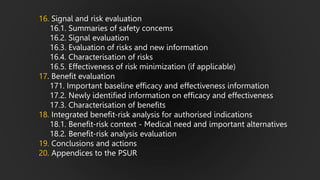
16. Signal and risk evaluation
16.1. Summaries of safety concems
16.2. Signal evaluation
16.3. Evaluation of risks and new information
16.4. Characterisation of risks
16.5. Effectiveness of risk minimization (if applicable)
17. Benefit evaluation
171. Important baseline efficacy and effectiveness information
17.2. Newly identified information on efficacy and effectiveness
17.3. Characterisation of benefits
18. Integrated benefit-risk analysis for authorised indications
18.1. Benefit-risk context - Medical need and important alternatives
18.2. Benefit-risk analysis evaluation
19. Conclusions and actions
20. Appendices to the PSUR
Topic – PSUR by Sourav Chander.pptx

Topic – PSUR by Sourav Chander.pptx

  • 1.
    TOPIC – PSUR PresentedBy : Mr.Sourav Chander Reg.no. 71910684 Under Guidance of : Ms.Jagpreet kaur (ass. Proff.) PSUR-Periodic Safety Update Report
  • 2.
    CONTENT • Periodic Reporting •PSUR • Major types of Periodic Reports • Differences between PSUR and PADER • Differences between PSUR and PBRER • The frequency of these reports • PSUR OBJECTIVES • Principles of PSUR • The content and format of PSUR
  • 3.
    PERIODIC REPORTING Periodic Reportingis the preparation and submission of SAFETY INFORMATION LACK OF EFFICACY MEDICATION ERRORS OFF LABEL USES Withdrawal symptoms ADVERSE EVENTS ACCIDENTAL EXPOSURE Product Quality Issues
  • 4.
    PSUR SAFETY INFORMATION SUBMISSIONOF MEDINICAL PRODUCT on a periodic or timely basis e.g  Every year or  every 3 months or  every 6 months.
  • 5.
    MAJOR TYPES OFPERIODIC REPORTS ARE: DSUR- Development Safety Update Report • It’s a periodic report for drugs under development(including marketed Drugs that are under further study). • It is submitted on annual basis. PSUR-Periodic Safety Update Report PADER-Periodic Adverse Drug Experience Report PBRER: Periodic Benefit Risk Evaluation Report
  • 6.
    DIFFERENCES BETWEEN PSUR ANDPADER ARE OUTLINED BELOW: PSUR PADER Approved by worldwide Agencies Approved by US FDA Adverse events occuring around the world Adverse events occurring in the U.S.(especially 15 day report). Overall safety evaluations with specific highlighting. Non-Serious Adverse Events can be exempted.
  • 7.
    The guidelines forPSUR were revised 2012 With the recognition of the fact that Assessment of the risk of a medicinal product is more meaningful when evaluated in context of its Benefits. Hence the report format of PSUR CHANGED (Periodic Benefit Risk Evaluation Report: ICH E2C (R2)), PBRER
  • 8.
    Is an aggregatesafety report that is accepted worldwide including the European Union, Japan, and Canada. PSUR/PBRER
  • 9.
    Though US-FDA recommendsperiodic submission of a But Marketing Authorization Holder(The company that is authorized to sell the drug) can submit Along with NDA listings (also called US Supplement/FDA PSUR) in place of PADER after obtaining a waiver. PADER
  • 10.
    SOME DIFFERENCES BETWEENPSUR AND PBRER ARE: PSUR PBRER No Benefit Evaluation Benefit Evaluation Risk evaluation (risk minimization procedures for limited products). Risk evaluation (risk minimization Procedures for all significant risks Associated with all products). No integrated risk benefit analysis. Integrated risk benefit analysis.
  • 11.
    THE FREQUENCY OFTHESE REPORTS IS: Report Name Frequency DSUR Annual PSUR For EMA, every 6 months for 2 years and annually for 3 years For PMDA, every 6 months for 3 years PADER Quarterly for first 3 years followed by annually PBRER Half-yearly for first 2 years followed by Annually
  • 13.
    PSUR • PSURs areimportant pharmacovigilance documents applying to drugs already approved for marketing-regularly updating regulatory authorities on the worldwide safety experience of approved drugs.
  • 14.
    A tool forpost- authorization evaluation PSUR OBJECTIVES Assessment of the benefit-risk balance of the medicinal product Recommendations for any necessary changes to the product information or risk management plan. Present a comprehensive, concise and critical analysis of the risk-benefit balance of the medicinal product To provide information to regulatory authorities for their benefit-risk assessment To facilitate communication with healthcare professionals and patients about the safe use of the product
  • 15.
    PRINCIPLES OF PSUR Datacollection: PSUR should be based on the latest available safety data from all relevant sources, including clinical trials, post-marketing surveillance, and scientific literature. Continual evaluation: PSUR should be updated regularly to reflect any new safety data and to ensure the ongoing evaluation of the product's safety profile throughout its lifecycle. Compliance: PSUR should comply with regulatory requirements and guidelines. Communication: PSUR should provide relevant safety information to healthcare professionals, regulatory authorities, and patients as appropriate. Risk management: PSUR should evaluate the effectiveness of risk management measures and propose new measures if necessary. Benefit-risk assessment: PSUR should provide an assessment of the product's benefit-risk balance based on the latest safety data and the product's intended use.
  • 17.
    THE CONTENT ANDFORMAT OF PSUR • The content and format of PSURs are specified in the International Council for Harmonisation (ICH) guideline E2C(R2). • It is a pharmacovigilance document that provides an evaluation of the safety of a medicinal product over a specific period of time. • The PSUR is submitted by the marketing authorization holder (MAH) to the regulatory authorities at defined intervals
  • 18.
    THE CONTENT AND FORMATOF PSUR Part I: Title page including signature Part II: Executive Summary Part III: Table of Contents PSUR Part1 Part2 Part3
  • 19.
    PSUR TITLE PAGE Nameof the medicinal product(s)& substance International birth date (IBD) Reporting interval Date of the report Marketing authorisation holder details
  • 20.
    PSUR EXECUTIVE SUMMARY CONCISESUMMARY OF CONTENT Purpose to Provide IMPORTANT INFORMATION INCLUDE  Medicinal products, therapeutic classes ,mechanism(s) of action,, indication(s), pharmaceutical formulation(s),dose(s) and route(s) of administration;  Number of countries in which the medicinal product is authorised;  Summary of the overall benefit-risk analysis evaluation  Conclusions.
  • 21.
    TABLE OF CONTENTS •1.Introduction • 2. Worldwide marketing authorisation status • 3.Actions taken in the reporting interval for safety reasons • 4. Changes to reference safety information • 5. Estimated exposure and use pattems • 5.1. Cumulative subject exposure in clinical trials • 5.2. Cumulative and interval patient exposure from marketingexperience • 6. Data in summary tabulations • 6.1. Reference information • 6.2. Cumulative summary tabulations of serious adverse events fromclinical trials • 6.3. Cumulative and interval summary tabulations from post- marketing data sources
  • 22.
    • 7. Summariesof significant findings from clinical trials during thereporting interval • 7.1 Completed clinical trials • 7.2. Ongoing clinical trials • 7.3. Long-term follow-up • 7.4. Other therapeutic use of medicinal product • 7.5. New safety data related to fixed combination therapies • 8. Findings from non-interventional studies • 9. Information from other clinical trials and sources • 10. Non-clinical Data • 11. Literature • 12 . Other periodic reports • 13. Lack of efficacy in controlled clinical trials • 14. Late-breaking information • 15. Overview of signals: new, ongoing or closed
  • 23.
    16. Signal andrisk evaluation 16.1. Summaries of safety concems 16.2. Signal evaluation 16.3. Evaluation of risks and new information 16.4. Characterisation of risks 16.5. Effectiveness of risk minimization (if applicable) 17. Benefit evaluation 171. Important baseline efficacy and effectiveness information 17.2. Newly identified information on efficacy and effectiveness 17.3. Characterisation of benefits 18. Integrated benefit-risk analysis for authorised indications 18.1. Benefit-risk context - Medical need and important alternatives 18.2. Benefit-risk analysis evaluation 19. Conclusions and actions 20. Appendices to the PSUR