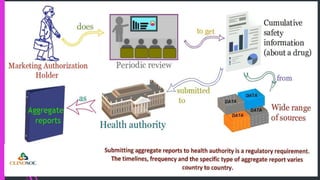
AGGREGATE
REPORTING
DIFFERENT TYPES OF AGGREGATE REPORTS
 Preapproval aggregate reports are:
 Developmental Safety Update Report{DSUR}
 Investigational New Drug{IND} report in United States & Annual Safety
Report{ASR} in Europe are also getting replaced by DSUR
 Post approval aggregate reports are:
 Periodic Safety Update Report{PSUR} OR
 Periodic Benefit Risk Evaluation Report{PBRER}
 Periodic Adverse Drug Experience Report{PADER}
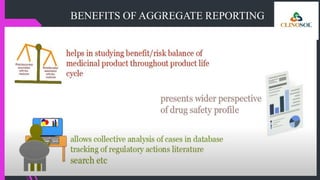
BENEFITS OF AGGREGATE REPORTING
DRUG SAFETY UPDATE REPORT
 Drug Safety Update Reports{DSURs} are new , intentionally-harmonized , safety
documents covering the safety summary of medicinal products during their
development or clinical trial phase.
 OBJECTIVES
 The potential risks are summarized based on the current understanding and
management.
 Examine changes in the product safety profile.
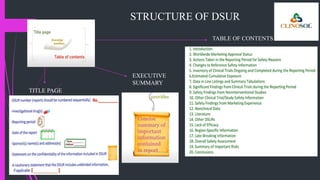
STRUCTURE OF DSUR
TABLE OF CONTENTS
TITLE PAGE
EXECUTIVE
SUMMARY
REPORTING TIMELINES
 Should be submitted no later than 60 calendar days from the DSUR data lock
point
The DSUR presents an annual reviews and evaluation of safety information
• It focus on clinical trial drugs like drugs, vaccines and biologics.
• Safety and welfare of the subjects
• Investigational drug data should be equal to comparator drug.
PERIODIC SAFETY UPDATE REPORTS{PSUR}
Periodic Safety Update Reports{PSUR’s} are pharmacovigilance documents intended to
provide an evaluation of the risk-benefit balance of a medicinal product for submission by
marketing authorization holders{MAH’s} at defined time points during the post-authorization
phase.
OBJECTIVE:-
 To present a comprehensive and critical analysis of the risk-benefit balance of the
medicinal product taking into account new or emerging information in the cumulative risk-
benefit analysis.
 This evaluation of risk-benefit assessment should be undertaken in the context of ongoing
pharmacovigilance and risk management.
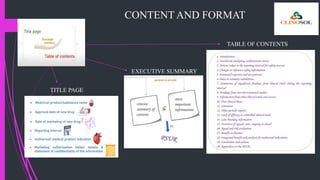
CONTENT AND FORMAT
TABLE OF CONTENTS
TITLE PAGE
EXECUTIVE SUMMARY
REPORTING TIMELINES
 Within 70 calendar days PSURs intervals up to 12 months
 Within 90 calendar days – if in excess of 12 months
 Timeline for ad hoc PSURs requested by CA-timeline will be provided by CA or
else 90 days.
PERIODIC BENEFIT RISK EVALUATION
REPORTS
 Periodic Benefit Risk Evaluation Reports (PBRERs) are pharmacovigilance
documents for preparation and submission by marketing authorization holders at
defined time points during the post-authorization phase with objective to provide a
comprehensive, concise and critical evaluation of the risk-benefit balance of a
medicinal product taking into account new or emerging information in the context
of cumulative information on risks and benefits
 OBJECTIVES:-
 To present overall benefit-risk profile.
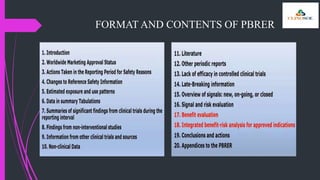
FORMAT AND CONTENTS OF PBRER
REPORTING TIMELINE
 A Market Authorization Holder {MAH} is required to make the PBRER
submission:
 Every 6 months for the first 2 years after the product is marketed
 Once a year for the following 2 years
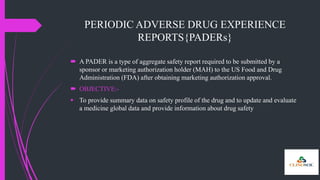
PERIODIC ADVERSE DRUG EXPERIENCE
REPORTS{PADERs}
 A PADER is a type of aggregate safety report required to be submitted by a
sponsor or marketing authorization holder (MAH) to the US Food and Drug
Administration (FDA) after obtaining marketing authorization approval.
 OBJECTIVE:-
 To provide summary data on safety profile of the drug and to update and evaluate
a medicine global data and provide information about drug safety
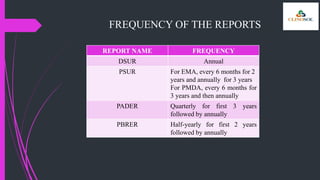
FREQUENCY OF THE REPORTS
REPORT NAME FREQUENCY
DSUR Annual
PSUR For EMA, every 6 months for 2
years and annually for 3 years
For PMDA, every 6 months for
3 years and then annually
PADER Quarterly for first 3 years
followed by annually
PBRER Half-yearly for first 2 years
followed by annually
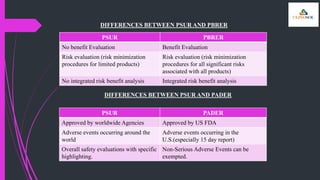
PSUR PBRER
No benefit Evaluation Benefit Evaluation
Risk evaluation (risk minimization
procedures for limited products)
Risk evaluation (risk minimization
procedures for all significant risks
associated with all products)
No integrated risk benefit analysis Integrated risk benefit analysis
DIFFERENCES BETWEEN PSUR AND PBRER
DIFFERENCES BETWEEN PSUR AND PADER
PSUR PADER
Approved by worldwide Agencies Approved by US FDA
Adverse events occurring around the
world
Adverse events occurring in the
U.S.(especially 15 day report)
Overall safety evaluations with specific
highlighting.
Non-Serious Adverse Events can be
exempted.
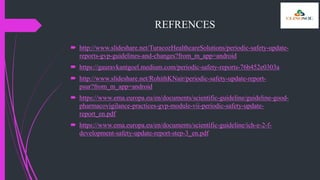
REFRENCES
 http://www.slideshare.net/TuracozHealthcareSolutions/periodic-safety-update-
reports-gvp-guidelines-and-changes?from_m_app=android
 https://gauravkantgoel.medium.com/periodic-safety-reports-76b452e0303a
 http://www.slideshare.net/RohithKNair/periodic-safety-update-report-
psur?from_m_app=android
 https://www.ema.europa.eu/en/documents/scientific-guideline/guideline-good-
pharmacovigilance-practices-gvp-module-vii-periodic-safety-update-
report_en.pdf
 https://www.ema.europa.eu/en/documents/scientific-guideline/ich-e-2-f-
development-safety-update-report-step-3_en.pdf
Thank you
BOLLAM.SARIKA -007/0122
bollamsarika@gmail.com

AGGREGATE REPORTING.

  • 1.
  • 4.
    DIFFERENT TYPES OFAGGREGATE REPORTS  Preapproval aggregate reports are:  Developmental Safety Update Report{DSUR}  Investigational New Drug{IND} report in United States & Annual Safety Report{ASR} in Europe are also getting replaced by DSUR  Post approval aggregate reports are:  Periodic Safety Update Report{PSUR} OR  Periodic Benefit Risk Evaluation Report{PBRER}  Periodic Adverse Drug Experience Report{PADER}
  • 5.
  • 6.
    DRUG SAFETY UPDATEREPORT  Drug Safety Update Reports{DSURs} are new , intentionally-harmonized , safety documents covering the safety summary of medicinal products during their development or clinical trial phase.  OBJECTIVES  The potential risks are summarized based on the current understanding and management.  Examine changes in the product safety profile.
  • 7.
    STRUCTURE OF DSUR TABLEOF CONTENTS TITLE PAGE EXECUTIVE SUMMARY
  • 8.
    REPORTING TIMELINES  Shouldbe submitted no later than 60 calendar days from the DSUR data lock point The DSUR presents an annual reviews and evaluation of safety information • It focus on clinical trial drugs like drugs, vaccines and biologics. • Safety and welfare of the subjects • Investigational drug data should be equal to comparator drug.
  • 9.
    PERIODIC SAFETY UPDATEREPORTS{PSUR} Periodic Safety Update Reports{PSUR’s} are pharmacovigilance documents intended to provide an evaluation of the risk-benefit balance of a medicinal product for submission by marketing authorization holders{MAH’s} at defined time points during the post-authorization phase. OBJECTIVE:-  To present a comprehensive and critical analysis of the risk-benefit balance of the medicinal product taking into account new or emerging information in the cumulative risk- benefit analysis.  This evaluation of risk-benefit assessment should be undertaken in the context of ongoing pharmacovigilance and risk management.
  • 10.
    CONTENT AND FORMAT TABLEOF CONTENTS TITLE PAGE EXECUTIVE SUMMARY
  • 11.
    REPORTING TIMELINES  Within70 calendar days PSURs intervals up to 12 months  Within 90 calendar days – if in excess of 12 months  Timeline for ad hoc PSURs requested by CA-timeline will be provided by CA or else 90 days.
  • 12.
    PERIODIC BENEFIT RISKEVALUATION REPORTS  Periodic Benefit Risk Evaluation Reports (PBRERs) are pharmacovigilance documents for preparation and submission by marketing authorization holders at defined time points during the post-authorization phase with objective to provide a comprehensive, concise and critical evaluation of the risk-benefit balance of a medicinal product taking into account new or emerging information in the context of cumulative information on risks and benefits  OBJECTIVES:-  To present overall benefit-risk profile.
  • 13.
  • 14.
    REPORTING TIMELINE  AMarket Authorization Holder {MAH} is required to make the PBRER submission:  Every 6 months for the first 2 years after the product is marketed  Once a year for the following 2 years
  • 15.
    PERIODIC ADVERSE DRUGEXPERIENCE REPORTS{PADERs}  A PADER is a type of aggregate safety report required to be submitted by a sponsor or marketing authorization holder (MAH) to the US Food and Drug Administration (FDA) after obtaining marketing authorization approval.  OBJECTIVE:-  To provide summary data on safety profile of the drug and to update and evaluate a medicine global data and provide information about drug safety
  • 16.
    FREQUENCY OF THEREPORTS REPORT NAME FREQUENCY DSUR Annual PSUR For EMA, every 6 months for 2 years and annually for 3 years For PMDA, every 6 months for 3 years and then annually PADER Quarterly for first 3 years followed by annually PBRER Half-yearly for first 2 years followed by annually
  • 17.
    PSUR PBRER No benefitEvaluation Benefit Evaluation Risk evaluation (risk minimization procedures for limited products) Risk evaluation (risk minimization procedures for all significant risks associated with all products) No integrated risk benefit analysis Integrated risk benefit analysis DIFFERENCES BETWEEN PSUR AND PBRER DIFFERENCES BETWEEN PSUR AND PADER PSUR PADER Approved by worldwide Agencies Approved by US FDA Adverse events occurring around the world Adverse events occurring in the U.S.(especially 15 day report) Overall safety evaluations with specific highlighting. Non-Serious Adverse Events can be exempted.
  • 18.
    REFRENCES  http://www.slideshare.net/TuracozHealthcareSolutions/periodic-safety-update- reports-gvp-guidelines-and-changes?from_m_app=android  https://gauravkantgoel.medium.com/periodic-safety-reports-76b452e0303a http://www.slideshare.net/RohithKNair/periodic-safety-update-report- psur?from_m_app=android  https://www.ema.europa.eu/en/documents/scientific-guideline/guideline-good- pharmacovigilance-practices-gvp-module-vii-periodic-safety-update- report_en.pdf  https://www.ema.europa.eu/en/documents/scientific-guideline/ich-e-2-f- development-safety-update-report-step-3_en.pdf
  • 19.