SAFETY REPORT FILING
SUBMITTED BY : Pradeep
M.sc. Clinical Research
INTRODUCTION
1. Aggregate reports are the reports that emphasize on
evaluation of safety profile and benefit risks.
2. Pre-marketing report includes IND annual report, Clinical
Study Reports and annual safety report in Europe.
3. The post approval aggregate report consists of :
• Periodic Benefit Risk Evaluation Report (PBRER) ICH E2C(R2)
guideline serve as a standard norm for benefit risk
evaluation.
• Periodic Adverse Drug Experience Report (PADER) are
presented regularly in post-marketing safety report in the
United State,
• Development Safety Update Report (DSUR) provides reporting
of drugs being marketed under research in the ICH region,
and
• Periodic Safety Update Report (PSUR) represent an acceptable
and practical mechanism for conducting an overall safety
evaluation and for summarizing interval safety data.
4. The safety evaluation of medicinal product can be achieved
by aggregate report and submitting it to various regulatory
agency.
OBJECTIVES
1. It covers ongoing safety issue and helps MAH for conducting
the efficient analysis of safety information on the consistent
basis.
2. PSUR include an update on developing or urgent safety
issues. Throughout the development period, based on the
limited number of patients involved in the trial the safety
and efficacy of the substance are measured.
3. The MAH should monitor the product continuously after
launching the product during the first year on the market.
Detailed assessment of the drugs benefit risk ratio is not
possible for individual case report. Thus, periodic review of
the safety report is obtained globally cumulatively. This
grows very important in order to analyze the product’s
benefit risk.
4. All dosage form, formulation, indication of new drug should
be contained in the single PSUR.
5. All appropriate clinical, non-clinical security information
should be given in PSUR, global MAH status, product
approval, removal or launch status must be given during the
reporting interval and cumulative information must be
submitted on severe, unlisted ADR’s.
6. PSUR should concentrate on Adverse Drug Reaction (ADR)
and whether modification needs to be made to the product
reference safety data to optimize the product use.
7. Attention should be provided to existing such a rise in ADR
frequency and its impact on the safety of general product.
FORMAT & PRESENTATION OF PSUR
Title page The title page includes data on the medical product
name, approval date of the new drug, marketing
date of the holder name and address of the new
drug marketing authorization, authorized medical
product indication.
Introduction The PSUR contains the information about medical
product pharmacokinetic, efficacy, dosage form,
formulation and report of the approved indication
and population.
Worldwide marketing
authorization status
PSUR contains details of the country where the
product approved currently with the date of
approval, date of marketing and reason should be
given if any product was withdrawn in any country
with reasons
Steps taken for safety
purposes in the
reporting interval
Actions related to the investigational uses -
Summary of planned and ongoing studies;
Activity related to investigational use -Regulatory
authorities work toward the safety studies
Changes in the safety
data reference
The part of PSUR contain any change in reference
safety information such changes associated with a
warning, precaution, adverse drug reaction,
overdose, interaction, and contraindication.
Assessed patient
exposure
This part of PSUR contain individual patient
information when exposed to the product in a
clinical trial, cumulatively and patient exposure from
marketing experience
Individual case history General consideration
To determine the safety information of the
marketed product marketing authorization holder
the normal medical and science journals should be
monitored
The case accessible as line listing
The type of cases included in line listing are:
All severe and non-serious unlisted literature and
notified reaction All serious reaction from
regulatory authorities and from studies or named-
patient.
Presentation of line listing
Cases should be tabularized by figure system
(typical structure system arrangement system).
Summary of significant
findings in the
reporting period
This section contains the finding from completed
clinical trials, finding from ongoing clinical trials,
finding from literature or independent studies
Signal assessment and
risk evaluation
WHO defines the safe signal as the data outlined in
a necessary causal link between an adverse case
and a medication. The strength of the safety signal
is determined by several factors of adverse effect.
The safety signal detected from a wide range of
bases such as experimental studies and systematic
literature.
Overall safety evaluation The pharmaceutical companies should
demonstrate the benefit and the risk of the
medical products during the marketing
authorization process.
Conclusion This part of PSUR should contain the safety
outline of the medical product and the essential
action taken by Marketing authorization holder.
Appendix The appendix contains copy of marketing
authorization, line listing of an individual case
safety report.
INDIA-CDSCO
1. The structure of PSUR In India, Periodic Safety Update
Reports (PSURs) of drugs is presented to the office of Drugs
Controller General India in accordance with the regulations
of clause 4 of Schedule “Y” Drugs and Cosmetics Rules.
2. The PSURs should be structured as per clause 4 sub clause (v)
of schedule “Y”.
EUROPEAN MEDICINE AGENCY-
EUROPEAN UNION
1. Marketing authorization submit PSUR as detailed in the list of
EU reference date (EURD).
2. For each active substance/combination contained in it, the
EURD list provides the following information
3. PSUR submission frequency
4. Date for submission
5. Requirement for generic, well-established use of PSUR,
herbal product, homeopathic and traditional medicine.
By Manisha Yadav
SINGAPORE – HEALTH SCIENCE
AUTHORITY (HAS)
1. PBRER preparation for regulatory officials is a regular
pharmacovigilance activity described in the E2E rules of the
ICH.
2. The content and format guidelines for the PBRER found in
the recent version of ICH Periodic Benefit- Risk Evaluation
Report in the E2C(R2)
3. The PBRER report must be submitted by the registrant of a
therapeutic product:
4. For an early period of 2 year, at durations of 6 months either
from date of the therapeutic product registration or its
international birth date.
5. Each year, over the next three years.
HEALTH CANADA – CANADA
1. Described in ICH revised guidance E2C(R2)
2. It ensures that annual summary reports for marketed
substance or medicine play the role of periodic benefit-risk
evaluation reports by covering safety evaluation of all
relevant information available to MAHs benefit -risk
evaluation.
3. The objective of PBRER review in health Canada
4. An effect in the risk and benefit outline of the health
products on current evaluation of all new and cumulative
information.
5. Firming up the link between risk assessment and actions
taken to minimize risk.
6. Assisting the lifecycle approach to product vigilance.
7. Line-up product vigilance with international best practice.
JAPAN -PMDA
1. Once approved to sell a drug in Japan, the safety of the
product is evaluated over a period of four, six or ten years of
“re-examination”, depending on the nature of the drug.
2. Early Post-marketing phase vigilance
• To inquire medical organizations to use the medicines
cautiously and to report severe Adverse Drug Reactions to
pharmaceutical companies instantly if they occur
• To request suitable use and repeated ADR reporting for 6
months after delivery to medical organization.
• Non-serious, but moderate in serious and unidentifiable,
adverse responses must be recorded for 3 years every 6
months and annually thereafter.
3. Main purpose of performing EPPV
• Is to ensure that the prescribers have received adequate
information to promote warning,
• Awareness of the suitable use of drug,
• Investigate adverse effect
• Enforce the subsequent safety precautions and
• Reduce the consequent health hazard
AUSTRALIA-TGA
1. Australia Periodic Safety Update Report are needed for
2. Registered goods in accordance with Australian criteria and
3. Requirements for pharmacovigilance functions of sponsors
drugs published by the Therapeutic Goods Administration.
4. Outlined in the guideline on Good Pharmacovigilance
Practices (GVP) module VII -Periodic Safety Update report of
European Medicines Agency.
5. Periodic Safety Update Report may be presented
6. Annually for at least 3 years from the registration date or
may be presented separately for every 6 months
7. The first Data Lock Point is either six months or one year
from the approval date.
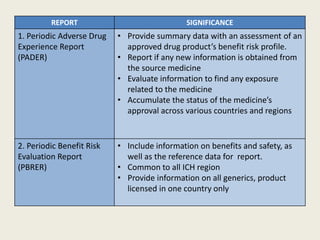
REPORT SIGNIFICANCE
1. Periodic Adverse Drug
Experience Report
(PADER)
• Provide summary data with an assessment of an
approved drug product’s benefit risk profile.
• Report if any new information is obtained from
the source medicine
• Evaluate information to find any exposure
related to the medicine
• Accumulate the status of the medicine’s
approval across various countries and regions
2. Periodic Benefit Risk
Evaluation Report
(PBRER)
• Include information on benefits and safety, as
well as the reference data for report.
• Common to all ICH region
• Provide information on all generics, product
licensed in one country only
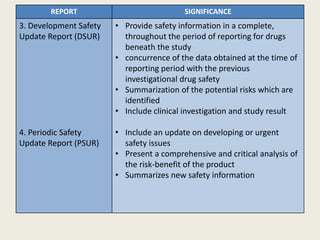
REPORT SIGNIFICANCE
3. Development Safety
Update Report (DSUR)
4. Periodic Safety
Update Report (PSUR)
• Provide safety information in a complete,
throughout the period of reporting for drugs
beneath the study
• concurrence of the data obtained at the time of
reporting period with the previous
investigational drug safety
• Summarization of the potential risks which are
identified
• Include clinical investigation and study result
• Include an update on developing or urgent
safety issues
• Present a comprehensive and critical analysis of
the risk-benefit of the product
• Summarizes new safety information
THANK YOU.

Safety report filing

  • 1.
    SAFETY REPORT FILING SUBMITTEDBY : Pradeep M.sc. Clinical Research
  • 2.
    INTRODUCTION 1. Aggregate reportsare the reports that emphasize on evaluation of safety profile and benefit risks. 2. Pre-marketing report includes IND annual report, Clinical Study Reports and annual safety report in Europe. 3. The post approval aggregate report consists of : • Periodic Benefit Risk Evaluation Report (PBRER) ICH E2C(R2) guideline serve as a standard norm for benefit risk evaluation. • Periodic Adverse Drug Experience Report (PADER) are presented regularly in post-marketing safety report in the United State,
  • 3.
    • Development SafetyUpdate Report (DSUR) provides reporting of drugs being marketed under research in the ICH region, and • Periodic Safety Update Report (PSUR) represent an acceptable and practical mechanism for conducting an overall safety evaluation and for summarizing interval safety data. 4. The safety evaluation of medicinal product can be achieved by aggregate report and submitting it to various regulatory agency.
  • 4.
    OBJECTIVES 1. It coversongoing safety issue and helps MAH for conducting the efficient analysis of safety information on the consistent basis. 2. PSUR include an update on developing or urgent safety issues. Throughout the development period, based on the limited number of patients involved in the trial the safety and efficacy of the substance are measured. 3. The MAH should monitor the product continuously after launching the product during the first year on the market. Detailed assessment of the drugs benefit risk ratio is not possible for individual case report. Thus, periodic review of the safety report is obtained globally cumulatively. This grows very important in order to analyze the product’s benefit risk.
  • 5.
    4. All dosageform, formulation, indication of new drug should be contained in the single PSUR. 5. All appropriate clinical, non-clinical security information should be given in PSUR, global MAH status, product approval, removal or launch status must be given during the reporting interval and cumulative information must be submitted on severe, unlisted ADR’s. 6. PSUR should concentrate on Adverse Drug Reaction (ADR) and whether modification needs to be made to the product reference safety data to optimize the product use. 7. Attention should be provided to existing such a rise in ADR frequency and its impact on the safety of general product.
  • 6.
    FORMAT & PRESENTATIONOF PSUR Title page The title page includes data on the medical product name, approval date of the new drug, marketing date of the holder name and address of the new drug marketing authorization, authorized medical product indication. Introduction The PSUR contains the information about medical product pharmacokinetic, efficacy, dosage form, formulation and report of the approved indication and population. Worldwide marketing authorization status PSUR contains details of the country where the product approved currently with the date of approval, date of marketing and reason should be given if any product was withdrawn in any country with reasons
  • 7.
    Steps taken forsafety purposes in the reporting interval Actions related to the investigational uses - Summary of planned and ongoing studies; Activity related to investigational use -Regulatory authorities work toward the safety studies Changes in the safety data reference The part of PSUR contain any change in reference safety information such changes associated with a warning, precaution, adverse drug reaction, overdose, interaction, and contraindication. Assessed patient exposure This part of PSUR contain individual patient information when exposed to the product in a clinical trial, cumulatively and patient exposure from marketing experience
  • 8.
    Individual case historyGeneral consideration To determine the safety information of the marketed product marketing authorization holder the normal medical and science journals should be monitored The case accessible as line listing The type of cases included in line listing are: All severe and non-serious unlisted literature and notified reaction All serious reaction from regulatory authorities and from studies or named- patient. Presentation of line listing Cases should be tabularized by figure system (typical structure system arrangement system). Summary of significant findings in the reporting period This section contains the finding from completed clinical trials, finding from ongoing clinical trials, finding from literature or independent studies
  • 9.
    Signal assessment and riskevaluation WHO defines the safe signal as the data outlined in a necessary causal link between an adverse case and a medication. The strength of the safety signal is determined by several factors of adverse effect. The safety signal detected from a wide range of bases such as experimental studies and systematic literature. Overall safety evaluation The pharmaceutical companies should demonstrate the benefit and the risk of the medical products during the marketing authorization process.
  • 10.
    Conclusion This partof PSUR should contain the safety outline of the medical product and the essential action taken by Marketing authorization holder. Appendix The appendix contains copy of marketing authorization, line listing of an individual case safety report.
  • 11.
    INDIA-CDSCO 1. The structureof PSUR In India, Periodic Safety Update Reports (PSURs) of drugs is presented to the office of Drugs Controller General India in accordance with the regulations of clause 4 of Schedule “Y” Drugs and Cosmetics Rules. 2. The PSURs should be structured as per clause 4 sub clause (v) of schedule “Y”.
  • 13.
    EUROPEAN MEDICINE AGENCY- EUROPEANUNION 1. Marketing authorization submit PSUR as detailed in the list of EU reference date (EURD). 2. For each active substance/combination contained in it, the EURD list provides the following information 3. PSUR submission frequency 4. Date for submission 5. Requirement for generic, well-established use of PSUR, herbal product, homeopathic and traditional medicine.
  • 14.
  • 15.
    SINGAPORE – HEALTHSCIENCE AUTHORITY (HAS) 1. PBRER preparation for regulatory officials is a regular pharmacovigilance activity described in the E2E rules of the ICH. 2. The content and format guidelines for the PBRER found in the recent version of ICH Periodic Benefit- Risk Evaluation Report in the E2C(R2) 3. The PBRER report must be submitted by the registrant of a therapeutic product: 4. For an early period of 2 year, at durations of 6 months either from date of the therapeutic product registration or its international birth date. 5. Each year, over the next three years.
  • 16.
    HEALTH CANADA –CANADA 1. Described in ICH revised guidance E2C(R2) 2. It ensures that annual summary reports for marketed substance or medicine play the role of periodic benefit-risk evaluation reports by covering safety evaluation of all relevant information available to MAHs benefit -risk evaluation. 3. The objective of PBRER review in health Canada
  • 17.
    4. An effectin the risk and benefit outline of the health products on current evaluation of all new and cumulative information. 5. Firming up the link between risk assessment and actions taken to minimize risk. 6. Assisting the lifecycle approach to product vigilance. 7. Line-up product vigilance with international best practice.
  • 19.
    JAPAN -PMDA 1. Onceapproved to sell a drug in Japan, the safety of the product is evaluated over a period of four, six or ten years of “re-examination”, depending on the nature of the drug.
  • 20.
    2. Early Post-marketingphase vigilance • To inquire medical organizations to use the medicines cautiously and to report severe Adverse Drug Reactions to pharmaceutical companies instantly if they occur • To request suitable use and repeated ADR reporting for 6 months after delivery to medical organization. • Non-serious, but moderate in serious and unidentifiable, adverse responses must be recorded for 3 years every 6 months and annually thereafter.
  • 21.
    3. Main purposeof performing EPPV • Is to ensure that the prescribers have received adequate information to promote warning, • Awareness of the suitable use of drug, • Investigate adverse effect • Enforce the subsequent safety precautions and • Reduce the consequent health hazard
  • 22.
    AUSTRALIA-TGA 1. Australia PeriodicSafety Update Report are needed for 2. Registered goods in accordance with Australian criteria and 3. Requirements for pharmacovigilance functions of sponsors drugs published by the Therapeutic Goods Administration. 4. Outlined in the guideline on Good Pharmacovigilance Practices (GVP) module VII -Periodic Safety Update report of European Medicines Agency. 5. Periodic Safety Update Report may be presented 6. Annually for at least 3 years from the registration date or may be presented separately for every 6 months 7. The first Data Lock Point is either six months or one year from the approval date.
  • 24.
    REPORT SIGNIFICANCE 1. PeriodicAdverse Drug Experience Report (PADER) • Provide summary data with an assessment of an approved drug product’s benefit risk profile. • Report if any new information is obtained from the source medicine • Evaluate information to find any exposure related to the medicine • Accumulate the status of the medicine’s approval across various countries and regions 2. Periodic Benefit Risk Evaluation Report (PBRER) • Include information on benefits and safety, as well as the reference data for report. • Common to all ICH region • Provide information on all generics, product licensed in one country only
  • 25.
    REPORT SIGNIFICANCE 3. DevelopmentSafety Update Report (DSUR) 4. Periodic Safety Update Report (PSUR) • Provide safety information in a complete, throughout the period of reporting for drugs beneath the study • concurrence of the data obtained at the time of reporting period with the previous investigational drug safety • Summarization of the potential risks which are identified • Include clinical investigation and study result • Include an update on developing or urgent safety issues • Present a comprehensive and critical analysis of the risk-benefit of the product • Summarizes new safety information
  • 26.