TOPIC 2: BUSINESS AND ENVIRONMENTBUSINESS ENTITYSole traderPartnershipsCompany (Corporation)
Comparison Between Sole trader and Partnership
COMPANYLimited CompanyPrivate Company Ltd		Public Company LtdGeneral Characteristics•	Under Malaysia Company Act 1965Separate legal entityLegal bodies to own assets, make credit, sign contract, sued and to be sued by court.Set up for the purpose of increasing the shareholder wealth.
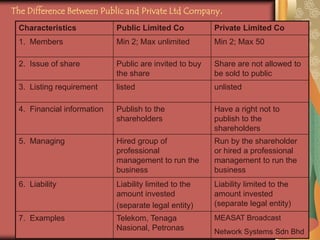
The Difference Between Public and Private Ltd Company.
TYPES OF BUSINESS ACTIVITYServices	• Supply services only – accounting firms, banks	• Supply services & goods – saloonMerchandising/trading/retailing	• Purchase goods in bulk from manufacturer and sell to customers	• Range from hypermarket to specialist store	• 2 categories of expenses		cost of good sold (COGS)		    -  the total cost of merchandise sold during the period		  Operating expenses		    -  expenses incurred in the process of earning sales revenue		    -  eg. Sales salaries, advertising expenses, insurance	    	        expenses.
Manufacturing • Manufacturing  firm produces goods for sale by processing raw materials in factory.    • Sell these goods either as finished products to a wholesaler, retailer or partly finished products to other manufacturers.    • 3 elements of cost:	 Direct Material Cost	 Direct Labor Cost	 Overhead cost
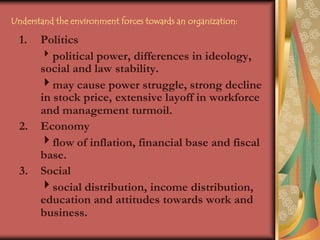
Understand the environment forces towards an organization:Politicspolitical power, differences in ideology, social and law 	stability.	may cause power struggle, strong decline in stock price, 	extensive layoff in workforce and management turmoil.Economy	flow of inflation, financial base and fiscal base.Social	social distribution, income distribution, education and attitudes towards work and business.
Technology	the changes of technology, future raw material availability, technological development in related areas, raw material costs.Geographicalthe plant location will lead to the international tariff base.Competitionthe entry of competitors into the market and the strategic changes and size of competition.
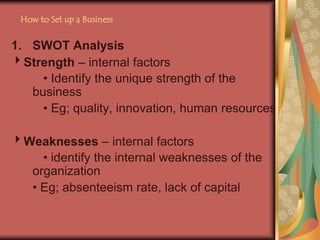
How to Set up a BusinessSWOT AnalysisStrength – internal factors• Identify the unique strength of the business		• Eg; quality, innovation, human resourcesWeaknesses – internal factors		• identify the internal weaknesses of the organization			• Eg; absenteeism rate, lack of capital
Opportunity – external factors	• Exploit the opportunity 			• Eg: Changes in technology, government policy, consumers profiles, economic growthThreat • Some external changes that will threaten the business.	• Eg: sudden changes in technology, economic downturn, stock market crash, political turmoil/climate
Internal aspects			External aspects		of business			of businessStrength				Opportunity		Weakness			     Threat
Form an objective Every new business must form at least one objective. In which it is different compared to other businesses.Eg: Maximization of profit or shareholder’s wealth.Considering other factors	Location: Is the location is strategic for the type of business being set up?	Resources: Are the resources easy to obtain and used by the business?	Law:  Is this business attached with any kind of  a specific law?.
Managing a businessPlanningdefinition- is the process of establishing enterprise objective”Type of planning•	Long term planningplanning made by top-level management for the period of 	    	    more than one year period, in which they anticipated the 		    future events.		 2 types of planningStrategic planning		        planning for 3 –5 years		         responsibility of the high-level management		         determination of corporate objective and goals, as well 	            	             as the development of broad policies and strategies bywhich they may be achieved.
	Tactical Planning Planning range 1 – 3 yearsResponsibility of the middle-level managementeg: opening a new branch, introducing a new product•	Short term planningplanning by each section or department for the period of 	    less than one year to harmonizing all the planning.type of planning - operating planning planning for less than 1 year		to support strategic and tactical plan	     Eg: to set the price of the product; number of workers to be 	    employed.
Budget	is an important tool for management planning and control	definition: It is the quantitative expressions of long range     	planning stated in either physical or financial terms or both.	types: periodic budget and continuous.	Objectives:		1. To fulfill the organizational objectives – short run		2. To estimate revenue and expenses		3. To estimate cash inflow and outflow		4. To forecast sales volume that gives break even point		5. To motivate employees		6. Communication tool for employees, external users and 		management

Topic 2 Business Entity

  • 1.
    TOPIC 2: BUSINESSAND ENVIRONMENTBUSINESS ENTITYSole traderPartnershipsCompany (Corporation)
  • 2.
    Comparison Between Soletrader and Partnership
  • 3.
    COMPANYLimited CompanyPrivate CompanyLtd Public Company LtdGeneral Characteristics• Under Malaysia Company Act 1965Separate legal entityLegal bodies to own assets, make credit, sign contract, sued and to be sued by court.Set up for the purpose of increasing the shareholder wealth.
  • 4.
    The Difference BetweenPublic and Private Ltd Company.
  • 5.
    TYPES OF BUSINESSACTIVITYServices • Supply services only – accounting firms, banks • Supply services & goods – saloonMerchandising/trading/retailing • Purchase goods in bulk from manufacturer and sell to customers • Range from hypermarket to specialist store • 2 categories of expenses cost of good sold (COGS) - the total cost of merchandise sold during the period  Operating expenses - expenses incurred in the process of earning sales revenue - eg. Sales salaries, advertising expenses, insurance expenses.
  • 6.
    Manufacturing • Manufacturing firm produces goods for sale by processing raw materials in factory. • Sell these goods either as finished products to a wholesaler, retailer or partly finished products to other manufacturers. • 3 elements of cost:  Direct Material Cost  Direct Labor Cost  Overhead cost
  • 7.
    Understand the environmentforces towards an organization:Politicspolitical power, differences in ideology, social and law stability. may cause power struggle, strong decline in stock price, extensive layoff in workforce and management turmoil.Economy flow of inflation, financial base and fiscal base.Social social distribution, income distribution, education and attitudes towards work and business.
  • 8.
    Technology the changes oftechnology, future raw material availability, technological development in related areas, raw material costs.Geographicalthe plant location will lead to the international tariff base.Competitionthe entry of competitors into the market and the strategic changes and size of competition.
  • 9.
    How to Setup a BusinessSWOT AnalysisStrength – internal factors• Identify the unique strength of the business • Eg; quality, innovation, human resourcesWeaknesses – internal factors • identify the internal weaknesses of the organization • Eg; absenteeism rate, lack of capital
  • 10.
    Opportunity – externalfactors • Exploit the opportunity • Eg: Changes in technology, government policy, consumers profiles, economic growthThreat • Some external changes that will threaten the business. • Eg: sudden changes in technology, economic downturn, stock market crash, political turmoil/climate
  • 11.
    Internal aspects External aspects ofbusiness of businessStrength Opportunity Weakness Threat
  • 12.
    Form an objectiveEvery new business must form at least one objective. In which it is different compared to other businesses.Eg: Maximization of profit or shareholder’s wealth.Considering other factors Location: Is the location is strategic for the type of business being set up? Resources: Are the resources easy to obtain and used by the business? Law: Is this business attached with any kind of a specific law?.
  • 13.
    Managing a businessPlanningdefinition-is the process of establishing enterprise objective”Type of planning• Long term planningplanning made by top-level management for the period of more than one year period, in which they anticipated the future events. 2 types of planningStrategic planning planning for 3 –5 years  responsibility of the high-level management  determination of corporate objective and goals, as well as the development of broad policies and strategies bywhich they may be achieved.
  • 14.
    Tactical Planning Planningrange 1 – 3 yearsResponsibility of the middle-level managementeg: opening a new branch, introducing a new product• Short term planningplanning by each section or department for the period of less than one year to harmonizing all the planning.type of planning - operating planning planning for less than 1 year to support strategic and tactical plan Eg: to set the price of the product; number of workers to be employed.
  • 15.
    Budget is an importanttool for management planning and control definition: It is the quantitative expressions of long range planning stated in either physical or financial terms or both. types: periodic budget and continuous. Objectives: 1. To fulfill the organizational objectives – short run 2. To estimate revenue and expenses 3. To estimate cash inflow and outflow 4. To forecast sales volume that gives break even point 5. To motivate employees 6. Communication tool for employees, external users and management