INDUSTRY AND ENVIRONMENTAL ANALYSIS:
BUSINESS OPPORTUNITIES IDENTIFICATION
Due to health crisis brought by covid 19, a lot of small and medium
enterprises closed down already for they have already incurred much losses
for the past few months. However, there are still businesses that flourish
amidst the pandemic. For example, Puregold’s stock value rose significantly
for couple of months while other industries had difficulty coping up with the
pandemic. If you are going to put up a business during these trying times,
whatwoulditbeandwhy?Whydoyouthinkthisindustryisattractiveinthe
marketevenduringpandemic?”
The activity aims to let you realize that firms
always analyze the industry first before putting up a
business. Different firms use different tools in assessing
the business environment and to see the rewards,
challenges and even attractiveness in the industry where
the business belongs.”
Business
• It is an entity or organization that is intended for
commercial, industrial or any professional activities.
• Its main objective is to earn profit for the owners.
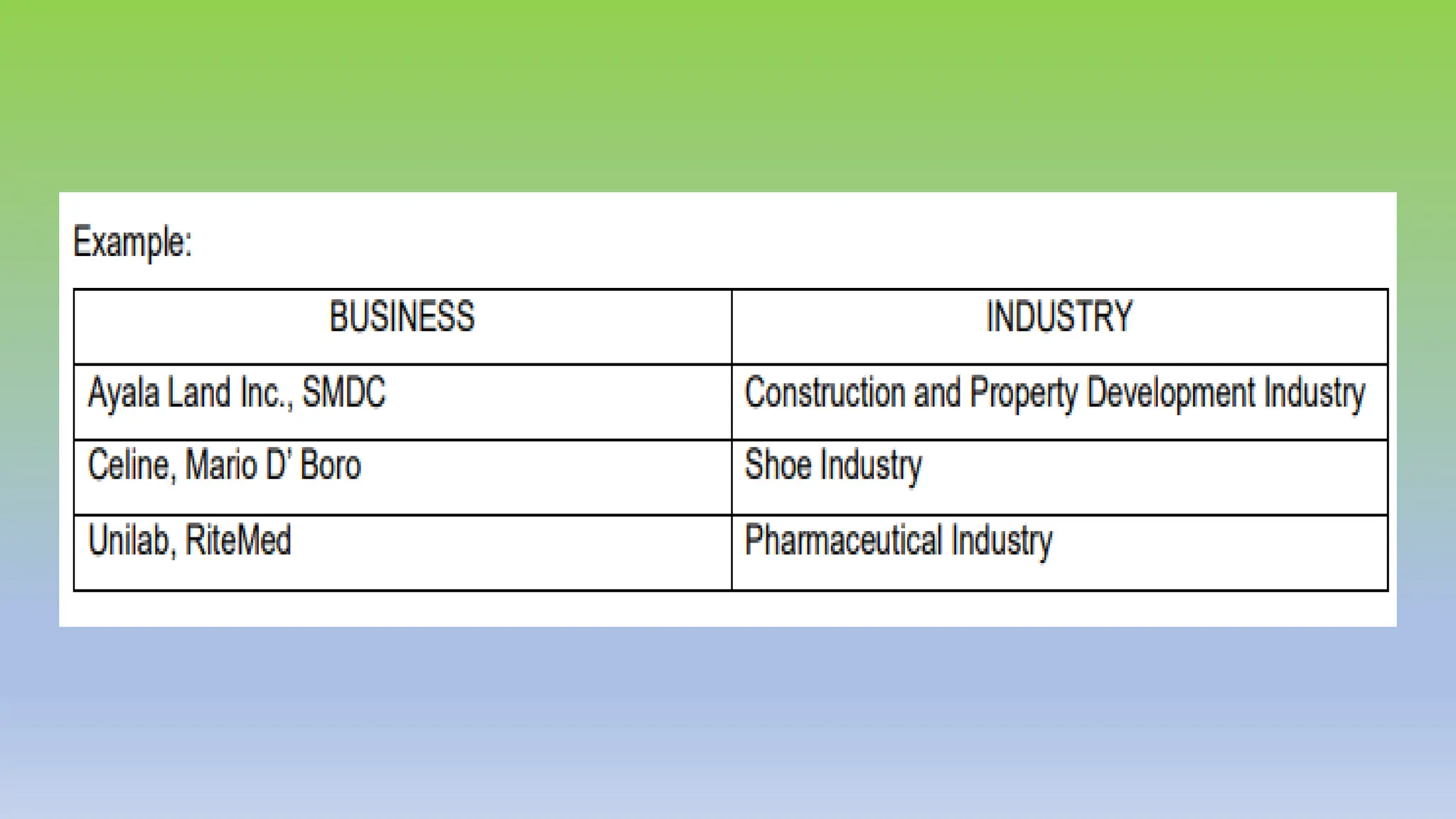
• A business is just a small portion of an industry.
Industry
• It is a group of companies or businesses that carry on
the same line of business activities or undertaking.
FORMS OF BUSINESS
ORGANIZATIONS
SOLE PROPRIETORSHIP
• This form of business organization consists of one person who
runs business.
• Among all business organizations, this takes the simplest
method to set-up and even to dissolve. “The owner has sole
control over business management and gets solely the profit
earned from its operations.”
• However, the sole proprietor also carries the whole
responsibility for all the debts and obligations and absorbs
all the losses in the course of the business operations.
• The owner faces the risk of unlimited liability in which his
personal assets might be exhausted to pay for the business’
loans.
PARTNERSHIP
• A partnership consists of two or more people who combine
their resources and run the business together with an
aim to gain profit.
• There must be a partnership agreement and profits are
divided among partners according to the terms of
agreement.
2 types of partnership:
a. General Partnership
All partners take part in the management of the business.
The general partners have unlimited liability wherein their
personal properties might be used just to pay for the debts of
the company.
b. Limited Partnership
These are the partners who contribute only capital and do
not take part in the management of the business. They have
limited share in the profit, but they are also only liable to
business debts to some extent only.
CORPORATION
• It is a legal entity that is separate from the owners of
the corporation or the shareholders.
• Board of Directors and the highest officers may bear
liability for their involvement with the corporation.
• The shareholders have limited liability.
• Corporations have unlimited commercial life for they can
exist for 50 years and it is renewable for another 50
years.
• Among all forms of business organizations, corporations
are heavily taxed and regulated by the government.
Generally speaking, one must be fully knowledgeable
of the industry first before putting up a business. By
analyzing the industry and the business to be established,
appropriate actions and strategies will be planned and
executed well which will also minimize, if not avoid,
waste of resources.
In planning a business, a thorough study needs to be
made from the creation of business. Understanding how the
business will operate and co-exists in the business world
thus one needs to study principle, tools and techniques in
creating business.
10 Principles in Creating a Business
Scalability
• Businesses which has a businesses which has a potential
to grow. For some potential to grow. For some instances
people are growing their business by aligning their
strategy/efforts on the present situation. (example the
Covid-19 pandemic)
• A business must be scalable for it to be successful.
Scalability is the capability of a company to sustain or
improve its performance in terms of profitability or
efficiency when its sales volume increases.
Big ideas
• Greater opportunities, in creating your business big
ideas plays a vital role, adopting to abrupt changes,
planning and aligning people to fit in the business.
Every business begins with an idea.
• Business ideas come from many from many sources.
Hobbies, interests, and business experiences often give
people ideas often give people ideas for new business.
• The success of one’s busine is through collaboration of
ideas.
Systems
• Recognizing small and big parts contributes success and
failures to the business, everybody should fit in from
the owner to its employee, resources and equipment. In
making plan/decision one should be align to the other.
• A business is a system in which all parts contribute to
the success or failure of the whole. In this system,
everything must work together from employee to
president; from equipment to resources.
Sustainability
• A business must be powerful able to harness all economic
conditions, in all market settings, providing positive
and meaningful quality results to its customers. Such
differentiated result is the key to survive.
• A business must be dynamic- able to thrive through all
economic conditions, in all markets, providing
meaningful highly differentiated results to all of its
customers.
Growth
• All business need to be growing especially in the
internal as internal aspect of business. When you are a
beginner in a business. When you are a beginner in a
business it is like a school wherein your employees are
students that need your guidance, with your intention
and determination that the business will grow.
• Growth is essential in business. Without continued
growth, operations will stagnate. This can result in
lowered standards of quality for products or services,
decreased customer service, and poor employee morale.
Vision
• What do you What do you want your business to be the
future, your very purpose in creating a business, in
creating a business, vision plays a vital role as it is
your guide in planning. Creating your own vision
statement, aligning it in abrupt changes, like what is
happening right now in our economy.
• Business must manifest the higher purpose upon which it
was seeded, the vision it was meant to exemplify, the
mission it was intended to fulfill.
Purpose
• A business is the results of a big dream in mind of the
person who dream for it.
• A business is the fruit of a Higher Aim in the mind of
the person who conceived it.
Autonomy
• A business if not part of the owner’s life, but in fact,
its own entity. A business possesses a life of its own.
Many start-up business owners are quite independent.
• Their businesses were started because they do not want
to take direction from other people. A business is
difficult is to start, however, without the help of
others. Even the smallest businesses need a few full or
part-time employees. The employees must be selected
carefully for their ability to work as a team.
• Choosing the “team” becomes one of the most important
initial business decisions.
Profitability
• A business help economic entity, managing economic
reality, creating an economic certainty for the
communities in which it thrives.
Standards
• A business creates standard against all businesses
measured as either successful or not. In order a
business will go beyond, aim high beyond the existing
standard.
TOOLS IN EVALUATING A BUSINESS
The following are the general factors that must be put into
consideration when evaluating a certain industry as indicated in a
guide developed by North Carolina’s Small Business and Technology
Development Center:
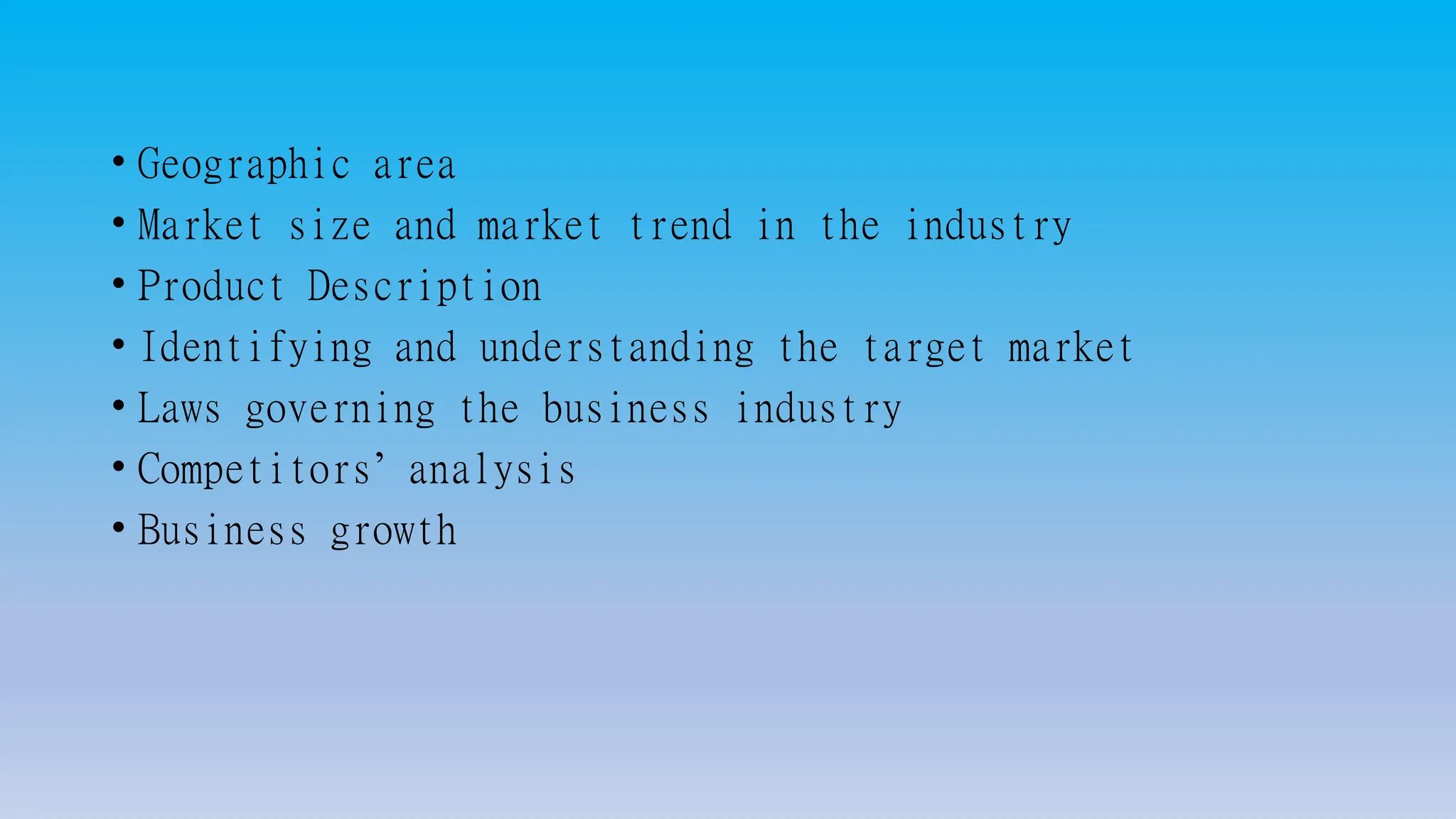
• Geographic area
• Market size and market trend in the industry
• Product Description
• Identifying and understanding the target market
• Laws governing the business industry
• Competitors’ analysis
• Business growth
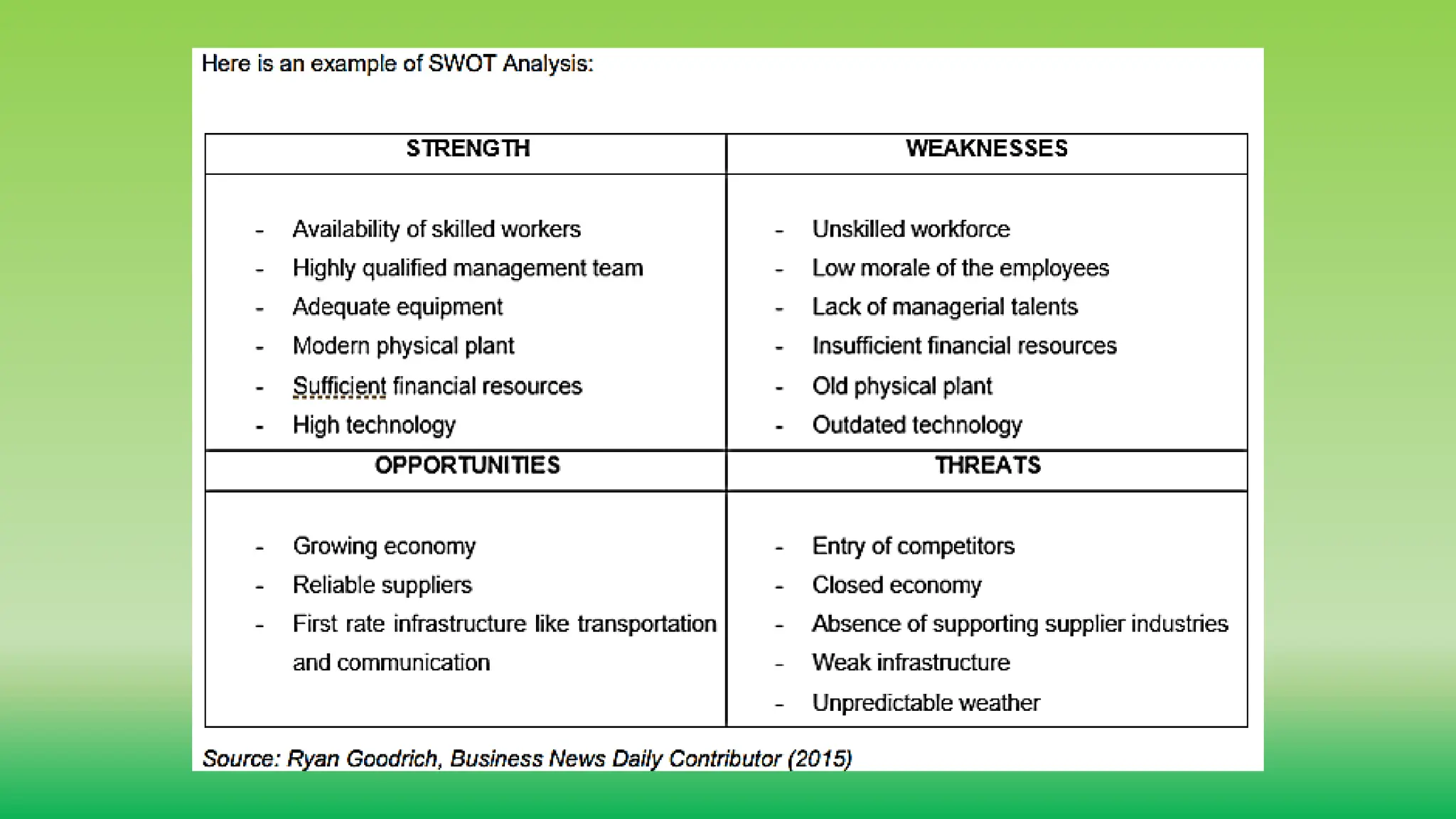
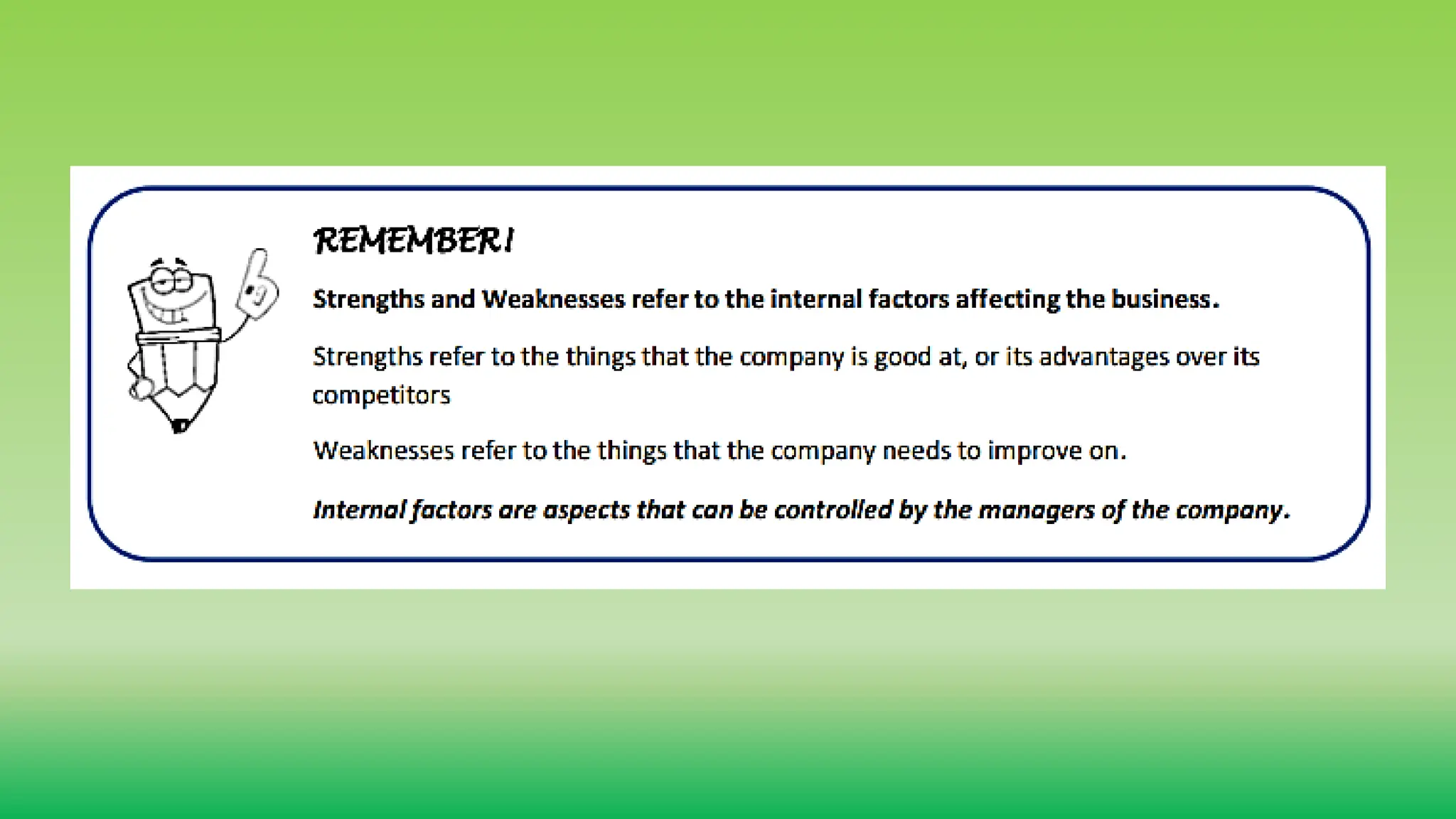
The SWOT Analysis
The SWOT Analysis
• It stands for Strength, Weaknesses, Opportunities and
Threats
• It is a framework that is used to seek business
opportunities and evaluate new business ventures.
• It helps to identify the company’s challenges and risks
of doing business.
• A helpful tool to assess the internal and external
factors affecting the business.
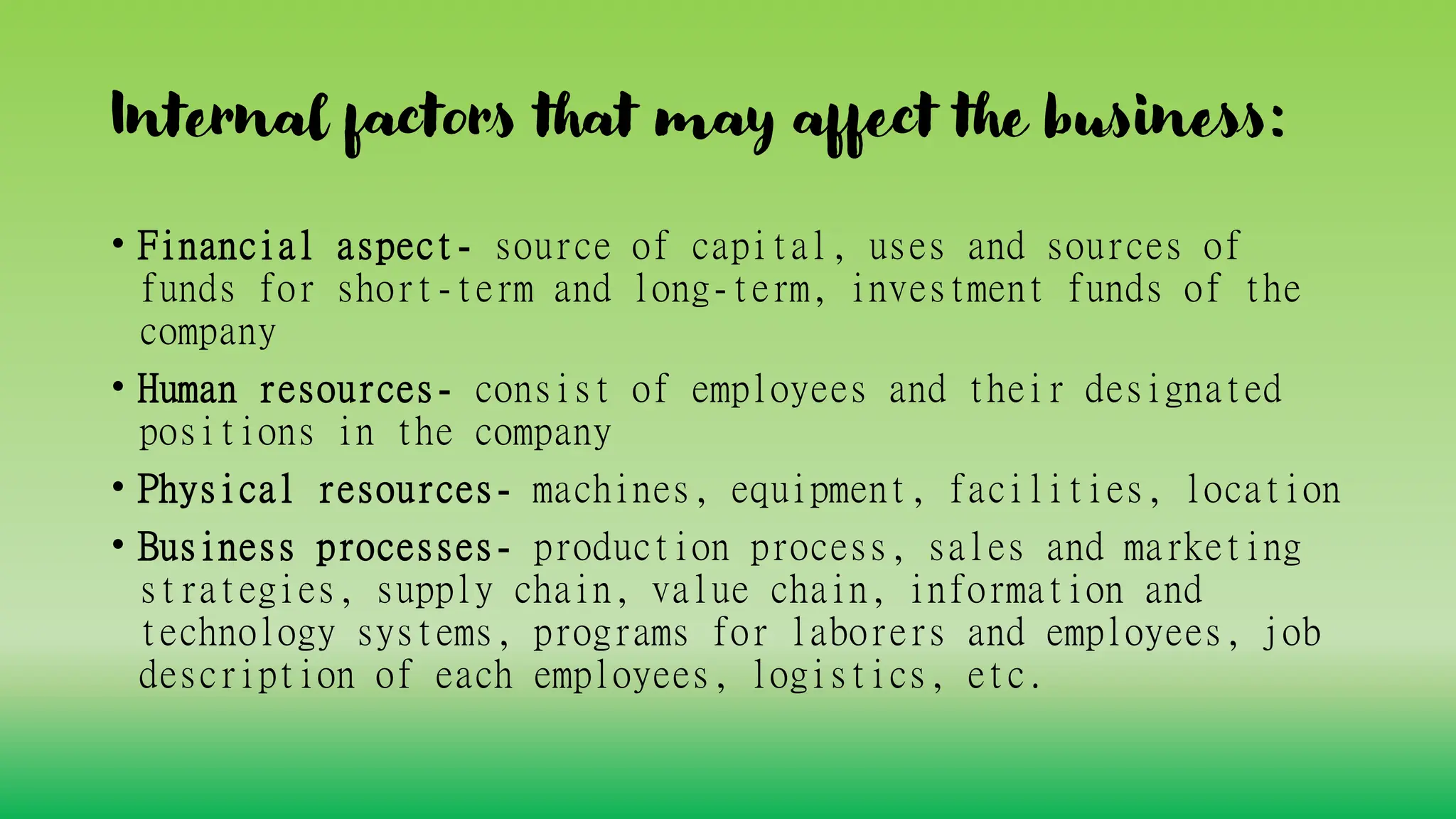
Internal factors that may affect the business:
• Financial aspect- source of capital, uses and sources of
funds for short-term and long-term, investment funds of the
company
• Human resources- consist of employees and their designated
positions in the company
• Physical resources- machines, equipment, facilities, location
• Business processes- production process, sales and marketing
strategies, supply chain, value chain, information and
technology systems, programs for laborers and employees, job
description of each employees, logistics, etc.
External forces that may affect the business:
• Economic aspect- international trading, financial and economic
trends in local, national and international scenes, inflation,
interest rate, GDP, banking system, national economic status, etc.
• Market trends- behavioral and psychographic descriptions of target
market, change in taste and lifestyle of customers, new products
and technology in the market, etc.
• Regulatory environment- political environment surrounding the
business, laws governing business operations, local and national
statutory regulations
• Demographic characteristics of target market- age, gender,
financial status, culture, etc.
• Competition in the market
• Relationship with suppliers and channel partners
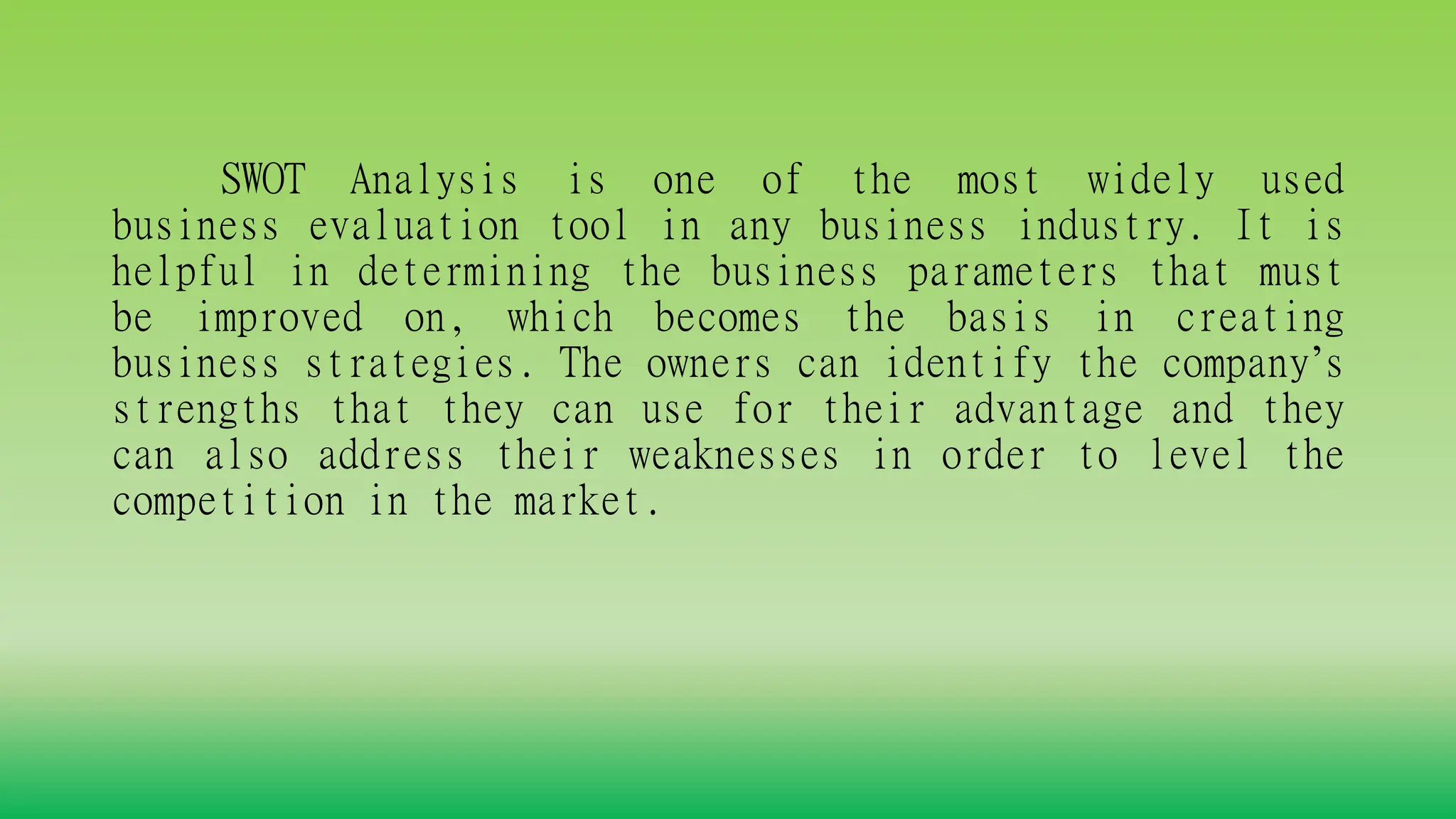
SWOT Analysis is one of the most widely used
business evaluation tool in any business industry. It is
helpful in determining the business parameters that must
be improved on, which becomes the basis in creating
business strategies. The owners can identify the company’s
strengths that they can use for their advantage and they
can also address their weaknesses in order to level the
competition in the market.
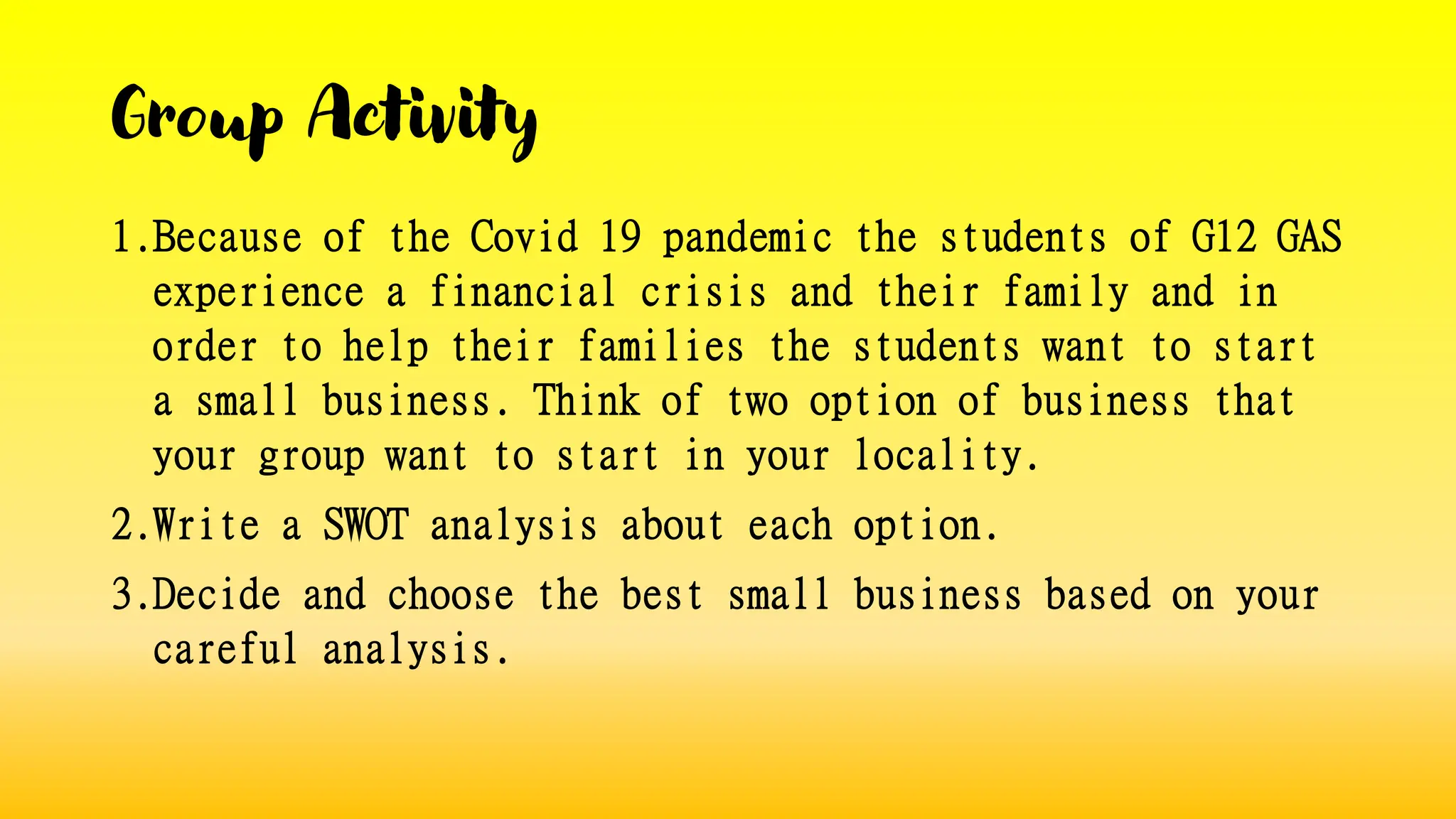
Group Activity
1.Because of the Covid 19 pandemic the students of G12 GAS
experience a financial crisis and their family and in
order to help their families the students want to start
a small business. Think of two option of business that
your group want to start in your locality.
2.Write a SWOT analysis about each option.
3.Decide and choose the best small business based on your
careful analysis.
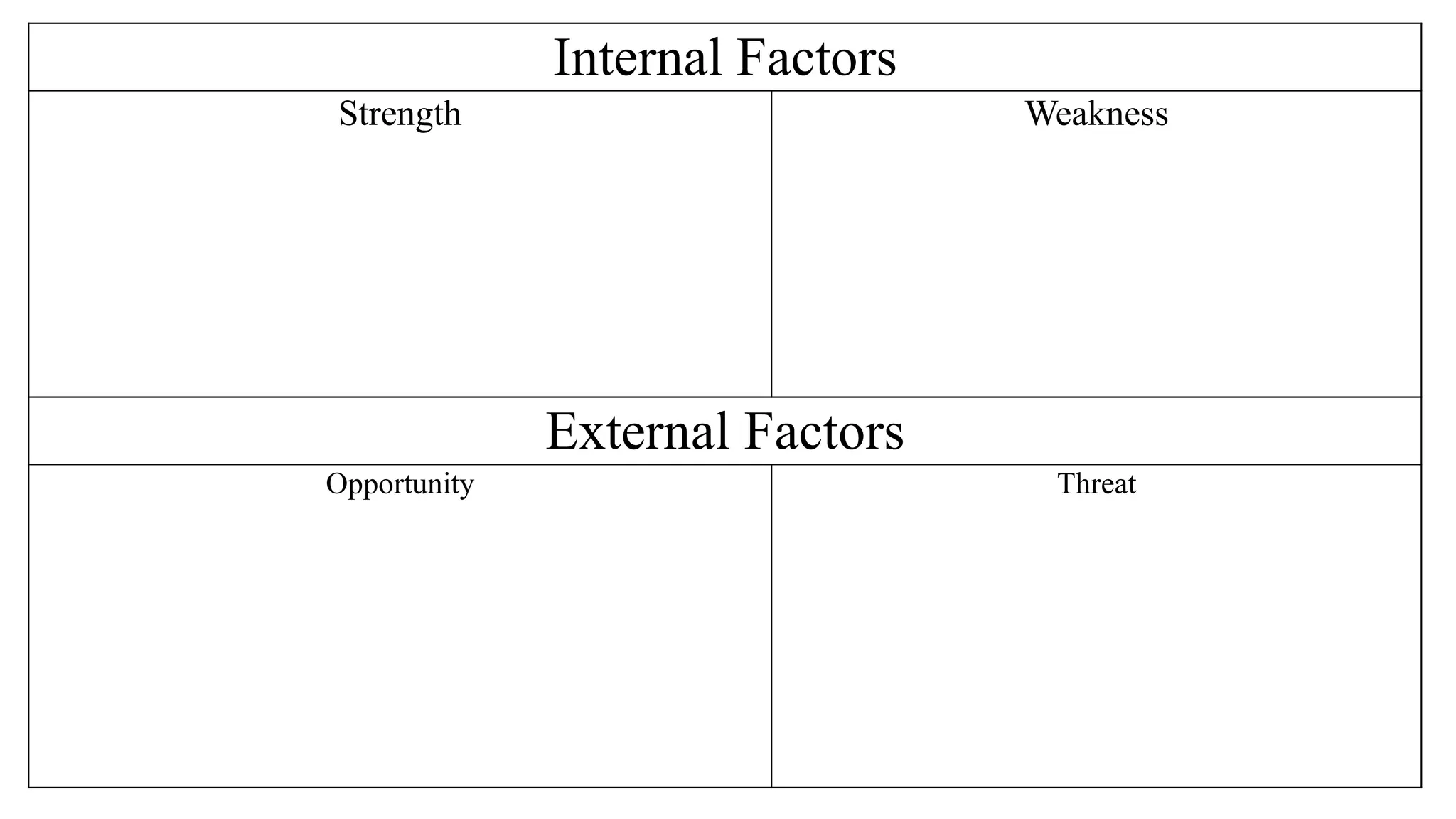
Internal Factors
Strength Weakness
External Factors
Opportunity Threat
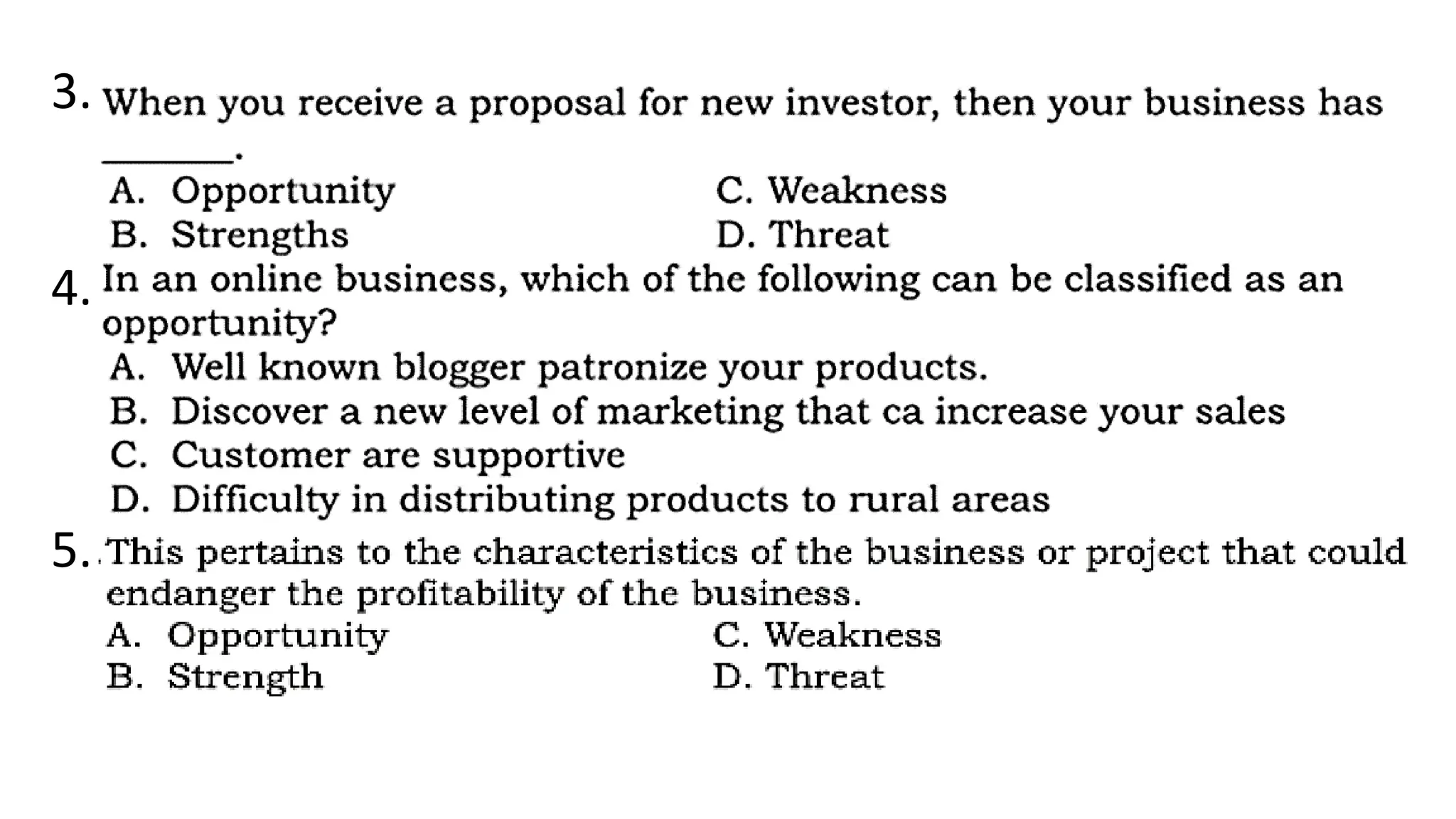
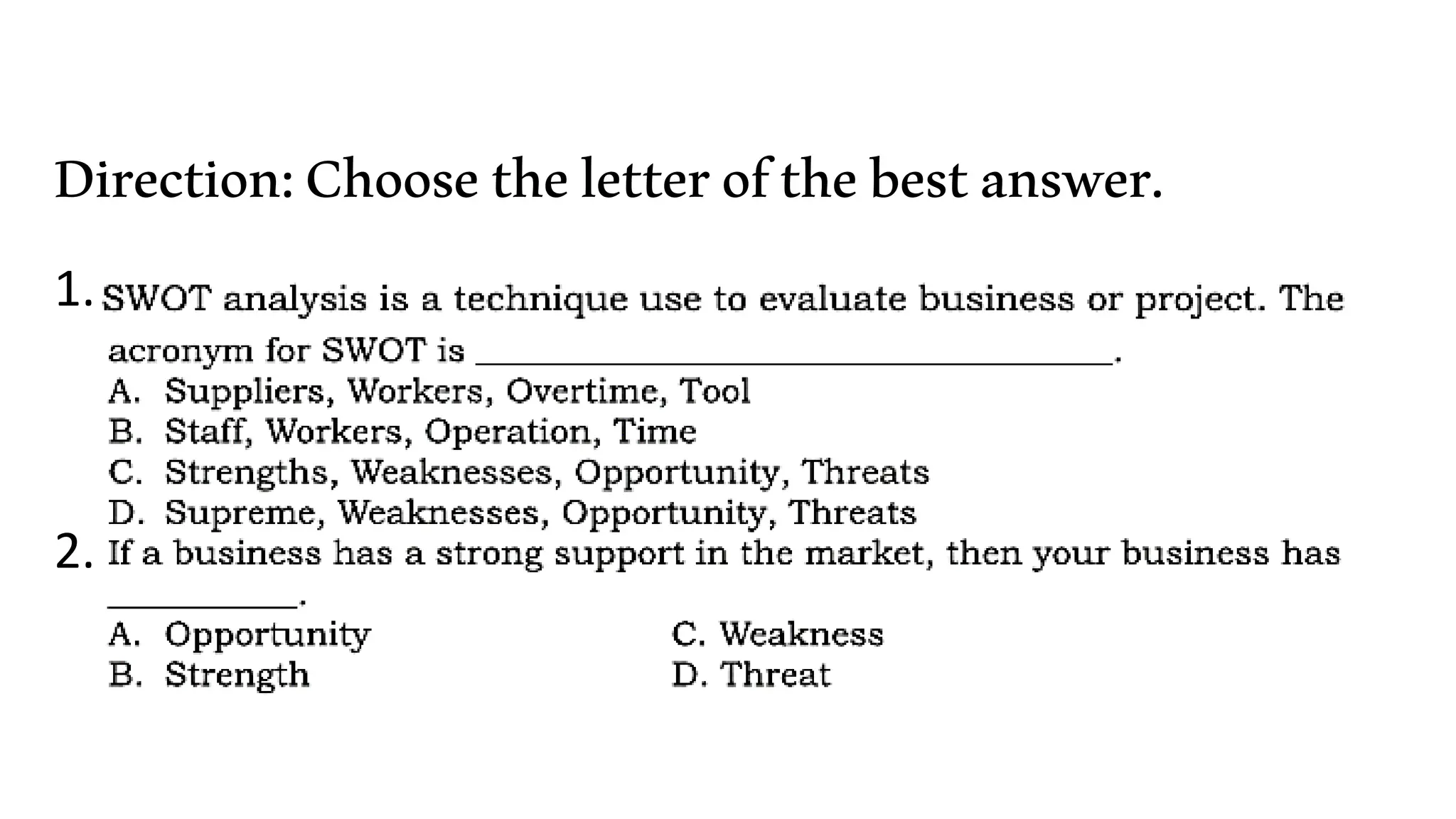
Direction:Choosetheletterofthebestanswer.
1.
2.
3.
4.
5.
1 principle, tools and techniques in creating business.pdf

1 principle, tools and techniques in creating business.pdf

  • 1.
    INDUSTRY AND ENVIRONMENTALANALYSIS: BUSINESS OPPORTUNITIES IDENTIFICATION
  • 2.
    Due to healthcrisis brought by covid 19, a lot of small and medium enterprises closed down already for they have already incurred much losses for the past few months. However, there are still businesses that flourish amidst the pandemic. For example, Puregold’s stock value rose significantly for couple of months while other industries had difficulty coping up with the pandemic. If you are going to put up a business during these trying times, whatwoulditbeandwhy?Whydoyouthinkthisindustryisattractiveinthe marketevenduringpandemic?”
  • 3.
    The activity aimsto let you realize that firms always analyze the industry first before putting up a business. Different firms use different tools in assessing the business environment and to see the rewards, challenges and even attractiveness in the industry where the business belongs.”
  • 4.
    Business • It isan entity or organization that is intended for commercial, industrial or any professional activities. • Its main objective is to earn profit for the owners. • A business is just a small portion of an industry.
  • 5.
    Industry • It isa group of companies or businesses that carry on the same line of business activities or undertaking.
  • 7.
  • 8.
    SOLE PROPRIETORSHIP • Thisform of business organization consists of one person who runs business. • Among all business organizations, this takes the simplest method to set-up and even to dissolve. “The owner has sole control over business management and gets solely the profit earned from its operations.” • However, the sole proprietor also carries the whole responsibility for all the debts and obligations and absorbs all the losses in the course of the business operations. • The owner faces the risk of unlimited liability in which his personal assets might be exhausted to pay for the business’ loans.
  • 9.
    PARTNERSHIP • A partnershipconsists of two or more people who combine their resources and run the business together with an aim to gain profit. • There must be a partnership agreement and profits are divided among partners according to the terms of agreement.
  • 10.
    2 types ofpartnership: a. General Partnership All partners take part in the management of the business. The general partners have unlimited liability wherein their personal properties might be used just to pay for the debts of the company. b. Limited Partnership These are the partners who contribute only capital and do not take part in the management of the business. They have limited share in the profit, but they are also only liable to business debts to some extent only.
  • 11.
    CORPORATION • It isa legal entity that is separate from the owners of the corporation or the shareholders. • Board of Directors and the highest officers may bear liability for their involvement with the corporation. • The shareholders have limited liability. • Corporations have unlimited commercial life for they can exist for 50 years and it is renewable for another 50 years. • Among all forms of business organizations, corporations are heavily taxed and regulated by the government.
  • 12.
    Generally speaking, onemust be fully knowledgeable of the industry first before putting up a business. By analyzing the industry and the business to be established, appropriate actions and strategies will be planned and executed well which will also minimize, if not avoid, waste of resources.
  • 13.
    In planning abusiness, a thorough study needs to be made from the creation of business. Understanding how the business will operate and co-exists in the business world thus one needs to study principle, tools and techniques in creating business.
  • 14.
    10 Principles inCreating a Business
  • 15.
    Scalability • Businesses whichhas a businesses which has a potential to grow. For some potential to grow. For some instances people are growing their business by aligning their strategy/efforts on the present situation. (example the Covid-19 pandemic) • A business must be scalable for it to be successful. Scalability is the capability of a company to sustain or improve its performance in terms of profitability or efficiency when its sales volume increases.
  • 16.
    Big ideas • Greateropportunities, in creating your business big ideas plays a vital role, adopting to abrupt changes, planning and aligning people to fit in the business. Every business begins with an idea. • Business ideas come from many from many sources. Hobbies, interests, and business experiences often give people ideas often give people ideas for new business. • The success of one’s busine is through collaboration of ideas.
  • 17.
    Systems • Recognizing smalland big parts contributes success and failures to the business, everybody should fit in from the owner to its employee, resources and equipment. In making plan/decision one should be align to the other. • A business is a system in which all parts contribute to the success or failure of the whole. In this system, everything must work together from employee to president; from equipment to resources.
  • 18.
    Sustainability • A businessmust be powerful able to harness all economic conditions, in all market settings, providing positive and meaningful quality results to its customers. Such differentiated result is the key to survive. • A business must be dynamic- able to thrive through all economic conditions, in all markets, providing meaningful highly differentiated results to all of its customers.
  • 19.
    Growth • All businessneed to be growing especially in the internal as internal aspect of business. When you are a beginner in a business. When you are a beginner in a business it is like a school wherein your employees are students that need your guidance, with your intention and determination that the business will grow. • Growth is essential in business. Without continued growth, operations will stagnate. This can result in lowered standards of quality for products or services, decreased customer service, and poor employee morale.
  • 20.
    Vision • What doyou What do you want your business to be the future, your very purpose in creating a business, in creating a business, vision plays a vital role as it is your guide in planning. Creating your own vision statement, aligning it in abrupt changes, like what is happening right now in our economy. • Business must manifest the higher purpose upon which it was seeded, the vision it was meant to exemplify, the mission it was intended to fulfill.
  • 21.
    Purpose • A businessis the results of a big dream in mind of the person who dream for it. • A business is the fruit of a Higher Aim in the mind of the person who conceived it.
  • 22.
    Autonomy • A businessif not part of the owner’s life, but in fact, its own entity. A business possesses a life of its own. Many start-up business owners are quite independent. • Their businesses were started because they do not want to take direction from other people. A business is difficult is to start, however, without the help of others. Even the smallest businesses need a few full or part-time employees. The employees must be selected carefully for their ability to work as a team. • Choosing the “team” becomes one of the most important initial business decisions.
  • 23.
    Profitability • A businesshelp economic entity, managing economic reality, creating an economic certainty for the communities in which it thrives.
  • 24.
    Standards • A businesscreates standard against all businesses measured as either successful or not. In order a business will go beyond, aim high beyond the existing standard.
  • 27.
    TOOLS IN EVALUATINGA BUSINESS The following are the general factors that must be put into consideration when evaluating a certain industry as indicated in a guide developed by North Carolina’s Small Business and Technology Development Center:
  • 28.
    • Geographic area •Market size and market trend in the industry • Product Description • Identifying and understanding the target market • Laws governing the business industry • Competitors’ analysis • Business growth
  • 29.
  • 30.
    The SWOT Analysis •It stands for Strength, Weaknesses, Opportunities and Threats • It is a framework that is used to seek business opportunities and evaluate new business ventures. • It helps to identify the company’s challenges and risks of doing business. • A helpful tool to assess the internal and external factors affecting the business.
  • 31.
    Internal factors thatmay affect the business: • Financial aspect- source of capital, uses and sources of funds for short-term and long-term, investment funds of the company • Human resources- consist of employees and their designated positions in the company • Physical resources- machines, equipment, facilities, location • Business processes- production process, sales and marketing strategies, supply chain, value chain, information and technology systems, programs for laborers and employees, job description of each employees, logistics, etc.
  • 33.
    External forces thatmay affect the business: • Economic aspect- international trading, financial and economic trends in local, national and international scenes, inflation, interest rate, GDP, banking system, national economic status, etc. • Market trends- behavioral and psychographic descriptions of target market, change in taste and lifestyle of customers, new products and technology in the market, etc. • Regulatory environment- political environment surrounding the business, laws governing business operations, local and national statutory regulations • Demographic characteristics of target market- age, gender, financial status, culture, etc. • Competition in the market • Relationship with suppliers and channel partners
  • 35.
    SWOT Analysis isone of the most widely used business evaluation tool in any business industry. It is helpful in determining the business parameters that must be improved on, which becomes the basis in creating business strategies. The owners can identify the company’s strengths that they can use for their advantage and they can also address their weaknesses in order to level the competition in the market.
  • 37.
    Group Activity 1.Because ofthe Covid 19 pandemic the students of G12 GAS experience a financial crisis and their family and in order to help their families the students want to start a small business. Think of two option of business that your group want to start in your locality. 2.Write a SWOT analysis about each option. 3.Decide and choose the best small business based on your careful analysis.
  • 38.
  • 39.
  • 40.