
NOTE ON PRICING
AND PUBLIC POLICY
A Harvard Business School Case Study
Introduction






Prices determine the functioning of market
economies.
Under perfect competition, firms are price takers.
Situation is different in many real world markets.
Different market structures :
Perfect competition
 Monopoly
 Monopolistic competition
 Oligopoly




Market structure models help us organize and
understand apparent chaos of real-world markets.
The Concept of Imperfect
Competition


Refers to market structures between perfect
competition and monopoly



Types of imperfectly competitive markets
 Monopolistic
 Oligopoly

competition
Monopolistic Competition


Hybrid of perfect competition and
monopoly, sharing some of features of each
A

monopolistically competitive market has three
fundamental characteristics
 Many

buyers and sellers
 Sellers offer a differentiated product
 Sellers can easily enter or exit the market
Pricing | Competitive Markets


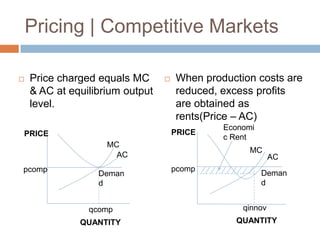
Price charged equals MC
& AC at equilibrium output
level.



When production costs are
reduced, excess profits
are obtained as
rents(Price – AC)
PRICE

PRICE
MC
AC
pcomp

Deman
d

Economi
c Rent
MC

pcomp

AC

Deman
d

qcomp

qinnov

QUANTITY

QUANTITY
Pricing | Natural Monopoly








An industry in which economies of scale are so
important that only one firm can survive.
Its average cost are downward slopping over the whole
output.
Society benefits from allowing the natural monopoly to
occur. As it can increase output and allow prices to be
lower due to economies of scale
It would not be efficient to encourage competition as it
would mean creating duplicate networks that could not
gain economies of scale


Examples:





Distribution of Electricity
Railways
Pipelines
Fixed- line telephone networks
Economies of Scale | Natural
Monopolies


Economies of Scale occur because of two
factors
 High

Fixed Cost

 Costs

 Low

involved in setting up business

Marginal Cost

 Cost

of adding new consumers to the network is low
Potential Competition And Natural
Monopolies










In case of negligible barriers to entry and exit, natural
monopolies charge prices that lead to no more than
normal profits by lowering prices in face of entry.
Franchise is not the best solution in terms of
inefficiencies! Franchising in this context is the
competitive bidding (of some form) for a long term
contract to operate a monopoly.
Natural Monopoly may eventually become Artificial
Monopoly.
Competition would lead to innovation at a much quicker
pace.
The incumbent faces possibility of losing market while
entrant foresees prospect of sharing!
Pricing | Oligopoly Markets








Pricing depends on cost, demand characteristics and ability
of firms to collude
Cartels are unstable because there is an incentive to cheat
Significant decline in industry demand may lead to price wars
Price wars may lead to firms requesting assistance from govt.
in the form of subsidies/ setting minimum and target prices
Govt. intervention might reduce allocative efficiency

Oligopoly firm faces market power in certain geographic
markets, consumer groups, product lines, but also faces
constraints similar to those faced by monopolists.
Oligopoly vs. Other Market
Structures
Oligopoly presents the greatest challenge
to economists.
 Essence of oligopoly is strategic
interdependence.
 Need new tools of modeling.
 One approach—game theory—has
yielded rich insights into oligopoly
behavior.

Conclusion


The combination of market
imperfections, strategic actions on the part of
the firms and interest groups, and intervention
by the policy makers will shape the
levels, structure and dynamics of prices in any
given market.

Note on Pricing and Public Policy

  • 1.
    NOTE ON PRICING ANDPUBLIC POLICY A Harvard Business School Case Study
  • 2.
    Introduction     Prices determine thefunctioning of market economies. Under perfect competition, firms are price takers. Situation is different in many real world markets. Different market structures : Perfect competition  Monopoly  Monopolistic competition  Oligopoly   Market structure models help us organize and understand apparent chaos of real-world markets.
  • 3.
    The Concept ofImperfect Competition  Refers to market structures between perfect competition and monopoly  Types of imperfectly competitive markets  Monopolistic  Oligopoly competition
  • 4.
    Monopolistic Competition  Hybrid ofperfect competition and monopoly, sharing some of features of each A monopolistically competitive market has three fundamental characteristics  Many buyers and sellers  Sellers offer a differentiated product  Sellers can easily enter or exit the market
  • 5.
    Pricing | CompetitiveMarkets  Price charged equals MC & AC at equilibrium output level.  When production costs are reduced, excess profits are obtained as rents(Price – AC) PRICE PRICE MC AC pcomp Deman d Economi c Rent MC pcomp AC Deman d qcomp qinnov QUANTITY QUANTITY
  • 6.
    Pricing | NaturalMonopoly     An industry in which economies of scale are so important that only one firm can survive. Its average cost are downward slopping over the whole output. Society benefits from allowing the natural monopoly to occur. As it can increase output and allow prices to be lower due to economies of scale It would not be efficient to encourage competition as it would mean creating duplicate networks that could not gain economies of scale  Examples:     Distribution of Electricity Railways Pipelines Fixed- line telephone networks
  • 7.
    Economies of Scale| Natural Monopolies  Economies of Scale occur because of two factors  High Fixed Cost  Costs  Low involved in setting up business Marginal Cost  Cost of adding new consumers to the network is low
  • 8.
    Potential Competition AndNatural Monopolies      In case of negligible barriers to entry and exit, natural monopolies charge prices that lead to no more than normal profits by lowering prices in face of entry. Franchise is not the best solution in terms of inefficiencies! Franchising in this context is the competitive bidding (of some form) for a long term contract to operate a monopoly. Natural Monopoly may eventually become Artificial Monopoly. Competition would lead to innovation at a much quicker pace. The incumbent faces possibility of losing market while entrant foresees prospect of sharing!
  • 9.
    Pricing | OligopolyMarkets      Pricing depends on cost, demand characteristics and ability of firms to collude Cartels are unstable because there is an incentive to cheat Significant decline in industry demand may lead to price wars Price wars may lead to firms requesting assistance from govt. in the form of subsidies/ setting minimum and target prices Govt. intervention might reduce allocative efficiency Oligopoly firm faces market power in certain geographic markets, consumer groups, product lines, but also faces constraints similar to those faced by monopolists.
  • 10.
    Oligopoly vs. OtherMarket Structures Oligopoly presents the greatest challenge to economists.  Essence of oligopoly is strategic interdependence.  Need new tools of modeling.  One approach—game theory—has yielded rich insights into oligopoly behavior. 
  • 11.
    Conclusion  The combination ofmarket imperfections, strategic actions on the part of the firms and interest groups, and intervention by the policy makers will shape the levels, structure and dynamics of prices in any given market.