TOPIC 6 :NON-CURRENT ASSET
CLASSIFICATION OF NON-CURRENT ASSETDETERMINATION OF COSTDEPRECIATIONDISPOSAL OF ASSETTRADE IN ASSETREPORTING THE DEPRECIATION AND ACCUMULATED DEPRECATIONINTANGIBLE ASSET
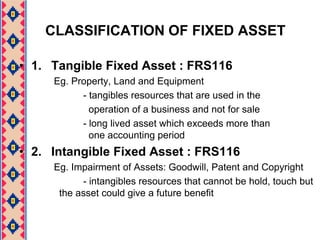
CLASSIFICATION OF FIXED ASSET1.	Tangible Fixed Asset : FRS116 Eg. Property, Land and Equipment		- tangibles resources that are used in the 		  operation of a business and not for sale		- long lived asset which exceeds more than 	 	   	  one accounting period2.	Intangible Fixed Asset : FRS116 Eg. Impairment of Assets: Goodwill, Patent and Copyright		- intangibles resources that cannot be hold, touch but the asset could give a future benefit
Determination of Cost of an Asset :	- according to historical cost concept:	  Asset is recorded at cost price not market price	- Cost : all expenditures necessary to acquire the asset and make it ready for its intended use.Determination of Cost
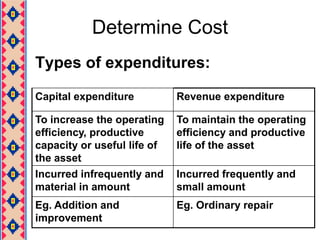
Determine CostTypes of expenditures:
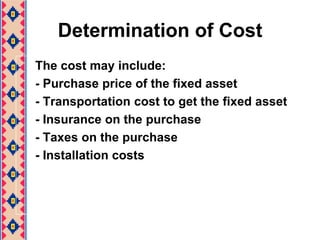
Determination of CostThe cost may include:- Purchase price of the fixed asset- Transportation cost to get the fixed asset- Insurance on the purchase- Taxes on the purchase- Installation costs
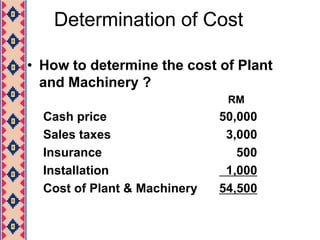
Determination of CostHow to determine the cost of Plant and Machinery ?					   	   RMCash price			 	50,000Sales taxes		 	  	  3,000Insurance			     	     500Installation		 		  1,000Cost of Plant & Machinery 	54,500
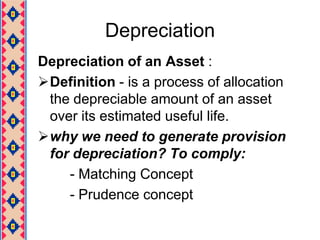
DepreciationDepreciation of an Asset :Definition - is a process of allocation the depreciable amount of an asset over its estimated useful life.
why we need to generate provision for depreciation? To comply:	    	- Matching Concept		- Prudence concept
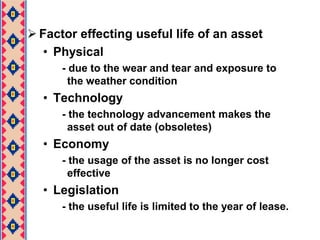
Factor effecting useful life of an asset
Physical - due to the wear and tear and exposure to the weather conditionTechnology - the technology advancement makes the asset out of date (obsoletes)Economy - the usage of the asset is no longer cost effectiveLegislation - the useful life is limited to the year of lease.
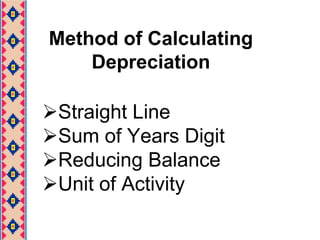
Method of Calculating DepreciationStraight Line
Sum of Years Digit
Reducing Balance
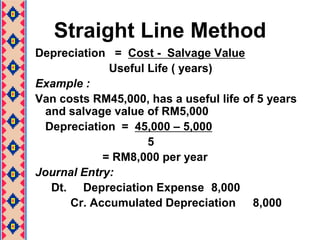
Unit of ActivityStraight Line MethodDepreciation   =  Cost -  Salvage Value			        Useful Life ( years)Example :Van costs RM45,000, has a useful life of 5 years and salvage value of RM5,000	Depreciation  =  45,000 – 5,000			                    5		       	      = RM8,000 per yearJournal Entry:		Dt.	Depreciation Expense	8,000		      Cr. Accumulated Depreciation	   8,000
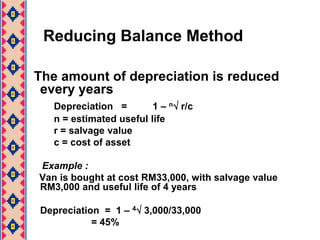
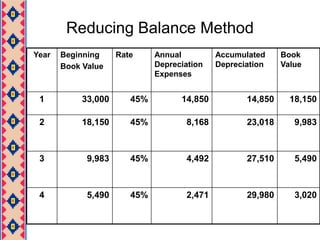
Reducing Balance MethodThe amount of depreciation is reduced every yearsDepreciation   = 	 1 – n r/c 			n = estimated useful life		r = salvage value		c = cost of asset   Example :  Van is bought at cost RM33,000, with salvage value RM3,000 and useful life of 4 years	Depreciation  =  1 – 4 3,000/33,000			  = 45%
Reducing Balance Method
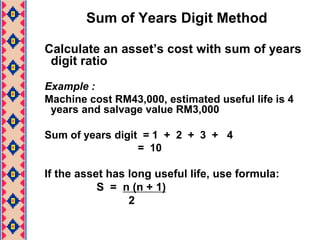
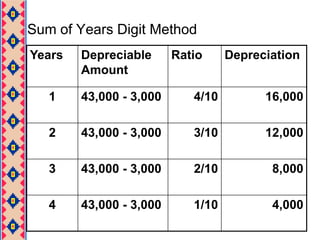
Sum of Years Digit MethodCalculate an asset’s cost with sum of years digit ratioExample :Machine cost RM43,000, estimated useful life is 4 years and salvage value RM3,000Sum of years digit  = 1  +  2  +  3  +   4			              =  10	If the asset has long useful life, use formula:			S  =  n (n + 1)				2
Sum of Years Digit Method
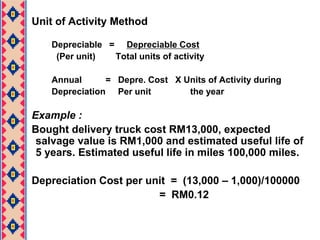
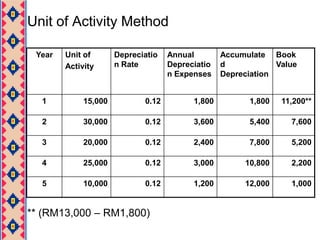
Unit of Activity Method		Depreciable   =     Depreciable Cost		  (Per unit)	Total units of activity		Annual	         =   Depre. Cost   X Units of Activity during		Depreciation	 Per unit                the yearExample :Bought delivery truck cost RM13,000, expected salvage value is RM1,000 and estimated useful life of 5 years. Estimated useful life in miles 100,000 miles.Depreciation Cost per unit  =  (13,000 – 1,000)/100000		              		    =  RM0.12
Unit of Activity Method** (RM13,000 – RM1,800)
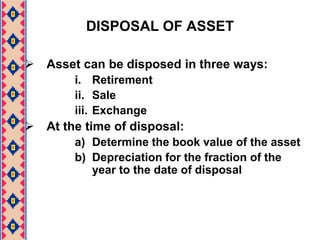
DISPOSAL OF ASSETAsset can be disposed in three ways:RetirementSaleExchangeAt the time of disposal:Determine the book value of the assetDepreciation for the fraction of the year to the date of disposal
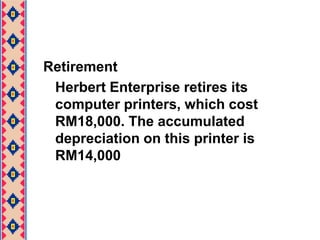
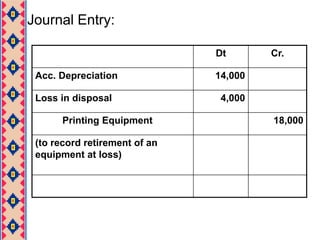
Retirement	Herbert Enterprise retires its computer printers, which cost RM18,000. The accumulated depreciation on this printer is RM14,000
Journal Entry:
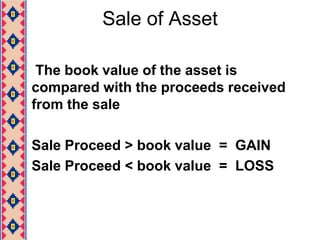
Sale of AssetThe book value of the asset is compared with the proceeds received from the sale	Sale Proceed > book value  =  GAIN	Sale Proceed < book value  =  LOSS
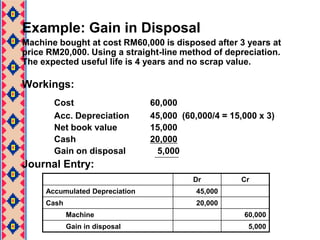
Example: Gain in DisposalMachine bought at cost RM60,000 is disposed after 3 years at price RM20,000. Using a straight-line method of depreciation. The expected useful life is 4 years and no scrap value.Workings:Cost			60,000	Acc. Depreciation	45,000  (60,000/4 = 15,000 x 3)	Net book value		15,000	Cash			20,000	Gain on disposal	   5,000Journal Entry:
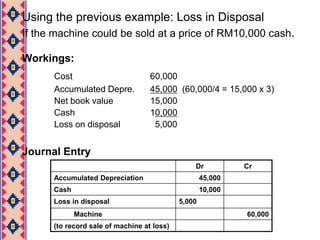
Using the previous example: Loss in DisposalIf the machine could be sold at a price of RM10,000 cash.Workings:Cost			60,000	Accumulated Depre.	45,000  (60,000/4 = 15,000 x 3)	Net book value		15,000	Cash			10,000	Loss on disposal	  5,000Journal Entry
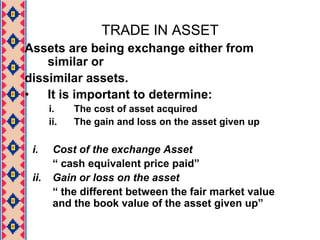
TRADEIN ASSETAssets are being exchange either from similar or dissimilar assets.It is important to determine:The cost of asset acquiredThe gain and loss on the asset given upCost of the exchange Asset	“ cash equivalent price paid”Gain or loss on the asset 	“ the different between the fair market value and the book value of the asset given up”
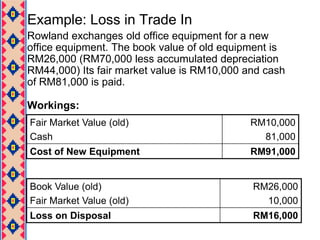
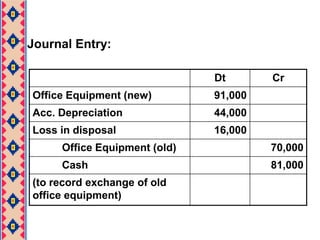
Example: Loss in Trade InRowland exchanges old office equipment for a new office equipment. The book value of old equipment is RM26,000 (RM70,000 less accumulated depreciation RM44,000) Its fair market value is RM10,000 and cash of RM81,000 is paid.Workings:
Journal Entry:
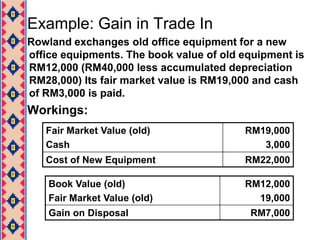
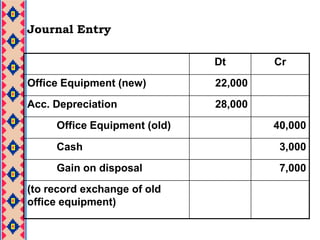
Example: Gain in Trade InRowland exchanges old office equipment for a new office equipments. The book value of old equipment is RM12,000 (RM40,000 less accumulated depreciation RM28,000) Its fair market value is RM19,000 and cash of RM3,000 is paid.Workings:
Journal Entry
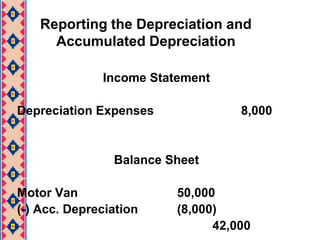
Reporting the Depreciation and Accumulated DepreciationIncome StatementDepreciation Expenses			8,000Balance SheetMotor Van				50,000(-) Acc. Depreciation		(8,000)						    	 42,000
INTANGIBLEASSETDefinition:Right, privileges and competitive advantage that result from the ownership of long-lived assets that do not possess physical substanceExamples include:Patents (e.g. Polaroid)Franchises (e.g. McDonald’s)Trademarks (e.g. swoosh of Nike)
Intangible AssetsIntangible assets can be separated into:a. IdentifiableMust be capable of being separated or divided from an entity (whether sold, licensed, rented or exchanged) or must arise from contractual or other legal rights.b. Unidentifiable Cannot be separated from the entity itself.Collectively referred to as goodwill.
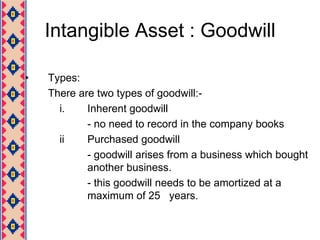
IntangibleAsset : GoodwillTypes:	There are two types of goodwill:-Inherent goodwill	- no need to record in the company booksii	Purchased goodwill	- goodwill arises from a business which bought another business.	- this goodwill needs to be amortized at a maximum of 25   years.
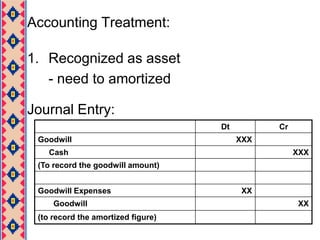
Accounting Treatment:Recognized as asset	- need to amortizedJournal Entry:
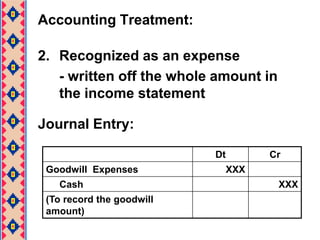
Accounting Treatment:2.	Recognized as an expense	- written off the whole amount in the income statementJournal Entry:

Topic 6 Non Current Asset

  • 1.
  • 2.
    CLASSIFICATION OF NON-CURRENTASSETDETERMINATION OF COSTDEPRECIATIONDISPOSAL OF ASSETTRADE IN ASSETREPORTING THE DEPRECIATION AND ACCUMULATED DEPRECATIONINTANGIBLE ASSET
  • 3.
    CLASSIFICATION OF FIXEDASSET1. Tangible Fixed Asset : FRS116 Eg. Property, Land and Equipment - tangibles resources that are used in the operation of a business and not for sale - long lived asset which exceeds more than one accounting period2. Intangible Fixed Asset : FRS116 Eg. Impairment of Assets: Goodwill, Patent and Copyright - intangibles resources that cannot be hold, touch but the asset could give a future benefit
  • 4.
    Determination of Costof an Asset : - according to historical cost concept: Asset is recorded at cost price not market price - Cost : all expenditures necessary to acquire the asset and make it ready for its intended use.Determination of Cost
  • 5.
  • 6.
    Determination of CostThecost may include:- Purchase price of the fixed asset- Transportation cost to get the fixed asset- Insurance on the purchase- Taxes on the purchase- Installation costs
  • 7.
    Determination of CostHowto determine the cost of Plant and Machinery ? RMCash price 50,000Sales taxes 3,000Insurance 500Installation 1,000Cost of Plant & Machinery 54,500
  • 8.
    DepreciationDepreciation of anAsset :Definition - is a process of allocation the depreciable amount of an asset over its estimated useful life.
  • 9.
    why we needto generate provision for depreciation? To comply: - Matching Concept - Prudence concept
  • 10.
    Factor effecting usefullife of an asset
  • 11.
    Physical - dueto the wear and tear and exposure to the weather conditionTechnology - the technology advancement makes the asset out of date (obsoletes)Economy - the usage of the asset is no longer cost effectiveLegislation - the useful life is limited to the year of lease.
  • 12.
    Method of CalculatingDepreciationStraight Line
  • 13.
  • 14.
  • 15.
    Unit of ActivityStraightLine MethodDepreciation = Cost - Salvage Value Useful Life ( years)Example :Van costs RM45,000, has a useful life of 5 years and salvage value of RM5,000 Depreciation = 45,000 – 5,000 5 = RM8,000 per yearJournal Entry: Dt. Depreciation Expense 8,000 Cr. Accumulated Depreciation 8,000
  • 16.
    Reducing Balance MethodTheamount of depreciation is reduced every yearsDepreciation = 1 – n r/c n = estimated useful life r = salvage value c = cost of asset Example : Van is bought at cost RM33,000, with salvage value RM3,000 and useful life of 4 years Depreciation = 1 – 4 3,000/33,000 = 45%
  • 17.
  • 18.
    Sum of YearsDigit MethodCalculate an asset’s cost with sum of years digit ratioExample :Machine cost RM43,000, estimated useful life is 4 years and salvage value RM3,000Sum of years digit = 1 + 2 + 3 + 4 = 10 If the asset has long useful life, use formula: S = n (n + 1) 2
  • 19.
    Sum of YearsDigit Method
  • 20.
    Unit of ActivityMethod Depreciable = Depreciable Cost (Per unit) Total units of activity Annual = Depre. Cost X Units of Activity during Depreciation Per unit the yearExample :Bought delivery truck cost RM13,000, expected salvage value is RM1,000 and estimated useful life of 5 years. Estimated useful life in miles 100,000 miles.Depreciation Cost per unit = (13,000 – 1,000)/100000 = RM0.12
  • 21.
    Unit of ActivityMethod** (RM13,000 – RM1,800)
  • 22.
    DISPOSAL OF ASSETAssetcan be disposed in three ways:RetirementSaleExchangeAt the time of disposal:Determine the book value of the assetDepreciation for the fraction of the year to the date of disposal
  • 23.
    Retirement Herbert Enterprise retiresits computer printers, which cost RM18,000. The accumulated depreciation on this printer is RM14,000
  • 24.
  • 25.
    Sale of AssetThebook value of the asset is compared with the proceeds received from the sale Sale Proceed > book value = GAIN Sale Proceed < book value = LOSS
  • 26.
    Example: Gain inDisposalMachine bought at cost RM60,000 is disposed after 3 years at price RM20,000. Using a straight-line method of depreciation. The expected useful life is 4 years and no scrap value.Workings:Cost 60,000 Acc. Depreciation 45,000 (60,000/4 = 15,000 x 3) Net book value 15,000 Cash 20,000 Gain on disposal 5,000Journal Entry:
  • 27.
    Using the previousexample: Loss in DisposalIf the machine could be sold at a price of RM10,000 cash.Workings:Cost 60,000 Accumulated Depre. 45,000 (60,000/4 = 15,000 x 3) Net book value 15,000 Cash 10,000 Loss on disposal 5,000Journal Entry
  • 28.
    TRADEIN ASSETAssets arebeing exchange either from similar or dissimilar assets.It is important to determine:The cost of asset acquiredThe gain and loss on the asset given upCost of the exchange Asset “ cash equivalent price paid”Gain or loss on the asset “ the different between the fair market value and the book value of the asset given up”
  • 29.
    Example: Loss inTrade InRowland exchanges old office equipment for a new office equipment. The book value of old equipment is RM26,000 (RM70,000 less accumulated depreciation RM44,000) Its fair market value is RM10,000 and cash of RM81,000 is paid.Workings:
  • 30.
  • 31.
    Example: Gain inTrade InRowland exchanges old office equipment for a new office equipments. The book value of old equipment is RM12,000 (RM40,000 less accumulated depreciation RM28,000) Its fair market value is RM19,000 and cash of RM3,000 is paid.Workings:
  • 32.
  • 33.
    Reporting the Depreciationand Accumulated DepreciationIncome StatementDepreciation Expenses 8,000Balance SheetMotor Van 50,000(-) Acc. Depreciation (8,000) 42,000
  • 34.
    INTANGIBLEASSETDefinition:Right, privileges andcompetitive advantage that result from the ownership of long-lived assets that do not possess physical substanceExamples include:Patents (e.g. Polaroid)Franchises (e.g. McDonald’s)Trademarks (e.g. swoosh of Nike)
  • 35.
    Intangible AssetsIntangible assetscan be separated into:a. IdentifiableMust be capable of being separated or divided from an entity (whether sold, licensed, rented or exchanged) or must arise from contractual or other legal rights.b. Unidentifiable Cannot be separated from the entity itself.Collectively referred to as goodwill.
  • 36.
    IntangibleAsset : GoodwillTypes: Thereare two types of goodwill:-Inherent goodwill - no need to record in the company booksii Purchased goodwill - goodwill arises from a business which bought another business. - this goodwill needs to be amortized at a maximum of 25 years.
  • 37.
    Accounting Treatment:Recognized asasset - need to amortizedJournal Entry:
  • 38.
    Accounting Treatment:2. Recognized asan expense - written off the whole amount in the income statementJournal Entry: