Ethical considerations
 in researching online
learning and teaching
                     #unisa12

                Palitha Edirisingha
               University of Leicester


    Palitha Edirisingha, 12 June 2012, Unisa, South Africa
Session objectives

• To be familiar with the ethical principles involved in
  social research
• To consider possible links between research methods /
  methodological approaches and specific ethical issues
• To raise awareness of the risks to participants,
  researchers, institutions, profession (research field) by
  not taking ethical codes seriously
• To consider how ethical issues relating to Internet
  research might differ from research in traditional
  settings.
To help you ‘leave the field [in such
   as way] that future researchers
       are not disadvantaged’
            (Eynon et al, 2008: 31).
Before we begin…

• Debates on ethical issues – on going!
• Internet for social researchers –
  opportunities!
• Link between ethical issues and research
  methods and tools (e.g., social and
  participatory media)
• Consequences of ignoring ethical codes!
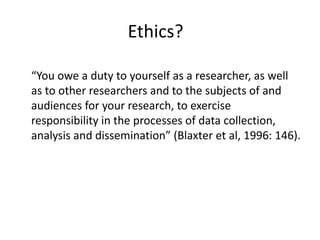
Ethics?

“You owe a duty to yourself as a researcher, as well
as to other researchers and to the subjects of and
audiences for your research, to exercise
responsibility in the processes of data collection,
analysis and dissemination” (Blaxter et al, 1996: 146).
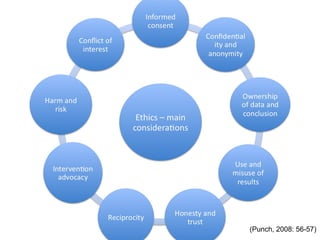
(Punch, 2008: 56-57)
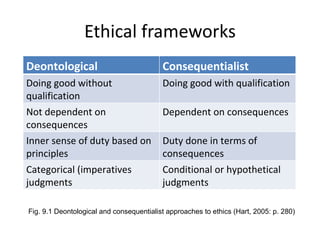
Ethical frameworks
Deontological                             Consequentialist
Doing good without                        Doing good with qualification
qualification
Not dependent on                          Dependent on consequences
consequences
Inner sense of duty based on              Duty done in terms of
principles                                consequences
Categorical (imperatives                  Conditional or hypothetical
judgments                                 judgments

Fig. 9.1 Deontological and consequentialist approaches to ethics (Hart, 2005: p. 280)
Ethical frameworks

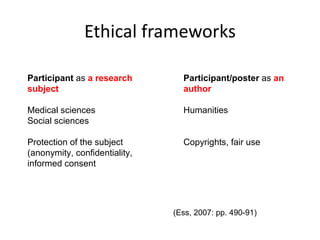
Participant as a research        Participant/poster as an
subject                          author

Medical sciences                 Humanities
Social sciences

Protection of the subject        Copyrights, fair use
(anonymity, confidentiality,
informed consent


                               (Ess, 2007: pp. 490-91)
Ethics – Stake-holders
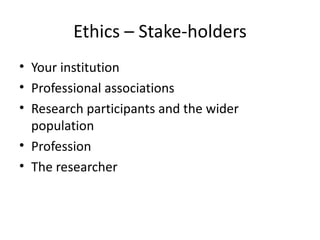
• Your institution
• Professional associations
• Research participants and the wider
  population
• Profession
• The researcher
Ethics – professional associations

The association                               URL
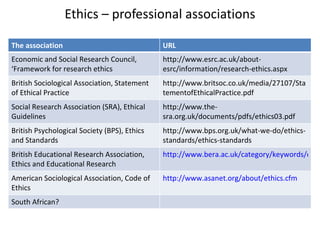
Economic and Social Research Council,         http://www.esrc.ac.uk/about-
‘Framework for research ethics                esrc/information/research-ethics.aspx
British Sociological Association, Statement   http://www.britsoc.co.uk/media/27107/Sta
of Ethical Practice                           tementofEthicalPractice.pdf
Social Research Association (SRA), Ethical    http://www.the-
Guidelines                                    sra.org.uk/documents/pdfs/ethics03.pdf
British Psychological Society (BPS), Ethics   http://www.bps.org.uk/what-we-do/ethics-
and Standards                                 standards/ethics-standards
British Educational Research Association,     http://www.bera.ac.uk/category/keywords/ethic
Ethics and Educational Research
American Sociological Association, Code of    http://www.asanet.org/about/ethics.cfm
Ethics
South African?
Activity 1


A review of main data collection methods,
 distinguishing features, and their ethical
               implications


                 [5 mins]
Methods (offline and online)
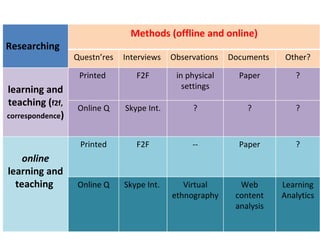
Researching
                  Questn’res   Interviews   Observations   Documents    Other?

                   Printed        F2F        in physical     Paper        ?
learning and                                   settings
teaching (f2f,    Online Q     Skype Int.        ?             ?          ?
correspondence)


                   Printed        F2F            --          Paper        ?
    online
learning and
  teaching        Online Q     Skype Int.      Virtual       Web       Learning
                                            ethnography     content    Analytics
                                                            analysis
Internet in the context of online research
                             [2 mins]
In social science research                                                   Examples from
                                                                             educational
                                                                             research?
A major data resource
A lens through which to observe the subjects of research (and how
they construct their identities and communities online)

A tool for gathering and analysing social science data on a large scale MOOCs

A laboratory for the social sciences [a bit like astronomers using an        i-Spot, Galaxy Zoo
observatory to study the sky]

Mechanism for communicating and collaborating with a distributed
community of peer researchers (e.g., Facebook Twitter [TB’s session]


                                                      (Eynon et al., 2008)
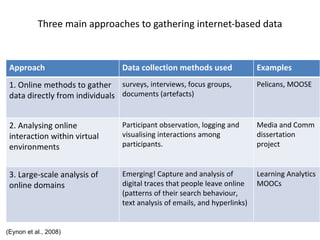
Three main approaches to gathering internet-based data


 Approach                       Data collection methods used               Examples
 1. Online methods to gather surveys, interviews, focus groups,            Pelicans, MOOSE
 data directly from individuals documents (artefacts)


 2. Analysing online            Participant observation, logging and       Media and Comm
 interaction within virtual     visualising interactions among             dissertation
 environments                   participants.                              project


 3. Large-scale analysis of     Emerging! Capture and analysis of          Learning Analytics
 online domains                 digital traces that people leave online    MOOCs
                                (patterns of their search behaviour,
                                text analysis of emails, and hyperlinks)


(Eynon et al., 2008)
Ethical issues associated with
      three approaches
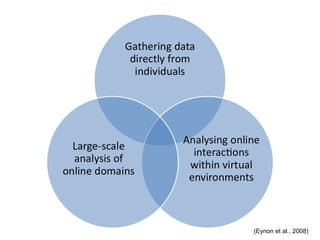
(Eynon et al., 2008)
(1). Using online methods to gather data
          directly from individuals
• Online versions of traditional methods. What
  are they?
• Different ethical challenges to f2f
  context(Mann, 2003)
• Ethical challenges?
  –   Difficult to assess the risk to participants, reactions to questions
  –   Confidentiality and anonymity
  –   Informed consent
  –   Words much stronger when written down, permanent records, [stuff
      on episodic interviews [reference]
(2). Analysing online interactions on the Web

 • Examples? discussion boards / forums, chat
   rooms, 3D multi user virtual environments (eg.
   Second Life), online gaming environments.
 • Is online environment public, private or even a
   ‘third place’ (Oldenburg, 1989)
 • How might we treat the interactions occur in a
   VLE?
 • [disclosing identity as a researcher]
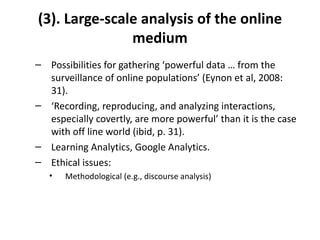
(3). Large-scale analysis of the online
               medium
– Possibilities for gathering ‘powerful data … from the
  surveillance of online populations’ (Eynon et al, 2008:
  31).
– ‘Recording, reproducing, and analyzing interactions,
  especially covertly, are more powerful’ than it is the case
  with off line world (ibid, p. 31).
– Learning Analytics, Google Analytics.
– Ethical issues:
   •   Methodological (e.g., discourse analysis)
Here is a question!

• You are the tutor / teacher / lecturer,
  and you are researching your
  students’ learning. Should you
  disclose your identity as a
  researcher?
And another one!
• If you are a blogger or tweeter, and you
  observe some interesting stuff that fits into
  your on-going research (and maybe your
  book). And you might write about that
  observation later on. Should you have
  disclosed your identity as a ‘researcher’?
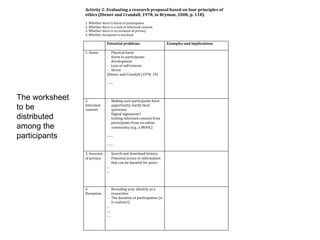
Activity 2


An activity (in pairs, 3s or groups) based on
   four ethical principles [20 minutes]
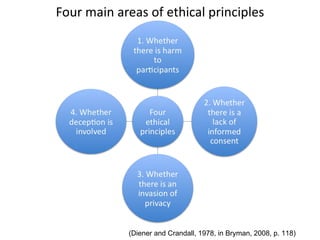
Four main areas of ethical principles


            (Diener and Crandall, 1978, in Bryman, 2008, p. 118)
The Activity
(in pairs, 3s or small groups)


          [20 minutes]
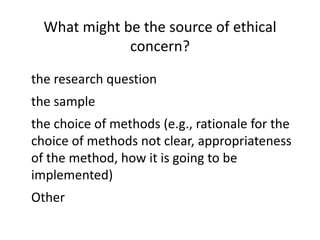
What might be the source of ethical
              concern?

the research question
the sample
the choice of methods (e.g., rationale for the
choice of methods not clear, appropriateness
of the method, how it is going to be
implemented)
Other
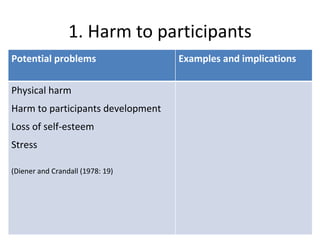
1. Harm to participants
Potential problems                 Examples and implications

Physical harm
Harm to participants development
Loss of self-esteem
Stress

(Diener and Crandall (1978: 19)
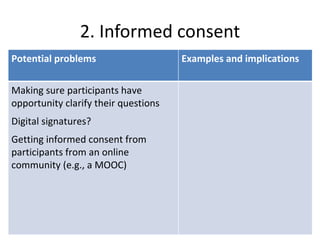
2. Informed consent
Potential problems                    Examples and implications

Making sure participants have
opportunity clarify their questions
Digital signatures?
Getting informed consent from
participants from an online
community (e.g., a MOOC)
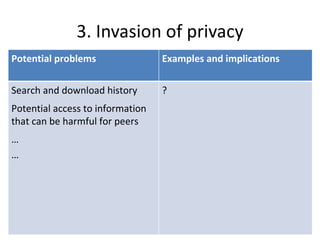
3. Invasion of privacy
Potential problems                Examples and implications

Search and download history       ?
Potential access to information
that can be harmful for peers
…
…
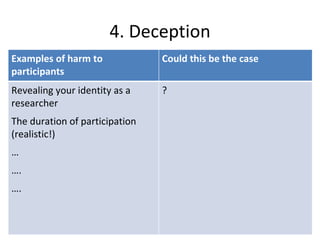
4. Deception
Examples of harm to             Could this be the case
participants
Revealing your identity as a    ?
researcher
The duration of participation
(realistic!)
…
….
….
The worksheet
to be
distributed
among the
participants
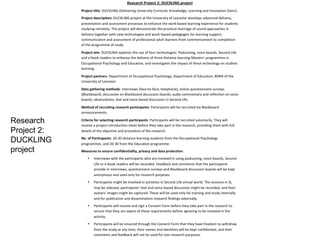
Next three slides
• Two brief descriptions of the research projects
  to be reviewed by participants
  – Project 1: Dissertation research and supervision
    with technology [DiReSTe]
  – Research Project 2: DUCKLING project
Project 1:
Dissertation
research and
supervision
with
technology
[DiReSTe]
Project 1:
Dissertation
research and
supervision
with
technology
[DiReSTe]
Research
Project 2:
DUCKLING
project
Responses from the participants
A checklist of information to be included in an
                informed consent form
•   Outline of the purpose of the project
•   Notification to the participants that:
     – Participation is voluntary
     – Participants free to refuse to answer any of the questions (if interviews)
     – They could withdraw from the study at any time
     – They could withdraw their data within [specify the time] of the interview /
        participation
     – interview would be recorded
     – nobody but the researcher and the supervisors would listen to the interview
     – small sections might be heard by a few others
     – transcribed but all identifying information would be removed
     – parts of the interview might be used in the research publication(s)
     – sign the form to confirm their consent
     (Bryman, 2008: 123-24)
Concluding remarks
• Planning the research so that you can ‘leave
  the field [in such as way] that future
  researchers are not disadvantaged’ (Eynon et
  al, 2008: 31)
• Other take-home messages from the session…
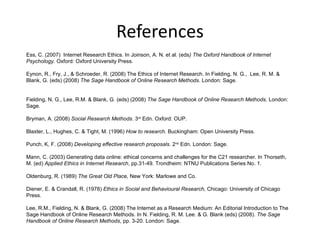
References
Ess, C. (2007) Internet Research Ethics. In Joinson, A. N. et al. (eds) The Oxford Handbook of Internet
Psychology. Oxford: Oxford University Press.

Eynon, R., Fry, J., & Schroeder, R. (2008) The Ethics of Internet Research. In Fielding, N. G., Lee, R. M. &
Blank, G. (eds) (2008) The Sage Handbook of Online Research Methods. London: Sage.


Fielding, N. G., Lee, R.M. & Blank, G. (eds) (2008) The Sage Handbook of Online Research Methods. London:
Sage.

Bryman, A. (2008) Social Research Methods. 3rd Edn. Oxford: OUP.

Blaxter, L., Hughes, C. & Tight, M. (1996) How to research. Buckingham: Open University Press.

Punch, K, F. (2008) Developing effective research proposals. 2nd Edn. London: Sage.

Mann, C. (2003) Generating data online: ethical concerns and challenges for the C21 researcher. In Thorseth,
M. (ed) Applied Ethics in Internet Research, pp.31-49. Trondheim: NTNU Publications Series No. 1.

Oldenburg, R. (1989) The Great Old Place, New York: Marlowe and Co.

Diener, E. & Crandall, R. (1978) Ethics in Social and Behavioural Research, Chicago: University of Chicago
Press.

Lee, R.M., Fielding, N. & Blank, G. (2008) The Internet as a Research Medium: An Editorial Introduction to The
Sage Handbook of Online Research Methods. In N. Fielding, R. M. Lee. & G. Blank (eds) (2008). The Sage
Handbook of Online Research Methods, pp. 3-20. London: Sage.

Edirisingha ethics unisa2012_12_june2012

  • 1.
    Ethical considerations inresearching online learning and teaching #unisa12 Palitha Edirisingha University of Leicester Palitha Edirisingha, 12 June 2012, Unisa, South Africa
  • 2.
    Session objectives • Tobe familiar with the ethical principles involved in social research • To consider possible links between research methods / methodological approaches and specific ethical issues • To raise awareness of the risks to participants, researchers, institutions, profession (research field) by not taking ethical codes seriously • To consider how ethical issues relating to Internet research might differ from research in traditional settings.
  • 3.
    To help you‘leave the field [in such as way] that future researchers are not disadvantaged’ (Eynon et al, 2008: 31).
  • 4.
    Before we begin… •Debates on ethical issues – on going! • Internet for social researchers – opportunities! • Link between ethical issues and research methods and tools (e.g., social and participatory media) • Consequences of ignoring ethical codes!
  • 5.
    Ethics? “You owe aduty to yourself as a researcher, as well as to other researchers and to the subjects of and audiences for your research, to exercise responsibility in the processes of data collection, analysis and dissemination” (Blaxter et al, 1996: 146).
  • 6.
  • 7.
    Ethical frameworks Deontological Consequentialist Doing good without Doing good with qualification qualification Not dependent on Dependent on consequences consequences Inner sense of duty based on Duty done in terms of principles consequences Categorical (imperatives Conditional or hypothetical judgments judgments Fig. 9.1 Deontological and consequentialist approaches to ethics (Hart, 2005: p. 280)
  • 8.
    Ethical frameworks Participant asa research Participant/poster as an subject author Medical sciences Humanities Social sciences Protection of the subject Copyrights, fair use (anonymity, confidentiality, informed consent (Ess, 2007: pp. 490-91)
  • 9.
    Ethics – Stake-holders •Your institution • Professional associations • Research participants and the wider population • Profession • The researcher
  • 10.
    Ethics – professionalassociations The association URL Economic and Social Research Council, http://www.esrc.ac.uk/about- ‘Framework for research ethics esrc/information/research-ethics.aspx British Sociological Association, Statement http://www.britsoc.co.uk/media/27107/Sta of Ethical Practice tementofEthicalPractice.pdf Social Research Association (SRA), Ethical http://www.the- Guidelines sra.org.uk/documents/pdfs/ethics03.pdf British Psychological Society (BPS), Ethics http://www.bps.org.uk/what-we-do/ethics- and Standards standards/ethics-standards British Educational Research Association, http://www.bera.ac.uk/category/keywords/ethic Ethics and Educational Research American Sociological Association, Code of http://www.asanet.org/about/ethics.cfm Ethics South African?
  • 11.
    Activity 1 A reviewof main data collection methods, distinguishing features, and their ethical implications [5 mins]
  • 12.
    Methods (offline andonline) Researching Questn’res Interviews Observations Documents Other? Printed F2F in physical Paper ? learning and settings teaching (f2f, Online Q Skype Int. ? ? ? correspondence) Printed F2F -- Paper ? online learning and teaching Online Q Skype Int. Virtual Web Learning ethnography content Analytics analysis
  • 13.
    Internet in thecontext of online research [2 mins] In social science research Examples from educational research? A major data resource A lens through which to observe the subjects of research (and how they construct their identities and communities online) A tool for gathering and analysing social science data on a large scale MOOCs A laboratory for the social sciences [a bit like astronomers using an i-Spot, Galaxy Zoo observatory to study the sky] Mechanism for communicating and collaborating with a distributed community of peer researchers (e.g., Facebook Twitter [TB’s session] (Eynon et al., 2008)
  • 14.
    Three main approachesto gathering internet-based data Approach Data collection methods used Examples 1. Online methods to gather surveys, interviews, focus groups, Pelicans, MOOSE data directly from individuals documents (artefacts) 2. Analysing online Participant observation, logging and Media and Comm interaction within virtual visualising interactions among dissertation environments participants. project 3. Large-scale analysis of Emerging! Capture and analysis of Learning Analytics online domains digital traces that people leave online MOOCs (patterns of their search behaviour, text analysis of emails, and hyperlinks) (Eynon et al., 2008)
  • 15.
    Ethical issues associatedwith three approaches
  • 16.
  • 17.
    (1). Using onlinemethods to gather data directly from individuals • Online versions of traditional methods. What are they? • Different ethical challenges to f2f context(Mann, 2003) • Ethical challenges? – Difficult to assess the risk to participants, reactions to questions – Confidentiality and anonymity – Informed consent – Words much stronger when written down, permanent records, [stuff on episodic interviews [reference]
  • 18.
    (2). Analysing onlineinteractions on the Web • Examples? discussion boards / forums, chat rooms, 3D multi user virtual environments (eg. Second Life), online gaming environments. • Is online environment public, private or even a ‘third place’ (Oldenburg, 1989) • How might we treat the interactions occur in a VLE? • [disclosing identity as a researcher]
  • 19.
    (3). Large-scale analysisof the online medium – Possibilities for gathering ‘powerful data … from the surveillance of online populations’ (Eynon et al, 2008: 31). – ‘Recording, reproducing, and analyzing interactions, especially covertly, are more powerful’ than it is the case with off line world (ibid, p. 31). – Learning Analytics, Google Analytics. – Ethical issues: • Methodological (e.g., discourse analysis)
  • 20.
    Here is aquestion! • You are the tutor / teacher / lecturer, and you are researching your students’ learning. Should you disclose your identity as a researcher?
  • 21.
    And another one! •If you are a blogger or tweeter, and you observe some interesting stuff that fits into your on-going research (and maybe your book). And you might write about that observation later on. Should you have disclosed your identity as a ‘researcher’?
  • 22.
    Activity 2 An activity(in pairs, 3s or groups) based on four ethical principles [20 minutes]
  • 23.
    Four main areasof ethical principles (Diener and Crandall, 1978, in Bryman, 2008, p. 118)
  • 24.
    The Activity (in pairs,3s or small groups) [20 minutes]
  • 25.
    What might bethe source of ethical concern? the research question the sample the choice of methods (e.g., rationale for the choice of methods not clear, appropriateness of the method, how it is going to be implemented) Other
  • 26.
    1. Harm toparticipants Potential problems Examples and implications Physical harm Harm to participants development Loss of self-esteem Stress (Diener and Crandall (1978: 19)
  • 27.
    2. Informed consent Potentialproblems Examples and implications Making sure participants have opportunity clarify their questions Digital signatures? Getting informed consent from participants from an online community (e.g., a MOOC)
  • 28.
    3. Invasion ofprivacy Potential problems Examples and implications Search and download history ? Potential access to information that can be harmful for peers … …
  • 29.
    4. Deception Examples ofharm to Could this be the case participants Revealing your identity as a ? researcher The duration of participation (realistic!) … …. ….
  • 30.
  • 31.
    Next three slides •Two brief descriptions of the research projects to be reviewed by participants – Project 1: Dissertation research and supervision with technology [DiReSTe] – Research Project 2: DUCKLING project
  • 32.
  • 33.
  • 34.
  • 35.
    Responses from theparticipants
  • 36.
    A checklist ofinformation to be included in an informed consent form • Outline of the purpose of the project • Notification to the participants that: – Participation is voluntary – Participants free to refuse to answer any of the questions (if interviews) – They could withdraw from the study at any time – They could withdraw their data within [specify the time] of the interview / participation – interview would be recorded – nobody but the researcher and the supervisors would listen to the interview – small sections might be heard by a few others – transcribed but all identifying information would be removed – parts of the interview might be used in the research publication(s) – sign the form to confirm their consent (Bryman, 2008: 123-24)
  • 37.
    Concluding remarks • Planningthe research so that you can ‘leave the field [in such as way] that future researchers are not disadvantaged’ (Eynon et al, 2008: 31) • Other take-home messages from the session…
  • 38.
    References Ess, C. (2007)Internet Research Ethics. In Joinson, A. N. et al. (eds) The Oxford Handbook of Internet Psychology. Oxford: Oxford University Press. Eynon, R., Fry, J., & Schroeder, R. (2008) The Ethics of Internet Research. In Fielding, N. G., Lee, R. M. & Blank, G. (eds) (2008) The Sage Handbook of Online Research Methods. London: Sage. Fielding, N. G., Lee, R.M. & Blank, G. (eds) (2008) The Sage Handbook of Online Research Methods. London: Sage. Bryman, A. (2008) Social Research Methods. 3rd Edn. Oxford: OUP. Blaxter, L., Hughes, C. & Tight, M. (1996) How to research. Buckingham: Open University Press. Punch, K, F. (2008) Developing effective research proposals. 2nd Edn. London: Sage. Mann, C. (2003) Generating data online: ethical concerns and challenges for the C21 researcher. In Thorseth, M. (ed) Applied Ethics in Internet Research, pp.31-49. Trondheim: NTNU Publications Series No. 1. Oldenburg, R. (1989) The Great Old Place, New York: Marlowe and Co. Diener, E. & Crandall, R. (1978) Ethics in Social and Behavioural Research, Chicago: University of Chicago Press. Lee, R.M., Fielding, N. & Blank, G. (2008) The Internet as a Research Medium: An Editorial Introduction to The Sage Handbook of Online Research Methods. In N. Fielding, R. M. Lee. & G. Blank (eds) (2008). The Sage Handbook of Online Research Methods, pp. 3-20. London: Sage.

Editor's Notes

  • #3 In this session, we consider researching online learning and teaching using both: off line method, and online methods We ask the question: should online research require additional considerations / treatment? Should ‘online research require separate or additional treatment?’ [welfare of animals – outside the scope of this session] We discuss how some research methods / methodological approaches give rise to specific ethical issues (e.g., virtual ethnography; participant, non-participant observations; and discourse analysis)
  • #4 The overall objective is….
  • #5 Debates about ethical issues of researching is ongoing. We are not going to be able to resolve them in our lifetime. We need to take precautionary actions, according to the context in which we work. Internet provides many opportunities for social researchers (see for example Fielding et al, 2008). At the same time, it brings up new ethical dilemmas, which we will consider in this session and follow up discussions. ‘ ethics and research methods are closely interrelated’ (Eynon et al., 2008: p. 23). … ‘consideration of ethical issues in a context-independent manner, divorced from matters of research design, methods, and conceptual frameworks, would be limited in scope and usefulness.’ (ibid, p. 23 – 24). For example, researching thru social and participatory media raise new ethical issues. More particularly in terms of internet-based research, ‘challenges to developing a coherent approach to ethical dilemmas in Internet research is as the Internet evolves as a space for social interaction and information dissemination, the methods necessary to capture and document such activities are also emergent and novel.’ (p. 23). ‘ considerable debate about the ethics of Internet research – not least because the Internet is still in a formative phase and new phenomena continue to emerge.’ (p. 23). ‘… you should be aware of the possible opprobrium that will be coming your way if you make certain kinds of choices’ (Bryman, 2008, p. 115).
  • #7 Informed consent: about providing full information to the participant including why and how they have been chosen. Getting consent freely. How do you get consent if children are involved. Informed consent as not a straight forward issue in qualitative research (Steane 2004: 64). How about in online research? Confidentiality and anonymity: How are you going to safe guard information and the identity of people, institutions, places mentioned. Not only personal cofidentiality but also commercial confidentiality (Le Voi, 2002, 155) with commercial sponsorship. Same applies to professional organisations. Ownership of data and conclusion: Who owns the data and the conclusions. How will the research results be reported and disseminated? Use and misuse of results: As stressed by Miles and Hubermann (1994, 290-7, in Punch, 2008, p. 56): what obligations do I have to help my findings be used appropriately. Honesty and trust: What is my relationship with the people I am studying? What if you help / attempt to make any interventions as a result of your findings? Reciprocity: What do participants gain from my research Intervention and advocacy: What do I do if I see harmful, illegal, wrongful behaviour during my research? [slow feedback from tutors! Illegal downloading of music files!] Harm and risk: Will the research do anything to harm / hurt people involved? Health and safety issues? In all cases, the principle of non-malficence (no harm) takes place. Conflict of interest: Steane (2004: 66): questions of power and reliance, along with benefit and trust, are involved in some research situations, and need to be handled with care.
  • #10 Here we consider who is interested in your ethical frameworks and who might be affected by how you follow ethical standards.
  • #12 [with the whole group responding] [resource / tool to be used – the next slide]
  • #13 What do online research methods offer to social scientists (Fielding et al, 2008, p. 5):   offer ‘technological means to previously intractable problems of social science methods’ provide ‘a picture of overall contours of contemporary human knowledge (although very large, very unruly, and changing)’ Might this be the case for educational researchers too?
  • #14 It is difficult not to talk about the internet in the context of online research and research into online teaching and learning. We can consider internet as: [input from GC, examples for the second column?]
  • #15 1. Use of online tools to ask participants for responses to particular questions or issues. 2. Analysing online interaction within virtual environments 3. Techniques rely on indirect observation, with the data being de-contextualised from its sources and the analysis often combined with powerful visualisation tools. This is an emerging field. Eg., learning analytics conference. People like George Siemens. Examples: (Rita Kop, IRRODL, Frances Bell,
  • #17 [note to the presenter]. A quick round of responses from participants for each of the three.
  • #18 Question: So, what are the online versions of traditional methods? ….[online questionnaires, online interviews, online observations, online documents] Words much stronger when written down, permanent records, [stuff on episodic interviews [reference] Technology can influence bias the response? Self-selected sample?
  • #21 If you do, will your students’ behaviour (to do with learning) change?
  • #22 Ethical principles [person] or ethical procedures [process]? [Hawthorn effect if you disclose your identity as a researcher?
  • #23 The ethics forms that can be used for this activity: Duckling project (3 types of technologies, distance learners) Tiger project (OERs, learners, teachers, practitioners, sectors) Media and Comm Dissertation project Pelicans research project Toucans research project Swift project
  • #26 [note to the presenter] Show this slide as some guide / prompts for the participants to start their group activity.
  • #28 What do we mean by informed consent in this research context? Can you honestly handle this given the methodological choices you have made? (e.g., covert observations on line?) Your research training as an ethnographer? Blogger? When can we violate the informed consent principle? Can we violate it at all? What forms of wording need to go in the informed consent form? [provide an example]