RESEARCH WRITING
English for Academic
Purposes
EAP511S
LEARNING OBJECTIVES
demonstrate an understanding of what research writing is
apply the process of research to own research experiences
Questions to be answered
 What is research?
 What is the research process?
WHAT IS RESEARCH WRITING?
It is “a circular process of thinking of ideas, conducting research,
writing as you go along, going back to ideas and possibly back to
research, continuing writing and so on”(Badenhorst, 2012, p. xvii).
WHAT IS RESEARCH WRITING?
(CONT.)
Writing is NOT A LINEAR PROCESS. [circular process]
Thinking is critical because there is a need to BRAINSTORM before
putting ideas together in written form. [thinking of ideas]
CONDUCT RESEARCH through locating and evaluating information
from diverse (primary and/or secondary) sources. [Collecting
evidence to support your ideas.]
Writing - combining of your ideas and those of other scholars who
have published information on what you are writing about.
WHAT IS RESEARCH?
Research can be seen as any systematic investigation in search of
knowledge
to solve a problem
[systematic investigation involves a prospective research plan that
incorporates data collection, either quantitative or qualitative, and
data analysis to answer a research question.]
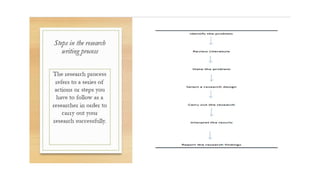
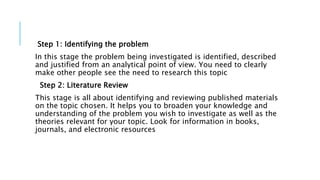
Step 1: Identifying the problem
In this stage the problem being investigated is identified, described
and justified from an analytical point of view. You need to clearly
make other people see the need to research this topic
Step 2: Literature Review
This stage is all about identifying and reviewing published materials
on the topic chosen. It helps you to broaden your knowledge and
understanding of the problem you wish to investigate as well as the
theories relevant for your topic. Look for information in books,
journals, and electronic resources
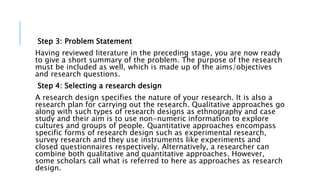
Step 3: Problem Statement
Having reviewed literature in the preceding stage, you are now ready
to give a short summary of the problem. The purpose of the research
must be included as well, which is made up of the aims/objectives
and research questions.
Step 4: Selecting a research design
A research design specifies the nature of your research. It is also a
research plan for carrying out the research. Qualitative approaches go
along with such types of research designs as ethnography and case
study and their aim is to use non-numeric information to explore
cultures and groups of people. Quantitative approaches encompass
specific forms of research design such as experimental research,
survey research and they use instruments like experiments and
closed questionnaires respectively. Alternatively, a researcher can
combine both qualitative and quantitative approaches. However,
some scholars call what is referred to here as approaches as research
design.
Step 5: Carry out the Research
Carrying out your research entails collection of data. Empirical
studies make use of primary data collected in the field, while desk-
based research makes use of secondary data.
 Primary data is collected using interviews, questionnaires, observation etc.
 Secondary data is collected by, for example, reviewing published
works such as books, trade journals, newspapers etc.
Step 6: Interpretation of the results
Collected data (or facts) is then analyzed using qualitative,
quantitative or a combination of both methods. Nowadays there are
software tools that one might use e.g. SPSS (Statistical Package for the
Social Science), to analyze questionnaire data, Atlasti which is used to
analyze qualitative data, and many others.
The data is usually presented in the form of tables, figures and
pictures to enable readers to understand it clearly. Finally, conclusions
are stated and these must relate to the research questions stated in
stage 3.
Step 7: Reporting the research findings
The final stage in the process involves writing a report (dissertation,
thesis, journal article etc.) of what your research was all about
detailing all the stages of the research process, findings and
recommendations.
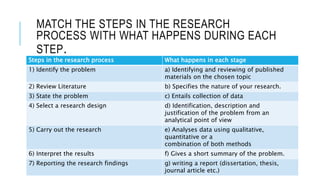
Steps in the research process What happens in each stage
1) Identify the problem a) Identifying and reviewing of published
materials on the chosen topic
2) Review Literature b) Specifies the nature of your research.
3) State the problem c) Entails collection of data
4) Select a research design d) Identification, description and
justification of the problem from an
analytical point of view
5) Carry out the research e) Analyses data using qualitative,
quantitative or a
combination of both methods
6) Interpret the results f) Gives a short summary of the problem.
7) Reporting the research findings g) writing a report (dissertation, thesis,
journal article etc.)
MATCH THE STEPS IN THE RESEARCH
PROCESS WITH WHAT HAPPENS DURING EACH
STEP.
EMPIRICAL VS DESK-BASED
RESEARCH
Carrying out your research entails collection of data.
Empirical studies make use of primary data collected in the field,
while desk-based research makes use of secondary data.
Primary data is collected using interviews, questionnaires,
observation.
Secondary data is collected by, for example, reviewing published
works such as books, trade journals, newspapers.
SELECT AND ANALYSE A
RESEARCH TOPIC
Selecting a research topic
Select from courses that you have studied in your degree programme.
Select from a subject area that you are interested in or passionate
about.
It can also arise from your work or everyday experiences.
The topic must be researchable in terms of its scope and the
availability of
literature to guide the study.
NB! If a topic is provided, analyse the topic; determine if topic is broad
or narrow.
NARROWING A RESEARCH
TOPIC
Some research topics are broad, e.g. The environment, Teacher
effectiveness, Youth substance abuse.
How to narrow a broad topic
Limiting its scope to deal with a single or one specific aspect of that
topic, e.g. environmental pollution
limit your research to a specific place such as Windhoek.
Narrowed topic = Pollution of the environment in Windhoek
NARROW THE FOLLOWING TOPICS
Alcohol abuse
Tertiary education
Unemployment
Plagiarism
Adolescent pregnancy
wildlife
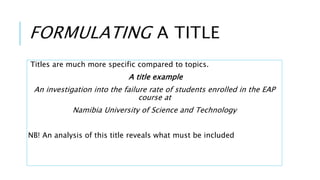
FORMULATING A TITLE
Titles are much more specific compared to topics.
A title example
An investigation into the failure rate of students enrolled in the EAP
course at
Namibia University of Science and Technology
NB! An analysis of this title reveals what must be included
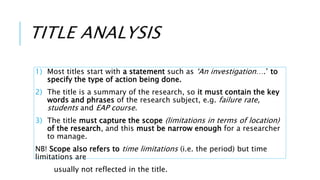
TITLE ANALYSIS
1) Most titles start with a statement such as ‘An investigation….’ to
specify the type of action being done.
2) The title is a summary of the research, so it must contain the key
words and phrases of the research subject, e.g. failure rate,
students and EAP course.
3) The title must capture the scope (limitations in terms of location)
of the research, and this must be narrow enough for a researcher
to manage.
NB! Scope also refers to time limitations (i.e. the period) but time
limitations are
usually not reflected in the title.
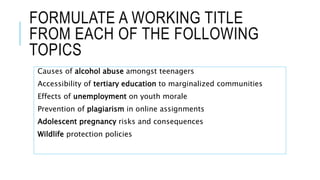
FORMULATE A WORKING TITLE
FROM EACH OF THE FOLLOWING
TOPICS
Causes of alcohol abuse amongst teenagers
Accessibility of tertiary education to marginalized communities
Effects of unemployment on youth morale
Prevention of plagiarism in online assignments
Adolescent pregnancy risks and consequences
Wildlife protection policies
ADD A STATEMENT SUCH AS ‘AN
INVESTIGATION….’ TO SPECIFY THE
THE TYPE OF ACTION BEING DONE.
&
THE SCOPE OF THE RESEARCH
HOW TO WRITE A RESEARCH
PROPOSAL
Before embarking on a research, you might need to write what is
called a research proposal.
A research proposal is a plan outlining your envisaged research.
In it you must develop an argument as to why your study is important
and in which way it will benefit the research community.
SECTIONS OF THE RESEARCH
PROPOSAL (CONT.).
1) Proposed title - about 15 words in length, must capture the scope
of the
research and arouse reader interest and it must also be
unambiguous.
2) Background of the research - provides a context to the study (what
is known or
has been discovered up to now as well as what prompted you to
pursue it further).
3) Statement of the problem - brief and clear statement of the
problem to be solved
in one short paragraph.
SECTIONS OF THE RESEARCH
PROPOSAL (CONT.).
Characteristics of a good statement of the problem
Researchable, that is, it should be possible to investigate it
empirically.
Precise, that is, it should be written in clear unambiguous language.
Resolved through research -the problem chosen should have definite
sources of information which, when collected, can answer the key
questions sufficiently.
Fit into the broader context of current theory and relevant research.
Related to its research questions.
SECTIONS OF THE RESEARCH
PROPOSAL (CONT.).
4) Purpose of the study - clarify your topic by listing objectives (purpose or
goal) of the study as well as research questions.
Begin your objectives as follows:
To explore … - to find out more about an area which few or no people have
ventured into.
To describe …- to reveal patterns and trends of situations, events, objects,
phenomena or
behaviours.
To explain …- to reveal the linkages among the elements constituting
situations, events and phenomena.
To assess …- to weigh available evidence, either confirming or denying the
truth of the argument.
SECTIONS OF THE RESEARCH
PROPOSAL (CONT.).
Research questions:
are developed from, and are meant to unpack the research problem
Should not be totally answered by a simple “Yes” or a simple “No”.
Research questions easily lend themselves to the w/h question format
e.g.
a) What …
b) Why …
c) When …
d) Which …
e) How …
Research writing.pptx

Research writing.pptx

  • 1.
    RESEARCH WRITING English forAcademic Purposes EAP511S
  • 2.
    LEARNING OBJECTIVES demonstrate anunderstanding of what research writing is apply the process of research to own research experiences Questions to be answered  What is research?  What is the research process?
  • 3.
    WHAT IS RESEARCHWRITING? It is “a circular process of thinking of ideas, conducting research, writing as you go along, going back to ideas and possibly back to research, continuing writing and so on”(Badenhorst, 2012, p. xvii).
  • 4.
    WHAT IS RESEARCHWRITING? (CONT.) Writing is NOT A LINEAR PROCESS. [circular process] Thinking is critical because there is a need to BRAINSTORM before putting ideas together in written form. [thinking of ideas] CONDUCT RESEARCH through locating and evaluating information from diverse (primary and/or secondary) sources. [Collecting evidence to support your ideas.] Writing - combining of your ideas and those of other scholars who have published information on what you are writing about.
  • 5.
    WHAT IS RESEARCH? Researchcan be seen as any systematic investigation in search of knowledge to solve a problem [systematic investigation involves a prospective research plan that incorporates data collection, either quantitative or qualitative, and data analysis to answer a research question.]
  • 7.
    Step 1: Identifyingthe problem In this stage the problem being investigated is identified, described and justified from an analytical point of view. You need to clearly make other people see the need to research this topic Step 2: Literature Review This stage is all about identifying and reviewing published materials on the topic chosen. It helps you to broaden your knowledge and understanding of the problem you wish to investigate as well as the theories relevant for your topic. Look for information in books, journals, and electronic resources
  • 8.
    Step 3: ProblemStatement Having reviewed literature in the preceding stage, you are now ready to give a short summary of the problem. The purpose of the research must be included as well, which is made up of the aims/objectives and research questions. Step 4: Selecting a research design A research design specifies the nature of your research. It is also a research plan for carrying out the research. Qualitative approaches go along with such types of research designs as ethnography and case study and their aim is to use non-numeric information to explore cultures and groups of people. Quantitative approaches encompass specific forms of research design such as experimental research, survey research and they use instruments like experiments and closed questionnaires respectively. Alternatively, a researcher can combine both qualitative and quantitative approaches. However, some scholars call what is referred to here as approaches as research design.
  • 9.
    Step 5: Carryout the Research Carrying out your research entails collection of data. Empirical studies make use of primary data collected in the field, while desk- based research makes use of secondary data.  Primary data is collected using interviews, questionnaires, observation etc.  Secondary data is collected by, for example, reviewing published works such as books, trade journals, newspapers etc.
  • 10.
    Step 6: Interpretationof the results Collected data (or facts) is then analyzed using qualitative, quantitative or a combination of both methods. Nowadays there are software tools that one might use e.g. SPSS (Statistical Package for the Social Science), to analyze questionnaire data, Atlasti which is used to analyze qualitative data, and many others. The data is usually presented in the form of tables, figures and pictures to enable readers to understand it clearly. Finally, conclusions are stated and these must relate to the research questions stated in stage 3.
  • 11.
    Step 7: Reportingthe research findings The final stage in the process involves writing a report (dissertation, thesis, journal article etc.) of what your research was all about detailing all the stages of the research process, findings and recommendations.
  • 12.
    Steps in theresearch process What happens in each stage 1) Identify the problem a) Identifying and reviewing of published materials on the chosen topic 2) Review Literature b) Specifies the nature of your research. 3) State the problem c) Entails collection of data 4) Select a research design d) Identification, description and justification of the problem from an analytical point of view 5) Carry out the research e) Analyses data using qualitative, quantitative or a combination of both methods 6) Interpret the results f) Gives a short summary of the problem. 7) Reporting the research findings g) writing a report (dissertation, thesis, journal article etc.) MATCH THE STEPS IN THE RESEARCH PROCESS WITH WHAT HAPPENS DURING EACH STEP.
  • 13.
    EMPIRICAL VS DESK-BASED RESEARCH Carryingout your research entails collection of data. Empirical studies make use of primary data collected in the field, while desk-based research makes use of secondary data. Primary data is collected using interviews, questionnaires, observation. Secondary data is collected by, for example, reviewing published works such as books, trade journals, newspapers.
  • 14.
    SELECT AND ANALYSEA RESEARCH TOPIC Selecting a research topic Select from courses that you have studied in your degree programme. Select from a subject area that you are interested in or passionate about. It can also arise from your work or everyday experiences. The topic must be researchable in terms of its scope and the availability of literature to guide the study. NB! If a topic is provided, analyse the topic; determine if topic is broad or narrow.
  • 15.
    NARROWING A RESEARCH TOPIC Someresearch topics are broad, e.g. The environment, Teacher effectiveness, Youth substance abuse. How to narrow a broad topic Limiting its scope to deal with a single or one specific aspect of that topic, e.g. environmental pollution limit your research to a specific place such as Windhoek. Narrowed topic = Pollution of the environment in Windhoek
  • 16.
    NARROW THE FOLLOWINGTOPICS Alcohol abuse Tertiary education Unemployment Plagiarism Adolescent pregnancy wildlife
  • 17.
    FORMULATING A TITLE Titlesare much more specific compared to topics. A title example An investigation into the failure rate of students enrolled in the EAP course at Namibia University of Science and Technology NB! An analysis of this title reveals what must be included
  • 18.
    TITLE ANALYSIS 1) Mosttitles start with a statement such as ‘An investigation….’ to specify the type of action being done. 2) The title is a summary of the research, so it must contain the key words and phrases of the research subject, e.g. failure rate, students and EAP course. 3) The title must capture the scope (limitations in terms of location) of the research, and this must be narrow enough for a researcher to manage. NB! Scope also refers to time limitations (i.e. the period) but time limitations are usually not reflected in the title.
  • 19.
    FORMULATE A WORKINGTITLE FROM EACH OF THE FOLLOWING TOPICS Causes of alcohol abuse amongst teenagers Accessibility of tertiary education to marginalized communities Effects of unemployment on youth morale Prevention of plagiarism in online assignments Adolescent pregnancy risks and consequences Wildlife protection policies
  • 20.
    ADD A STATEMENTSUCH AS ‘AN INVESTIGATION….’ TO SPECIFY THE THE TYPE OF ACTION BEING DONE. & THE SCOPE OF THE RESEARCH
  • 21.
    HOW TO WRITEA RESEARCH PROPOSAL Before embarking on a research, you might need to write what is called a research proposal. A research proposal is a plan outlining your envisaged research. In it you must develop an argument as to why your study is important and in which way it will benefit the research community.
  • 22.
    SECTIONS OF THERESEARCH PROPOSAL (CONT.). 1) Proposed title - about 15 words in length, must capture the scope of the research and arouse reader interest and it must also be unambiguous. 2) Background of the research - provides a context to the study (what is known or has been discovered up to now as well as what prompted you to pursue it further). 3) Statement of the problem - brief and clear statement of the problem to be solved in one short paragraph.
  • 23.
    SECTIONS OF THERESEARCH PROPOSAL (CONT.). Characteristics of a good statement of the problem Researchable, that is, it should be possible to investigate it empirically. Precise, that is, it should be written in clear unambiguous language. Resolved through research -the problem chosen should have definite sources of information which, when collected, can answer the key questions sufficiently. Fit into the broader context of current theory and relevant research. Related to its research questions.
  • 24.
    SECTIONS OF THERESEARCH PROPOSAL (CONT.). 4) Purpose of the study - clarify your topic by listing objectives (purpose or goal) of the study as well as research questions. Begin your objectives as follows: To explore … - to find out more about an area which few or no people have ventured into. To describe …- to reveal patterns and trends of situations, events, objects, phenomena or behaviours. To explain …- to reveal the linkages among the elements constituting situations, events and phenomena. To assess …- to weigh available evidence, either confirming or denying the truth of the argument.
  • 25.
    SECTIONS OF THERESEARCH PROPOSAL (CONT.). Research questions: are developed from, and are meant to unpack the research problem Should not be totally answered by a simple “Yes” or a simple “No”. Research questions easily lend themselves to the w/h question format e.g. a) What … b) Why … c) When … d) Which … e) How …

Editor's Notes

  • #15 Group G ended here on 9/10/2019
  • #17 Group D ended here on 9/10/2019
  • #20 A comparison of wildlife protection policies in Southern African countries
  • #23 Group F and E ended here on Friday.