Closing The Gap
Technology Impact on Building Operations
Cliff Ward
Manager of Strategic Programs
3
Dude Facts:
8,600+ Organizations
5.5B sq ft Facilities Managed
$3B/yr Energy Spend Tracked
2M Users in Active Accounts
1M Work Orders/mo Processed
4
A Closer Look:
200+ US-Based Employees
Award-Winning Support
Industry Leading Reliability
Pure Cloud Since Day 1
Leadership in Cloud + BMS
www.facilitydude.com
“The Good Dude”
Each year, we give:
– 1% of employee working time
– 1% of sales via monetary donations
– 1% of product services to under-served rural
schools and non-profit organizations
– Technology hardware donations to non-profit
organizations
Today’s Topics
1. Update on the Operating Environment
– Economic Trends
– Technology Trends
– Capital Project Realities
2. Integration of Building Control Technology
& Cloud-based Management Tools
3. How do we move the needle?
We need real ROI!!!
8
Let’s Look at the Current Operating Environment
10
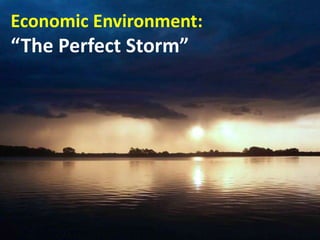
Economic Environment:
“The Perfect Storm”
Economic Environment:
“The Perfect Storm”
11
History of Cutting
Asset Maintenance
Economic Environment:
“The Perfect Storm”
12
Aging Equipment
Near/Past Design Life
Economic Environment:
“The Perfect Storm”
13
CapEx Funding Limited
Current & Projected
Economic Environment:
“The Perfect Storm”
14
Operational Costs
Continue to Spiral
(Energy, Water, Wages, etc.)
Economic Environment:
“The Perfect Storm”
15
Lean Maintenance
Staff Behind in
Technology Adoption
Results in
Run-To-Fail
Environment
17
“The state and local government
sector continues to face near-term
and long-term fiscal challenges that
grow over time.”
US Government Accountability Office
State and Local Government’s Fiscal Outlook
April 2012 Update
18
“The model’s base case simulations
show that the fiscal position of the
sector will steadily decline through
2060 absent any policy changes.”
US Government Accountability Office
State and Local Government’s Fiscal Outlook
April 2012 Update
19
20
21
2060
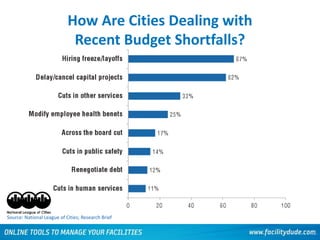
How Are Cities Dealing with
Recent Budget Shortfalls?
25
Source: National League of Cities; Research Brief
Ratio of Retiring vs. New
Skilled Maintenance Technicians
26
Linus may have
the right idea!
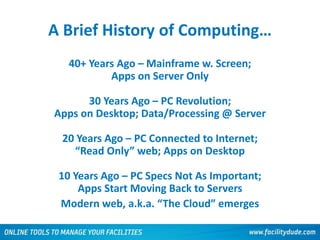
A Brief History of Computing…
40+ Years Ago – Mainframe w. Screen;
Apps on Server Only
30 Years Ago – PC Revolution;
Apps on Desktop; Data/Processing @ Server
20 Years Ago – PC Connected to Internet;
“Read Only” web; Apps on Desktop
10 Years Ago – PC Specs Not As Important;
Apps Start Moving Back to Servers
Modern web, a.k.a. “The Cloud” emerges
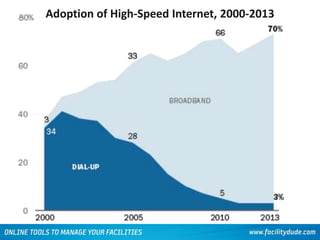
CONNECTIVITY.
Adoption of High-Speed Internet, 2000-2013
$2000+
2000
$38
2013
US AVERAGE MONTHLY COST FOR HIGH SPEED
25% of IT Budget
to the Cloud
($20B)
Why?
• Efficiency
• Agility
• Innovation
34
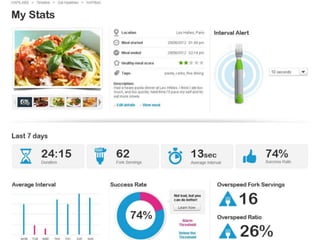
What is This?
35
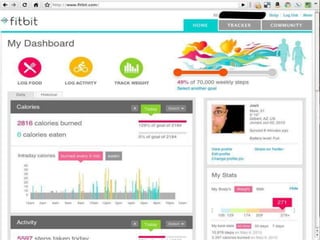
And now?
36
37
38
39
40
What Expectations Do Your
Customers Have?
Do You Think This is a Trend?
How Do You Respond?
42
Internal Customers
(Your Team, Admin & Colleagues)
43
44
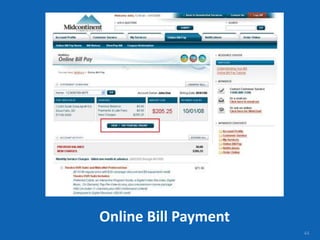
Online Bill Payment
45
Online Work Management
External Customers
(Community, Partners & Citizens)
46
47
Simple Search
48
Simple Request
Key Takeaway:
As Technology Advances Around
Us…
…Expectations Increase, too.
49
Is this an IT Lecture?
No, but the world is changing,
and it affects YOU.
The Role of
Information
Technology
Professionals is
Changing.
The Changing Role of IT Dept
• Understand that the world of technology is
changing – and your IT department may be
working overtime to keep up.
• Trend: More governance, less hands-on
• If you are bringing a new solution to the table
(e.g. Cloud-Based Software) be prepared for
“lukewarm reception”
• Policies and Procedures for Cloud?
53
Building Controls and IT
• BAS Controls are increasingly piggybacking IT
infrastructure
• Introduces new security requirements
and potential threat vectors
• Education & training requirements for field
technicians is changing
• Opening big doors of opportunity for what
you can do with the data OUTSIDE the
building
54
What Have We Learned So Far?
• Bleak budget outlook; no quick relief
• Capital dollars very limited
• Skilled labor is leaving; not replaced
• Customer expectations increasing
• Role of IT has evolved; Prepare yourself!
• BAS+IT is opening new doors; but be careful
55
56
Please Raise Your Hand
If All Your Buildings
Look Like This…
57
58
Gorecki Alumni Center
University of North Dakota
LEED Platinum – Built 2012
59
Ohlone College
Newark Center for Health
Sciences and Technology
Do Some, If Not a Majority
of Your Buildings Look
More Like This?
60
62
63
Our Reality is…
Can’t Tear Down and Rebuild
Every Facility in our Portfolio.
So we must…
Find new ways of doing things to
maintain safe and functional
buildings for occupants & citizens.
What Does the Dude
Have to Say About That?
66
68
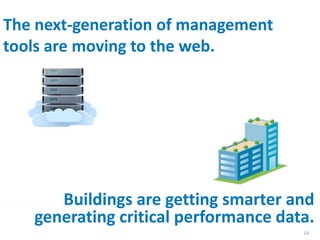
The next-generation of management
tools are moving to the web.
Buildings are getting smarter and
generating critical performance data.
What is CMMS?
Computerized Maintenance
Management Software
Software used to track the
business processes around
facility maintenance and
energy operations.
Why Should We Use It?
Documentation, Accountability,
Efficiency and more…
What Other Systems Exist?
Do you recognize any of these?
Some Alternatives to CMMS…
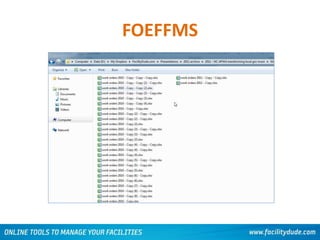
FOEFFMS
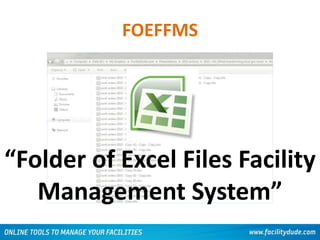
FOEFFMS
“Folder of Excel Files Facility
Management System”
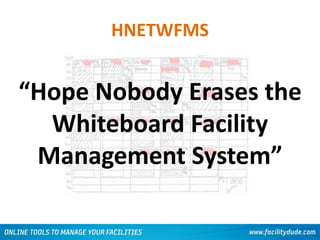
HNETWFMS
HNETWFMS
“Hope Nobody Erases the
Whiteboard Facility
Management System”
FPNFMS
FPNFMS
“Fish Post-it Note Facility
Management System”
FPNFMS
Core Features
Core Features
Create Work Items
(Manual or Automated)
Core Features
Prioritize & Assign Work
Core Features
Record Transactions
(Labor & Materials)
Core Features
Manage Assets
(Equipment & Vehicles)
Core Features
Track Inventory
Core Features
Report and Analyze
Impact of Preventive
Maintenance on Operations
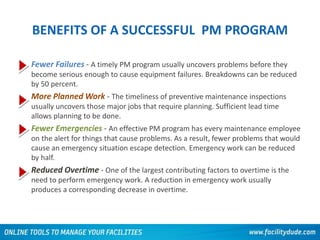
BENEFITS OF A SUCCESSFUL PM PROGRAM
• Fewer Failures - A timely PM program usually uncovers problems before they
become serious enough to cause equipment failures. Breakdowns can be reduced
by 50 percent.
• More Planned Work - The timeliness of preventive maintenance inspections
usually uncovers those major jobs that require planning. Sufficient lead time
allows planning to be done.
• Fewer Emergencies - An effective PM program has every maintenance employee
on the alert for things that cause problems. As a result, fewer problems that would
cause an emergency situation escape detection. Emergency work can be reduced
by half.
• Reduced Overtime - One of the largest contributing factors to overtime is the
need to perform emergency work. A reduction in emergency work usually
produces a corresponding decrease in overtime.
• Extended Equipment Life - PM invariably rewards its users by extending
equipment life by as much as 20 percent and increasing dependability.
Better Use of Maintenance Personnel - A job done under emergency
conditions is 15 percent more costly in labor than a similar, well planned job.
A maintenance department with a good PM program commits more staff to
planned work. The result is more effective, productive use of this manpower.
Improved Equipment Operation - Well-cared-for equipment is its own
reward - it runs better.
Less Downtime - Because the PM program can reduce emergency work, it
follows that downtime can also be reduced.
“Benefits of a Successful PM Program” is taken from Complete Building Equipment Maintenance Desk Book Second Edition, Edited by
Sheldon J. Fuchs, P.E. Page 19 in the chapter by Paul D. Tomlingson.
BENEFITS OF A SUCCESSFUL PM PROGRAM
Continued…
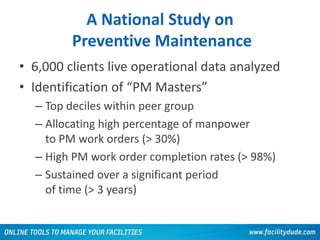
A National Study on
Preventive Maintenance
• 6,000 clients live operational data analyzed
• Identification of “PM Masters”
– Top deciles within peer group
– Allocating high percentage of manpower
to PM work orders (> 30%)
– High PM work order completion rates (> 98%)
– Sustained over a significant period
of time (> 3 years)
PM Reduces Corrective Work
• Over a 5-year period, a sampling of PM
Masters garnered a 16% reduction in
corrective maintenance.
• Corrective work as a percent of the total
work is reduced from 87% to 71% of the total
work performed.
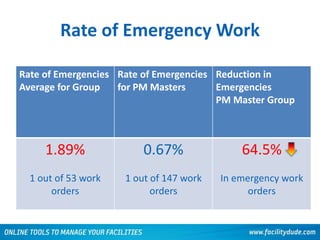
Rate of Emergency Work
Rate of Emergencies
Average for Group
Rate of Emergencies
for PM Masters
Reduction in
Emergencies
PM Master Group
1.89%
1 out of 53 work
orders
0.67%
1 out of 147 work
orders
64.5%
In emergency work
orders
Cost Impact
• 50% - 65% reduction in the rate of emergency work
• Lower cost per work order
with the average cost per work order being 28.6% to 39.3% less
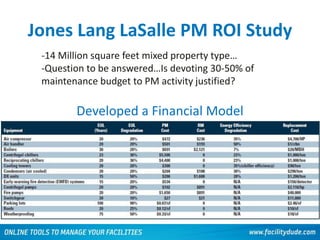
Jones Lang LaSalle PM ROI Study
Developed a Financial Model
-14 Million square feet mixed property type…
-Question to be answered…Is devoting 30-50% of
maintenance budget to PM activity justified?
Establish $ per sq/ft for PM Work
Jones Lang LaSalle PM ROI Study
545% ROI in a PM Program
Jones Lang LaSalle PM ROI Study
One Example
• 10- year old, 7 HP Air Compressor
• Replace- $32,900 – 25 Year Outlook
• $472 per year PM Work Order. $944 per repair
• With PM Program ($50,600)- 20 year lifespan. 1 of
every 4 years at $944 per repair ($472/yr PM, $236 a
year Repair) Replaced in year 10-
• Without PM ($73,675)- 16 year lifespan. 1 of every 3
years repaired. ($315/year repairs) Replaced at year 6 and
year 20.
Jones Lang LaSalle PM ROI Study
Major impact of PM on one large
piece of equipment
• Average building chiller is 350 tons.
• Replacement cost @ $1000/ton = $350,000.
• Maintenance cost with PM costs only
$5,500/year, yet adds 5-7 years of life to
chiller.
Jones Lang LaSalle PM ROI Study
BAS (Building Automation Systems)
Impact on Facility Management
Business Processes
Respond to & Document
Critical Conditions
Transition to
Condition-Based PM
Monitor & Measure
Long-Term Building Health
Reduce Labor & Energy
Costs of Event Schedule
Management
Time-Based Metrics of Work Flow
• Mean Time to Report
• Meant Time to Respond
• Mean Time to Repair
• Total Outage Time
• Mean Time Between Failures
Cloud-enabled work management drives
step change in metrics; not incremental changes
103
1. Leverage Your Investment in
Building Controls to Generate
Timely, Accurate Work Orders
104
Smart Equipment
Generating Work Orders
• Intelligent Filtering & Duplicates Prevention
• Step Change Reduction in Mean Time to Report
• Immediate Documentation in System of Record
• Real-Time Data Included in Work Order
• Automate Routing to Internal/External Resources
2. Use control points and runtime
values to reduce dependency on
calendar-based preventive
maintenance.
106
Proactive PM with
Automated PM Work Orders
• Move from Calendar-Based to Condition-Based
• Utilize Runtime Values & Other Sensor Data
• Combine the Intelligence of BMS w/ CMMS Suite
• Goal to Reduce Life-Cycle TCO & Increase Agility
• Full Integration to Core Work Order Application
3. Monitor key performance
indicators of system health to
watch for negative trends.
108
Automated Continued Commissioning
• Monitor key systems & health index
• Breach of threshold creates a work order
• More accurate equipment life cycle analysis
• Real-time data included in work order
• Automated routing to appropriate resources
4. Reduce admin labor and energy
expenses of facility rental & event
usage by connecting schedules to
controls.
110
Automated Facility Event Scheduling
• Creates efficient process to handle community requests for
public spaces
• Improves productivity and coordination among everyone
involved in the process.
• Increases energy savings by conditioning the spaces only
when needed
• Tracks the facility usage, costs recovered and other relevant
information
• Reduces liability by managing the necessary documentation
Take Home Money Makers!
112
Take Home Money Makers!
Regarding IT Departments…
• Build a bridge to IT staff sooner than later!
• Leverage existing IT infrastructure for BAS
deployments.
– Reduce duplication
– Take advantage of existing security
• Bring IT into discussion early in process; reduce snags
downstream
• Do some fact finding on policies, if they exist
113
Take Home Money Makers!
Regarding BAS Controls…
• If you have BAS in place already –
what is available?
• Check for underutilized features in your existing
system? (e.g. Did you turn off most alarms?)
• How can you maximize that investment?
• Determine which external technologies can you
connect to and take advantage
114
Take Home Money Makers!
Regarding Work Management…
• Condition-based PM can help free-up man-power for other tasks
• PM Masters garnered a 16% reduction in corrective maintenance
work
• 50+% reduction in Emergency work orders; 28-39% lower $/wo
With top performing PM program – supported by technology
can you reallocate resources?
115
Take Home Money Makers!
Regarding Work Management… (cont’d)
• Automated work orders from equipment help to reduce
impact of catastrophic failures.
Don’t let a boiler flame failure turn into a frozen pipe issue!!!
• Know before they do and allow equipment self-request
• Author your dispatching/routing policy to match
116
Take Home Money Makers!
Regarding Facility Scheduling…
• Are you conditioning your spaces to optimize energy &
maintenance costs?
• Do customers have visibility into process & ability for self-
service of requests? (Save $$)
• Check for space / zone alignment to see if you can improve
granularity of your conditioning requests
• Can you automate some of your building zones based on
event schedules?
117
Discussion & Questions
118
Cliff Ward
Manager, Strategic Programs
cliff@facilitydude.com

Closing the Gap - Technology Impact on Building Operations

  • 1.
    Closing The Gap TechnologyImpact on Building Operations Cliff Ward Manager of Strategic Programs
  • 3.
    3 Dude Facts: 8,600+ Organizations 5.5Bsq ft Facilities Managed $3B/yr Energy Spend Tracked 2M Users in Active Accounts 1M Work Orders/mo Processed
  • 4.
    4 A Closer Look: 200+US-Based Employees Award-Winning Support Industry Leading Reliability Pure Cloud Since Day 1 Leadership in Cloud + BMS
  • 5.
    www.facilitydude.com “The Good Dude” Eachyear, we give: – 1% of employee working time – 1% of sales via monetary donations – 1% of product services to under-served rural schools and non-profit organizations – Technology hardware donations to non-profit organizations
  • 6.
    Today’s Topics 1. Updateon the Operating Environment – Economic Trends – Technology Trends – Capital Project Realities 2. Integration of Building Control Technology & Cloud-based Management Tools 3. How do we move the needle? We need real ROI!!!
  • 7.
    8 Let’s Look atthe Current Operating Environment
  • 9.
  • 10.
    Economic Environment: “The PerfectStorm” 11 History of Cutting Asset Maintenance
  • 11.
    Economic Environment: “The PerfectStorm” 12 Aging Equipment Near/Past Design Life
  • 12.
    Economic Environment: “The PerfectStorm” 13 CapEx Funding Limited Current & Projected
  • 13.
    Economic Environment: “The PerfectStorm” 14 Operational Costs Continue to Spiral (Energy, Water, Wages, etc.)
  • 14.
    Economic Environment: “The PerfectStorm” 15 Lean Maintenance Staff Behind in Technology Adoption
  • 15.
  • 16.
  • 17.
    “The state andlocal government sector continues to face near-term and long-term fiscal challenges that grow over time.” US Government Accountability Office State and Local Government’s Fiscal Outlook April 2012 Update 18
  • 18.
    “The model’s basecase simulations show that the fiscal position of the sector will steadily decline through 2060 absent any policy changes.” US Government Accountability Office State and Local Government’s Fiscal Outlook April 2012 Update 19
  • 19.
  • 20.
  • 21.
    How Are CitiesDealing with Recent Budget Shortfalls? 25 Source: National League of Cities; Research Brief
  • 22.
    Ratio of Retiringvs. New Skilled Maintenance Technicians 26
  • 23.
    Linus may have theright idea!
  • 25.
    A Brief Historyof Computing… 40+ Years Ago – Mainframe w. Screen; Apps on Server Only 30 Years Ago – PC Revolution; Apps on Desktop; Data/Processing @ Server 20 Years Ago – PC Connected to Internet; “Read Only” web; Apps on Desktop 10 Years Ago – PC Specs Not As Important; Apps Start Moving Back to Servers Modern web, a.k.a. “The Cloud” emerges
  • 26.
  • 27.
    Adoption of High-SpeedInternet, 2000-2013
  • 28.
  • 29.
    25% of ITBudget to the Cloud ($20B) Why? • Efficiency • Agility • Innovation
  • 30.
  • 31.
  • 32.
  • 33.
  • 34.
  • 35.
  • 36.
  • 38.
    What Expectations DoYour Customers Have? Do You Think This is a Trend? How Do You Respond? 42
  • 39.
    Internal Customers (Your Team,Admin & Colleagues) 43
  • 40.
  • 41.
  • 42.
  • 43.
  • 44.
  • 45.
    Key Takeaway: As TechnologyAdvances Around Us… …Expectations Increase, too. 49
  • 46.
    Is this anIT Lecture? No, but the world is changing, and it affects YOU.
  • 47.
  • 49.
    The Changing Roleof IT Dept • Understand that the world of technology is changing – and your IT department may be working overtime to keep up. • Trend: More governance, less hands-on • If you are bringing a new solution to the table (e.g. Cloud-Based Software) be prepared for “lukewarm reception” • Policies and Procedures for Cloud? 53
  • 50.
    Building Controls andIT • BAS Controls are increasingly piggybacking IT infrastructure • Introduces new security requirements and potential threat vectors • Education & training requirements for field technicians is changing • Opening big doors of opportunity for what you can do with the data OUTSIDE the building 54
  • 51.
    What Have WeLearned So Far? • Bleak budget outlook; no quick relief • Capital dollars very limited • Skilled labor is leaving; not replaced • Customer expectations increasing • Role of IT has evolved; Prepare yourself! • BAS+IT is opening new doors; but be careful 55
  • 52.
  • 53.
    Please Raise YourHand If All Your Buildings Look Like This… 57
  • 54.
    58 Gorecki Alumni Center Universityof North Dakota LEED Platinum – Built 2012
  • 55.
    59 Ohlone College Newark Centerfor Health Sciences and Technology
  • 56.
    Do Some, IfNot a Majority of Your Buildings Look More Like This? 60
  • 58.
  • 59.
  • 60.
    Our Reality is… Can’tTear Down and Rebuild Every Facility in our Portfolio.
  • 61.
    So we must… Findnew ways of doing things to maintain safe and functional buildings for occupants & citizens.
  • 62.
    What Does theDude Have to Say About That? 66
  • 64.
    68 The next-generation ofmanagement tools are moving to the web. Buildings are getting smarter and generating critical performance data.
  • 65.
    What is CMMS? ComputerizedMaintenance Management Software
  • 66.
    Software used totrack the business processes around facility maintenance and energy operations.
  • 67.
    Why Should WeUse It? Documentation, Accountability, Efficiency and more…
  • 68.
    What Other SystemsExist? Do you recognize any of these?
  • 69.
  • 70.
  • 71.
    FOEFFMS “Folder of ExcelFiles Facility Management System”
  • 72.
  • 73.
    HNETWFMS “Hope Nobody Erasesthe Whiteboard Facility Management System”
  • 74.
  • 75.
    FPNFMS “Fish Post-it NoteFacility Management System”
  • 76.
  • 77.
  • 78.
    Core Features Create WorkItems (Manual or Automated)
  • 79.
  • 80.
  • 81.
  • 82.
  • 83.
  • 86.
  • 87.
    BENEFITS OF ASUCCESSFUL PM PROGRAM • Fewer Failures - A timely PM program usually uncovers problems before they become serious enough to cause equipment failures. Breakdowns can be reduced by 50 percent. • More Planned Work - The timeliness of preventive maintenance inspections usually uncovers those major jobs that require planning. Sufficient lead time allows planning to be done. • Fewer Emergencies - An effective PM program has every maintenance employee on the alert for things that cause problems. As a result, fewer problems that would cause an emergency situation escape detection. Emergency work can be reduced by half. • Reduced Overtime - One of the largest contributing factors to overtime is the need to perform emergency work. A reduction in emergency work usually produces a corresponding decrease in overtime.
  • 88.
    • Extended EquipmentLife - PM invariably rewards its users by extending equipment life by as much as 20 percent and increasing dependability. Better Use of Maintenance Personnel - A job done under emergency conditions is 15 percent more costly in labor than a similar, well planned job. A maintenance department with a good PM program commits more staff to planned work. The result is more effective, productive use of this manpower. Improved Equipment Operation - Well-cared-for equipment is its own reward - it runs better. Less Downtime - Because the PM program can reduce emergency work, it follows that downtime can also be reduced. “Benefits of a Successful PM Program” is taken from Complete Building Equipment Maintenance Desk Book Second Edition, Edited by Sheldon J. Fuchs, P.E. Page 19 in the chapter by Paul D. Tomlingson. BENEFITS OF A SUCCESSFUL PM PROGRAM Continued…
  • 89.
    A National Studyon Preventive Maintenance • 6,000 clients live operational data analyzed • Identification of “PM Masters” – Top deciles within peer group – Allocating high percentage of manpower to PM work orders (> 30%) – High PM work order completion rates (> 98%) – Sustained over a significant period of time (> 3 years)
  • 90.
    PM Reduces CorrectiveWork • Over a 5-year period, a sampling of PM Masters garnered a 16% reduction in corrective maintenance. • Corrective work as a percent of the total work is reduced from 87% to 71% of the total work performed.
  • 91.
    Rate of EmergencyWork Rate of Emergencies Average for Group Rate of Emergencies for PM Masters Reduction in Emergencies PM Master Group 1.89% 1 out of 53 work orders 0.67% 1 out of 147 work orders 64.5% In emergency work orders
  • 92.
    Cost Impact • 50%- 65% reduction in the rate of emergency work • Lower cost per work order with the average cost per work order being 28.6% to 39.3% less
  • 93.
    Jones Lang LaSallePM ROI Study Developed a Financial Model -14 Million square feet mixed property type… -Question to be answered…Is devoting 30-50% of maintenance budget to PM activity justified?
  • 94.
    Establish $ persq/ft for PM Work Jones Lang LaSalle PM ROI Study
  • 95.
    545% ROI ina PM Program Jones Lang LaSalle PM ROI Study
  • 96.
    One Example • 10-year old, 7 HP Air Compressor • Replace- $32,900 – 25 Year Outlook • $472 per year PM Work Order. $944 per repair • With PM Program ($50,600)- 20 year lifespan. 1 of every 4 years at $944 per repair ($472/yr PM, $236 a year Repair) Replaced in year 10- • Without PM ($73,675)- 16 year lifespan. 1 of every 3 years repaired. ($315/year repairs) Replaced at year 6 and year 20. Jones Lang LaSalle PM ROI Study
  • 97.
    Major impact ofPM on one large piece of equipment • Average building chiller is 350 tons. • Replacement cost @ $1000/ton = $350,000. • Maintenance cost with PM costs only $5,500/year, yet adds 5-7 years of life to chiller. Jones Lang LaSalle PM ROI Study
  • 98.
    BAS (Building AutomationSystems) Impact on Facility Management Business Processes Respond to & Document Critical Conditions Transition to Condition-Based PM Monitor & Measure Long-Term Building Health Reduce Labor & Energy Costs of Event Schedule Management
  • 99.
    Time-Based Metrics ofWork Flow • Mean Time to Report • Meant Time to Respond • Mean Time to Repair • Total Outage Time • Mean Time Between Failures Cloud-enabled work management drives step change in metrics; not incremental changes 103
  • 100.
    1. Leverage YourInvestment in Building Controls to Generate Timely, Accurate Work Orders 104
  • 101.
    Smart Equipment Generating WorkOrders • Intelligent Filtering & Duplicates Prevention • Step Change Reduction in Mean Time to Report • Immediate Documentation in System of Record • Real-Time Data Included in Work Order • Automate Routing to Internal/External Resources
  • 102.
    2. Use controlpoints and runtime values to reduce dependency on calendar-based preventive maintenance. 106
  • 103.
    Proactive PM with AutomatedPM Work Orders • Move from Calendar-Based to Condition-Based • Utilize Runtime Values & Other Sensor Data • Combine the Intelligence of BMS w/ CMMS Suite • Goal to Reduce Life-Cycle TCO & Increase Agility • Full Integration to Core Work Order Application
  • 104.
    3. Monitor keyperformance indicators of system health to watch for negative trends. 108
  • 105.
    Automated Continued Commissioning •Monitor key systems & health index • Breach of threshold creates a work order • More accurate equipment life cycle analysis • Real-time data included in work order • Automated routing to appropriate resources
  • 106.
    4. Reduce adminlabor and energy expenses of facility rental & event usage by connecting schedules to controls. 110
  • 107.
    Automated Facility EventScheduling • Creates efficient process to handle community requests for public spaces • Improves productivity and coordination among everyone involved in the process. • Increases energy savings by conditioning the spaces only when needed • Tracks the facility usage, costs recovered and other relevant information • Reduces liability by managing the necessary documentation
  • 108.
    Take Home MoneyMakers! 112
  • 109.
    Take Home MoneyMakers! Regarding IT Departments… • Build a bridge to IT staff sooner than later! • Leverage existing IT infrastructure for BAS deployments. – Reduce duplication – Take advantage of existing security • Bring IT into discussion early in process; reduce snags downstream • Do some fact finding on policies, if they exist 113
  • 110.
    Take Home MoneyMakers! Regarding BAS Controls… • If you have BAS in place already – what is available? • Check for underutilized features in your existing system? (e.g. Did you turn off most alarms?) • How can you maximize that investment? • Determine which external technologies can you connect to and take advantage 114
  • 111.
    Take Home MoneyMakers! Regarding Work Management… • Condition-based PM can help free-up man-power for other tasks • PM Masters garnered a 16% reduction in corrective maintenance work • 50+% reduction in Emergency work orders; 28-39% lower $/wo With top performing PM program – supported by technology can you reallocate resources? 115
  • 112.
    Take Home MoneyMakers! Regarding Work Management… (cont’d) • Automated work orders from equipment help to reduce impact of catastrophic failures. Don’t let a boiler flame failure turn into a frozen pipe issue!!! • Know before they do and allow equipment self-request • Author your dispatching/routing policy to match 116
  • 113.
    Take Home MoneyMakers! Regarding Facility Scheduling… • Are you conditioning your spaces to optimize energy & maintenance costs? • Do customers have visibility into process & ability for self- service of requests? (Save $$) • Check for space / zone alignment to see if you can improve granularity of your conditioning requests • Can you automate some of your building zones based on event schedules? 117
  • 114.
    Discussion & Questions 118 CliffWard Manager, Strategic Programs cliff@facilitydude.com