Tools for Effective Feedback: Creating a
Culture for Performance Improvement
Dr. Tim Baker
tim@winnersatwork.com.au
www.winnesatwork.com.au
Some sobering
statistics
Some how to’s 3 models
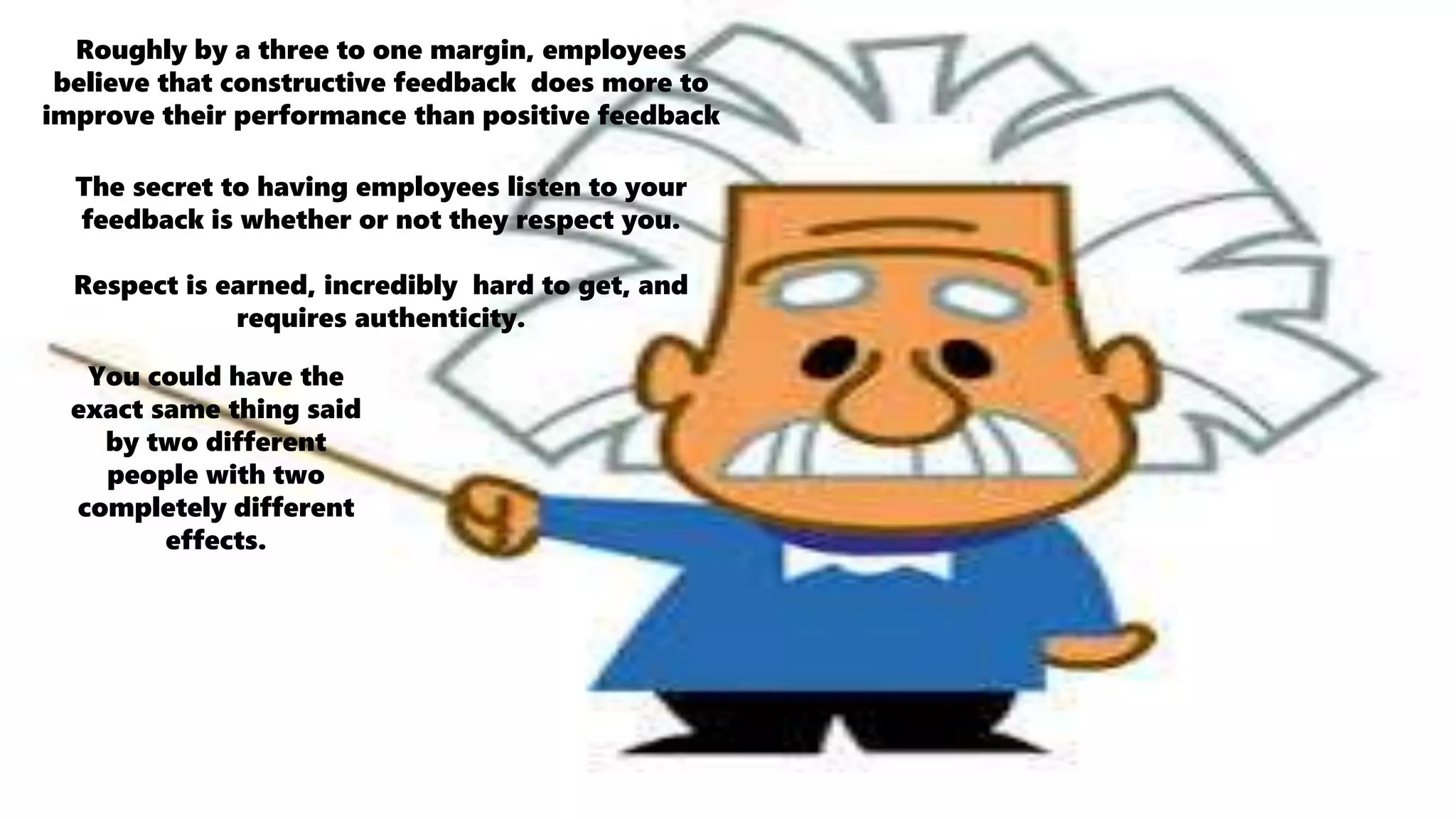
Roughly by a three to one margin, employees
believe that constructive feedback does more to
improve their performance than positive feedback
The secret to having employees listen to your
feedback is whether or not they respect you.
Respect is earned, incredibly hard to get, and
requires authenticity.
You could have the
exact same thing said
by two different
people with two
completely different
effects.
Managing Expectations
What are my expectations as the leader?
Have I communicated these expectations to my team?
Do my team understand my expectations?
Do my team members accept my expectations?
Are my team members omitted to meeting those expectations?
Do my team members know how they are performing against those expectations?
Am I supporting my team members to achieve those expectations?
Timing
Specific
Make your feedback specific
“Overall good job on the
presentation at this
morning’s meeting. But it
could have been better.”
This is so vague. What was
wrong with it. Plus, just
because you didn’t like it,
does it necessarily mean it is
bad? How could it have been
better?
“Great job on the presentation!
I really like how you used
statistics to back up your key
points.
One small comment: Maybe for
next time would be to invite
more comments from the group
to get them more involved.”
Frequency
Questions
Privacy
Critical Incidents
Focus on the future
Guidelines for
Conversations
on Poor
Performance
Avoid
confrontation
& argument
Emphasis
strengths as
well as
weaknesses
Seek out
the causes
The five conversations framework
Date Topic Content Key Questions
Month 1 Climate review Job satisfaction, morale
and communication
• How would you rate your current job satisfaction?
• How would you rate morale?
• How would you rate communication?
Month 2 Strengths
and talents
Efficiently deploying
strengths and talents
• What are your strengths and talents?
• How can these strengths and talents be used in your current and
future roles in the organisation?
Month 3 Opportunities
for growth
Improving performance
and standards
• Where are opportunities for improved performance?
• How can I assist you to improve your performance?
Month 4 Learning and
development
Support and growth • What skills would you like to learn?
• What learning opportunities would you like to undertake?
Month 5 Innovation and
continuous
improvement
Ways and means to improve
the efficiency and
effectiveness of the business
• What is the one way that you could improve your own working
efficiency?
• What is the one way that we can improve our team’s operations?
Baker, T. (2013). The End of the Performance Review: A New Approach to Appraising Employee Performance
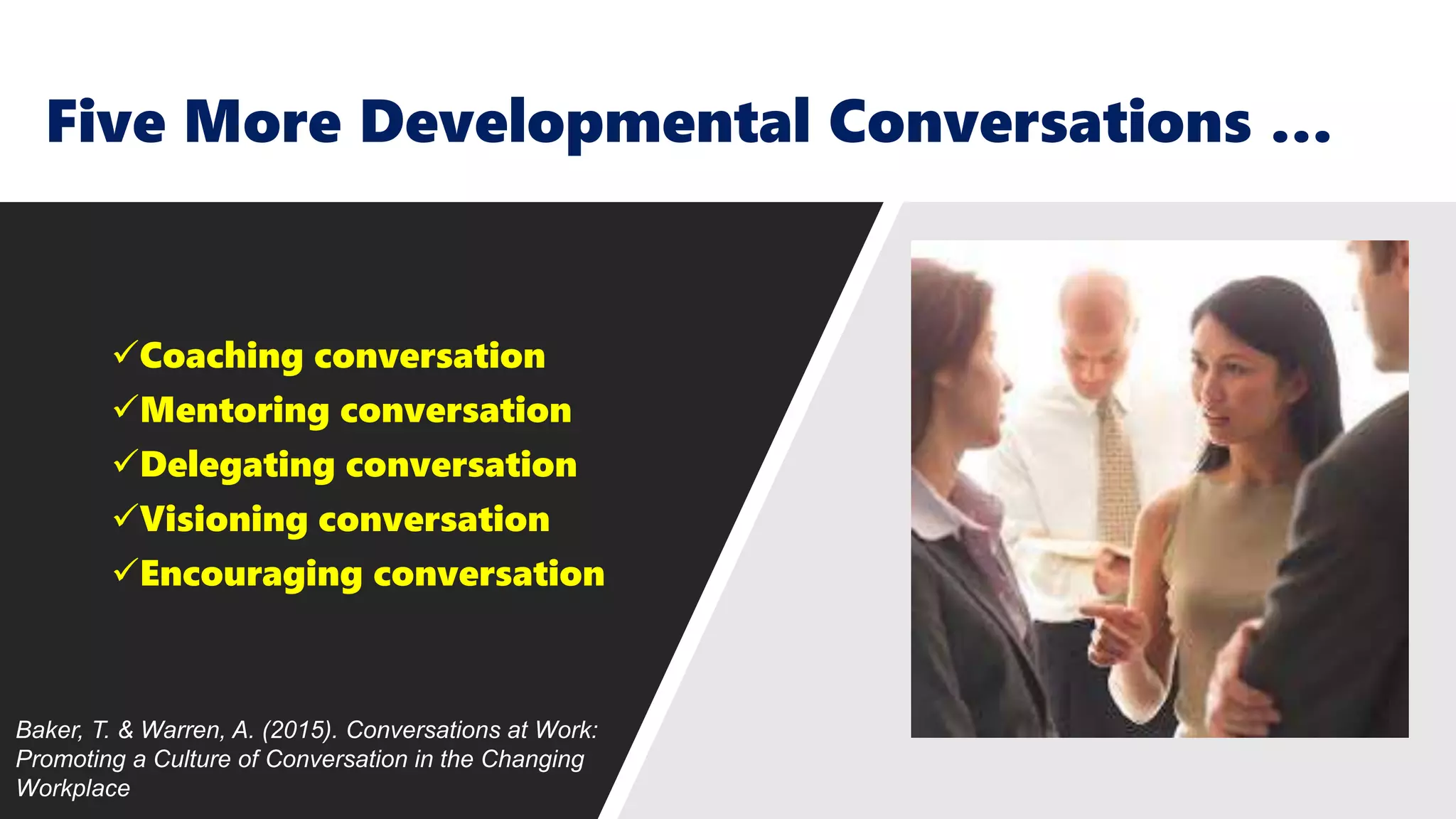
Five More Developmental Conversations …
Coaching conversation
Mentoring conversation
Delegating conversation
Visioning conversation
Encouraging conversation
Baker, T. & Warren, A. (2015). Conversations at Work:
Promoting a Culture of Conversation in the Changing
Workplace
Mod 1 – The Ingredients of Effective Feedback
Mod 2 – Enhancing Your Personal Influence
Mod 3 – Optimising Team Performance
Mod 4 – Getting the Very Best from People
Mod 5 – Understanding People and their
Personalities
Mod 6 – Facilitating Effective Meetings
$176
per
person
tim@winnersatwork.com.au
21
Dr Tim Baker
tim@winnersatwork.com.au
www.winnersatwork.com.au
20% Discount plus
postage

Tools for Effective Feedback

  • 1.
    Tools for EffectiveFeedback: Creating a Culture for Performance Improvement Dr. Tim Baker tim@winnersatwork.com.au www.winnesatwork.com.au
  • 2.
  • 4.
    Roughly by athree to one margin, employees believe that constructive feedback does more to improve their performance than positive feedback The secret to having employees listen to your feedback is whether or not they respect you. Respect is earned, incredibly hard to get, and requires authenticity. You could have the exact same thing said by two different people with two completely different effects.
  • 6.
    Managing Expectations What aremy expectations as the leader? Have I communicated these expectations to my team? Do my team understand my expectations? Do my team members accept my expectations? Are my team members omitted to meeting those expectations? Do my team members know how they are performing against those expectations? Am I supporting my team members to achieve those expectations?
  • 7.
  • 8.
  • 9.
    Make your feedbackspecific “Overall good job on the presentation at this morning’s meeting. But it could have been better.” This is so vague. What was wrong with it. Plus, just because you didn’t like it, does it necessarily mean it is bad? How could it have been better? “Great job on the presentation! I really like how you used statistics to back up your key points. One small comment: Maybe for next time would be to invite more comments from the group to get them more involved.”
  • 10.
  • 11.
  • 12.
  • 13.
  • 14.
  • 15.
  • 16.
  • 17.
    The five conversationsframework Date Topic Content Key Questions Month 1 Climate review Job satisfaction, morale and communication • How would you rate your current job satisfaction? • How would you rate morale? • How would you rate communication? Month 2 Strengths and talents Efficiently deploying strengths and talents • What are your strengths and talents? • How can these strengths and talents be used in your current and future roles in the organisation? Month 3 Opportunities for growth Improving performance and standards • Where are opportunities for improved performance? • How can I assist you to improve your performance? Month 4 Learning and development Support and growth • What skills would you like to learn? • What learning opportunities would you like to undertake? Month 5 Innovation and continuous improvement Ways and means to improve the efficiency and effectiveness of the business • What is the one way that you could improve your own working efficiency? • What is the one way that we can improve our team’s operations? Baker, T. (2013). The End of the Performance Review: A New Approach to Appraising Employee Performance
  • 18.
    Five More DevelopmentalConversations … Coaching conversation Mentoring conversation Delegating conversation Visioning conversation Encouraging conversation Baker, T. & Warren, A. (2015). Conversations at Work: Promoting a Culture of Conversation in the Changing Workplace
  • 20.
    Mod 1 –The Ingredients of Effective Feedback Mod 2 – Enhancing Your Personal Influence Mod 3 – Optimising Team Performance Mod 4 – Getting the Very Best from People Mod 5 – Understanding People and their Personalities Mod 6 – Facilitating Effective Meetings $176 per person tim@winnersatwork.com.au
  • 21.
  • 22.

Editor's Notes

  • #18 So those are the main barriers to communication. So how do we encourage more productive conversations and meaningful dialogue? You need a framework in place that promotes these conversations. I want to share with you two frameworks. Both of these frameworks can, and should be, recorded for reference. The first of this frameworks that we discuss in Conversations at Work is The Five Conversations Framework. Briefly describe the framework and the fact that some organisations are using this as a substitute for the traditional performance review.
  • #19 Which of these conversations do you need to do more of? Coaching conversation Coaching conversations can take place informally, spontaneously, and briefly. We might call it “corridor coaching.” Mentoring conversation While coaching and mentoring are clearly related, and the descriptions sometimes used interchangeably, there is a difference in dialogue. Where the coaching conversation is solution-focused, and driven by the needs and goals of the person being coached, the mentoring conversation is often more general and tends to directly tap the experience and expertise of the mentor. Delegation conversation The delegation conversation is not about dumping work or responsibility on someone else, nor is it about abrogating our own responsibilities. It’s about incrementally increasing others’ responsibilities as a part of their continuous development. Visioning conversation Visioning can sound like a fluffy concept, but it’s actually a quite everyday need we have in our work and in our lives. We all crave a sense of purpose and meaning in what we do. Simon Sinek reminds us in his book, Start with the why, that “it doesn’t what you do, it matters why you do it. We need to explain the why. Encouraging conversation Opportunities to engage in encouraging conversations are perhaps amongst the easiest and certainly amongst the most enjoyable. A key to bringing out the best in others is to express appreciation, acknowledge contribution, and celebrate achievements.