1
Contents
 Introduction
 Scope
 Purpose
 Definitions:
 Working at height
 Short duration of work
 Safe system of work
 Legal requirements
 Hazards
 Procedural guidance:
 Necessity of working at height
 Precaution for all working at height
 General access scaffolds
 Tower scaffolds
 Access/ work platforms
 Step ladders
 Ppe used
 Conclusion
 References
2
Introduction
Working at height is a high-risk activity. Falls are the largest cause of accidental death in the
construction industry and need to be avoided by provision of suitable access equipment
being properly used. However, it must be stressed that working at height takes place
throughout our University, not just in the construction areas, and this sub-policy applies to all
such work.
According to the HSE, since 2001 an average of 50 people in Great Britain, have died at work
each year as a result of a fall from height. A further 8,702 have been seriously injured. This
gives an indication of the care needed when work at height is being undertaken.
Proper safety standards are essential for all working at height and the nature of the
precautions required must be assessed for each individual task. This sub-policy sets out
responsibilities, precautions and provides general guidance for good practice relevant to all
working at height.
Scope
This sub-policy applies to all working at height on UEL premises. Individual Schools and
Services may have additional arrangements for certain aspects of work at height, such as
access for roof work, which supplement or augment this sub-policy.
Purpose
Therefore the purpose of this sub-policy is to ensure:
 Working at height is avoided where possible.
 When working at height is unavoidable, all hazards are considered and sufficient.
 Safe systems of work are in operation that will actively reduce the risk of injury to all
persons involved.
 Compliance with relevant legislative requirements, best practice is adopted.
3
Definition
Working at height
All falls from any height need to be prevented. Work at
height means work in any place, including a place at or
below ground level or when a person is accessing or
exiting from such a place (except via a staircase in a
permanent workplace) where if regulatory measures
are not taken, a person could fall a distance likely to
cause personal injury.
Short duration work
Short duration work is measured in minutes rather than hours. It includes jobs such as
replacing a few tiles, making minor adjustments to equipment, inspections and access to
other areas/locations. Work at height is still dangerous even if it lasts for a short time and
appropriate safety measures are essential.
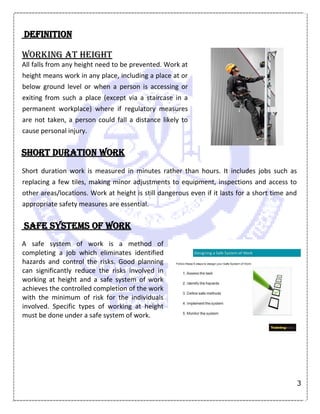
Safe systems of work
A safe system of work is a method of
completing a job which eliminates identified
hazards and control the risks. Good planning
can significantly reduce the risks involved in
working at height and a safe system of work
achieves the controlled completion of the work
with the minimum of risk for the individuals
involved. Specific types of working at height
must be done under a safe system of work.
4
Legal Requirements
The Work at Height Regulations 2005
The overriding principle of these regulations is that UEL must do all that is reasonably
practicable to prevent anyone falling. The guiding principles for managing work at height are
as follows:
 Avoid work at height if you can.
 If work at height cannot be avoided, prevent falls by selecting and using the right
access equipment.
 Where you cannot eliminate the risk of a fall, use work equipment or other means to
minimise the distance and consequences of a fall should one occur.
All work at height must be properly planned and organised
 Ensure that no work at height is carried out if it is safe and reasonably practicable
to do it other than at height.
 Ensure that the work at height is properly planned, supervised and carried out as
safely as is reasonably practicable.
 Ensure that emergencies and rescue procedures are planned for.
 Take account of the risk assessment findings carried out under regulation 3 of the
Management of Health and Safety at Work Regulations.
All work at height must take account of weather conditions that could pose a
risk to the health and safety of any person working at height
 Ensure that any work is postponed until the weather improves sufficiently.
 Anyone involved in working at height must be competent and appropriately trained.
 If a person is being trained they must be supervised by a competent person.
 Competency and training refers to anyone involved in organisation, planning,
supervision and the supply/maintenance of equipment in respect of working at
height.
 Where a risk of falling remains, ensure that those persons working at height are
trained in how to avoid falling and how to avoid or minimise any injuries should
they fall.
5
The place where work at height is undertaken must be safe
 The place of work and the means of access must have features to prevent falls from
height.
Equipment used for working at height must be appropriately inspected
 If it is not reasonably practicable to include features to prevent a fall and they would
not allow the worker to carry out the work safely, equipment must be provided to
prevent a fall occurring (as far as reasonably practicable).
 If the risk of falling cannot be entirely eliminated, the potential distance and effect of
the fall must be minimised.
 Equipment provided for work at height must be the most suitable available, provide
collective measures (e.g. guard rails) with priority over personal protection (e.g. safety
harnesses), and take account of the working conditions and risks to the safety of all
persons at the place where the equipment is to be used.
 Equipment, temporary structures and safety features must comply with the
requirements laid out in Schedules 2 to 6 of the Regulations.
 Ensure that each location where work at height is to be undertaken is checked on
every occasion before that place is used. This must take account of checking the
surface of every parapet, permanent rail, etc.
 Ensure that any equipment included within Schedules 2 to 6 of the Regulations is
inspected after assembly or installation and as often as is necessary thereafter to
ensure safety.
 Any equipment which belonged to another
organisation must be accompanied with a
clear indication that the last inspections
have been carried out. Likewise for any
equipment leaving UEL.
 Any work platform where someone could
fall more than 2m must be inspected in-
situ prior to use (but not more than 7 days
before).Any mobile platform must be
inspected at the site of use rather than
each time it is moved within the site
boundary.
 The person inspecting the platform must prepare a report before going off duty
providing the details laid out in Schedule 7 of the Regulations and provide a copy
6
within 24 hours to the person who requested the inspection. Reports should be
available at the construction site until the work is completed and then at the
employers main office for another 3 months.
 General inspection records should be kept until the next inspection has been
completed. The risks posed by fragile materials must be properly controlled.
 Ensure that no person at work goes onto or near a fragile surface, where it is
reasonably
 Practicable to carry out work safely without his/her doing so. Any person working on or
near to a fragile surface must be provided with suitable work platforms, coverings,
guard rails, etc. to minimise any risks and employers must do all that is reasonably
practicable to minimise the distance and effect of a fall.
Ensure that the risks from falling objects are properly controlled
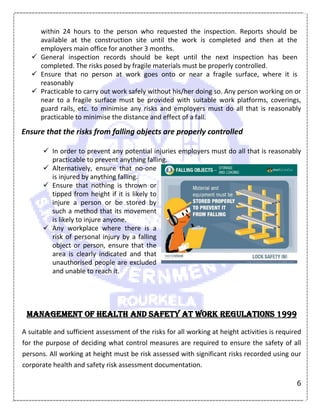
 In order to prevent any potential injuries employers must do all that is reasonably
practicable to prevent anything falling.
 Alternatively, ensure that no-one
is injured by anything falling.
 Ensure that nothing is thrown or
tipped from height if it is likely to
injure a person or be stored by
such a method that its movement
is likely to injure anyone.
 Any workplace where there is a
risk of personal injury by a falling
object or person, ensure that the
area is clearly indicated and that
unauthorised people are excluded
and unable to reach it.
Management of Health and Safety at Work Regulations 1999
A suitable and sufficient assessment of the risks for all working at height activities is required
for the purpose of deciding what control measures are required to ensure the safety of all
persons. All working at height must be risk assessed with significant risks recorded using our
corporate health and safety risk assessment documentation.
7
The Provision and Use of Work Equipment Regulations 1998
These regulations make the following requirements in respect to all equipment provided for
use at work. All work equipment must be.
 Maintained in a safe state of repair and regularly checked provided for use to persons
who have received adequate information, instruction and training in the equipment.
 Safe operation/use; fitted with all necessary suitable safety measures or protective
devices e.g.
 Warnings and guards used with correct safe working
load specifications.
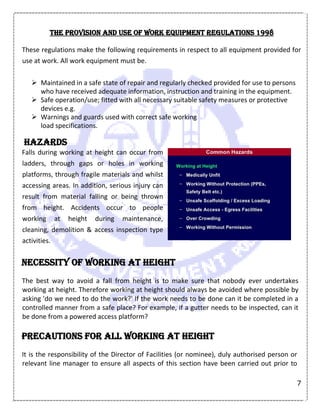
Hazards
Falls during working at height can occur from
ladders, through gaps or holes in working
platforms, through fragile materials and whilst
accessing areas. In addition, serious injury can
result from material falling or being thrown
from height. Accidents occur to people
working at height during maintenance,
cleaning, demolition & access inspection type
activities.
Necessity of working at height
The best way to avoid a fall from height is to make sure that nobody ever undertakes
working at height. Therefore working at height should always be avoided where possible by
asking 'do we need to do the work?' If the work needs to be done can it be completed in a
controlled manner from a safe place? For example, if a gutter needs to be inspected, can it
be done from a powered access platform?
Precautions for all working at height
It is the responsibility of the Director of Facilities (or nominee), duly authorised person or
relevant line manager to ensure all aspects of this section have been carried out prior to
8
work commencing and to ensure that a safe system of work to include a working at height
permit (as required) is fully implemented.
The following precautions are required for all working at height:
 Cut-off power supply in nearby electric line to avoid shock and fall.
 Don’t lift or carry excessive load so as to lose balance and fall.
 Tools should be attached by lanyard to the belt or garment to prevent their fall on
others.
 Safety helmet, shoes, FBH, respirator & other ppe should be worn as per need.
 Work floor should dry, clean and well protected.
 Floor should be checked for fragility, crack & it’s should ness to carry load.
 Know safe means of access, emergency stair case, fire extinguisher, first-aid box and
other devices like areal platform, rope ladder before starting the work.
 No stair case shall be used for the purpose of a accessing a place at height without
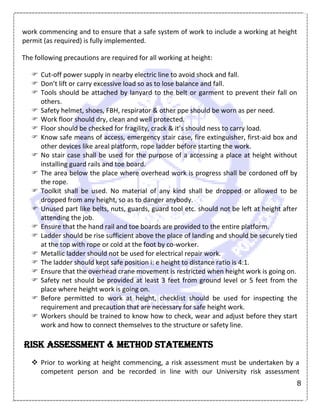
installing guard rails and toe board.
 The area below the place where overhead work is progress shall be cordoned off by
the rope.
 Toolkit shall be used. No material of any kind shall be dropped or allowed to be
dropped from any height, so as to danger anybody.
 Unused part like belts, nuts, guards, guard tool etc. should not be left at height after
attending the job.
 Ensure that the hand rail and toe boards are provided to the entire platform.
 Ladder should be rise sufficient above the place of landing and should be securely tied
at the top with rope or cold at the foot by co-worker.
 Metallic ladder should not be used for electrical repair work.
 The ladder should kept safe position i: e height to distance ratio is 4:1.
 Ensure that the overhead crane movement is restricted when height work is going on.
 Safety net should be provided at least 3 feet from ground level or 5 feet from the
place where height work is going on.
 Before permitted to work at height, checklist should be used for inspecting the
requirement and precaution that are necessary for safe height work.
 Workers should be trained to know how to check, wear and adjust before they start
work and how to connect themselves to the structure or safety line.
Risk assessment & method statements
 Prior to working at height commencing, a risk assessment must be undertaken by a
competent person and be recorded in line with our University risk assessment
9
procedure. Any person requested by their line manager to assist in the risk assessment
process will be competent and trained in the risk assessment process. It is the
responsibility of Heads of School/Directors of Service, etc. to ensure that such persons
receive appropriate information, instruction and training in risk assessment as
required.
 The risk assessment must identify a safe system of work detailed in a safety method
statement being specific and relevant to the work to be undertaken. The risk
assessment and method statement must be signed by the competent person and
communicated to all those involved in the working at height activity.
 A risk assessment, safe working procedure/method statement and permit to work (if
deemed appropriate by the UEL representative responsible) covering all work to be
carried out at a height from which a fall could result in personal injury, must be
authorised and in operation for the duration of the task.
 General risk assessments and method statements are to be used for routine working at
height operations.
Working at height permit
A permit to work system is a formal written system used to control certain types of work that
are potentially hazardous. A permit to work is a document which specifies the work to be
done and the precautions to be taken. They form an essential part of safe systems of work for
many maintenance activities. They allow work to start only after safe procedures have been
defined and they provide a clear record that all foreseeable hazards have been considered.
Prevention of falls
Generally:-
 Do not work at height unless it is essential.
Ensure that the working platform is secure.
 Ensure that the working platform will
support the weight of those persons using it
and any materials.
 Ensure that the working platform is stable.
10
 Ensure that there is adequate working space to undertake the work; ensure that the
working platform is footed on stable ground/support/structure; ensure that all open
edges are protected by use of guard rails, barriers, etc.
Working platforms
The nature and duration of the work will influence the type of working platform most
appropriate for the work. Much working at height can be seen to be done from scaffolding
but there are other means of access e.g. mobile elevated work platforms, tower scaffolds,
personal suspension equipment (rope access and boatswain's chairs) and ladders that offer
both advantages and disadvantages in use. Risks associated with erecting the equipment in
addition to using it must be assessed. Consideration must be given to the following when
selecting the type of work platform or means of access to the workplace:-
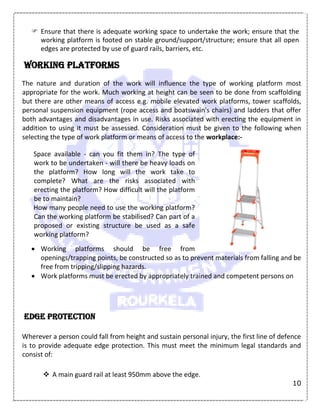
Space available - can you fit them in? The type of
work to be undertaken - will there be heavy loads on
the platform? How long will the work take to
complete? What are the risks associated with
erecting the platform? How difficult will the platform
be to maintain?
How many people need to use the working platform?
Can the working platform be stabilised? Can part of a
proposed or existing structure be used as a safe
working platform?
 Working platforms should be free from
openings/trapping points, be constructed so as to prevent materials from falling and be
free from tripping/slipping hazards.
 Work platforms must be erected by appropriately trained and competent persons on
Edge protection
Wherever a person could fall from height and sustain personal injury, the first line of defence
is to provide adequate edge protection. This must meet the minimum legal standards and
consist of:
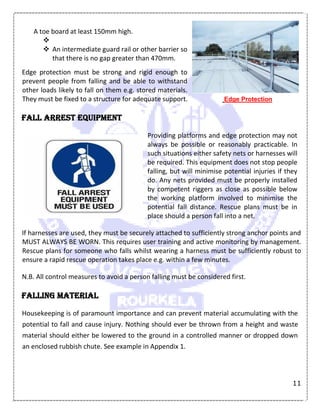
 A main guard rail at least 950mm above the edge.
11
A toe board at least 150mm high.

 An intermediate guard rail or other barrier so
that there is no gap greater than 470mm.
Edge protection must be strong and rigid enough to
prevent people from falling and be able to withstand
other loads likely to fall on them e.g. stored materials.
They must be fixed to a structure for adequate support. Edge Protection
Fall arrest equipment
Providing platforms and edge protection may not
always be possible or reasonably practicable. In
such situations either safety nets or harnesses will
be required. This equipment does not stop people
falling, but will minimise potential injuries if they
do. Any nets provided must be properly installed
by competent riggers as close as possible below
the working platform involved to minimise the
potential fall distance. Rescue plans must be in
place should a person fall into a net.
If harnesses are used, they must be securely attached to sufficiently strong anchor points and
MUST ALWAYS BE WORN. This requires user training and active monitoring by management.
Rescue plans for someone who falls whilst wearing a harness must be sufficiently robust to
ensure a rapid rescue operation takes place e.g. within a few minutes.
N.B. All control measures to avoid a person falling must be considered first.
Falling material
Housekeeping is of paramount importance and can prevent material accumulating with the
potential to fall and cause injury. Nothing should ever be thrown from a height and waste
material should either be lowered to the ground in a controlled manner or dropped down
an enclosed rubbish chute. See example in Appendix 1.
12
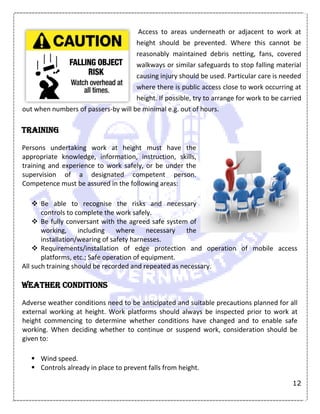
Access to areas underneath or adjacent to work at
height should be prevented. Where this cannot be
reasonably maintained debris netting, fans, covered
walkways or similar safeguards to stop falling material
causing injury should be used. Particular care is needed
where there is public access close to work occurring at
height. If possible, try to arrange for work to be carried
out when numbers of passers-by will be minimal e.g. out of hours.
Training
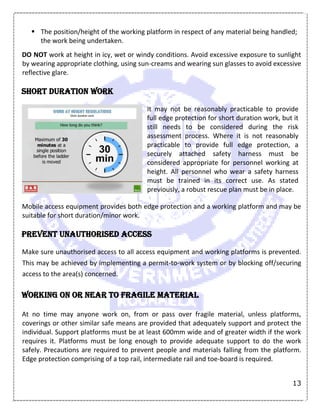
Persons undertaking work at height must have the
appropriate knowledge, information, instruction, skills,
training and experience to work safely, or be under the
supervision of a designated competent person.
Competence must be assured in the following areas:
 Be able to recognise the risks and necessary
controls to complete the work safely.
 Be fully conversant with the agreed safe system of
working, including where necessary the
installation/wearing of safety harnesses.
 Requirements/installation of edge protection and operation of mobile access
platforms, etc.; Safe operation of equipment.
All such training should be recorded and repeated as necessary.
Weather conditions
Adverse weather conditions need to be anticipated and suitable precautions planned for all
external working at height. Work platforms should always be inspected prior to work at
height commencing to determine whether conditions have changed and to enable safe
working. When deciding whether to continue or suspend work, consideration should be
given to:
 Wind speed.
 Controls already in place to prevent falls from height.
13
 The position/height of the working platform in respect of any material being handled;
the work being undertaken.
DO NOT work at height in icy, wet or windy conditions. Avoid excessive exposure to sunlight
by wearing appropriate clothing, using sun-creams and wearing sun glasses to avoid excessive
reflective glare.
Short duration work
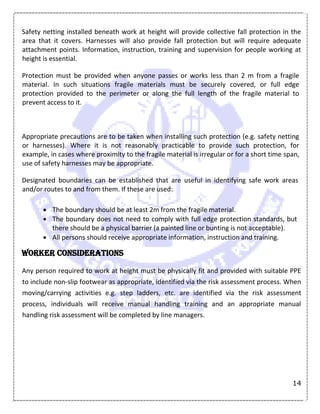
It may not be reasonably practicable to provide
full edge protection for short duration work, but it
still needs to be considered during the risk
assessment process. Where it is not reasonably
practicable to provide full edge protection, a
securely attached safety harness must be
considered appropriate for personnel working at
height. All personnel who wear a safety harness
must be trained in its correct use. As stated
previously, a robust rescue plan must be in place.
Mobile access equipment provides both edge protection and a working platform and may be
suitable for short duration/minor work.
Prevent unauthorised access
Make sure unauthorised access to all access equipment and working platforms is prevented.
This may be achieved by implementing a permit-to-work system or by blocking off/securing
access to the area(s) concerned.
Working on or near to fragile material
At no time may anyone work on, from or pass over fragile material, unless platforms,
coverings or other similar safe means are provided that adequately support and protect the
individual. Support platforms must be at least 600mm wide and of greater width if the work
requires it. Platforms must be long enough to provide adequate support to do the work
safely. Precautions are required to prevent people and materials falling from the platform.
Edge protection comprising of a top rail, intermediate rail and toe-board is required.
14
Safety netting installed beneath work at height will provide collective fall protection in the
area that it covers. Harnesses will also provide fall protection but will require adequate
attachment points. Information, instruction, training and supervision for people working at
height is essential.
Protection must be provided when anyone passes or works less than 2 m from a fragile
material. In such situations fragile materials must be securely covered, or full edge
protection provided to the perimeter or along the full length of the fragile material to
prevent access to it.
Appropriate precautions are to be taken when installing such protection (e.g. safety netting
or harnesses). Where it is not reasonably practicable to provide such protection, for
example, in cases where proximity to the fragile material is irregular or for a short time span,
use of safety harnesses may be appropriate.
Designated boundaries can be established that are useful in identifying safe work areas
and/or routes to and from them. If these are used:
 The boundary should be at least 2m from the fragile material.
 The boundary does not need to comply with full edge protection standards, but
there should be a physical barrier (a painted line or bunting is not acceptable).
 All persons should receive appropriate information, instruction and training.
Worker considerations
Any person required to work at height must be physically fit and provided with suitable PPE
to include non-slip footwear as appropriate, identified via the risk assessment process. When
moving/carrying activities e.g. step ladders, etc. are identified via the risk assessment
process, individuals will receive manual handling training and an appropriate manual
handling risk assessment will be completed by line managers.
15
General access scaffolds
All scaffold must:-
 Be designed, erected, altered and dismantled by competent trained personnel and
such work must be directed by a competent supervisor; never be erected over
people or busy areas.
 This risk must be controlled by scheduling the work during quiet times such as early
mornings or alternatively, closing pavements/areas with permission from local
authorities.
 Be placed on a firm and level foundation that is capable of supporting the weight of
the scaffold and any other potential loading.
 Be braced and tied into a permanent structure or otherwise suitably stabilised as
per any manufacturer’s instructions.
 Only be sheeted after informing and obtaining guidance from the supplier; have
platforms that are fully boarded and of adequate width for the intended work and
access.
 Consist of scaffold boards that are adequately supported and do not overhang
excessively.
 Be designed to prevent falling materials have
platforms at least four boards wide.
 Provide ladders or other safe access onto the work platform;
only be altered by a competent scaffold, be erected following
manufacturer’s instructions.
 Be checked for suitability for the task prior to use or whenever it is altered or
adversely affected (e.g. in high winds).
 Be inspected by a competent person before first use, after substantial alteration,
after any event likely to have affected stability and at regular intervals not
exceeding 7 days.
When scaffolding is left unattended it should be secured in such a manner to stop
unauthorised access for example by removing ladders at ground level. Waste materials
should be removed via mechanical hoists or more often rubbish chutes (see Appendix 1).
Scaffolding erected on public highways or on any roads, pavements, paths or routes used by
the public must be authorised by the relevant Local Authority.
16
Tower scaffolds
Tower scaffolds are quick to erect and can provide safe access but many are involved in
accidents due to incorrect operation and use. A wide range of prefabricated towers are
available and the manufacturer or supplier should
provide an adequate instruction manual detailing
advice on the erection sequence and bracing
requirements. If the equipment is hired, the hirer
should provide this information. If a tower scaffold
is to be used:
 All manufacturer’s instructions for
erection, use and dismantling must be
adhered to.
 The person erecting the tower should be
trained and competent.
 An instruction manual should be kept with the tower scaffold for reference.
 The tower must be vertical with the legs supported on firm level ground and
wheel brakes on
 Wheels and outriggers must be locked when the tower scaffold is in position.
 A safe means of access to and from the work platform must be provided e.g.
internal ladders with secure handholds at all landing places.
 Edge protection in the form of guard rails and toe boards to all platforms
(including intermediate ones) must be provided.
 Tie the tower rigidly to the structure it is serving or provide additional support if
the tower is sheeted, may be exposed to strong winds is used for grit
blasting/water jetting; or where heavy items are lifted up the outside or
where the tower base is too small to ensure stability for the height of
the platform.
 In exposed conditions or outside, the height of the working platform
should be no more than 3 times the minimum base dimension.
 Internally on firm level ground, the height of the working platform should be no
more than 3.5 times the minimum base dimension.
 Always check the safe base to height ratio in the instruction manual.
17
 Suitable edge protection to platforms must be provided where a person could fall
a distance liable to cause personal injury. Guard rails should be at least 950mm
high, toe boards at least 150mm high and intermediate guard rails provided to
ensure that no unprotected gasps exceed 470mm.
DO NOT:
 Use a ladder footed on the working platform;
apply horizontal loads; overload the working
platform;
 Fix ties to the centre of thin walled aluminium tubes; move
the tower by applying force at the platform level;
 Climb up the outside of the tower unless it has been specifically designed for this.
When moving a mobile tower scaffold the route must be checked in advance for power lines
and overhead obstructions and holes/dips in the ground. The tower must be cleared of all
materials and people prior to it being pushed/pulled at its base. Anyone moving a tower
scaffold must have received manual handling training and be in possession of a manual
handling risk assessment covering the task.
Tower scaffolds must be inspected by a competent person. The requirement for inspection is
different for small towers under 2m, and for towers of 2m and above.
If the working platform is less than 2m in height, the tower must be inspected:
 After assembly in any position.
 After any event liable to have affected its stability and at suitable
intervals depending on frequency and conditions of use.
If the working platform is 2m or more in height, it must be inspected:
 After assembly in any position.
 After any event liable to have affected its stability; and at
intervals not exceeding seven days.
18
A new inspection and report is not required every time a mobile access tower is moved to a
new location on the same site. However, if any part of the tower has to be removed as part
of the moving process, then a pre-use check should be undertaken by a trained and
competent person to make sure the tower has been reinstated correctly.
Mobile and suspended access equipment
Where work cannot be done from an existing structure and the use of a scaffold working
platform is not appropriate, there is a range of mobile access equipment that may be used.
These include mobile elevating work platforms (MCWPs), suspended cradles, mast climbing
work platforms (MCWPs), boatswain's chairs/seats and rope access equipment. Any person
using this type of equipment must be trained and competent to operate it and be fully
conversant with emergency and evacuation procedures.
Before any work commences that involves mobile and suspended access equipment the
following must be in place:
 A handover certificate provided by the supplier/installer. It should include details of
how to deal with emergencies, operate, check and maintain the equipment and
state its safe working load.
 Any equipment installed, modified and dismantled must be undertaken by a
competent specialist.
 A current report of thorough examination provided for the equipment.
 Areas cordoned off to avoid the impact of people with the platform and debris.
 Safe systems of use in place for when the platform rises and descends to
ensure that it does not come into contact with anything/anyone.
 Any supports are protected from damage.
 Ensure that the equipment is protected from adverse weather.
At the end of each working day the following checks must be carried out and
recorded:-
 The platform is clear of all materials and tools.
 All power is switched off and cables secured and made dead.
 The equipment is secured to avoid access to trespassers and vandals;
19
 Notices stating that the equipment is out of service and must not be
used are to be displayed.
 Shift reports to be checked for any warnings of malfunctions.
Mobile elevating work platforms (MEWPS)
Mobile elevating work platforms (MEWPs) can provide excellent safe access to high levels.
Anyone using a MEWP must ensure that:
 The operator is fully trained
and competent;
 The work platform is fitted
with guard rails, toe boards or
other suitable barriers;
 It is only used on firm and level
ground; the tyres are fully
inflated;
 Outriggers are properly
extended and chocked before
the platform is raised into
position;
 Emergency procedures are in
place should the platform fail in the elevated position;
 The MEWP is not operated close to overhead obstructions or cables; allow any
part of the MEWP to extend over a traffic route
 The MEWP is not moved with the platform in the elevated position, unless it is
designed to do so.
Those responsible for the use of MEWPs must assess the risks of people falling from or being
thrown from the carrier, or the MEWP overturning and take precautions to eliminate or
control these risks. If the risks cannot be eliminated then measures should be put into place
to minimise the risk of falling from or with the carrier. If there is still a residual risk of impact
or persons falling then the use of fall protection equipment should be considered, for
example:
 When working adjacent to or in a live highway;
 When travelling with the carrier in a raised position where it may strike fixed
objects in its path;
20
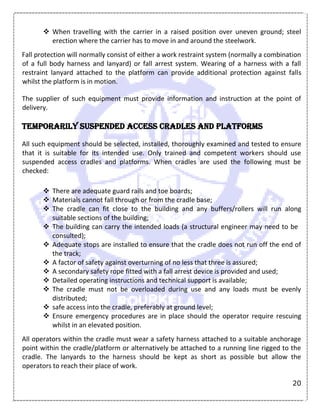
 When travelling with the carrier in a raised position over uneven ground; steel
erection where the carrier has to move in and around the steelwork.
Fall protection will normally consist of either a work restraint system (normally a combination
of a full body harness and lanyard) or fall arrest system. Wearing of a harness with a fall
restraint lanyard attached to the platform can provide additional protection against falls
whilst the platform is in motion.
The supplier of such equipment must provide information and instruction at the point of
delivery.
Temporarily suspended access cradles and platforms
All such equipment should be selected, installed, thoroughly examined and tested to ensure
that it is suitable for its intended use. Only trained and competent workers should use
suspended access cradles and platforms. When cradles are used the following must be
checked:
 There are adequate guard rails and toe boards;
 Materials cannot fall through or from the cradle base;
 The cradle can fit close to the building and any buffers/rollers will run along
suitable sections of the building;
 The building can carry the intended loads (a structural engineer may need to be
consulted);
 Adequate stops are installed to ensure that the cradle does not run off the end of
the track;
 A factor of safety against overturning of no less that three is assured;
 A secondary safety rope fitted with a fall arrest device is provided and used;
 Detailed operating instructions and technical support is available;
 The cradle must not be overloaded during use and any loads must be evenly
distributed;
 safe access into the cradle, preferably at ground level;
 Ensure emergency procedures are in place should the operator require rescuing
whilst in an elevated position.
All operators within the cradle must wear a safety harness attached to a suitable anchorage
point within the cradle/platform or alternatively be attached to a running line rigged to the
cradle. The lanyards to the harness should be kept as short as possible but allow the
operators to reach their place of work.
21
A thorough visual pre-use check for obvious faults must be undertaken prior to each use and
a weekly inspection by a competent person scheduled and recorded.
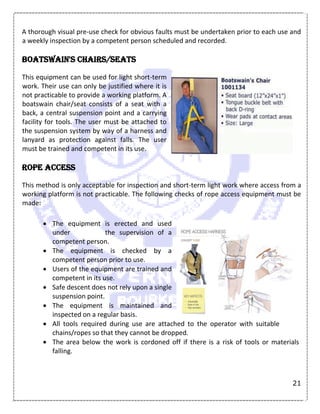
Boatswain's chairs/seats
This equipment can be used for light short-term
work. Their use can only be justified where it is
not practicable to provide a working platform. A
boatswain chair/seat consists of a seat with a
back, a central suspension point and a carrying
facility for tools. The user must be attached to
the suspension system by way of a harness and
lanyard as protection against falls. The user
must be trained and competent in its use.
Rope access
This method is only acceptable for inspection and short-term light work where access from a
working platform is not practicable. The following checks of rope access equipment must be
made:
 The equipment is erected and used
under the supervision of a
competent person.
 The equipment is checked by a
competent person prior to use.
 Users of the equipment are trained and
competent in its use.
 Safe descent does not rely upon a single
suspension point.
 The equipment is maintained and
inspected on a regular basis.
 All tools required during use are attached to the operator with suitable
chains/ropes so that they cannot be dropped.
 The area below the work is cordoned off if there is a risk of tools or materials
falling.
22
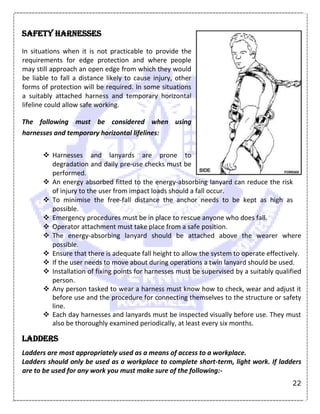
Safety harnesses
In situations when it is not practicable to provide the
requirements for edge protection and where people
may still approach an open edge from which they would
be liable to fall a distance likely to cause injury, other
forms of protection will be required. In some situations
a suitably attached harness and temporary horizontal
lifeline could allow safe working.
The following must be considered when using
harnesses and temporary horizontal lifelines:
 Harnesses and lanyards are prone to
degradation and daily pre-use checks must be
performed.
 An energy absorbed fitted to the energy-absorbing lanyard can reduce the risk
of injury to the user from impact loads should a fall occur.
 To minimise the free-fall distance the anchor needs to be kept as high as
possible.
 Emergency procedures must be in place to rescue anyone who does fall.
 Operator attachment must take place from a safe position.
 The energy-absorbing lanyard should be attached above the wearer where
possible.
 Ensure that there is adequate fall height to allow the system to operate effectively.
 If the user needs to move about during operations a twin lanyard should be used.
 Installation of fixing points for harnesses must be supervised by a suitably qualified
person.
 Any person tasked to wear a harness must know how to check, wear and adjust it
before use and the procedure for connecting themselves to the structure or safety
line.
 Each day harnesses and lanyards must be inspected visually before use. They must
also be thoroughly examined periodically, at least every six months.
Ladders
Ladders are most appropriately used as a means of access to a workplace.
Ladders should only be used as a workplace to complete short-term, light work. If ladders
are to be used for any work you must make sure of the following:-
23
 The work only needs one hand to be used at any time.
 The work area can be reached without the need for overstretching.
 The ladder can be fixed to prevent it slipping.
 The ladder is strong enough for the job and in good condition.
 A good handhold is available for the user.
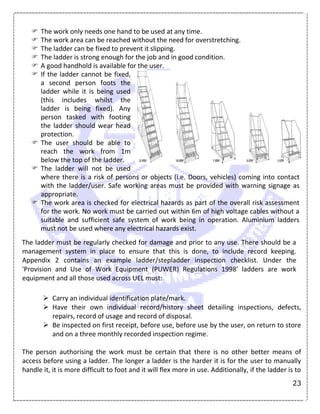
 If the ladder cannot be fixed,
a second person foots the
ladder while it is being used
(this includes whilst the
ladder is being fixed). Any
person tasked with footing
the ladder should wear head
protection.
 The user should be able to
reach the work from 1m
below the top of the ladder.
 The ladder will not be used
where there is a risk of persons or objects (i.e. Doors, vehicles) coming into contact
with the ladder/user. Safe working areas must be provided with warning signage as
appropriate.
 The work area is checked for electrical hazards as part of the overall risk assessment
for the work. No work must be carried out within 6m of high voltage cables without a
suitable and sufficient safe system of work being in operation. Aluminium ladders
must not be used where any electrical hazards exist.
The ladder must be regularly checked for damage and prior to any use. There should be a
management system in place to ensure that this is done, to include record keeping.
Appendix 2 contains an example ladder/stepladder inspection checklist. Under the
'Provision and Use of Work Equipment (PUWER) Regulations 1998' ladders are work
equipment and all those used across UEL must:
 Carry an individual identification plate/mark.
 Have their own individual record/history sheet detailing inspections, defects,
repairs, record of usage and record of disposal.
 Be inspected on first receipt, before use, before use by the user, on return to store
and on a three monthly recorded inspection regime.
The person authorising the work must be certain that there is no other better means of
access before using a ladder. The longer a ladder is the harder it is for the user to manually
handle it, it is more difficult to foot and it will flex more in use. Additionally, if the ladder is to
24
be used in several locations requiring constant movement/repositioning, there is more scope
for user carelessness.
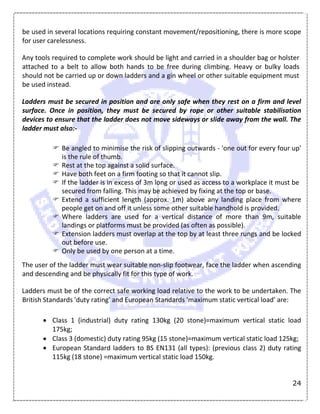
Any tools required to complete work should be light and carried in a shoulder bag or holster
attached to a belt to allow both hands to be free during climbing. Heavy or bulky loads
should not be carried up or down ladders and a gin wheel or other suitable equipment must
be used instead.
Ladders must be secured in position and are only safe when they rest on a firm and level
surface. Once in position, they must be secured by rope or other suitable stabilisation
devices to ensure that the ladder does not move sideways or slide away from the wall. The
ladder must also:-
 Be angled to minimise the risk of slipping outwards - 'one out for every four up'
is the rule of thumb.
 Rest at the top against a solid surface.
 Have both feet on a firm footing so that it cannot slip.
 If the ladder is in excess of 3m long or used as access to a workplace it must be
secured from falling. This may be achieved by fixing at the top or base.
 Extend a sufficient length (approx. 1m) above any landing place from where
people get on and off it unless some other suitable handhold is provided.
 Where ladders are used for a vertical distance of more than 9m, suitable
landings or platforms must be provided (as often as possible).
 Extension ladders must overlap at the top by at least three rungs and be locked
out before use.
 Only be used by one person at a time.
The user of the ladder must wear suitable non-slip footwear, face the ladder when ascending
and descending and be physically fit for this type of work.
Ladders must be of the correct safe working load relative to the work to be undertaken. The
British Standards 'duty rating' and European Standards 'maximum static vertical load' are:
 Class 1 (industrial) duty rating 130kg (20 stone)=maximum vertical static load
175kg;
 Class 3 (domestic) duty rating 95kg (15 stone)=maximum vertical static load 125kg;
 European Standard ladders to BS EN131 (all types): (previous class 2) duty rating
115kg (18 stone) =maximum vertical static load 150kg.
25
Domestic standard ladders, British Standard Class 3 are not recommended for use in the
workplace. Although they are lighter, they are not as durable and should not be used on UEL
premises.
 DO NOT use home-made or makeshift ladders!
 DO NOT carry out repairs to damaged ladders!
 DO NOT use painted ladders as the paint may cover defects and damage!
 DO NOT use DIY type ladders for site work - they may not be strong enough!
 DO NOT loan ladders to unauthorised persons!
Access/work platforms
Fixed height access platforms provide a safe, secure and stable work platform when working
at low levels for prolonged periods of time.
 Maximum safe working height is normally 3m.
 Normally for light work only.
 Locking guardrail - allows easy access to the platform. It can be secured after the
user is in work position to provide security/safety.
 Secure lockable castors required to prevent inadvertent movement of the
platform.
26
Step Ladders
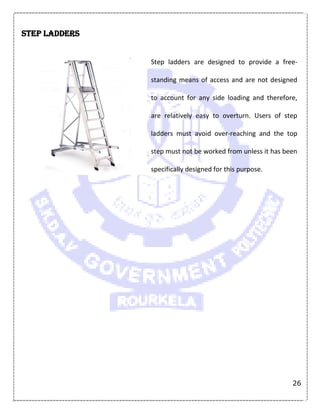
Step ladders are designed to provide a free-
standing means of access and are not designed
to account for any side loading and therefore,
are relatively easy to overturn. Users of step
ladders must avoid over-reaching and the top
step must not be worked from unless it has been
specifically designed for this purpose.
27
Ppe’s used:
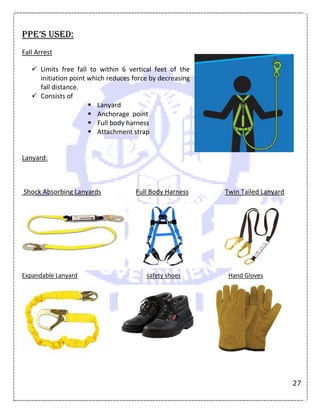
Fall Arrest
 Limits free fall to within 6 vertical feet of the
initiation point which reduces force by decreasing
fall distance.
 Consists of
 Lanyard
 Anchorage point
 Full body harness
 Attachment strap
Lanyard:
Shock Absorbing Lanyards Full Body Harness Twin Tailed Lanyard
Expandable Lanyard safety shoes Hand Gloves
28
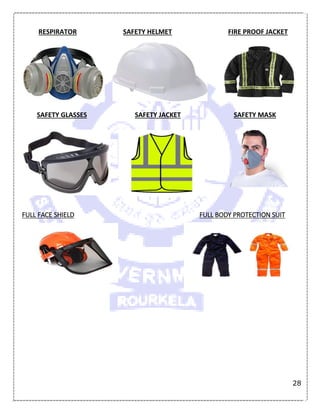
RESPIRATOR SAFETY HELMET FIRE PROOF JACKET
SAFETY GLASSES SAFETY JACKET SAFETY MASK
FULL FACE SHIELD FULL BODY PROTECTION SUIT
29
Conclusion:
Every single person who has died from a fall in which the victim was not utilizing
provided fall protection most likely believed one of the myths above. Otherwise,
knowing the potential result of their actions, why would they have chosen to
forego it?
To Conclude
A fall is a fall, once it happens there will be no dramatic
lifesaving fingertip catch by your co-worker. Falls can
happen & unfortunately do so happen.
30
References:
 INDG284 - "Working on Roofs".
 "Height Safe - Essential health and safety information for people who work at height"
(HSE Publication).
 "Health and Safety in Construction" HSG150 (rev1).
 www.hse.gov.uk/work-at-height.
 www.hsebooks.co.uk.
 www.hse.gov.uk.
 Work at Height Regulations 2005.
 www.irata.org Industrial Rope Access Trade Association (IRATA).
 www.wikipdedia.com.
 WWW.GOOOGLE.COM
31
Wear your fall protection,
because nobody can defy the laws
of gravity.

HEIGHT WORK SAFETY REPORT

  • 1.
    1 Contents  Introduction  Scope Purpose  Definitions:  Working at height  Short duration of work  Safe system of work  Legal requirements  Hazards  Procedural guidance:  Necessity of working at height  Precaution for all working at height  General access scaffolds  Tower scaffolds  Access/ work platforms  Step ladders  Ppe used  Conclusion  References
  • 2.
    2 Introduction Working at heightis a high-risk activity. Falls are the largest cause of accidental death in the construction industry and need to be avoided by provision of suitable access equipment being properly used. However, it must be stressed that working at height takes place throughout our University, not just in the construction areas, and this sub-policy applies to all such work. According to the HSE, since 2001 an average of 50 people in Great Britain, have died at work each year as a result of a fall from height. A further 8,702 have been seriously injured. This gives an indication of the care needed when work at height is being undertaken. Proper safety standards are essential for all working at height and the nature of the precautions required must be assessed for each individual task. This sub-policy sets out responsibilities, precautions and provides general guidance for good practice relevant to all working at height. Scope This sub-policy applies to all working at height on UEL premises. Individual Schools and Services may have additional arrangements for certain aspects of work at height, such as access for roof work, which supplement or augment this sub-policy. Purpose Therefore the purpose of this sub-policy is to ensure:  Working at height is avoided where possible.  When working at height is unavoidable, all hazards are considered and sufficient.  Safe systems of work are in operation that will actively reduce the risk of injury to all persons involved.  Compliance with relevant legislative requirements, best practice is adopted.
  • 3.
    3 Definition Working at height Allfalls from any height need to be prevented. Work at height means work in any place, including a place at or below ground level or when a person is accessing or exiting from such a place (except via a staircase in a permanent workplace) where if regulatory measures are not taken, a person could fall a distance likely to cause personal injury. Short duration work Short duration work is measured in minutes rather than hours. It includes jobs such as replacing a few tiles, making minor adjustments to equipment, inspections and access to other areas/locations. Work at height is still dangerous even if it lasts for a short time and appropriate safety measures are essential. Safe systems of work A safe system of work is a method of completing a job which eliminates identified hazards and control the risks. Good planning can significantly reduce the risks involved in working at height and a safe system of work achieves the controlled completion of the work with the minimum of risk for the individuals involved. Specific types of working at height must be done under a safe system of work.
  • 4.
    4 Legal Requirements The Workat Height Regulations 2005 The overriding principle of these regulations is that UEL must do all that is reasonably practicable to prevent anyone falling. The guiding principles for managing work at height are as follows:  Avoid work at height if you can.  If work at height cannot be avoided, prevent falls by selecting and using the right access equipment.  Where you cannot eliminate the risk of a fall, use work equipment or other means to minimise the distance and consequences of a fall should one occur. All work at height must be properly planned and organised  Ensure that no work at height is carried out if it is safe and reasonably practicable to do it other than at height.  Ensure that the work at height is properly planned, supervised and carried out as safely as is reasonably practicable.  Ensure that emergencies and rescue procedures are planned for.  Take account of the risk assessment findings carried out under regulation 3 of the Management of Health and Safety at Work Regulations. All work at height must take account of weather conditions that could pose a risk to the health and safety of any person working at height  Ensure that any work is postponed until the weather improves sufficiently.  Anyone involved in working at height must be competent and appropriately trained.  If a person is being trained they must be supervised by a competent person.  Competency and training refers to anyone involved in organisation, planning, supervision and the supply/maintenance of equipment in respect of working at height.  Where a risk of falling remains, ensure that those persons working at height are trained in how to avoid falling and how to avoid or minimise any injuries should they fall.
  • 5.
    5 The place wherework at height is undertaken must be safe  The place of work and the means of access must have features to prevent falls from height. Equipment used for working at height must be appropriately inspected  If it is not reasonably practicable to include features to prevent a fall and they would not allow the worker to carry out the work safely, equipment must be provided to prevent a fall occurring (as far as reasonably practicable).  If the risk of falling cannot be entirely eliminated, the potential distance and effect of the fall must be minimised.  Equipment provided for work at height must be the most suitable available, provide collective measures (e.g. guard rails) with priority over personal protection (e.g. safety harnesses), and take account of the working conditions and risks to the safety of all persons at the place where the equipment is to be used.  Equipment, temporary structures and safety features must comply with the requirements laid out in Schedules 2 to 6 of the Regulations.  Ensure that each location where work at height is to be undertaken is checked on every occasion before that place is used. This must take account of checking the surface of every parapet, permanent rail, etc.  Ensure that any equipment included within Schedules 2 to 6 of the Regulations is inspected after assembly or installation and as often as is necessary thereafter to ensure safety.  Any equipment which belonged to another organisation must be accompanied with a clear indication that the last inspections have been carried out. Likewise for any equipment leaving UEL.  Any work platform where someone could fall more than 2m must be inspected in- situ prior to use (but not more than 7 days before).Any mobile platform must be inspected at the site of use rather than each time it is moved within the site boundary.  The person inspecting the platform must prepare a report before going off duty providing the details laid out in Schedule 7 of the Regulations and provide a copy
  • 6.
    6 within 24 hoursto the person who requested the inspection. Reports should be available at the construction site until the work is completed and then at the employers main office for another 3 months.  General inspection records should be kept until the next inspection has been completed. The risks posed by fragile materials must be properly controlled.  Ensure that no person at work goes onto or near a fragile surface, where it is reasonably  Practicable to carry out work safely without his/her doing so. Any person working on or near to a fragile surface must be provided with suitable work platforms, coverings, guard rails, etc. to minimise any risks and employers must do all that is reasonably practicable to minimise the distance and effect of a fall. Ensure that the risks from falling objects are properly controlled  In order to prevent any potential injuries employers must do all that is reasonably practicable to prevent anything falling.  Alternatively, ensure that no-one is injured by anything falling.  Ensure that nothing is thrown or tipped from height if it is likely to injure a person or be stored by such a method that its movement is likely to injure anyone.  Any workplace where there is a risk of personal injury by a falling object or person, ensure that the area is clearly indicated and that unauthorised people are excluded and unable to reach it. Management of Health and Safety at Work Regulations 1999 A suitable and sufficient assessment of the risks for all working at height activities is required for the purpose of deciding what control measures are required to ensure the safety of all persons. All working at height must be risk assessed with significant risks recorded using our corporate health and safety risk assessment documentation.
  • 7.
    7 The Provision andUse of Work Equipment Regulations 1998 These regulations make the following requirements in respect to all equipment provided for use at work. All work equipment must be.  Maintained in a safe state of repair and regularly checked provided for use to persons who have received adequate information, instruction and training in the equipment.  Safe operation/use; fitted with all necessary suitable safety measures or protective devices e.g.  Warnings and guards used with correct safe working load specifications. Hazards Falls during working at height can occur from ladders, through gaps or holes in working platforms, through fragile materials and whilst accessing areas. In addition, serious injury can result from material falling or being thrown from height. Accidents occur to people working at height during maintenance, cleaning, demolition & access inspection type activities. Necessity of working at height The best way to avoid a fall from height is to make sure that nobody ever undertakes working at height. Therefore working at height should always be avoided where possible by asking 'do we need to do the work?' If the work needs to be done can it be completed in a controlled manner from a safe place? For example, if a gutter needs to be inspected, can it be done from a powered access platform? Precautions for all working at height It is the responsibility of the Director of Facilities (or nominee), duly authorised person or relevant line manager to ensure all aspects of this section have been carried out prior to
  • 8.
    8 work commencing andto ensure that a safe system of work to include a working at height permit (as required) is fully implemented. The following precautions are required for all working at height:  Cut-off power supply in nearby electric line to avoid shock and fall.  Don’t lift or carry excessive load so as to lose balance and fall.  Tools should be attached by lanyard to the belt or garment to prevent their fall on others.  Safety helmet, shoes, FBH, respirator & other ppe should be worn as per need.  Work floor should dry, clean and well protected.  Floor should be checked for fragility, crack & it’s should ness to carry load.  Know safe means of access, emergency stair case, fire extinguisher, first-aid box and other devices like areal platform, rope ladder before starting the work.  No stair case shall be used for the purpose of a accessing a place at height without installing guard rails and toe board.  The area below the place where overhead work is progress shall be cordoned off by the rope.  Toolkit shall be used. No material of any kind shall be dropped or allowed to be dropped from any height, so as to danger anybody.  Unused part like belts, nuts, guards, guard tool etc. should not be left at height after attending the job.  Ensure that the hand rail and toe boards are provided to the entire platform.  Ladder should be rise sufficient above the place of landing and should be securely tied at the top with rope or cold at the foot by co-worker.  Metallic ladder should not be used for electrical repair work.  The ladder should kept safe position i: e height to distance ratio is 4:1.  Ensure that the overhead crane movement is restricted when height work is going on.  Safety net should be provided at least 3 feet from ground level or 5 feet from the place where height work is going on.  Before permitted to work at height, checklist should be used for inspecting the requirement and precaution that are necessary for safe height work.  Workers should be trained to know how to check, wear and adjust before they start work and how to connect themselves to the structure or safety line. Risk assessment & method statements  Prior to working at height commencing, a risk assessment must be undertaken by a competent person and be recorded in line with our University risk assessment
  • 9.
    9 procedure. Any personrequested by their line manager to assist in the risk assessment process will be competent and trained in the risk assessment process. It is the responsibility of Heads of School/Directors of Service, etc. to ensure that such persons receive appropriate information, instruction and training in risk assessment as required.  The risk assessment must identify a safe system of work detailed in a safety method statement being specific and relevant to the work to be undertaken. The risk assessment and method statement must be signed by the competent person and communicated to all those involved in the working at height activity.  A risk assessment, safe working procedure/method statement and permit to work (if deemed appropriate by the UEL representative responsible) covering all work to be carried out at a height from which a fall could result in personal injury, must be authorised and in operation for the duration of the task.  General risk assessments and method statements are to be used for routine working at height operations. Working at height permit A permit to work system is a formal written system used to control certain types of work that are potentially hazardous. A permit to work is a document which specifies the work to be done and the precautions to be taken. They form an essential part of safe systems of work for many maintenance activities. They allow work to start only after safe procedures have been defined and they provide a clear record that all foreseeable hazards have been considered. Prevention of falls Generally:-  Do not work at height unless it is essential. Ensure that the working platform is secure.  Ensure that the working platform will support the weight of those persons using it and any materials.  Ensure that the working platform is stable.
  • 10.
    10  Ensure thatthere is adequate working space to undertake the work; ensure that the working platform is footed on stable ground/support/structure; ensure that all open edges are protected by use of guard rails, barriers, etc. Working platforms The nature and duration of the work will influence the type of working platform most appropriate for the work. Much working at height can be seen to be done from scaffolding but there are other means of access e.g. mobile elevated work platforms, tower scaffolds, personal suspension equipment (rope access and boatswain's chairs) and ladders that offer both advantages and disadvantages in use. Risks associated with erecting the equipment in addition to using it must be assessed. Consideration must be given to the following when selecting the type of work platform or means of access to the workplace:- Space available - can you fit them in? The type of work to be undertaken - will there be heavy loads on the platform? How long will the work take to complete? What are the risks associated with erecting the platform? How difficult will the platform be to maintain? How many people need to use the working platform? Can the working platform be stabilised? Can part of a proposed or existing structure be used as a safe working platform?  Working platforms should be free from openings/trapping points, be constructed so as to prevent materials from falling and be free from tripping/slipping hazards.  Work platforms must be erected by appropriately trained and competent persons on Edge protection Wherever a person could fall from height and sustain personal injury, the first line of defence is to provide adequate edge protection. This must meet the minimum legal standards and consist of:  A main guard rail at least 950mm above the edge.
  • 11.
    11 A toe boardat least 150mm high.   An intermediate guard rail or other barrier so that there is no gap greater than 470mm. Edge protection must be strong and rigid enough to prevent people from falling and be able to withstand other loads likely to fall on them e.g. stored materials. They must be fixed to a structure for adequate support. Edge Protection Fall arrest equipment Providing platforms and edge protection may not always be possible or reasonably practicable. In such situations either safety nets or harnesses will be required. This equipment does not stop people falling, but will minimise potential injuries if they do. Any nets provided must be properly installed by competent riggers as close as possible below the working platform involved to minimise the potential fall distance. Rescue plans must be in place should a person fall into a net. If harnesses are used, they must be securely attached to sufficiently strong anchor points and MUST ALWAYS BE WORN. This requires user training and active monitoring by management. Rescue plans for someone who falls whilst wearing a harness must be sufficiently robust to ensure a rapid rescue operation takes place e.g. within a few minutes. N.B. All control measures to avoid a person falling must be considered first. Falling material Housekeeping is of paramount importance and can prevent material accumulating with the potential to fall and cause injury. Nothing should ever be thrown from a height and waste material should either be lowered to the ground in a controlled manner or dropped down an enclosed rubbish chute. See example in Appendix 1.
  • 12.
    12 Access to areasunderneath or adjacent to work at height should be prevented. Where this cannot be reasonably maintained debris netting, fans, covered walkways or similar safeguards to stop falling material causing injury should be used. Particular care is needed where there is public access close to work occurring at height. If possible, try to arrange for work to be carried out when numbers of passers-by will be minimal e.g. out of hours. Training Persons undertaking work at height must have the appropriate knowledge, information, instruction, skills, training and experience to work safely, or be under the supervision of a designated competent person. Competence must be assured in the following areas:  Be able to recognise the risks and necessary controls to complete the work safely.  Be fully conversant with the agreed safe system of working, including where necessary the installation/wearing of safety harnesses.  Requirements/installation of edge protection and operation of mobile access platforms, etc.; Safe operation of equipment. All such training should be recorded and repeated as necessary. Weather conditions Adverse weather conditions need to be anticipated and suitable precautions planned for all external working at height. Work platforms should always be inspected prior to work at height commencing to determine whether conditions have changed and to enable safe working. When deciding whether to continue or suspend work, consideration should be given to:  Wind speed.  Controls already in place to prevent falls from height.
  • 13.
    13  The position/heightof the working platform in respect of any material being handled; the work being undertaken. DO NOT work at height in icy, wet or windy conditions. Avoid excessive exposure to sunlight by wearing appropriate clothing, using sun-creams and wearing sun glasses to avoid excessive reflective glare. Short duration work It may not be reasonably practicable to provide full edge protection for short duration work, but it still needs to be considered during the risk assessment process. Where it is not reasonably practicable to provide full edge protection, a securely attached safety harness must be considered appropriate for personnel working at height. All personnel who wear a safety harness must be trained in its correct use. As stated previously, a robust rescue plan must be in place. Mobile access equipment provides both edge protection and a working platform and may be suitable for short duration/minor work. Prevent unauthorised access Make sure unauthorised access to all access equipment and working platforms is prevented. This may be achieved by implementing a permit-to-work system or by blocking off/securing access to the area(s) concerned. Working on or near to fragile material At no time may anyone work on, from or pass over fragile material, unless platforms, coverings or other similar safe means are provided that adequately support and protect the individual. Support platforms must be at least 600mm wide and of greater width if the work requires it. Platforms must be long enough to provide adequate support to do the work safely. Precautions are required to prevent people and materials falling from the platform. Edge protection comprising of a top rail, intermediate rail and toe-board is required.
  • 14.
    14 Safety netting installedbeneath work at height will provide collective fall protection in the area that it covers. Harnesses will also provide fall protection but will require adequate attachment points. Information, instruction, training and supervision for people working at height is essential. Protection must be provided when anyone passes or works less than 2 m from a fragile material. In such situations fragile materials must be securely covered, or full edge protection provided to the perimeter or along the full length of the fragile material to prevent access to it. Appropriate precautions are to be taken when installing such protection (e.g. safety netting or harnesses). Where it is not reasonably practicable to provide such protection, for example, in cases where proximity to the fragile material is irregular or for a short time span, use of safety harnesses may be appropriate. Designated boundaries can be established that are useful in identifying safe work areas and/or routes to and from them. If these are used:  The boundary should be at least 2m from the fragile material.  The boundary does not need to comply with full edge protection standards, but there should be a physical barrier (a painted line or bunting is not acceptable).  All persons should receive appropriate information, instruction and training. Worker considerations Any person required to work at height must be physically fit and provided with suitable PPE to include non-slip footwear as appropriate, identified via the risk assessment process. When moving/carrying activities e.g. step ladders, etc. are identified via the risk assessment process, individuals will receive manual handling training and an appropriate manual handling risk assessment will be completed by line managers.
  • 15.
    15 General access scaffolds Allscaffold must:-  Be designed, erected, altered and dismantled by competent trained personnel and such work must be directed by a competent supervisor; never be erected over people or busy areas.  This risk must be controlled by scheduling the work during quiet times such as early mornings or alternatively, closing pavements/areas with permission from local authorities.  Be placed on a firm and level foundation that is capable of supporting the weight of the scaffold and any other potential loading.  Be braced and tied into a permanent structure or otherwise suitably stabilised as per any manufacturer’s instructions.  Only be sheeted after informing and obtaining guidance from the supplier; have platforms that are fully boarded and of adequate width for the intended work and access.  Consist of scaffold boards that are adequately supported and do not overhang excessively.  Be designed to prevent falling materials have platforms at least four boards wide.  Provide ladders or other safe access onto the work platform; only be altered by a competent scaffold, be erected following manufacturer’s instructions.  Be checked for suitability for the task prior to use or whenever it is altered or adversely affected (e.g. in high winds).  Be inspected by a competent person before first use, after substantial alteration, after any event likely to have affected stability and at regular intervals not exceeding 7 days. When scaffolding is left unattended it should be secured in such a manner to stop unauthorised access for example by removing ladders at ground level. Waste materials should be removed via mechanical hoists or more often rubbish chutes (see Appendix 1). Scaffolding erected on public highways or on any roads, pavements, paths or routes used by the public must be authorised by the relevant Local Authority.
  • 16.
    16 Tower scaffolds Tower scaffoldsare quick to erect and can provide safe access but many are involved in accidents due to incorrect operation and use. A wide range of prefabricated towers are available and the manufacturer or supplier should provide an adequate instruction manual detailing advice on the erection sequence and bracing requirements. If the equipment is hired, the hirer should provide this information. If a tower scaffold is to be used:  All manufacturer’s instructions for erection, use and dismantling must be adhered to.  The person erecting the tower should be trained and competent.  An instruction manual should be kept with the tower scaffold for reference.  The tower must be vertical with the legs supported on firm level ground and wheel brakes on  Wheels and outriggers must be locked when the tower scaffold is in position.  A safe means of access to and from the work platform must be provided e.g. internal ladders with secure handholds at all landing places.  Edge protection in the form of guard rails and toe boards to all platforms (including intermediate ones) must be provided.  Tie the tower rigidly to the structure it is serving or provide additional support if the tower is sheeted, may be exposed to strong winds is used for grit blasting/water jetting; or where heavy items are lifted up the outside or where the tower base is too small to ensure stability for the height of the platform.  In exposed conditions or outside, the height of the working platform should be no more than 3 times the minimum base dimension.  Internally on firm level ground, the height of the working platform should be no more than 3.5 times the minimum base dimension.  Always check the safe base to height ratio in the instruction manual.
  • 17.
    17  Suitable edgeprotection to platforms must be provided where a person could fall a distance liable to cause personal injury. Guard rails should be at least 950mm high, toe boards at least 150mm high and intermediate guard rails provided to ensure that no unprotected gasps exceed 470mm. DO NOT:  Use a ladder footed on the working platform; apply horizontal loads; overload the working platform;  Fix ties to the centre of thin walled aluminium tubes; move the tower by applying force at the platform level;  Climb up the outside of the tower unless it has been specifically designed for this. When moving a mobile tower scaffold the route must be checked in advance for power lines and overhead obstructions and holes/dips in the ground. The tower must be cleared of all materials and people prior to it being pushed/pulled at its base. Anyone moving a tower scaffold must have received manual handling training and be in possession of a manual handling risk assessment covering the task. Tower scaffolds must be inspected by a competent person. The requirement for inspection is different for small towers under 2m, and for towers of 2m and above. If the working platform is less than 2m in height, the tower must be inspected:  After assembly in any position.  After any event liable to have affected its stability and at suitable intervals depending on frequency and conditions of use. If the working platform is 2m or more in height, it must be inspected:  After assembly in any position.  After any event liable to have affected its stability; and at intervals not exceeding seven days.
  • 18.
    18 A new inspectionand report is not required every time a mobile access tower is moved to a new location on the same site. However, if any part of the tower has to be removed as part of the moving process, then a pre-use check should be undertaken by a trained and competent person to make sure the tower has been reinstated correctly. Mobile and suspended access equipment Where work cannot be done from an existing structure and the use of a scaffold working platform is not appropriate, there is a range of mobile access equipment that may be used. These include mobile elevating work platforms (MCWPs), suspended cradles, mast climbing work platforms (MCWPs), boatswain's chairs/seats and rope access equipment. Any person using this type of equipment must be trained and competent to operate it and be fully conversant with emergency and evacuation procedures. Before any work commences that involves mobile and suspended access equipment the following must be in place:  A handover certificate provided by the supplier/installer. It should include details of how to deal with emergencies, operate, check and maintain the equipment and state its safe working load.  Any equipment installed, modified and dismantled must be undertaken by a competent specialist.  A current report of thorough examination provided for the equipment.  Areas cordoned off to avoid the impact of people with the platform and debris.  Safe systems of use in place for when the platform rises and descends to ensure that it does not come into contact with anything/anyone.  Any supports are protected from damage.  Ensure that the equipment is protected from adverse weather. At the end of each working day the following checks must be carried out and recorded:-  The platform is clear of all materials and tools.  All power is switched off and cables secured and made dead.  The equipment is secured to avoid access to trespassers and vandals;
  • 19.
    19  Notices statingthat the equipment is out of service and must not be used are to be displayed.  Shift reports to be checked for any warnings of malfunctions. Mobile elevating work platforms (MEWPS) Mobile elevating work platforms (MEWPs) can provide excellent safe access to high levels. Anyone using a MEWP must ensure that:  The operator is fully trained and competent;  The work platform is fitted with guard rails, toe boards or other suitable barriers;  It is only used on firm and level ground; the tyres are fully inflated;  Outriggers are properly extended and chocked before the platform is raised into position;  Emergency procedures are in place should the platform fail in the elevated position;  The MEWP is not operated close to overhead obstructions or cables; allow any part of the MEWP to extend over a traffic route  The MEWP is not moved with the platform in the elevated position, unless it is designed to do so. Those responsible for the use of MEWPs must assess the risks of people falling from or being thrown from the carrier, or the MEWP overturning and take precautions to eliminate or control these risks. If the risks cannot be eliminated then measures should be put into place to minimise the risk of falling from or with the carrier. If there is still a residual risk of impact or persons falling then the use of fall protection equipment should be considered, for example:  When working adjacent to or in a live highway;  When travelling with the carrier in a raised position where it may strike fixed objects in its path;
  • 20.
    20  When travellingwith the carrier in a raised position over uneven ground; steel erection where the carrier has to move in and around the steelwork. Fall protection will normally consist of either a work restraint system (normally a combination of a full body harness and lanyard) or fall arrest system. Wearing of a harness with a fall restraint lanyard attached to the platform can provide additional protection against falls whilst the platform is in motion. The supplier of such equipment must provide information and instruction at the point of delivery. Temporarily suspended access cradles and platforms All such equipment should be selected, installed, thoroughly examined and tested to ensure that it is suitable for its intended use. Only trained and competent workers should use suspended access cradles and platforms. When cradles are used the following must be checked:  There are adequate guard rails and toe boards;  Materials cannot fall through or from the cradle base;  The cradle can fit close to the building and any buffers/rollers will run along suitable sections of the building;  The building can carry the intended loads (a structural engineer may need to be consulted);  Adequate stops are installed to ensure that the cradle does not run off the end of the track;  A factor of safety against overturning of no less that three is assured;  A secondary safety rope fitted with a fall arrest device is provided and used;  Detailed operating instructions and technical support is available;  The cradle must not be overloaded during use and any loads must be evenly distributed;  safe access into the cradle, preferably at ground level;  Ensure emergency procedures are in place should the operator require rescuing whilst in an elevated position. All operators within the cradle must wear a safety harness attached to a suitable anchorage point within the cradle/platform or alternatively be attached to a running line rigged to the cradle. The lanyards to the harness should be kept as short as possible but allow the operators to reach their place of work.
  • 21.
    21 A thorough visualpre-use check for obvious faults must be undertaken prior to each use and a weekly inspection by a competent person scheduled and recorded. Boatswain's chairs/seats This equipment can be used for light short-term work. Their use can only be justified where it is not practicable to provide a working platform. A boatswain chair/seat consists of a seat with a back, a central suspension point and a carrying facility for tools. The user must be attached to the suspension system by way of a harness and lanyard as protection against falls. The user must be trained and competent in its use. Rope access This method is only acceptable for inspection and short-term light work where access from a working platform is not practicable. The following checks of rope access equipment must be made:  The equipment is erected and used under the supervision of a competent person.  The equipment is checked by a competent person prior to use.  Users of the equipment are trained and competent in its use.  Safe descent does not rely upon a single suspension point.  The equipment is maintained and inspected on a regular basis.  All tools required during use are attached to the operator with suitable chains/ropes so that they cannot be dropped.  The area below the work is cordoned off if there is a risk of tools or materials falling.
  • 22.
    22 Safety harnesses In situationswhen it is not practicable to provide the requirements for edge protection and where people may still approach an open edge from which they would be liable to fall a distance likely to cause injury, other forms of protection will be required. In some situations a suitably attached harness and temporary horizontal lifeline could allow safe working. The following must be considered when using harnesses and temporary horizontal lifelines:  Harnesses and lanyards are prone to degradation and daily pre-use checks must be performed.  An energy absorbed fitted to the energy-absorbing lanyard can reduce the risk of injury to the user from impact loads should a fall occur.  To minimise the free-fall distance the anchor needs to be kept as high as possible.  Emergency procedures must be in place to rescue anyone who does fall.  Operator attachment must take place from a safe position.  The energy-absorbing lanyard should be attached above the wearer where possible.  Ensure that there is adequate fall height to allow the system to operate effectively.  If the user needs to move about during operations a twin lanyard should be used.  Installation of fixing points for harnesses must be supervised by a suitably qualified person.  Any person tasked to wear a harness must know how to check, wear and adjust it before use and the procedure for connecting themselves to the structure or safety line.  Each day harnesses and lanyards must be inspected visually before use. They must also be thoroughly examined periodically, at least every six months. Ladders Ladders are most appropriately used as a means of access to a workplace. Ladders should only be used as a workplace to complete short-term, light work. If ladders are to be used for any work you must make sure of the following:-
  • 23.
    23  The workonly needs one hand to be used at any time.  The work area can be reached without the need for overstretching.  The ladder can be fixed to prevent it slipping.  The ladder is strong enough for the job and in good condition.  A good handhold is available for the user.  If the ladder cannot be fixed, a second person foots the ladder while it is being used (this includes whilst the ladder is being fixed). Any person tasked with footing the ladder should wear head protection.  The user should be able to reach the work from 1m below the top of the ladder.  The ladder will not be used where there is a risk of persons or objects (i.e. Doors, vehicles) coming into contact with the ladder/user. Safe working areas must be provided with warning signage as appropriate.  The work area is checked for electrical hazards as part of the overall risk assessment for the work. No work must be carried out within 6m of high voltage cables without a suitable and sufficient safe system of work being in operation. Aluminium ladders must not be used where any electrical hazards exist. The ladder must be regularly checked for damage and prior to any use. There should be a management system in place to ensure that this is done, to include record keeping. Appendix 2 contains an example ladder/stepladder inspection checklist. Under the 'Provision and Use of Work Equipment (PUWER) Regulations 1998' ladders are work equipment and all those used across UEL must:  Carry an individual identification plate/mark.  Have their own individual record/history sheet detailing inspections, defects, repairs, record of usage and record of disposal.  Be inspected on first receipt, before use, before use by the user, on return to store and on a three monthly recorded inspection regime. The person authorising the work must be certain that there is no other better means of access before using a ladder. The longer a ladder is the harder it is for the user to manually handle it, it is more difficult to foot and it will flex more in use. Additionally, if the ladder is to
  • 24.
    24 be used inseveral locations requiring constant movement/repositioning, there is more scope for user carelessness. Any tools required to complete work should be light and carried in a shoulder bag or holster attached to a belt to allow both hands to be free during climbing. Heavy or bulky loads should not be carried up or down ladders and a gin wheel or other suitable equipment must be used instead. Ladders must be secured in position and are only safe when they rest on a firm and level surface. Once in position, they must be secured by rope or other suitable stabilisation devices to ensure that the ladder does not move sideways or slide away from the wall. The ladder must also:-  Be angled to minimise the risk of slipping outwards - 'one out for every four up' is the rule of thumb.  Rest at the top against a solid surface.  Have both feet on a firm footing so that it cannot slip.  If the ladder is in excess of 3m long or used as access to a workplace it must be secured from falling. This may be achieved by fixing at the top or base.  Extend a sufficient length (approx. 1m) above any landing place from where people get on and off it unless some other suitable handhold is provided.  Where ladders are used for a vertical distance of more than 9m, suitable landings or platforms must be provided (as often as possible).  Extension ladders must overlap at the top by at least three rungs and be locked out before use.  Only be used by one person at a time. The user of the ladder must wear suitable non-slip footwear, face the ladder when ascending and descending and be physically fit for this type of work. Ladders must be of the correct safe working load relative to the work to be undertaken. The British Standards 'duty rating' and European Standards 'maximum static vertical load' are:  Class 1 (industrial) duty rating 130kg (20 stone)=maximum vertical static load 175kg;  Class 3 (domestic) duty rating 95kg (15 stone)=maximum vertical static load 125kg;  European Standard ladders to BS EN131 (all types): (previous class 2) duty rating 115kg (18 stone) =maximum vertical static load 150kg.
  • 25.
    25 Domestic standard ladders,British Standard Class 3 are not recommended for use in the workplace. Although they are lighter, they are not as durable and should not be used on UEL premises.  DO NOT use home-made or makeshift ladders!  DO NOT carry out repairs to damaged ladders!  DO NOT use painted ladders as the paint may cover defects and damage!  DO NOT use DIY type ladders for site work - they may not be strong enough!  DO NOT loan ladders to unauthorised persons! Access/work platforms Fixed height access platforms provide a safe, secure and stable work platform when working at low levels for prolonged periods of time.  Maximum safe working height is normally 3m.  Normally for light work only.  Locking guardrail - allows easy access to the platform. It can be secured after the user is in work position to provide security/safety.  Secure lockable castors required to prevent inadvertent movement of the platform.
  • 26.
    26 Step Ladders Step laddersare designed to provide a free- standing means of access and are not designed to account for any side loading and therefore, are relatively easy to overturn. Users of step ladders must avoid over-reaching and the top step must not be worked from unless it has been specifically designed for this purpose.
  • 27.
    27 Ppe’s used: Fall Arrest Limits free fall to within 6 vertical feet of the initiation point which reduces force by decreasing fall distance.  Consists of  Lanyard  Anchorage point  Full body harness  Attachment strap Lanyard: Shock Absorbing Lanyards Full Body Harness Twin Tailed Lanyard Expandable Lanyard safety shoes Hand Gloves
  • 28.
    28 RESPIRATOR SAFETY HELMETFIRE PROOF JACKET SAFETY GLASSES SAFETY JACKET SAFETY MASK FULL FACE SHIELD FULL BODY PROTECTION SUIT
  • 29.
    29 Conclusion: Every single personwho has died from a fall in which the victim was not utilizing provided fall protection most likely believed one of the myths above. Otherwise, knowing the potential result of their actions, why would they have chosen to forego it? To Conclude A fall is a fall, once it happens there will be no dramatic lifesaving fingertip catch by your co-worker. Falls can happen & unfortunately do so happen.
  • 30.
    30 References:  INDG284 -"Working on Roofs".  "Height Safe - Essential health and safety information for people who work at height" (HSE Publication).  "Health and Safety in Construction" HSG150 (rev1).  www.hse.gov.uk/work-at-height.  www.hsebooks.co.uk.  www.hse.gov.uk.  Work at Height Regulations 2005.  www.irata.org Industrial Rope Access Trade Association (IRATA).  www.wikipdedia.com.  WWW.GOOOGLE.COM
  • 31.
    31 Wear your fallprotection, because nobody can defy the laws of gravity.