Presented by Anastasiya Smirnova
DEN 1114/Section 8216
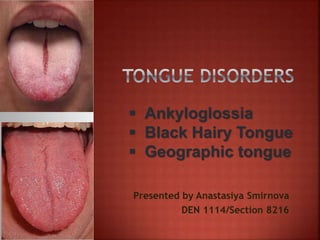
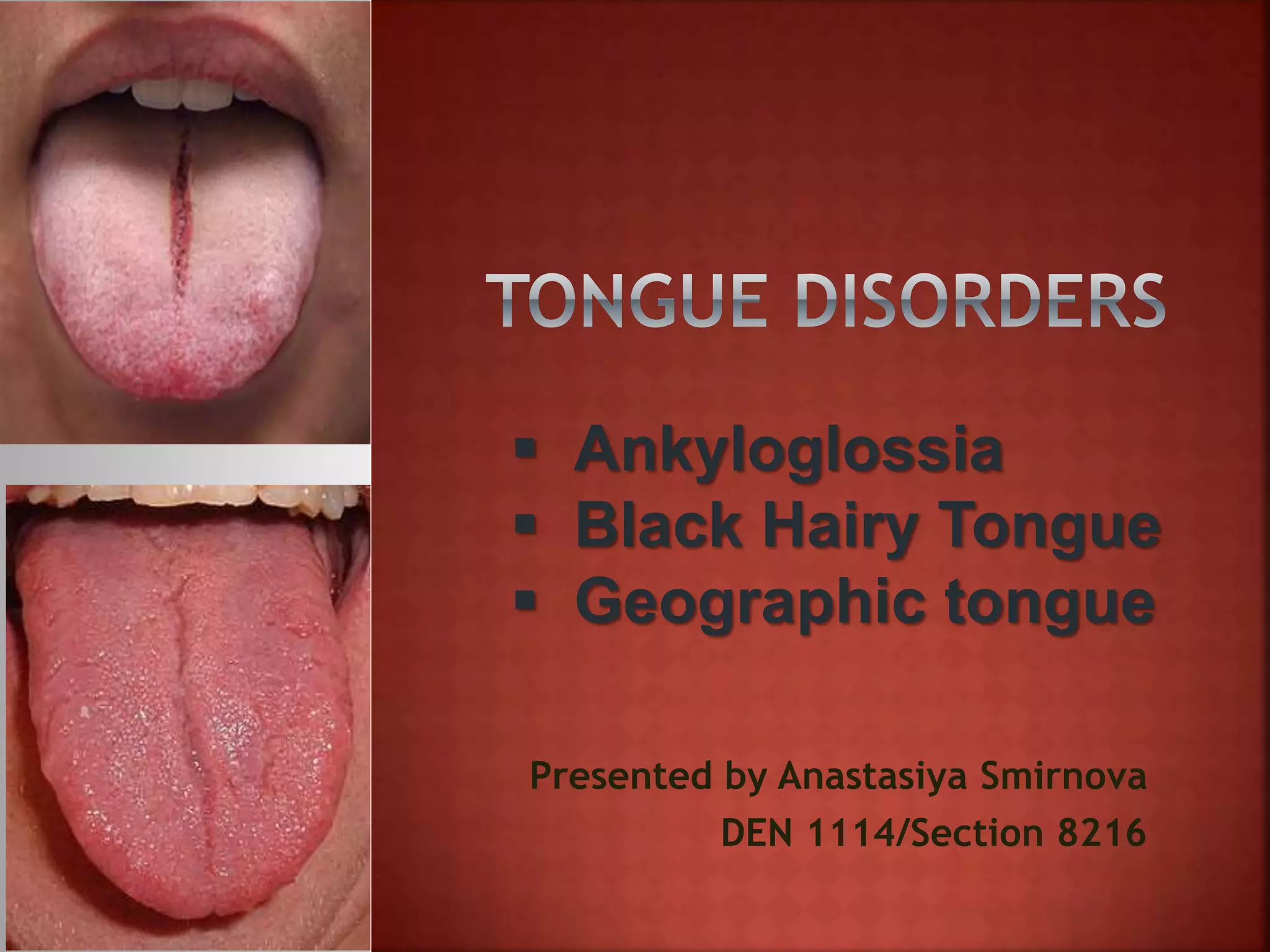
 Ankyloglossia
 Black Hairy Tongue
 Geographic tongue
DEFINITION
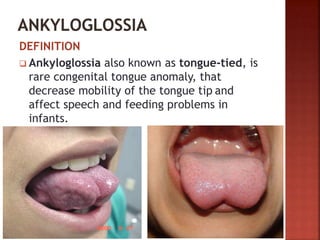
 Ankyloglossia also known as tongue-tied, is
rare congenital tongue anomaly, that
decrease mobility of the tongue tip and
affect speech and feeding problems in
infants.
CAUSES
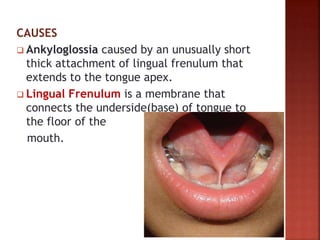
 Ankyloglossia caused by an unusually short
thick attachment of lingual frenulum that
extends to the tongue apex.
 Lingual Frenulum is a membrane that
connects the underside(base) of tongue to
the floor of the
mouth.
PROGNOSIS
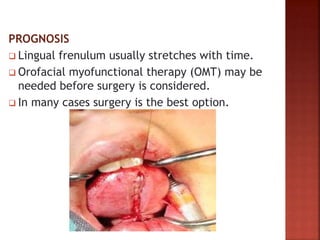
 Lingual frenulum usually stretches with time.
 Orofacial myofunctional therapy (OMT) may be
needed before surgery is considered.
 In many cases surgery is the best option.
DEFINITION
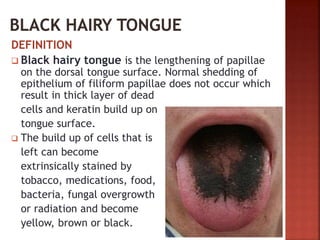
 Black hairy tongue is the lengthening of papillae
on the dorsal tongue surface. Normal shedding of
epithelium of filiform papillae does not occur which
result in thick layer of dead
cells and keratin build up on
tongue surface.
 The build up of cells that is
left can become
extrinsically stained by
tobacco, medications, food,
bacteria, fungal overgrowth
or radiation and become
yellow, brown or black.
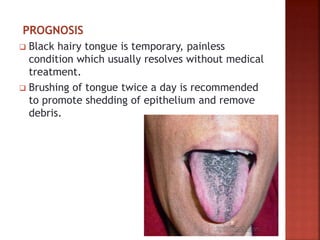
PROGNOSIS
 Black hairy tongue is temporary, painless
condition which usually resolves without medical
treatment.
 Brushing of tongue twice a day is recommended
to promote shedding of epithelium and remove
debris.
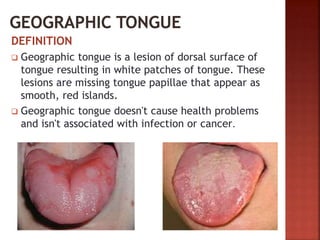
DEFINITION
 Geographic tongue is a lesion of dorsal surface of
tongue resulting in white patches of tongue. These
lesions are missing tongue papillae that appear as
smooth, red islands.
 Geographic tongue doesn't cause health problems
and isn't associated with infection or cancer.
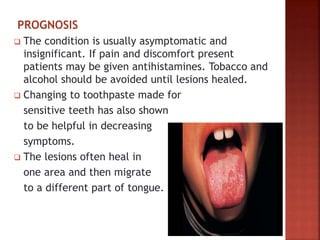
PROGNOSIS
 The condition is usually asymptomatic and
insignificant. If pain and discomfort present
patients may be given antihistamines. Tobacco and
alcohol should be avoided until lesions healed.
 Changing to toothpaste made for
sensitive teeth has also shown
to be helpful in decreasing
symptoms.
 The lesions often heal in
one area and then migrate
to a different part of tongue.
 Rule out if any lesions you find are
not associated with more serious
tongue diseases.
 Educate patients about
their tongue conditions.
 Refer patients with
ankyloglossia to specialist.
 Encourage patients to maintain better oral health
by brushing teeth and tongue twice a day.
 Work in team with patient after surgery
(ankyloglossia) as more oral health required and
must be obtained.
 Illustrated Dental Embryology, Histology, and Anatomy, Third
Edition. Mary Bath-Balogh and Margaret J. Fehrenbach. 2010
 http://www.webmd.com/skin-problems-and-treatments/picture-
of-geographic-tongue
 http://www.mayoclinic.com/health/

TONGUE-DISORDERS.pptx

  • 1.
    Presented by AnastasiyaSmirnova DEN 1114/Section 8216  Ankyloglossia  Black Hairy Tongue  Geographic tongue
  • 2.
    DEFINITION  Ankyloglossia alsoknown as tongue-tied, is rare congenital tongue anomaly, that decrease mobility of the tongue tip and affect speech and feeding problems in infants.
  • 3.
    CAUSES  Ankyloglossia causedby an unusually short thick attachment of lingual frenulum that extends to the tongue apex.  Lingual Frenulum is a membrane that connects the underside(base) of tongue to the floor of the mouth.
  • 4.
    PROGNOSIS  Lingual frenulumusually stretches with time.  Orofacial myofunctional therapy (OMT) may be needed before surgery is considered.  In many cases surgery is the best option.
  • 5.
    DEFINITION  Black hairytongue is the lengthening of papillae on the dorsal tongue surface. Normal shedding of epithelium of filiform papillae does not occur which result in thick layer of dead cells and keratin build up on tongue surface.  The build up of cells that is left can become extrinsically stained by tobacco, medications, food, bacteria, fungal overgrowth or radiation and become yellow, brown or black.
  • 6.
    PROGNOSIS  Black hairytongue is temporary, painless condition which usually resolves without medical treatment.  Brushing of tongue twice a day is recommended to promote shedding of epithelium and remove debris.
  • 7.
    DEFINITION  Geographic tongueis a lesion of dorsal surface of tongue resulting in white patches of tongue. These lesions are missing tongue papillae that appear as smooth, red islands.  Geographic tongue doesn't cause health problems and isn't associated with infection or cancer.
  • 8.
    PROGNOSIS  The conditionis usually asymptomatic and insignificant. If pain and discomfort present patients may be given antihistamines. Tobacco and alcohol should be avoided until lesions healed.  Changing to toothpaste made for sensitive teeth has also shown to be helpful in decreasing symptoms.  The lesions often heal in one area and then migrate to a different part of tongue.
  • 9.
     Rule outif any lesions you find are not associated with more serious tongue diseases.  Educate patients about their tongue conditions.  Refer patients with ankyloglossia to specialist.  Encourage patients to maintain better oral health by brushing teeth and tongue twice a day.  Work in team with patient after surgery (ankyloglossia) as more oral health required and must be obtained.
  • 10.
     Illustrated DentalEmbryology, Histology, and Anatomy, Third Edition. Mary Bath-Balogh and Margaret J. Fehrenbach. 2010  http://www.webmd.com/skin-problems-and-treatments/picture- of-geographic-tongue  http://www.mayoclinic.com/health/