Scotiaaghelek1306
TOMSThe Ultimate Biofuel
and much more than that
TOMS=Triglycerides of Modified Structure
FROM NATURAL OILS AND FATS we
manufacture:
1. NOVEL BIOFUEL PRODUCT TOMS RSPO CEN 590 RENEWABLE
DIESEL.
2. LIMITLESS NUMBER OF TAILOR MADE NEW MOLECULES FOR
THE OLEOCHEMICAL INDUSTRIES (TOMS2)
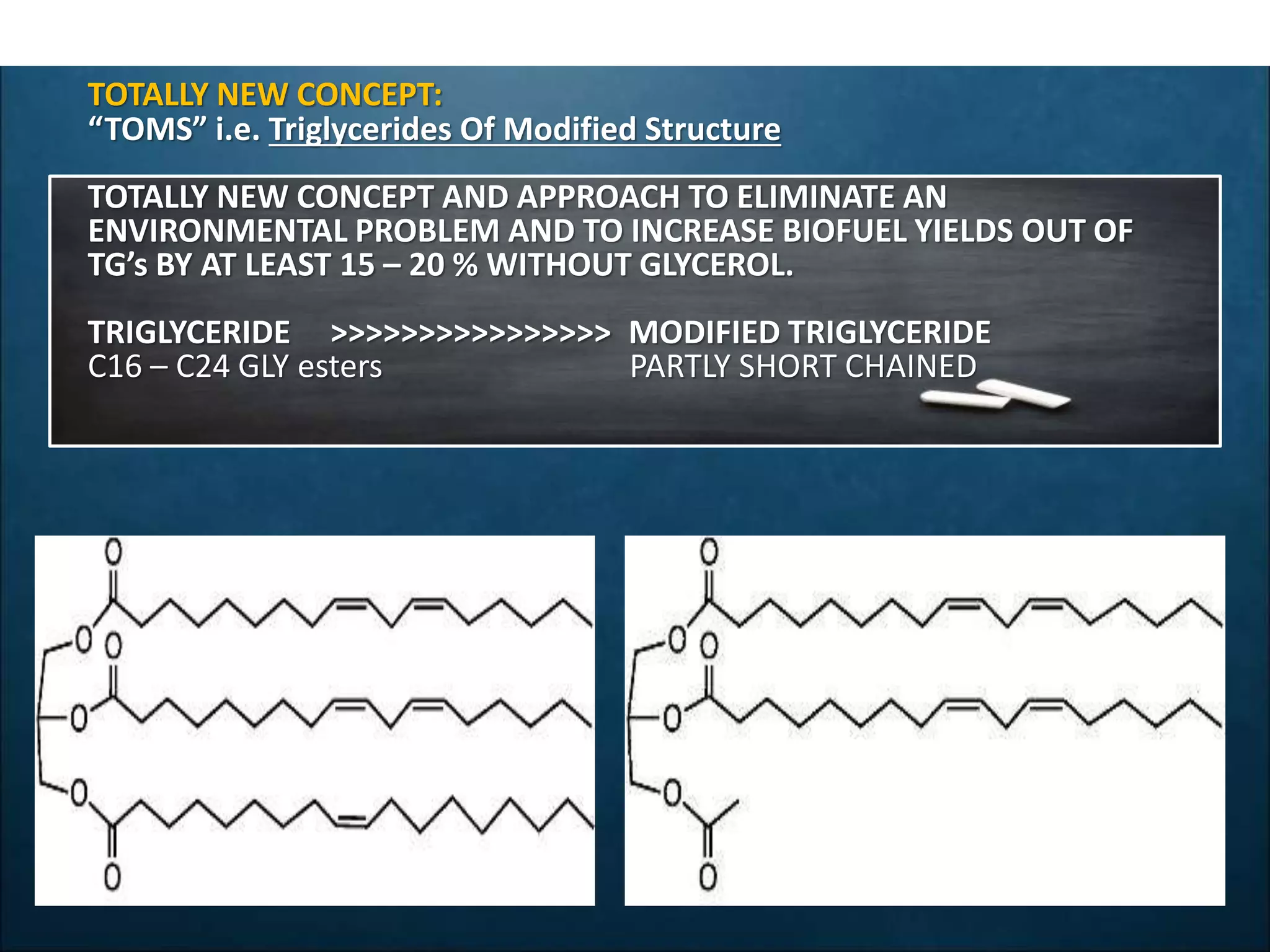
TOTALLY NEW CONCEPT:
“TOMS” i.e. Triglycerides Of Modified Structure
TOTALLY NEW CONCEPT AND APPROACH TO ELIMINATE AN
ENVIRONMENTAL PROBLEM AND TO INCREASE BIOFUEL YIELDS OUT OF
TG’s BY AT LEAST 15 – 20 % WITHOUT GLYCEROL.
TRIGLYCERIDE >>>>>>>>>>>>>>>> MODIFIED TRIGLYCERIDE
C16 – C24 GLY esters PARTLY SHORT CHAINED
ADVANTAGES AND FAVOURABLE PROPERTIES OF THE NEW TOMS1
BIOFUEL AND PROCESS:
• EVERY ATOM OF BIOMASS TRIGLYCERIDES IS UTILIZED FOR FUEL PURPOSES
• UNIVERSAL PROCESS FOR ALL KINDS OF OILS/ANIMAL FATS
• 15 - 20 % EXTRA YIELD OF BIOFUEL FROM THE FEEDSTOCK
• BY RETAINING THE GLYCERYL BACKBONE NO NEED TO HANDLE A
BYPRODUCT NO GLYCEROL STREAMS  30% LESS PLANT COST
• “TOMS” CAN BE PRODUCED IN OLD BIODIESEL PLANTS, TOO (SOME
REVAMPING)
• LOWER MANUFACTURING COSTS
• 30% MORE OXYGEN CONTENT, BETTER COMBUSTION ! CLEAN BURN !
MINIMUM PARTICULATE MATTER !
• BETTER COLD FLOW PROPERTIES, CAN BE DESIGNED FOR SPECIFIC USE.
• WASTELESS, ECO-FRIENDLY PROCESS, NO WATER USED, NO SEWAGE
• MORE STABLE PRODUCT
• 100% RENEWABLE (“GREEN”) AS NO METHANOL USED IN CASE OF
BIOETHYL ACETATE USAGE
• CAN BE BLENDED TO PETRODIESEL WITHIN EN590 LIMIT!!! 80%
• ALSO UTILISED AS TOMS CEN 590 100% AS COMPLETE DIESEL REPLACER.
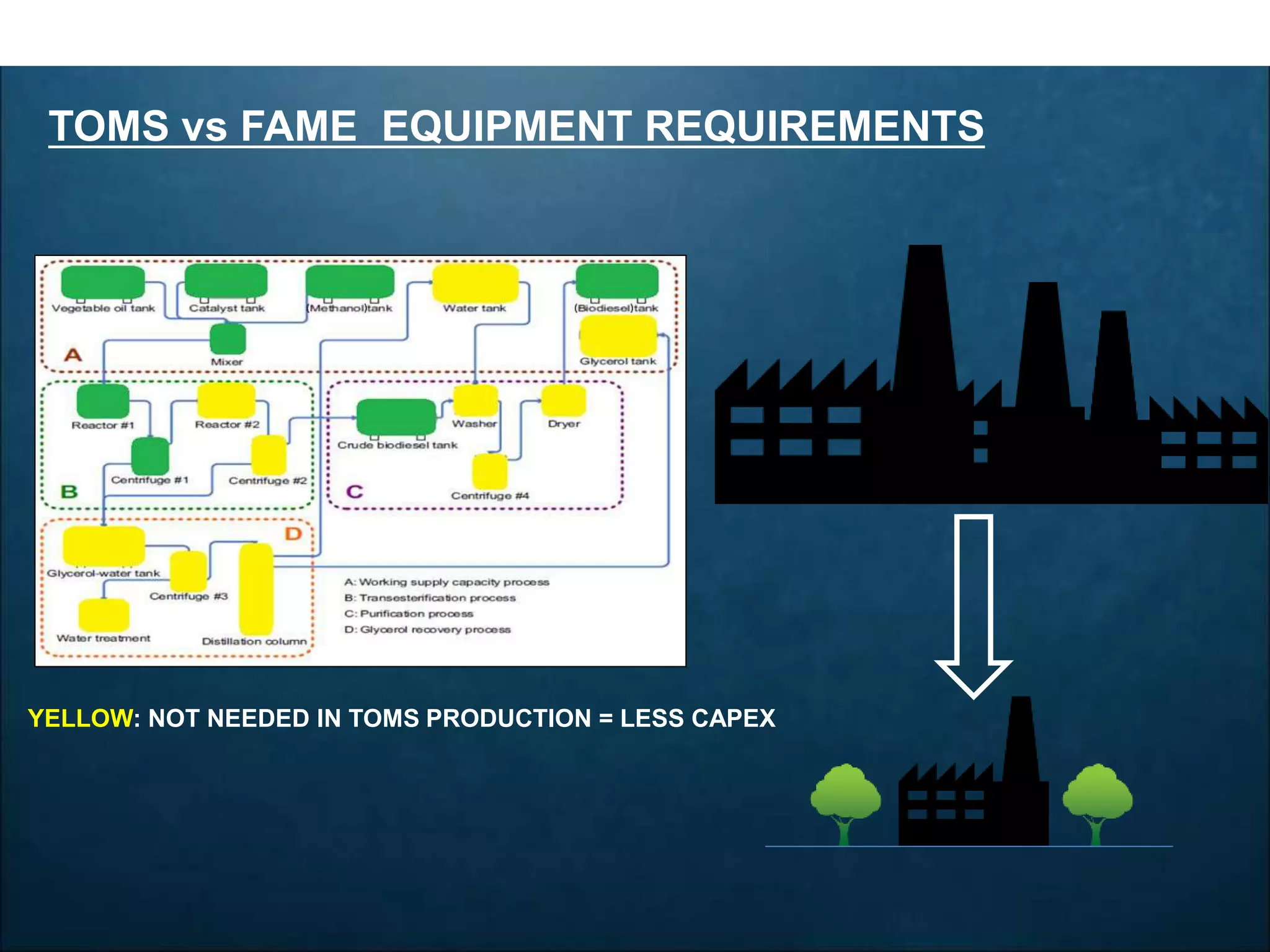
TOMS vs FAME EQUIPMENT REQUIREMENTS
YELLOW: NOT NEEDED IN TOMS PRODUCTION = LESS CAPEX
Visual Difference:
FAME + Glycerol vs. TOMS from the same
volume of feedstock oil
a. FAME
b. Glycerol
c. TOMS, no glycerol, but + 15 - 20 % extra
fuel mass
7.01 7.00 6.70 6.45 6.23 5.98 5.56
7.12
6.42 6.75
6.18
5.51
4.98
5.61
0.00
2.00
4.00
6.00
8.00
992.2 1196.4 1292.9 1392.5 1593.8 1789.7 1894.7
SpecificNOxemission
[g/kWh]
Engine speed [1/min]
Comparison of the specific NOx emissions while engine full load
Specific
NOx
emission -
Diesel fuel
Specific
NOx
emission -
TBK
Biodiesel
0.680
0.380
0.230
0.190
0.118
0.078 0.106
0.110
0.085 0.070
0.042 0.027 0.015 0.0150.000
0.200
0.400
0.600
0.800
992.2 1196.4 1292.9 1392.5 1593.8 1789.7 1894.7
Smoke[1/m]
Engine speed [1/min]
Comparison of the smoke values while engine full load
Smoke
values -
Diesel fuel
0.502 0.523
0.501
0.468
0.513
0.488 0.480 0.459 0.442
0.485
0.090 0.092 0.086 0.097 0.099 0.093 0.089 0.091 0.085 0.088
0
0.1
0.2
0.3
0.4
0.5
0.6
1. 2. 3. 4. 5. 6. 7. 8. 9. 10.
Smoke[1/m]
Measure ordinal number
Comparison of the free peak smoke values
Free peak
smoke - Diesel
fuel
Free peak
smoke - TBK
Biodiesel
Better Emission Values than Petrodiesel
c
a
b
EXAMPLE
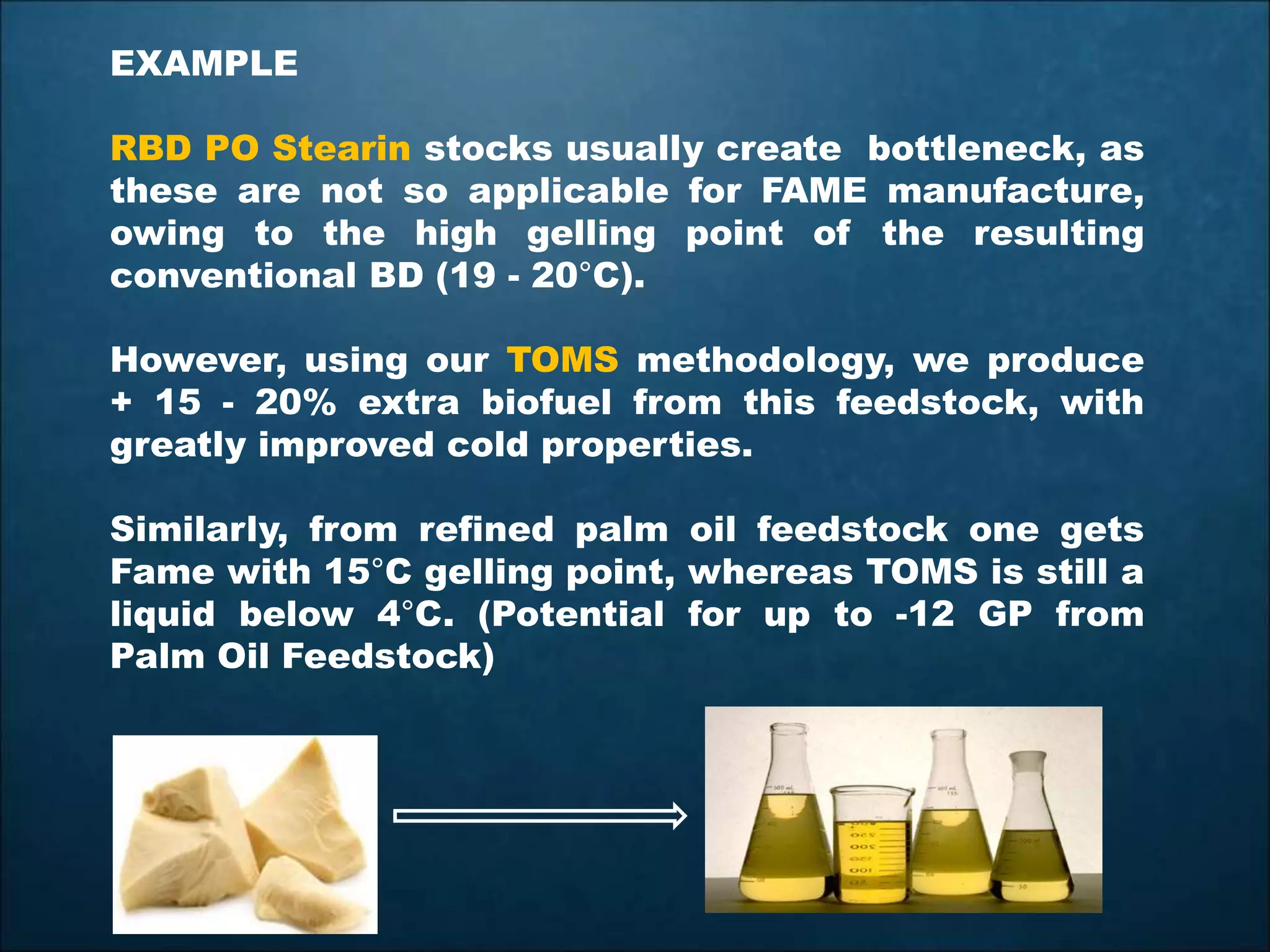
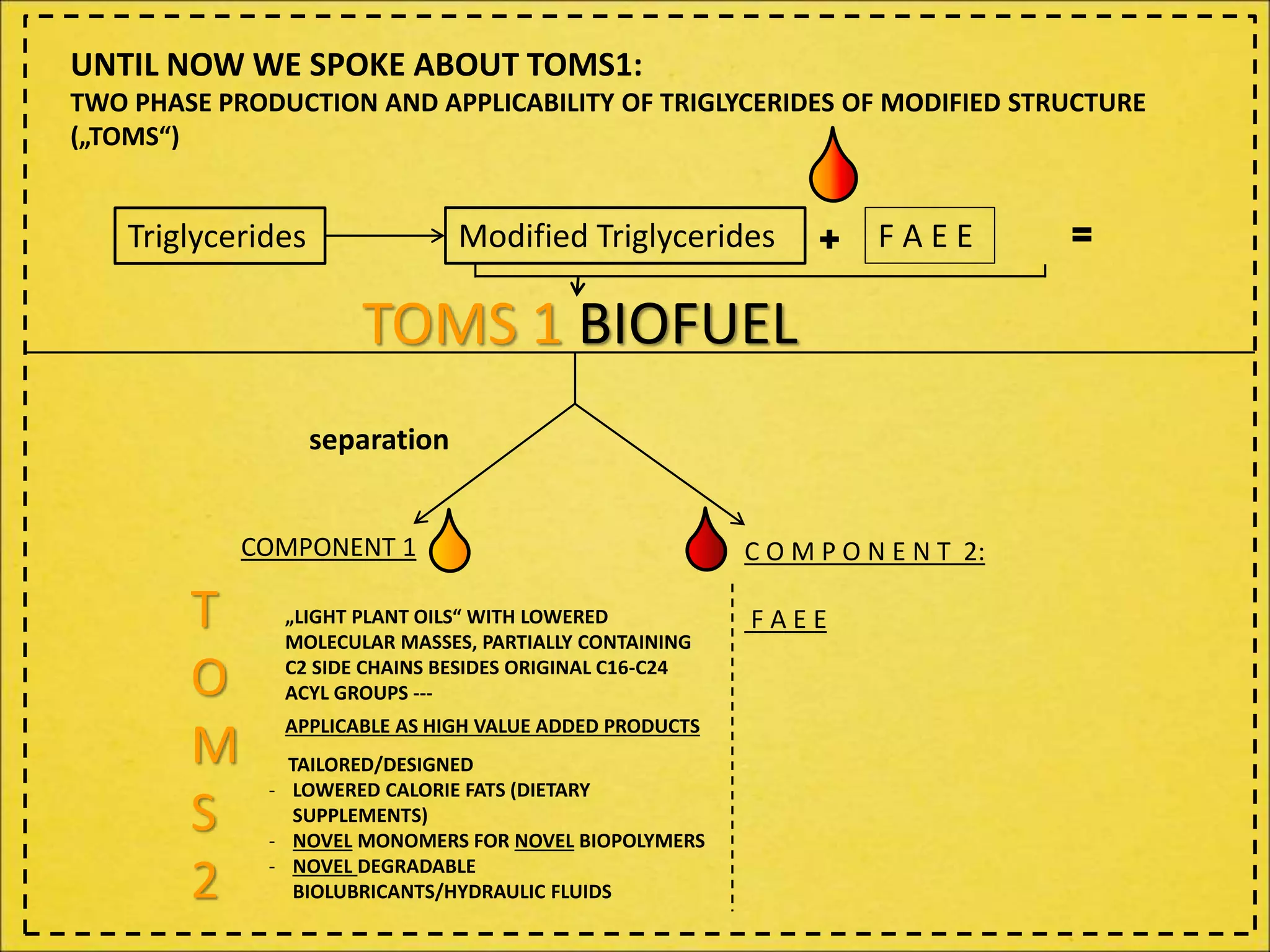
RBD PO Stearin stocks usually create bottleneck, as
these are not so applicable for FAME manufacture,
owing to the high gelling point of the resulting
conventional BD (19 - 20°C).
However, using our TOMS methodology, we produce
+ 15 - 20% extra biofuel from this feedstock, with
greatly improved cold properties.
Similarly, from refined palm oil feedstock one gets
Fame with 15°C gelling point, whereas TOMS is still a
liquid below 4°C. (Potential for up to -12 GP from
Palm Oil Feedstock)
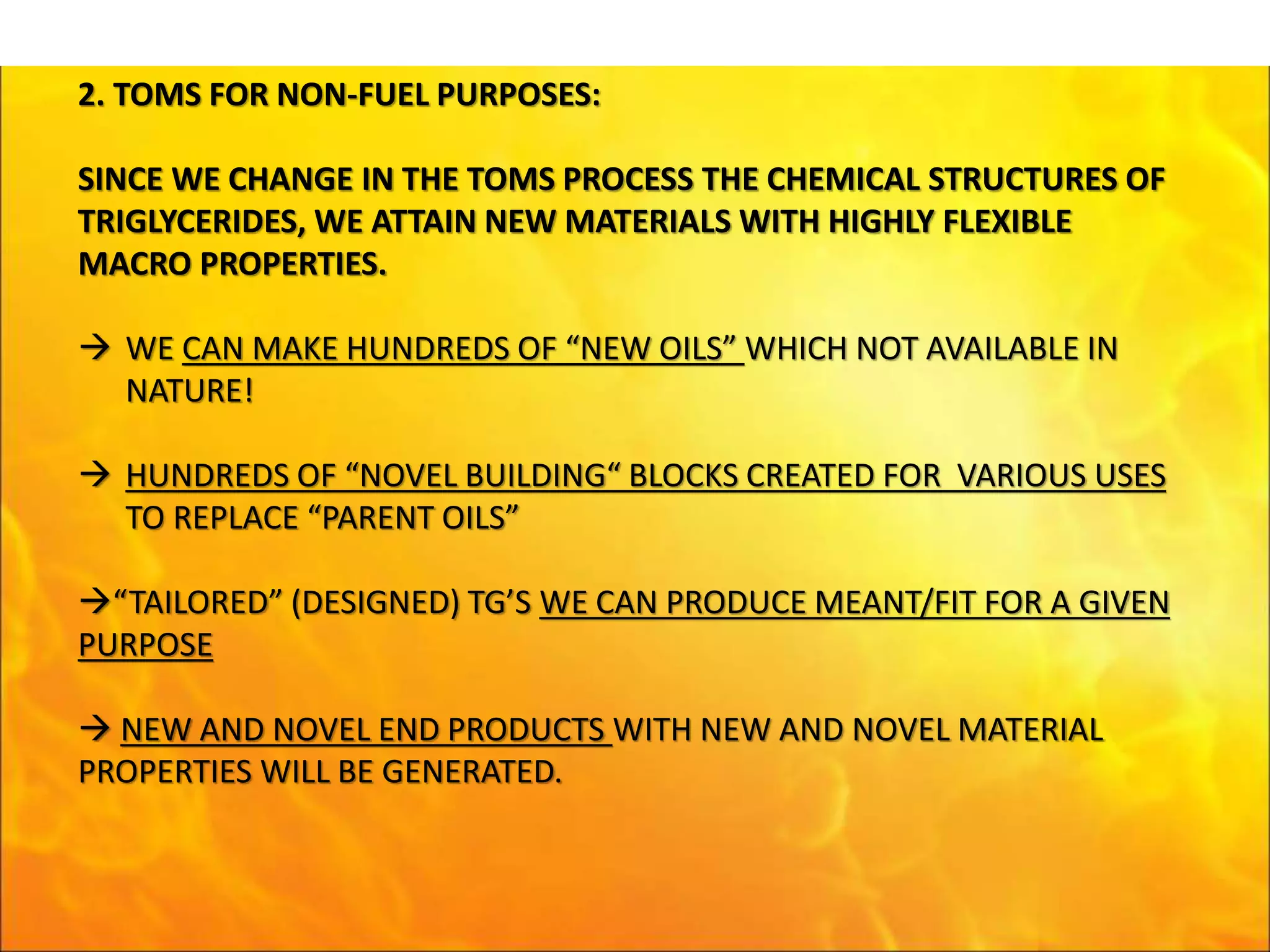
UNTIL NOW WE SPOKE ABOUT TOMS1:
TWO PHASE PRODUCTION AND APPLICABILITY OF TRIGLYCERIDES OF MODIFIED STRUCTURE
(„TOMS“)
Triglycerides Modified Triglycerides F A E E+
TOMS 1 BIOFUEL
separation
COMPONENT 1 C O M P O N E N T 2:
F A E E„LIGHT PLANT OILS“ WITH LOWERED
MOLECULAR MASSES, PARTIALLY CONTAINING
C2 SIDE CHAINS BESIDES ORIGINAL C16-C24
ACYL GROUPS ---
APPLICABLE AS HIGH VALUE ADDED PRODUCTS
TAILORED/DESIGNED
- LOWERED CALORIE FATS (DIETARY
SUPPLEMENTS)
- NOVEL MONOMERS FOR NOVEL BIOPOLYMERS
- NOVEL DEGRADABLE
BIOLUBRICANTS/HYDRAULIC FLUIDS
T
O
M
S
2
=
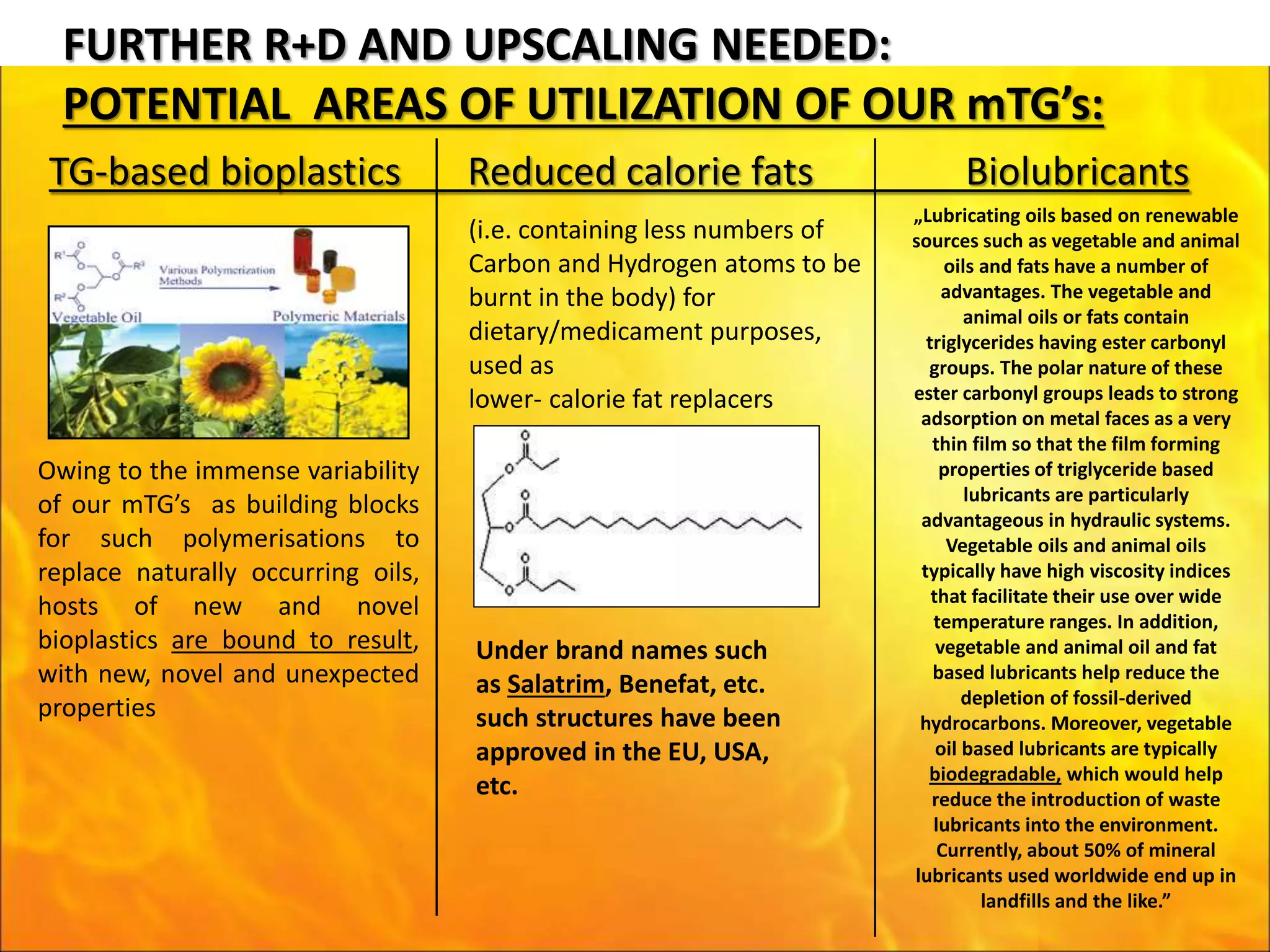
2. TOMS FOR NON-FUEL PURPOSES:
SINCE WE CHANGE IN THE TOMS PROCESS THE CHEMICAL STRUCTURES OF
TRIGLYCERIDES, WE ATTAIN NEW MATERIALS WITH HIGHLY FLEXIBLE
MACRO PROPERTIES.
 WE CAN MAKE HUNDREDS OF “NEW OILS” WHICH NOT AVAILABLE IN
NATURE!
 HUNDREDS OF “NOVEL BUILDING“ BLOCKS CREATED FOR VARIOUS USES
TO REPLACE “PARENT OILS”
“TAILORED” (DESIGNED) TG’S WE CAN PRODUCE MEANT/FIT FOR A GIVEN
PURPOSE
 NEW AND NOVEL END PRODUCTS WITH NEW AND NOVEL MATERIAL
PROPERTIES WILL BE GENERATED.
FURTHER R+D AND UPSCALING NEEDED:
POTENTIAL AREAS OF UTILIZATION OF OUR mTG’s:
TG-based bioplastics Reduced calorie fats Biolubricants
Owing to the immense variability
of our mTG’s as building blocks
for such polymerisations to
replace naturally occurring oils,
hosts of new and novel
bioplastics are bound to result,
with new, novel and unexpected
properties
(i.e. containing less numbers of
Carbon and Hydrogen atoms to be
burnt in the body) for
dietary/medicament purposes,
used as
lower- calorie fat replacers
Under brand names such
as Salatrim, Benefat, etc.
such structures have been
approved in the EU, USA,
etc.
„Lubricating oils based on renewable
sources such as vegetable and animal
oils and fats have a number of
advantages. The vegetable and
animal oils or fats contain
triglycerides having ester carbonyl
groups. The polar nature of these
ester carbonyl groups leads to strong
adsorption on metal faces as a very
thin film so that the film forming
properties of triglyceride based
lubricants are particularly
advantageous in hydraulic systems.
Vegetable oils and animal oils
typically have high viscosity indices
that facilitate their use over wide
temperature ranges. In addition,
vegetable and animal oil and fat
based lubricants help reduce the
depletion of fossil-derived
hydrocarbons. Moreover, vegetable
oil based lubricants are typically
biodegradable, which would help
reduce the introduction of waste
lubricants into the environment.
Currently, about 50% of mineral
lubricants used worldwide end up in
landfills and the like.”
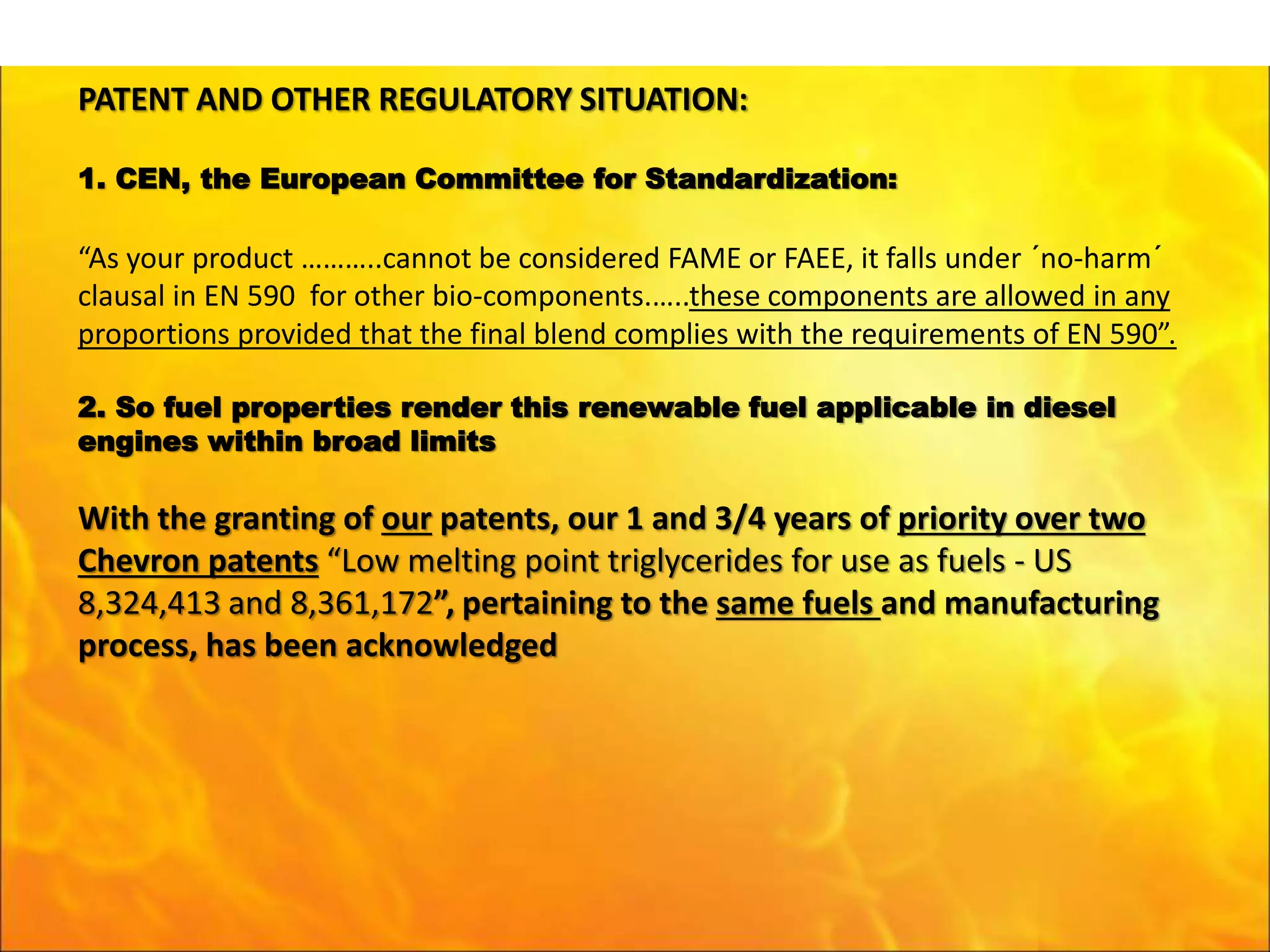
PATENT AND OTHER REGULATORY SITUATION:
1. CEN, the European Committee for Standardization:
“As your product ………..cannot be considered FAME or FAEE, it falls under ´no-harm´
clausal in EN 590 for other bio-components.…..these components are allowed in any
proportions provided that the final blend complies with the requirements of EN 590”.
2. So fuel properties render this renewable fuel applicable in diesel
engines within broad limits
With the granting of our patents, our 1 and 3/4 years of priority over two
Chevron patents “Low melting point triglycerides for use as fuels - US
8,324,413 and 8,361,172”, pertaining to the same fuels and manufacturing
process, has been acknowledged
BEHIND TOMS
Name: Janos THESZ – THE INVENTOR OF „TOMS“
Born: 15. 09. 1949., Budapest, Hungary
Lives in Budapest, owner and managing director of TRANS-KEM Technical Consultancy,
working out new routes in chemical technologies, coordinating implementation of
the same (Hungary/Taiwan/India). Specialist in organic syntheses, organofluorides, biofuels.
Degrees:
-B. Sc. (Chem.Eng.) 1979, Budapest Technical University
-M. Sc. (Chemistry) 1983, Budapest Technical University
Professional experience:
1972-1977: Chemicals and Explosives Supervisory Board (working on oil well opening devices, shaped charges)
1977-1979: Institute of Enzymology (working on exploring active centres of enzymes)
1979-1987: laboratory manager at Chinoin Pharmaceutical Works (working on scaling up pyrethroid insecticides
syntheses)
1987-1991: deputy R&D manager at Chemicals and Explosives Supervisory Board (working on heat-resistant explosives for
the oil industry)
1991-1994: R&D manager at Budapest Chemical Works (conducting research on active ingredients and synthetic routes
for pesticides)
1994: forms own company, subcontractor of Chenco GmbH (Germany) for implementing fluoro-chemical technologies in
India (Navin Fluorine, Tanfac Industries), Taiwan (Formosa Plastics), China (Maui Group)
Patents: HU 197 292 (GB 2 178 030, DE 3 619 294, FR 2 583 045)
HU 209 385
HU 226 873 & WO (international) family

TOMS short presentation (3) [Autosaved]

  • 1.
  • 2.
    TOMS=Triglycerides of ModifiedStructure FROM NATURAL OILS AND FATS we manufacture: 1. NOVEL BIOFUEL PRODUCT TOMS RSPO CEN 590 RENEWABLE DIESEL. 2. LIMITLESS NUMBER OF TAILOR MADE NEW MOLECULES FOR THE OLEOCHEMICAL INDUSTRIES (TOMS2)
  • 3.
    TOTALLY NEW CONCEPT: “TOMS”i.e. Triglycerides Of Modified Structure TOTALLY NEW CONCEPT AND APPROACH TO ELIMINATE AN ENVIRONMENTAL PROBLEM AND TO INCREASE BIOFUEL YIELDS OUT OF TG’s BY AT LEAST 15 – 20 % WITHOUT GLYCEROL. TRIGLYCERIDE >>>>>>>>>>>>>>>> MODIFIED TRIGLYCERIDE C16 – C24 GLY esters PARTLY SHORT CHAINED
  • 4.
    ADVANTAGES AND FAVOURABLEPROPERTIES OF THE NEW TOMS1 BIOFUEL AND PROCESS: • EVERY ATOM OF BIOMASS TRIGLYCERIDES IS UTILIZED FOR FUEL PURPOSES • UNIVERSAL PROCESS FOR ALL KINDS OF OILS/ANIMAL FATS • 15 - 20 % EXTRA YIELD OF BIOFUEL FROM THE FEEDSTOCK • BY RETAINING THE GLYCERYL BACKBONE NO NEED TO HANDLE A BYPRODUCT NO GLYCEROL STREAMS  30% LESS PLANT COST • “TOMS” CAN BE PRODUCED IN OLD BIODIESEL PLANTS, TOO (SOME REVAMPING) • LOWER MANUFACTURING COSTS • 30% MORE OXYGEN CONTENT, BETTER COMBUSTION ! CLEAN BURN ! MINIMUM PARTICULATE MATTER ! • BETTER COLD FLOW PROPERTIES, CAN BE DESIGNED FOR SPECIFIC USE. • WASTELESS, ECO-FRIENDLY PROCESS, NO WATER USED, NO SEWAGE • MORE STABLE PRODUCT • 100% RENEWABLE (“GREEN”) AS NO METHANOL USED IN CASE OF BIOETHYL ACETATE USAGE • CAN BE BLENDED TO PETRODIESEL WITHIN EN590 LIMIT!!! 80% • ALSO UTILISED AS TOMS CEN 590 100% AS COMPLETE DIESEL REPLACER.
  • 5.
    TOMS vs FAMEEQUIPMENT REQUIREMENTS YELLOW: NOT NEEDED IN TOMS PRODUCTION = LESS CAPEX
  • 6.
    Visual Difference: FAME +Glycerol vs. TOMS from the same volume of feedstock oil a. FAME b. Glycerol c. TOMS, no glycerol, but + 15 - 20 % extra fuel mass 7.01 7.00 6.70 6.45 6.23 5.98 5.56 7.12 6.42 6.75 6.18 5.51 4.98 5.61 0.00 2.00 4.00 6.00 8.00 992.2 1196.4 1292.9 1392.5 1593.8 1789.7 1894.7 SpecificNOxemission [g/kWh] Engine speed [1/min] Comparison of the specific NOx emissions while engine full load Specific NOx emission - Diesel fuel Specific NOx emission - TBK Biodiesel 0.680 0.380 0.230 0.190 0.118 0.078 0.106 0.110 0.085 0.070 0.042 0.027 0.015 0.0150.000 0.200 0.400 0.600 0.800 992.2 1196.4 1292.9 1392.5 1593.8 1789.7 1894.7 Smoke[1/m] Engine speed [1/min] Comparison of the smoke values while engine full load Smoke values - Diesel fuel 0.502 0.523 0.501 0.468 0.513 0.488 0.480 0.459 0.442 0.485 0.090 0.092 0.086 0.097 0.099 0.093 0.089 0.091 0.085 0.088 0 0.1 0.2 0.3 0.4 0.5 0.6 1. 2. 3. 4. 5. 6. 7. 8. 9. 10. Smoke[1/m] Measure ordinal number Comparison of the free peak smoke values Free peak smoke - Diesel fuel Free peak smoke - TBK Biodiesel Better Emission Values than Petrodiesel c a b
  • 7.
    EXAMPLE RBD PO Stearinstocks usually create bottleneck, as these are not so applicable for FAME manufacture, owing to the high gelling point of the resulting conventional BD (19 - 20°C). However, using our TOMS methodology, we produce + 15 - 20% extra biofuel from this feedstock, with greatly improved cold properties. Similarly, from refined palm oil feedstock one gets Fame with 15°C gelling point, whereas TOMS is still a liquid below 4°C. (Potential for up to -12 GP from Palm Oil Feedstock)
  • 8.
    UNTIL NOW WESPOKE ABOUT TOMS1: TWO PHASE PRODUCTION AND APPLICABILITY OF TRIGLYCERIDES OF MODIFIED STRUCTURE („TOMS“) Triglycerides Modified Triglycerides F A E E+ TOMS 1 BIOFUEL separation COMPONENT 1 C O M P O N E N T 2: F A E E„LIGHT PLANT OILS“ WITH LOWERED MOLECULAR MASSES, PARTIALLY CONTAINING C2 SIDE CHAINS BESIDES ORIGINAL C16-C24 ACYL GROUPS --- APPLICABLE AS HIGH VALUE ADDED PRODUCTS TAILORED/DESIGNED - LOWERED CALORIE FATS (DIETARY SUPPLEMENTS) - NOVEL MONOMERS FOR NOVEL BIOPOLYMERS - NOVEL DEGRADABLE BIOLUBRICANTS/HYDRAULIC FLUIDS T O M S 2 =
  • 9.
    2. TOMS FORNON-FUEL PURPOSES: SINCE WE CHANGE IN THE TOMS PROCESS THE CHEMICAL STRUCTURES OF TRIGLYCERIDES, WE ATTAIN NEW MATERIALS WITH HIGHLY FLEXIBLE MACRO PROPERTIES.  WE CAN MAKE HUNDREDS OF “NEW OILS” WHICH NOT AVAILABLE IN NATURE!  HUNDREDS OF “NOVEL BUILDING“ BLOCKS CREATED FOR VARIOUS USES TO REPLACE “PARENT OILS” “TAILORED” (DESIGNED) TG’S WE CAN PRODUCE MEANT/FIT FOR A GIVEN PURPOSE  NEW AND NOVEL END PRODUCTS WITH NEW AND NOVEL MATERIAL PROPERTIES WILL BE GENERATED.
  • 10.
    FURTHER R+D ANDUPSCALING NEEDED: POTENTIAL AREAS OF UTILIZATION OF OUR mTG’s: TG-based bioplastics Reduced calorie fats Biolubricants Owing to the immense variability of our mTG’s as building blocks for such polymerisations to replace naturally occurring oils, hosts of new and novel bioplastics are bound to result, with new, novel and unexpected properties (i.e. containing less numbers of Carbon and Hydrogen atoms to be burnt in the body) for dietary/medicament purposes, used as lower- calorie fat replacers Under brand names such as Salatrim, Benefat, etc. such structures have been approved in the EU, USA, etc. „Lubricating oils based on renewable sources such as vegetable and animal oils and fats have a number of advantages. The vegetable and animal oils or fats contain triglycerides having ester carbonyl groups. The polar nature of these ester carbonyl groups leads to strong adsorption on metal faces as a very thin film so that the film forming properties of triglyceride based lubricants are particularly advantageous in hydraulic systems. Vegetable oils and animal oils typically have high viscosity indices that facilitate their use over wide temperature ranges. In addition, vegetable and animal oil and fat based lubricants help reduce the depletion of fossil-derived hydrocarbons. Moreover, vegetable oil based lubricants are typically biodegradable, which would help reduce the introduction of waste lubricants into the environment. Currently, about 50% of mineral lubricants used worldwide end up in landfills and the like.”
  • 11.
    PATENT AND OTHERREGULATORY SITUATION: 1. CEN, the European Committee for Standardization: “As your product ………..cannot be considered FAME or FAEE, it falls under ´no-harm´ clausal in EN 590 for other bio-components.…..these components are allowed in any proportions provided that the final blend complies with the requirements of EN 590”. 2. So fuel properties render this renewable fuel applicable in diesel engines within broad limits With the granting of our patents, our 1 and 3/4 years of priority over two Chevron patents “Low melting point triglycerides for use as fuels - US 8,324,413 and 8,361,172”, pertaining to the same fuels and manufacturing process, has been acknowledged
  • 12.
    BEHIND TOMS Name: JanosTHESZ – THE INVENTOR OF „TOMS“ Born: 15. 09. 1949., Budapest, Hungary Lives in Budapest, owner and managing director of TRANS-KEM Technical Consultancy, working out new routes in chemical technologies, coordinating implementation of the same (Hungary/Taiwan/India). Specialist in organic syntheses, organofluorides, biofuels. Degrees: -B. Sc. (Chem.Eng.) 1979, Budapest Technical University -M. Sc. (Chemistry) 1983, Budapest Technical University Professional experience: 1972-1977: Chemicals and Explosives Supervisory Board (working on oil well opening devices, shaped charges) 1977-1979: Institute of Enzymology (working on exploring active centres of enzymes) 1979-1987: laboratory manager at Chinoin Pharmaceutical Works (working on scaling up pyrethroid insecticides syntheses) 1987-1991: deputy R&D manager at Chemicals and Explosives Supervisory Board (working on heat-resistant explosives for the oil industry) 1991-1994: R&D manager at Budapest Chemical Works (conducting research on active ingredients and synthetic routes for pesticides) 1994: forms own company, subcontractor of Chenco GmbH (Germany) for implementing fluoro-chemical technologies in India (Navin Fluorine, Tanfac Industries), Taiwan (Formosa Plastics), China (Maui Group) Patents: HU 197 292 (GB 2 178 030, DE 3 619 294, FR 2 583 045) HU 209 385 HU 226 873 & WO (international) family