MITTAL COLLEGE OF NURSING
AJMER
PRESENTATION ON-
TOCOLYTIC AGENT
SUBMITTED TO: SUBMITTED BY:
MISS.SNEHLATA PARASHAR MR.SHIVPAL DHAKAR
ASSOCIATE PROFESSER B.SC NURSING 4TH YEAR
(HOD)OBG BATCH 2017-2018
INTRODUCTION
 Tocolytics (also called anti-contraction
medications or labor suppressants) are
medications used to suppress premature labor.
Preterm birth accounts for 70% of neonatal
deaths.Therefore, tocolytic therapy is provided when
delivery would result in premature birth, postponing
delivery long enough for the administration
of glucocorticoids, which accelerate fetal lung maturity
but may require one to two days to take effect.
DEFINITION
 A medication that can inhibit labor, slow down or halt
the contractions of the uterus. Tocolytic agents are
widely used today to treat premature labor and
permit pregnancy to proceed and so permit the fetus
to gain in size and maturity before being born.
INDICATION
 Generally,from 24 gestation week onward.
 Before 37 gestational week.
 Sponataneous premature contractions.
 No evidence of infection.
 No life threatening
CONTRA-INDICATION
Several general factors may contraindicate delaying
childbirth with the use of tocolytic medications.
 Pregnant woman has severe pregnancy-induced
hypertension.
 Fetus weighs less than 2.5 kg.
 intrauterine infection is present.
 Lethal congenital or chromosomal abnormalities.
 Intrauterine fetal demise.
 Placental insufficiency.
Mechanism of action
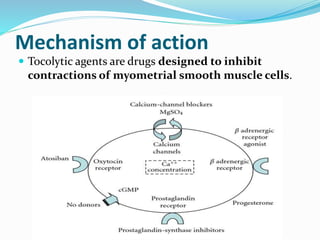
 Tocolytic agents are drugs designed to inhibit
contractions of myometrial smooth muscle cells.
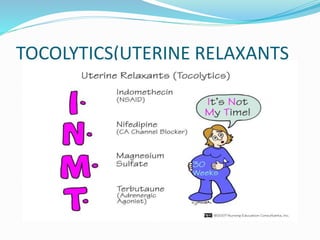
TOCOLYTICS(UTERINE RELAXANTS
CLASSIFICATION OF TOCOLYTICS
 β2 adrenergic receptor agonist-
-Terbutaline,Isoxsuprine,Retodrine
 Magnesium sulphate
 Calcium channel blocker
-Nifedipine and Nicardipine
 Oxytocin receptor antagonist
 Prostaglandin synthetase inhibitors
-Indomethacin,Sulindac
 Nitric oxide
-Nitroglycerine
 Halothane
β2 adrenergic receptor agonist-
 Terbutaline
 Isoxsuprine (DUVADILAN)
 Retodrine hydrochloride (YUTOPAR)
Isoxsuprine (DUVADILAN)
Acts directly on vascular smooth muscles, causes
stimulation and uterine relaxation.
MECHANISM OF ACTION
 Mechanism of action :- Activation of intracellular
enzymes (adenylate cyclase, cAMP, Protein kinase,
decreases intracellular free Ca++ ( Ca++) & inhibits
activation of MLCK ( ) Reduced interaction of
actin & myosin smooth muscle relaxation.
 DOSAGE AND ROUTES
Initial
IV drip 100 mg in 5% dextrose at rate of 0.2 μg per min
Maintainance
IM 10mg 6hourly for 24 hours ,tab 10mg 6-8hourly.
 CONTRA-INDICATION
-hypersensitivity
-postpartum
 SIDE EFFECTS
-hypotension
-nausea
-tachycardia
Magnesium sulphate
 Magnesium sulphate (MgSO4) has been
successfully used to inhibit premature labor.
 Magnesium sulphate is used mainly for
patients who have contraindications to beta-
adrenergic agents.
 Magnesium sulfate used as a second-line
tocolysis .
Mechanism of action
 Acts by competitive inhibition of Ca2+ ion
either at the motor end place at the cell
membrane reducing calcium influx. es
acetylcholine release & its sensitivity at
motor end plate.
 Direct depressant action on uterine muscle.
 DOSAGE AND ROUTES
Initial
Loading dose 4-6gm IV (10-20% solution) over 20-30
mins.
Maintainance
followed by an infusion of 1-2gm/hr to continue
tocolysis for 12 hrs after the contractions have stopped
 Contraindications
Patient with myasthenia gravis , heart block & impaired
renal function.
 Side effects & precautions :-
* Common maternal side effects are flushing,
perspiration, headache, muscle weakness, rarely
pulmonary oedema.
* Neonatal side effects are lethargy, hypotonia, rarely
respiratory depression.
CALCIUM CHANNEL BLOCKER
 Calcium channel blockers such as nifidipine
appear to be powerful uterine relaxant. The
mechanism of action appears to be derived from
blockade of voltage-dependent calcium channels
in myometrial cells.
 E.g. - Nifedipine, Nicadipine, Verapamil
MECHANISM OF ACTION
 It blocks the entry of calcium inside the cell.
 i.e;block the influx of calcium ions , thereby reducing
the intra cellular calcium,reduces the tone of
myometrium and opposes the contraction.
 Nifedipine,which has prominent smooth muscle relaxant
action is effective, if used early.
CONTRA –INDICATION
CHF , Hypotension, aortic stenosis
 DOSAGE AND ROUTES
can be given by sublingual and oral route i.e; a standard
dosage regimens of 20 mg every 6 hours till uterine
contraction subside.
 Side effect
Hypotension, Headache, Flushing , tachycardia and
nausea.
 Precautions
Combined therapy with Beta mimetic or MgSO4 should
be avoided.
PROSTAGLANDIN INHIBITORS
 Indomethacin (Cyclo-oxygenase inhibitor)
 Suldinac another NSAID is also used as it has less
placental transfer.
Mechanism of action
es synthesis of PGs thereby es intracellular free Ca++,
activation of myosin light chain kinase and uterine
contractions.
 CONTRA-INDICATIONS
Hepatic diseases, active peptic ulcer ,coagulation
disorders.
 DOSAGE AND ROUTES
Loading dose 50mg PO or PR followed by 25mg every 6
hrs for 48 hrs.
 SIDE EFFECTS
Maternal
headache,dizziness,nausea,vomiting,diarrhoea,
haematemesis
Neonatal-neonatal pulmonary
hypertension,oligohydraminos,
Oxytocin Antagonists
 E.g. – Atosiban
is a peptide analogue of oxytocin,acts as an antagonist
at oxytocin receptors.
 Has been licensed in UK for use in pre-term labour.
Mechanism of action
blocks myometrial oxytocin receptors. It inhibits
intracellular Ca++ release, release of PGs & thereby
inhibits myometrial contractions
 CONTRA-INDICATIONS
Hepatic and Renal diseases.
 DOSAGE AND ROUTES
Adminstered i.e;6.75mg as a bolus over 1 minute
followed by infusion at 18mg/hour for 3 hours and
6mg/hour for upto 45 hours.
Total duration of treatment not to exceed 48hours and
total dose not to be exceed 330mg.
 SIDE EFFECTS
Nausea, vomiting,dyspnea,chest pain
Nitric Oxide (NO) Donors
 E.g. – Glyceryl trinitrate (GTN)
 Mechanism of action :- Smooth muscle relaxant.
 Doses :- Patches
 Side effects :- May cause cervical ripening, Headache
Conclusion
 As I present my topic on tocolytics agent I explain
their mechanism of action , indicaion , side effects ,
complication ,dosage and drugs.
 I thanks to MRS. SNEHLATA PARASHAR for guiding
me and helping me, and also thanks to my classmates
for their cooperation.
BIBLIOGRAPHY
 BOOK
1.MATERNAL-FETAL AND NEONATAL MEDICINE
(volume 30)
AUTHOR-DEV MAULIK
2.MIDWIFERY AND GYNECOLOGICAL NURSING
AUTHOR-NEELAM KUMARI,DR.PREETI GUPTA
WEB
1. https://www.slideshare.net/ankita0809/oxytocics-
tocolytics
2. https://www.slideshare.net/SnehlataParashar/diuretics-
and-tocolytics
MCQ
1.Tocolytic drugs are used for
(A)Uterine contraction
(B)Bronchodilation
(C)Uterine relaxants
(D)Brochoconstrictor
2.Select the drug which is used for suppress the labour
(A)Atropine
(B)Ritrodine
(C)Prostaglandin E2
(D)Progesterone
TOCOLYTIC AGENT.pptx

TOCOLYTIC AGENT.pptx

  • 1.
    MITTAL COLLEGE OFNURSING AJMER PRESENTATION ON- TOCOLYTIC AGENT SUBMITTED TO: SUBMITTED BY: MISS.SNEHLATA PARASHAR MR.SHIVPAL DHAKAR ASSOCIATE PROFESSER B.SC NURSING 4TH YEAR (HOD)OBG BATCH 2017-2018
  • 2.
    INTRODUCTION  Tocolytics (alsocalled anti-contraction medications or labor suppressants) are medications used to suppress premature labor. Preterm birth accounts for 70% of neonatal deaths.Therefore, tocolytic therapy is provided when delivery would result in premature birth, postponing delivery long enough for the administration of glucocorticoids, which accelerate fetal lung maturity but may require one to two days to take effect.
  • 3.
    DEFINITION  A medicationthat can inhibit labor, slow down or halt the contractions of the uterus. Tocolytic agents are widely used today to treat premature labor and permit pregnancy to proceed and so permit the fetus to gain in size and maturity before being born.
  • 4.
    INDICATION  Generally,from 24gestation week onward.  Before 37 gestational week.  Sponataneous premature contractions.  No evidence of infection.  No life threatening
  • 5.
    CONTRA-INDICATION Several general factorsmay contraindicate delaying childbirth with the use of tocolytic medications.  Pregnant woman has severe pregnancy-induced hypertension.  Fetus weighs less than 2.5 kg.  intrauterine infection is present.  Lethal congenital or chromosomal abnormalities.  Intrauterine fetal demise.  Placental insufficiency.
  • 6.
    Mechanism of action Tocolytic agents are drugs designed to inhibit contractions of myometrial smooth muscle cells.
  • 7.
  • 8.
    CLASSIFICATION OF TOCOLYTICS β2 adrenergic receptor agonist- -Terbutaline,Isoxsuprine,Retodrine  Magnesium sulphate  Calcium channel blocker -Nifedipine and Nicardipine  Oxytocin receptor antagonist  Prostaglandin synthetase inhibitors -Indomethacin,Sulindac  Nitric oxide -Nitroglycerine  Halothane
  • 9.
    β2 adrenergic receptoragonist-  Terbutaline  Isoxsuprine (DUVADILAN)  Retodrine hydrochloride (YUTOPAR) Isoxsuprine (DUVADILAN) Acts directly on vascular smooth muscles, causes stimulation and uterine relaxation.
  • 10.
    MECHANISM OF ACTION Mechanism of action :- Activation of intracellular enzymes (adenylate cyclase, cAMP, Protein kinase, decreases intracellular free Ca++ ( Ca++) & inhibits activation of MLCK ( ) Reduced interaction of actin & myosin smooth muscle relaxation.
  • 11.
     DOSAGE ANDROUTES Initial IV drip 100 mg in 5% dextrose at rate of 0.2 μg per min Maintainance IM 10mg 6hourly for 24 hours ,tab 10mg 6-8hourly.  CONTRA-INDICATION -hypersensitivity -postpartum  SIDE EFFECTS -hypotension -nausea -tachycardia
  • 12.
    Magnesium sulphate  Magnesiumsulphate (MgSO4) has been successfully used to inhibit premature labor.  Magnesium sulphate is used mainly for patients who have contraindications to beta- adrenergic agents.  Magnesium sulfate used as a second-line tocolysis .
  • 13.
    Mechanism of action Acts by competitive inhibition of Ca2+ ion either at the motor end place at the cell membrane reducing calcium influx. es acetylcholine release & its sensitivity at motor end plate.  Direct depressant action on uterine muscle.
  • 14.
     DOSAGE ANDROUTES Initial Loading dose 4-6gm IV (10-20% solution) over 20-30 mins. Maintainance followed by an infusion of 1-2gm/hr to continue tocolysis for 12 hrs after the contractions have stopped  Contraindications Patient with myasthenia gravis , heart block & impaired renal function.
  • 15.
     Side effects& precautions :- * Common maternal side effects are flushing, perspiration, headache, muscle weakness, rarely pulmonary oedema. * Neonatal side effects are lethargy, hypotonia, rarely respiratory depression.
  • 16.
    CALCIUM CHANNEL BLOCKER Calcium channel blockers such as nifidipine appear to be powerful uterine relaxant. The mechanism of action appears to be derived from blockade of voltage-dependent calcium channels in myometrial cells.  E.g. - Nifedipine, Nicadipine, Verapamil
  • 17.
    MECHANISM OF ACTION It blocks the entry of calcium inside the cell.  i.e;block the influx of calcium ions , thereby reducing the intra cellular calcium,reduces the tone of myometrium and opposes the contraction.  Nifedipine,which has prominent smooth muscle relaxant action is effective, if used early. CONTRA –INDICATION CHF , Hypotension, aortic stenosis
  • 18.
     DOSAGE ANDROUTES can be given by sublingual and oral route i.e; a standard dosage regimens of 20 mg every 6 hours till uterine contraction subside.  Side effect Hypotension, Headache, Flushing , tachycardia and nausea.  Precautions Combined therapy with Beta mimetic or MgSO4 should be avoided.
  • 19.
    PROSTAGLANDIN INHIBITORS  Indomethacin(Cyclo-oxygenase inhibitor)  Suldinac another NSAID is also used as it has less placental transfer. Mechanism of action es synthesis of PGs thereby es intracellular free Ca++, activation of myosin light chain kinase and uterine contractions.
  • 20.
     CONTRA-INDICATIONS Hepatic diseases,active peptic ulcer ,coagulation disorders.  DOSAGE AND ROUTES Loading dose 50mg PO or PR followed by 25mg every 6 hrs for 48 hrs.  SIDE EFFECTS Maternal headache,dizziness,nausea,vomiting,diarrhoea, haematemesis Neonatal-neonatal pulmonary hypertension,oligohydraminos,
  • 21.
    Oxytocin Antagonists  E.g.– Atosiban is a peptide analogue of oxytocin,acts as an antagonist at oxytocin receptors.  Has been licensed in UK for use in pre-term labour. Mechanism of action blocks myometrial oxytocin receptors. It inhibits intracellular Ca++ release, release of PGs & thereby inhibits myometrial contractions
  • 22.
     CONTRA-INDICATIONS Hepatic andRenal diseases.  DOSAGE AND ROUTES Adminstered i.e;6.75mg as a bolus over 1 minute followed by infusion at 18mg/hour for 3 hours and 6mg/hour for upto 45 hours. Total duration of treatment not to exceed 48hours and total dose not to be exceed 330mg.  SIDE EFFECTS Nausea, vomiting,dyspnea,chest pain
  • 23.
    Nitric Oxide (NO)Donors  E.g. – Glyceryl trinitrate (GTN)  Mechanism of action :- Smooth muscle relaxant.  Doses :- Patches  Side effects :- May cause cervical ripening, Headache
  • 24.
    Conclusion  As Ipresent my topic on tocolytics agent I explain their mechanism of action , indicaion , side effects , complication ,dosage and drugs.  I thanks to MRS. SNEHLATA PARASHAR for guiding me and helping me, and also thanks to my classmates for their cooperation.
  • 25.
    BIBLIOGRAPHY  BOOK 1.MATERNAL-FETAL ANDNEONATAL MEDICINE (volume 30) AUTHOR-DEV MAULIK 2.MIDWIFERY AND GYNECOLOGICAL NURSING AUTHOR-NEELAM KUMARI,DR.PREETI GUPTA WEB 1. https://www.slideshare.net/ankita0809/oxytocics- tocolytics 2. https://www.slideshare.net/SnehlataParashar/diuretics- and-tocolytics
  • 26.
    MCQ 1.Tocolytic drugs areused for (A)Uterine contraction (B)Bronchodilation (C)Uterine relaxants (D)Brochoconstrictor 2.Select the drug which is used for suppress the labour (A)Atropine (B)Ritrodine (C)Prostaglandin E2 (D)Progesterone