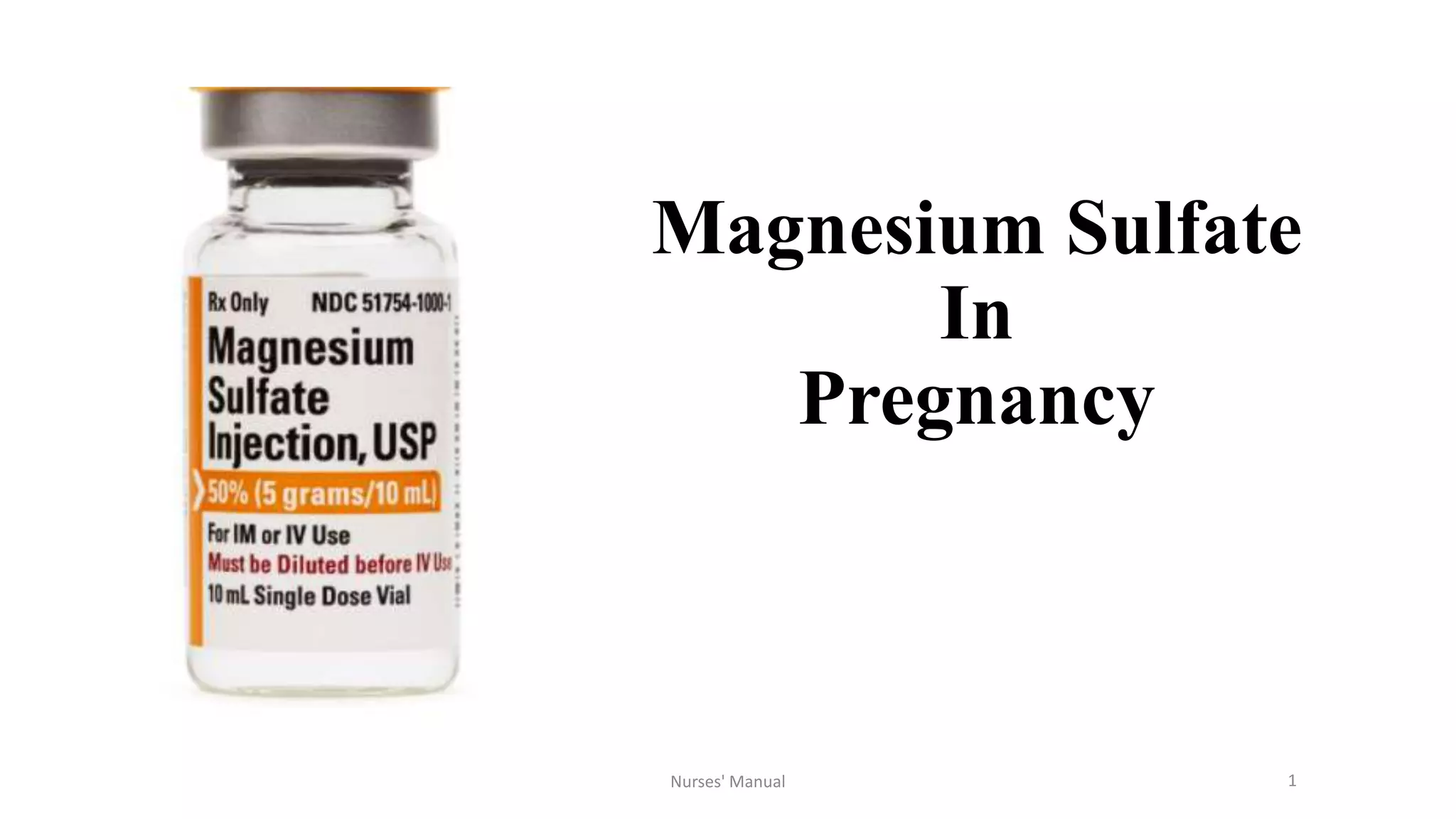



Magnesium Sulfate
In
Pregnancy
Nurses' Manual 1
Introduction
Magnesium sulfate is the drug of choice for preventing and treating
convulsion in severe pre-eclampsia and eclampsia.
Nurses' Manual 2
Facts On Magnesium Sulfate
• AKA Epsom salt
• 1gm of salt= 98mg elements of magnesium
• Is an inorganic salt with formula MgSO4
• Is in the WHO model list of Essential Medicine
• Highly water soluble
• Solubility inhibited by lipids
Nurses' Manual 3
Physiological Roles
• Acts as mediator for Na⁺/K⁺-ATPase system.
• Helps in oxidative phosphorylation, glucose utilization and protein
synthesis
• Generation of cAMP via adenyl cyclase.
• Control release and action of parathyroid hormone thus regulates Ca2+
metabolism
• Synthesis of DNA,RNA and protein
Nurses' Manual 4
Cardiovascular Effects
• Direct depressant on myocardial and vascular smooth muscle.
• Reduce systolic BP but no changes in DBP.
• Inhibit release of catecholamines from adrenal medulla.
• Act as anti arrhythmic and slows HR.
• Reduce cardiac output and vascular tone causing hypotension
Nurses' Manual 5
Nervous System Effects
• Reduce release of Ach at Neuromuscular junction by antagonizing Ca2+
ions.
• Reduce excitability of nerves.
• Act as an anti convulsant by blocking Ca2+ channel.
Nurses' Manual 6
Routes
• Iv
• Im as anticonvulsants
• Orally -as laxative
Nurses' Manual 7
Uses In Gynae/Obs
• Severe pre-eclampsia
• Eclampsia
• Preterm labour (as tocolytic agent)
• Prevention of cerebral palsy in preterm babies (due to its
neuroprotective action)
Nurses' Manual 8
Other uses
• In hypomagnesia
• Treatment of severe asthma exacerbation
• Constipation
• Barium poisoning
Nurses' Manual 9
Mode Of Action
• Decrease acetylcholine(Ach) release from nerve endings and reduce
motor end plate sensitivity to Ach.
• Blocks calcium channel
• Cause vasodilation, increase cerebral, uterine and renal blood flow
Nurses' Manual 10
Pharmacology
For anticonvulsant action
• Onset: IV immediate/ IM 1 hour
• Protein bound 30%
• Excretion: via urine
Nurses' Manual 11
Advantages of MgSO4
• Relatively safe drug and DOC
• Can be given IV/IM
• In appropriate dose, it doesn’t affect fetus
• In appropriate dose, it doesn’t sedate patient
• Inexpensive and is on essential drug list
• It is metabolized by kidney, hence doesn’t cause hepatic problems
that are often associated with severe pre-eclampsia
Nurses' Manual 12
Disadvantages
• Respiratory depression
• Respiratory arrest
Nurses' Manual 13
Administration
• MgSO4 is the drug of choice in all circumstances – it should
always be available at both health centre and hospital levels
• Give diazepam 10 mg (2 ml) over 2 minutes if
• There is MgSO4 toxicity
• MgSO4 is not available
Nurses' Manual 14
In Health Centre
Loading dose:
• Wash hand properly and dry well
• Tell women that she may feel warmth while the medicine is given.
Nurses' Manual 15
Give 4 g of 20% MgSO4 solution
IV slowly over 5-15 min.
• Take one 20ml sterile syringe
• Draw 8ml(4g) of MgSO4 50% into
syringe.
• Add/dissolve with 12ml of sterile
water for injection to make a
solution of 20%.
• Observe for any complications
while giving.
Nurses' Manual 16
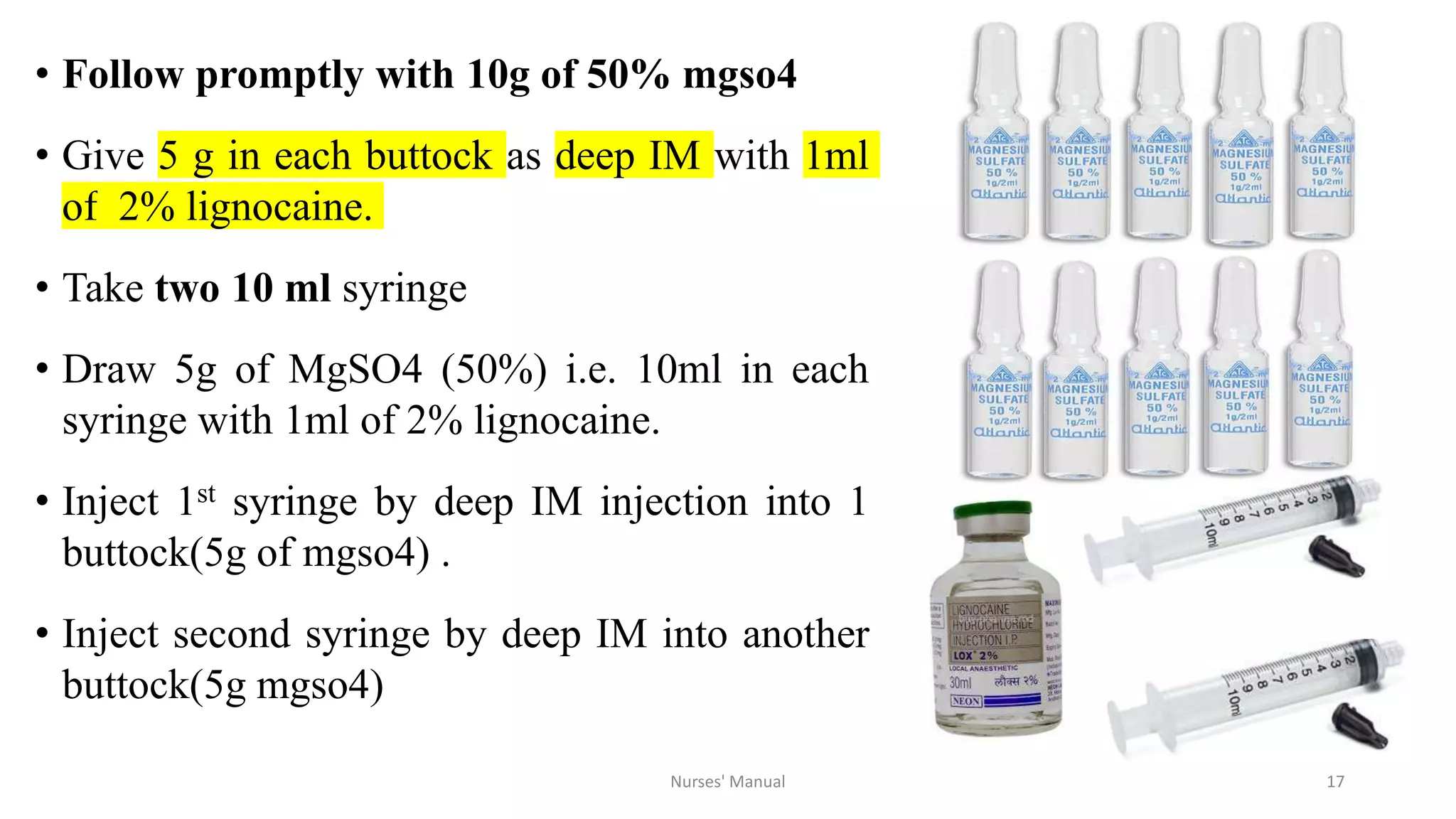
• Follow promptly with 10g of 50% mgso4
• Give 5 g in each buttock as deep IM with 1ml
of 2% lignocaine.
• Take two 10 ml syringe
• Draw 5g of MgSO4 (50%) i.e. 10ml in each
syringe with 1ml of 2% lignocaine.
• Inject 1st syringe by deep IM injection into 1
buttock(5g of mgso4) .
• Inject second syringe by deep IM into another
buttock(5g mgso4)
Nurses' Manual 17
• Place needle and syringe in puncture proof container
• Remove gloves and discard properly
• Wash hand thoroughly with soap and water
• If convulsant reoccur after 15minutes, give 2g of mgso4(4ml) IV over
five minutes.
• Rationale:
Pre-eclampsia can quickly develop into eclampsia
Shaking during transport is a convulsion stimulus
Nurses' Manual 18
In Hospitals
• Loading dose-same as above
• Maintenance dose:
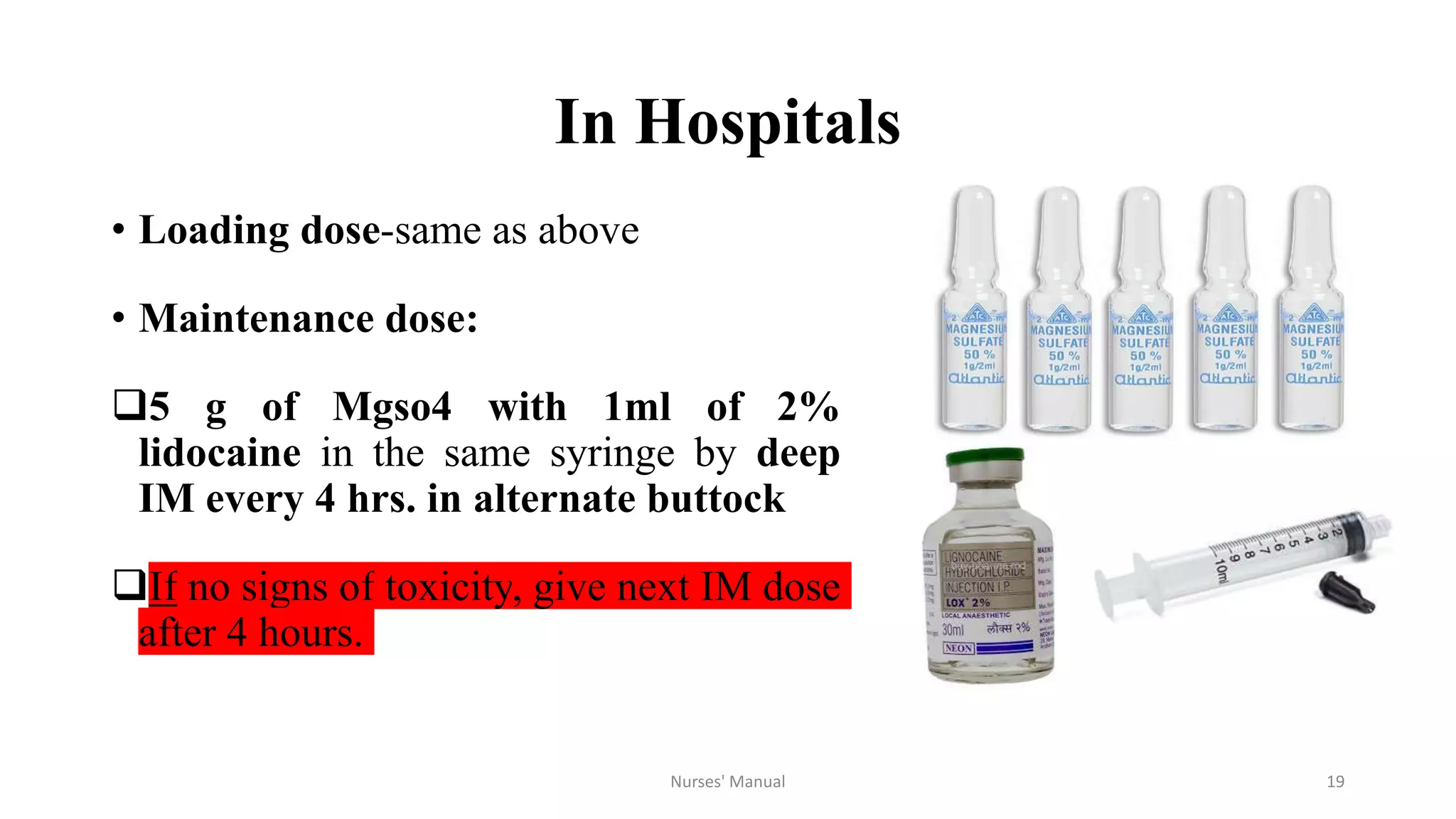
5 g of Mgso4 with 1ml of 2%
lidocaine in the same syringe by deep
IM every 4 hrs. in alternate buttock
If no signs of toxicity, give next IM dose
after 4 hours.
Nurses' Manual 19
• Maintaining IV dose:
Continue treatment for 24 hours after childbirth or the
last convulsion, whichever occur last.
Nurses' Manual 20
TIPS
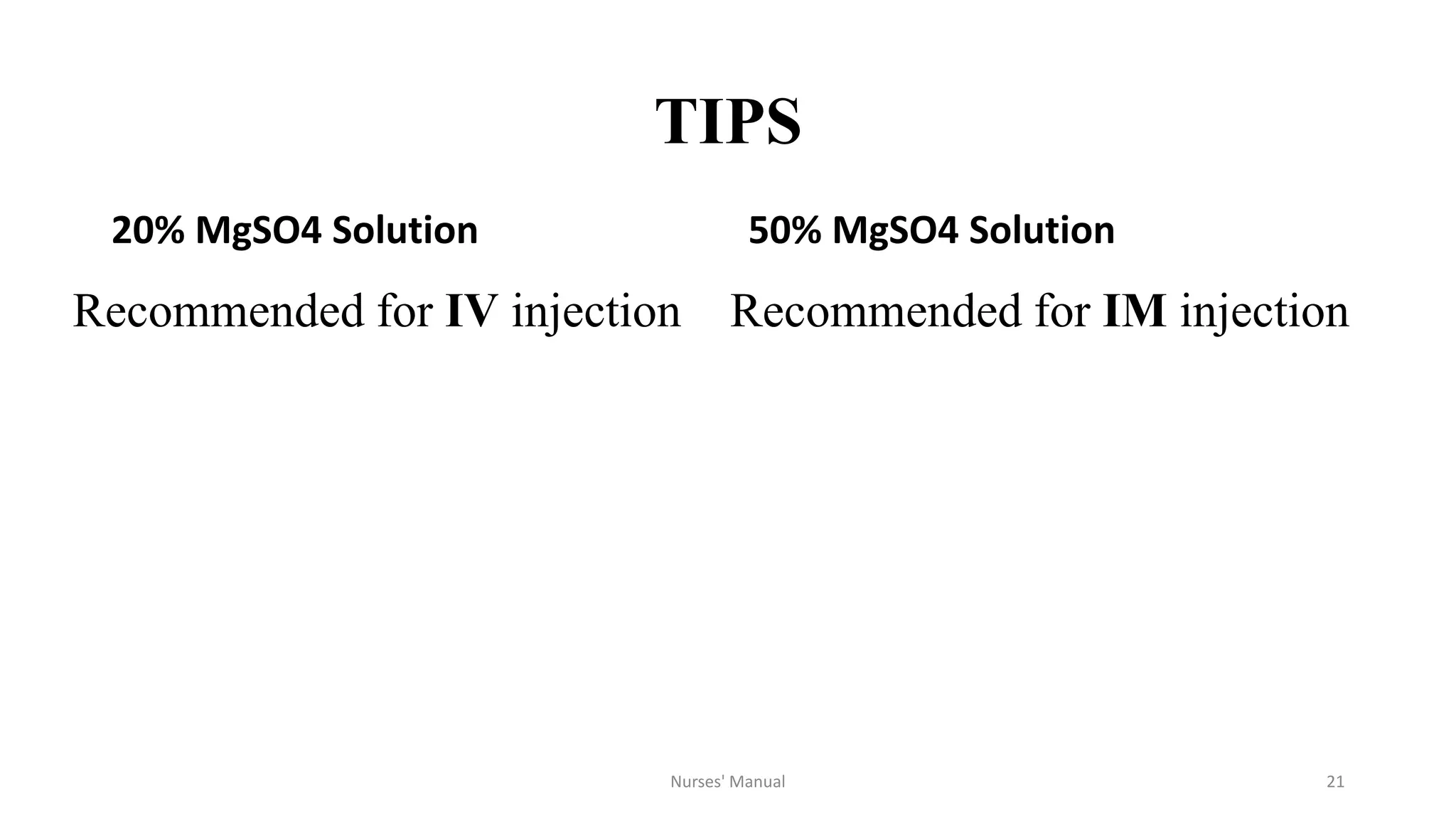
20% MgSO4 Solution
Recommended for IV injection
50% MgSO4 Solution
Recommended for IM injection
21Nurses' Manual
Monitoring Signs Of Toxicity
• Count Respiration rate for 1 minute every hour, should be ≥ 16
• Check Patellar reflex q. 4 hours, should be present
• Measure Urine output, should be ≥30ml/hr.
• Measure BP
• Measure serum magnesium level (1.7 to 2.2 mg/dL)
Nurses' Manual 22
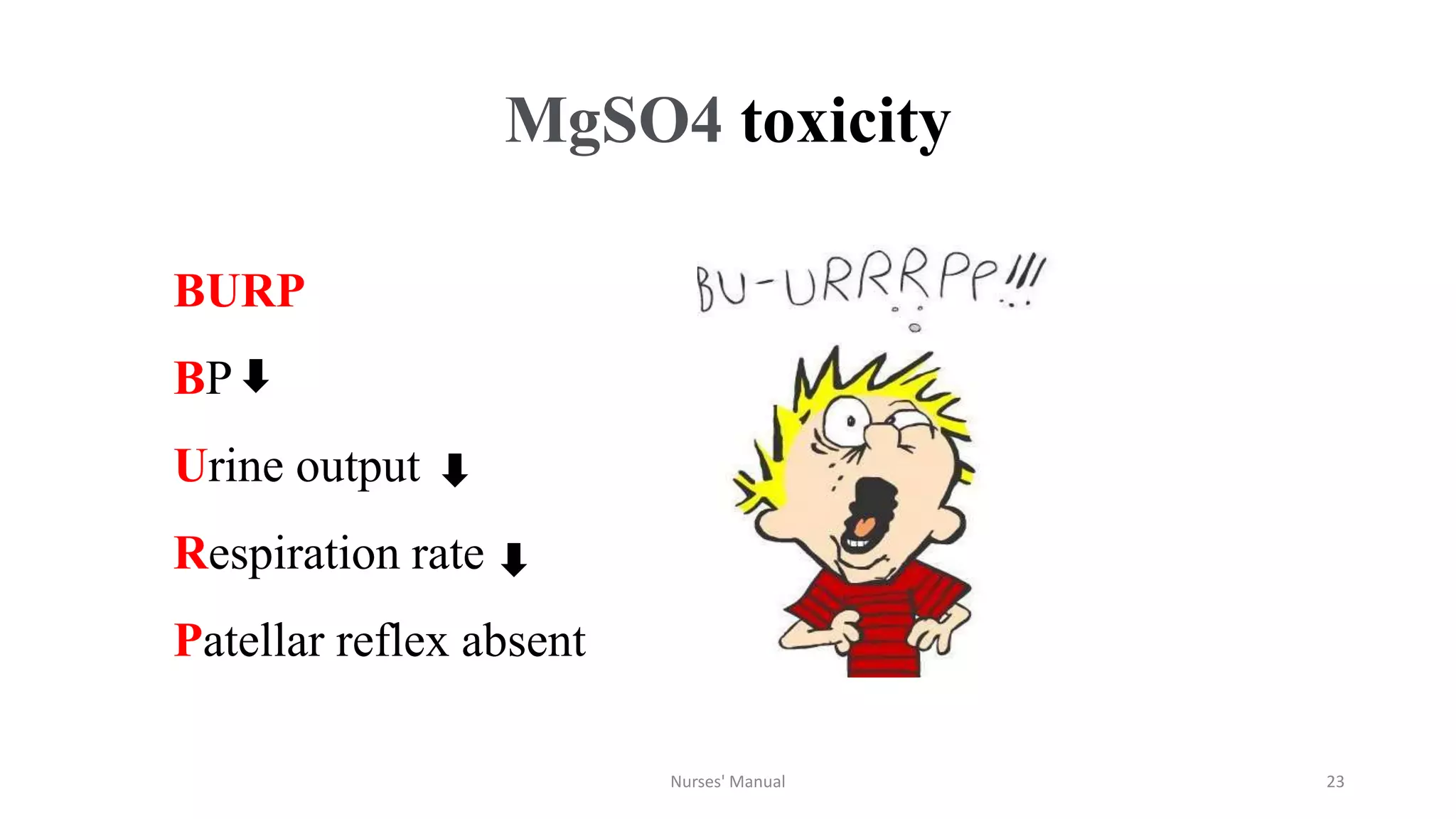
MgSO4 toxicity
Nurses' Manual 23
BURP
BP
Urine output
Respiration rate
Patellar reflex absent
NOTE
Repeat dose of MgSO4 should be withheld or delayed if Signs of
toxicity are seen.
Nurses' Manual 24
Antidote
• Keep antidote ready.
• In case of respiratory arrest:
Assist ventilation(bag & mask ,anesthesia ,
intubation)
Give Calcium Gluconate 1g(10ml of 10%
solution) IV slowly over 3 minutes, until
respiration begins to counteract effects of
MgSO4
Nurses' Manual 25
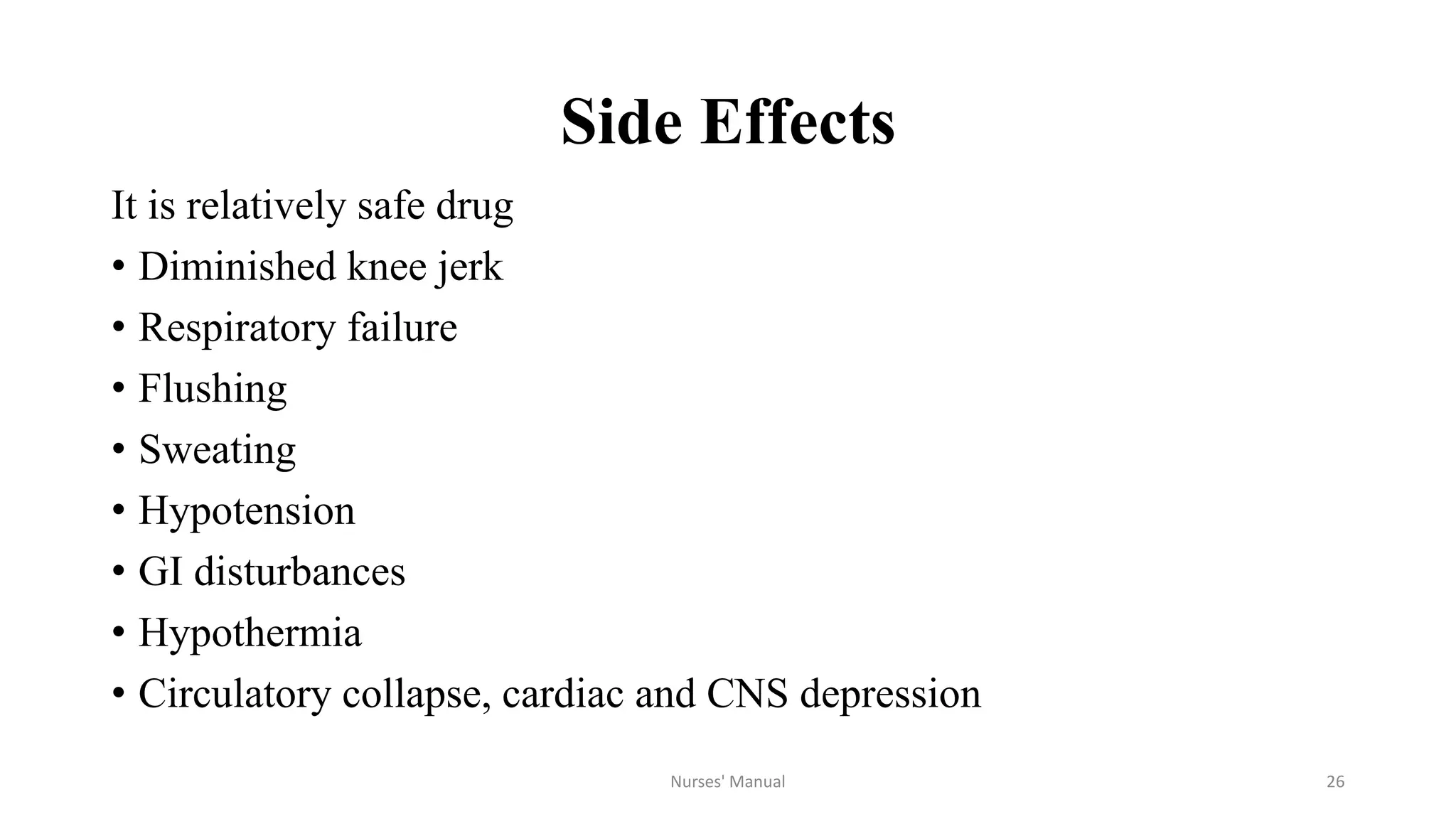
Side Effects
It is relatively safe drug
• Diminished knee jerk
• Respiratory failure
• Flushing
• Sweating
• Hypotension
• GI disturbances
• Hypothermia
• Circulatory collapse, cardiac and CNS depression
Nurses' Manual 26
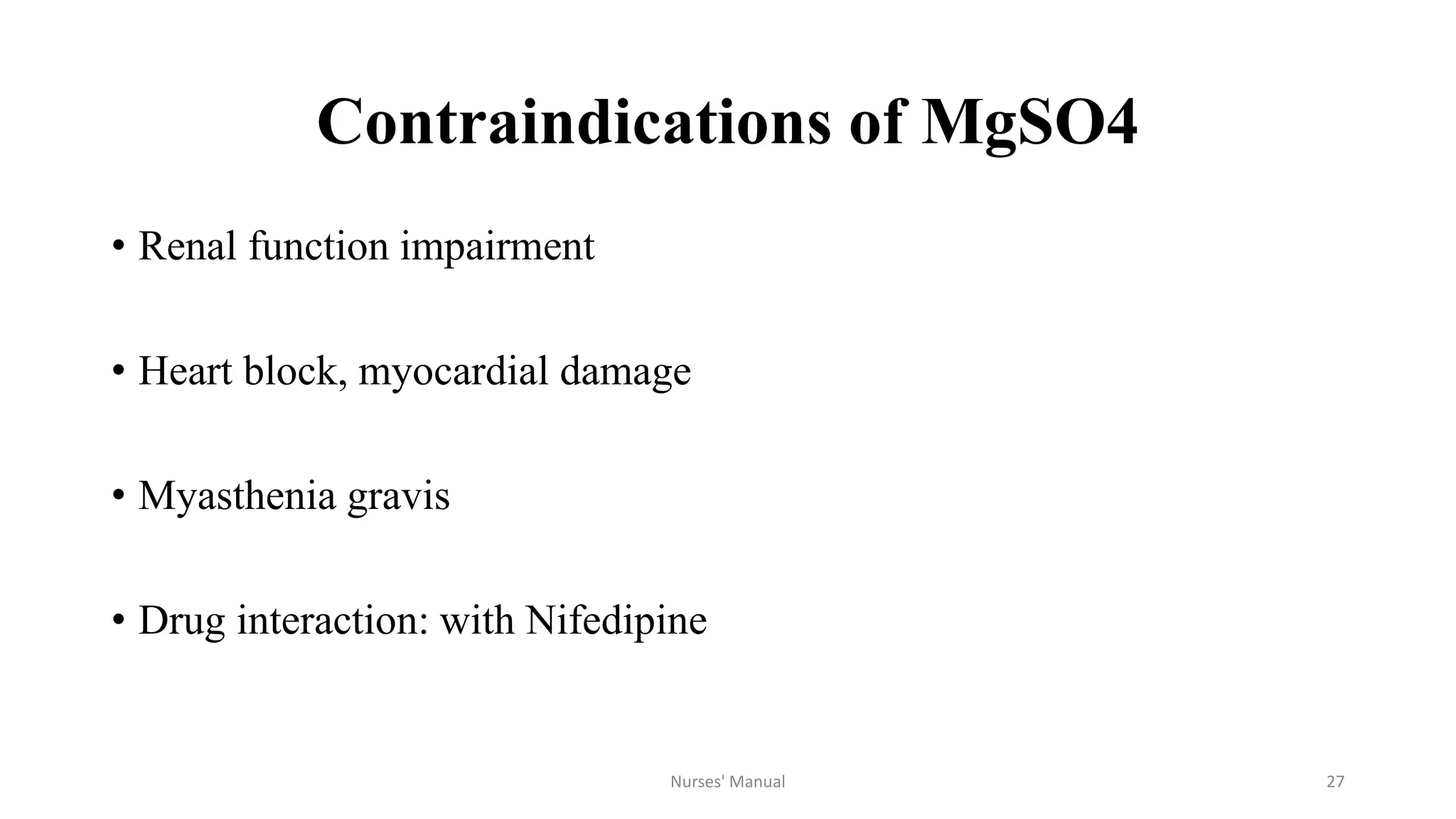
Contraindications of MgSO4
• Renal function impairment
• Heart block, myocardial damage
• Myasthenia gravis
• Drug interaction: with Nifedipine
Nurses' Manual 27
Nursing Consideration
• Assess vital signs with in 15min after IV dose
• Monitor serum magnesium level if used during labor, contractions and
intensity
• Assess urine output and notify physician if ≤30ml/hour
• Examine patellar reflex.
• Use seizure precautions
Nurses' Manual 28
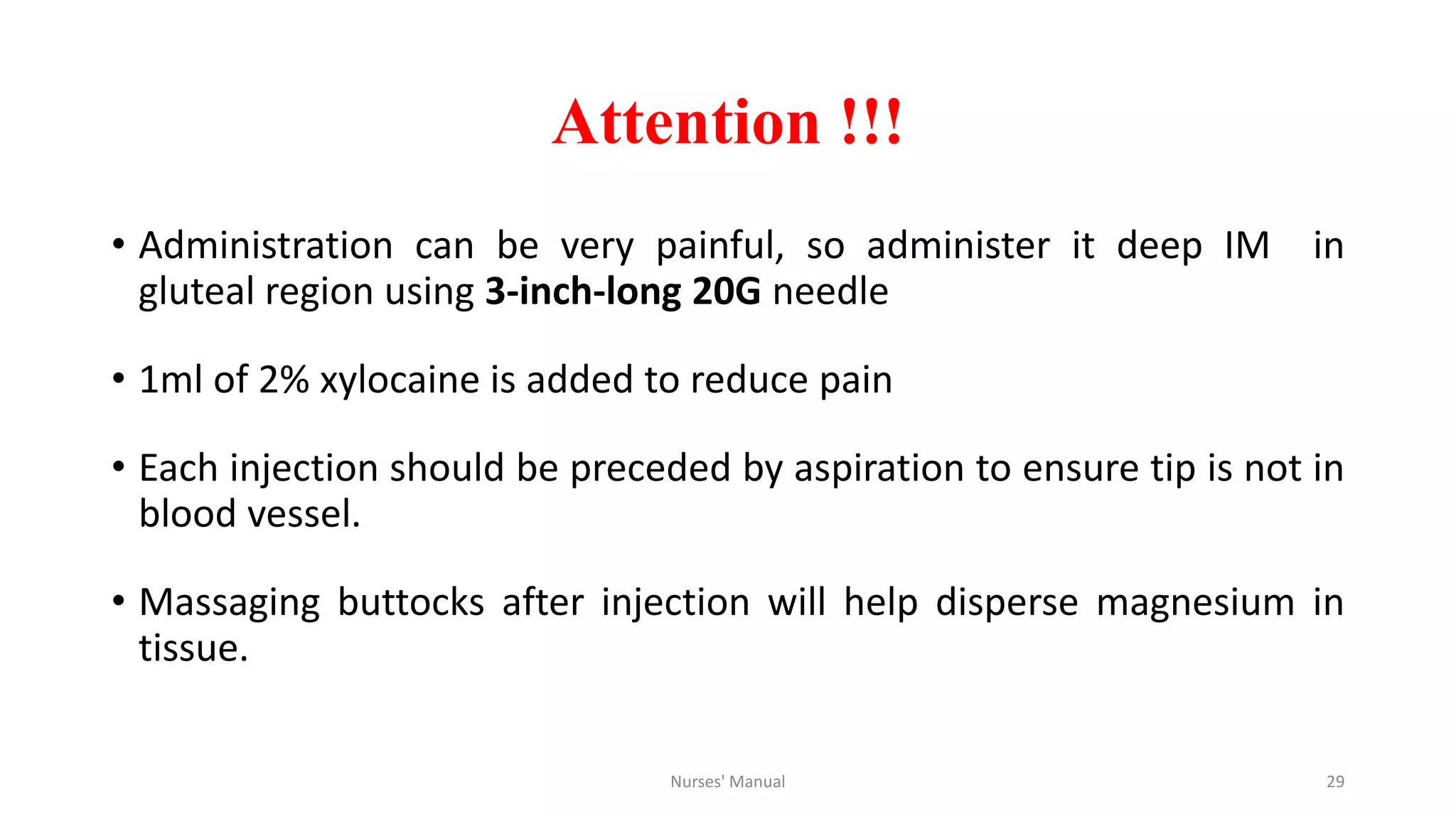
Attention !!!
• Administration can be very painful, so administer it deep IM in
gluteal region using 3-inch-long 20G needle
• 1ml of 2% xylocaine is added to reduce pain
• Each injection should be preceded by aspiration to ensure tip is not in
blood vessel.
• Massaging buttocks after injection will help disperse magnesium in
tissue.
Nurses' Manual 29
1. Is Magnesium sulphate dangerous?
• After administration, about 30% of plasma magnesium is protein
bound.
• Magnesium is almost exclusively excreted in the urine, with 90% of the
dose excreted during the first 24 hours after an intravenous infusion of
MgSO4. Hence the need to monitor urine output in patients receiving
the drug.
30Nurses' Manual
2. Is Magnesium sulphate dangerous in
pregnancy ?
• MgSO4 toxicity is rare when it is carefully administered and
monitored.
• Studies show that the benefits of MgSO4 may outweigh the risks to
her and to her baby.
The answer to this question is NO!
31Nurses' Manual
Why is Eclampsia still a major cause of
maternal deaths in Nepal?
32Nurses' Manual
Nurses' Manual 33

Magnesium sulfate during pregnancy

  • 1.
  • 2.
    Introduction Magnesium sulfate isthe drug of choice for preventing and treating convulsion in severe pre-eclampsia and eclampsia. Nurses' Manual 2
  • 3.
    Facts On MagnesiumSulfate • AKA Epsom salt • 1gm of salt= 98mg elements of magnesium • Is an inorganic salt with formula MgSO4 • Is in the WHO model list of Essential Medicine • Highly water soluble • Solubility inhibited by lipids Nurses' Manual 3
  • 4.
    Physiological Roles • Actsas mediator for Na⁺/K⁺-ATPase system. • Helps in oxidative phosphorylation, glucose utilization and protein synthesis • Generation of cAMP via adenyl cyclase. • Control release and action of parathyroid hormone thus regulates Ca2+ metabolism • Synthesis of DNA,RNA and protein Nurses' Manual 4
  • 5.
    Cardiovascular Effects • Directdepressant on myocardial and vascular smooth muscle. • Reduce systolic BP but no changes in DBP. • Inhibit release of catecholamines from adrenal medulla. • Act as anti arrhythmic and slows HR. • Reduce cardiac output and vascular tone causing hypotension Nurses' Manual 5
  • 6.
    Nervous System Effects •Reduce release of Ach at Neuromuscular junction by antagonizing Ca2+ ions. • Reduce excitability of nerves. • Act as an anti convulsant by blocking Ca2+ channel. Nurses' Manual 6
  • 7.
    Routes • Iv • Imas anticonvulsants • Orally -as laxative Nurses' Manual 7
  • 8.
    Uses In Gynae/Obs •Severe pre-eclampsia • Eclampsia • Preterm labour (as tocolytic agent) • Prevention of cerebral palsy in preterm babies (due to its neuroprotective action) Nurses' Manual 8
  • 9.
    Other uses • Inhypomagnesia • Treatment of severe asthma exacerbation • Constipation • Barium poisoning Nurses' Manual 9
  • 10.
    Mode Of Action •Decrease acetylcholine(Ach) release from nerve endings and reduce motor end plate sensitivity to Ach. • Blocks calcium channel • Cause vasodilation, increase cerebral, uterine and renal blood flow Nurses' Manual 10
  • 11.
    Pharmacology For anticonvulsant action •Onset: IV immediate/ IM 1 hour • Protein bound 30% • Excretion: via urine Nurses' Manual 11
  • 12.
    Advantages of MgSO4 •Relatively safe drug and DOC • Can be given IV/IM • In appropriate dose, it doesn’t affect fetus • In appropriate dose, it doesn’t sedate patient • Inexpensive and is on essential drug list • It is metabolized by kidney, hence doesn’t cause hepatic problems that are often associated with severe pre-eclampsia Nurses' Manual 12
  • 13.
    Disadvantages • Respiratory depression •Respiratory arrest Nurses' Manual 13
  • 14.
    Administration • MgSO4 isthe drug of choice in all circumstances – it should always be available at both health centre and hospital levels • Give diazepam 10 mg (2 ml) over 2 minutes if • There is MgSO4 toxicity • MgSO4 is not available Nurses' Manual 14
  • 15.
    In Health Centre Loadingdose: • Wash hand properly and dry well • Tell women that she may feel warmth while the medicine is given. Nurses' Manual 15
  • 16.
    Give 4 gof 20% MgSO4 solution IV slowly over 5-15 min. • Take one 20ml sterile syringe • Draw 8ml(4g) of MgSO4 50% into syringe. • Add/dissolve with 12ml of sterile water for injection to make a solution of 20%. • Observe for any complications while giving. Nurses' Manual 16
  • 17.
    • Follow promptlywith 10g of 50% mgso4 • Give 5 g in each buttock as deep IM with 1ml of 2% lignocaine. • Take two 10 ml syringe • Draw 5g of MgSO4 (50%) i.e. 10ml in each syringe with 1ml of 2% lignocaine. • Inject 1st syringe by deep IM injection into 1 buttock(5g of mgso4) . • Inject second syringe by deep IM into another buttock(5g mgso4) Nurses' Manual 17
  • 18.
    • Place needleand syringe in puncture proof container • Remove gloves and discard properly • Wash hand thoroughly with soap and water • If convulsant reoccur after 15minutes, give 2g of mgso4(4ml) IV over five minutes. • Rationale: Pre-eclampsia can quickly develop into eclampsia Shaking during transport is a convulsion stimulus Nurses' Manual 18
  • 19.
    In Hospitals • Loadingdose-same as above • Maintenance dose: 5 g of Mgso4 with 1ml of 2% lidocaine in the same syringe by deep IM every 4 hrs. in alternate buttock If no signs of toxicity, give next IM dose after 4 hours. Nurses' Manual 19
  • 20.
    • Maintaining IVdose: Continue treatment for 24 hours after childbirth or the last convulsion, whichever occur last. Nurses' Manual 20
  • 21.
    TIPS 20% MgSO4 Solution Recommendedfor IV injection 50% MgSO4 Solution Recommended for IM injection 21Nurses' Manual
  • 22.
    Monitoring Signs OfToxicity • Count Respiration rate for 1 minute every hour, should be ≥ 16 • Check Patellar reflex q. 4 hours, should be present • Measure Urine output, should be ≥30ml/hr. • Measure BP • Measure serum magnesium level (1.7 to 2.2 mg/dL) Nurses' Manual 22
  • 23.
    MgSO4 toxicity Nurses' Manual23 BURP BP Urine output Respiration rate Patellar reflex absent
  • 24.
    NOTE Repeat dose ofMgSO4 should be withheld or delayed if Signs of toxicity are seen. Nurses' Manual 24
  • 25.
    Antidote • Keep antidoteready. • In case of respiratory arrest: Assist ventilation(bag & mask ,anesthesia , intubation) Give Calcium Gluconate 1g(10ml of 10% solution) IV slowly over 3 minutes, until respiration begins to counteract effects of MgSO4 Nurses' Manual 25
  • 26.
    Side Effects It isrelatively safe drug • Diminished knee jerk • Respiratory failure • Flushing • Sweating • Hypotension • GI disturbances • Hypothermia • Circulatory collapse, cardiac and CNS depression Nurses' Manual 26
  • 27.
    Contraindications of MgSO4 •Renal function impairment • Heart block, myocardial damage • Myasthenia gravis • Drug interaction: with Nifedipine Nurses' Manual 27
  • 28.
    Nursing Consideration • Assessvital signs with in 15min after IV dose • Monitor serum magnesium level if used during labor, contractions and intensity • Assess urine output and notify physician if ≤30ml/hour • Examine patellar reflex. • Use seizure precautions Nurses' Manual 28
  • 29.
    Attention !!! • Administrationcan be very painful, so administer it deep IM in gluteal region using 3-inch-long 20G needle • 1ml of 2% xylocaine is added to reduce pain • Each injection should be preceded by aspiration to ensure tip is not in blood vessel. • Massaging buttocks after injection will help disperse magnesium in tissue. Nurses' Manual 29
  • 30.
    1. Is Magnesiumsulphate dangerous? • After administration, about 30% of plasma magnesium is protein bound. • Magnesium is almost exclusively excreted in the urine, with 90% of the dose excreted during the first 24 hours after an intravenous infusion of MgSO4. Hence the need to monitor urine output in patients receiving the drug. 30Nurses' Manual
  • 31.
    2. Is Magnesiumsulphate dangerous in pregnancy ? • MgSO4 toxicity is rare when it is carefully administered and monitored. • Studies show that the benefits of MgSO4 may outweigh the risks to her and to her baby. The answer to this question is NO! 31Nurses' Manual
  • 32.
    Why is Eclampsiastill a major cause of maternal deaths in Nepal? 32Nurses' Manual
  • 33.

Editor's Notes

  • #22 Speaker’s notes: You need both 20% and 50% solutions on the ward.
  • #31 Speaker’s Notes: SLIDE Fear of the side-effects of MgSO4 is the major factor in the many PIH related maternal deaths in this country. This fear is unfounded.
  • #32 Speaker’s notes: SLIDE DHMTs in Malawi must orient all delivery room staff in the use of MgSO4 in the management of PIH.
  • #33 Speaker’s notes: SLIDE Despite all the available data that MgSO4 provides a better outcome in the management of severe pre-eclampsia and eclampsia, and despite the fact that it is a cheaper drug, women in Malawi continue to die from eclampsia because that drug is not used. Clinical Officers being team leaders in maternity care, should be at the fore front to institutionalise the use of MgSO4 in Malawi.