Recipe Card Evaluation
Robyn Collinson
1Creative Media Production 2013
Producing Print Based Media
2
Visual Language
How have you chosen to set out your designs and why? (Reference
layout, image/text ratio, busy/simplistic etc)
We chose to set out our designs in the way we did after looking into other recipe cards,
such as the official VegSoc ones. We thought this was a good idea as we could get a
good basis of what VegSoc wanted from us. Like ours, the VegSoc cards are quite
minimalistic but are effective and aesthetically pleasing, which seems to work well.
Having a more simple design is a lot more readable and attractive rather than having a
lot or to much un-needed detail. On the adult cards we have produced, we have used
the same image twice, but one on the front and one on the back. I think using the same
image twice makes it a lot more easier and avoids confusion, especially as we used
stock images, it would be more difficult to find the same dish photographed twice, so we
would have had to use two different dishes. We also have the VegSoc logo on each of
the adult cards, as was requested, in the bottom right hand corner of the front, we put
this there as its easy to see especially with the off-white background but is not to much.
We then have two cartoon vegetables on the cards, one on the front and one on the
back, the type of vegetable depends on the card we have focused on, this equates to
the ratio of graphics being roughly 60/40. On the opposing children's card, we tried to
incorporate a more child like theme, including happy cartoon vegetables to represent 4
vegetables. We included 3 ‘fun facts’ on each child card about the particular vegetable
the card focused on along with ways to get involved and help safely to make the dinner.
Like the adult card, we put the VegSoc logo in the same place to make sure we were
consistent with the theme. The graphic ratio on the child card is 70/30.
Visual Language
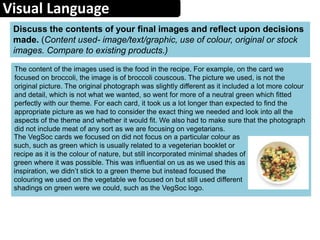
The content of the images used is the food in the recipe. For example, on the card we
focused on broccoli, the image is of broccoli couscous. The picture we used, is not the
original picture. The original photograph was slightly different as it included a lot more colour
and detail, which is not what we wanted, so went for more of a neutral green which fitted
perfectly with our theme. For each card, it took us a lot longer than expected to find the
appropriate picture as we had to consider the exact thing we needed and look into all the
aspects of the theme and whether it would fit. We also had to make sure that the photograph
did not include meat of any sort as we are focusing on vegetarians.
Discuss the contents of your final images and reflect upon decisions
made. (Content used- image/text/graphic, use of colour, original or stock
images. Compare to existing products.)
The VegSoc cards we focused on did not focus on a particular colour as
such, such as green which is usually related to a vegeterian booklet or
recipe as it is the colour of nature, but still incorporated minimal shades of
green where it was possible. This was influential on us as we used this as
inspiration, we didn’t stick to a green theme but instead focused the
colouring we used on the vegetable we focused on but still used different
shadings on green were we could, such as the VegSoc logo.
Visual Language
Discuss the semiotics and connotations created from the content you have
included. (What meaning or suggestions are created from the
images/colours/designs you have used? You could reference how they were used
in products you look at during the project.)
We chose the colours we did to represent a particular vegetable. For
example, we used the colour orange to represent a carrot and we used a
deep red to represent a tomato. We were consistent throughout with the
font and only used two. The fonts we did use are both very similar but
have noticeable differences, we chose to use two similar fonts because it
wouldn’t be to much of a drastic change but it they would be slightly
different. On the child card, we used a vegetable cartoon on each 4 in a
bid to make the child find cooking and eating and using vegetables fun
and enjoyable.
Audiences
Create an audience profile of your chosen demographic
(Age, gender, psychographic, geodemographic, NRS Social Grade, hobbies,
sexuality [if appropriate] etc)
Age: Adult – middle aged, 30-45. Child – 6-10
Gender: Adult – female. Child – gender neutral
Geodemographics: Outer suburbs
NRS social grade: Middle class/ABC1
Occupation: Stay at home mum/house wife
Hobbies: Cooking/walking/reading
Lifestyle: Reformer
This is Elizabeth, a middle aged, middle class, stay at home mum/house wife who lives
in the outer suburbs of Harrogate with her husband, James, two children, Isabella, 8,
and Thomas, 13, and the family dog, Pippin. Her husband James, works as an
accountant in York. In her spare time Elizabeth enjoys walking Pippin, reading and
cooking.
Audiences
How have you constructed your work to appeal to this audience?
Include an annotated copy of an example of your work to help illustrate how you
have done this.
We constructed our work to appeal to our audience in may ways. For
example, in the children's cards we incorporated child like things, such as
cartoon figures and fun facts. We also added ways that the child could
help the adult with the cooking safely. Although we used the same colours
for the adult and child cards, the colours are quite bright which again is
quite child like. For the adults, we made the layout simple and classy but
modern. We are aiming for a middle aged audience who enjoy cooking, so
the recipes we chose were adventurous in a sense as they incorporated a
whole range of different ingredients.
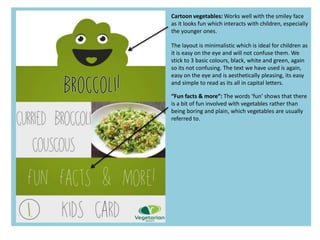
Cartoon vegetables: Works well with the smiley face
as it looks fun which interacts with children, especially
the younger ones.
“Fun facts & more”: The words ‘fun’ shows that there
is a bit of fun involved with vegetables rather than
being boring and plain, which vegetables are usually
referred to.
The layout is minimalistic which is ideal for children as
it is easy on the eye and will not confuse them. We
stick to 3 basic colours, black, white and green, again
so its not confusing. The text we have used is again,
easy on the eye and is aesthetically pleasing, its easy
and simple to read as its all in capital letters.
Cultural context
What did you use as your design influences and why were they chosen?
(What existing media products influenced the final look of your work?)
The current VegSoc recipe cards influenced our choice of design. We look
at past and present recipe cards with various themes, including seasonal
designs and deserts. We chose to look at these as we thought that it might
give us inspiration for our recipe cards and to see if the VegSoc stuck to a
consistent theme with all of the cards they’ve created. When looking at
other cards, we noticed that each set had a theme but the whole range of
cards didn’t which was a good thing because I felt like it opened what we
could do with the cards.
Cultural context
Do vegetarian products have a specific design aesthetic and how does your
project reflect/contrast this? Why?
Finished products
Does your finished product reflect your initial plans? How? If there are any
differences, describe why changes were made.
(You can use visual examples of flat plans and finished products to illustrate this
Finished products
Does your finished product match what you were set in the brief? How?
Finished products
How did the use of peer feedback help you in your production?
(Reference specific examples and their final outcome in finished product)
Finished product
Discuss the strengths and weaknesses of your final product regarding its
technical qualities.
Use box below for text or page space to include an annotated copy of your work
to help illustrate how you have done this.
Reference what you like and dislike about the work with consistent reference to
correct terminology of tools/effects used. Reference existing products.
Finished product
Discuss the strengths and weaknesses of your final product regarding its
aesthetical qualities.
Use box below for text or page space to include an annotated copy of your work
to help illustrate how you have done this. Reference what you like and dislike
about the work with consistent reference to correct terminology. You can
reference existing products here and compare your work to them.
Finished products
What skills/knowledge have you gained/developed in this project? How could
these be applied in future practice?
I feel that during the production of the project I learnt more and more about
how Photoshop worked. Prior to the project, I knew how to use it but just
didn’t have a wide range of skills, just the basics and I feel like my
knowledge has improved vastly. I learnt little tips and trick that will enable
me to improve projects I may come across in the second year of PBM.
This is a good thing as I feel like it could be a positive thing in the future,
such as further along in the course or in education later on, for example
when I go to university, it will be a good skill to have or if when I’m older, it
would be good thing to put on my CV that I am skilled with Photoshop.
Production process
Do you believe your work is creative and technically competent? Why?
(Reference specific examples (use images if this will help) of where you believe
your work is particularly visually or technically impressive. Reference
professionally producted work and compare your products to them)
Production process
How effectively did you manage your time?
(Could you have used time more wisely? Did a particular aspect of the project
take longer than expected? Did you complete everything on schedule?)
Production process
If you could repeat the process what would you do differently?
I think if I were to repeat the process, I would try a bit harder to get
involved abit more as in part of the project as I felt like I sometimes didn’t
have a say. I think this was because my partner was a lot more confident
in his ideas than I was in mine and from when we first discussed the ideas,
he had an idea of what he wanted to do and how he wanted to produce it.
This isn’t a bad thing but I feel like I wanted to be involved a little more.
When we did eventually start creating the cards, I got the chance to put my
input in by creating the four adult cards which I was very pleased with.
When my partner and I have finished producing the cards, we picked
through all eight cards, altering little things to make them perfect. We were
meant to do this as a pair but again, I felt that my partner was a little
controlling but I understand this was because he knew the idea he wanted
and he wanted a good grade. Overall, if it was repeated I would change
the fact that I was quiet and reserved about what I wanted and make more
of an effort to put my ideas down rather than just leaving it to the other
partner.
Working to a brief
23
Constraints
What constraints did you encounter and how did you consider/avoid them?
Legal:
Regulatory:
Financial:
Management
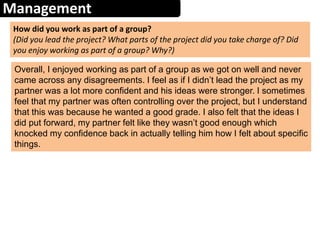
How did you work as part of a group?
(Did you lead the project? What parts of the project did you take charge of? Did
you enjoy working as part of a group? Why?)
Overall, I enjoyed working as part of a group as we got on well and never
came across any disagreements. I feel as if I didn’t lead the project as my
partner was a lot more confident and his ideas were stronger. I sometimes
feel that my partner was often controlling over the project, but I understand
that this was because he wanted a good grade. I also felt that the ideas I
did put forward, my partner felt like they wasn’t good enough which
knocked my confidence back in actually telling him how I felt about specific
things.
Management
How important is communication when working in a group?
(Use specific examples from working in a group on this project)
Management
How important is communication when working in a group?
(Use specific examples from working in a group on this project)
Management
What have you learnt about working in a group and how will you apply this to
future practice?

To email evaluation

  • 1.
    Recipe Card Evaluation RobynCollinson 1Creative Media Production 2013
  • 2.
  • 3.
    Visual Language How haveyou chosen to set out your designs and why? (Reference layout, image/text ratio, busy/simplistic etc) We chose to set out our designs in the way we did after looking into other recipe cards, such as the official VegSoc ones. We thought this was a good idea as we could get a good basis of what VegSoc wanted from us. Like ours, the VegSoc cards are quite minimalistic but are effective and aesthetically pleasing, which seems to work well. Having a more simple design is a lot more readable and attractive rather than having a lot or to much un-needed detail. On the adult cards we have produced, we have used the same image twice, but one on the front and one on the back. I think using the same image twice makes it a lot more easier and avoids confusion, especially as we used stock images, it would be more difficult to find the same dish photographed twice, so we would have had to use two different dishes. We also have the VegSoc logo on each of the adult cards, as was requested, in the bottom right hand corner of the front, we put this there as its easy to see especially with the off-white background but is not to much. We then have two cartoon vegetables on the cards, one on the front and one on the back, the type of vegetable depends on the card we have focused on, this equates to the ratio of graphics being roughly 60/40. On the opposing children's card, we tried to incorporate a more child like theme, including happy cartoon vegetables to represent 4 vegetables. We included 3 ‘fun facts’ on each child card about the particular vegetable the card focused on along with ways to get involved and help safely to make the dinner. Like the adult card, we put the VegSoc logo in the same place to make sure we were consistent with the theme. The graphic ratio on the child card is 70/30.
  • 4.
    Visual Language The contentof the images used is the food in the recipe. For example, on the card we focused on broccoli, the image is of broccoli couscous. The picture we used, is not the original picture. The original photograph was slightly different as it included a lot more colour and detail, which is not what we wanted, so went for more of a neutral green which fitted perfectly with our theme. For each card, it took us a lot longer than expected to find the appropriate picture as we had to consider the exact thing we needed and look into all the aspects of the theme and whether it would fit. We also had to make sure that the photograph did not include meat of any sort as we are focusing on vegetarians. Discuss the contents of your final images and reflect upon decisions made. (Content used- image/text/graphic, use of colour, original or stock images. Compare to existing products.) The VegSoc cards we focused on did not focus on a particular colour as such, such as green which is usually related to a vegeterian booklet or recipe as it is the colour of nature, but still incorporated minimal shades of green where it was possible. This was influential on us as we used this as inspiration, we didn’t stick to a green theme but instead focused the colouring we used on the vegetable we focused on but still used different shadings on green were we could, such as the VegSoc logo.
  • 5.
    Visual Language Discuss thesemiotics and connotations created from the content you have included. (What meaning or suggestions are created from the images/colours/designs you have used? You could reference how they were used in products you look at during the project.) We chose the colours we did to represent a particular vegetable. For example, we used the colour orange to represent a carrot and we used a deep red to represent a tomato. We were consistent throughout with the font and only used two. The fonts we did use are both very similar but have noticeable differences, we chose to use two similar fonts because it wouldn’t be to much of a drastic change but it they would be slightly different. On the child card, we used a vegetable cartoon on each 4 in a bid to make the child find cooking and eating and using vegetables fun and enjoyable.
  • 6.
    Audiences Create an audienceprofile of your chosen demographic (Age, gender, psychographic, geodemographic, NRS Social Grade, hobbies, sexuality [if appropriate] etc) Age: Adult – middle aged, 30-45. Child – 6-10 Gender: Adult – female. Child – gender neutral Geodemographics: Outer suburbs NRS social grade: Middle class/ABC1 Occupation: Stay at home mum/house wife Hobbies: Cooking/walking/reading Lifestyle: Reformer This is Elizabeth, a middle aged, middle class, stay at home mum/house wife who lives in the outer suburbs of Harrogate with her husband, James, two children, Isabella, 8, and Thomas, 13, and the family dog, Pippin. Her husband James, works as an accountant in York. In her spare time Elizabeth enjoys walking Pippin, reading and cooking.
  • 7.
    Audiences How have youconstructed your work to appeal to this audience? Include an annotated copy of an example of your work to help illustrate how you have done this. We constructed our work to appeal to our audience in may ways. For example, in the children's cards we incorporated child like things, such as cartoon figures and fun facts. We also added ways that the child could help the adult with the cooking safely. Although we used the same colours for the adult and child cards, the colours are quite bright which again is quite child like. For the adults, we made the layout simple and classy but modern. We are aiming for a middle aged audience who enjoy cooking, so the recipes we chose were adventurous in a sense as they incorporated a whole range of different ingredients.
  • 8.
    Cartoon vegetables: Workswell with the smiley face as it looks fun which interacts with children, especially the younger ones. “Fun facts & more”: The words ‘fun’ shows that there is a bit of fun involved with vegetables rather than being boring and plain, which vegetables are usually referred to. The layout is minimalistic which is ideal for children as it is easy on the eye and will not confuse them. We stick to 3 basic colours, black, white and green, again so its not confusing. The text we have used is again, easy on the eye and is aesthetically pleasing, its easy and simple to read as its all in capital letters.
  • 9.
    Cultural context What didyou use as your design influences and why were they chosen? (What existing media products influenced the final look of your work?) The current VegSoc recipe cards influenced our choice of design. We look at past and present recipe cards with various themes, including seasonal designs and deserts. We chose to look at these as we thought that it might give us inspiration for our recipe cards and to see if the VegSoc stuck to a consistent theme with all of the cards they’ve created. When looking at other cards, we noticed that each set had a theme but the whole range of cards didn’t which was a good thing because I felt like it opened what we could do with the cards.
  • 10.
    Cultural context Do vegetarianproducts have a specific design aesthetic and how does your project reflect/contrast this? Why?
  • 11.
    Finished products Does yourfinished product reflect your initial plans? How? If there are any differences, describe why changes were made. (You can use visual examples of flat plans and finished products to illustrate this
  • 12.
    Finished products Does yourfinished product match what you were set in the brief? How?
  • 13.
    Finished products How didthe use of peer feedback help you in your production? (Reference specific examples and their final outcome in finished product)
  • 14.
    Finished product Discuss thestrengths and weaknesses of your final product regarding its technical qualities. Use box below for text or page space to include an annotated copy of your work to help illustrate how you have done this. Reference what you like and dislike about the work with consistent reference to correct terminology of tools/effects used. Reference existing products.
  • 16.
    Finished product Discuss thestrengths and weaknesses of your final product regarding its aesthetical qualities. Use box below for text or page space to include an annotated copy of your work to help illustrate how you have done this. Reference what you like and dislike about the work with consistent reference to correct terminology. You can reference existing products here and compare your work to them.
  • 19.
    Finished products What skills/knowledgehave you gained/developed in this project? How could these be applied in future practice? I feel that during the production of the project I learnt more and more about how Photoshop worked. Prior to the project, I knew how to use it but just didn’t have a wide range of skills, just the basics and I feel like my knowledge has improved vastly. I learnt little tips and trick that will enable me to improve projects I may come across in the second year of PBM. This is a good thing as I feel like it could be a positive thing in the future, such as further along in the course or in education later on, for example when I go to university, it will be a good skill to have or if when I’m older, it would be good thing to put on my CV that I am skilled with Photoshop.
  • 20.
    Production process Do youbelieve your work is creative and technically competent? Why? (Reference specific examples (use images if this will help) of where you believe your work is particularly visually or technically impressive. Reference professionally producted work and compare your products to them)
  • 21.
    Production process How effectivelydid you manage your time? (Could you have used time more wisely? Did a particular aspect of the project take longer than expected? Did you complete everything on schedule?)
  • 22.
    Production process If youcould repeat the process what would you do differently? I think if I were to repeat the process, I would try a bit harder to get involved abit more as in part of the project as I felt like I sometimes didn’t have a say. I think this was because my partner was a lot more confident in his ideas than I was in mine and from when we first discussed the ideas, he had an idea of what he wanted to do and how he wanted to produce it. This isn’t a bad thing but I feel like I wanted to be involved a little more. When we did eventually start creating the cards, I got the chance to put my input in by creating the four adult cards which I was very pleased with. When my partner and I have finished producing the cards, we picked through all eight cards, altering little things to make them perfect. We were meant to do this as a pair but again, I felt that my partner was a little controlling but I understand this was because he knew the idea he wanted and he wanted a good grade. Overall, if it was repeated I would change the fact that I was quiet and reserved about what I wanted and make more of an effort to put my ideas down rather than just leaving it to the other partner.
  • 23.
    Working to abrief 23
  • 24.
    Constraints What constraints didyou encounter and how did you consider/avoid them? Legal:
  • 25.
  • 26.
  • 27.
    Management How did youwork as part of a group? (Did you lead the project? What parts of the project did you take charge of? Did you enjoy working as part of a group? Why?) Overall, I enjoyed working as part of a group as we got on well and never came across any disagreements. I feel as if I didn’t lead the project as my partner was a lot more confident and his ideas were stronger. I sometimes feel that my partner was often controlling over the project, but I understand that this was because he wanted a good grade. I also felt that the ideas I did put forward, my partner felt like they wasn’t good enough which knocked my confidence back in actually telling him how I felt about specific things.
  • 28.
    Management How important iscommunication when working in a group? (Use specific examples from working in a group on this project)
  • 29.
    Management How important iscommunication when working in a group? (Use specific examples from working in a group on this project)
  • 30.
    Management What have youlearnt about working in a group and how will you apply this to future practice?