Visual language
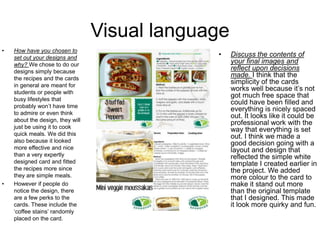
• How have you chosen to
set out your designs and
why? We chose to do our
designs simply because
the recipes and the cards
in general are meant for
students or people with
busy lifestyles that
probably won’t have time
to admire or even think
about the design, they will
just be using it to cook
quick meals. We did this
also because it looked
more effective and nice
than a very expertly
designed card and fitted
the recipes more since
they are simple meals.
• However if people do
notice the design, there
are a few perks to the
cards. These include the
‘coffee stains’ randomly
placed on the card.
• Discuss the contents of
your final images and
reflect upon decisions
made. I think that the
simplicity of the cards
works well because it’s not
got much free space that
could have been filled and
everything is nicely spaced
out. It looks like it could be
professional work with the
way that everything is set
out. I think we made a
good decision going with a
layout and design that
reflected the simple white
template I created earlier in
the project. We added
more colour to the card to
make it stand out more
than the original template
that I designed. This made
it look more quirky and fun.
Visual language and audience
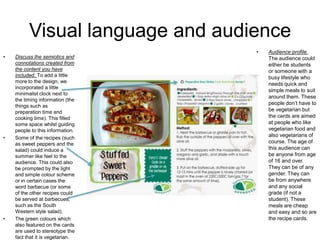
• Discuss the semiotics and
connotations created from
the content you have
included. To add a little
more to the design, we
incorporated a little
minimalist clock next to
the timing information (the
things such as
preparation time and
cooking time). This filled
some space whilst guiding
people to this information.
• Some of the recipes (such
as sweet peppers and the
salad) could induce a
summer like feel to the
audience. This could also
be prompted by the light
and simple colour scheme
or in certain cases the
word barbecue (or some
of the other recipes could
be served at barbecues,
such as the South
Western style salad).
• The green colours which
also featured on the cards
are used to stereotype the
fact that it is vegetarian.
• Audience profile.
The audience could
either be students
or someone with a
busy lifestyle who
needs quick and
simple meals to suit
around them. These
people don’t have to
be vegetarian but
the cards are aimed
at people who like
vegetarian food and
also vegetarians of
course. The age of
this audience can
be anyone from age
of 16 and over.
They can be of any
gender. They can
be from anywhere
and any social
grade (if not a
student). These
meals are cheap
and easy and so are
the recipe cards.
Audience and cultural context
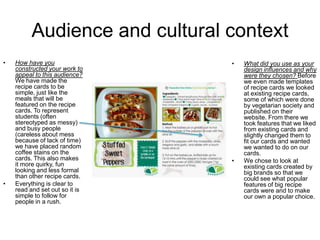
• How have you
constructed your work to
appeal to this audience?
We have made the
recipe cards to be
simple, just like the
meals that will be
featured on the recipe
cards. To represent
students (often
stereotyped as messy)
and busy people
(careless about mess
because of lack of time)
we have placed random
coffee stains on the
cards. This also makes
it more quirky, fun
looking and less formal
than other recipe cards.
• Everything is clear to
read and set out so it is
simple to follow for
people in a rush.
• What did you use as your
design influences and why
were they chosen? Before
we even made templates
of recipe cards we looked
at existing recipe cards,
some of which were done
by vegetarian society and
published on their
website. From there we
took features that we liked
from existing cards and
slightly changed them to
fit our cards and wanted
we wanted to do on our
cards.
• We chose to look at
existing cards created by
big brands so that we
could see what popular
features of big recipe
cards were and to make
our own a popular choice.
Cultural context and finished
product• Do vegetarian products
have a specific design
aesthetic and how does
your project reflect/contrast
this? Why? I think that
vegetarian products are
very stereotyped and are
very associated with the
colour green. This is
because plants are green
and vegetarians are seen
to only eat plants. Also the
white of the card is seen as
pure and vegetarians are
seen to have more pure
diets.
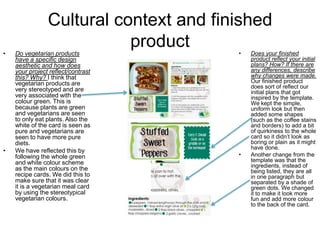
• We have reflected this by
following the whole green
and white colour scheme
as the main colours on the
recipe cards. We did this to
make sure that it was clear
it is a vegetarian meal card
by using the stereotypical
vegetarian colours.
• Does your finished
product reflect your initial
plans? How? If there are
any differences, describe
why changes were made.
Our finished product
does sort of reflect our
initial plans that got
inspired by the template.
We kept the simple,
uniform look but then
added some shapes
(such as the coffee stains
and borders) to add a bit
of quirkiness to the whole
card so it didn’t look as
boring or plain as it might
have done.
• Another change from the
template was that the
ingredients, instead of
being listed, they are all
in one paragraph but
separated by a shade of
green dots. We changed
it to make it look more
fun and add more colour
to the back of the card.
Finished products
• Does your finished product match
what you were set in the brief?
How? The brief states that the
design must be ‘Interesting,
creative and have a clear theme
running throughout all of the cards
that can either be based on an
ingredient or country etc’.
• We have complied this need by
creating eight recipe cards all on
the theme of quick and easy
meals. All of the cards look very
neat and clean cut but do contain
an element of fun and
creativeness by the use of
different shapes throughout the
cards.
• Another thing that we have also
done to math the brief is the use
of information such as preparation
time, cook time etc.
• How did the use of peer feedback help you in
your production? Peer feedback came in very
useful and showed us areas in which we could
improve and/or things that other people liked
about our work. This means we could then
improve our work to suit our feedback and
make the cards more appealing to others
rather than to what we want. This would also
help give us other ideas for the cards and then
we could improve them even further.
• Another reason why the peer feedback we
received was useful was because part of our
target audience included students and we are
all students so we could see what hey thought
of them and adjust them to the audiences
wants and needs.
• We also received some feedback from one of
our tutors. This also helped us improve our
work further, getting opinions from someone
possibly outside of the target audience and
seeing if they like it, what they’d improve and
things like that.
Finished product
• Strengths and weaknesses of final
product? I think that overall our
product looks professional and neat
with some quirky elements. There
could be a few improvements made
to the card.
• These could include things like better
placed coffee stains that look more
like coffee (darker and maybe less
transparent) and maybe the logo
should be the same size on both
sides of the card so it looks like a
page template that has been set out
before the construction of the actual
cards as if both sides have been
created from the same template.
• The best bit of the cards, in my
opinion, is the fonts and also the
photographs used.
• What skills/knowledge have you
gained/developed in this project? How
could these be applied in future practice?
I believe that I have earned a range of
new skills. These include things such as
using a vast range of shapes to create
borders and more interesting and
creative backgrounds for the card.
• I have also developed further knowledge
and skills on the use of Photoshop,
making my work a better quality.
• These could be applied in future practice
and pieces of work by making better
quality pieces of work and/or improving
my skills further.
• I have also improved my photograph
skills. I learned that to take a good
photograph you have to take your time
and let the camera focus itself.
Production process
• Is the work creative and
technically competent? I do
believe that the work we produced
is quite creative because it is not
like any of the others that the rest
of the group made and it is has
been changed numerous times
(meaning that we have tried a
range of ideas, therefore been
creative). Even if the recipe cards
we made are quite simple in
design, they contain everything
that the client stated that they
want in the brief. We spent a lot of
time making sure everything was
rightly positioned and looked
good. The cards didn’t look empty,
which is important since we chose
to do a simple design.
• Effective time management? I
think we managed our time pretty
well. We organised to have one
person at home, creating the
meals and then photographing
them, whilst the other person was
at college working on the designs
and cards in general. This help
gain us a lot of time instead of
both of us being off to create the
food and photograph it.
• We did, however need a bit of
extra time at the end just to finish
the last card off. This is because
some of the files got corrupted so
we had to re-do the cards that
were effected by this.
Production process and constraints
• If you could repeat the process
what would you do differently? I
think if we were to do this process
all again we would probably talk
more to get a clear idea of what
we wanted the cards too look like.
• We could have also had less days
off college when we weren’t
planned to so we could actually
get on and do the work.
• Another thing that we could also
have done is that we could have
shared the workload more. By this
I mean we could have made the
initial design together and then
split the cards (four each maybe)
and get on with putting them all
together so we have all the cards
prepared for photos.
• Legal, regulatory and financial
constraints. The only thing that
might be a legal restraint is that all
but one of the recipes that we
used are off of the BBC Good
Food website so we would need
permission to publish their work.
• Regulatory constraint would
include things such as who did
what work and if it actually was
their job. This wasn’t an issue for
use because we all did what we
were meant to do but helped each
other when needed to.
• Financial constraints would
include the money I used to buy
the ingredients used to create the
recipes so we could have original
images instead of sourced recipes
along with sourced images.
Management
• How did you work as part of a group?
In the group I think I worked quite well.
I think this because, at the end of the
day, we got all our work done and to a
high standard. We may have had
some opposing opinions but we
worked around them and finally got a
good end piece. We organised tasks to
each other and did what we were
meant to and in the end all the work
we did paid off as we had created a
quality piece of work.
• As just one person, however, I feel I
did well working in a group. I got
everything that I needed to done and
kept up with my work and kept the
blog up to date.
• In future, however, I might just work on
my own so that I am only relying on
myself and won’t let other people down
and no one can let me down either.
• How important is communication when
working in a group? Communication
whilst working in a group is highly
important. This is so that everyone
knows what they’ll be doing, when it
needs doing by and other things on
the same line.
• Listening is also an important part so
that you know what everyone else is
doing, why they’re doing what they’re
doing, what they might need you to do
and other things.
• If both factors are achieved then the
project should run smoothly and you
should be finished by your deadline (or
even before).
Management
• What have you learnt about
working in a group and how will
you apply this to future practice?
I have learned that working in a
group requires many different
skills and abilities. These include
patients with your other group
members (this goes alongside
tolerance too).
• Another thing that you would
need is responsibility and the
ability to be organised. This will
all make the project that you are
working on run smoothly. It will
also be easier to locate files and
other works that you may need.
• What have you learnt about working in to a
brief and how will you apply this to future
practice? I have learned that to work to a brief
requires a level of acceptance, negotiation and
creativity.
• Acceptance is needed so that you agree with
the brief and stick to everything that the client
that wants. This is important so you don’t rip
the client off with giving them a product that
doesn’t fit the brief.
• Negotiation is need so that if the brief asks you
to do something impossible then you can
negotiate with the client to create something a
little more possible
• Creativity so that you can make a piece of
work to a really good quality and still manage
to fit all the brief features in.
• I could use this in future practice because I will
already know in advance what to do and what
is to be expected. If I am not too great at one
of these skills I could work on improving it for
the future.

Evaluation powerpoint

  • 1.
    Visual language • Howhave you chosen to set out your designs and why? We chose to do our designs simply because the recipes and the cards in general are meant for students or people with busy lifestyles that probably won’t have time to admire or even think about the design, they will just be using it to cook quick meals. We did this also because it looked more effective and nice than a very expertly designed card and fitted the recipes more since they are simple meals. • However if people do notice the design, there are a few perks to the cards. These include the ‘coffee stains’ randomly placed on the card. • Discuss the contents of your final images and reflect upon decisions made. I think that the simplicity of the cards works well because it’s not got much free space that could have been filled and everything is nicely spaced out. It looks like it could be professional work with the way that everything is set out. I think we made a good decision going with a layout and design that reflected the simple white template I created earlier in the project. We added more colour to the card to make it stand out more than the original template that I designed. This made it look more quirky and fun.
  • 2.
    Visual language andaudience • Discuss the semiotics and connotations created from the content you have included. To add a little more to the design, we incorporated a little minimalist clock next to the timing information (the things such as preparation time and cooking time). This filled some space whilst guiding people to this information. • Some of the recipes (such as sweet peppers and the salad) could induce a summer like feel to the audience. This could also be prompted by the light and simple colour scheme or in certain cases the word barbecue (or some of the other recipes could be served at barbecues, such as the South Western style salad). • The green colours which also featured on the cards are used to stereotype the fact that it is vegetarian. • Audience profile. The audience could either be students or someone with a busy lifestyle who needs quick and simple meals to suit around them. These people don’t have to be vegetarian but the cards are aimed at people who like vegetarian food and also vegetarians of course. The age of this audience can be anyone from age of 16 and over. They can be of any gender. They can be from anywhere and any social grade (if not a student). These meals are cheap and easy and so are the recipe cards.
  • 3.
    Audience and culturalcontext • How have you constructed your work to appeal to this audience? We have made the recipe cards to be simple, just like the meals that will be featured on the recipe cards. To represent students (often stereotyped as messy) and busy people (careless about mess because of lack of time) we have placed random coffee stains on the cards. This also makes it more quirky, fun looking and less formal than other recipe cards. • Everything is clear to read and set out so it is simple to follow for people in a rush. • What did you use as your design influences and why were they chosen? Before we even made templates of recipe cards we looked at existing recipe cards, some of which were done by vegetarian society and published on their website. From there we took features that we liked from existing cards and slightly changed them to fit our cards and wanted we wanted to do on our cards. • We chose to look at existing cards created by big brands so that we could see what popular features of big recipe cards were and to make our own a popular choice.
  • 4.
    Cultural context andfinished product• Do vegetarian products have a specific design aesthetic and how does your project reflect/contrast this? Why? I think that vegetarian products are very stereotyped and are very associated with the colour green. This is because plants are green and vegetarians are seen to only eat plants. Also the white of the card is seen as pure and vegetarians are seen to have more pure diets. • We have reflected this by following the whole green and white colour scheme as the main colours on the recipe cards. We did this to make sure that it was clear it is a vegetarian meal card by using the stereotypical vegetarian colours. • Does your finished product reflect your initial plans? How? If there are any differences, describe why changes were made. Our finished product does sort of reflect our initial plans that got inspired by the template. We kept the simple, uniform look but then added some shapes (such as the coffee stains and borders) to add a bit of quirkiness to the whole card so it didn’t look as boring or plain as it might have done. • Another change from the template was that the ingredients, instead of being listed, they are all in one paragraph but separated by a shade of green dots. We changed it to make it look more fun and add more colour to the back of the card.
  • 5.
    Finished products • Doesyour finished product match what you were set in the brief? How? The brief states that the design must be ‘Interesting, creative and have a clear theme running throughout all of the cards that can either be based on an ingredient or country etc’. • We have complied this need by creating eight recipe cards all on the theme of quick and easy meals. All of the cards look very neat and clean cut but do contain an element of fun and creativeness by the use of different shapes throughout the cards. • Another thing that we have also done to math the brief is the use of information such as preparation time, cook time etc. • How did the use of peer feedback help you in your production? Peer feedback came in very useful and showed us areas in which we could improve and/or things that other people liked about our work. This means we could then improve our work to suit our feedback and make the cards more appealing to others rather than to what we want. This would also help give us other ideas for the cards and then we could improve them even further. • Another reason why the peer feedback we received was useful was because part of our target audience included students and we are all students so we could see what hey thought of them and adjust them to the audiences wants and needs. • We also received some feedback from one of our tutors. This also helped us improve our work further, getting opinions from someone possibly outside of the target audience and seeing if they like it, what they’d improve and things like that.
  • 6.
    Finished product • Strengthsand weaknesses of final product? I think that overall our product looks professional and neat with some quirky elements. There could be a few improvements made to the card. • These could include things like better placed coffee stains that look more like coffee (darker and maybe less transparent) and maybe the logo should be the same size on both sides of the card so it looks like a page template that has been set out before the construction of the actual cards as if both sides have been created from the same template. • The best bit of the cards, in my opinion, is the fonts and also the photographs used. • What skills/knowledge have you gained/developed in this project? How could these be applied in future practice? I believe that I have earned a range of new skills. These include things such as using a vast range of shapes to create borders and more interesting and creative backgrounds for the card. • I have also developed further knowledge and skills on the use of Photoshop, making my work a better quality. • These could be applied in future practice and pieces of work by making better quality pieces of work and/or improving my skills further. • I have also improved my photograph skills. I learned that to take a good photograph you have to take your time and let the camera focus itself.
  • 7.
    Production process • Isthe work creative and technically competent? I do believe that the work we produced is quite creative because it is not like any of the others that the rest of the group made and it is has been changed numerous times (meaning that we have tried a range of ideas, therefore been creative). Even if the recipe cards we made are quite simple in design, they contain everything that the client stated that they want in the brief. We spent a lot of time making sure everything was rightly positioned and looked good. The cards didn’t look empty, which is important since we chose to do a simple design. • Effective time management? I think we managed our time pretty well. We organised to have one person at home, creating the meals and then photographing them, whilst the other person was at college working on the designs and cards in general. This help gain us a lot of time instead of both of us being off to create the food and photograph it. • We did, however need a bit of extra time at the end just to finish the last card off. This is because some of the files got corrupted so we had to re-do the cards that were effected by this.
  • 8.
    Production process andconstraints • If you could repeat the process what would you do differently? I think if we were to do this process all again we would probably talk more to get a clear idea of what we wanted the cards too look like. • We could have also had less days off college when we weren’t planned to so we could actually get on and do the work. • Another thing that we could also have done is that we could have shared the workload more. By this I mean we could have made the initial design together and then split the cards (four each maybe) and get on with putting them all together so we have all the cards prepared for photos. • Legal, regulatory and financial constraints. The only thing that might be a legal restraint is that all but one of the recipes that we used are off of the BBC Good Food website so we would need permission to publish their work. • Regulatory constraint would include things such as who did what work and if it actually was their job. This wasn’t an issue for use because we all did what we were meant to do but helped each other when needed to. • Financial constraints would include the money I used to buy the ingredients used to create the recipes so we could have original images instead of sourced recipes along with sourced images.
  • 9.
    Management • How didyou work as part of a group? In the group I think I worked quite well. I think this because, at the end of the day, we got all our work done and to a high standard. We may have had some opposing opinions but we worked around them and finally got a good end piece. We organised tasks to each other and did what we were meant to and in the end all the work we did paid off as we had created a quality piece of work. • As just one person, however, I feel I did well working in a group. I got everything that I needed to done and kept up with my work and kept the blog up to date. • In future, however, I might just work on my own so that I am only relying on myself and won’t let other people down and no one can let me down either. • How important is communication when working in a group? Communication whilst working in a group is highly important. This is so that everyone knows what they’ll be doing, when it needs doing by and other things on the same line. • Listening is also an important part so that you know what everyone else is doing, why they’re doing what they’re doing, what they might need you to do and other things. • If both factors are achieved then the project should run smoothly and you should be finished by your deadline (or even before).
  • 10.
    Management • What haveyou learnt about working in a group and how will you apply this to future practice? I have learned that working in a group requires many different skills and abilities. These include patients with your other group members (this goes alongside tolerance too). • Another thing that you would need is responsibility and the ability to be organised. This will all make the project that you are working on run smoothly. It will also be easier to locate files and other works that you may need. • What have you learnt about working in to a brief and how will you apply this to future practice? I have learned that to work to a brief requires a level of acceptance, negotiation and creativity. • Acceptance is needed so that you agree with the brief and stick to everything that the client that wants. This is important so you don’t rip the client off with giving them a product that doesn’t fit the brief. • Negotiation is need so that if the brief asks you to do something impossible then you can negotiate with the client to create something a little more possible • Creativity so that you can make a piece of work to a really good quality and still manage to fit all the brief features in. • I could use this in future practice because I will already know in advance what to do and what is to be expected. If I am not too great at one of these skills I could work on improving it for the future.