Evaluation

Producing Print Based Media
Visual Language:
Composition
How have you chosen to set out your designs and why?
(Reference layout, image/text ratio, busy/simplistic etc)
The first side of the recipe card is used to attract the attention of the reader and also
set the theme. This is had been done by filling this side of the recipe card with the
flag of Great Britain (showcasing the theme) and by turning the flag into shades of
green (attracting the readers attention).
Putting the title across the centre line was chosen as it is easy to read on this part of
the flag.
As little text as possible was wanted on the flag, this would mean that the majority of
the flag would be able to remain clear and easily recognisable.
The second half of the recipe card contains the actual method and ingredients on it.
This was left to be as simplistic as possible. This was so it could be read easily at
speed as I felt it was information that was very important and therefore needed no
unnecessary potential complications. These complications could include a
unreadable font or perhaps a colour scheme that made the text difficult to read. To
counter these potential problems I useda simple Franklin Gothic font and added a
white rectangle to the background of the text.

Image Construction
Discuss the contents of your final images and reflect upon decisions made.
(Content used- image/text/graphic, use of colour, original or stock images etc)
The final images used in recipe cards were all stock images. The stock images all
contained a picture of the finished recipe. The stock images were made to fill
whatever gap had been left after the text on the recipe card had been inserted. The
text was sometimes made to be a smaller font if we felt that the size of the images
were not adequate in size.
Representation
Discuss the semiotics and connotations created from the content you have
included.
(What meaning or suggestions are created from the images/colours/designs you
have used?)
I think there are certainly connotations of patriotism in the recipe cards. People who
believe in National Pride and follow the “Good Old Blighty” mantra will probably find
this very appealing as a result. With changing the colours on the flag from it’s
traditional blue, white and red to that of green and white, connotations are given to
whoever my looking at the card to that of vegetarianism. So with this small change,
already the reader can already have a idea of what the theme of the dish is; British
Vegetarian dishes.

Audiences:

Create an audience profile of your chosen demographic
(Age, gender, psychographic, geodemographic, NRS Social Grade, hobbies,
sexuality [if appropriate] etc)
With the target audience primarily being those visiting Britain wanting to taste the
British cuisine, an assumption could be made that they probably are those of a
higher wealth. This would tie in also with the majority of vegetarians. This would
mean someone in the A,B,C1 NRS Social Grade. This person would also be more
likely middle aged to elderly, living abroad and with hobbies including tennis and golf.

How have you constructed your work to appeal to this audience?
Use box below for text or page space to include an annotated copy of an example of
your work to help illustrate how you have done this. You can use a combination of
the two.
Many middle and upper-class families are visibly excited by the sight of a British
Flag, with this in mind, appealing to middle class and upper-class families returning
to Britain with a British flag was an easy decision.
Historical and Cultural Context:
What did you use as your design influences and why were they chosen?
(What existing media products influenced the final look of your work?)
The 2012 Summer Olympics were a design influence. The games showed that the
majority of people in Britain feeling comfortable surrounded by the British flag and
will also buy into anything that is represented by one.

Do vegetarian products have a specific design aesthetic and how does your
project reflect/contrast this? Why?
In the main vegetarian and non-vegetarian recipes are very similar aesthetically. The
few differences that occasionally occur are that vegetarian recipe cards often use
brighter colours than non-vegetarian recipe cards; the colour green for example is
frequently used.
Also vegetarian cards often give health tips and guides on how to easily maintain a
healthy living.

Finished Products:
Does your finished product reflect your initial plans? How? If there are any
differences, describe why changes were made.
(You can use visual examples of flat plans and finished products to illustrate this)

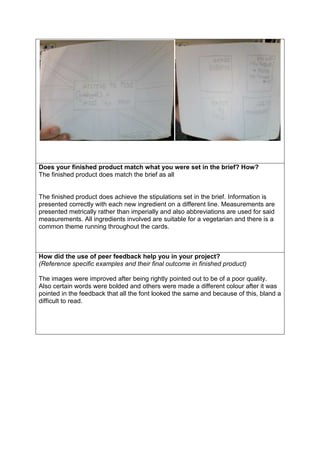
The initial flat plans (below) show the original idea was followed through with and
maintained the predominant feature that is the Union Jack. Small changes were
made to the structure of the information with the cooking method and ingredients
swapped in what sides of the card they would be on. Also the cooking method and
ingredients now take up more than a corner of the page, which was originally
planned. This was changed when we thought that it was more important to have less
information but all completely readable rather than more words but additionally less
important information, such as where were the ingredients sourced from.
Does your finished product match what you were set in the brief? How?
The finished product does match the brief as all

The finished product does achieve the stipulations set in the brief. Information is
presented correctly with each new ingredient on a different line. Measurements are
presented metrically rather than imperially and also abbreviations are used for said
measurements. All ingredients involved are suitable for a vegetarian and there is a
common theme running throughout the cards.

How did the use of peer feedback help you in your project?
(Reference specific examples and their final outcome in finished product)
The images were improved after being rightly pointed out to be of a poor quality.
Also certain words were bolded and others were made a different colour after it was
pointed in the feedback that all the font looked the same and because of this, bland a
difficult to read.
Discuss the strengths and weaknesses of your final product regarding its
technical and aesthetical qualities.
Use box below for text or page space to include an annotated copy of your work to
help illustrate how you have done this. You can use a combination of the two.
Reference what you like and dislike about the work with consistent reference to
correct terminology of tools/effects used.
The main strengths of the recipe cards are that they are bright, attractive and easily
readable. The only downside to the font (for the ingredients and method) bring as
easy possible to read, was that a more complicated font and perhaps one that tied in
with the theme a little more was sacrificed.
What skills/knowledge have you gained/developed in this project? How could
these be applied in future practice?

Skills that I have developed in this project have been working in a team,
communication skills, organisation skills and the skill of presenting to a group of
people. My skill and knowledge in using Photoshop has also developed.

Production Processes
Do you believe your work is creative and technically competent? Why?
(Reference specific examples (use images if this will help) of where you believe your
work is particularly visually or technically impressive)
I believe my work does show competent creative and technical capabilities. Granted
the work is not overly complicated, but I believe the cards are is more simple and
effective than over complicated and unreadable.

How effectively did you manage your time?
(Could you have used time more wisely? Did a particular aspect of the project take
longer than expected? Did you complete everything on schedule?)
Towards the end of the project mistakes kept being discovered when we thought we
were nearing the end. Due to being near completed work started to be completed at
a leisurely pace and as a result the end of the project was rather rushed. To have
avoided this we should maintained the work ethic shown at the start of the project
until completely done.

If you could repeat the process what would you do differently?
I would have used an Italian theme rather than a ‘Best of British’ one. This is
because the ‘Best of British’ theme was limited in the amount of dishes capable of
being used, the Italian one had many more dishes that would have been able to be
used and perhaps more suited to a vegetarian.
Working to a Brief in the Creative Media Industries
Constraints Experienced:
What constraints did you encounter and how did you consider/avoid them?
Legal Constraints
Stock Photographs being used and infringing the owners copyright as a result. Stock
photographs, which had permission to be used by the owner were sourced.

Regulatory Constraints

Financial Constraints
High-level graphic designers costing a huge amount. To counter this a middle of the
range graphic designer was sourced with hours being limited to 60.

Management:
How did you work as part of a group?
(Did you lead the project? What parts of the project did you take charge of? Did you
enjoy working as part of a group? Why?)
I lead the project as team leader. Work was enjoyable as group work was split
evenly and fairly.

How important is communication when working in a group?
(Use specific examples from working in a group on this project)
Communication is very important when working in a group. Team members can get
across their expectations of each other and also work can be split correctly avoiding
work being done twice over.

What have you learnt about working in a group and how will you apply this to
future practice?
I have learnt that work should be done as quickly as possible whilst maintaining a
high standard. This would in the future avoid the stress of tight deadlines.
What have you learnt about working in to a brief and how will you apply this to
future practice?
I have learnt that a brief being followed correctly is critical to the success of the
project.

Ashley Boyne

Evaluation (print based media and working to brief) 1

  • 1.
    Evaluation Producing Print BasedMedia Visual Language: Composition How have you chosen to set out your designs and why? (Reference layout, image/text ratio, busy/simplistic etc) The first side of the recipe card is used to attract the attention of the reader and also set the theme. This is had been done by filling this side of the recipe card with the flag of Great Britain (showcasing the theme) and by turning the flag into shades of green (attracting the readers attention). Putting the title across the centre line was chosen as it is easy to read on this part of the flag. As little text as possible was wanted on the flag, this would mean that the majority of the flag would be able to remain clear and easily recognisable. The second half of the recipe card contains the actual method and ingredients on it. This was left to be as simplistic as possible. This was so it could be read easily at speed as I felt it was information that was very important and therefore needed no unnecessary potential complications. These complications could include a unreadable font or perhaps a colour scheme that made the text difficult to read. To counter these potential problems I useda simple Franklin Gothic font and added a white rectangle to the background of the text. Image Construction Discuss the contents of your final images and reflect upon decisions made. (Content used- image/text/graphic, use of colour, original or stock images etc) The final images used in recipe cards were all stock images. The stock images all contained a picture of the finished recipe. The stock images were made to fill whatever gap had been left after the text on the recipe card had been inserted. The text was sometimes made to be a smaller font if we felt that the size of the images were not adequate in size.
  • 2.
    Representation Discuss the semioticsand connotations created from the content you have included. (What meaning or suggestions are created from the images/colours/designs you have used?) I think there are certainly connotations of patriotism in the recipe cards. People who believe in National Pride and follow the “Good Old Blighty” mantra will probably find this very appealing as a result. With changing the colours on the flag from it’s traditional blue, white and red to that of green and white, connotations are given to whoever my looking at the card to that of vegetarianism. So with this small change, already the reader can already have a idea of what the theme of the dish is; British Vegetarian dishes. Audiences: Create an audience profile of your chosen demographic (Age, gender, psychographic, geodemographic, NRS Social Grade, hobbies, sexuality [if appropriate] etc) With the target audience primarily being those visiting Britain wanting to taste the British cuisine, an assumption could be made that they probably are those of a higher wealth. This would tie in also with the majority of vegetarians. This would mean someone in the A,B,C1 NRS Social Grade. This person would also be more likely middle aged to elderly, living abroad and with hobbies including tennis and golf. How have you constructed your work to appeal to this audience? Use box below for text or page space to include an annotated copy of an example of your work to help illustrate how you have done this. You can use a combination of the two. Many middle and upper-class families are visibly excited by the sight of a British Flag, with this in mind, appealing to middle class and upper-class families returning to Britain with a British flag was an easy decision.
  • 4.
    Historical and CulturalContext: What did you use as your design influences and why were they chosen? (What existing media products influenced the final look of your work?) The 2012 Summer Olympics were a design influence. The games showed that the majority of people in Britain feeling comfortable surrounded by the British flag and will also buy into anything that is represented by one. Do vegetarian products have a specific design aesthetic and how does your project reflect/contrast this? Why? In the main vegetarian and non-vegetarian recipes are very similar aesthetically. The few differences that occasionally occur are that vegetarian recipe cards often use brighter colours than non-vegetarian recipe cards; the colour green for example is frequently used. Also vegetarian cards often give health tips and guides on how to easily maintain a healthy living. Finished Products: Does your finished product reflect your initial plans? How? If there are any differences, describe why changes were made. (You can use visual examples of flat plans and finished products to illustrate this) The initial flat plans (below) show the original idea was followed through with and maintained the predominant feature that is the Union Jack. Small changes were made to the structure of the information with the cooking method and ingredients swapped in what sides of the card they would be on. Also the cooking method and ingredients now take up more than a corner of the page, which was originally planned. This was changed when we thought that it was more important to have less information but all completely readable rather than more words but additionally less important information, such as where were the ingredients sourced from.
  • 5.
    Does your finishedproduct match what you were set in the brief? How? The finished product does match the brief as all The finished product does achieve the stipulations set in the brief. Information is presented correctly with each new ingredient on a different line. Measurements are presented metrically rather than imperially and also abbreviations are used for said measurements. All ingredients involved are suitable for a vegetarian and there is a common theme running throughout the cards. How did the use of peer feedback help you in your project? (Reference specific examples and their final outcome in finished product) The images were improved after being rightly pointed out to be of a poor quality. Also certain words were bolded and others were made a different colour after it was pointed in the feedback that all the font looked the same and because of this, bland a difficult to read.
  • 6.
    Discuss the strengthsand weaknesses of your final product regarding its technical and aesthetical qualities. Use box below for text or page space to include an annotated copy of your work to help illustrate how you have done this. You can use a combination of the two. Reference what you like and dislike about the work with consistent reference to correct terminology of tools/effects used. The main strengths of the recipe cards are that they are bright, attractive and easily readable. The only downside to the font (for the ingredients and method) bring as easy possible to read, was that a more complicated font and perhaps one that tied in with the theme a little more was sacrificed.
  • 7.
    What skills/knowledge haveyou gained/developed in this project? How could these be applied in future practice? Skills that I have developed in this project have been working in a team, communication skills, organisation skills and the skill of presenting to a group of people. My skill and knowledge in using Photoshop has also developed. Production Processes Do you believe your work is creative and technically competent? Why? (Reference specific examples (use images if this will help) of where you believe your work is particularly visually or technically impressive) I believe my work does show competent creative and technical capabilities. Granted the work is not overly complicated, but I believe the cards are is more simple and effective than over complicated and unreadable. How effectively did you manage your time? (Could you have used time more wisely? Did a particular aspect of the project take longer than expected? Did you complete everything on schedule?) Towards the end of the project mistakes kept being discovered when we thought we were nearing the end. Due to being near completed work started to be completed at a leisurely pace and as a result the end of the project was rather rushed. To have avoided this we should maintained the work ethic shown at the start of the project until completely done. If you could repeat the process what would you do differently? I would have used an Italian theme rather than a ‘Best of British’ one. This is because the ‘Best of British’ theme was limited in the amount of dishes capable of being used, the Italian one had many more dishes that would have been able to be used and perhaps more suited to a vegetarian.
  • 9.
    Working to aBrief in the Creative Media Industries Constraints Experienced: What constraints did you encounter and how did you consider/avoid them? Legal Constraints Stock Photographs being used and infringing the owners copyright as a result. Stock photographs, which had permission to be used by the owner were sourced. Regulatory Constraints Financial Constraints High-level graphic designers costing a huge amount. To counter this a middle of the range graphic designer was sourced with hours being limited to 60. Management: How did you work as part of a group? (Did you lead the project? What parts of the project did you take charge of? Did you enjoy working as part of a group? Why?) I lead the project as team leader. Work was enjoyable as group work was split evenly and fairly. How important is communication when working in a group? (Use specific examples from working in a group on this project) Communication is very important when working in a group. Team members can get across their expectations of each other and also work can be split correctly avoiding work being done twice over. What have you learnt about working in a group and how will you apply this to future practice? I have learnt that work should be done as quickly as possible whilst maintaining a high standard. This would in the future avoid the stress of tight deadlines.
  • 10.
    What have youlearnt about working in to a brief and how will you apply this to future practice? I have learnt that a brief being followed correctly is critical to the success of the project. Ashley Boyne