ICH E6(R1): Guideline for Good Clinical
Practice ICH E6(R2) ICH
BY-Manisha Chauhan
(Apeejay Stya University)
INTRODUCTION
• A standard for the design, conduct, performance, monitoring, auditing,
recording, analyses, and reporting of clinical trials that provides assurance
that the data and reported results are credible and accurate, and that the
rights, integrity, and confidentiality of trial subjects are protected.
• Ethical and scientific quality standards for designing, conducting, recording
and reporting trials that involve participation of human subjects to ensure that
the rights, safety and wellbeing of the trial subjects are protected.
WHAT IS GCP?
• Good Clinical Practice (GCP) is an international ethical and scientific quality
standard for designing, conducting, recording and reporting trials that involve
the participation of human subjects.
• Compliance with this standard provides public assurance that the rights,
safety and well-being of trial subjects are protected, consistent with the
principles that have their origin in the Declaration of Helsinki, and that the
clinical trial data are credible.
OBJECTIVE OF ICH GCP
• The objective of this ICH GCP Guideline is to provide a unified standard for
the European Union (EU), Japan and the United States to facilitate the mutual
acceptance of clinical data by the regulatory authorities in these jurisdictions.
• The guideline was developed with consideration of the current good clinical
practices of the European Union, Japan, and the United States, as well as
those of Australia, Canada, the Nordic countries and the World Health
Organization (WHO).
• This guideline should be followed when generating clinical trial data that are
intended to be submitted to regulatory authorities.
PRINCIPLES OF ICH GCP
PRINCIPLE 1
• Clinical trials should be conducted in accordance with the ethical principles that have their
origin in the Declaration of Helsinki, and that are consistent with GCP and the applicable
regulatory requirement.
PRINCIPLE 2
• Before a trial is initiated, foreseeable risks and inconveniences should be weighed against the
anticipated benefit for the individual trial subject and society. A trial should be initiated and
continued only if the anticipated benefits justify the risks.
PRINCIPLE 3
• The rights, safety, and well-being of the trial subjects are the most important considerations
and should prevail over interests of science and society.
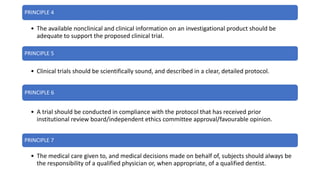
PRINCIPLE 4
• The available nonclinical and clinical information on an investigational product should be
adequate to support the proposed clinical trial.
PRINCIPLE 5
• Clinical trials should be scientifically sound, and described in a clear, detailed protocol.
PRINCIPLE 6
• A trial should be conducted in compliance with the protocol that has received prior
institutional review board/independent ethics committee approval/favourable opinion.
PRINCIPLE 7
• The medical care given to, and medical decisions made on behalf of, subjects should always be
the responsibility of a qualified physician or, when appropriate, of a qualified dentist.
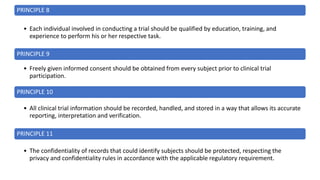
PRINCIPLE 8
• Each individual involved in conducting a trial should be qualified by education, training, and
experience to perform his or her respective task.
PRINCIPLE 9
• Freely given informed consent should be obtained from every subject prior to clinical trial
participation.
PRINCIPLE 10
• All clinical trial information should be recorded, handled, and stored in a way that allows its accurate
reporting, interpretation and verification.
PRINCIPLE 11
• The confidentiality of records that could identify subjects should be protected, respecting the
privacy and confidentiality rules in accordance with the applicable regulatory requirement.
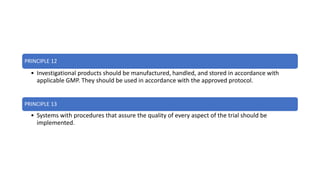
PRINCIPLE 12
• Investigational products should be manufactured, handled, and stored in accordance with
applicable GMP. They should be used in accordance with the approved protocol.
PRINCIPLE 13
• Systems with procedures that assure the quality of every aspect of the trial should be
implemented.
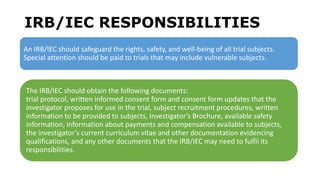
IRB/IEC RESPONSIBILITIES
An IRB/IEC should safeguard the rights, safety, and well-being of all trial subjects.
Special attention should be paid to trials that may include vulnerable subjects.
The IRB/IEC should obtain the following documents:
trial protocol, written informed consent form and consent form updates that the
investigator proposes for use in the trial, subject recruitment procedures, written
information to be provided to subjects, Investigator’s Brochure, available safety
information, information about payments and compensation available to subjects,
the investigator’s current curriculum vitae and other documentation evidencing
qualifications, and any other documents that the IRB/IEC may need to fulfil its
responsibilities.
The IRB/IEC should consider the qualifications of the investigator for the proposed trial, as
documented by a current curriculum vitae and/or by any other relevant documentation the IRB/IEC
requests.
The IRB/IEC should conduct continuing review of each ongoing trial at intervals appropriate to the
degree of risk to human subjects, but at least once per year.
The IRB/IEC may request more information when, in the judgement of the IRB/IEC, the additional
information would add meaningfully to the protection of the rights, safety and/or well-being of the
subjects.
When a non-therapeutic trial is to be carried out with the consent of the subject’s legally
acceptable representative, the IRB/IEC should determine that the proposed protocol and/or other
document adequately addresses relevant ethical concerns and meets applicable regulatory
requirements for such trials.
COMPOSITION OF IRB/IEC
The IRB/IEC should consist of a reasonable number of members, who collectively have the
qualifications and experience to review and evaluate the science, medical aspects, and
ethics of the proposed trial. It is recommended that the IRB/IEC should include:
At least five members.
At least one member whose
primary area of interest is in a
nonscientific area.
At least one member who is
independent of the
institution/trial site.
INVESTIGATOR
• Investigator’s Qualifications and Agreements
The investigator should be qualified by education, training, and experience to assume
responsibility for the proper conduct of the trial, should meet all the qualifications
specified by the applicable regulatory requirement, and should provide evidence of
such qualifications through up-to-date curriculum vitae and other relevant
documentation requested by the sponsor, the IRB/IEC, and the regulatory authority.
The investigator should be thoroughly familiar with the appropriate use of the
investigational product, as described in the protocol, in the current Investigator’s
Brochure, in the product information and in other information sources provided by the
sponsor.
• Responsibilities of Investigator
Medical care of the trial subjects
Communication with an IRB/IEC
Compliance with protocol
Responsibility for investigational product accountability at the
trial site rests with the investigator/institution.
Randomization Procedures and Unblinding
Informed Consent of Trial Subjects
 Records and Reports
RESPONSIBILITY OF SPONSOR
• Quality Management
• Critical Process and Data Identification
• Risk Evaluation, Identification, and Control
• Risk Communication, Review and Reporting
• Quality Assurance and Quality Control
• Contract Research Organization (CRO)
• Medical Expertise
• Trial Design
• Trial Management, Data Handling, and Record Keeping
• Investigator Selection
• Allocation of Responsibilities
• Compensation to Subjects and Investigators
• Financing
• Notification/Submission to Regulatory Authority
• Confirmation of Review by IRB/IEC
• Information on Investigational Product
• Manufacturing, Packaging, Labelling, and Coding Investigational Product
• Supplying and Handling Investigational Product
• Record Access
• Safety Information
• Adverse Drug Reaction Reporting
• Monitoring
• Audit
• Noncompliance
• Premature Termination or Suspension of a Trial
• Clinical Trial/Study Reports
• Multicentre Trials
INVESTIGATOR’S BROCHURE
The Investigator’s Brochure is a compilation of the clinical and nonclinical data on
the investigational product that are relevant to the study of the product in human
subjects. Its purpose is to provide the investigators and others involved in the trial
with the information to facilitate their understanding of the rationale for, and their
compliance with, many key features of the protocol, such as the dose, dose
frequency/interval, methods of administration: and safety monitoring procedures.
The IB also provides insight to support the clinical management of the study
subjects during the course of the clinical trial.
The sponsor is responsible for ensuring that an up-to-date IB is made available to
the investigator and the investigators are responsible for providing the up-to-date
IB to the responsible IRBs/IECs.
ESSENTIAL DOCUMENTS FOR THE
CONDUCT OF A CLINICAL TRIAL
Essential Documents are those documents which individually and collectively
permit evaluation of the conduct of a trial and the quality of the data produced.
These documents serve to demonstrate the compliance of the investigator, sponsor
and monitor with the standards of Good Clinical Practice and with all applicable
regulatory requirements.
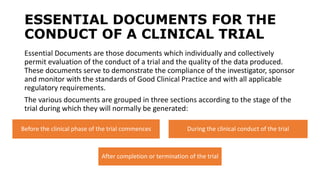
The various documents are grouped in three sections according to the stage of the
trial during which they will normally be generated:
Before the clinical phase of the trial commences During the clinical conduct of the trial
After completion or termination of the trial
DOCUMENTS GENERATED BEFORE THE
CLINICAL PHASE OF THE TRIAL COMMENCES
• INVESTIGATOR’S BROCHURE
• SIGNED PROTOCOL AND AMENDMENTS, IF ANY, AND SAMPLE CASE REPORT
FORM (CRF)
• INFORMATION GIVEN TO TRIAL SUBJECT-INFORMED CONSENT FORM
• FINANCIAL ASPECTS OF THE TRIAL
• INSURANCE STATEMENT (where required)
• SIGNED AGREEMENT BETWEEN INVOLVED PARTIES, e.g.:
- investigator/institution and sponsor
• DATED, DOCUMENTED APPROVAL/FAVOURABLE OPINION OF INSTITUTIONAL
REVIEW BOARD (IRB) /INDEPENDENT ETHICS COMMITTEE (IEC)
• INSTITUTIONAL REVIEW BOARD / INDEPENDENT ETHICS COMMITTEE
COMPOSITION
• REGULATORY AUTHORITY(IES) AUTHORISATION / APPROVAL / NOTIFICATION OF
PROTOCOL
(where required)
• CURRICULUM VITAE AND/OR OTHER RELEVANT DOCUMENTS EVIDENCING
QUALIFICATIONS OF INVESTIGATOR AND SUB-INVESTIGATOR
• NORMAL VALUE/RANGE FOR MEDICAL / LABORATORY / TECHNICAL PROCEDURE
AND/OR TEST INCLUDED IN THE PROTOCOL
• MEDICAL/LABORATORY/TECHNICAL PROCEDURES / TESTS
• SAMPLE OF LABEL ATTACHED TO INVESTIGATIONAL PRODUCT CONTAINER
• INSTRUCTIONS FOR HANDLING OF INVESTIGATIONAL PRODUCT AND TRIAL-RELATED
MATERIALS
• SHIPPING RECORDS FOR INVESTIGATIONAL PRODUCT AND TRIAL-RELATED MATERIALS
• CERTIFICATE OF ANALYSIS OF INVESTIGATIONAL PRODUCT SHIPPED
• DECODING PROCEDURES FOR BLINDED TRIALS
• MASTER RANDOMISATION LIST
• PRE-TRIAL MONITORING REPORT
• TRIAL INITIATION MONITORING REPORT
DOCUMENTS GENERATED DURING THE
CLINICAL CONDUCT OF THE TRIAL
• INVESTIGATOR’S BROCHURE UPDATES
• ANY REVISION TO:
- protocol/amendment and CRF
- informed consent form
- any other written information provided to subjects
- advertisement for subject recruitment
• DATED, DOCUMENTED APPROVAL / FAVOURABLE OPINION OF INSTITUTIONAL REVIEW BOARD
(IRB) / INDEPENDENT ETHICS COMMITTEE (IEC) OF THE FOLLOWING:
- protocol amendment
- revision of:
- informed consent form
- any other written information to be provided to the subject
- advertisement for subject recruitment
- any other documents given approval/favourable opinion
- continuing review of trial
• REGULATORY AUTHORITY AUTHORISATIONS / APPROVALS / NOTIFICATIONS
• CURRICULUM VITAE FOR NEW INVESTIGATOR AND/OR SUB-INVESTIGATOR
• UPDATES TO NORMAL VALUE/RANGE FOR MEDICAL / LABORATORY / TECHNICAL
PROCEDURE / TEST INCLUDED IN THE PROTOCOL
• NOTIFICATION BY ORIGINATING INVESTIGATOR TO SPONSOR OF SERIOUS ADVERSE
EVENTS AND RELATED REPORTS
• NOTIFICATION BY SPONSOR AND/OR INVESTIGATOR, WHERE APPLICABLE, TO
REGULATORY AUTHORITY AND IRB/IEC OF UNEXPECTED SERIOUS ADVERSE DRUG
REACTIONS AND OF OTHER SAFETY INFORMATION
• UPDATES OF MEDICAL/LABORATORY/ TECHNICAL PROCEDURES/TESTS
• DOCUMENTATION OF INVESTIGATIONAL PRODUCT AND TRIAL-RELATED MATERIALS
SHIPMENT
• CERTIFICATE OF ANALYSIS FOR NEW BATCHES OF INVESTIGATIONAL PRODUCTS
• MONITORING VISIT REPORTS
• RELEVANT COMMUNICATIONS OTHER THAN SITE VISITS
• SIGNED INFORMED CONSENT FORMS
• SOURCE DOCUMENTS
• SIGNED, DATED AND COMPLETED CASE REPORT FORMS
• DOCUMENTATION OF CRF CORRECTIONS
• NOTIFICATION BY SPONSOR TO INVESTIGATORS OF SAFETY INFORMATION
• INTERIM OR ANNUAL REPORTS TO IRB/IEC AND AUTHORITY
• SUBJECT SCREENING LOG
• SUBJECT IDENTIFICATION CODE LIST
• INVESTIGATIONAL PRODUCTS ACCOUNTABILITY AT THE SITE
• SIGNATURE SHEET
• RECORD OF RETAINED BODY FLUIDS/ TISSUE SAMPLES
DOCUMENTS GENERATED AFTER
TERMINATION OF CLINICAL TRIAL
• INVESTIGATIONAL PRODUCT ACCOUNTABILITY AT SITE
• DOCUMENTATION OF INVESTIGATIONAL PRODUCT DESTRUCTION
• COMPLETED SUBJECT IDENTIFICATION CODE LIST
• AUDIT CERTIFICATE
• FINAL TRIAL CLOSE-OUT MONITORING REPORT
• TREATMENT ALLOCATION AND DECODING DOCUMENTATION
• FINAL REPORT BY INVESTIGATOR TO IRB/IEC WHERE REQUIRED, AND WHERE
APPLICABLE, TO THE REGULATORY AUTHORITY
• CLINICAL STUDY REPORT
Ich e6(r1)

Ich e6(r1)

  • 1.
    ICH E6(R1): Guidelinefor Good Clinical Practice ICH E6(R2) ICH BY-Manisha Chauhan (Apeejay Stya University)
  • 2.
    INTRODUCTION • A standardfor the design, conduct, performance, monitoring, auditing, recording, analyses, and reporting of clinical trials that provides assurance that the data and reported results are credible and accurate, and that the rights, integrity, and confidentiality of trial subjects are protected. • Ethical and scientific quality standards for designing, conducting, recording and reporting trials that involve participation of human subjects to ensure that the rights, safety and wellbeing of the trial subjects are protected.
  • 3.
    WHAT IS GCP? •Good Clinical Practice (GCP) is an international ethical and scientific quality standard for designing, conducting, recording and reporting trials that involve the participation of human subjects. • Compliance with this standard provides public assurance that the rights, safety and well-being of trial subjects are protected, consistent with the principles that have their origin in the Declaration of Helsinki, and that the clinical trial data are credible.
  • 4.
    OBJECTIVE OF ICHGCP • The objective of this ICH GCP Guideline is to provide a unified standard for the European Union (EU), Japan and the United States to facilitate the mutual acceptance of clinical data by the regulatory authorities in these jurisdictions. • The guideline was developed with consideration of the current good clinical practices of the European Union, Japan, and the United States, as well as those of Australia, Canada, the Nordic countries and the World Health Organization (WHO). • This guideline should be followed when generating clinical trial data that are intended to be submitted to regulatory authorities.
  • 5.
    PRINCIPLES OF ICHGCP PRINCIPLE 1 • Clinical trials should be conducted in accordance with the ethical principles that have their origin in the Declaration of Helsinki, and that are consistent with GCP and the applicable regulatory requirement. PRINCIPLE 2 • Before a trial is initiated, foreseeable risks and inconveniences should be weighed against the anticipated benefit for the individual trial subject and society. A trial should be initiated and continued only if the anticipated benefits justify the risks. PRINCIPLE 3 • The rights, safety, and well-being of the trial subjects are the most important considerations and should prevail over interests of science and society.
  • 6.
    PRINCIPLE 4 • Theavailable nonclinical and clinical information on an investigational product should be adequate to support the proposed clinical trial. PRINCIPLE 5 • Clinical trials should be scientifically sound, and described in a clear, detailed protocol. PRINCIPLE 6 • A trial should be conducted in compliance with the protocol that has received prior institutional review board/independent ethics committee approval/favourable opinion. PRINCIPLE 7 • The medical care given to, and medical decisions made on behalf of, subjects should always be the responsibility of a qualified physician or, when appropriate, of a qualified dentist.
  • 7.
    PRINCIPLE 8 • Eachindividual involved in conducting a trial should be qualified by education, training, and experience to perform his or her respective task. PRINCIPLE 9 • Freely given informed consent should be obtained from every subject prior to clinical trial participation. PRINCIPLE 10 • All clinical trial information should be recorded, handled, and stored in a way that allows its accurate reporting, interpretation and verification. PRINCIPLE 11 • The confidentiality of records that could identify subjects should be protected, respecting the privacy and confidentiality rules in accordance with the applicable regulatory requirement.
  • 8.
    PRINCIPLE 12 • Investigationalproducts should be manufactured, handled, and stored in accordance with applicable GMP. They should be used in accordance with the approved protocol. PRINCIPLE 13 • Systems with procedures that assure the quality of every aspect of the trial should be implemented.
  • 9.
    IRB/IEC RESPONSIBILITIES An IRB/IECshould safeguard the rights, safety, and well-being of all trial subjects. Special attention should be paid to trials that may include vulnerable subjects. The IRB/IEC should obtain the following documents: trial protocol, written informed consent form and consent form updates that the investigator proposes for use in the trial, subject recruitment procedures, written information to be provided to subjects, Investigator’s Brochure, available safety information, information about payments and compensation available to subjects, the investigator’s current curriculum vitae and other documentation evidencing qualifications, and any other documents that the IRB/IEC may need to fulfil its responsibilities.
  • 10.
    The IRB/IEC shouldconsider the qualifications of the investigator for the proposed trial, as documented by a current curriculum vitae and/or by any other relevant documentation the IRB/IEC requests. The IRB/IEC should conduct continuing review of each ongoing trial at intervals appropriate to the degree of risk to human subjects, but at least once per year. The IRB/IEC may request more information when, in the judgement of the IRB/IEC, the additional information would add meaningfully to the protection of the rights, safety and/or well-being of the subjects. When a non-therapeutic trial is to be carried out with the consent of the subject’s legally acceptable representative, the IRB/IEC should determine that the proposed protocol and/or other document adequately addresses relevant ethical concerns and meets applicable regulatory requirements for such trials.
  • 11.
    COMPOSITION OF IRB/IEC TheIRB/IEC should consist of a reasonable number of members, who collectively have the qualifications and experience to review and evaluate the science, medical aspects, and ethics of the proposed trial. It is recommended that the IRB/IEC should include: At least five members. At least one member whose primary area of interest is in a nonscientific area. At least one member who is independent of the institution/trial site.
  • 12.
    INVESTIGATOR • Investigator’s Qualificationsand Agreements The investigator should be qualified by education, training, and experience to assume responsibility for the proper conduct of the trial, should meet all the qualifications specified by the applicable regulatory requirement, and should provide evidence of such qualifications through up-to-date curriculum vitae and other relevant documentation requested by the sponsor, the IRB/IEC, and the regulatory authority. The investigator should be thoroughly familiar with the appropriate use of the investigational product, as described in the protocol, in the current Investigator’s Brochure, in the product information and in other information sources provided by the sponsor.
  • 13.
    • Responsibilities ofInvestigator Medical care of the trial subjects Communication with an IRB/IEC Compliance with protocol Responsibility for investigational product accountability at the trial site rests with the investigator/institution. Randomization Procedures and Unblinding Informed Consent of Trial Subjects  Records and Reports
  • 14.
    RESPONSIBILITY OF SPONSOR •Quality Management • Critical Process and Data Identification • Risk Evaluation, Identification, and Control • Risk Communication, Review and Reporting • Quality Assurance and Quality Control • Contract Research Organization (CRO) • Medical Expertise • Trial Design • Trial Management, Data Handling, and Record Keeping • Investigator Selection • Allocation of Responsibilities • Compensation to Subjects and Investigators
  • 15.
    • Financing • Notification/Submissionto Regulatory Authority • Confirmation of Review by IRB/IEC • Information on Investigational Product • Manufacturing, Packaging, Labelling, and Coding Investigational Product • Supplying and Handling Investigational Product • Record Access • Safety Information • Adverse Drug Reaction Reporting • Monitoring • Audit • Noncompliance • Premature Termination or Suspension of a Trial • Clinical Trial/Study Reports • Multicentre Trials
  • 16.
    INVESTIGATOR’S BROCHURE The Investigator’sBrochure is a compilation of the clinical and nonclinical data on the investigational product that are relevant to the study of the product in human subjects. Its purpose is to provide the investigators and others involved in the trial with the information to facilitate their understanding of the rationale for, and their compliance with, many key features of the protocol, such as the dose, dose frequency/interval, methods of administration: and safety monitoring procedures. The IB also provides insight to support the clinical management of the study subjects during the course of the clinical trial. The sponsor is responsible for ensuring that an up-to-date IB is made available to the investigator and the investigators are responsible for providing the up-to-date IB to the responsible IRBs/IECs.
  • 17.
    ESSENTIAL DOCUMENTS FORTHE CONDUCT OF A CLINICAL TRIAL Essential Documents are those documents which individually and collectively permit evaluation of the conduct of a trial and the quality of the data produced. These documents serve to demonstrate the compliance of the investigator, sponsor and monitor with the standards of Good Clinical Practice and with all applicable regulatory requirements. The various documents are grouped in three sections according to the stage of the trial during which they will normally be generated: Before the clinical phase of the trial commences During the clinical conduct of the trial After completion or termination of the trial
  • 18.
    DOCUMENTS GENERATED BEFORETHE CLINICAL PHASE OF THE TRIAL COMMENCES • INVESTIGATOR’S BROCHURE • SIGNED PROTOCOL AND AMENDMENTS, IF ANY, AND SAMPLE CASE REPORT FORM (CRF) • INFORMATION GIVEN TO TRIAL SUBJECT-INFORMED CONSENT FORM • FINANCIAL ASPECTS OF THE TRIAL • INSURANCE STATEMENT (where required) • SIGNED AGREEMENT BETWEEN INVOLVED PARTIES, e.g.: - investigator/institution and sponsor • DATED, DOCUMENTED APPROVAL/FAVOURABLE OPINION OF INSTITUTIONAL REVIEW BOARD (IRB) /INDEPENDENT ETHICS COMMITTEE (IEC) • INSTITUTIONAL REVIEW BOARD / INDEPENDENT ETHICS COMMITTEE COMPOSITION
  • 19.
    • REGULATORY AUTHORITY(IES)AUTHORISATION / APPROVAL / NOTIFICATION OF PROTOCOL (where required) • CURRICULUM VITAE AND/OR OTHER RELEVANT DOCUMENTS EVIDENCING QUALIFICATIONS OF INVESTIGATOR AND SUB-INVESTIGATOR • NORMAL VALUE/RANGE FOR MEDICAL / LABORATORY / TECHNICAL PROCEDURE AND/OR TEST INCLUDED IN THE PROTOCOL • MEDICAL/LABORATORY/TECHNICAL PROCEDURES / TESTS • SAMPLE OF LABEL ATTACHED TO INVESTIGATIONAL PRODUCT CONTAINER • INSTRUCTIONS FOR HANDLING OF INVESTIGATIONAL PRODUCT AND TRIAL-RELATED MATERIALS • SHIPPING RECORDS FOR INVESTIGATIONAL PRODUCT AND TRIAL-RELATED MATERIALS • CERTIFICATE OF ANALYSIS OF INVESTIGATIONAL PRODUCT SHIPPED • DECODING PROCEDURES FOR BLINDED TRIALS • MASTER RANDOMISATION LIST • PRE-TRIAL MONITORING REPORT • TRIAL INITIATION MONITORING REPORT
  • 20.
    DOCUMENTS GENERATED DURINGTHE CLINICAL CONDUCT OF THE TRIAL • INVESTIGATOR’S BROCHURE UPDATES • ANY REVISION TO: - protocol/amendment and CRF - informed consent form - any other written information provided to subjects - advertisement for subject recruitment • DATED, DOCUMENTED APPROVAL / FAVOURABLE OPINION OF INSTITUTIONAL REVIEW BOARD (IRB) / INDEPENDENT ETHICS COMMITTEE (IEC) OF THE FOLLOWING: - protocol amendment - revision of: - informed consent form - any other written information to be provided to the subject - advertisement for subject recruitment - any other documents given approval/favourable opinion - continuing review of trial • REGULATORY AUTHORITY AUTHORISATIONS / APPROVALS / NOTIFICATIONS • CURRICULUM VITAE FOR NEW INVESTIGATOR AND/OR SUB-INVESTIGATOR
  • 21.
    • UPDATES TONORMAL VALUE/RANGE FOR MEDICAL / LABORATORY / TECHNICAL PROCEDURE / TEST INCLUDED IN THE PROTOCOL • NOTIFICATION BY ORIGINATING INVESTIGATOR TO SPONSOR OF SERIOUS ADVERSE EVENTS AND RELATED REPORTS • NOTIFICATION BY SPONSOR AND/OR INVESTIGATOR, WHERE APPLICABLE, TO REGULATORY AUTHORITY AND IRB/IEC OF UNEXPECTED SERIOUS ADVERSE DRUG REACTIONS AND OF OTHER SAFETY INFORMATION • UPDATES OF MEDICAL/LABORATORY/ TECHNICAL PROCEDURES/TESTS • DOCUMENTATION OF INVESTIGATIONAL PRODUCT AND TRIAL-RELATED MATERIALS SHIPMENT • CERTIFICATE OF ANALYSIS FOR NEW BATCHES OF INVESTIGATIONAL PRODUCTS • MONITORING VISIT REPORTS • RELEVANT COMMUNICATIONS OTHER THAN SITE VISITS • SIGNED INFORMED CONSENT FORMS • SOURCE DOCUMENTS • SIGNED, DATED AND COMPLETED CASE REPORT FORMS • DOCUMENTATION OF CRF CORRECTIONS
  • 22.
    • NOTIFICATION BYSPONSOR TO INVESTIGATORS OF SAFETY INFORMATION • INTERIM OR ANNUAL REPORTS TO IRB/IEC AND AUTHORITY • SUBJECT SCREENING LOG • SUBJECT IDENTIFICATION CODE LIST • INVESTIGATIONAL PRODUCTS ACCOUNTABILITY AT THE SITE • SIGNATURE SHEET • RECORD OF RETAINED BODY FLUIDS/ TISSUE SAMPLES
  • 23.
    DOCUMENTS GENERATED AFTER TERMINATIONOF CLINICAL TRIAL • INVESTIGATIONAL PRODUCT ACCOUNTABILITY AT SITE • DOCUMENTATION OF INVESTIGATIONAL PRODUCT DESTRUCTION • COMPLETED SUBJECT IDENTIFICATION CODE LIST • AUDIT CERTIFICATE • FINAL TRIAL CLOSE-OUT MONITORING REPORT • TREATMENT ALLOCATION AND DECODING DOCUMENTATION • FINAL REPORT BY INVESTIGATOR TO IRB/IEC WHERE REQUIRED, AND WHERE APPLICABLE, TO THE REGULATORY AUTHORITY • CLINICAL STUDY REPORT