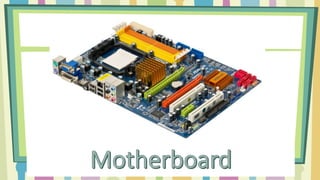

Motherboard/ Mainboard/ System Board
•The main circuit board of a
computer. It contains all the circuits
and components that run the
computer.
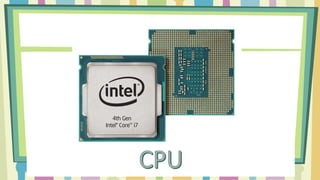
CPU (Central Processing Unit)
• The processor is the main “brain” or “heart” of a
computer system. It performs all of the
instructions and calculations that are needed
and manages the flow of information through a
computer
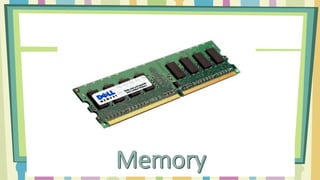
Primary Storage (Internal storage, main memory or
memory)
• It is the computer’s working storage space that
holds data, instructions for processing and
processed data (information) waiting to be sent
to secondary storage. Physically, primary
storage is a collection of RAM chips.
Two Types of Memory
A. ROM – (Read Only Memory)
•ROM is non-volatile, meaning it holds
data even when the power is ON or OFF.
Two Types of Memory
A. RAM – (Random Access Memory)
•RAM is volatile, meaning it holds data
only when the power is on. When the
power is off, RAM’s contents are lost.
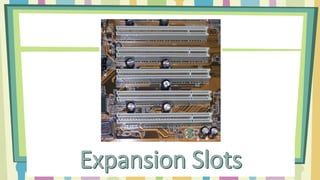
Expansion Slots
• A bus is a data pathway between several
hardware components inside or outside a
computer. It does not only connect the parts of
the CPU to each other, but also links the CPU
with other important hardware.
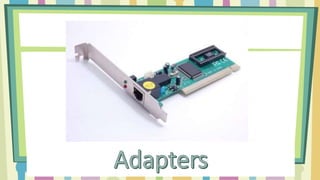
Adapters
• Printed-circuit boards (also called interface cards)
that enable the computer to use a peripheral device
for which it does not have the necessary connections
or circuit boards. They are often used to permit
upgrading to anew different hardware.
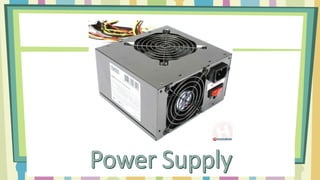
Power Supply
• Installed in the back corner of the PC case, next
to the motherboard. It converts 120VAC
(standard house power) into DC voltages that
are used by other components on the PC
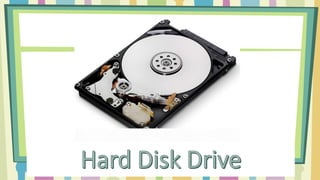
Hard Disk Drive (HDD)
• Installed in the back corner of the PC case, next
to the motherboard. It converts 120VAC
(standard house power) into DC voltages that
are used by other components on the PC
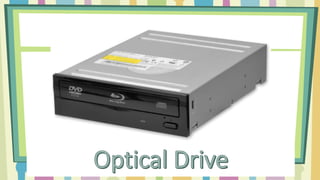
Optical Drive
• An Optical drive is a storage device that uses
lasers to read the data on the optical media:
There are three types of optical drives: Compact
Disc (CD), Digital Versatile Disc (DVD), and Blu-
ray Disc (BD)

TLE-CSS 9 Q4 Week 1_System Unit

  • 6.
    Motherboard/ Mainboard/ SystemBoard •The main circuit board of a computer. It contains all the circuits and components that run the computer.
  • 8.
    CPU (Central ProcessingUnit) • The processor is the main “brain” or “heart” of a computer system. It performs all of the instructions and calculations that are needed and manages the flow of information through a computer
  • 10.
    Primary Storage (Internalstorage, main memory or memory) • It is the computer’s working storage space that holds data, instructions for processing and processed data (information) waiting to be sent to secondary storage. Physically, primary storage is a collection of RAM chips.
  • 11.
    Two Types ofMemory A. ROM – (Read Only Memory) •ROM is non-volatile, meaning it holds data even when the power is ON or OFF.
  • 12.
    Two Types ofMemory A. RAM – (Random Access Memory) •RAM is volatile, meaning it holds data only when the power is on. When the power is off, RAM’s contents are lost.
  • 14.
    Expansion Slots • Abus is a data pathway between several hardware components inside or outside a computer. It does not only connect the parts of the CPU to each other, but also links the CPU with other important hardware.
  • 16.
    Adapters • Printed-circuit boards(also called interface cards) that enable the computer to use a peripheral device for which it does not have the necessary connections or circuit boards. They are often used to permit upgrading to anew different hardware.
  • 18.
    Power Supply • Installedin the back corner of the PC case, next to the motherboard. It converts 120VAC (standard house power) into DC voltages that are used by other components on the PC
  • 20.
    Hard Disk Drive(HDD) • Installed in the back corner of the PC case, next to the motherboard. It converts 120VAC (standard house power) into DC voltages that are used by other components on the PC
  • 22.
    Optical Drive • AnOptical drive is a storage device that uses lasers to read the data on the optical media: There are three types of optical drives: Compact Disc (CD), Digital Versatile Disc (DVD), and Blu- ray Disc (BD)