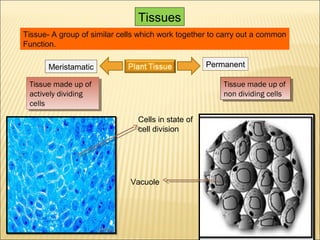
Tissue- A group of similar cells which work together to carry out a common
Function.
Meristamatic Permanent
Tissues
Tissue made up of
actively dividing
cells
Tissue made up of
actively dividing
cells
Tissue made up of
non dividing cells
Tissue made up of
non dividing cells
Vacuole
Cells in state of
cell division
Meristamatic Tissue
Intercalary meristem Apical meristem Lateral meristem
Meristamatic Tissue
Permanent Tissue
SimpleSimple ComplexComplex
Made up of one type of cellsMade up of one type of cells Made up of more than one
type of cells
Made up of more than one
type of cells
Parenchyma Collenchyma
Sclerenchyma
Xylem Phloem
Simple Permanent Tissue
•Parenchyma are
loosely-packed,
cube shaped or
elongate cells with
a large central
vacuole & thin cell
walls
Function-
Storage of food
Modified Parenchyma
Arenchyma Chlorenchyma
Intercellular space
Chlorophyll
Found in aquatic
plants
Function-
Photosynthesis
Function-Provide
aquatic plants
buoyancy
Collenchyma
Thickening
at the
corners of
cell wall
Function –Provides elasticity and strength
Sclerenchyma
Sclerenchyma is
made up of dead
cells and the walls
are uniformly thick.
Function- It
provides strength
and rigidity
Tissue with
structure
Location Function
Parenchyma
a
Root and Shoot make
up cortex, In leaf make
up mesophyll
Stalk of leaves, young
stems
Provides strength and
elasticity
Hard parts like seed
coats ,shells of dry fruits
Provides strength and
protection
Types of Simple Permanent Tissue
Thin walled
cells
Collenchyma
Walls
thickened
at corners
Sclerenchyma
Uniformly
thick walls.
Dead cells
Storage and
making food
Xylem
Complex permanent tissue
Tracheids
Vessels
Tracheids
Vessels
Vessels
Phloem
Transport by Xylem and Phloem
Plant tissue classified on the basis of location
Epidermal tissue
The epidermis is a single-layered group of cells that covers plants
leaves, flowers, roots and stems.
In stems it protects against water loss,
In roots it absorbs water and mineral nutrients
Cuticle
Single layer of cell
Root hairs
Stem Epidermis
Root Epidermis
Has thin walled cells and stomata for transpiration. Leaves of xerophytic plants
have thick layer of cutin to prevent water loss .
Leaf epidermis
Stomata
Animal Tissue
Epithelial
Tissue
Connective
Tissue
Muscle
Tissue
Nervous
Tissue
 The tissue is avascular, or without blood vessels.
Epithelial Tissue
 The cells within this tissue are firmly attached to each other.
 The upper surface of epithelium is free, or exposed to the
outside of the body or to an internal body cavity.
 A thin, extracellular layer called the basement membrane forms
between the epithelial and connective tissue.
Types of Epithelial Tissue
Type / Structure Location
Squamous Lungs ,lining of blood vessels
Cuboidal Pancreas ,lining of kidney tubles, ovaries
and testes
Inner lining of nose ,ear, tongue ,glands
Uterus and Fallopian tubes
Outer layer of skin
Cells are thin and flat.
Cells are cuboidal in shape
Columnar
The cells are elongated
and column-shaped
Ciliated
Stratified Epithelium
composed of several
layers of cells
Functions of Epithelial Tissue
 Protection - Epithelial cells from the skin
protect underlying tissue.
 Diffusion -Simple epithelium promotes the diffusion
of gases, liquids and nutrients..
 Absorption- Certain epithelial cells lining the small
intestine absorb nutrients from the digestion of food.
 Secretion- In glands, epithelial tissue is
specialised to secrete specific chemical substances
such as enzymes, hormones and lubricating fluids.
.
 Sensation- Specialised epithelial tissue
containing sensory nerve endings is found in the
skin, eyes, ears, nose and on the tongue
Connective Tissue
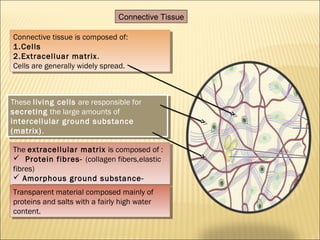
These living cells are responsible for
secreting the large amounts of
intercellular ground substance
(matrix).
These living cells are responsible for
secreting the large amounts of
intercellular ground substance
(matrix).
Connective tissue is composed of:
1.Cells
2.Extracelluar matrix.
Cells are generally widely spread.
Connective tissue is composed of:
1.Cells
2.Extracelluar matrix.
Cells are generally widely spread.
The extracellular matrix is composed of :
 Protein fibres- (collagen fibers,elastic
fibres)
 Amorphous ground substance-
The extracellular matrix is composed of :
 Protein fibres- (collagen fibers,elastic
fibres)
 Amorphous ground substance-
Transparent material composed mainly of
proteins and salts with a fairly high water
content.
Transparent material composed mainly of
proteins and salts with a fairly high water
content.
 The most widespread connective tissue
of the body.
 It is used to attach the skin to the
underlying tissue.
 It also fills the spaces between various
organs and thus holds them in place as well
as cushions and protects them
Collagen fibers
Elastin fibers
Areolar Adipose
Adipocytes
 It is a connective tissue
composed of adipocytes.
 It is composed of roughly
80% fat;
 Its main role is to store fat and it
also cushions and insulates the
body
Fibroblasts
Collagen
fibers
Elastin
fibers
Types of connective tissue
TendonTendon
 A tendon is a tough band of fibrous
connective tissue that usually connects
muscle to bone.
 Tendons are mostly composed of parallel
strands of collagen fibres closely packed
together
LigamentLigament
 A ligament is made up of
collagen fibers arranged parallely.
 A ligament joins two bones at
joints.
 The fibbers in ligaments are
arranged in criss-crossed layers.
Types of connective tissue
Cartilage
 It is found in the pinna of the
ear,windpipe, nasal septum and in the
epiglottis.
 Made up of dense matrix of collagen
fibres and elastic fibres. The cells are
called chondrocytes.
 Reduces friction at joints
Functions
 Support The cartilagenous rings in the
windpipes (trachea and bronchi) assist in
keeping those tubes open.
 Maintain shape. In the ear cartilage
helps to maintain the shape and
flexibility of the organ
Structure of bone
 The bone matrix has two main
components :
Organic matrix –Has collagen
fibbers.
Inorganic salts-Has mainly
calcium salts.
 Bone cells are osteocytes
which have long processes
called canaliculi
 The skeleton is built of bone tissue.
Bone provides the internal support of the
body
 Bone provides protection for the vital
organs of the body: the skull protects the
brain; the ribs protect the heart and lungs.
FUNCTIONS OF BONE TISSUEFUNCTIONS OF BONE TISSUE
 Provides sites of attachment of tendons
and muscles, essential for locomotion.
 The main store of calcium and
phosphate is in bone
Blood-A fluid connective tissue
White blood cells
Plasma
Red blood cells
Platelets
PlateletsRed Blood Cells
Blood cells
White blood cells
• Are red due to hemoglobin
• Are without nucleus
• Help in transport of oxygen.
• Are colorless.
• Have well defined nucleus.
• Help in protection
against diseases.
• Are colorless and
smallest cells
• Are without nucleus.
• Help in clotting of blood.
Oxygen carrying red blood cells Clotting by plateletsTypes of WBCs.
Functions of blood cells
Muscle Tissue
SKELETAL MUSCLES
SMOOTH MUSCLES
CARDIAC MUSCLES
Muscle Tissue
o Made up of long fiber like cells called muscle fibers.
o Help in movement and locomotion.
Nervous Tissue
 Made up of long cells called nerve cells.
 Make up the brain and spinal cord. Forms a network in the body.
Neuron
Tissues
Tissues

Tissues

  • 1.
    Tissue- A groupof similar cells which work together to carry out a common Function. Meristamatic Permanent Tissues Tissue made up of actively dividing cells Tissue made up of actively dividing cells Tissue made up of non dividing cells Tissue made up of non dividing cells Vacuole Cells in state of cell division
  • 2.
    Meristamatic Tissue Intercalary meristemApical meristem Lateral meristem
  • 3.
  • 4.
    Permanent Tissue SimpleSimple ComplexComplex Madeup of one type of cellsMade up of one type of cells Made up of more than one type of cells Made up of more than one type of cells Parenchyma Collenchyma Sclerenchyma Xylem Phloem
  • 5.
    Simple Permanent Tissue •Parenchymaare loosely-packed, cube shaped or elongate cells with a large central vacuole & thin cell walls Function- Storage of food Modified Parenchyma Arenchyma Chlorenchyma Intercellular space Chlorophyll Found in aquatic plants Function- Photosynthesis Function-Provide aquatic plants buoyancy
  • 6.
    Collenchyma Thickening at the corners of cellwall Function –Provides elasticity and strength
  • 7.
    Sclerenchyma Sclerenchyma is made upof dead cells and the walls are uniformly thick. Function- It provides strength and rigidity
  • 8.
    Tissue with structure Location Function Parenchyma a Rootand Shoot make up cortex, In leaf make up mesophyll Stalk of leaves, young stems Provides strength and elasticity Hard parts like seed coats ,shells of dry fruits Provides strength and protection Types of Simple Permanent Tissue Thin walled cells Collenchyma Walls thickened at corners Sclerenchyma Uniformly thick walls. Dead cells Storage and making food
  • 9.
  • 10.
  • 11.
  • 13.
    Plant tissue classifiedon the basis of location
  • 14.
    Epidermal tissue The epidermisis a single-layered group of cells that covers plants leaves, flowers, roots and stems. In stems it protects against water loss, In roots it absorbs water and mineral nutrients Cuticle Single layer of cell Root hairs Stem Epidermis Root Epidermis
  • 15.
    Has thin walledcells and stomata for transpiration. Leaves of xerophytic plants have thick layer of cutin to prevent water loss . Leaf epidermis Stomata
  • 16.
  • 17.
     The tissueis avascular, or without blood vessels. Epithelial Tissue  The cells within this tissue are firmly attached to each other.  The upper surface of epithelium is free, or exposed to the outside of the body or to an internal body cavity.  A thin, extracellular layer called the basement membrane forms between the epithelial and connective tissue. Types of Epithelial Tissue
  • 18.
    Types of EpithelialTissue Type / Structure Location Squamous Lungs ,lining of blood vessels Cuboidal Pancreas ,lining of kidney tubles, ovaries and testes Inner lining of nose ,ear, tongue ,glands Uterus and Fallopian tubes Outer layer of skin Cells are thin and flat. Cells are cuboidal in shape Columnar The cells are elongated and column-shaped Ciliated Stratified Epithelium composed of several layers of cells
  • 19.
    Functions of EpithelialTissue  Protection - Epithelial cells from the skin protect underlying tissue.  Diffusion -Simple epithelium promotes the diffusion of gases, liquids and nutrients..  Absorption- Certain epithelial cells lining the small intestine absorb nutrients from the digestion of food.  Secretion- In glands, epithelial tissue is specialised to secrete specific chemical substances such as enzymes, hormones and lubricating fluids. .  Sensation- Specialised epithelial tissue containing sensory nerve endings is found in the skin, eyes, ears, nose and on the tongue
  • 20.
    Connective Tissue These livingcells are responsible for secreting the large amounts of intercellular ground substance (matrix). These living cells are responsible for secreting the large amounts of intercellular ground substance (matrix). Connective tissue is composed of: 1.Cells 2.Extracelluar matrix. Cells are generally widely spread. Connective tissue is composed of: 1.Cells 2.Extracelluar matrix. Cells are generally widely spread. The extracellular matrix is composed of :  Protein fibres- (collagen fibers,elastic fibres)  Amorphous ground substance- The extracellular matrix is composed of :  Protein fibres- (collagen fibers,elastic fibres)  Amorphous ground substance- Transparent material composed mainly of proteins and salts with a fairly high water content. Transparent material composed mainly of proteins and salts with a fairly high water content.
  • 21.
     The mostwidespread connective tissue of the body.  It is used to attach the skin to the underlying tissue.  It also fills the spaces between various organs and thus holds them in place as well as cushions and protects them Collagen fibers Elastin fibers Areolar Adipose Adipocytes  It is a connective tissue composed of adipocytes.  It is composed of roughly 80% fat;  Its main role is to store fat and it also cushions and insulates the body Fibroblasts Collagen fibers Elastin fibers Types of connective tissue
  • 22.
    Types of connectivetissue TendonTendon  A tendon is a tough band of fibrous connective tissue that usually connects muscle to bone.  Tendons are mostly composed of parallel strands of collagen fibres closely packed together LigamentLigament  A ligament is made up of collagen fibers arranged parallely.  A ligament joins two bones at joints.  The fibbers in ligaments are arranged in criss-crossed layers.
  • 23.
    Types of connectivetissue Cartilage  It is found in the pinna of the ear,windpipe, nasal septum and in the epiglottis.  Made up of dense matrix of collagen fibres and elastic fibres. The cells are called chondrocytes.  Reduces friction at joints Functions  Support The cartilagenous rings in the windpipes (trachea and bronchi) assist in keeping those tubes open.  Maintain shape. In the ear cartilage helps to maintain the shape and flexibility of the organ
  • 24.
    Structure of bone The bone matrix has two main components : Organic matrix –Has collagen fibbers. Inorganic salts-Has mainly calcium salts.  Bone cells are osteocytes which have long processes called canaliculi
  • 25.
     The skeletonis built of bone tissue. Bone provides the internal support of the body  Bone provides protection for the vital organs of the body: the skull protects the brain; the ribs protect the heart and lungs. FUNCTIONS OF BONE TISSUEFUNCTIONS OF BONE TISSUE  Provides sites of attachment of tendons and muscles, essential for locomotion.  The main store of calcium and phosphate is in bone
  • 26.
    Blood-A fluid connectivetissue White blood cells Plasma Red blood cells Platelets
  • 27.
    PlateletsRed Blood Cells Bloodcells White blood cells • Are red due to hemoglobin • Are without nucleus • Help in transport of oxygen. • Are colorless. • Have well defined nucleus. • Help in protection against diseases. • Are colorless and smallest cells • Are without nucleus. • Help in clotting of blood.
  • 28.
    Oxygen carrying redblood cells Clotting by plateletsTypes of WBCs. Functions of blood cells
  • 29.
  • 30.
    Muscle Tissue o Madeup of long fiber like cells called muscle fibers. o Help in movement and locomotion.
  • 31.
    Nervous Tissue  Madeup of long cells called nerve cells.  Make up the brain and spinal cord. Forms a network in the body. Neuron