



Rahanuma Islam Mithila
Id:16121035
Department of Development Studies
Bangladesh University of professionals(BUP)
 Introduction
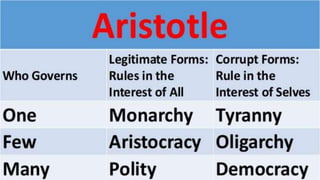
 View of Aristotle
 Quotations
 Concept of Aristocracy
 The Athenian Aristocracy
 The myth of labor Aristocracy
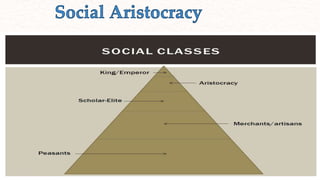
 Social Aristocracy
 Presence of Aristocracy
 Aristocracy in India
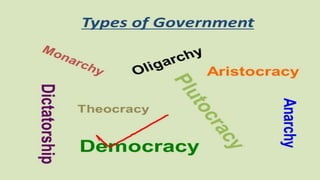
 Aristocracy VS. Democracy
 Conclusion
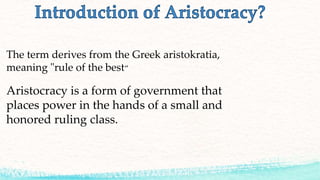
The term derives from the Greek aristokratia,
meaning "rule of the best“
Aristocracy is a form of government that
places power in the hands of a small and
honored ruling class.
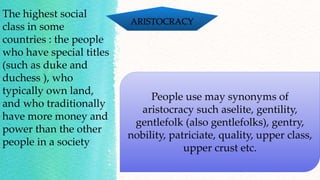
The highest social
class in some
countries : the people
who have special titles
(such as duke and
duchess ), who
typically own land,
and who traditionally
have more money and
power than the other
people in a society
ARISTOCRACY
People use may synonyms of
aristocracy such aselite, gentility,
gentlefolk (also gentlefolks), gentry,
nobility, patriciate, quality, upper class,
upper crust etc.
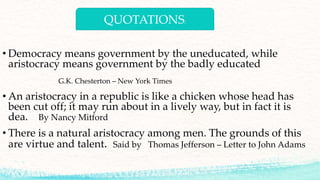
QUOTATIONS:
• Democracy means government by the uneducated, while
aristocracy means government by the badly educated
G.K. Chesterton – New York Times
• An aristocracy in a republic is like a chicken whose head has
been cut off; it may run about in a lively way, but in fact it is
dea. By Nancy Mitford
• There is a natural aristocracy among men. The grounds of this
are virtue and talent. Said by Thomas Jefferson – Letter to John Adams
The concept changed in Ancient Greece
In Ancient Rome the Republic consisted of
an aristocracy as well as consuls, a senate,
and a tribal assembly.
Democracy upheld again.
Promotion to the supreme offices of state went by
birth and wealth.
Aristocratic families enjoyed huge wealth and
exchanges .
And they were held at first for life.
Denmark
 England
 Spain
Nigeria and
 United Kingdom
At present the term aristocracy is used roughly
and in a great selection of combinations to
symbolize a select few with authority in various
categories, for example, an aristocracy of birth,
of wealth, or of intelligence.
Aristocracy

Aristocracy

  • 2.
    Rahanuma Islam Mithila Id:16121035 Departmentof Development Studies Bangladesh University of professionals(BUP)
  • 4.
     Introduction  Viewof Aristotle  Quotations  Concept of Aristocracy  The Athenian Aristocracy  The myth of labor Aristocracy  Social Aristocracy  Presence of Aristocracy  Aristocracy in India  Aristocracy VS. Democracy  Conclusion
  • 5.
    The term derivesfrom the Greek aristokratia, meaning "rule of the best“ Aristocracy is a form of government that places power in the hands of a small and honored ruling class.
  • 6.
    The highest social classin some countries : the people who have special titles (such as duke and duchess ), who typically own land, and who traditionally have more money and power than the other people in a society ARISTOCRACY People use may synonyms of aristocracy such aselite, gentility, gentlefolk (also gentlefolks), gentry, nobility, patriciate, quality, upper class, upper crust etc.
  • 8.
    QUOTATIONS: • Democracy meansgovernment by the uneducated, while aristocracy means government by the badly educated G.K. Chesterton – New York Times • An aristocracy in a republic is like a chicken whose head has been cut off; it may run about in a lively way, but in fact it is dea. By Nancy Mitford • There is a natural aristocracy among men. The grounds of this are virtue and talent. Said by Thomas Jefferson – Letter to John Adams
  • 9.
    The concept changedin Ancient Greece In Ancient Rome the Republic consisted of an aristocracy as well as consuls, a senate, and a tribal assembly. Democracy upheld again.
  • 10.
    Promotion to thesupreme offices of state went by birth and wealth. Aristocratic families enjoyed huge wealth and exchanges . And they were held at first for life.
  • 13.
  • 16.
    At present theterm aristocracy is used roughly and in a great selection of combinations to symbolize a select few with authority in various categories, for example, an aristocracy of birth, of wealth, or of intelligence.