Erik Champion, Hon Research Fellow UNSW, Honorary Research Professor UWA, Australia erikchampion@uwa.edu.au @nzerik
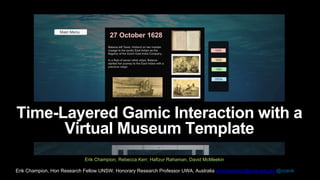
Time-Layered Gamic Interaction with a
Virtual Museum Template
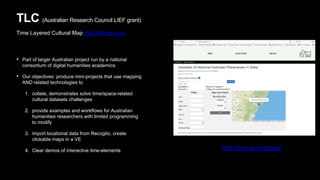
TLC (Australian Research Council LIEF grant)
Time Layered Cultural Map http://tlcmap.org/
• Part of larger Australian project run by a national
consortium of digital humanities academics.
• Our objectives: produce mini-projects that use mapping
AND related technologies to
1. collate, demonstrates solve time/space-related
cultural datasets challenges
2. provide examples and workflows for Australian
humanities researchers with limited programming
to modify
3. import locational data from Recogito, create
clickable maps in a VE
4. Clear demos of interactive time-elements http://tlcmap.org/ghap/
Real and Virtual Museums
virtual museums-missing evocative elements
Studies of real-world museums’ website images: visitor aims more than experiencing art collection:
also museum’s actual physical space and to enjoy the presence of others.
Hadley survey of 24 museum websites-“three strong trends”:
• depictions of the buildings / grounds
• collection and its “treasures”
• photos of visitors (and “how will I feel when I get there?”)
Strong branding of museums websites emphasise
• spatial grandeur (and setting)
• explorative nature of the collection experience
• shared social sense of expectation and atmosphere.
Criticism: VMs vs VH
virtual museums as heritage
• Parry & Huhtamo: VMs vaguely defined.
• Baldwin: (VMs) emphasise perfection NOT risk
and experimentation.
• how can VMs capture and retain visitors
• VR is impressive BUT expensive, expertise
required, dynamic and volatile market-driven
supply of technology
• GLAM implementation / preservation
challenges
• “Vanishing Virtual” how to survive and prosper..
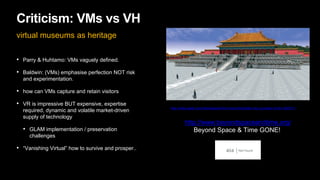
http://www.geek.com/news/expore-the-virtual-forbidden-city-courtesy-of-ibm-593731/
http://www.beyondspaceandtime.org/
Beyond Space & Time GONE!
Criticism II
• main features and attractions of virtual museums?
Why out of fashion? Have they benefitted real-world museums?
• The ViMM - Virtual Multimodal Museum project investigators:
virtual museums “…may add value in ways not possible in the physical
museum such as enhanced cultural ‘presence’, immersive experiences, and
vivid narratives by means of animation, and virtual functionalities.”
UNESCO May 2020 survey: more than 1 in 10 museums could stay closed
permanently
• “In Africa and Small Island Developing States (SIDS), only 5% of museums
have developed online content for their audiences.
Criticism III
• virtual museums free of the limitations of real museums?
• Klaus Müller: virtual museums no longer need walls, and “… Virtual museum ‘spaces’ can take on any
shape they want, but they lack the conventional authority and emotion a museum building evokes.”
• The Uses of Virtual Museums: The French Viewpoint, Roxane Bernier: VMs= newfound freedom from
awkward display spaces; freedom from “limitations on objects”; and “indefinite storytelling.” Mokre
(1998) and Davallon (1998) stress there are no physical constraints.
• Do participants wish to change the experience? [Art as mental gestalt based on observer movement]
• VM implies a spatial, immersive experience: spatially navigable, intentionally traversed or wander
able
• Examine how different participants prefer to experience virtual museums.
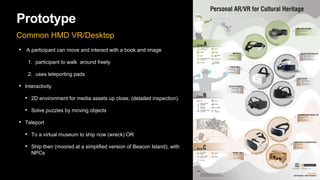
Prototype
Common HMD VR/Desktop
• A participant can move and interact with a book and image
1. participant to walk around freely
2. uses teleporting pads
• Interactivity
• 2D environment for media assets up close, (detailed inspection).
• Solve puzzles by moving objects
• Teleport
• To a virtual museum to ship now (wreck) OR
• Ship then (moored at a simplified version of Beacon Island), with
NPCs
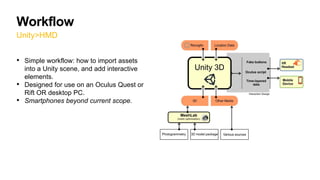
Workflow
Unity>HMD
• Simple workflow: how to import assets
into a Unity scene, and add interactive
elements.
• Designed for use on an Oculus Quest or
Rift OR desktop PC.
• Smartphones beyond current scope.
Diagram by Dr Hafizur Rahaman.
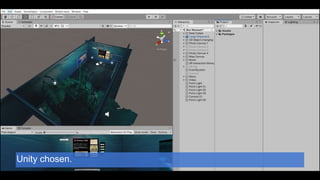
Unity chosen.
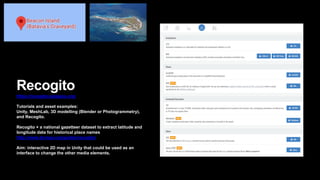
Recogito
https://recogito.pelagios.org/
Tutorials and asset examples:
Unity, MeshLab, 3D modelling (Blender or Photogrammetry),
and Recogito.
Recogito + a national gazetteer dataset to extract latitude and
longitude data for historical place names
http://www.tlcmap.org/guides/recogito/
Aim: interactive 2D map in Unity that could be used as an
interface to change the other media elements.
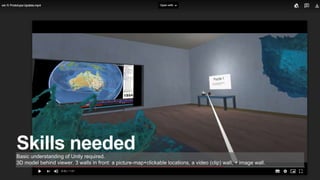
Skills neededBasic understanding of Unity required.
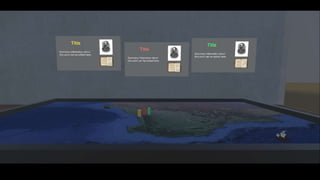
3D model behind viewer. 3 walls in front: a picture-map+clickable locations, a video (clip) wall, + image wall.
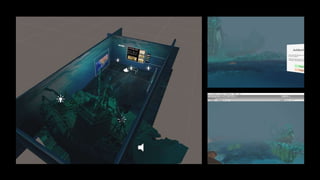
Media Walls (Videos, Images, Clickable map, 3D model)
Each media element can reconfigure / change other media
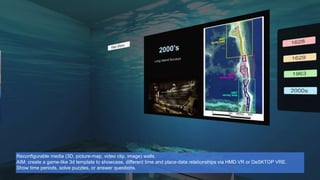
Reconfigurable media (3D, picture-map, video clip, image) walls.
AIM: create a game-like 3d template to showcase, different time and place-data relationships via HMD VR or DeSKTOP VRE.
Show time periods, solve puzzles, or answer questions.
Media assets
• Buttons with dates - selecting these dates changes the content displayed in the scene. Selecting
a date will change the photo/art images on the top right and the 3D object in the bottom right.
• Map with an animated ship: An example of how the map could be used. Currently, the animation
is on loop however it can be tied to move with the selection of buttons.
• Interactive diary: A diary or information panel can be scrolled through by the user. In this example,
we took two images from the diary of a historic shipwreck, the user can switch between the two
by pressing the green or white arrow buttons.
• Animated 3D object: This example shows a 3D object that is animated and changes when a date
is selected. Users can change the orientation of the 3D object.
• Photo/art images: Images can be displayed in a variety of different ways. In this example, the
images are placed together in the top right and change when different dates are selected.
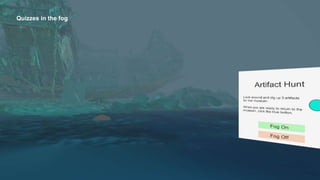
Quizzes in the fog
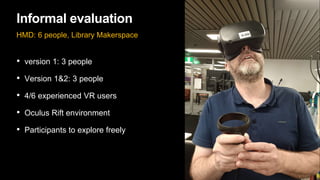
Informal evaluation
HMD: 6 people, Library Makerspace
• version 1: 3 people
• Version 1&2: 3 people
• 4/6 experienced VR users
• Oculus Rift environment
• Participants to explore freely
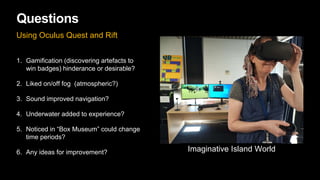
Questions
Using Oculus Quest and Rift
1. Gamification (discovering artefacts to
win badges) hinderance or desirable?
2. Liked on/off fog (atmospheric?)
3. Sound improved navigation?
4. Underwater added to experience?
5. Noticed in “Box Museum” could change
time periods?
6. Any ideas for improvement? Imaginative Island World
USERS
Formative responses (6 users)
• Gamification (6/6)
• Fog option (4/6)
• Sound (5/6)
• Underwater scene (but more direction)
• Box Museum: noticed changeable time periods (5/6)
Feedback:
1. more instructions ( 1: said to encourage more exploration and gameplay without right/wrong)
2. The historian saw great opportunities for template in workshops with historians: present &
explore different types of collections, historical data.
SQL>RStudio>UnityDrew Fordham [https://github.com/drewfrobot/more-unity-and-data] tutorial: QGIS, R/RStudio, SQLite + Unity.
Unity to create global landscapes with data from RStudio, to generate contours (heightmaps).
He taught this tutorial to two groups of students-we have yet to incorporate this workflow.
https://github.com/drewfrobot/more-unity-and-data/blob/master/Images/vis01.JPG
Related project
Collaborative Mixed reality
• A Ph.D. student has also been developing collaborative mixed
reality projects using two Microsoft HoloLenses
• walkable mixed reality maps with interactive objects and 3D
models that appear only when the participant is near or walks
over that point in the mixed reality 3D map.
• Map data-GeoJSON format, to handle time-related data.
• Alternative historical interpretations can be viewed and
interacted with and the results shared by speaking to the other
participant.
Duyfken-Mafkereseb Bekele’s PhD
Conclusion
• workflow using free software (Recogito, Unity and MeshLab.
• Demo media walls (video, images, 3D and picture-map) +micro-games
• Test participants preferred gamification over less interactive VEs
• Embodiment and gamification appear to improve the desirability of VMs
• More engaging micro-games to be investigated.
Erik Champion, Hon Research Fellow UNSW, Honorary Research Professor UWA, Australia erikchampion@uwa.edu.au @nzerik

Time-Layered Gamic Interaction with a Virtual Museum Template

  • 1.
    Erik Champion, HonResearch Fellow UNSW, Honorary Research Professor UWA, Australia erikchampion@uwa.edu.au @nzerik Time-Layered Gamic Interaction with a Virtual Museum Template
  • 2.
    TLC (Australian ResearchCouncil LIEF grant) Time Layered Cultural Map http://tlcmap.org/ • Part of larger Australian project run by a national consortium of digital humanities academics. • Our objectives: produce mini-projects that use mapping AND related technologies to 1. collate, demonstrates solve time/space-related cultural datasets challenges 2. provide examples and workflows for Australian humanities researchers with limited programming to modify 3. import locational data from Recogito, create clickable maps in a VE 4. Clear demos of interactive time-elements http://tlcmap.org/ghap/
  • 3.
    Real and VirtualMuseums virtual museums-missing evocative elements Studies of real-world museums’ website images: visitor aims more than experiencing art collection: also museum’s actual physical space and to enjoy the presence of others. Hadley survey of 24 museum websites-“three strong trends”: • depictions of the buildings / grounds • collection and its “treasures” • photos of visitors (and “how will I feel when I get there?”) Strong branding of museums websites emphasise • spatial grandeur (and setting) • explorative nature of the collection experience • shared social sense of expectation and atmosphere.
  • 4.
    Criticism: VMs vsVH virtual museums as heritage • Parry & Huhtamo: VMs vaguely defined. • Baldwin: (VMs) emphasise perfection NOT risk and experimentation. • how can VMs capture and retain visitors • VR is impressive BUT expensive, expertise required, dynamic and volatile market-driven supply of technology • GLAM implementation / preservation challenges • “Vanishing Virtual” how to survive and prosper.. http://www.geek.com/news/expore-the-virtual-forbidden-city-courtesy-of-ibm-593731/ http://www.beyondspaceandtime.org/ Beyond Space & Time GONE!
  • 5.
    Criticism II • mainfeatures and attractions of virtual museums? Why out of fashion? Have they benefitted real-world museums? • The ViMM - Virtual Multimodal Museum project investigators: virtual museums “…may add value in ways not possible in the physical museum such as enhanced cultural ‘presence’, immersive experiences, and vivid narratives by means of animation, and virtual functionalities.” UNESCO May 2020 survey: more than 1 in 10 museums could stay closed permanently • “In Africa and Small Island Developing States (SIDS), only 5% of museums have developed online content for their audiences.
  • 6.
    Criticism III • virtualmuseums free of the limitations of real museums? • Klaus Müller: virtual museums no longer need walls, and “… Virtual museum ‘spaces’ can take on any shape they want, but they lack the conventional authority and emotion a museum building evokes.” • The Uses of Virtual Museums: The French Viewpoint, Roxane Bernier: VMs= newfound freedom from awkward display spaces; freedom from “limitations on objects”; and “indefinite storytelling.” Mokre (1998) and Davallon (1998) stress there are no physical constraints. • Do participants wish to change the experience? [Art as mental gestalt based on observer movement] • VM implies a spatial, immersive experience: spatially navigable, intentionally traversed or wander able • Examine how different participants prefer to experience virtual museums.
  • 7.
    Prototype Common HMD VR/Desktop •A participant can move and interact with a book and image 1. participant to walk around freely 2. uses teleporting pads • Interactivity • 2D environment for media assets up close, (detailed inspection). • Solve puzzles by moving objects • Teleport • To a virtual museum to ship now (wreck) OR • Ship then (moored at a simplified version of Beacon Island), with NPCs
  • 8.
    Workflow Unity>HMD • Simple workflow:how to import assets into a Unity scene, and add interactive elements. • Designed for use on an Oculus Quest or Rift OR desktop PC. • Smartphones beyond current scope. Diagram by Dr Hafizur Rahaman.
  • 9.
  • 10.
    Recogito https://recogito.pelagios.org/ Tutorials and assetexamples: Unity, MeshLab, 3D modelling (Blender or Photogrammetry), and Recogito. Recogito + a national gazetteer dataset to extract latitude and longitude data for historical place names http://www.tlcmap.org/guides/recogito/ Aim: interactive 2D map in Unity that could be used as an interface to change the other media elements.
  • 11.
    Skills neededBasic understandingof Unity required. 3D model behind viewer. 3 walls in front: a picture-map+clickable locations, a video (clip) wall, + image wall.
  • 13.
    Media Walls (Videos,Images, Clickable map, 3D model) Each media element can reconfigure / change other media
  • 14.
    Reconfigurable media (3D,picture-map, video clip, image) walls. AIM: create a game-like 3d template to showcase, different time and place-data relationships via HMD VR or DeSKTOP VRE. Show time periods, solve puzzles, or answer questions.
  • 16.
    Media assets • Buttonswith dates - selecting these dates changes the content displayed in the scene. Selecting a date will change the photo/art images on the top right and the 3D object in the bottom right. • Map with an animated ship: An example of how the map could be used. Currently, the animation is on loop however it can be tied to move with the selection of buttons. • Interactive diary: A diary or information panel can be scrolled through by the user. In this example, we took two images from the diary of a historic shipwreck, the user can switch between the two by pressing the green or white arrow buttons. • Animated 3D object: This example shows a 3D object that is animated and changes when a date is selected. Users can change the orientation of the 3D object. • Photo/art images: Images can be displayed in a variety of different ways. In this example, the images are placed together in the top right and change when different dates are selected.
  • 18.
  • 19.
    Informal evaluation HMD: 6people, Library Makerspace • version 1: 3 people • Version 1&2: 3 people • 4/6 experienced VR users • Oculus Rift environment • Participants to explore freely
  • 20.
    Questions Using Oculus Questand Rift 1. Gamification (discovering artefacts to win badges) hinderance or desirable? 2. Liked on/off fog (atmospheric?) 3. Sound improved navigation? 4. Underwater added to experience? 5. Noticed in “Box Museum” could change time periods? 6. Any ideas for improvement? Imaginative Island World
  • 21.
    USERS Formative responses (6users) • Gamification (6/6) • Fog option (4/6) • Sound (5/6) • Underwater scene (but more direction) • Box Museum: noticed changeable time periods (5/6) Feedback: 1. more instructions ( 1: said to encourage more exploration and gameplay without right/wrong) 2. The historian saw great opportunities for template in workshops with historians: present & explore different types of collections, historical data.
  • 22.
    SQL>RStudio>UnityDrew Fordham [https://github.com/drewfrobot/more-unity-and-data]tutorial: QGIS, R/RStudio, SQLite + Unity. Unity to create global landscapes with data from RStudio, to generate contours (heightmaps). He taught this tutorial to two groups of students-we have yet to incorporate this workflow. https://github.com/drewfrobot/more-unity-and-data/blob/master/Images/vis01.JPG
  • 23.
    Related project Collaborative Mixedreality • A Ph.D. student has also been developing collaborative mixed reality projects using two Microsoft HoloLenses • walkable mixed reality maps with interactive objects and 3D models that appear only when the participant is near or walks over that point in the mixed reality 3D map. • Map data-GeoJSON format, to handle time-related data. • Alternative historical interpretations can be viewed and interacted with and the results shared by speaking to the other participant. Duyfken-Mafkereseb Bekele’s PhD
  • 24.
    Conclusion • workflow usingfree software (Recogito, Unity and MeshLab. • Demo media walls (video, images, 3D and picture-map) +micro-games • Test participants preferred gamification over less interactive VEs • Embodiment and gamification appear to improve the desirability of VMs • More engaging micro-games to be investigated. Erik Champion, Hon Research Fellow UNSW, Honorary Research Professor UWA, Australia erikchampion@uwa.edu.au @nzerik