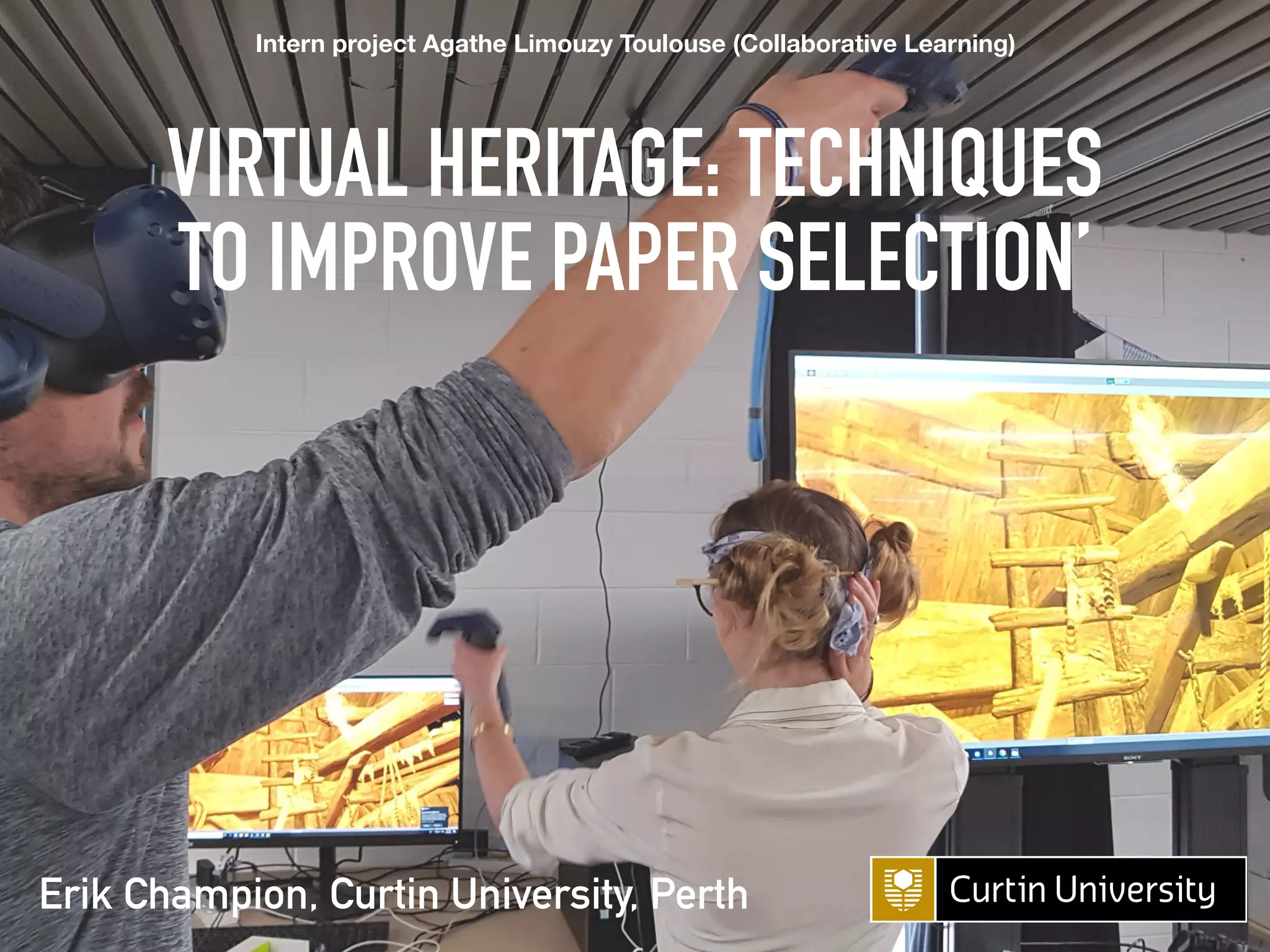
VIRTUAL HERITAGE: TECHNIQUES
TO IMPROVE PAPER SELECTION’
Erik Champion, Curtin University, Perth
Intern project Agathe Limouzy Toulouse (Collaborative Learning)
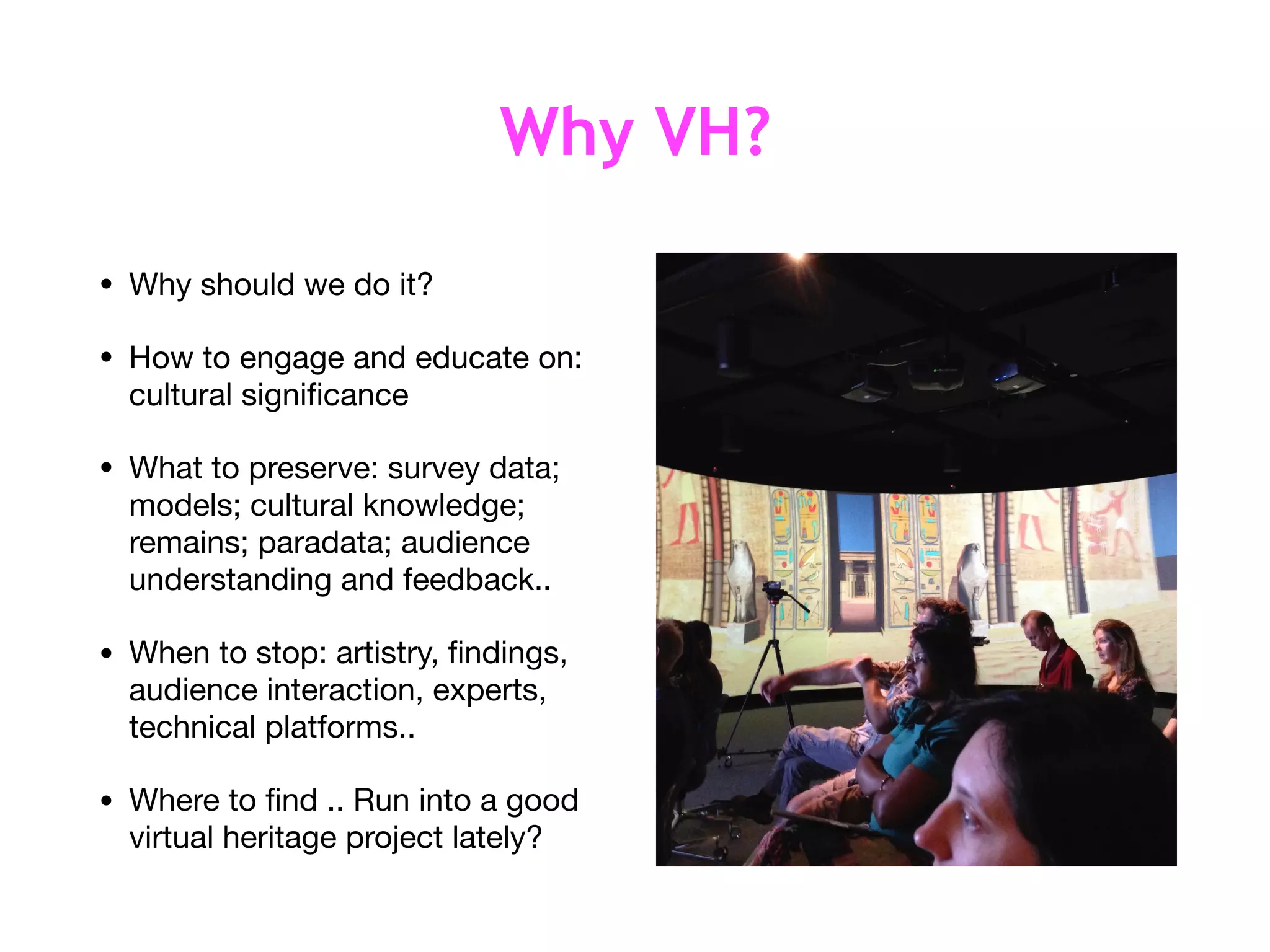
Why VH?
• Why should we do it?

• How to engage and educate on:
cultural significance

• What to preserve: survey data;
models; cultural knowledge;
remains; paradata; audience
understanding and feedback..

• When to stop: artistry, findings,
audience interaction, experts,
technical platforms..

• Where to find .. Run into a good
virtual heritage project lately?
Important
controversies,
debates,
issues
• Recreation or “the fallacy of”
reconstruction (Jeff Clarke)

• Completeness or
authenticity

• Levels of realism

• Ownership and shareholders

• Cultural appropriation

• Obsolescence 

• Gamification
EU Chess project DH2013 Marseilles
VR cannot match the real thing??
• … the emotions you feel when you have a virtual
experience are not as valuable. When you actually see
Niagara Falls, especially if you get up close, you feel awe
and even fear in the face of an overpowering force of
nature… Computer simulations, however good, contain
only what photography, laser technology and pre-existing
expertise put into them… Real experiences connect us to
the deeds of past people and place us in contexts where
history was made… VR will never be a substitute for
encounters with the real thing. 

Janna Thompson, Professor of Philosophy, La Trobe University https://
theconversation.com/why-virtual-reality-cannot-match-the-real-thing-92035
https://youtu.be/Vo4hCg91Xhk
Computer Visualisation
• The London Charter [Den09] defined
computer-based visualization as
‘[t]he process of representing
information visually with the aid of
computer technologies.’ 

• implies visualization is only visual,
that all is required is to represent (in
a visual format) content to an end
user. 

• Does not explain the cultural
significance of the object or process
simulated, and reasons for why it
should be preserved and
communicated.
VH is..#1
• ..a fusion of virtual reality technology with cultural heritage content
[Addison 2008] [Roussou 2000]. 

• … the use of computer-based interactive technologies to record,
preserve, or recreate artifacts, sites and actors of historic, artistic,
religious, and cultural significance and to deliver the results openly
to a global audience in such a way as to provide formative
educational experiences through electronic manipulations of time
and space. Stone and Ojika [2O08] 

• NB intangible heritage, ‘practices, representations, expressions,
knowledge, skills – as well as the instruments, objects, artefacts
and cultural spaces associated therewith – that communities,
groups and, in some cases, individuals recognize as part of their
cultural heritage’ [UNESCO 2003].
‘In	game’	footage:	Sims	4	machinima -3rd Person-
Susannah	Emery Honours -with	Michele	Wilson
VH is #2
Champion [2008]: ‘the attempt to
convey not just the appearance but
also the meaning and significance
of cultural artefacts and the
associated social agency that
designed and used them, through
the use of interactive and immersive
digital media.’ 

NB I distinguish between digital &
virtual heritage.
New media growing pains
• New media constantly changing 

• NM can potentially suggest new
perceptions and behaviour for end users. 

• DH aims to preserve heritage content. So
there is an implicit conflict here.

• VH =latest tech, but cannot bridge both
new media & digital heritage.

• HOW MANY VH PROJECTS VERIFIED
FOR FUTURE ROBUSTNESS AND
USAGE?

• …the purpose of new heritage is to
‘examine the user experience that digital
media can provide for the understanding
and experiencing of tangible and
intangible cultural heritage’.
VH issues
• Levels of authenticity (not fabrication)

• Contribution, clear stage of progress listed

• Accuracy, completeness listed

• Provided complete data (counter views)
• Appropriate statistical procedures (e.g. Likert)

• Originality (Not old findings) + Credit 

• Citing sources of information ideas and words

• Observing copyright and permissions 

• Disclosure of conflicts of interest etc

GUIDELINES FOR RESEARCH WRITING Ethics in writing slide 44 https://
www.slideshare.net/kmahmood2/how-to-write-a-journal-article-73216063
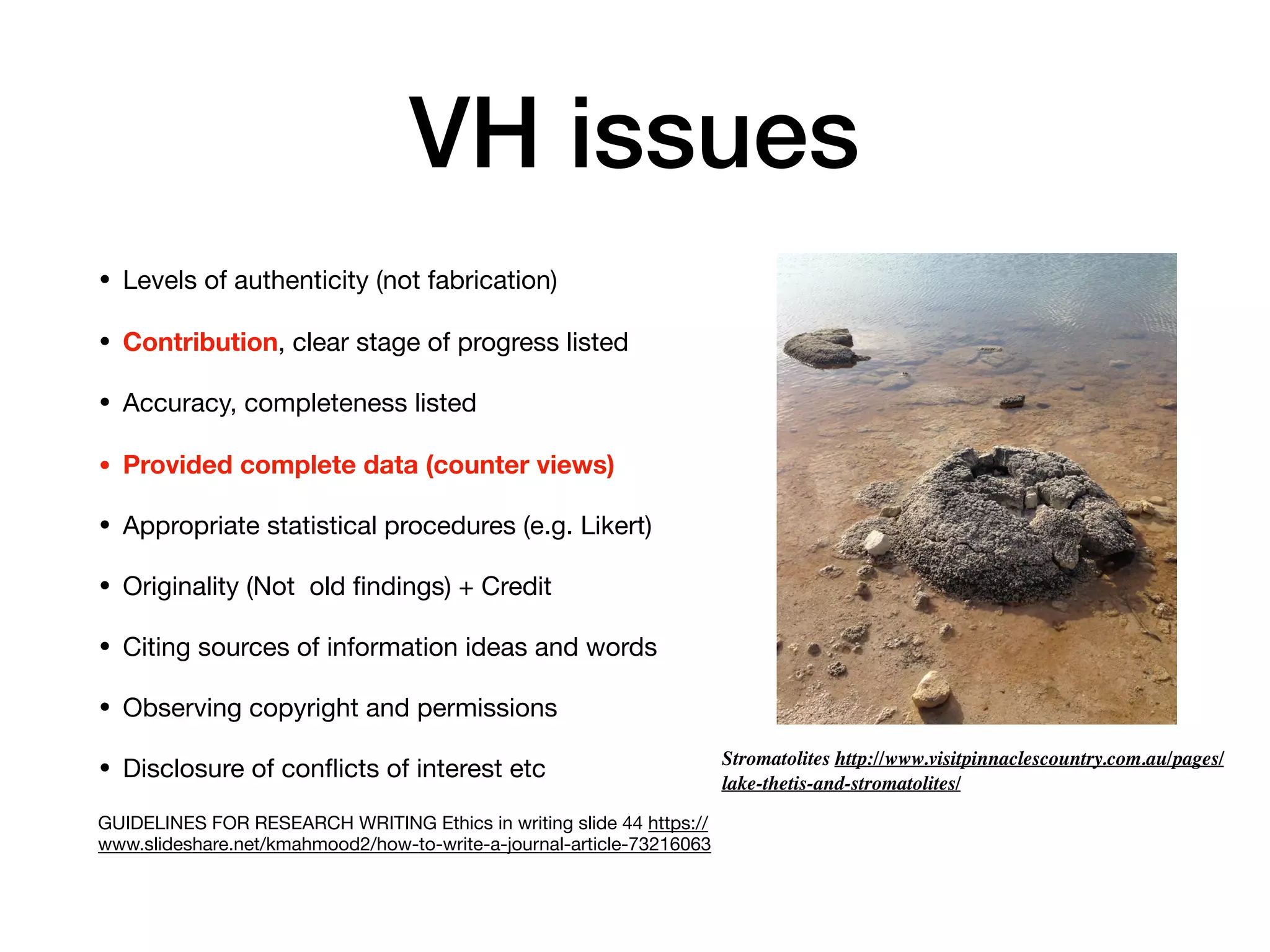
Stromatolites http://www.visitpinnaclescountry.com.au/pages/
lake-thetis-and-stromatolites/
Selecting a (VH) journal
1. Select clearly reviewed journals. manuscripts must be peer reviewed to be research articles.

2. Focus: technical, conceptual, theoretically based, articles review each other? Discussion?

3. Indexing: Indexed in Scopus Web of Science ACM IEEE…? Are there related tools?

4. Availability: Is journal broadly available and online? OA? PDF? Or HTML? 3D or VR friendly?

5. Reputation?

6. Format:: format, typeface, and references style? Clear templates?

7. Figures: Resolution quality? Time to Print: (“date submitted” to “date accepted”)? 

8. Charges: Some journals charge, like JCAA but there are often special issue fee waivers etc..

Abridged-modified from a UNL website https://www.unl.edu/gradstudies/current/news/twenty-steps-writing-research-article Twenty Steps to Writing a
Research, which reproduces with permission from Beth A. Fischer and Michael J. Zigmond, Survival Skills and Ethics Program, University of Pittsburgh
Targeting a journal or book
1. Compare your article’s research quality to published articles in the same area

2. The reputation of a journal is best found by journals that leaders in your area
publish in

3. How articles are refereed, if blind or recommended is worth discussing

4. How long articles take to publish is a factor for all esp in VH. 

5. Are you writing about area X to audience Y? Will readers X and Y Read this book?

6. IS the format acceptable to you? Some publishers don’t give templates, some
have strict page limits or don’t publish appendices or link to updatable webpages.

7. Fees; are they upfront on costs? Are costs legitimate? B

Best practices for scholarly authors in the age of predatory journals https://
www.ncbi.nlm.nih.gov/pmc/articles/PMC5210492/
www.etc.cmu.edu/etc-press/publication/game-mods/
What VH reviewers want
• Is the title focused, relevant and informative?

• Abstract captures the essential elements of the paper--does it spark reader interest?

• Paper has a clear key message..clearly contributes something relevant / new?

• Is the paper firmly grounded in the relevant theory or methodology?

• Is the issue sufficiently well-explained for the target audience?

• Good use of evidence that demonstrates a sophisticated understanding of the literature
available on the topic (even if it contradicts you)?

• Is the paper well-structured and well-written? Is the paper referenced appropriately to
the journal's style? Do all aspects of presentation conform to the journal's house-style?

ANU Turning a chapter into an article http://www.anu.edu.au/students/learning-development/research-writing/journal-article-writing/turning-a-
chapter-into-an
Z
References
• https://www.insidehighered.com/advice/2017/05/09/how-write-effective-journal-article-and-get-it-
published-essay

• https://www.proof-reading-service.com/en/blog/write-journal-article/ 

• http://www.anu.edu.au/students/learning-development/research-writing/journal-article-writing esp
http://www.anu.edu.au/students/learning-development/research-writing/journal-article-writing/
targeting-a-journal targeting a journal

Some lists of relevant journals:
• https://erikchampion.wordpress.com/2015/10/07/are-there-open-access-virtual-heritagedigital-
archaeology-journals/ (add https://scholarworks.iu.edu/journals/index.php/sdh/index and https://
journal.caa-international.org/) 

• http://www.openaccessarchaeology.org/journal-search.html#.VpY6B1Lgq4o 

• http://ancientworldonline.blogspot.com/2010/12/open-access-journal-virtual-archaeology.html 

• https://scholarworks.iu.edu/journals/index.php/sdh/index
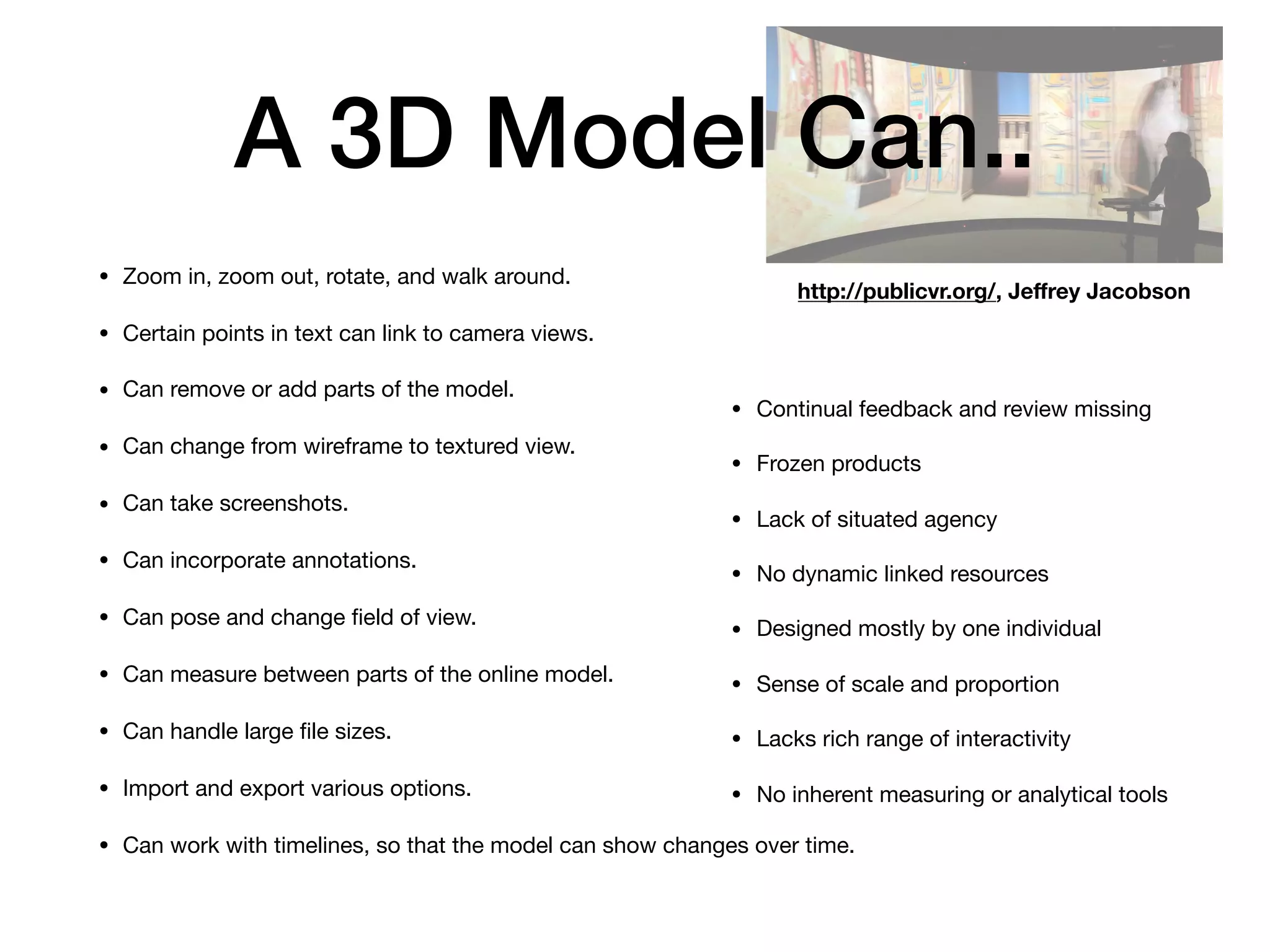
A 3D Model Can..
• Zoom in, zoom out, rotate, and walk around.

• Certain points in text can link to camera views.

• Can remove or add parts of the model.

• Can change from wireframe to textured view.

• Can take screenshots.

• Can incorporate annotations.

• Can pose and change field of view.

• Can measure between parts of the online model.

• Can handle large file sizes.

• Import and export various options.

• Can work with timelines, so that the model can show changes over time.
http://publicvr.org/, Jeffrey Jacobson
• Continual feedback and review missing

• Frozen products

• Lack of situated agency

• No dynamic linked resources

• Designed mostly by one individual

• Sense of scale and proportion

• Lacks rich range of interactivity

• No inherent measuring or analytical tools
GLAM+ Councils most
interested in sharing..
2018 National Digital Forum (19–21 November, Wellington)

• How can we work collaboratively and effectively with people outside the sector?

• How does our sector work with educators and students in the digital realm?
How should it?

• How can we share experiences of things not going well and learn from our
mistakes?

• How can we embrace new modes of research?

• How can we share the work we’re doing to make a tangible impact in our
communities

• http://www.ndf.org.nz/call-for-presentations/
CAA Session 2017 Atlanta Georgia
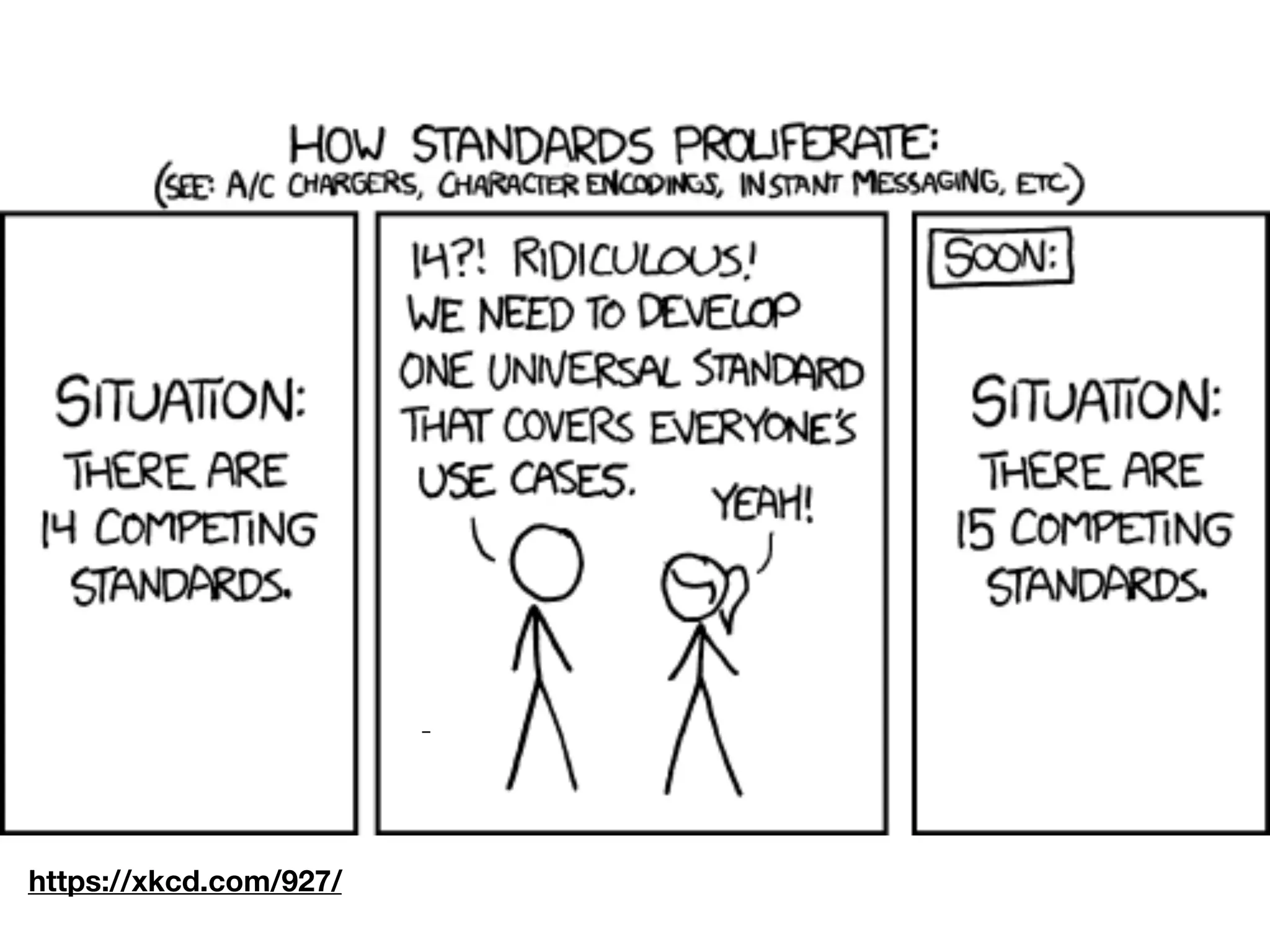
BUT: 3D Format issues
• Non standard formats nor created
specifically for preservation

• Archive versus presentation

• understanding the quantity, quality,
accessibility and usefulness of virtual
heritage models

• Missing survey on relative strengths,
weaknesses, suitability and popularity
of 3D file formats 

• DAE, OBJ, and VRML/X3D popular,
suitable?

• Game formats (UNITY) assets not
easily exported to other software.
https://xkcd.com/927/
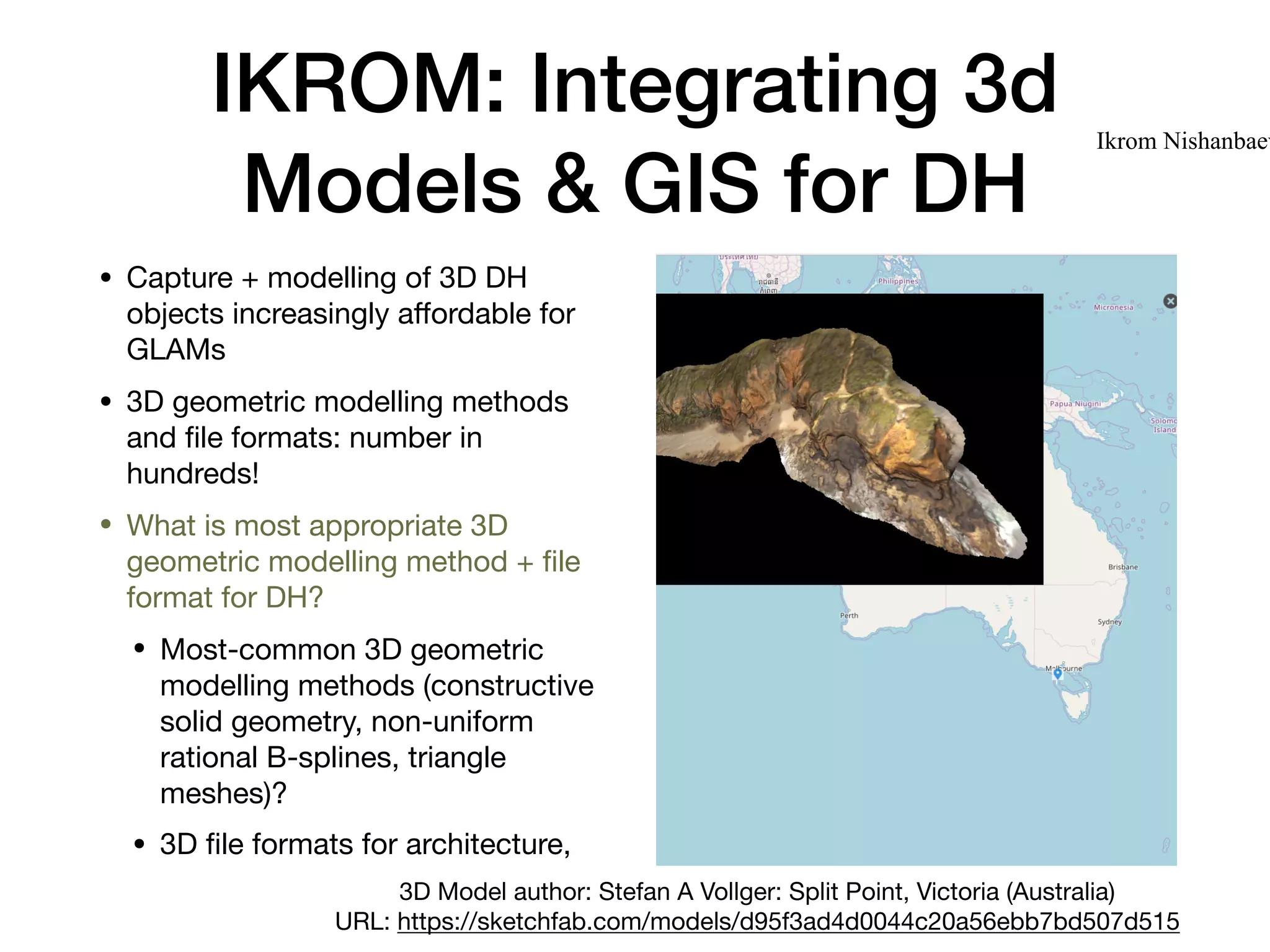
IKROM: Integrating 3d
Models & GIS for DH
• Capture + modelling of 3D DH
objects increasingly affordable for
GLAMs

• 3D geometric modelling methods
and file formats: number in
hundreds!

• What is most appropriate 3D
geometric modelling method + file
format for DH?

• Most-common 3D geometric
modelling methods (constructive
solid geometry, non-uniform
rational B-splines, triangle
meshes)?

• 3D file formats for architecture,
Ikrom Nishanbaev
3D Model author: Stefan A Vollger: Split Point, Victoria (Australia) 

URL: https://sketchfab.com/models/d95f3ad4d0044c20a56ebb7bd507d515
3D: a Key scholarly resource?
(Di Benedetto et al,, 2014).
• Teaching VH via careful inspection, contextualization + modification of
3D=problematic.

• Hard to find, download or edit; unwieldy + obsolete formats, standalone
meshes, no metadata or info on how data acquired or how sharable,
accuracy of scanning or modelling, paradata?

• Problem #1 VH dev, #2 lacks aims, #3 infrastructure.

• Scholarly ecosystem: media assets & communities (scholars,
shareholders and public) active participants in development.

• VH IS NOT DH if it cannot preserve its own models; so leverage digital
real-time reconfiguration to suit learner, device & task at hand;
personalisation; increased sense of agency; auto tracking + evaluation;
filtered feedback.
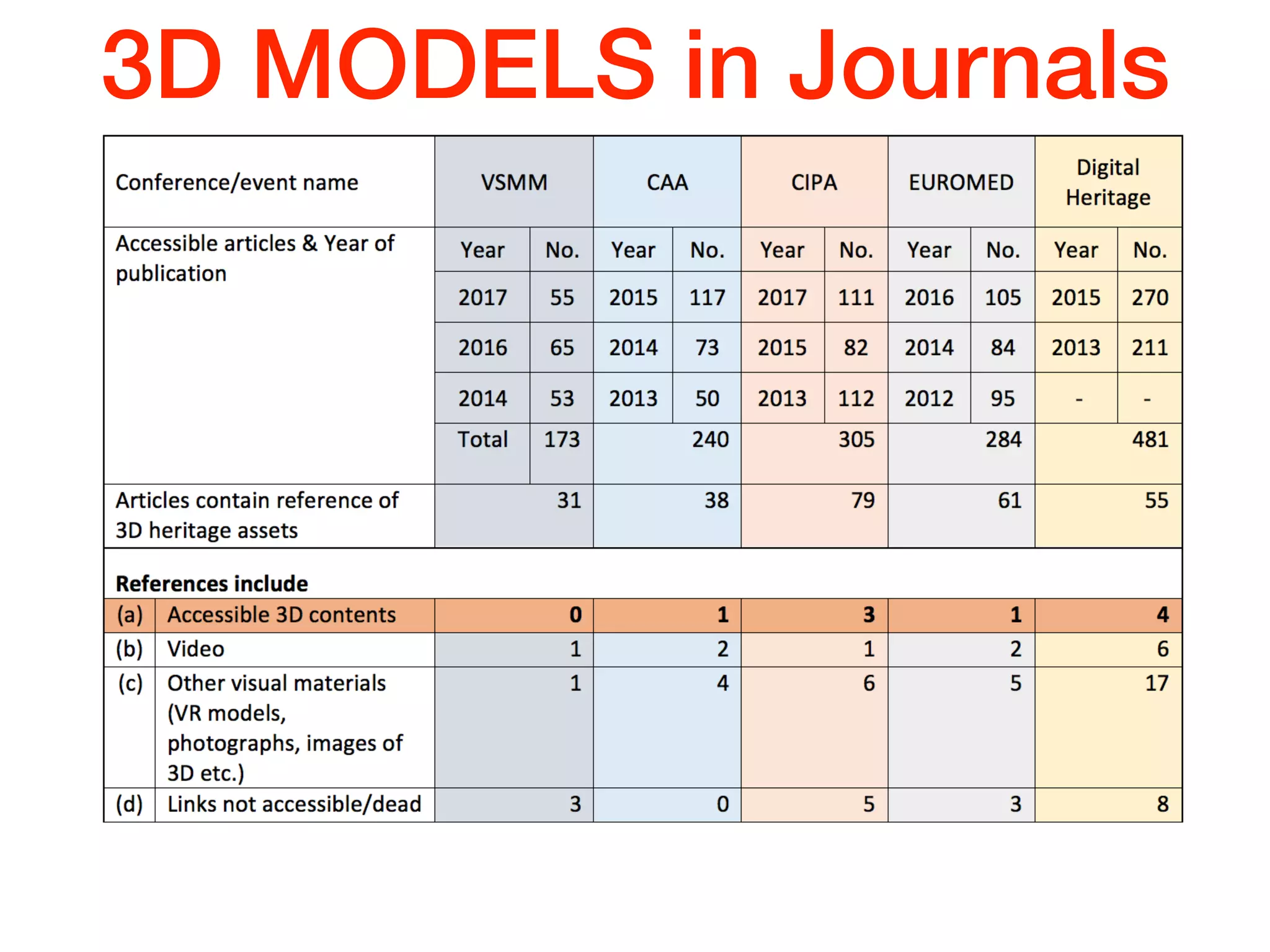
3D MODELS in Journals
VHEs/Games aren’t
gamification
Don’t seriously entertain or
work easily with dynamic,
valuable interactive content
Are NOT easily preserved,
let alone scholarly
accessible
Forbidden City: Beyond
Space & Time
Challenges of access affect
everyone: The ‘Vanishing virtual’
• Disappearing Virtual Heritage-Becoming Archaeological , p33, Ruth
Tringham University of California Berkeley, USA, Michael Ashley CODA
• While searching in 2014 in Erik Champion’s Playing with the Past
(2011) for web-based virtual cultural environments that could act as
models for a game, Dead Women Do Tell Tales, that was being
developed about Çatalhöy k (Tringham n.d. 3; see also Tringham
2015), we found that at least half of his examples have
disappeared by now, which seems to be a common trend with
games and other web-based interfaces in general. It’s not surprising—
according to the Library of Congress, the average lifespan of a
webpage is only 100 days. Many of the disappeared, like Okapi
Island, can be seen as tempting frag ments displayed through video
documentation on YouTube or Vimeo (e.g. Leavy n.d.).
AR software, hosting + Data-Gone
Advanced Challenges: 3D Modeling, UCLA USA
2016
3D models (& article) ideally
1. Traceable: links to previous works and to related info.

• Component-based so that parts can be directly linked, updated, online
3D created at runtime. 

• Formats easy to find, reliable, compact.

• Metadata records completeness, measurement methodology and
accuracy. LOD preferable.

2. Communal: scholars, students and public involved, incorporate their
understanding & feedback, and engage: play-testing & evaluation required.

3. Linkable to journals + refereed conference papers, tools and methods
used in project; robust feedback system; levels of learning skills and
knowledge required (or cultural knowledge that needs to be hidden..)
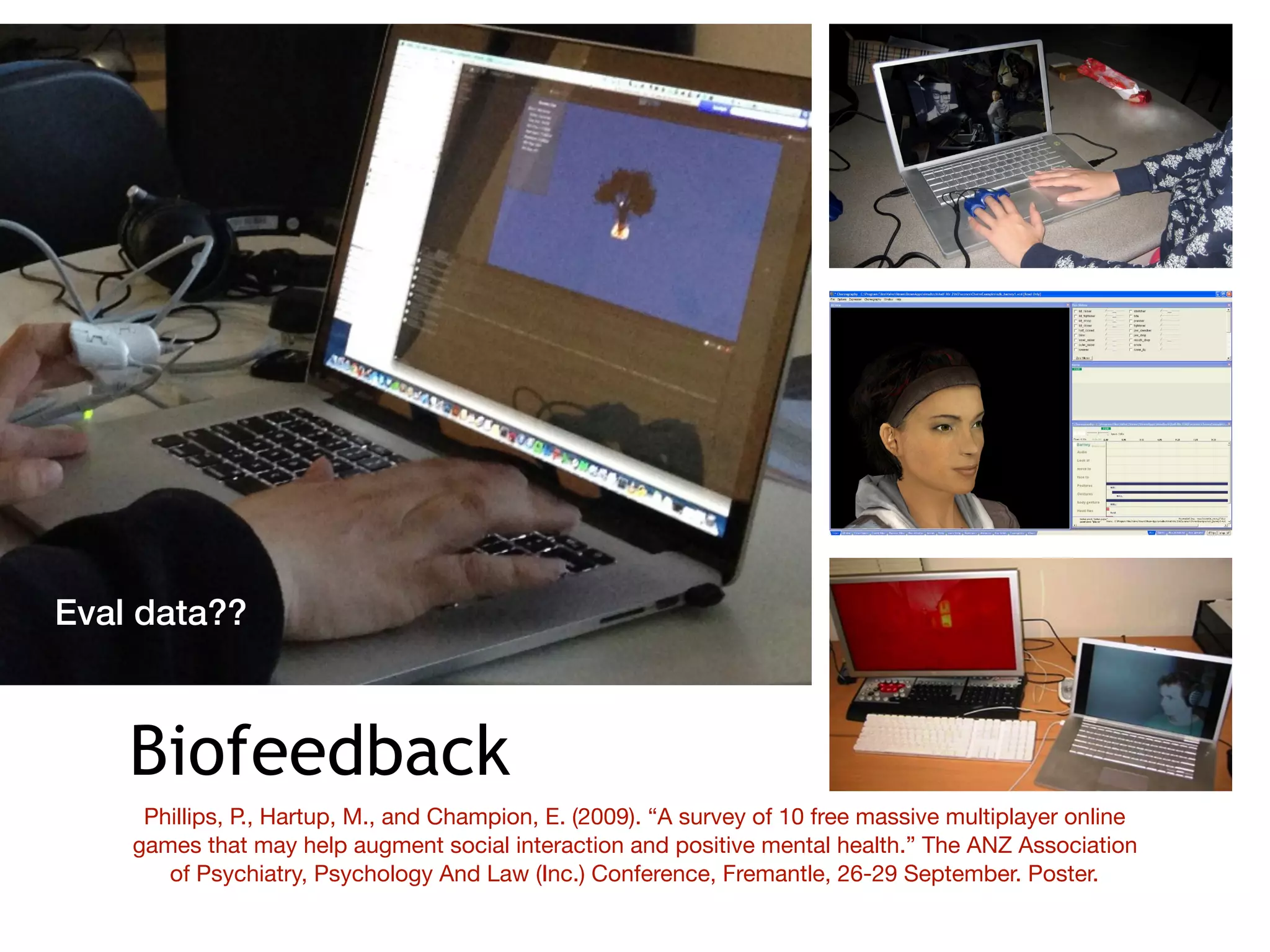
Biofeedback
Phillips, P., Hartup, M., and Champion, E. (2009). “A survey of 10 free massive multiplayer online
games that may help augment social interaction and positive mental health.” The ANZ Association
of Psychiatry, Psychology And Law (Inc.) Conference, Fremantle, 26-29 September. Poster.
Eval data??
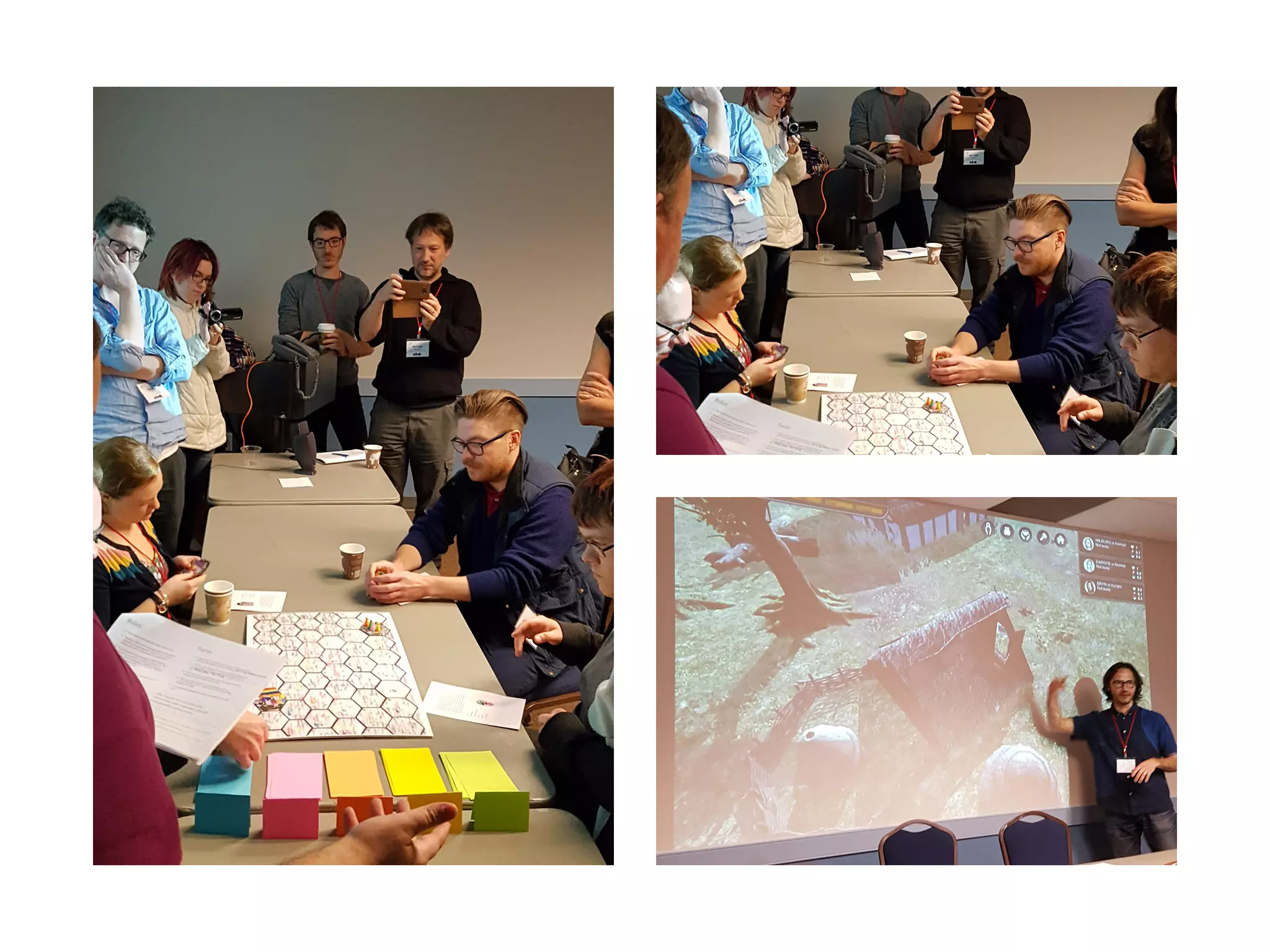
Virtual Past-Palestine
Rusaila Bazlamit, Curtin PhD student (supervisor:
Andrew Hutchison Erik Champion)
Subj. Experiences
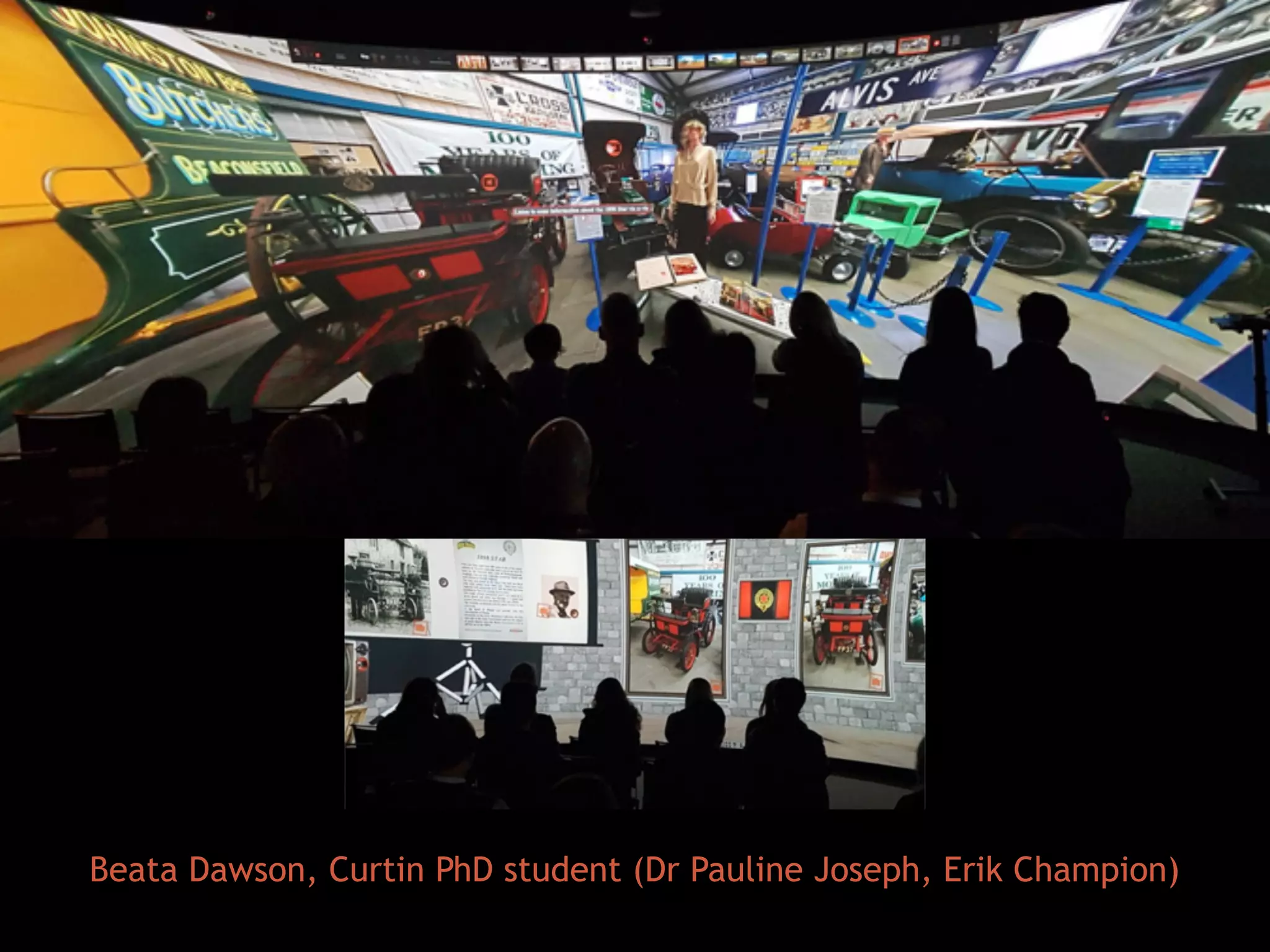
Beata Dawson, Curtin PhD student (Dr Pauline Joseph, Erik Champion)
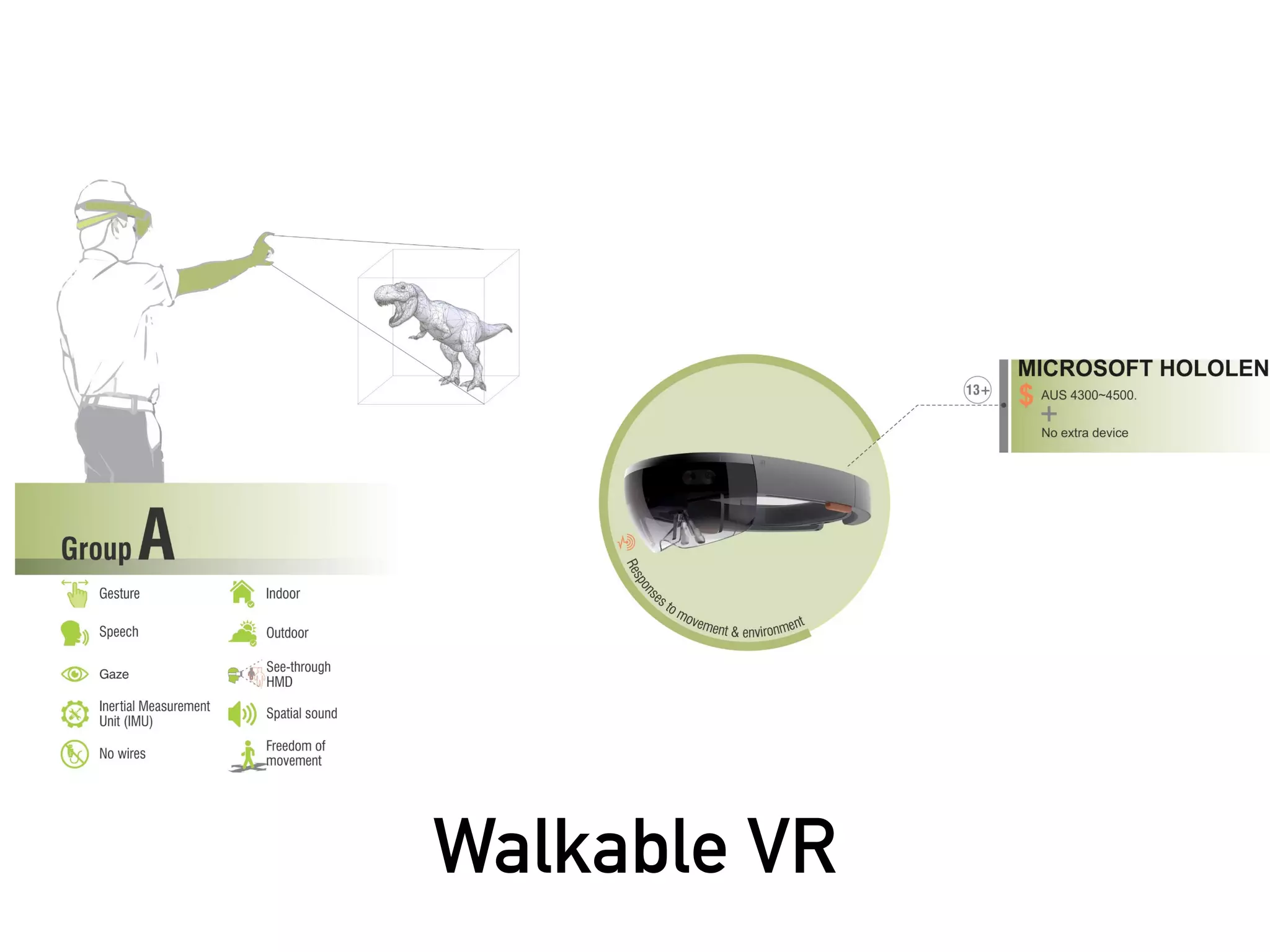
Walkable VR
Seated/Standing VR
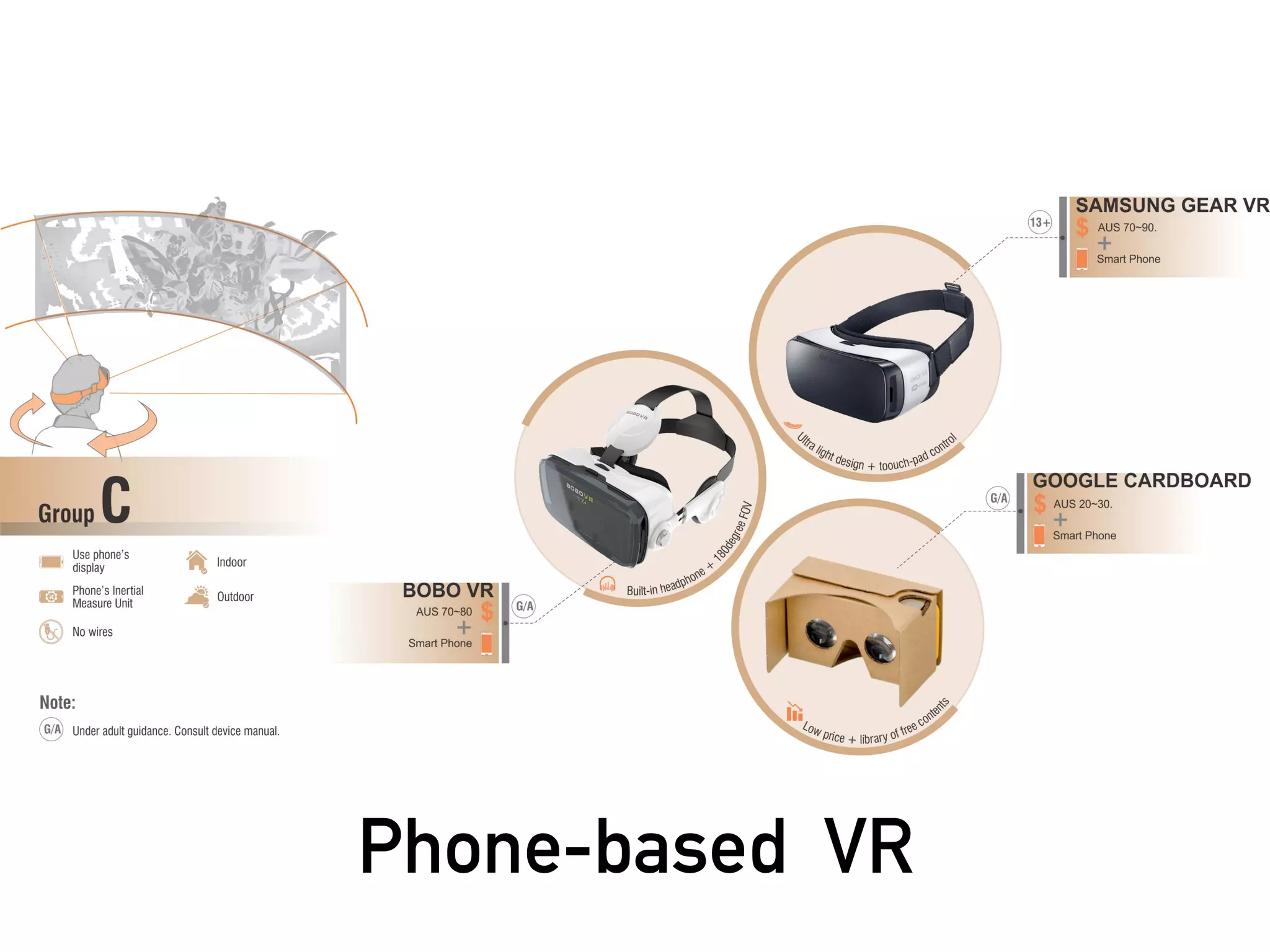
Phone-based VR
Shared Experiences?
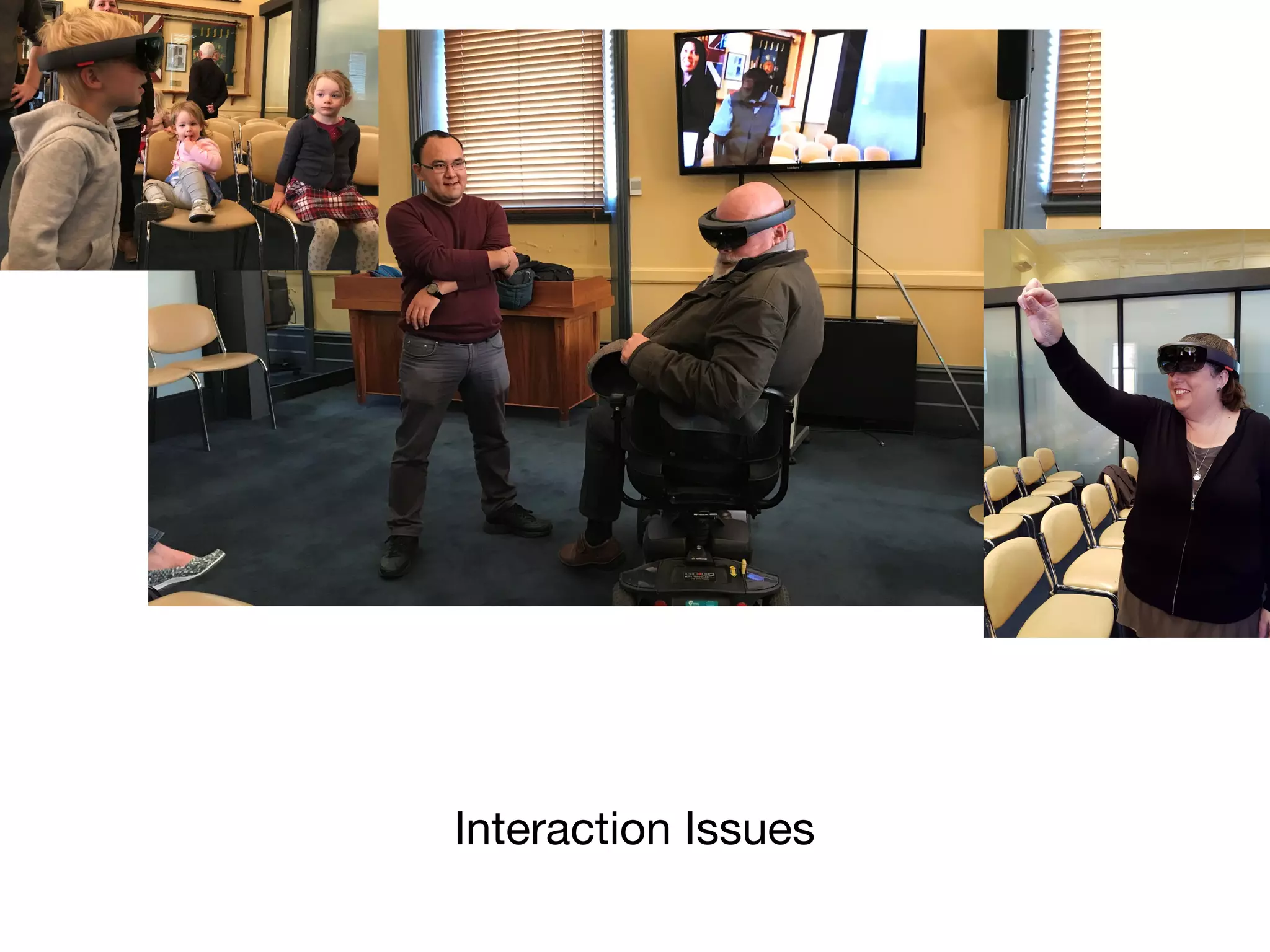
Interaction Issues
Holo RecogiTo
Figure 1: A conceptual model of the ARrecogito application. The user sees through the HoloLens an expedition route map
generated from historical texts (annotated and extracted via Recogito) and interacts with the map.
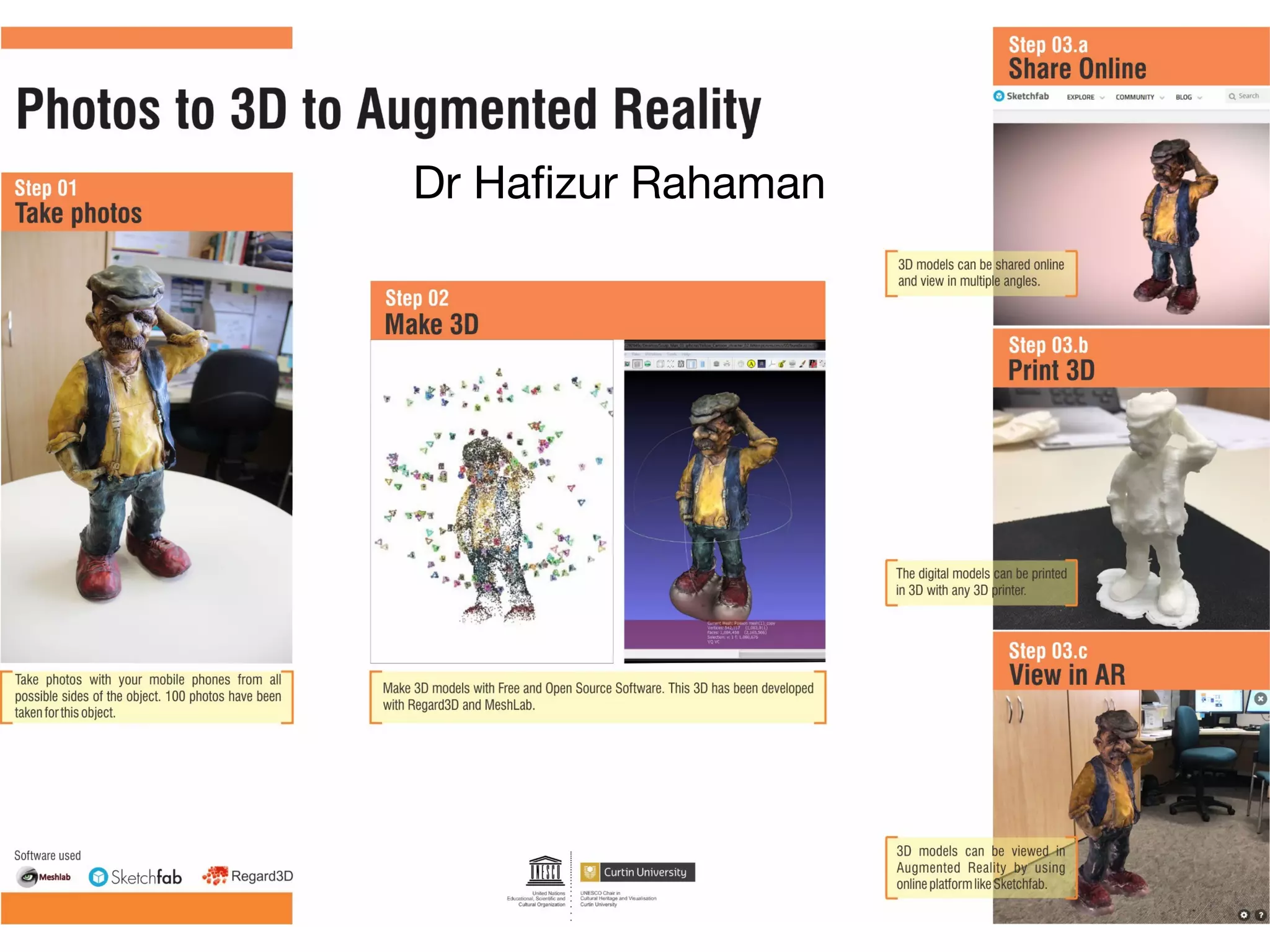
Dr Hafizur Rahaman
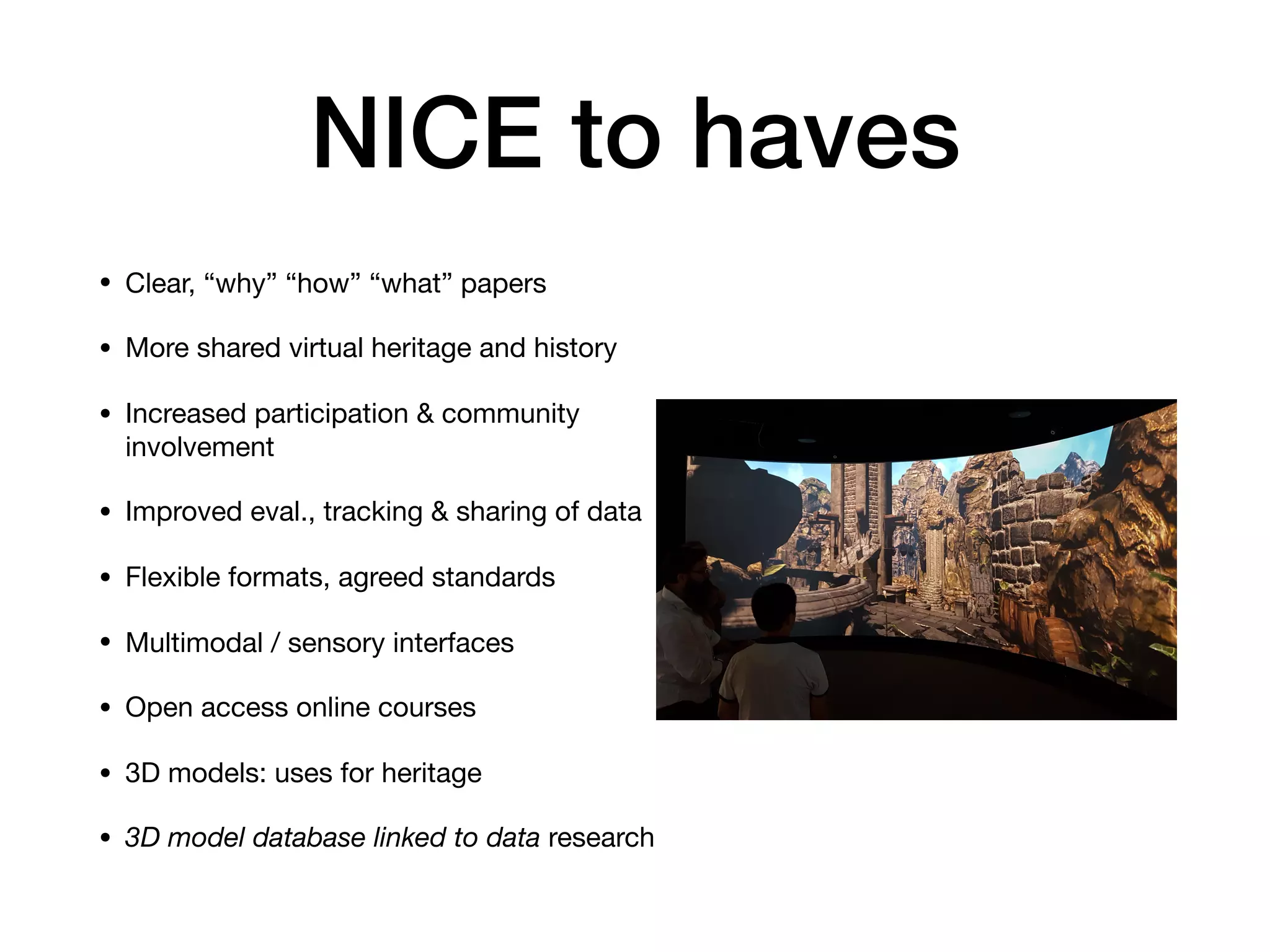
NICE to haves
• Clear, “why” “how” “what” papers

• More shared virtual heritage and history

• Increased participation & community
involvement

• Improved eval., tracking & sharing of data

• Flexible formats, agreed standards

• Multimodal / sensory interfaces

• Open access online courses

• 3D models: uses for heritage

• 3D model database linked to data research
What can You do about it?
• Bekele et al., Guidelines for Integrating Spatial
Information and Immersive Visualisation in
Virtual Heritage, GI FORUM Journal.

• Rahaman et al., Upcoming paper-Missing 3D
Models

• Rahaman, H. FOSS Photogrammetry, paper in
process. 

• Champion, E. (2018: in press). From Historical
Models to Virtual Heritage Simulations. OA
chapter for Der Modelle Tugend 2.0,
Heidelberg University Press, Germany. 

• Champion, E. (2018: in press). Rethinking
Virtual Places. Indiana University Press,
Spatial Humanities series.

• Champion, E. (Ed.). (2018: in press). The
Phenomenology of Real and Virtual Places.
Routledge Studies in Contemporary
Philosophy series.
Erik Champion, @nzerik

erik.champion@curtin.edu.au

Virtual Heritage Techniques to improve paper selection

  • 1.
    VIRTUAL HERITAGE: TECHNIQUES TOIMPROVE PAPER SELECTION’ Erik Champion, Curtin University, Perth Intern project Agathe Limouzy Toulouse (Collaborative Learning)
  • 2.
    Why VH? • Whyshould we do it? • How to engage and educate on: cultural significance • What to preserve: survey data; models; cultural knowledge; remains; paradata; audience understanding and feedback.. • When to stop: artistry, findings, audience interaction, experts, technical platforms.. • Where to find .. Run into a good virtual heritage project lately?
  • 3.
    Important controversies, debates, issues • Recreation or“the fallacy of” reconstruction (Jeff Clarke) • Completeness or authenticity • Levels of realism • Ownership and shareholders • Cultural appropriation • Obsolescence • Gamification EU Chess project DH2013 Marseilles
  • 4.
    VR cannot matchthe real thing?? • … the emotions you feel when you have a virtual experience are not as valuable. When you actually see Niagara Falls, especially if you get up close, you feel awe and even fear in the face of an overpowering force of nature… Computer simulations, however good, contain only what photography, laser technology and pre-existing expertise put into them… Real experiences connect us to the deeds of past people and place us in contexts where history was made… VR will never be a substitute for encounters with the real thing. Janna Thompson, Professor of Philosophy, La Trobe University https:// theconversation.com/why-virtual-reality-cannot-match-the-real-thing-92035 https://youtu.be/Vo4hCg91Xhk
  • 5.
    Computer Visualisation • TheLondon Charter [Den09] defined computer-based visualization as ‘[t]he process of representing information visually with the aid of computer technologies.’ • implies visualization is only visual, that all is required is to represent (in a visual format) content to an end user. • Does not explain the cultural significance of the object or process simulated, and reasons for why it should be preserved and communicated.
  • 6.
    VH is..#1 • ..afusion of virtual reality technology with cultural heritage content [Addison 2008] [Roussou 2000]. • … the use of computer-based interactive technologies to record, preserve, or recreate artifacts, sites and actors of historic, artistic, religious, and cultural significance and to deliver the results openly to a global audience in such a way as to provide formative educational experiences through electronic manipulations of time and space. Stone and Ojika [2O08] • NB intangible heritage, ‘practices, representations, expressions, knowledge, skills – as well as the instruments, objects, artefacts and cultural spaces associated therewith – that communities, groups and, in some cases, individuals recognize as part of their cultural heritage’ [UNESCO 2003]. ‘In game’ footage: Sims 4 machinima -3rd Person- Susannah Emery Honours -with Michele Wilson
  • 7.
    VH is #2 Champion[2008]: ‘the attempt to convey not just the appearance but also the meaning and significance of cultural artefacts and the associated social agency that designed and used them, through the use of interactive and immersive digital media.’ NB I distinguish between digital & virtual heritage.
  • 8.
    New media growingpains • New media constantly changing • NM can potentially suggest new perceptions and behaviour for end users. • DH aims to preserve heritage content. So there is an implicit conflict here. • VH =latest tech, but cannot bridge both new media & digital heritage. • HOW MANY VH PROJECTS VERIFIED FOR FUTURE ROBUSTNESS AND USAGE? • …the purpose of new heritage is to ‘examine the user experience that digital media can provide for the understanding and experiencing of tangible and intangible cultural heritage’.
  • 9.
    VH issues • Levelsof authenticity (not fabrication) • Contribution, clear stage of progress listed • Accuracy, completeness listed • Provided complete data (counter views) • Appropriate statistical procedures (e.g. Likert) • Originality (Not old findings) + Credit • Citing sources of information ideas and words • Observing copyright and permissions • Disclosure of conflicts of interest etc GUIDELINES FOR RESEARCH WRITING Ethics in writing slide 44 https:// www.slideshare.net/kmahmood2/how-to-write-a-journal-article-73216063 Stromatolites http://www.visitpinnaclescountry.com.au/pages/ lake-thetis-and-stromatolites/
  • 10.
    Selecting a (VH)journal 1. Select clearly reviewed journals. manuscripts must be peer reviewed to be research articles. 2. Focus: technical, conceptual, theoretically based, articles review each other? Discussion? 3. Indexing: Indexed in Scopus Web of Science ACM IEEE…? Are there related tools? 4. Availability: Is journal broadly available and online? OA? PDF? Or HTML? 3D or VR friendly? 5. Reputation? 6. Format:: format, typeface, and references style? Clear templates? 7. Figures: Resolution quality? Time to Print: (“date submitted” to “date accepted”)? 8. Charges: Some journals charge, like JCAA but there are often special issue fee waivers etc.. Abridged-modified from a UNL website https://www.unl.edu/gradstudies/current/news/twenty-steps-writing-research-article Twenty Steps to Writing a Research, which reproduces with permission from Beth A. Fischer and Michael J. Zigmond, Survival Skills and Ethics Program, University of Pittsburgh
  • 11.
    Targeting a journalor book 1. Compare your article’s research quality to published articles in the same area 2. The reputation of a journal is best found by journals that leaders in your area publish in 3. How articles are refereed, if blind or recommended is worth discussing 4. How long articles take to publish is a factor for all esp in VH. 5. Are you writing about area X to audience Y? Will readers X and Y Read this book? 6. IS the format acceptable to you? Some publishers don’t give templates, some have strict page limits or don’t publish appendices or link to updatable webpages. 7. Fees; are they upfront on costs? Are costs legitimate? B Best practices for scholarly authors in the age of predatory journals https:// www.ncbi.nlm.nih.gov/pmc/articles/PMC5210492/ www.etc.cmu.edu/etc-press/publication/game-mods/
  • 12.
    What VH reviewerswant • Is the title focused, relevant and informative? • Abstract captures the essential elements of the paper--does it spark reader interest? • Paper has a clear key message..clearly contributes something relevant / new? • Is the paper firmly grounded in the relevant theory or methodology? • Is the issue sufficiently well-explained for the target audience? • Good use of evidence that demonstrates a sophisticated understanding of the literature available on the topic (even if it contradicts you)? • Is the paper well-structured and well-written? Is the paper referenced appropriately to the journal's style? Do all aspects of presentation conform to the journal's house-style? ANU Turning a chapter into an article http://www.anu.edu.au/students/learning-development/research-writing/journal-article-writing/turning-a- chapter-into-an Z
  • 13.
    References • https://www.insidehighered.com/advice/2017/05/09/how-write-effective-journal-article-and-get-it- published-essay • https://www.proof-reading-service.com/en/blog/write-journal-article/ • http://www.anu.edu.au/students/learning-development/research-writing/journal-article-writing esp http://www.anu.edu.au/students/learning-development/research-writing/journal-article-writing/ targeting-a-journal targeting a journal Some lists of relevant journals: • https://erikchampion.wordpress.com/2015/10/07/are-there-open-access-virtual-heritagedigital- archaeology-journals/ (add https://scholarworks.iu.edu/journals/index.php/sdh/index and https:// journal.caa-international.org/) • http://www.openaccessarchaeology.org/journal-search.html#.VpY6B1Lgq4o • http://ancientworldonline.blogspot.com/2010/12/open-access-journal-virtual-archaeology.html • https://scholarworks.iu.edu/journals/index.php/sdh/index
  • 14.
    A 3D ModelCan.. • Zoom in, zoom out, rotate, and walk around. • Certain points in text can link to camera views. • Can remove or add parts of the model. • Can change from wireframe to textured view. • Can take screenshots. • Can incorporate annotations. • Can pose and change field of view. • Can measure between parts of the online model. • Can handle large file sizes. • Import and export various options. • Can work with timelines, so that the model can show changes over time. http://publicvr.org/, Jeffrey Jacobson • Continual feedback and review missing • Frozen products • Lack of situated agency • No dynamic linked resources • Designed mostly by one individual • Sense of scale and proportion • Lacks rich range of interactivity • No inherent measuring or analytical tools
  • 15.
    GLAM+ Councils most interestedin sharing.. 2018 National Digital Forum (19–21 November, Wellington) • How can we work collaboratively and effectively with people outside the sector? • How does our sector work with educators and students in the digital realm? How should it? • How can we share experiences of things not going well and learn from our mistakes? • How can we embrace new modes of research? • How can we share the work we’re doing to make a tangible impact in our communities • http://www.ndf.org.nz/call-for-presentations/ CAA Session 2017 Atlanta Georgia
  • 16.
    BUT: 3D Formatissues • Non standard formats nor created specifically for preservation • Archive versus presentation • understanding the quantity, quality, accessibility and usefulness of virtual heritage models • Missing survey on relative strengths, weaknesses, suitability and popularity of 3D file formats • DAE, OBJ, and VRML/X3D popular, suitable? • Game formats (UNITY) assets not easily exported to other software.
  • 17.
  • 18.
    IKROM: Integrating 3d Models& GIS for DH • Capture + modelling of 3D DH objects increasingly affordable for GLAMs • 3D geometric modelling methods and file formats: number in hundreds! • What is most appropriate 3D geometric modelling method + file format for DH? • Most-common 3D geometric modelling methods (constructive solid geometry, non-uniform rational B-splines, triangle meshes)? • 3D file formats for architecture, Ikrom Nishanbaev 3D Model author: Stefan A Vollger: Split Point, Victoria (Australia) URL: https://sketchfab.com/models/d95f3ad4d0044c20a56ebb7bd507d515
  • 19.
    3D: a Keyscholarly resource? (Di Benedetto et al,, 2014). • Teaching VH via careful inspection, contextualization + modification of 3D=problematic. • Hard to find, download or edit; unwieldy + obsolete formats, standalone meshes, no metadata or info on how data acquired or how sharable, accuracy of scanning or modelling, paradata? • Problem #1 VH dev, #2 lacks aims, #3 infrastructure. • Scholarly ecosystem: media assets & communities (scholars, shareholders and public) active participants in development. • VH IS NOT DH if it cannot preserve its own models; so leverage digital real-time reconfiguration to suit learner, device & task at hand; personalisation; increased sense of agency; auto tracking + evaluation; filtered feedback.
  • 20.
    3D MODELS inJournals
  • 21.
    VHEs/Games aren’t gamification Don’t seriouslyentertain or work easily with dynamic, valuable interactive content Are NOT easily preserved, let alone scholarly accessible Forbidden City: Beyond Space & Time
  • 22.
    Challenges of accessaffect everyone: The ‘Vanishing virtual’ • Disappearing Virtual Heritage-Becoming Archaeological , p33, Ruth Tringham University of California Berkeley, USA, Michael Ashley CODA • While searching in 2014 in Erik Champion’s Playing with the Past (2011) for web-based virtual cultural environments that could act as models for a game, Dead Women Do Tell Tales, that was being developed about Çatalhöy k (Tringham n.d. 3; see also Tringham 2015), we found that at least half of his examples have disappeared by now, which seems to be a common trend with games and other web-based interfaces in general. It’s not surprising— according to the Library of Congress, the average lifespan of a webpage is only 100 days. Many of the disappeared, like Okapi Island, can be seen as tempting frag ments displayed through video documentation on YouTube or Vimeo (e.g. Leavy n.d.).
  • 23.
    AR software, hosting+ Data-Gone Advanced Challenges: 3D Modeling, UCLA USA 2016
  • 24.
    3D models (&article) ideally 1. Traceable: links to previous works and to related info. • Component-based so that parts can be directly linked, updated, online 3D created at runtime. • Formats easy to find, reliable, compact. • Metadata records completeness, measurement methodology and accuracy. LOD preferable. 2. Communal: scholars, students and public involved, incorporate their understanding & feedback, and engage: play-testing & evaluation required. 3. Linkable to journals + refereed conference papers, tools and methods used in project; robust feedback system; levels of learning skills and knowledge required (or cultural knowledge that needs to be hidden..)
  • 25.
    Biofeedback Phillips, P., Hartup,M., and Champion, E. (2009). “A survey of 10 free massive multiplayer online games that may help augment social interaction and positive mental health.” The ANZ Association of Psychiatry, Psychology And Law (Inc.) Conference, Fremantle, 26-29 September. Poster. Eval data??
  • 27.
    Virtual Past-Palestine Rusaila Bazlamit,Curtin PhD student (supervisor: Andrew Hutchison Erik Champion) Subj. Experiences
  • 28.
    Beata Dawson, CurtinPhD student (Dr Pauline Joseph, Erik Champion)
  • 29.
  • 30.
  • 31.
  • 32.
  • 33.
  • 34.
    Holo RecogiTo Figure 1:A conceptual model of the ARrecogito application. The user sees through the HoloLens an expedition route map generated from historical texts (annotated and extracted via Recogito) and interacts with the map.
  • 35.
  • 36.
    NICE to haves •Clear, “why” “how” “what” papers • More shared virtual heritage and history • Increased participation & community involvement • Improved eval., tracking & sharing of data • Flexible formats, agreed standards • Multimodal / sensory interfaces • Open access online courses • 3D models: uses for heritage • 3D model database linked to data research
  • 37.
    What can Youdo about it? • Bekele et al., Guidelines for Integrating Spatial Information and Immersive Visualisation in Virtual Heritage, GI FORUM Journal. • Rahaman et al., Upcoming paper-Missing 3D Models • Rahaman, H. FOSS Photogrammetry, paper in process. • Champion, E. (2018: in press). From Historical Models to Virtual Heritage Simulations. OA chapter for Der Modelle Tugend 2.0, Heidelberg University Press, Germany. • Champion, E. (2018: in press). Rethinking Virtual Places. Indiana University Press, Spatial Humanities series. • Champion, E. (Ed.). (2018: in press). The Phenomenology of Real and Virtual Places. Routledge Studies in Contemporary Philosophy series. Erik Champion, @nzerik
 erik.champion@curtin.edu.au