Time Series and Forecasting
Venkata Sai Krishna M
Introduction
• Forecasting or predicting is an essential tool in any decision-making
process
• Used for Inventory management to annual sales
• Quality depends on the quantity of the past data
• Pattern is used to arrive at an estimate in the future
• This analysis helps us cope with uncertainty about the future
Venkata Sai Krishna M
Variations in Time Series
4 different variation involved in time series:
1. Secular Trend
2. Cyclical Fluctuation
3. Seasonal Variation
4. Irregular Variation
Venkata Sai Krishna M
Secular Trend
• The value of the variable tends to increase or decrease over a long
period
• Steady increase in cost of living recorded by the Consumer Price Index
is an example of secular trend
• In terms of long term period, complete cost of living varies a great
deal
Venkata Sai Krishna M
Cyclical Trend
• Business cycle is the most common example
• Peak at sometimes and likely to slump at the other
• The cycle may extend up to 1 year to 15 to 20 years
• There is no regular pattern but will move in little unpredictable
manner
Venkata Sai Krishna M
Seasonal Variation
• Involves patterns of change within a year
• They tend to have a cycle from year to year
• Substantial peak and irregular through at particular periods in a year
Venkata Sai Krishna M
Irregular Variations
• Value of a variable may be completely unpredictable
• Effect of one situation ripples to the impact of any other inter related
commodity
• White Revolution and effect on Gas
Venkata Sai Krishna M
Reasons for Studying Trends
• The study of secular trends allows us to describe a historical pattern
• Evaluating the eating lifecycle resulted in creation of Maggie
• Studying secular trends permits us to project past patterns, or trends,
into the future
• Growth trend of population helps predict the population projections
• In many situations, studying the secular trend of a time series allows
us to eliminate the trend component from the series
• Make in India Campaign
Venkata Sai Krishna M
Fitting the Linear Trend
by the least-squares method
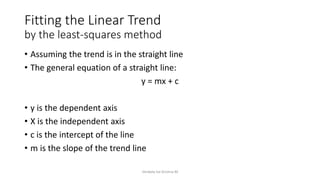
• Assuming the trend is in the straight line
• The general equation of a straight line:
y = mx + c
• y is the dependent axis
• X is the independent axis
• c is the intercept of the line
• m is the slope of the trend line
Venkata Sai Krishna M
Slope and Intercept
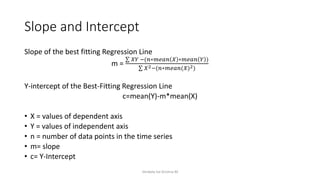
Slope of the best fitting Regression Line
m =
𝑋𝑌 −(𝑛∗𝑚𝑒𝑎𝑛 𝑋 ∗𝑚𝑒𝑎𝑛 𝑌 )
𝑋2−(𝑛∗𝑚𝑒𝑎𝑛(𝑋)2)
Y-intercept of the Best-Fitting Regression Line
c=mean(Y)-m*mean(X)
• X = values of dependent axis
• Y = values of independent axis
• n = number of data points in the time series
• m= slope
• c= Y-Intercept
Venkata Sai Krishna M
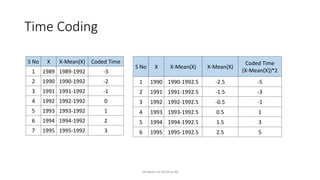
Translating or coding time
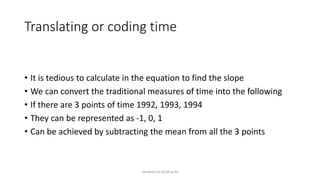
• It is tedious to calculate in the equation to find the slope
• We can convert the traditional measures of time into the following
• If there are 3 points of time 1992, 1993, 1994
• They can be represented as -1, 0, 1
• Can be achieved by subtracting the mean from all the 3 points
Venkata Sai Krishna M
Time Coding
Venkata Sai Krishna M
S No X X-Mean(X) Coded Time
1 1989 1989-1992 -3
2 1990 1990-1992 -2
3 1991 1991-1992 -1
4 1992 1992-1992 0
5 1993 1993-1992 1
6 1994 1994-1992 2
7 1995 1995-1992 3
S No X X-Mean(X) X-Mean(X)
Coded Time
(X-Mean(X))*2
1 1990 1990-1992.5 -2.5 -5
2 1991 1991-1992.5 -1.5 -3
3 1992 1992-1992.5 -0.5 -1
4 1993 1993-1992.5 0.5 1
5 1994 1994-1992.5 1.5 3
6 1995 1995-1992.5 2.5 5
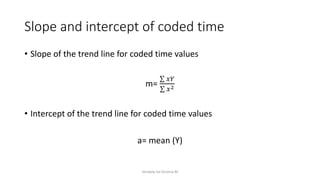
Slope and intercept of coded time
• Slope of the trend line for coded time values
m=
𝑥𝑌
𝑥2
• Intercept of the trend line for coded time values
a= mean (Y)
Venkata Sai Krishna M
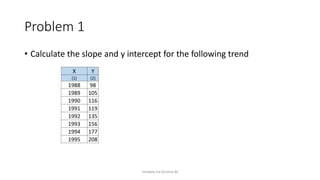
Problem 1
• Calculate the slope and y intercept for the following trend
Venkata Sai Krishna M
X Y
(1) (2)
1988 98
1989 105
1990 116
1991 119
1992 135
1993 156
1994 177
1995 208
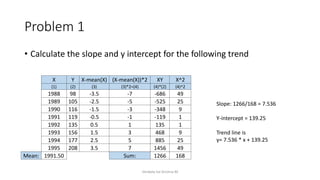
Problem 1
• Calculate the slope and y intercept for the following trend
Venkata Sai Krishna M
X Y X-mean(X) (X-mean(X))*2 XY X^2
(1) (2) (3) (3)*2=(4) (4)*(2) (4)^2
1988 98 -3.5 -7 -686 49
1989 105 -2.5 -5 -525 25
1990 116 -1.5 -3 -348 9
1991 119 -0.5 -1 -119 1
1992 135 0.5 1 135 1
1993 156 1.5 3 468 9
1994 177 2.5 5 885 25
1995 208 3.5 7 1456 49
Mean: 1991.50 Sum: 1266 168
Slope: 1266/168 = 7.536
Y-intercept = 139.25
Trend line is
y= 7.536 * x + 139.25
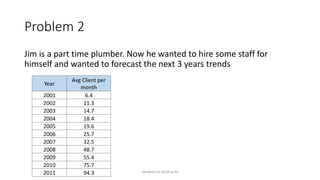
Problem 2
Jim is a part time plumber. Now he wanted to hire some staff for
himself and wanted to forecast the next 3 years trends
Venkata Sai Krishna M
Year
Avg Client per
month
2001 6.4
2002 11.3
2003 14.7
2004 18.4
2005 19.6
2006 25.7
2007 32.5
2008 48.7
2009 55.4
2010 75.7
2011 94.3
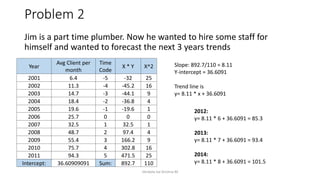
Problem 2
Jim is a part time plumber. Now he wanted to hire some staff for
himself and wanted to forecast the next 3 years trends
Venkata Sai Krishna M
Year
Avg Client per
month
Time
Code
X * Y X^2
2001 6.4 -5 -32 25
2002 11.3 -4 -45.2 16
2003 14.7 -3 -44.1 9
2004 18.4 -2 -36.8 4
2005 19.6 -1 -19.6 1
2006 25.7 0 0 0
2007 32.5 1 32.5 1
2008 48.7 2 97.4 4
2009 55.4 3 166.2 9
2010 75.7 4 302.8 16
2011 94.3 5 471.5 25
Intercept: 36.60909091 Sum: 892.7 110
Slope: 892.7/110 = 8.11
Y-intercept = 36.6091
Trend line is
y= 8.11 * x + 36.6091
2012:
y= 8.11 * 6 + 36.6091 = 85.3
2013:
y= 8.11 * 7 + 36.6091 = 93.4
2014:
y= 8.11 * 8 + 36.6091 = 101.5
Methods of estimating Trend
• Freehand Method
• Moving Average Method
• Semi-Average Method
• Least Square Method
Venkata Sai Krishna M
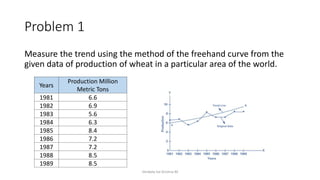
Freehand method
• Briefly described for drawing frequency curves
• Observations is plotted against time on the horizontal axis and a freehand
smooth curve is drawn through the plotted points
• Smoothness should not be scarified in trying to let the points fall exactly on
the curve
• Eliminates the short term and long term oscillations and the irregular
movements from the time series, and elevates the general trend
Disadvantages:
• Different individuals draw curves or lines that differ in slope and intercept
• Used only in situations where the scatter diagram of the original data
conforms to some well define trends
Venkata Sai Krishna M
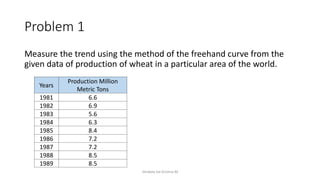
Problem 1
Measure the trend using the method of the freehand curve from the
given data of production of wheat in a particular area of the world.
Venkata Sai Krishna M
Years
Production Million
Metric Tons
1981 6.6
1982 6.9
1983 5.6
1984 6.3
1985 8.4
1986 7.2
1987 7.2
1988 8.5
1989 8.5
Problem 1
Measure the trend using the method of the freehand curve from the
given data of production of wheat in a particular area of the world.
Venkata Sai Krishna M
Years
Production Million
Metric Tons
1981 6.6
1982 6.9
1983 5.6
1984 6.3
1985 8.4
1986 7.2
1987 7.2
1988 8.5
1989 8.5
Moving Average Method
• A n-period moving average for time period t is the arithmetic average of the time series
values for the n most recent time periods
• For example: A 3-period moving average at period (t+1) is calculated by (yt-2 + yt-1 +
yt)/3
• Advantages of Moving Average Method
• Easily understood
• Easily computed
• Provides stable forecasts
• Disadvantages of Moving Average Method
• Requires saving all past n data points
• Lags behind a trend
• Ignores complex relationships in data
Venkata Sai Krishna M
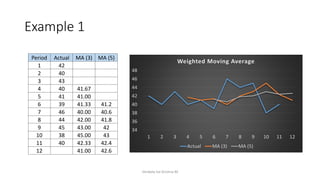
Example 1
Venkata Sai Krishna M
Period Actual MA (3) MA (5)
1 42
2 40
3 43
4 40 41.67
5 41 41.00
6 39 41.33 41.2
7 46 40.00 40.6
8 44 42.00 41.8
9 45 43.00 42
10 38 45.00 43
11 40 42.33 42.4
12 41.00 42.6
34
36
38
40
42
44
46
48
1 2 3 4 5 6 7 8 9 10 11 12
Weighted Moving Average
Actual MA (3) MA (5)
Semi Average Method
• This method is as simple and relatively objective as the free hand
method
• Data is divided in two equal halves and the arithmetic mean is
calculated
• If the number of observations is even the division into halves
• If the number of observations is odd, then the middle most item is
dropped
Venkata Sai Krishna M
Advantages and Disadvantages of the Semi-
Averages Method
• Advantages
• This method is very simple and easy to understand, and also it does
not require many calculations.
• Disadvantages
• For non-linear trends this method is not applicable.
• averages are affected by extreme values
• extreme value should either be omitted or this method should not be
applied
Venkata Sai Krishna M
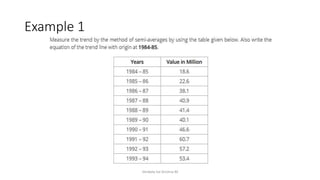
Example 1
Venkata Sai Krishna M
Example 1 Solutions
Venkata Sai Krishna M
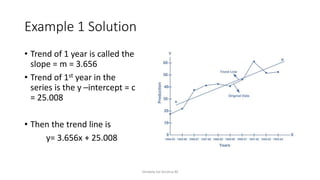
Example 1 Solution
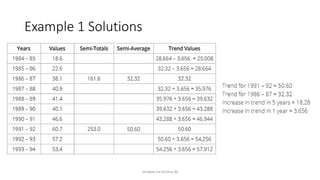
• Trend of 1 year is called the
slope = m = 3.656
• Trend of 1st year in the
series is the y –intercept = c
= 25.008
• Then the trend line is
y= 3.656x + 25.008
Venkata Sai Krishna M

Time series and forecasting

  • 1.
    Time Series andForecasting Venkata Sai Krishna M
  • 2.
    Introduction • Forecasting orpredicting is an essential tool in any decision-making process • Used for Inventory management to annual sales • Quality depends on the quantity of the past data • Pattern is used to arrive at an estimate in the future • This analysis helps us cope with uncertainty about the future Venkata Sai Krishna M
  • 3.
    Variations in TimeSeries 4 different variation involved in time series: 1. Secular Trend 2. Cyclical Fluctuation 3. Seasonal Variation 4. Irregular Variation Venkata Sai Krishna M
  • 4.
    Secular Trend • Thevalue of the variable tends to increase or decrease over a long period • Steady increase in cost of living recorded by the Consumer Price Index is an example of secular trend • In terms of long term period, complete cost of living varies a great deal Venkata Sai Krishna M
  • 5.
    Cyclical Trend • Businesscycle is the most common example • Peak at sometimes and likely to slump at the other • The cycle may extend up to 1 year to 15 to 20 years • There is no regular pattern but will move in little unpredictable manner Venkata Sai Krishna M
  • 6.
    Seasonal Variation • Involvespatterns of change within a year • They tend to have a cycle from year to year • Substantial peak and irregular through at particular periods in a year Venkata Sai Krishna M
  • 7.
    Irregular Variations • Valueof a variable may be completely unpredictable • Effect of one situation ripples to the impact of any other inter related commodity • White Revolution and effect on Gas Venkata Sai Krishna M
  • 8.
    Reasons for StudyingTrends • The study of secular trends allows us to describe a historical pattern • Evaluating the eating lifecycle resulted in creation of Maggie • Studying secular trends permits us to project past patterns, or trends, into the future • Growth trend of population helps predict the population projections • In many situations, studying the secular trend of a time series allows us to eliminate the trend component from the series • Make in India Campaign Venkata Sai Krishna M
  • 9.
    Fitting the LinearTrend by the least-squares method • Assuming the trend is in the straight line • The general equation of a straight line: y = mx + c • y is the dependent axis • X is the independent axis • c is the intercept of the line • m is the slope of the trend line Venkata Sai Krishna M
  • 10.
    Slope and Intercept Slopeof the best fitting Regression Line m = 𝑋𝑌 −(𝑛∗𝑚𝑒𝑎𝑛 𝑋 ∗𝑚𝑒𝑎𝑛 𝑌 ) 𝑋2−(𝑛∗𝑚𝑒𝑎𝑛(𝑋)2) Y-intercept of the Best-Fitting Regression Line c=mean(Y)-m*mean(X) • X = values of dependent axis • Y = values of independent axis • n = number of data points in the time series • m= slope • c= Y-Intercept Venkata Sai Krishna M
  • 11.
    Translating or codingtime • It is tedious to calculate in the equation to find the slope • We can convert the traditional measures of time into the following • If there are 3 points of time 1992, 1993, 1994 • They can be represented as -1, 0, 1 • Can be achieved by subtracting the mean from all the 3 points Venkata Sai Krishna M
  • 12.
    Time Coding Venkata SaiKrishna M S No X X-Mean(X) Coded Time 1 1989 1989-1992 -3 2 1990 1990-1992 -2 3 1991 1991-1992 -1 4 1992 1992-1992 0 5 1993 1993-1992 1 6 1994 1994-1992 2 7 1995 1995-1992 3 S No X X-Mean(X) X-Mean(X) Coded Time (X-Mean(X))*2 1 1990 1990-1992.5 -2.5 -5 2 1991 1991-1992.5 -1.5 -3 3 1992 1992-1992.5 -0.5 -1 4 1993 1993-1992.5 0.5 1 5 1994 1994-1992.5 1.5 3 6 1995 1995-1992.5 2.5 5
  • 13.
    Slope and interceptof coded time • Slope of the trend line for coded time values m= 𝑥𝑌 𝑥2 • Intercept of the trend line for coded time values a= mean (Y) Venkata Sai Krishna M
  • 14.
    Problem 1 • Calculatethe slope and y intercept for the following trend Venkata Sai Krishna M X Y (1) (2) 1988 98 1989 105 1990 116 1991 119 1992 135 1993 156 1994 177 1995 208
  • 15.
    Problem 1 • Calculatethe slope and y intercept for the following trend Venkata Sai Krishna M X Y X-mean(X) (X-mean(X))*2 XY X^2 (1) (2) (3) (3)*2=(4) (4)*(2) (4)^2 1988 98 -3.5 -7 -686 49 1989 105 -2.5 -5 -525 25 1990 116 -1.5 -3 -348 9 1991 119 -0.5 -1 -119 1 1992 135 0.5 1 135 1 1993 156 1.5 3 468 9 1994 177 2.5 5 885 25 1995 208 3.5 7 1456 49 Mean: 1991.50 Sum: 1266 168 Slope: 1266/168 = 7.536 Y-intercept = 139.25 Trend line is y= 7.536 * x + 139.25
  • 16.
    Problem 2 Jim isa part time plumber. Now he wanted to hire some staff for himself and wanted to forecast the next 3 years trends Venkata Sai Krishna M Year Avg Client per month 2001 6.4 2002 11.3 2003 14.7 2004 18.4 2005 19.6 2006 25.7 2007 32.5 2008 48.7 2009 55.4 2010 75.7 2011 94.3
  • 17.
    Problem 2 Jim isa part time plumber. Now he wanted to hire some staff for himself and wanted to forecast the next 3 years trends Venkata Sai Krishna M Year Avg Client per month Time Code X * Y X^2 2001 6.4 -5 -32 25 2002 11.3 -4 -45.2 16 2003 14.7 -3 -44.1 9 2004 18.4 -2 -36.8 4 2005 19.6 -1 -19.6 1 2006 25.7 0 0 0 2007 32.5 1 32.5 1 2008 48.7 2 97.4 4 2009 55.4 3 166.2 9 2010 75.7 4 302.8 16 2011 94.3 5 471.5 25 Intercept: 36.60909091 Sum: 892.7 110 Slope: 892.7/110 = 8.11 Y-intercept = 36.6091 Trend line is y= 8.11 * x + 36.6091 2012: y= 8.11 * 6 + 36.6091 = 85.3 2013: y= 8.11 * 7 + 36.6091 = 93.4 2014: y= 8.11 * 8 + 36.6091 = 101.5
  • 18.
    Methods of estimatingTrend • Freehand Method • Moving Average Method • Semi-Average Method • Least Square Method Venkata Sai Krishna M
  • 19.
    Freehand method • Brieflydescribed for drawing frequency curves • Observations is plotted against time on the horizontal axis and a freehand smooth curve is drawn through the plotted points • Smoothness should not be scarified in trying to let the points fall exactly on the curve • Eliminates the short term and long term oscillations and the irregular movements from the time series, and elevates the general trend Disadvantages: • Different individuals draw curves or lines that differ in slope and intercept • Used only in situations where the scatter diagram of the original data conforms to some well define trends Venkata Sai Krishna M
  • 20.
    Problem 1 Measure thetrend using the method of the freehand curve from the given data of production of wheat in a particular area of the world. Venkata Sai Krishna M Years Production Million Metric Tons 1981 6.6 1982 6.9 1983 5.6 1984 6.3 1985 8.4 1986 7.2 1987 7.2 1988 8.5 1989 8.5
  • 21.
    Problem 1 Measure thetrend using the method of the freehand curve from the given data of production of wheat in a particular area of the world. Venkata Sai Krishna M Years Production Million Metric Tons 1981 6.6 1982 6.9 1983 5.6 1984 6.3 1985 8.4 1986 7.2 1987 7.2 1988 8.5 1989 8.5
  • 22.
    Moving Average Method •A n-period moving average for time period t is the arithmetic average of the time series values for the n most recent time periods • For example: A 3-period moving average at period (t+1) is calculated by (yt-2 + yt-1 + yt)/3 • Advantages of Moving Average Method • Easily understood • Easily computed • Provides stable forecasts • Disadvantages of Moving Average Method • Requires saving all past n data points • Lags behind a trend • Ignores complex relationships in data Venkata Sai Krishna M
  • 23.
    Example 1 Venkata SaiKrishna M Period Actual MA (3) MA (5) 1 42 2 40 3 43 4 40 41.67 5 41 41.00 6 39 41.33 41.2 7 46 40.00 40.6 8 44 42.00 41.8 9 45 43.00 42 10 38 45.00 43 11 40 42.33 42.4 12 41.00 42.6 34 36 38 40 42 44 46 48 1 2 3 4 5 6 7 8 9 10 11 12 Weighted Moving Average Actual MA (3) MA (5)
  • 24.
    Semi Average Method •This method is as simple and relatively objective as the free hand method • Data is divided in two equal halves and the arithmetic mean is calculated • If the number of observations is even the division into halves • If the number of observations is odd, then the middle most item is dropped Venkata Sai Krishna M
  • 25.
    Advantages and Disadvantagesof the Semi- Averages Method • Advantages • This method is very simple and easy to understand, and also it does not require many calculations. • Disadvantages • For non-linear trends this method is not applicable. • averages are affected by extreme values • extreme value should either be omitted or this method should not be applied Venkata Sai Krishna M
  • 26.
  • 27.
  • 28.
    Example 1 Solution •Trend of 1 year is called the slope = m = 3.656 • Trend of 1st year in the series is the y –intercept = c = 25.008 • Then the trend line is y= 3.656x + 25.008 Venkata Sai Krishna M