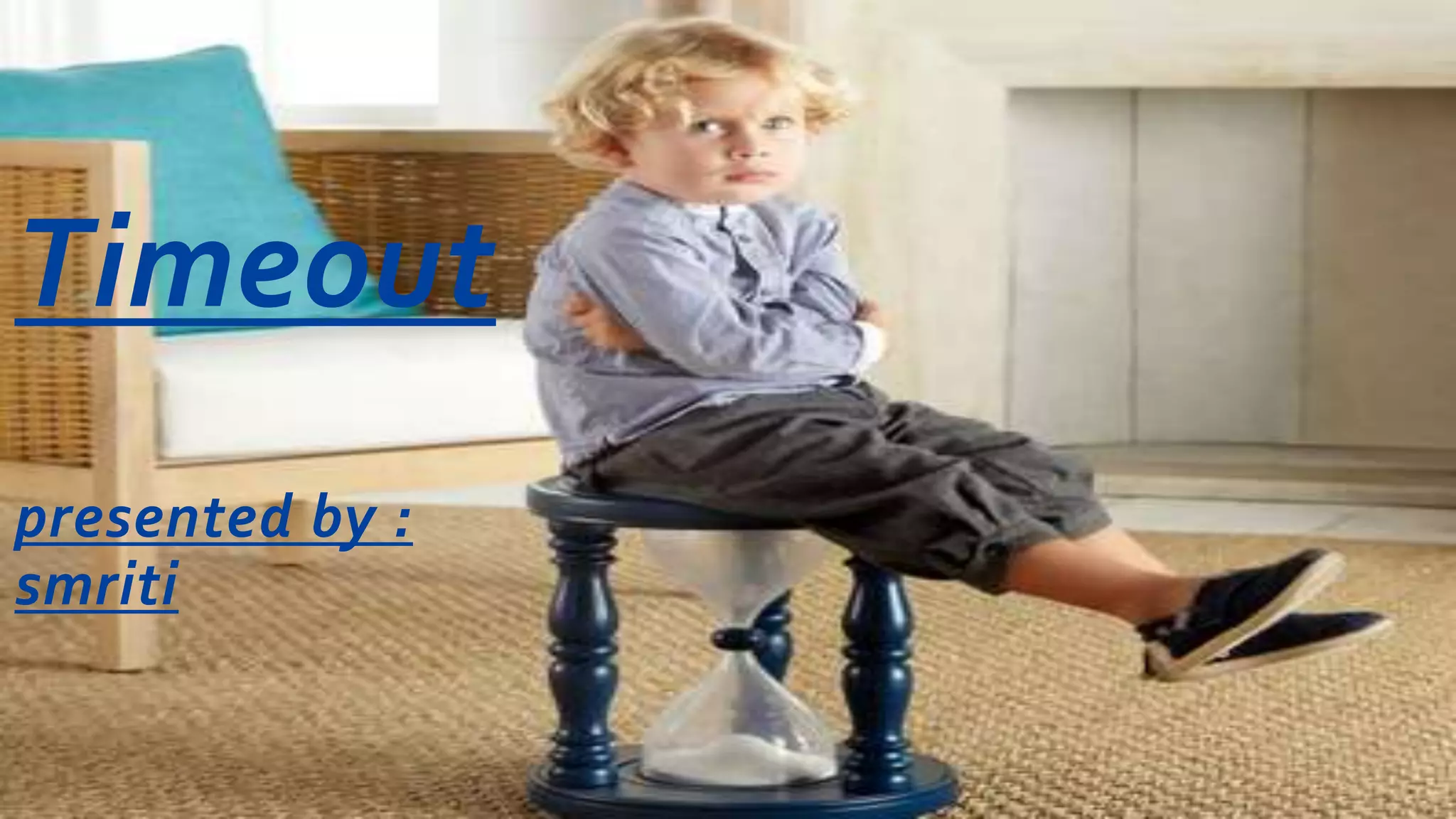
Timeout
presented by :
smriti
Time out
• In its purest form, the term “time out” means that a child is being
removed or isolated from anyone or anything that might provide
reinforcement, reward or the perception of attention.
• Timeout is a behavior therapy technique for the control of problem
behavior.
• The technique involves removing source of reward and/or
reinforcement for any behavior that is unwanted.
History
• concept of time-out was invented, named, and used by Arthur staats
• Also introduced various elements that later composed foundations
for Applied Behavior Analysis
• Staats described the discipline of his 2-year-old daughter in 1962:
• "I would put her in her crib and indicate that she had to stay there
until she stopped crying. If we were in a public place [where her
behavior was inappropriate], I would pick her up and go outside."This
has the effect of weakening the preceding behavior so that it occurs
less frequently in the future.
Types
Non-ExclusionaryTime-out:-
The student remains in the classroom but is temporarily prevented
from taking part in reinforcing activities through withdrawal of
materials or attention.
1 – 5 minutes is long enough to be effective.
Exclusion :-
The student is removed to another part of the room and cannot watch
or take part in activities
5 minutes approximately or as per year.
Isolation/Seclusion :-
The student is removed entirely from the classroom to a buddy room or
a separate time-out room.
An adult should always supervise.
No longer than 15 minutes.
Non rewarding activities Plans for exiting and returning to class.
Time-Out
• Do’s:
• `Give a warning before timeout is used
• `Give a clear request
• `Use a normal tone of voice and be respectful
• `Explain your reasoning
• `Have a specific place for time-out
• `Usually 1 minute per 1 year of age
• `Use a timer
• `Have a more secluded backup area in case of refusal
Time out
• Don’ts:
• Don’t over-use the technique
• Don’t use an excessive amount of time
• Don’t forget to let the child redeem himself/herself (restitution)
• Don’t add extra consequences on top of time-out
How to make the process effective?
• Time-out can be a very effective behavior modification tool when it’s used
appropriately…
Explain the time out process to the child
UseTime Out Sparingly
FollowThrough withTime-Out
Have a Back Up Plan
FinalThoughts
for example:- “If you don’t go to time out now, you’ll lose your electronics for the next 24 hours.”
What does effective time out look like?
• The most effective way to use time out is utilize this technique to target a specific
behavior or behaviors.
• For example,: A child is disrupting your class to the point that no one is learning,
speaking loudly, swearing or threatening other children.
• Once we have defined the behavior or behaviors that will result in a time out,
• we need to define where time out will take place, for how long and any
constrictions that will result.
• The child should be informed that when he or she engages in the target behavior.
• he or she will be placed in time out in a small room, or a corner of a classroom, the
hall, etc.The location of time out is best accessed if it is close to the classroom.
• https://www.youtube.com/watch?v=teJ1cO4769U
…Any questions???

Time out aba

  • 1.
  • 2.
    Time out • Inits purest form, the term “time out” means that a child is being removed or isolated from anyone or anything that might provide reinforcement, reward or the perception of attention. • Timeout is a behavior therapy technique for the control of problem behavior. • The technique involves removing source of reward and/or reinforcement for any behavior that is unwanted.
  • 3.
    History • concept oftime-out was invented, named, and used by Arthur staats • Also introduced various elements that later composed foundations for Applied Behavior Analysis • Staats described the discipline of his 2-year-old daughter in 1962: • "I would put her in her crib and indicate that she had to stay there until she stopped crying. If we were in a public place [where her behavior was inappropriate], I would pick her up and go outside."This has the effect of weakening the preceding behavior so that it occurs less frequently in the future.
  • 4.
    Types Non-ExclusionaryTime-out:- The student remainsin the classroom but is temporarily prevented from taking part in reinforcing activities through withdrawal of materials or attention. 1 – 5 minutes is long enough to be effective.
  • 5.
    Exclusion :- The studentis removed to another part of the room and cannot watch or take part in activities 5 minutes approximately or as per year.
  • 6.
    Isolation/Seclusion :- The studentis removed entirely from the classroom to a buddy room or a separate time-out room. An adult should always supervise. No longer than 15 minutes. Non rewarding activities Plans for exiting and returning to class.
  • 7.
    Time-Out • Do’s: • `Givea warning before timeout is used • `Give a clear request • `Use a normal tone of voice and be respectful • `Explain your reasoning • `Have a specific place for time-out • `Usually 1 minute per 1 year of age • `Use a timer • `Have a more secluded backup area in case of refusal
  • 8.
    Time out • Don’ts: •Don’t over-use the technique • Don’t use an excessive amount of time • Don’t forget to let the child redeem himself/herself (restitution) • Don’t add extra consequences on top of time-out
  • 9.
    How to makethe process effective? • Time-out can be a very effective behavior modification tool when it’s used appropriately… Explain the time out process to the child UseTime Out Sparingly FollowThrough withTime-Out Have a Back Up Plan FinalThoughts for example:- “If you don’t go to time out now, you’ll lose your electronics for the next 24 hours.”
  • 10.
    What does effectivetime out look like? • The most effective way to use time out is utilize this technique to target a specific behavior or behaviors. • For example,: A child is disrupting your class to the point that no one is learning, speaking loudly, swearing or threatening other children. • Once we have defined the behavior or behaviors that will result in a time out, • we need to define where time out will take place, for how long and any constrictions that will result. • The child should be informed that when he or she engages in the target behavior. • he or she will be placed in time out in a small room, or a corner of a classroom, the hall, etc.The location of time out is best accessed if it is close to the classroom.
  • 11.
  • 12.