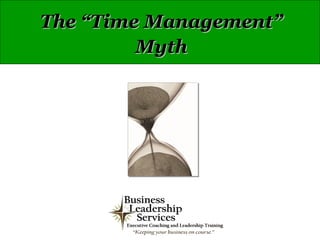
The “Time Management”
         Myth


                 :
“We say we waste time, but that is
 impossible. We waste ourselves.”
                          - Alice Bloch
Improve Your Time Habits

Identify Your Time Thieves

Prioritize What Matters Most
Daily Time Analysis
     Questions
The things that are easy
        to do…

 Are also easy NOT to
          do!
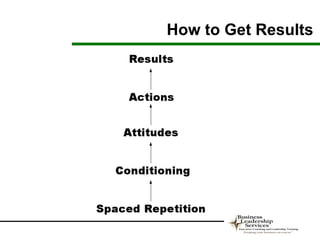
How to Get Results
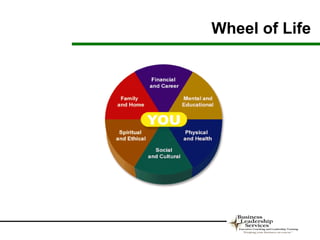
Wheel of Life
Managing Yourself,
    Not Time
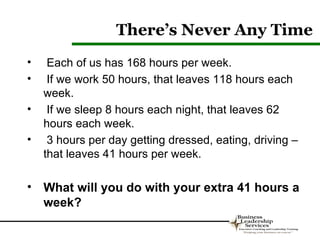
There’s Never Any Time
•    Each of us has 168 hours per week.
•    If we work 50 hours, that leaves 118 hours each
    week.
•    If we sleep 8 hours each night, that leaves 62
    hours each week.
•    3 hours per day getting dressed, eating, driving –
    that leaves 41 hours per week.

• What will you do with your extra 41 hours a
  week?
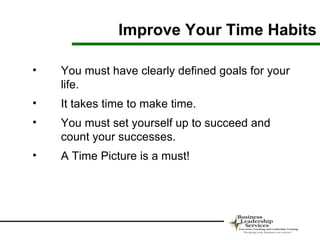
Improve Your Time Habits

•   You must have clearly defined goals for your
    life.
•   It takes time to make time.
•   You must set yourself up to succeed and
    count your successes.
•   A Time Picture is a must!
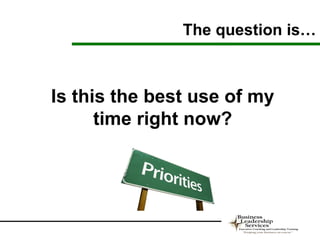
The question is…


Is this the best use of my
      time right now?
The Time Commitments
•   Know your system, (electronic and/or
    paper)
•   With You Always
•   2-3 Hours for Monthly Planning
•   Schedule Priorities First!
•   5-10 Minutes for Daily Planning
•   Prioritize Each Day
•   Track Your Progress
Monthly Planning

•   Schedule 2-3 Hours to Plan Upcoming
    Month
•   Prioritize Top Goals
•   Identify High Priority Activities
•   Complete Goal Planning Sheets
•   Set Up Tracking System
•   Schedule Priorities First!
Daily Planning

•   5-10 Minutes to Plan & Prioritize
•   Transfer Schedule from Monthly Planner to
    Daily Organizer Page
•   Review All Commitments for the Week
•   Organize Each Day
•   Prioritize Imperative/Important Lists
•   Close Out Each Day
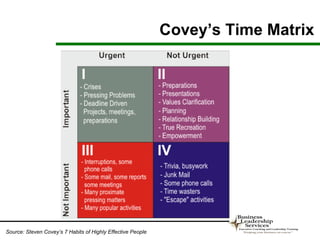
Covey’s Time Matrix


Source: Steven Covey’s 7 Habits of Highly Effective People
Identify Time Wasters

• Complete the Time-Wasters Exercise.

• What are your biggest time wasters? Who are
  your time thieves?

• How you can minimize the time wasters &
  manage the time thieves?
It’s all about Priorities!


•What are your High Priority Activities?

•In the eyes of my manager?

•In the eyes of the people I’m serving?
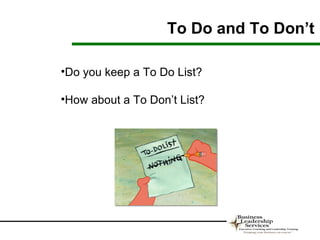
To Do and To Don’t

•Do you keep a To Do List?

•How about a To Don’t List?
Time Analysis

•   Make a commitment for the next 10 days.
•   Complete the Daily Time Analysis Questions
    at the end of each day.
•   Identify your 6 most productive and least
    productive activities during that timeframe.
•   Create your ideal Time Picture based on
    what you learn.
Key Ideas

•   Complete the Time Management Key Idea
    Action Plan (Page 3)
“Those who do not take time for relaxation are
    obliged sooner or later to find time for
          illness.” - John Wanamaker
Closing

      •Closing Thoughts

      •Questions?


“If you are not making the progress you would
   like to make and are capable of making, it is
     simply because your goals are not clearly
                    defined.”
                    - Paul J. Meyer
The “Time Management”
         Myth


            :
            Email:

Time Mgmt Myth

  • 1.
  • 3.
    “We say wewaste time, but that is impossible. We waste ourselves.” - Alice Bloch
  • 5.
    Improve Your TimeHabits Identify Your Time Thieves Prioritize What Matters Most
  • 6.
  • 7.
    The things thatare easy to do… Are also easy NOT to do!
  • 8.
    How to GetResults
  • 9.
  • 10.
  • 11.
    There’s Never AnyTime • Each of us has 168 hours per week. • If we work 50 hours, that leaves 118 hours each week. • If we sleep 8 hours each night, that leaves 62 hours each week. • 3 hours per day getting dressed, eating, driving – that leaves 41 hours per week. • What will you do with your extra 41 hours a week?
  • 12.
    Improve Your TimeHabits • You must have clearly defined goals for your life. • It takes time to make time. • You must set yourself up to succeed and count your successes. • A Time Picture is a must!
  • 13.
    The question is… Isthis the best use of my time right now?
  • 14.
    The Time Commitments • Know your system, (electronic and/or paper) • With You Always • 2-3 Hours for Monthly Planning • Schedule Priorities First! • 5-10 Minutes for Daily Planning • Prioritize Each Day • Track Your Progress
  • 15.
    Monthly Planning • Schedule 2-3 Hours to Plan Upcoming Month • Prioritize Top Goals • Identify High Priority Activities • Complete Goal Planning Sheets • Set Up Tracking System • Schedule Priorities First!
  • 16.
    Daily Planning • 5-10 Minutes to Plan & Prioritize • Transfer Schedule from Monthly Planner to Daily Organizer Page • Review All Commitments for the Week • Organize Each Day • Prioritize Imperative/Important Lists • Close Out Each Day
  • 17.
    Covey’s Time Matrix Source:Steven Covey’s 7 Habits of Highly Effective People
  • 18.
    Identify Time Wasters •Complete the Time-Wasters Exercise. • What are your biggest time wasters? Who are your time thieves? • How you can minimize the time wasters & manage the time thieves?
  • 19.
    It’s all aboutPriorities! •What are your High Priority Activities? •In the eyes of my manager? •In the eyes of the people I’m serving?
  • 20.
    To Do andTo Don’t •Do you keep a To Do List? •How about a To Don’t List?
  • 21.
    Time Analysis • Make a commitment for the next 10 days. • Complete the Daily Time Analysis Questions at the end of each day. • Identify your 6 most productive and least productive activities during that timeframe. • Create your ideal Time Picture based on what you learn.
  • 22.
    Key Ideas • Complete the Time Management Key Idea Action Plan (Page 3)
  • 23.
    “Those who donot take time for relaxation are obliged sooner or later to find time for illness.” - John Wanamaker
  • 24.
    Closing •Closing Thoughts •Questions? “If you are not making the progress you would like to make and are capable of making, it is simply because your goals are not clearly defined.” - Paul J. Meyer
  • 25.

Editor's Notes

  • #12 One of the things this program teaches is that time is finite … there’s no way we can hoard time or make more of it, and once time is gone, it’s gone forever. All of us have the same amount of time. Each of us is given 168 hours per week. Now, let’s say we work 50 hours per week. That leaves us 118 hours. And let’s say we get eight hours of sleep every night. That leaves 62 hours. If we spend three hours per day getting dressed, eating and driving to and from work, we’re still left with more than 40 hours per week. That means that each of us has enough free time every week to fill an average work week. So here is my question: What will you do with your extra week this week? Many people complain that they never have enough time to get everything done. The fact is that we all have more time available than we think we do. The difference lies in whether we know why we’re doing what we’re doing.
  • #13 Procrastination is a habit.