

FAHEEM AHMED 
III YEAR 
V.R. SIDDHARTHA ENGINEERING 
COLLEGE
WHAT’S IT ABOUT…? 
• Time Management refers to the development of 
processes and tools that increase efficiency and 
productivity. 
• Time Management refers to managing time 
effectively so that the right time is allocated to 
the right activity.
To Say Simply… 
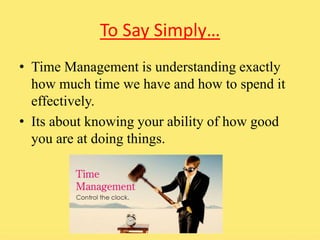
• Time Management is understanding exactly 
how much time we have and how to spend it 
effectively. 
• Its about knowing your ability of how good 
you are at doing things.
WHY PRACTICE 
TIME MANAGEMNENT..? 
To save time 
To reduce stress 
To function effectively 
To increase our work output 
To have more control over our job 
responsibilities.
DID YOU KNOW…? 
There are professionals who train you Time 
management, do you know how much they 
charge..??? 
Anywhere from 30,000 to 2,00,000 rupees. 
Yes its that EXPENSIVE…!!! 
No wonder Time is Money…!
CASE STUDY 
o Let’s take our college life. 
o Class works, Manuals, Records, Home 
Assignments and yeah the EXAMS…!!! 
o Do we have the time for doing these works..? 
Nooooooooooo……!!! Because we don’t have 
time.
EXCUSES 
Excuse 1 : There’s too much to do, I can’t 
handle it all. 
Excuse 2 : There’s plenty of time, I can do 
that later. 
Excuse 3 : This little task is not important.
CRISIS 
MANAGEMENT 
• When we decide to do all the works at a time 
by skipping classes, lectures and lunch because 
we postponed our works. 
• Recollect the amount of stress you go through.. 
Time management lets you be 
STRESS FREE…!
THEORIES 
a) ABC analysis 
b) Pareto analysis 
c) The Eisenhower Method 
d) Domino Reaction method 
e) POSEC method
ABC ANALYSIS 
Activities are ranked by these general criteria: 
A – Tasks that are perceived as being urgent and 
important 
B – Tasks that are important but not urgent, 
C – Tasks that are neither urgent nor important.
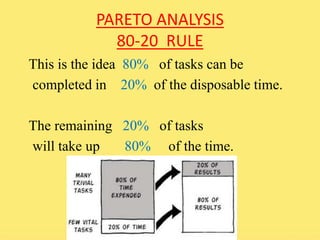
PARETO ANALYSIS 
80-20 RULE 
This is the idea 80% of tasks can be 
completed in 20% of the disposable time. 
The remaining 20% of tasks 
will take up 80% of the time.
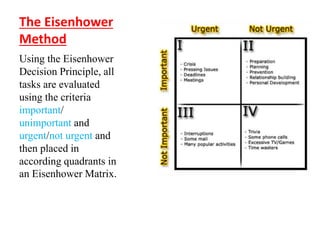
The Eisenhower 
Method 
Using the Eisenhower 
Decision Principle, all 
tasks are evaluated 
using the criteria 
important/ 
unimportant and 
urgent/not urgent and 
then placed in 
according quadrants in 
an Eisenhower Matrix.
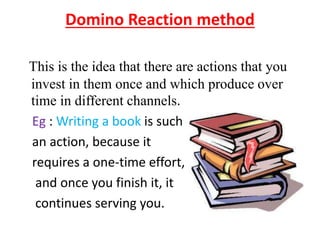
Domino Reaction method 
This is the idea that there are actions that you 
invest in them once and which produce over 
time in different channels. 
Eg : Writing a book is such 
an action, because it 
requires a one-time effort, 
and once you finish it, it 
continues serving you.
POSEC 
• POSEC is an acronym for Prioritize by 
Organizing, Streamlining, Economizing and 
Contributing. 
• It suggests that by attending to one's personal 
responsibilities first, an individual is better 
positioned to shoulder collective 
responsibilities.
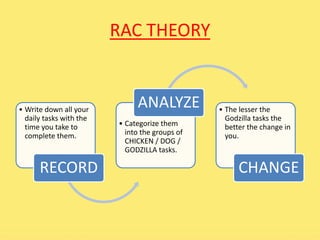
RAC THEORY 
• Write down all your 
daily tasks with the 
time you take to 
complete them. 
RECORD 
ANALYZE • The lesser the 
• Categorize them 
into the groups of 
CHICKEN / DOG / 
GODZILLA tasks. 
Godzilla tasks the 
better the change in 
you. 
CHANGE
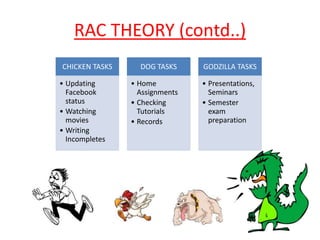
RAC THEORY (contd..) 
CHICKEN TASKS 
• Updating 
Facebook 
status 
• Watching 
movies 
• Writing 
Incompletes 
DOG TASKS 
• Home 
Assignments 
• Checking 
Tutorials 
• Records 
GODZILLA TASKS 
• Presentations, 
Seminars 
• Semester 
exam 
preparation
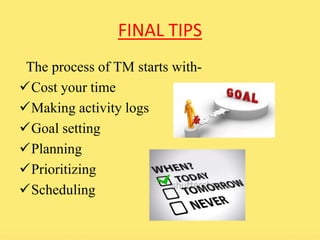
FINAL TIPS 
The process of TM starts with- 
Cost your time 
Making activity logs 
Goal setting 
Planning 
Prioritizing 
Scheduling
SUCCESS FORMULA 
 Make progress by 
continually adapting and 
evolving. 
 Recognize that 
the success formula 
is a continuous process.
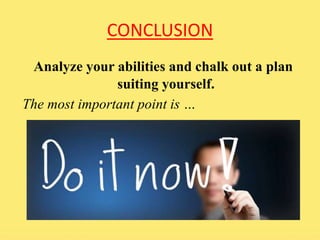
CONCLUSION 
Analyze your abilities and chalk out a plan 
suiting yourself. 
The most important point is …
TIME MANAGEMENT

TIME MANAGEMENT

  • 1.
    FAHEEM AHMED IIIYEAR V.R. SIDDHARTHA ENGINEERING COLLEGE
  • 2.
    WHAT’S IT ABOUT…? • Time Management refers to the development of processes and tools that increase efficiency and productivity. • Time Management refers to managing time effectively so that the right time is allocated to the right activity.
  • 3.
    To Say Simply… • Time Management is understanding exactly how much time we have and how to spend it effectively. • Its about knowing your ability of how good you are at doing things.
  • 4.
    WHY PRACTICE TIMEMANAGEMNENT..? To save time To reduce stress To function effectively To increase our work output To have more control over our job responsibilities.
  • 5.
    DID YOU KNOW…? There are professionals who train you Time management, do you know how much they charge..??? Anywhere from 30,000 to 2,00,000 rupees. Yes its that EXPENSIVE…!!! No wonder Time is Money…!
  • 6.
    CASE STUDY oLet’s take our college life. o Class works, Manuals, Records, Home Assignments and yeah the EXAMS…!!! o Do we have the time for doing these works..? Nooooooooooo……!!! Because we don’t have time.
  • 7.
    EXCUSES Excuse 1: There’s too much to do, I can’t handle it all. Excuse 2 : There’s plenty of time, I can do that later. Excuse 3 : This little task is not important.
  • 8.
    CRISIS MANAGEMENT •When we decide to do all the works at a time by skipping classes, lectures and lunch because we postponed our works. • Recollect the amount of stress you go through.. Time management lets you be STRESS FREE…!
  • 9.
    THEORIES a) ABCanalysis b) Pareto analysis c) The Eisenhower Method d) Domino Reaction method e) POSEC method
  • 10.
    ABC ANALYSIS Activitiesare ranked by these general criteria: A – Tasks that are perceived as being urgent and important B – Tasks that are important but not urgent, C – Tasks that are neither urgent nor important.
  • 11.
    PARETO ANALYSIS 80-20RULE This is the idea 80% of tasks can be completed in 20% of the disposable time. The remaining 20% of tasks will take up 80% of the time.
  • 12.
    The Eisenhower Method Using the Eisenhower Decision Principle, all tasks are evaluated using the criteria important/ unimportant and urgent/not urgent and then placed in according quadrants in an Eisenhower Matrix.
  • 13.
    Domino Reaction method This is the idea that there are actions that you invest in them once and which produce over time in different channels. Eg : Writing a book is such an action, because it requires a one-time effort, and once you finish it, it continues serving you.
  • 14.
    POSEC • POSECis an acronym for Prioritize by Organizing, Streamlining, Economizing and Contributing. • It suggests that by attending to one's personal responsibilities first, an individual is better positioned to shoulder collective responsibilities.
  • 15.
    RAC THEORY •Write down all your daily tasks with the time you take to complete them. RECORD ANALYZE • The lesser the • Categorize them into the groups of CHICKEN / DOG / GODZILLA tasks. Godzilla tasks the better the change in you. CHANGE
  • 16.
    RAC THEORY (contd..) CHICKEN TASKS • Updating Facebook status • Watching movies • Writing Incompletes DOG TASKS • Home Assignments • Checking Tutorials • Records GODZILLA TASKS • Presentations, Seminars • Semester exam preparation
  • 17.
    FINAL TIPS Theprocess of TM starts with- Cost your time Making activity logs Goal setting Planning Prioritizing Scheduling
  • 18.
    SUCCESS FORMULA Make progress by continually adapting and evolving.  Recognize that the success formula is a continuous process.
  • 19.
    CONCLUSION Analyze yourabilities and chalk out a plan suiting yourself. The most important point is …