
Time Management Workshop
   Prepared by Karen Calhoun
 for the ULS Leadership Program
          12 June 2012
Credits
  • Patti Hathaway – 1993 workshop
  • Stephen Covey and Charlie Whiting –
    1996 First Things First workshop
  • SkillPath workshop – Managing Multiple
    Projects, Objectives, Deadlines – 1998?
  • All the colleagues who have helped me
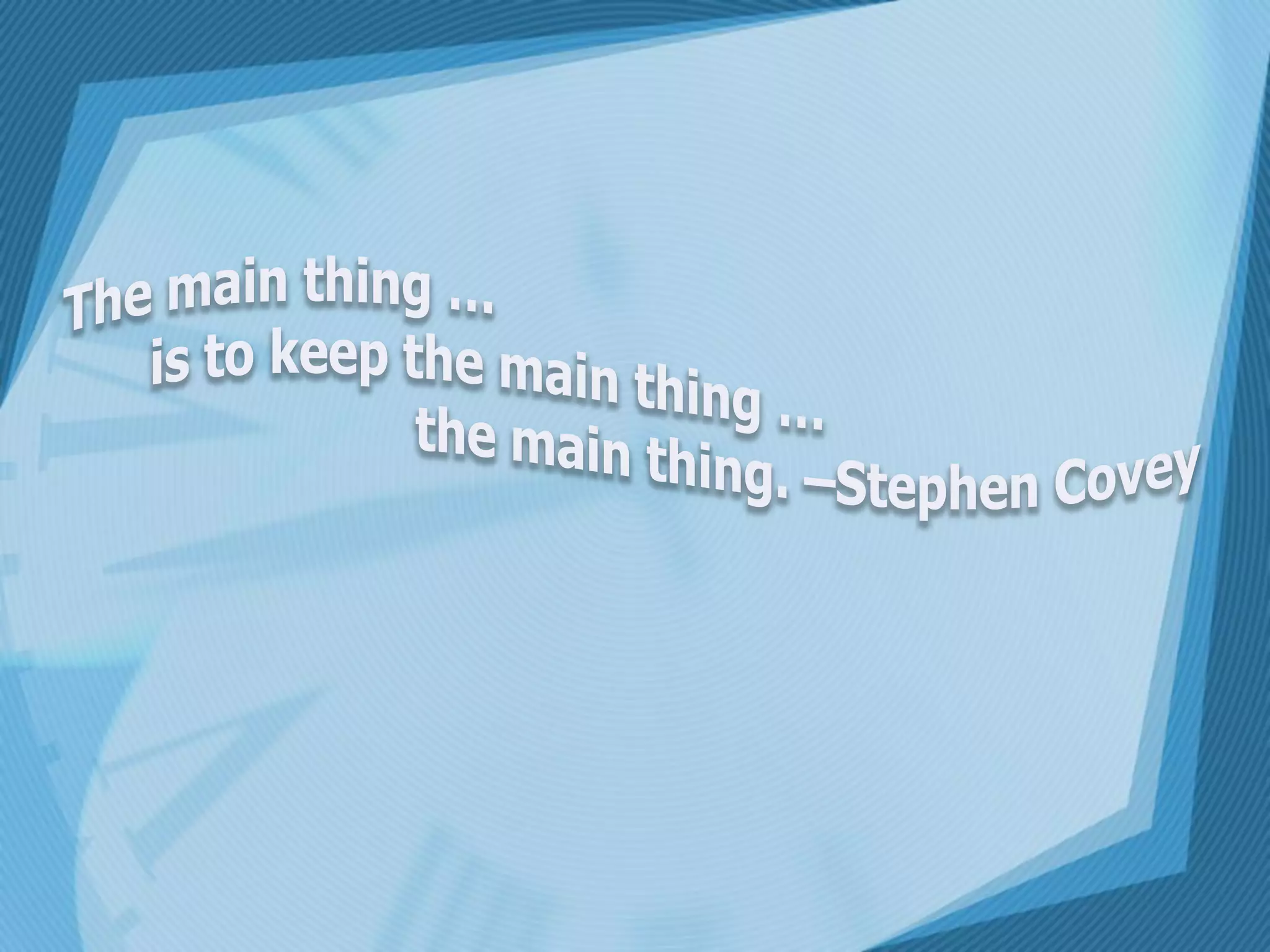
    try to “keep the main thing the main
    thing”
Illustration John Tenniel, Alice in Wonderland. Public domain.
Learning Objectives
    • Understand your own time
      management habits
    • Identify what you want to change
    • Assess what controls your time
    • Explore the links between values
      and how you manage your time
    • Add some tips and tricks to your
      personal tool kit
Write your name with the hand you usually use


________________________________________


Write your name with the other hand


________________________________________

 CHANGING OLD HABITS IS HARD AND
 FEELS WEIRD
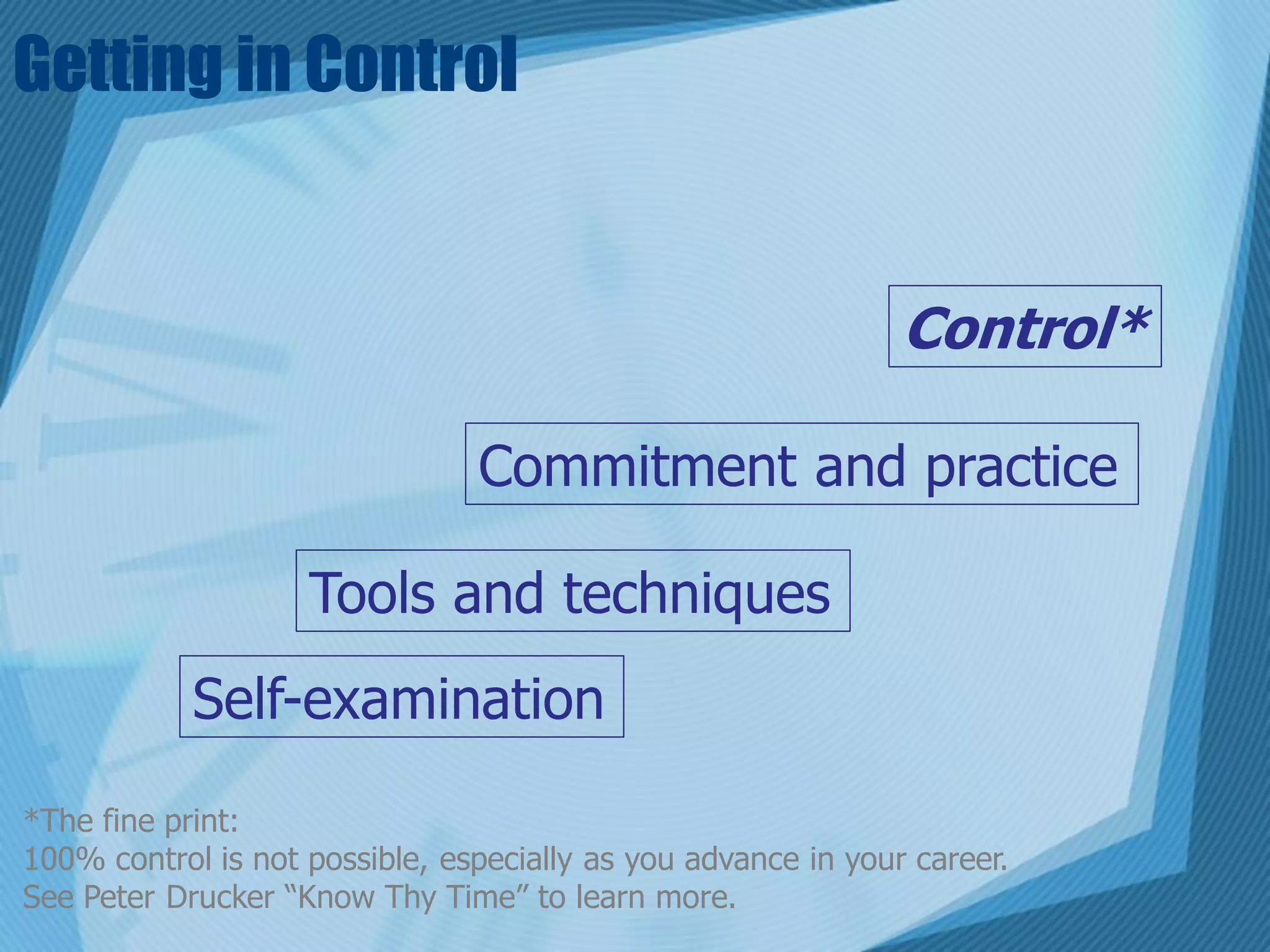
Getting in Control


                                                               Control*

                                Commitment and practice

                    Tools and techniques
            Self-examination

*The fine print:
100% control is not possible, especially as you advance in your career.
See Peter Drucker “Know Thy Time” to learn more.
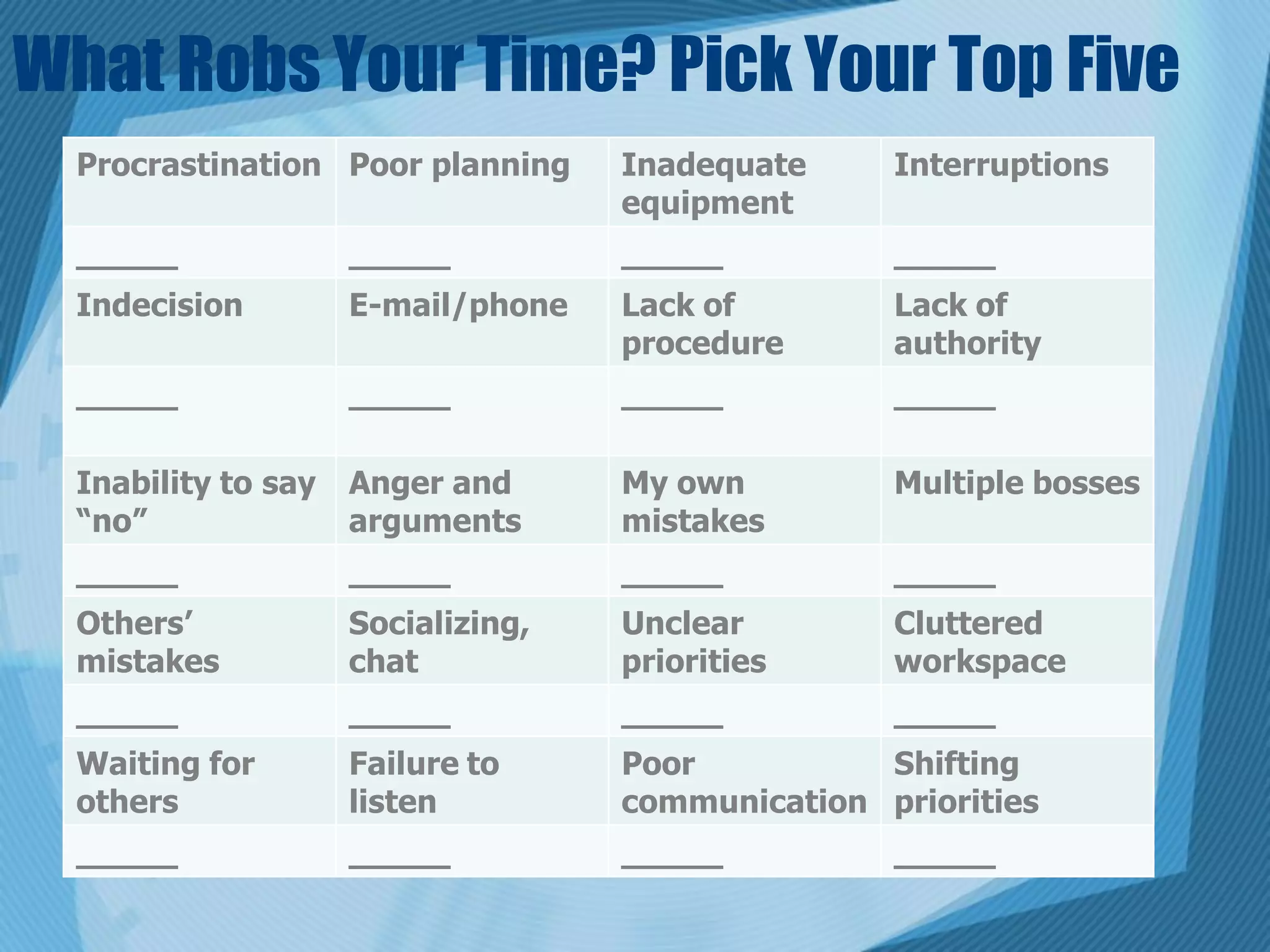
What Robs Your Time? Pick Your Top Five
  Procrastination Poor planning     Inadequate     Interruptions
                                    equipment
  _____              _____          _____          _____
  Indecision         E-mail/phone   Lack of        Lack of
                                    procedure      authority
  _____              _____          _____          _____

  Inability to say   Anger and      My own         Multiple bosses
  “no”               arguments      mistakes
  _____              _____          _____          _____
  Others’            Socializing,   Unclear        Cluttered
  mistakes           chat           priorities     workspace
  _____              _____          _____          _____
  Waiting for        Failure to     Poor          Shifting
  others             listen         communication priorities
  _____              _____          _____          _____
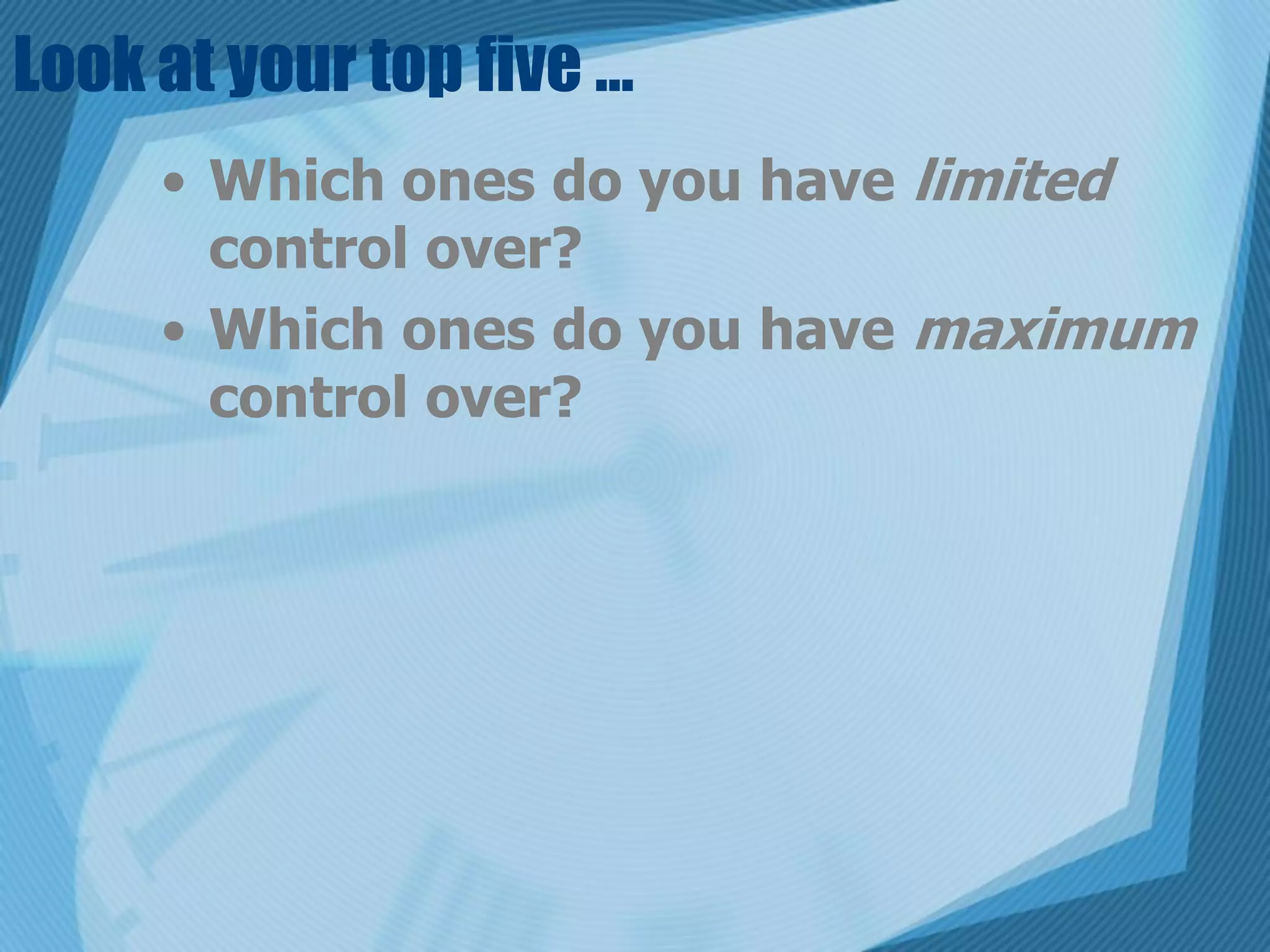
Look at your top five …
     • Which ones do you have limited
       control over?
     • Which ones do you have maximum
       control over?
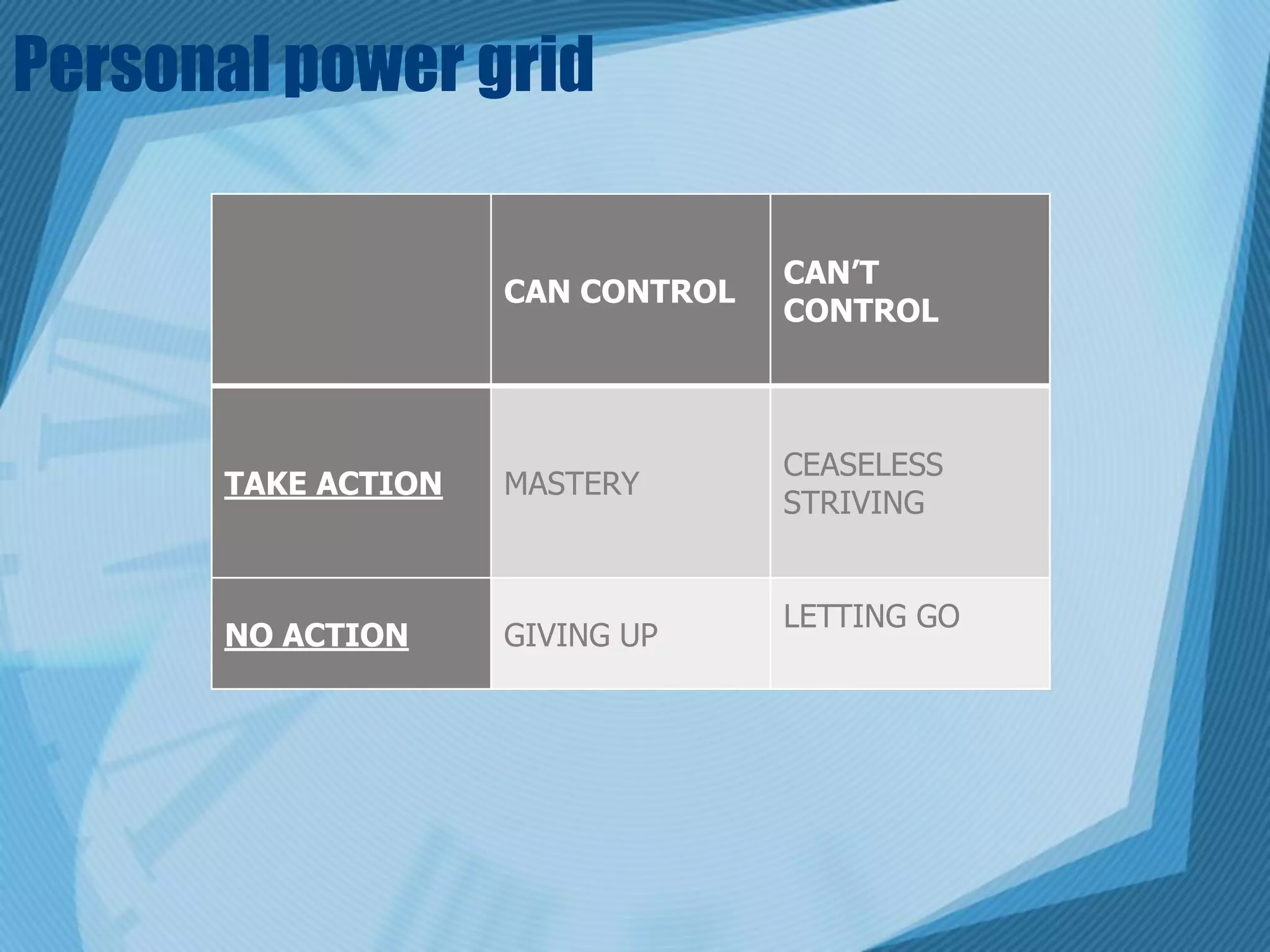
Personal power grid

                                  CAN’T
                    CAN CONTROL
                                  CONTROL


                                  CEASELESS
      TAKE ACTION   MASTERY
                                  STRIVING


                                  LETTING GO
      NO ACTION     GIVING UP
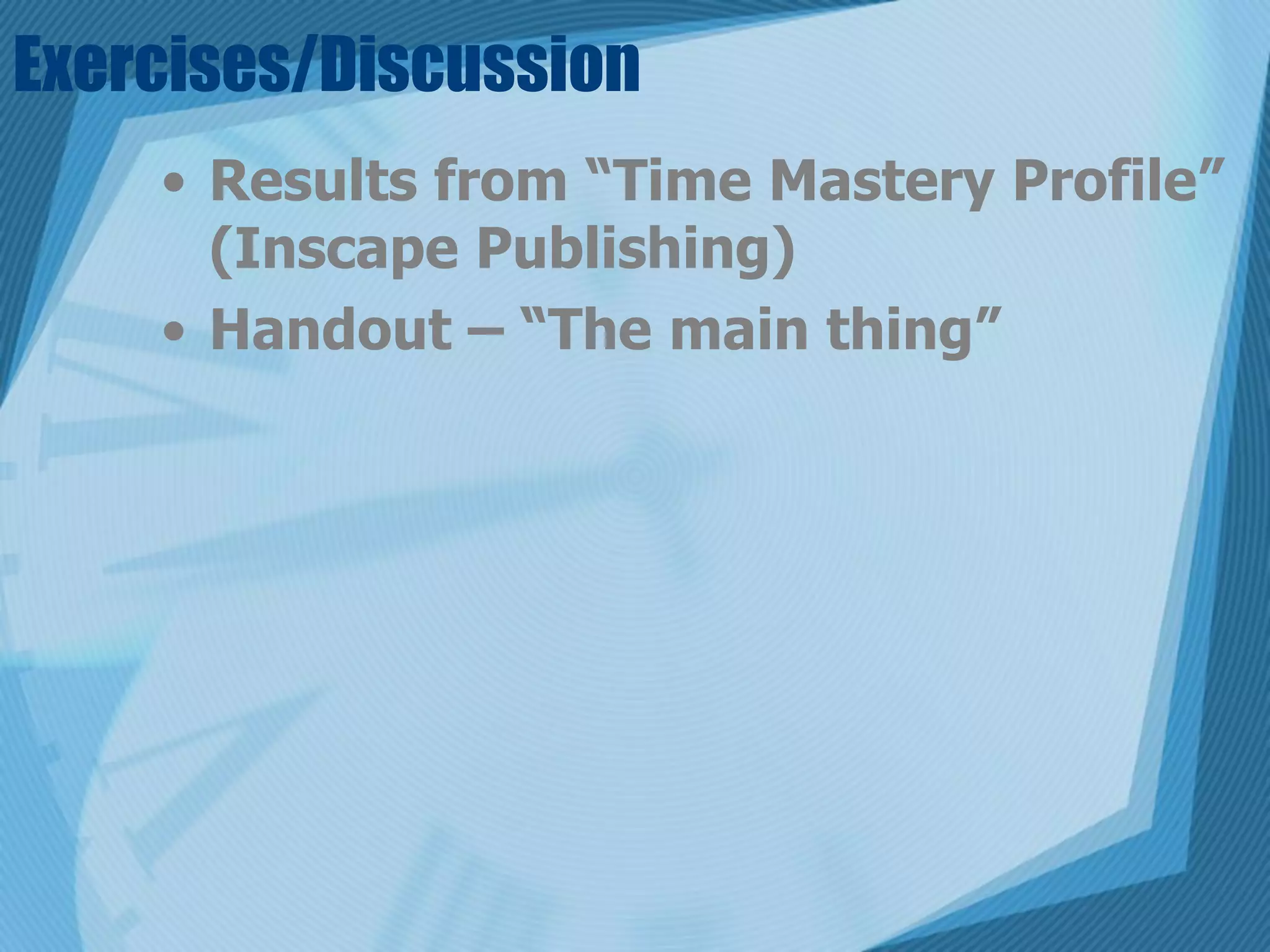
Exercises/Discussion
    • Results from “Time Mastery Profile”
      (Inscape Publishing)
    • Handout – “The main thing”
Action Plan Part One
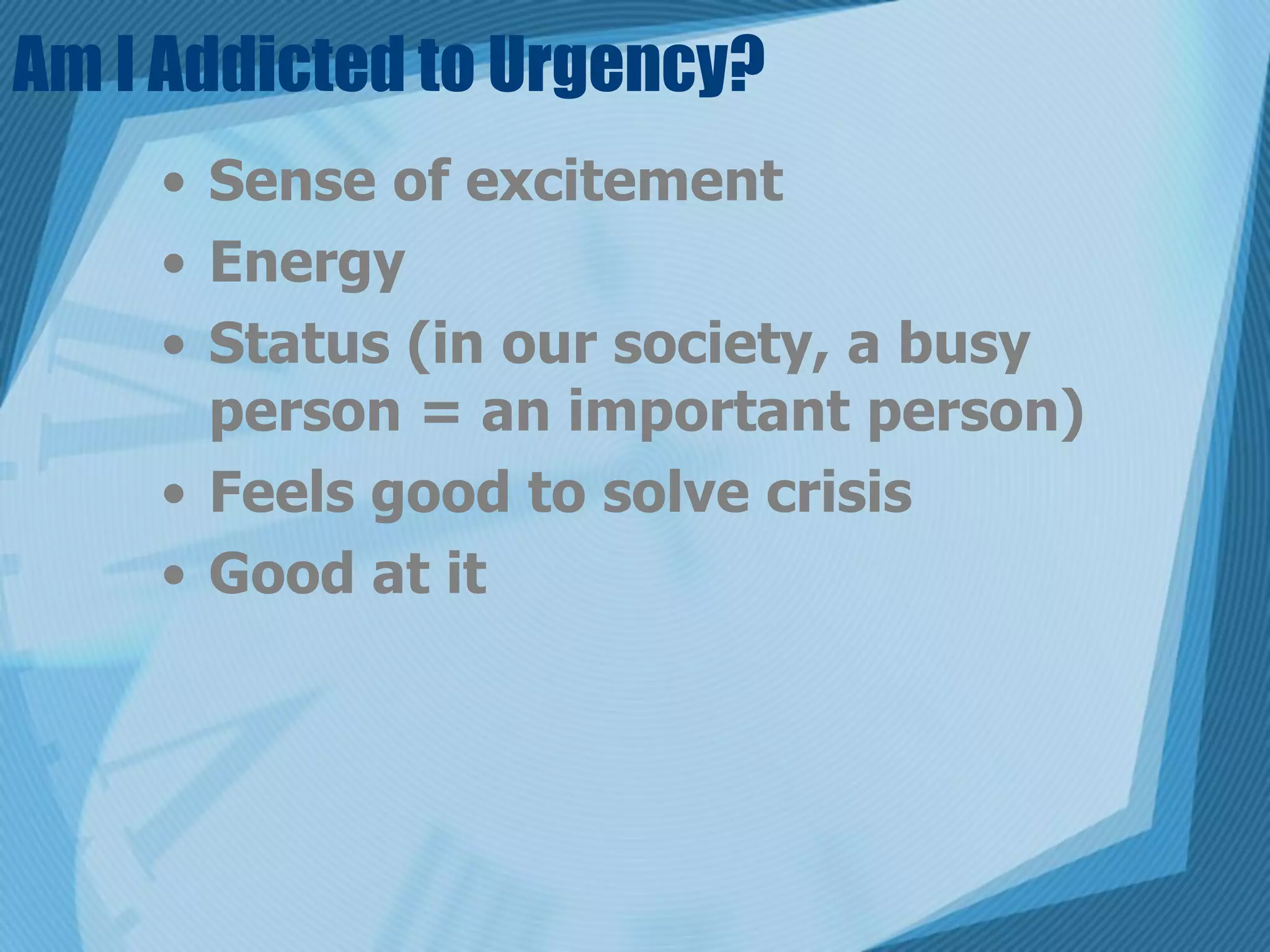
Am I Addicted to Urgency?
    • Sense of excitement
    • Energy
    • Status (in our society, a busy
      person = an important person)
    • Feels good to solve crisis
    • Good at it
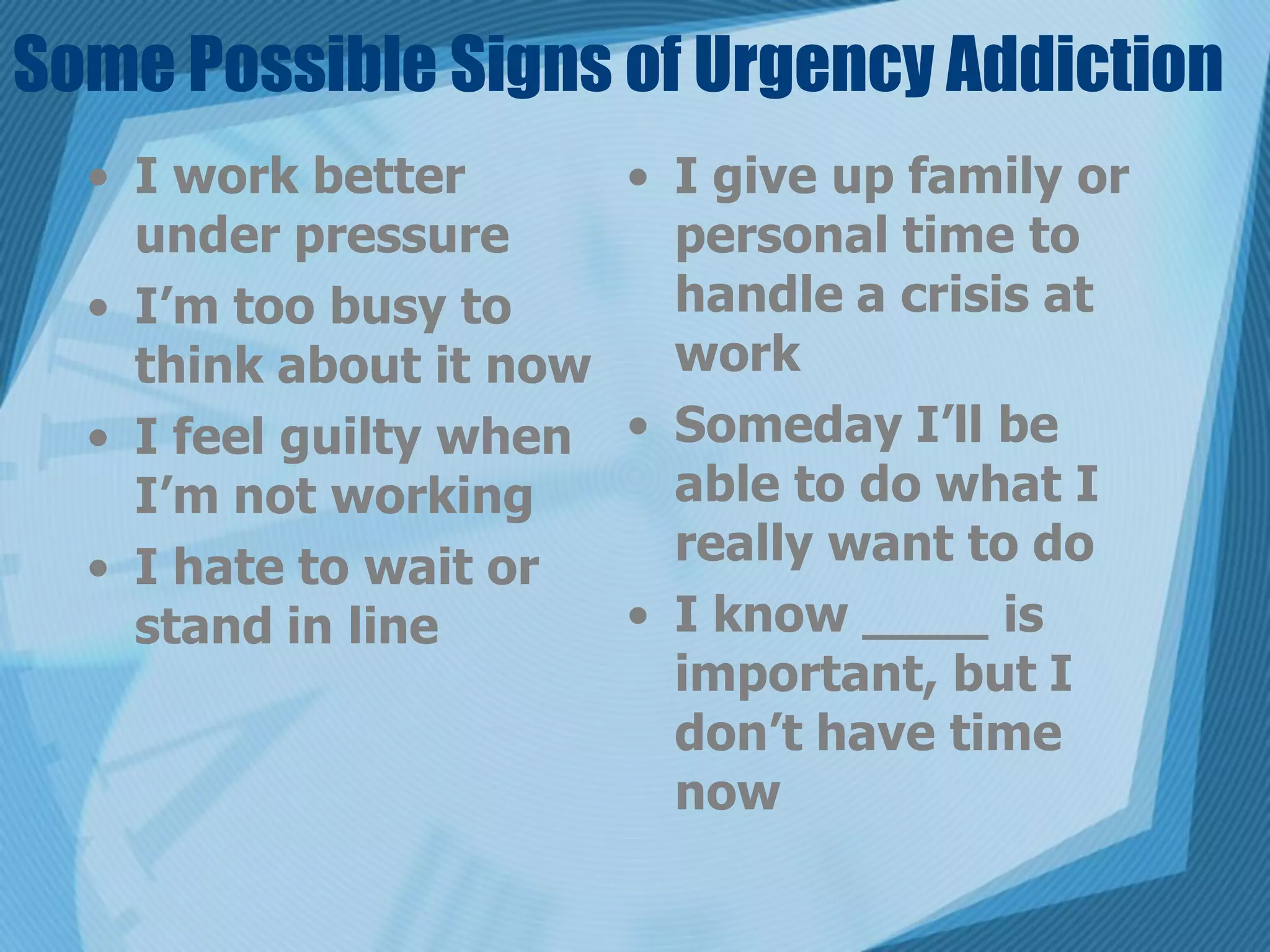
Some Possible Signs of Urgency Addiction
  • I work better      • I give up family or
    under pressure       personal time to
  • I’m too busy to      handle a crisis at
    think about it now   work
  • I feel guilty when • Someday I’ll be
    I’m not working      able to do what I
  • I hate to wait or    really want to do
    stand in line      • I know ____ is
                         important, but I
                         don’t have time
                         now
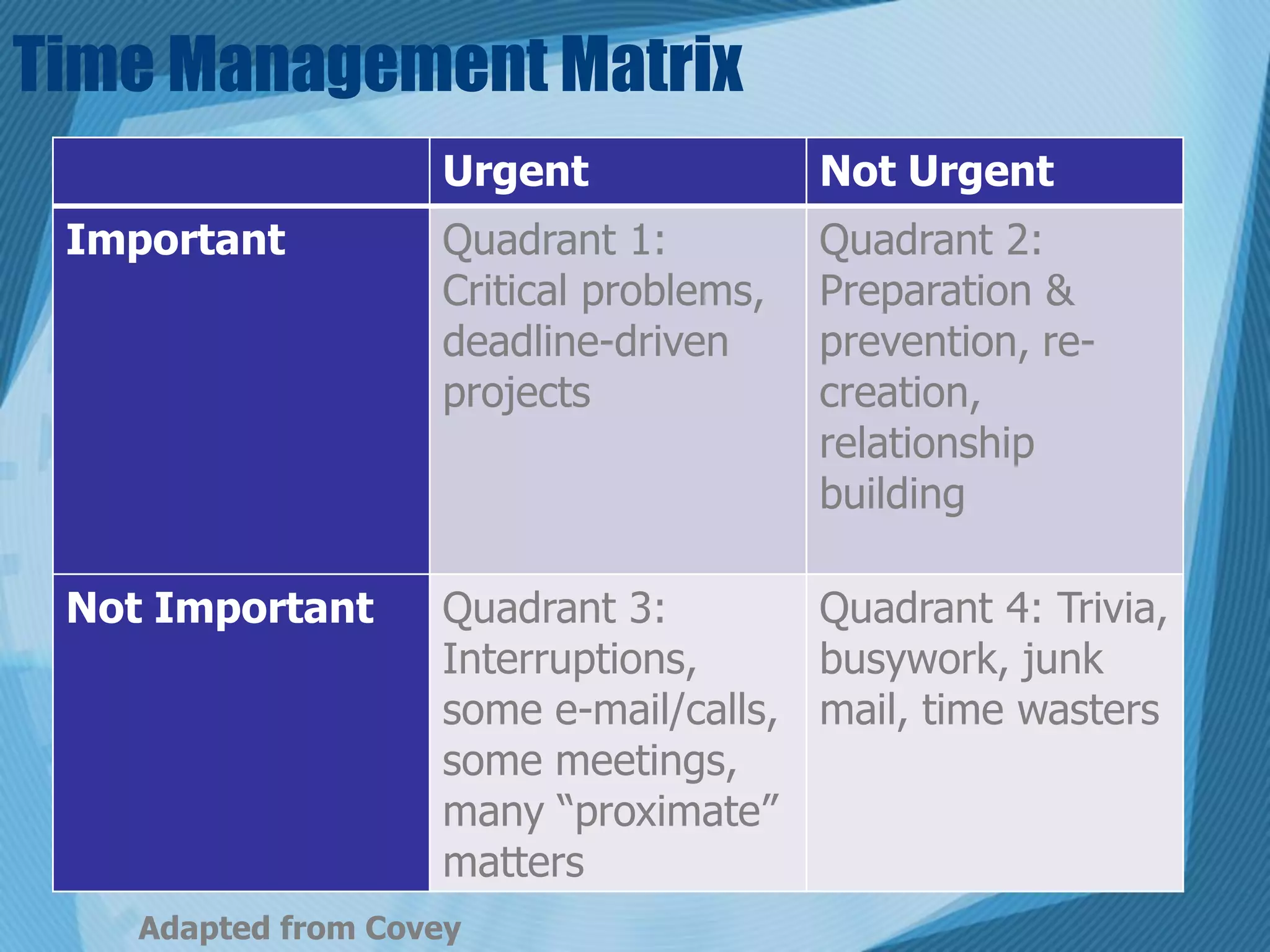
Time Management Matrix
                    Urgent               Not Urgent
 Important          Quadrant 1:          Quadrant 2:
                    Critical problems,   Preparation &
                    deadline-driven      prevention, re-
                    projects             creation,
                                         relationship
                                         building

 Not Important      Quadrant 3:        Quadrant 4: Trivia,
                    Interruptions,     busywork, junk
                    some e-mail/calls, mail, time wasters
                    some meetings,
                    many “proximate”
                    matters
    Adapted from Covey
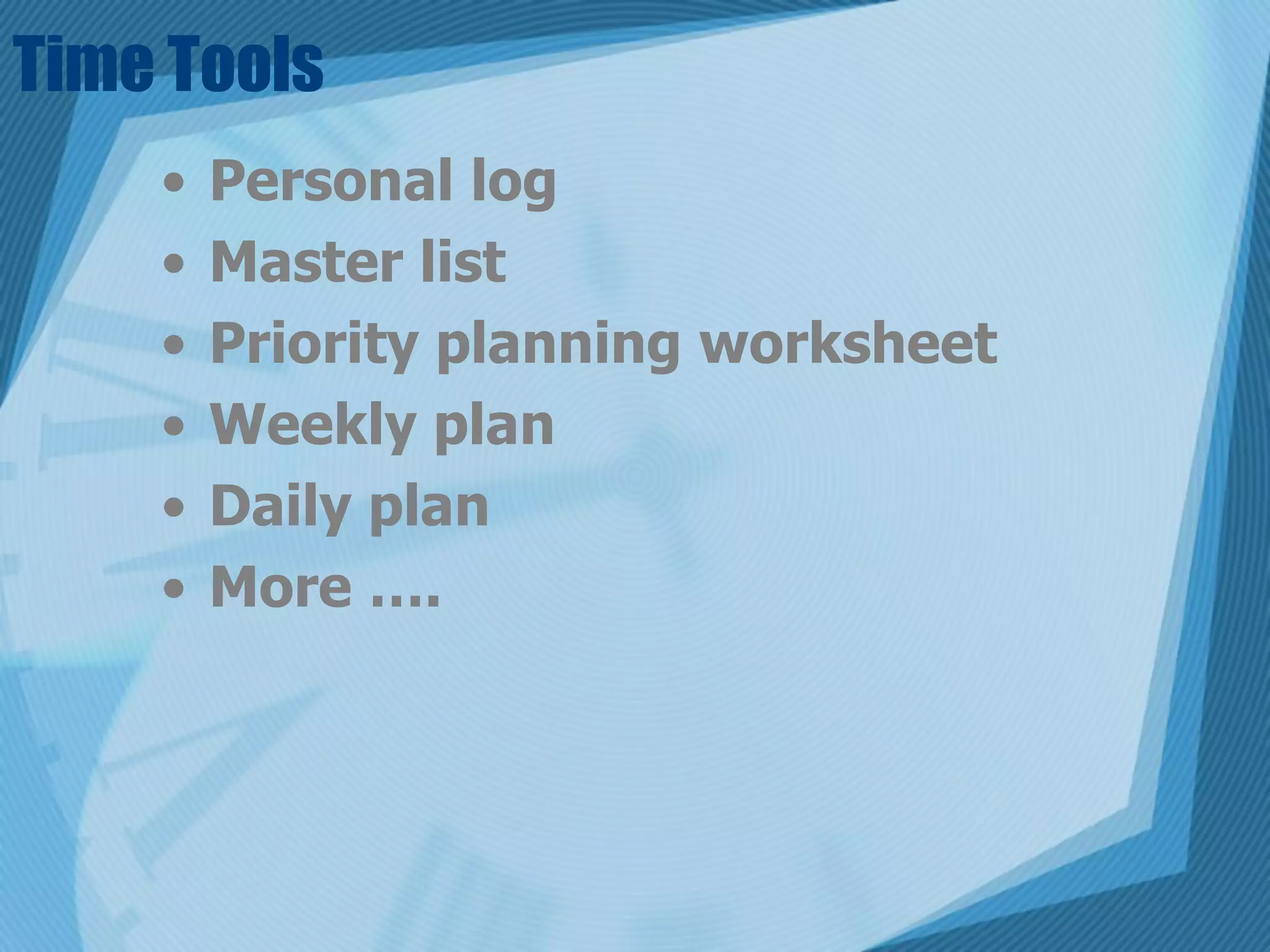
Time Tools
    •   Personal log
    •   Master list
    •   Priority planning worksheet
    •   Weekly plan
    •   Daily plan
    •   More ….
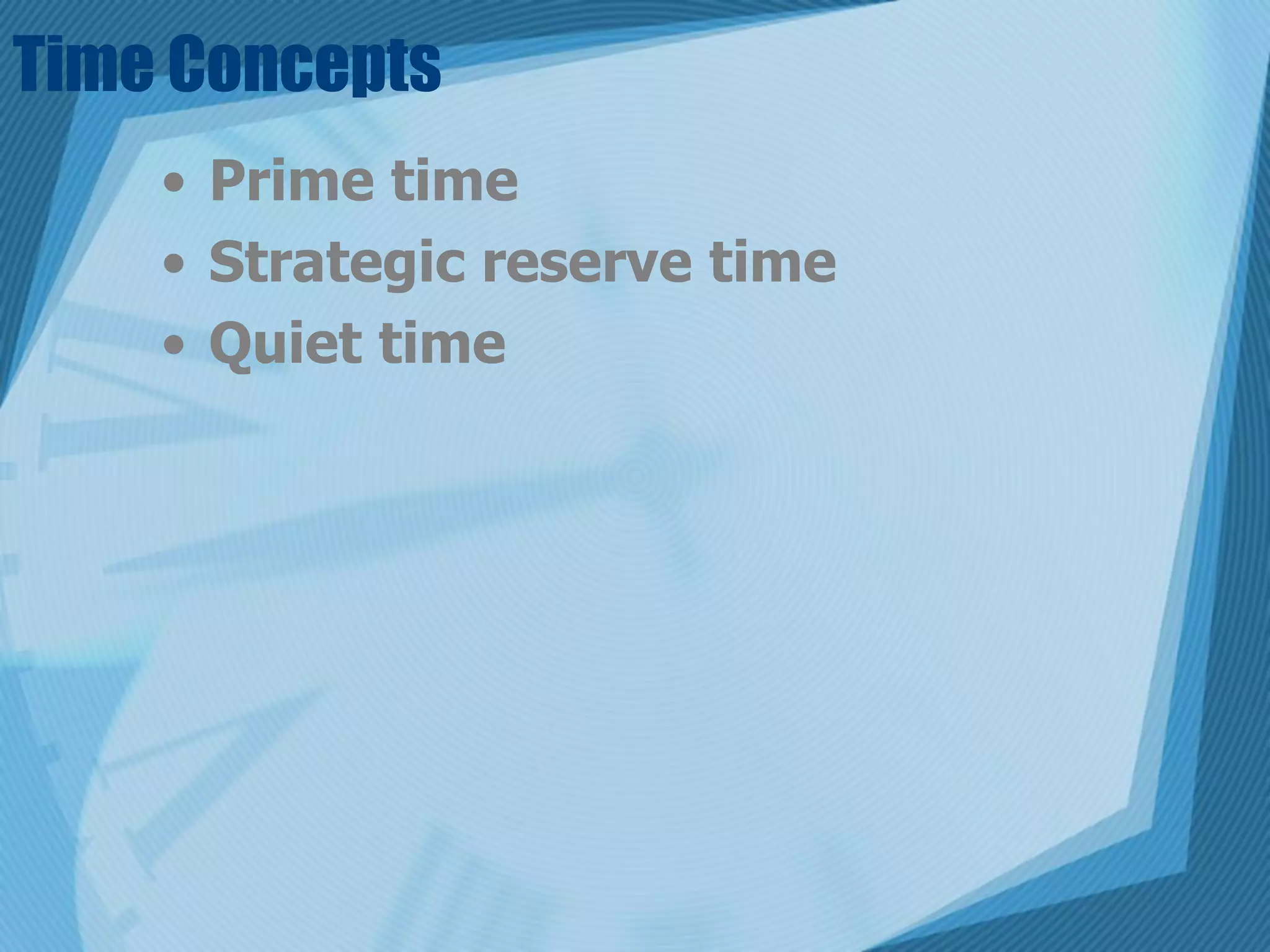
Time Concepts
    • Prime time
    • Strategic reserve time
    • Quiet time
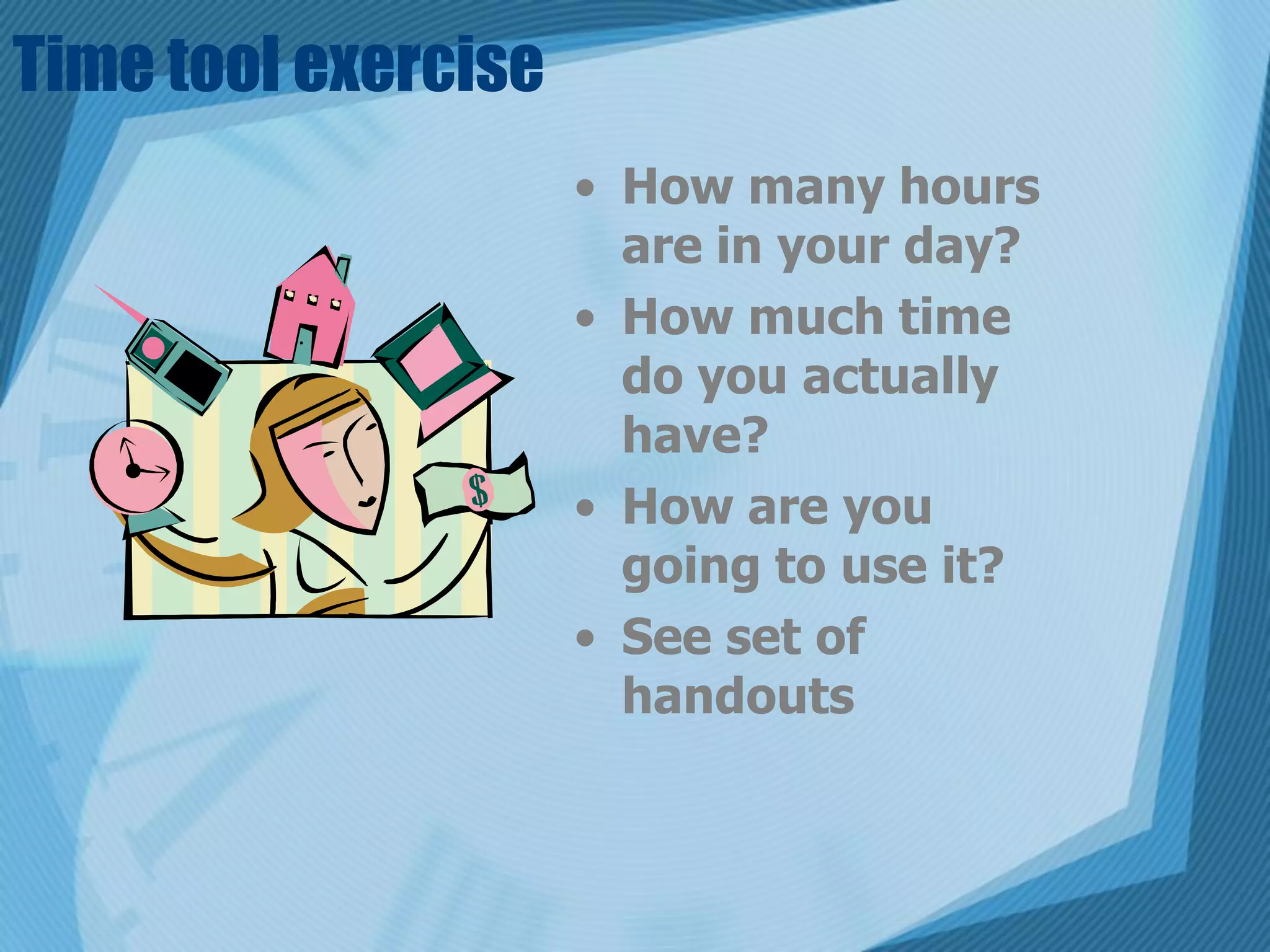
Time tool exercise
                     • How many hours
                       are in your day?
                     • How much time
                       do you actually
                       have?
                     • How are you
                       going to use it?
                     • See set of
                       handouts
An Unexpected Way of Paring Down a Task List: A
Tip from Laurie Ford (laurieford.com)*
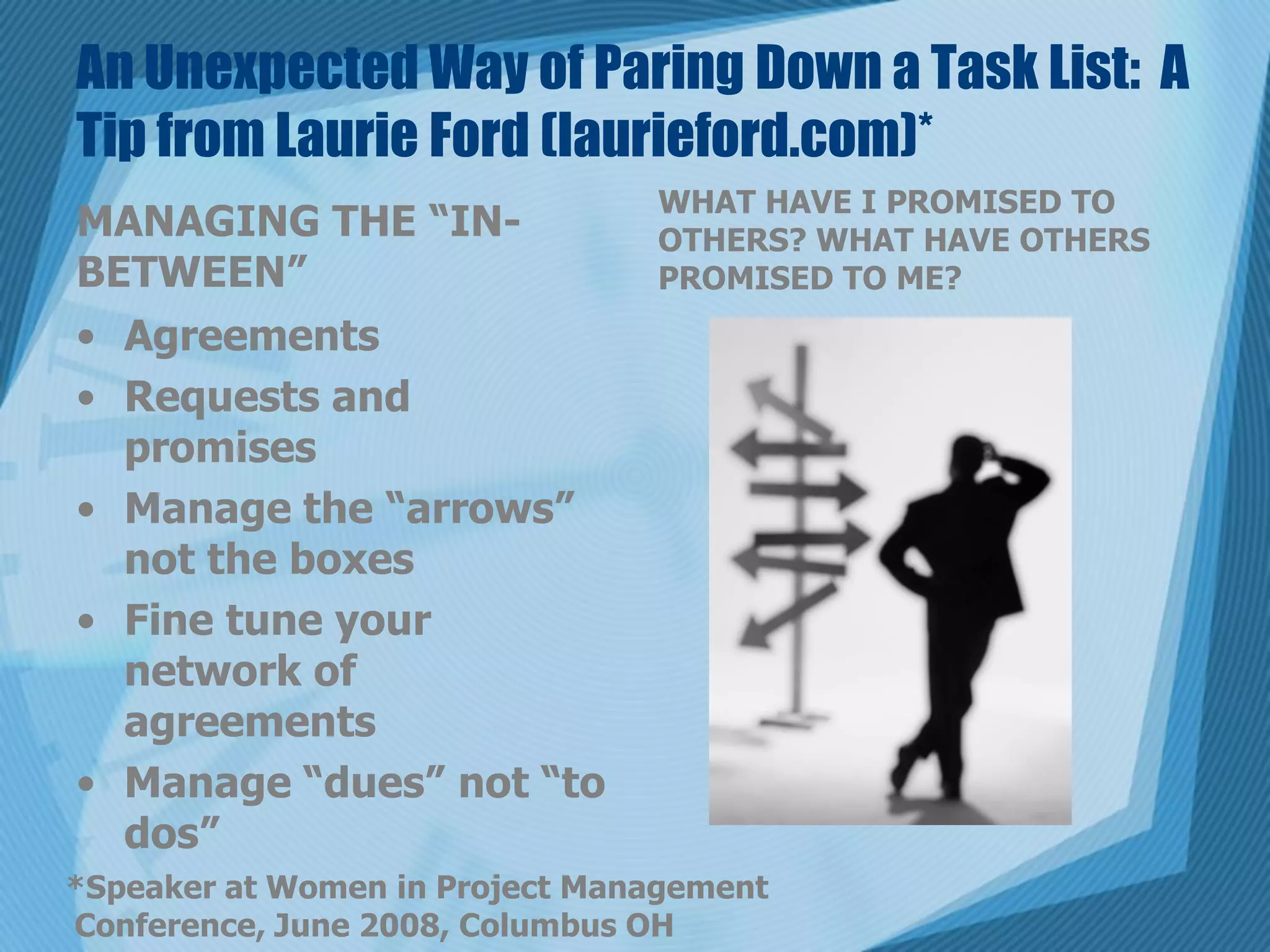
                                WHAT HAVE I PROMISED TO
MANAGING THE “IN-               OTHERS? WHAT HAVE OTHERS
BETWEEN”                        PROMISED TO ME?
• Agreements
• Requests and
  promises
• Manage the “arrows”
  not the boxes
• Fine tune your
  network of
  agreements
• Manage “dues” not “to
  dos”
*Speaker at Women in Project Management
Conference, June 2008, Columbus OH
Why Do We Procrastinate?
  • Forget
  • Don’t know how
  • Don’t have means
    – Lack of resources
    – Too complicated
    – Prospect of conflict
  • Attitude
    – Unpleasant
    – Outside my comfort zone
    – Fear of making mistakes
    – Sidetracked
A Dozen Ideas for Dealing with Procrastination
     • Deal with tough         • Schedule it; set aside
       issues during your        time, make a
       prime time                deadline
     • Start small but start   • Seek help
     • Write yourself a        • Let go (delegate)
       reminder                • Fight perfectionism
     • Reward yourself (I’ll   • Listen to your self-
       take a break after …)     talk (yes you can!)
     • Keep a master list      • JUST DO IT
     • Go somewhere else
       to do it
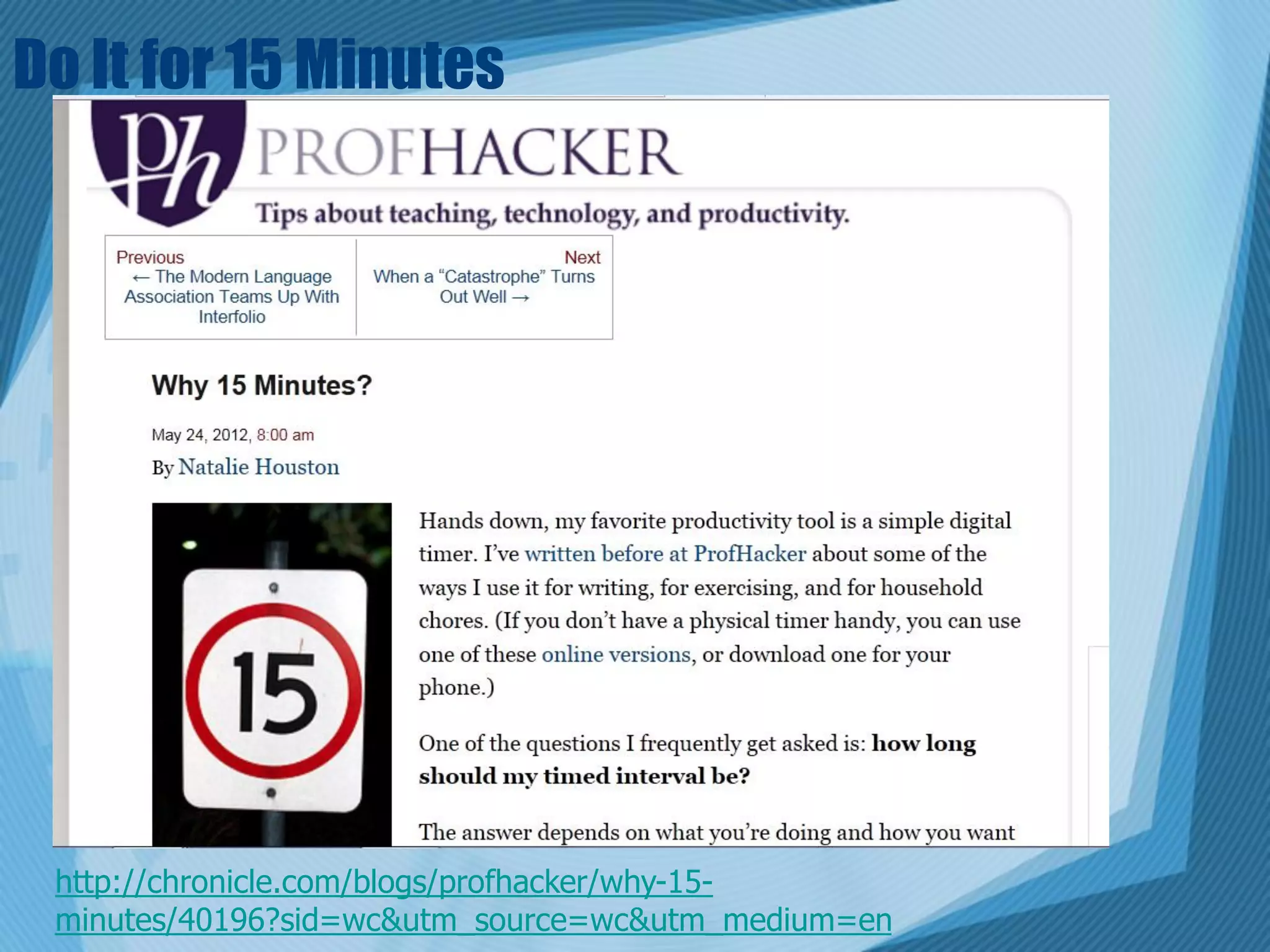
Do It for 15 Minutes


 http://chronicle.com/blogs/profhacker/why-15-
 minutes/40196?sid=wc&utm_source=wc&utm_medium=en
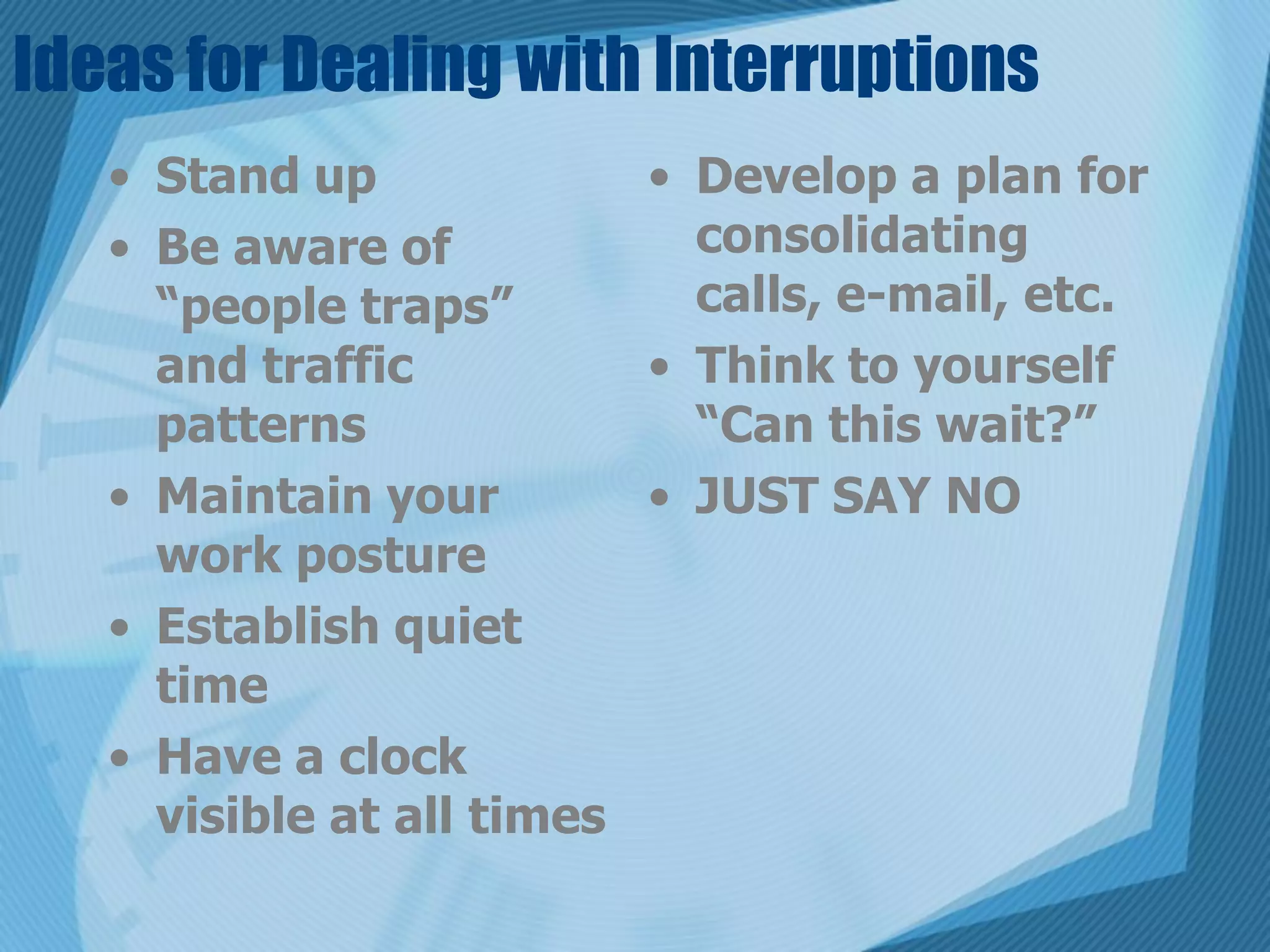
Ideas for Dealing with Interruptions
   • Stand up             • Develop a plan for
   • Be aware of            consolidating
     “people traps”         calls, e-mail, etc.
     and traffic          • Think to yourself
     patterns               “Can this wait?”
   • Maintain your        • JUST SAY NO
     work posture
   • Establish quiet
     time
   • Have a clock
     visible at all times
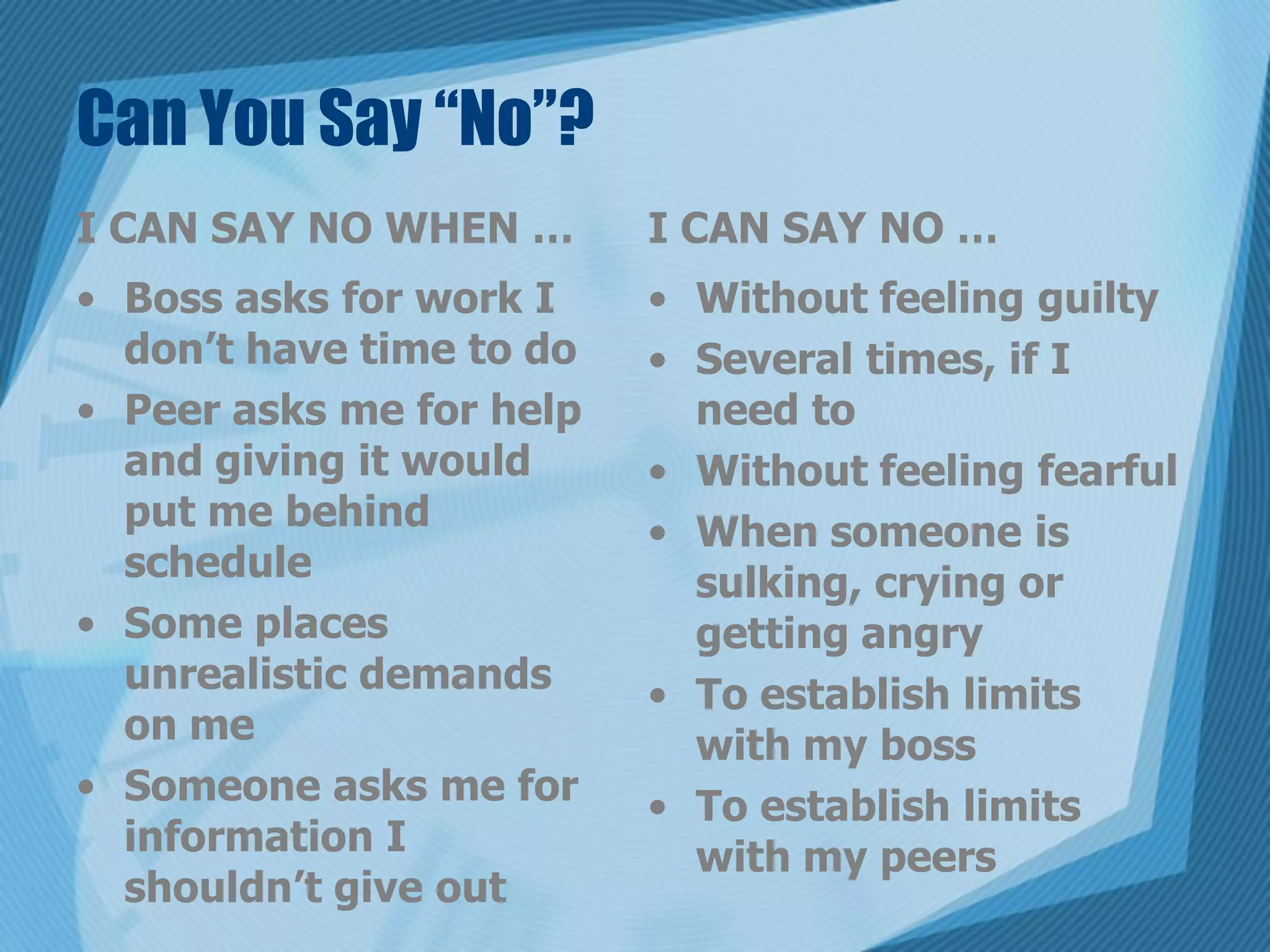
Can You Say “No”?
I CAN SAY NO WHEN …       I CAN SAY NO …
• Boss asks for work I    • Without feeling guilty
  don’t have time to do   • Several times, if I
• Peer asks me for help     need to
  and giving it would     • Without feeling fearful
  put me behind           • When someone is
  schedule                  sulking, crying or
• Some places               getting angry
  unrealistic demands     • To establish limits
  on me                     with my boss
• Someone asks me for     • To establish limits
  information I             with my peers
  shouldn’t give out
Tips for Saying “No”
  • Evaluate the request against your goals/plan
  • Ask for clarification (be sure you understand
    the request)
  • Say ‘no’ if appropriate
     – Boss: “Yes, provided someone else can…
       provided there is opportunity for …”
     – All others: “My problem is…” or USA = “I
       Understand … here is my Situation … let’s
       [Action]”
  • Give options if possible
  • Say it again, calmly (broken record)
  • Don’t give up, don’t lose your temper
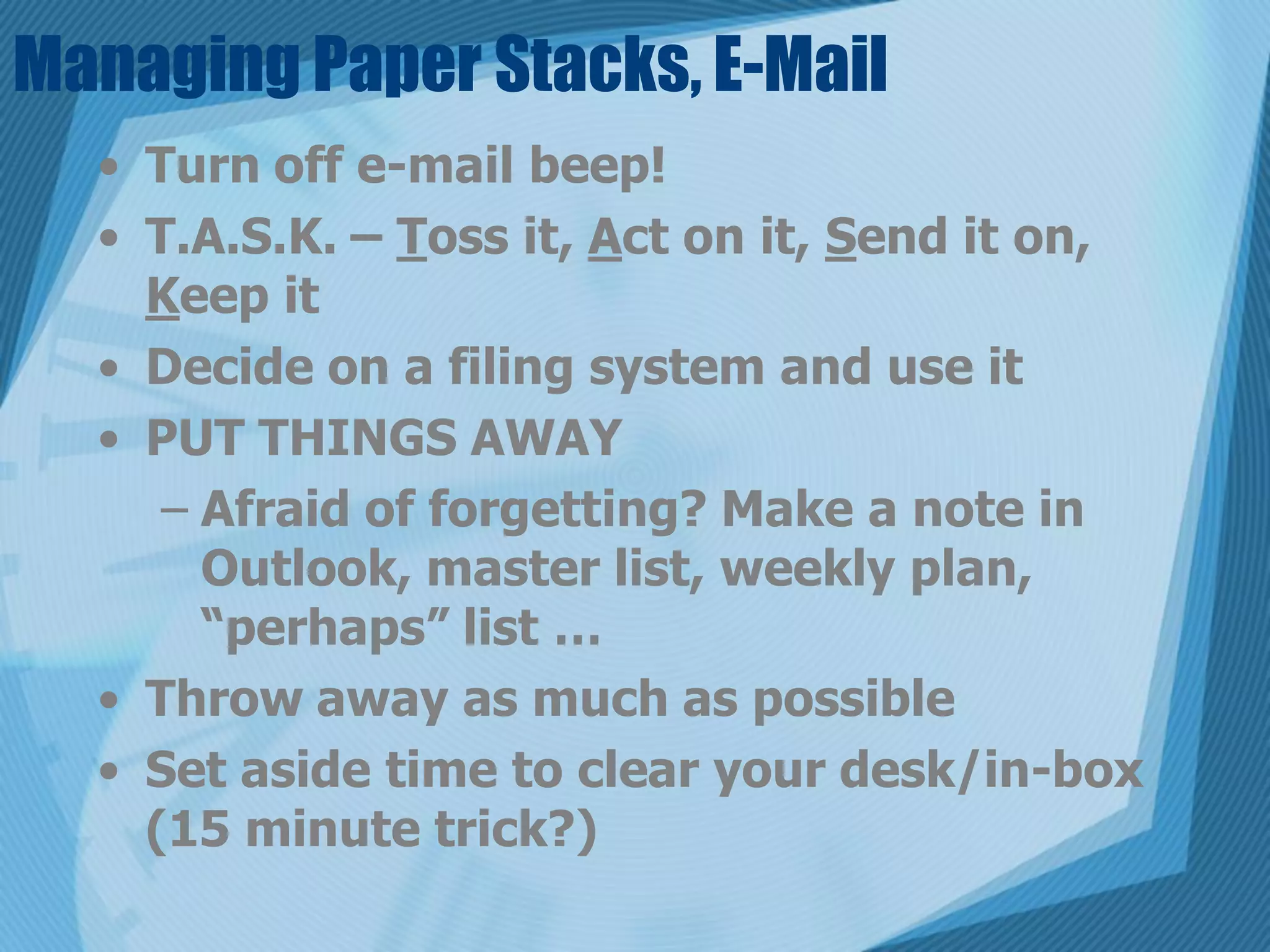
Managing Paper Stacks, E-Mail
  • Turn off e-mail beep!
  • T.A.S.K. – Toss it, Act on it, Send it on,
    Keep it
  • Decide on a filing system and use it
  • PUT THINGS AWAY
     – Afraid of forgetting? Make a note in
       Outlook, master list, weekly plan,
       “perhaps” list …
  • Throw away as much as possible
  • Set aside time to clear your desk/in-box
    (15 minute trick?)
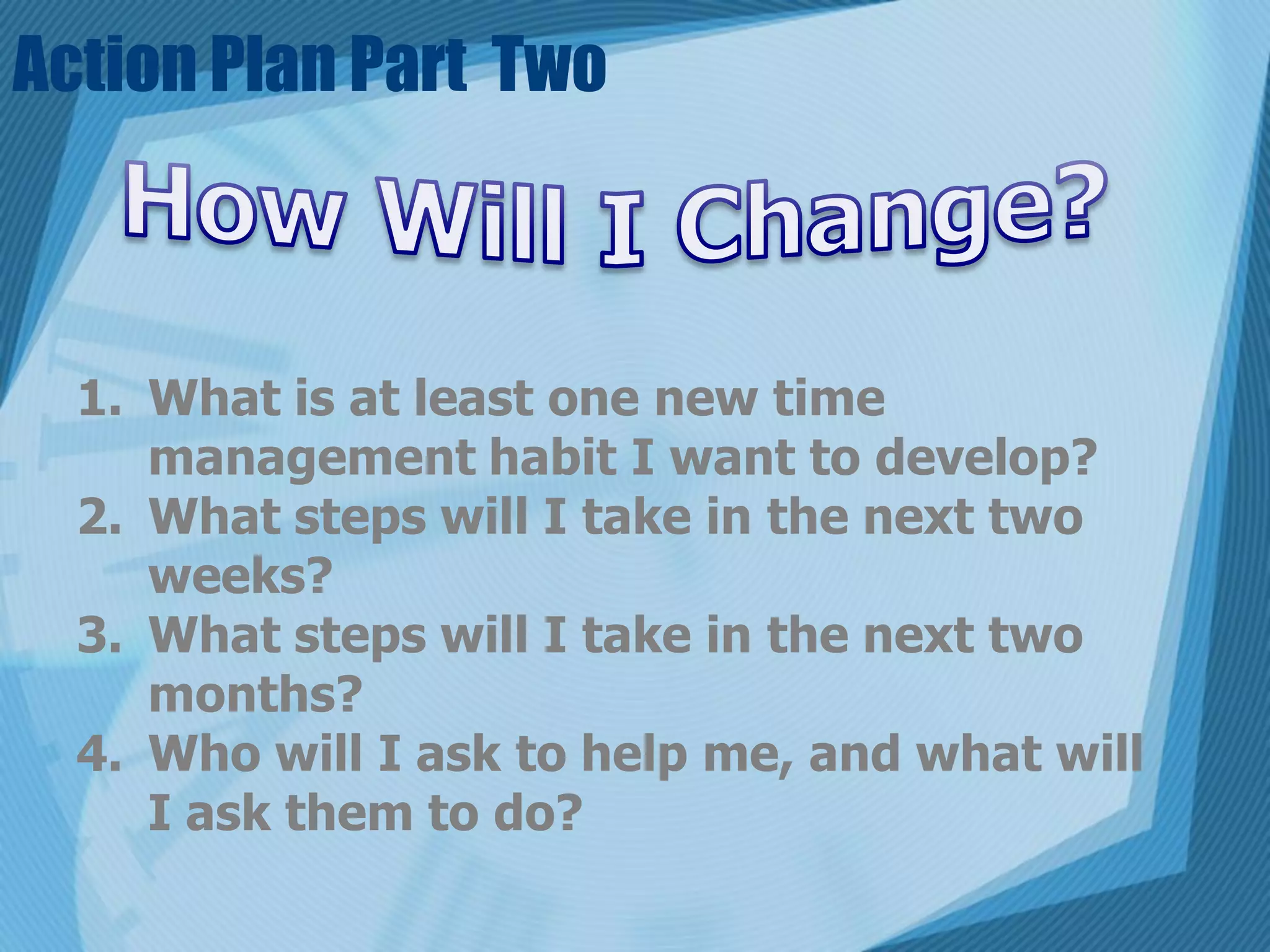
Action Plan Part Two


  1. What is at least one new time
     management habit I want to develop?
  2. What steps will I take in the next two
     weeks?
  3. What steps will I take in the next two
     months?
  4. Who will I ask to help me, and what will
     I ask them to do?
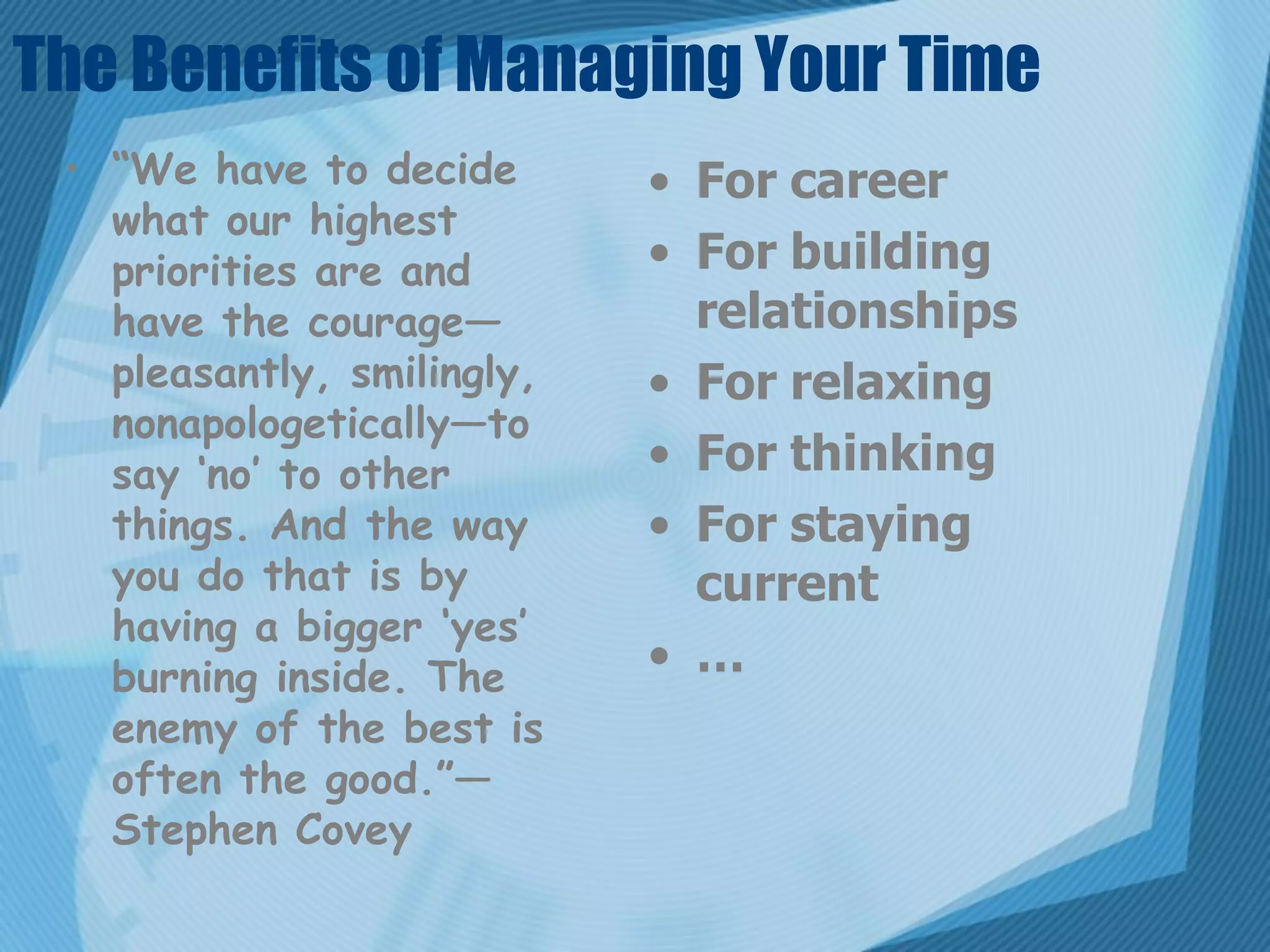
The Benefits of Managing Your Time
 • “We have to decide       • For career
   what our highest
   priorities are and       • For building
   have the courage—          relationships
   pleasantly, smilingly,   • For relaxing
   nonapologetically—to
   say ‘no’ to other        • For thinking
   things. And the way      • For staying
   you do that is by          current
   having a bigger ‘yes’
   burning inside. The      • …
   enemy of the best is
   often the good.”—
   Stephen Covey
Evaluations of This Workshop Please!
  • Please go to
    evaluation form
    for this workshop
  • Fill it out
  • I’ll share
    summary
  • Thanks!

Time Management Workshop - ULS Leadership Program

  • 1.
    Time Management Workshop Prepared by Karen Calhoun for the ULS Leadership Program 12 June 2012
  • 2.
    Credits •Patti Hathaway – 1993 workshop • Stephen Covey and Charlie Whiting – 1996 First Things First workshop • SkillPath workshop – Managing Multiple Projects, Objectives, Deadlines – 1998? • All the colleagues who have helped me try to “keep the main thing the main thing”
  • 3.
    Illustration John Tenniel,Alice in Wonderland. Public domain.
  • 4.
    Learning Objectives • Understand your own time management habits • Identify what you want to change • Assess what controls your time • Explore the links between values and how you manage your time • Add some tips and tricks to your personal tool kit
  • 5.
    Write your namewith the hand you usually use ________________________________________ Write your name with the other hand ________________________________________ CHANGING OLD HABITS IS HARD AND FEELS WEIRD
  • 6.
    Getting in Control Control* Commitment and practice Tools and techniques Self-examination *The fine print: 100% control is not possible, especially as you advance in your career. See Peter Drucker “Know Thy Time” to learn more.
  • 7.
    What Robs YourTime? Pick Your Top Five Procrastination Poor planning Inadequate Interruptions equipment _____ _____ _____ _____ Indecision E-mail/phone Lack of Lack of procedure authority _____ _____ _____ _____ Inability to say Anger and My own Multiple bosses “no” arguments mistakes _____ _____ _____ _____ Others’ Socializing, Unclear Cluttered mistakes chat priorities workspace _____ _____ _____ _____ Waiting for Failure to Poor Shifting others listen communication priorities _____ _____ _____ _____
  • 8.
    Look at yourtop five … • Which ones do you have limited control over? • Which ones do you have maximum control over?
  • 9.
    Personal power grid CAN’T CAN CONTROL CONTROL CEASELESS TAKE ACTION MASTERY STRIVING LETTING GO NO ACTION GIVING UP
  • 10.
    Exercises/Discussion • Results from “Time Mastery Profile” (Inscape Publishing) • Handout – “The main thing”
  • 11.
  • 13.
    Am I Addictedto Urgency? • Sense of excitement • Energy • Status (in our society, a busy person = an important person) • Feels good to solve crisis • Good at it
  • 14.
    Some Possible Signsof Urgency Addiction • I work better • I give up family or under pressure personal time to • I’m too busy to handle a crisis at think about it now work • I feel guilty when • Someday I’ll be I’m not working able to do what I • I hate to wait or really want to do stand in line • I know ____ is important, but I don’t have time now
  • 15.
    Time Management Matrix Urgent Not Urgent Important Quadrant 1: Quadrant 2: Critical problems, Preparation & deadline-driven prevention, re- projects creation, relationship building Not Important Quadrant 3: Quadrant 4: Trivia, Interruptions, busywork, junk some e-mail/calls, mail, time wasters some meetings, many “proximate” matters Adapted from Covey
  • 16.
    Time Tools • Personal log • Master list • Priority planning worksheet • Weekly plan • Daily plan • More ….
  • 17.
    Time Concepts • Prime time • Strategic reserve time • Quiet time
  • 18.
    Time tool exercise • How many hours are in your day? • How much time do you actually have? • How are you going to use it? • See set of handouts
  • 19.
    An Unexpected Wayof Paring Down a Task List: A Tip from Laurie Ford (laurieford.com)* WHAT HAVE I PROMISED TO MANAGING THE “IN- OTHERS? WHAT HAVE OTHERS BETWEEN” PROMISED TO ME? • Agreements • Requests and promises • Manage the “arrows” not the boxes • Fine tune your network of agreements • Manage “dues” not “to dos” *Speaker at Women in Project Management Conference, June 2008, Columbus OH
  • 20.
    Why Do WeProcrastinate? • Forget • Don’t know how • Don’t have means – Lack of resources – Too complicated – Prospect of conflict • Attitude – Unpleasant – Outside my comfort zone – Fear of making mistakes – Sidetracked
  • 21.
    A Dozen Ideasfor Dealing with Procrastination • Deal with tough • Schedule it; set aside issues during your time, make a prime time deadline • Start small but start • Seek help • Write yourself a • Let go (delegate) reminder • Fight perfectionism • Reward yourself (I’ll • Listen to your self- take a break after …) talk (yes you can!) • Keep a master list • JUST DO IT • Go somewhere else to do it
  • 22.
    Do It for15 Minutes http://chronicle.com/blogs/profhacker/why-15- minutes/40196?sid=wc&utm_source=wc&utm_medium=en
  • 23.
    Ideas for Dealingwith Interruptions • Stand up • Develop a plan for • Be aware of consolidating “people traps” calls, e-mail, etc. and traffic • Think to yourself patterns “Can this wait?” • Maintain your • JUST SAY NO work posture • Establish quiet time • Have a clock visible at all times
  • 24.
    Can You Say“No”? I CAN SAY NO WHEN … I CAN SAY NO … • Boss asks for work I • Without feeling guilty don’t have time to do • Several times, if I • Peer asks me for help need to and giving it would • Without feeling fearful put me behind • When someone is schedule sulking, crying or • Some places getting angry unrealistic demands • To establish limits on me with my boss • Someone asks me for • To establish limits information I with my peers shouldn’t give out
  • 25.
    Tips for Saying“No” • Evaluate the request against your goals/plan • Ask for clarification (be sure you understand the request) • Say ‘no’ if appropriate – Boss: “Yes, provided someone else can… provided there is opportunity for …” – All others: “My problem is…” or USA = “I Understand … here is my Situation … let’s [Action]” • Give options if possible • Say it again, calmly (broken record) • Don’t give up, don’t lose your temper
  • 26.
    Managing Paper Stacks,E-Mail • Turn off e-mail beep! • T.A.S.K. – Toss it, Act on it, Send it on, Keep it • Decide on a filing system and use it • PUT THINGS AWAY – Afraid of forgetting? Make a note in Outlook, master list, weekly plan, “perhaps” list … • Throw away as much as possible • Set aside time to clear your desk/in-box (15 minute trick?)
  • 27.
    Action Plan PartTwo 1. What is at least one new time management habit I want to develop? 2. What steps will I take in the next two weeks? 3. What steps will I take in the next two months? 4. Who will I ask to help me, and what will I ask them to do?
  • 28.
    The Benefits ofManaging Your Time • “We have to decide • For career what our highest priorities are and • For building have the courage— relationships pleasantly, smilingly, • For relaxing nonapologetically—to say ‘no’ to other • For thinking things. And the way • For staying you do that is by current having a bigger ‘yes’ burning inside. The • … enemy of the best is often the good.”— Stephen Covey
  • 29.
    Evaluations of ThisWorkshop Please! • Please go to evaluation form for this workshop • Fill it out • I’ll share summary • Thanks!