Report and Analysis
Of
Time Management
Submitted by
Dylan Muhlstock
October 20th 2013
Bus 150 – Section
71873

Contemporary Business Practice
Professor Nankin
Slide Number

Title

1

What is Time
Management?

2

Mission Statement

3

How do we measure Time
Management?

4

Day 1

5

Day 2

6

Overall Results

7

Strengths

8

Weaknesses

9

Conclusion
• Time Management is the act of planning and controlling the
amount of time spent on activities, and doing so in an effective and
efficient manor.
• According to Stephen Covey, author of The 7 Habits of Highly
Effective People, effective-self managers establish goals that are
based on personal and ethical principles. Personally the most
important and relatable statement to successful time management
is “begin with the end in mind.”
• The following presentation is an analysis of a consecutive 48 hour
time period and how well my time was managed.
To establish an efficient schedule in which I can
properly accomplish what needs to be done
daily, with a balanced lifestyle of work,
education and leisure activities.
•

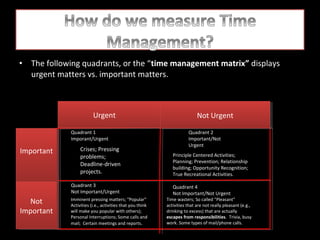
The following quadrants, or the “time management matrix” displays
urgent matters vs. important matters.

Urgent
Urgent
Quadrant 1
Imporant/Urgent

Important
Important

Crises; Pressing
problems;
Deadline-driven
projects.
Quadrant 3
Not Important/Urgent

Not
Not
Important
Important

Imminent pressing matters; "Popular"
Activities (i.e., activities that you think
will make you popular with others);
Personal Interruptions; Some calls and
mail; Certain meetings and reports .

Not Urgent
Not Urgent
Quadrant 2
Important/Not
Urgent
Principle Centered Activities;
Planning; Prevention; Relationship
building; Opportunity Recognition;
True Recreational Activities.
Quadrant 4
Not Important/Not Urgent

Time wasters; So called "Pleasant"
activities that are not really pleasant (e.g.,
drinking to excess) that are actually
escapes from responsibilities. Trivia, busy
work. Some types of mail/phone calls.
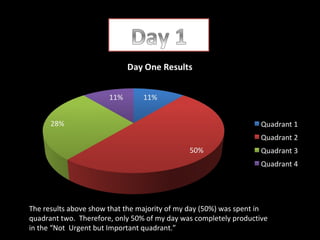
The results above show that the majority of my day (50%) was spent in
quadrant two. Therefore, only 50% of my day was completely productive
in the “Not Urgent but Important quadrant.”
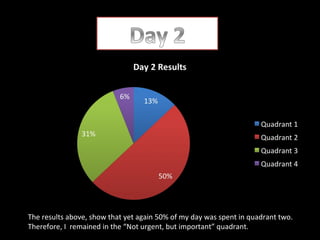
The results above, show that yet again 50% of my day was spent in quadrant two.
Therefore, I remained in the “Not urgent, but important” quadrant.
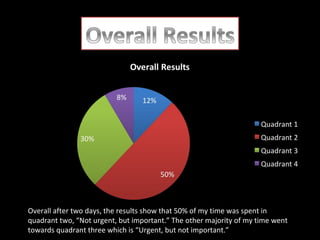
Overall after two days, the results show that 50% of my time was spent in
quadrant two, “Not urgent, but important.” The other majority of my time went
towards quadrant three which is “Urgent, but not important.”
•

•
•
•

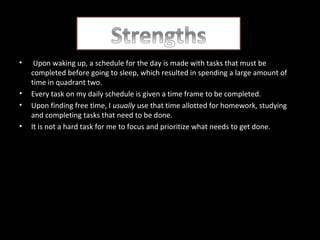
Upon waking up, a schedule for the day is made with tasks that must be
completed before going to sleep, which resulted in spending a large amount of
time in quadrant two.
Every task on my daily schedule is given a time frame to be completed.
Upon finding free time, I usually use that time allotted for homework, studying
and completing tasks that need to be done.
It is not a hard task for me to focus and prioritize what needs to get done.
•
•
•

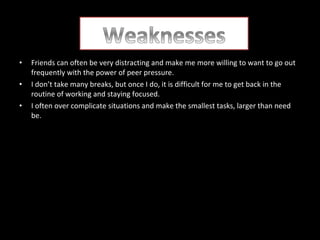
Friends can often be very distracting and make me more willing to want to go out
frequently with the power of peer pressure.
I don’t take many breaks, but once I do, it is difficult for me to get back in the
routine of working and staying focused.
I often over complicate situations and make the smallest tasks, larger than need
be.
•

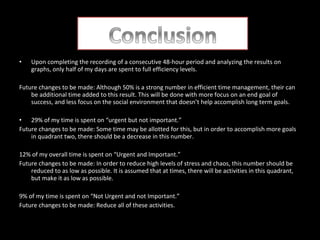
Upon completing the recording of a consecutive 48-hour period and analyzing the results on
graphs, only half of my days are spent to full efficiency levels.

Future changes to be made: Although 50% is a strong number in efficient time management, their can
be additional time added to this result. This will be done with more focus on an end goal of
success, and less focus on the social environment that doesn’t help accomplish long term goals.
• 29% of my time is spent on “urgent but not important.”
Future changes to be made: Some time may be allotted for this, but in order to accomplish more goals
in quadrant two, there should be a decrease in this number.
12% of my overall time is spent on “Urgent and Important.”
Future changes to be made: In order to reduce high levels of stress and chaos, this number should be
reduced to as low as possible. It is assumed that at times, there will be activities in this quadrant,
but make it as low as possible.
9% of my time is spent on “Not Urgent and not Important.”
Future changes to be made: Reduce all of these activities.

Time management dylan muhlstock

  • 1.
    Report and Analysis Of TimeManagement Submitted by Dylan Muhlstock October 20th 2013 Bus 150 – Section 71873 Contemporary Business Practice Professor Nankin
  • 2.
    Slide Number Title 1 What isTime Management? 2 Mission Statement 3 How do we measure Time Management? 4 Day 1 5 Day 2 6 Overall Results 7 Strengths 8 Weaknesses 9 Conclusion
  • 3.
    • Time Managementis the act of planning and controlling the amount of time spent on activities, and doing so in an effective and efficient manor. • According to Stephen Covey, author of The 7 Habits of Highly Effective People, effective-self managers establish goals that are based on personal and ethical principles. Personally the most important and relatable statement to successful time management is “begin with the end in mind.” • The following presentation is an analysis of a consecutive 48 hour time period and how well my time was managed.
  • 4.
    To establish anefficient schedule in which I can properly accomplish what needs to be done daily, with a balanced lifestyle of work, education and leisure activities.
  • 5.
    • The following quadrants,or the “time management matrix” displays urgent matters vs. important matters. Urgent Urgent Quadrant 1 Imporant/Urgent Important Important Crises; Pressing problems; Deadline-driven projects. Quadrant 3 Not Important/Urgent Not Not Important Important Imminent pressing matters; "Popular" Activities (i.e., activities that you think will make you popular with others); Personal Interruptions; Some calls and mail; Certain meetings and reports . Not Urgent Not Urgent Quadrant 2 Important/Not Urgent Principle Centered Activities; Planning; Prevention; Relationship building; Opportunity Recognition; True Recreational Activities. Quadrant 4 Not Important/Not Urgent Time wasters; So called "Pleasant" activities that are not really pleasant (e.g., drinking to excess) that are actually escapes from responsibilities. Trivia, busy work. Some types of mail/phone calls.
  • 6.
    The results aboveshow that the majority of my day (50%) was spent in quadrant two. Therefore, only 50% of my day was completely productive in the “Not Urgent but Important quadrant.”
  • 7.
    The results above,show that yet again 50% of my day was spent in quadrant two. Therefore, I remained in the “Not urgent, but important” quadrant.
  • 8.
    Overall after twodays, the results show that 50% of my time was spent in quadrant two, “Not urgent, but important.” The other majority of my time went towards quadrant three which is “Urgent, but not important.”
  • 9.
    • • • • Upon waking up,a schedule for the day is made with tasks that must be completed before going to sleep, which resulted in spending a large amount of time in quadrant two. Every task on my daily schedule is given a time frame to be completed. Upon finding free time, I usually use that time allotted for homework, studying and completing tasks that need to be done. It is not a hard task for me to focus and prioritize what needs to get done.
  • 10.
    • • • Friends can oftenbe very distracting and make me more willing to want to go out frequently with the power of peer pressure. I don’t take many breaks, but once I do, it is difficult for me to get back in the routine of working and staying focused. I often over complicate situations and make the smallest tasks, larger than need be.
  • 11.
    • Upon completing therecording of a consecutive 48-hour period and analyzing the results on graphs, only half of my days are spent to full efficiency levels. Future changes to be made: Although 50% is a strong number in efficient time management, their can be additional time added to this result. This will be done with more focus on an end goal of success, and less focus on the social environment that doesn’t help accomplish long term goals. • 29% of my time is spent on “urgent but not important.” Future changes to be made: Some time may be allotted for this, but in order to accomplish more goals in quadrant two, there should be a decrease in this number. 12% of my overall time is spent on “Urgent and Important.” Future changes to be made: In order to reduce high levels of stress and chaos, this number should be reduced to as low as possible. It is assumed that at times, there will be activities in this quadrant, but make it as low as possible. 9% of my time is spent on “Not Urgent and not Important.” Future changes to be made: Reduce all of these activities.

Editor's Notes