Report and Analysis of Effective SelfManagement
Submitted by:
Mark Krikke

October 18, 2013
BUS 150 – Section 71873

Contemporary Business Practice
Professor Nankin
Table of Content
1. Introduction………………………………………………………………………………………1
What is Self-Management?.…………………………………………………………………… 1
Efficiency vs. Effectiveness……………………………………………………………………..
1
2. Time Management Matrix………………………………………………………………………. 2
Origin………………………………………………………………………………………….. 2
Understanding the Matrix………………………………………………………………………2
3. 48 Hour Self-Management Assignment………………………………………………………….3
My Task………………………………………………………………………………….............
3
Personal Mission Statement……………………………………………………………………..
3
4. Quadrant Activity Allocation……………………………………………………………………..
4
Quadrant Breakdown…………………………………………………………………………….
4
Percentage Time Spent By Quadrant……………………………………………………………
4
5. Analysis……………………………………………………………………………………………
5
Dual Quadrant Activities…………………………………………………………………………
5
Strengths and Weakness……………………………………………………………………….…
5
6. Insights……………………………………………………………………………………………
6
Introduction
What is Self-Management?
Self-management is the holistic concept of organizing and executing the use of one’s time in order to meet goals and objectives that are based on
personal and ethical principles. Self-management incorporates an introspective approach towards time management, focusing on being effective
as a self-manager, rather than just efficient.

Efficiency vs. Effectiveness
Within the idea of self-management, efficiency involves using all time available to work, or rather, avoiding wasteful use of time. Efficient
minded self-managers fail to integrate higher order facets of life which are difficult to quantify or measure, like enjoying relationships and other
abstract features in day to day life. Where efficiency is about checking items off of a list as productively as possible, effectiveness is about
accomplishing results with a clear goal in mind. An effective self-manager has this personal vision, and all decisions are based on making that
vision reality.
Time Management Matrix
Origin
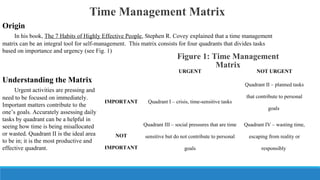
In his book, The 7 Habits of Highly Effective People, Stephen R. Covey explained that a time management
matrix can be an integral tool for self-management. This matrix consists for four quadrants that divides tasks
based on importance and urgency (see Fig. 1)

Figure 1: Time Management
Matrix
URGENT

Understanding the Matrix
Urgent activities are pressing and
need to be focused on immediately.
Important matters contribute to the
one’s goals. Accurately assessing daily
tasks by quadrant can be a helpful in
seeing how time is being misallocated
or wasted. Quadrant II is the ideal area
to be in; it is the most productive and
effective quadrant.

NOT URGENT

Quadrant II – planned tasks
IMPORTANT

Quadrant I – crisis, time-sensitive tasks

that contribute to personal
goals

Quadrant III – social pressures that are time

Quadrant IV – wasting time,

NOT

sensitive but do not contribute to personal

escaping from reality or

IMPORTANT

goals

responsibly
48 Hour Self-Management Assignment
My Task
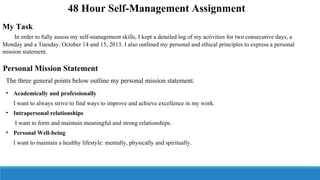
In order to fully assess my self-management skills, I kept a detailed log of my activities for two consecutive days, a
Monday and a Tuesday, October 14 and 15, 2013. I also outlined my personal and ethical principles to express a personal
mission statement.

Personal Mission Statement
The three general points below outline my personal mission statement.
• Academically and professionally
I want to always strive to find ways to improve and achieve excellence in my work.
• Intrapersonal relationships
I want to form and maintain meaningful and strong relationships.
• Personal Well-being
I want to maintain a healthy lifestyle: mentally, physically and spiritually.
Quadrant Activity Allocation
Quadrant Breakdown
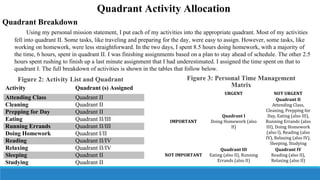
Using my personal mission statement, I put each of my activities into the appropriate quadrant. Most of my activities
fell into quadrant II. Some tasks, like traveling and preparing for the day, were easy to assign. However, some tasks, like
working on homework, were less straightforward. In the two days, I spent 8.5 hours doing homework, with a majority of
the time, 6 hours, spent in quadrant II. I was finishing assignments based on a plan to stay ahead of schedule. The other 2.5
hours spent rushing to finish up a last minute assignment that I had underestimated. I assigned the time spent on that to
quadrant I. The full breakdown of activities is shown in the tables that follow below.

Figure 3: Personal Time Management
Matrix

Figure 2: Activity List and Quadrant
Activity

Quadrant (s) Assigned

Attending Class
Cleaning
Prepping for Day
Eating
Running Errands
Doing Homework
Reading
Relaxing
Sleeping
Studying

Quadrant II
Quadrant II
Quadrant II
Quadrant II/III
Quadrant II/III
Quadrant I/II
Quadrant II/IV
Quadrant II/IV
Quadrant II
Quadrant II


URGENT

IMPORTANT

Quadrant I
Doing Homework (also
II)

NOT IMPORTANT

Quadrant III
Eating (also II), Running
Errands (also II)

NOT URGENT
Quadrant II
Attending Class,
Cleaning, Prepping for
Day, Eating (also III),
Running Errands (also
III), Doing Homework
(also I), Reading (also
IV), Relaxing (also IV),
Sleeping, Studying
Quadrant IV
Reading (also II),
Relaxing (also II)
Percentage Time Spent by Quadrant
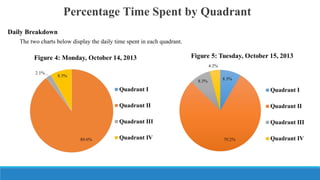
Daily Breakdown
The two charts below display the daily time spent in each quadrant.
Analysis
Dual Quadrant Activities
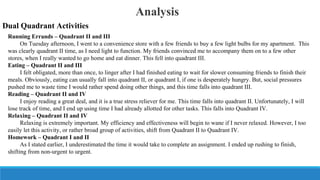
Running Errands – Quadrant II and III
On Tuesday afternoon, I went to a convenience store with a few friends to buy a few light bulbs for my apartment. This
was clearly quadrant II time, as I need light to function. My friends convinced me to accompany them on to a few other
stores, when I really wanted to go home and eat dinner. This fell into quadrant III.
Eating – Quadrant II and III
I felt obligated, more than once, to linger after I had finished eating to wait for slower consuming friends to finish their
meals. Obviously, eating can usually fall into quadrant II, or quadrant I, if one is desperately hungry. But, social pressures
pushed me to waste time I would rather spend doing other things, and this time falls into quadrant III.
Reading – Quadrant II and IV
I enjoy reading a great deal, and it is a true stress reliever for me. This time falls into quadrant II. Unfortunately, I will
lose track of time, and I end up using time I had already allotted for other tasks. This falls into Quadrant IV.
Relaxing – Quadrant II and IV
Relaxing is extremely important. My efficiency and effectiveness will begin to wane if I never relaxed. However, I too
easily let this activity, or rather broad group of activities, shift from Quadrant II to Quadrant IV.
Homework – Quadrant I and II
As I stated earlier, I underestimated the time it would take to complete an assignment. I ended up rushing to finish,
shifting from non-urgent to urgent.
Analysis (cont.)
Strengths and Weaknesses (Referencing the “Rules for Efficient Time Management”)
Strengths
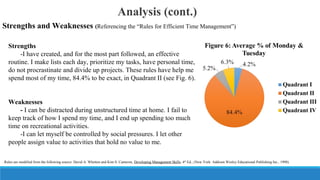
-I have created, and for the most part followed, an effective
routine. I make lists each day, prioritize my tasks, have personal time,
do not procrastinate and divide up projects. These rules have help me
spend most of my time, 84.4% to be exact, in Quadrant II (see Fig. 6).
Weaknesses
- I can be distracted during unstructured time at home. I fail to
keep track of how I spend my time, and I end up spending too much
time on recreational activities.
-I can let myself be controlled by social pressures. I let other
people assign value to activities that hold no value to me.
. Rules are modified from the following source: David A. Whetten and Kim S. Cameron, Developing Management Skills, 4th Ed., (New York: Addison Wesley Educational Publishing Inc., 1998).
Insights
• My first day had significantly more time spent in quadrant II than the second day.
The main scheduling difference between those two days is that Monday I have classes
distributed throughout the day, while Tuesday I have classes only in the morning. The
completely free afternoons are spent much less effectively. I should plan, in future
semesters, to create a schedule for school that more evenly distributes my classes. This
will help me optimize my effectiveness.
• Before I completed this assignment, I would have stated confidently that I waste no
time in my life. I now can quantifiable know that I do, in fact, waste time. This activity
of analyzing how effectively I spend my time should be apart of my routine. I should
be continuously examining how I spend my time.

Krikke time management assignment

  • 1.
    Report and Analysisof Effective SelfManagement Submitted by: Mark Krikke October 18, 2013 BUS 150 – Section 71873 Contemporary Business Practice Professor Nankin
  • 2.
    Table of Content 1.Introduction………………………………………………………………………………………1 What is Self-Management?.…………………………………………………………………… 1 Efficiency vs. Effectiveness…………………………………………………………………….. 1 2. Time Management Matrix………………………………………………………………………. 2 Origin………………………………………………………………………………………….. 2 Understanding the Matrix………………………………………………………………………2 3. 48 Hour Self-Management Assignment………………………………………………………….3 My Task…………………………………………………………………………………............. 3 Personal Mission Statement…………………………………………………………………….. 3 4. Quadrant Activity Allocation…………………………………………………………………….. 4 Quadrant Breakdown……………………………………………………………………………. 4 Percentage Time Spent By Quadrant…………………………………………………………… 4 5. Analysis…………………………………………………………………………………………… 5 Dual Quadrant Activities………………………………………………………………………… 5 Strengths and Weakness……………………………………………………………………….… 5 6. Insights…………………………………………………………………………………………… 6
  • 3.
    Introduction What is Self-Management? Self-managementis the holistic concept of organizing and executing the use of one’s time in order to meet goals and objectives that are based on personal and ethical principles. Self-management incorporates an introspective approach towards time management, focusing on being effective as a self-manager, rather than just efficient. Efficiency vs. Effectiveness Within the idea of self-management, efficiency involves using all time available to work, or rather, avoiding wasteful use of time. Efficient minded self-managers fail to integrate higher order facets of life which are difficult to quantify or measure, like enjoying relationships and other abstract features in day to day life. Where efficiency is about checking items off of a list as productively as possible, effectiveness is about accomplishing results with a clear goal in mind. An effective self-manager has this personal vision, and all decisions are based on making that vision reality.
  • 4.
    Time Management Matrix Origin Inhis book, The 7 Habits of Highly Effective People, Stephen R. Covey explained that a time management matrix can be an integral tool for self-management. This matrix consists for four quadrants that divides tasks based on importance and urgency (see Fig. 1) Figure 1: Time Management Matrix URGENT Understanding the Matrix Urgent activities are pressing and need to be focused on immediately. Important matters contribute to the one’s goals. Accurately assessing daily tasks by quadrant can be a helpful in seeing how time is being misallocated or wasted. Quadrant II is the ideal area to be in; it is the most productive and effective quadrant. NOT URGENT Quadrant II – planned tasks IMPORTANT Quadrant I – crisis, time-sensitive tasks that contribute to personal goals Quadrant III – social pressures that are time Quadrant IV – wasting time, NOT sensitive but do not contribute to personal escaping from reality or IMPORTANT goals responsibly
  • 5.
    48 Hour Self-ManagementAssignment My Task In order to fully assess my self-management skills, I kept a detailed log of my activities for two consecutive days, a Monday and a Tuesday, October 14 and 15, 2013. I also outlined my personal and ethical principles to express a personal mission statement. Personal Mission Statement The three general points below outline my personal mission statement. • Academically and professionally I want to always strive to find ways to improve and achieve excellence in my work. • Intrapersonal relationships I want to form and maintain meaningful and strong relationships. • Personal Well-being I want to maintain a healthy lifestyle: mentally, physically and spiritually.
  • 6.
    Quadrant Activity Allocation QuadrantBreakdown Using my personal mission statement, I put each of my activities into the appropriate quadrant. Most of my activities fell into quadrant II. Some tasks, like traveling and preparing for the day, were easy to assign. However, some tasks, like working on homework, were less straightforward. In the two days, I spent 8.5 hours doing homework, with a majority of the time, 6 hours, spent in quadrant II. I was finishing assignments based on a plan to stay ahead of schedule. The other 2.5 hours spent rushing to finish up a last minute assignment that I had underestimated. I assigned the time spent on that to quadrant I. The full breakdown of activities is shown in the tables that follow below. Figure 3: Personal Time Management Matrix Figure 2: Activity List and Quadrant Activity Quadrant (s) Assigned Attending Class Cleaning Prepping for Day Eating Running Errands Doing Homework Reading Relaxing Sleeping Studying Quadrant II Quadrant II Quadrant II Quadrant II/III Quadrant II/III Quadrant I/II Quadrant II/IV Quadrant II/IV Quadrant II Quadrant II   URGENT IMPORTANT Quadrant I Doing Homework (also II) NOT IMPORTANT Quadrant III Eating (also II), Running Errands (also II) NOT URGENT Quadrant II Attending Class, Cleaning, Prepping for Day, Eating (also III), Running Errands (also III), Doing Homework (also I), Reading (also IV), Relaxing (also IV), Sleeping, Studying Quadrant IV Reading (also II), Relaxing (also II)
  • 7.
    Percentage Time Spentby Quadrant Daily Breakdown The two charts below display the daily time spent in each quadrant.
  • 8.
    Analysis Dual Quadrant Activities RunningErrands – Quadrant II and III On Tuesday afternoon, I went to a convenience store with a few friends to buy a few light bulbs for my apartment. This was clearly quadrant II time, as I need light to function. My friends convinced me to accompany them on to a few other stores, when I really wanted to go home and eat dinner. This fell into quadrant III. Eating – Quadrant II and III I felt obligated, more than once, to linger after I had finished eating to wait for slower consuming friends to finish their meals. Obviously, eating can usually fall into quadrant II, or quadrant I, if one is desperately hungry. But, social pressures pushed me to waste time I would rather spend doing other things, and this time falls into quadrant III. Reading – Quadrant II and IV I enjoy reading a great deal, and it is a true stress reliever for me. This time falls into quadrant II. Unfortunately, I will lose track of time, and I end up using time I had already allotted for other tasks. This falls into Quadrant IV. Relaxing – Quadrant II and IV Relaxing is extremely important. My efficiency and effectiveness will begin to wane if I never relaxed. However, I too easily let this activity, or rather broad group of activities, shift from Quadrant II to Quadrant IV. Homework – Quadrant I and II As I stated earlier, I underestimated the time it would take to complete an assignment. I ended up rushing to finish, shifting from non-urgent to urgent.
  • 9.
    Analysis (cont.) Strengths andWeaknesses (Referencing the “Rules for Efficient Time Management”) Strengths -I have created, and for the most part followed, an effective routine. I make lists each day, prioritize my tasks, have personal time, do not procrastinate and divide up projects. These rules have help me spend most of my time, 84.4% to be exact, in Quadrant II (see Fig. 6). Weaknesses - I can be distracted during unstructured time at home. I fail to keep track of how I spend my time, and I end up spending too much time on recreational activities. -I can let myself be controlled by social pressures. I let other people assign value to activities that hold no value to me. . Rules are modified from the following source: David A. Whetten and Kim S. Cameron, Developing Management Skills, 4th Ed., (New York: Addison Wesley Educational Publishing Inc., 1998).
  • 10.
    Insights • My firstday had significantly more time spent in quadrant II than the second day. The main scheduling difference between those two days is that Monday I have classes distributed throughout the day, while Tuesday I have classes only in the morning. The completely free afternoons are spent much less effectively. I should plan, in future semesters, to create a schedule for school that more evenly distributes my classes. This will help me optimize my effectiveness. • Before I completed this assignment, I would have stated confidently that I waste no time in my life. I now can quantifiable know that I do, in fact, waste time. This activity of analyzing how effectively I spend my time should be apart of my routine. I should be continuously examining how I spend my time.

Editor's Notes