TIME MANAGEMENT ANALYSIS
KEVIN JONES
BUS 150-71873
PROFESSOR CONRAD NANKIN
FA L L 2 0 1 3
OCTOBER 17,2013
TABLE OF CONTENTS
Introduction- Page 3
Breakdown of Quadrant Equivalency- Page 4
Day 1 Analysis- Page 5
Day 2 Analysis- Page 6
Overall Analysis- Page 7
My Findings- Page 8
Strengths/ Weaknesses Page 9
Conclusion- Page 10
INTRODUCTION
Jim Loehr once said “Boundary setting is really a huge part of time management”. The data analyzed
in this presentation represents how I spent my time over a two day period. From waking up in the
morning to going to bed at night, I kept a record of my activities. This analysis shows the
efficiency of my time spent from activities which are classified as important/ urgent to activities
which were not important, neither urgent.
BREAKDOWN OF QUADRANT EQUIVALENCY
Quadrant I- Important/ Urgent (Crises; Pressing problems; Deadline-driven projects)
Quadrant II- Important/ Not Urgent (Principles Centered Activities; Planning; Prevention; True Recreational Aactivities)
Quadrant III- Not Important/ Urgent (Imminent pressing matters; “popular” Activities; Personal Interruptions)
Quadrant IV- Not Important/ Not Urgent (Time Wasters; Escaping responsibilities)
DAY 1 ANALYSIS
1st Qtr

2nd Qtr

3rd Qtr

4th Qtr

23%
Not Important/
Not Urgent

Important/ Urgent= 54%
Important/ Urgent

Not Important/
Urgent

15%

54%

Important/ Not Urgent= 8%
Not Important/ Urgent= 15%
Not Important/ Not Urgent= 23%

8%
Important/ Not Urgent
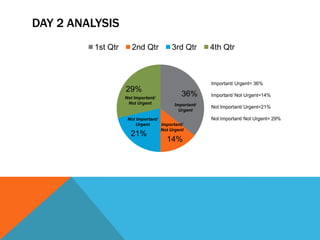
DAY 2 ANALYSIS
1st Qtr

2nd Qtr

29%
Not Important/
Not Urgent

3rd Qtr

Important/ Urgent= 36%

36%

Important/ Not Urgent=14%

Important/
Urgent

Not Important/ Urgent=21%

Not Important/
Urgent
Important/
Not Urgent

21%

4th Qtr

14%

Not Important/ Not Urgent= 29%
OVERALL ANALYSIS
Total Time Spent Over Two Days
1st Qtr

2nd Qtr

3rd Qtr

4th Qtr

Over a two day period I spent majority of
my time focusing on activities which were
important and urgent.

26%

44%

19%
11%

Important/ non urgent activities took up the
least of my time.
There was a small difference of 7%
between activities which were not
important/ urgent and not important/ not
urgent.
MY FINDINGS
•

On day 2 of my time management experiment you can see an increase in the time spent doing activities of quadrants 2, 3, and 4. Yet, a
decrease in quadrant 1 (important/ urgent). Showing how I can often slack off and attend activities which are time wasters or an escape

from my responsibilities.
•

Majority of my time is spent in quadrant one due to a large amount of responsibilities , such as work. Having a job limits the amount of
time I can spend on not important and non urgent matters since my time is already scarce.

•

Spending a lot of time in Quadrant 1 is also because I have a “To Do” list which I create the night before each day to remind myself of
the things that must get done.

•

Spending 44% of my time on activities which are important/ urgent derive from me taking opportunities of down time at work to get
assignments done.
STRENGTHS/ WEAKNESSES
Strengths

Weaknesses

• Being able to multitask

• I tend to get distracted easily

• Organization/ Prioritizing

• Becoming overwhelmed quickly
and shutting down on all
activities.

• Eliminating simple and
tedious work first

• Constantly putting too much on
my plate instead of spreading
out activities.
CONCLUSION
•

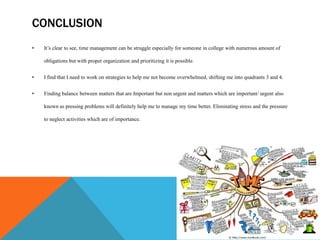
It’s clear to see, time management can be struggle especially for someone in college with numerous amount of
obligations but with proper organization and prioritizing it is possible.

•

I find that I need to work on strategies to help me not become overwhelmed, shifting me into quadrants 3 and 4.

•

Finding balance between matters that are Important but non urgent and matters which are important/ urgent also
known as pressing problems will definitely help me to manage my time better. Eliminating stress and the pressure

to neglect activities which are of importance.

Time management analysis

  • 1.
    TIME MANAGEMENT ANALYSIS KEVINJONES BUS 150-71873 PROFESSOR CONRAD NANKIN FA L L 2 0 1 3 OCTOBER 17,2013
  • 2.
    TABLE OF CONTENTS Introduction-Page 3 Breakdown of Quadrant Equivalency- Page 4 Day 1 Analysis- Page 5 Day 2 Analysis- Page 6 Overall Analysis- Page 7 My Findings- Page 8 Strengths/ Weaknesses Page 9 Conclusion- Page 10
  • 3.
    INTRODUCTION Jim Loehr oncesaid “Boundary setting is really a huge part of time management”. The data analyzed in this presentation represents how I spent my time over a two day period. From waking up in the morning to going to bed at night, I kept a record of my activities. This analysis shows the efficiency of my time spent from activities which are classified as important/ urgent to activities which were not important, neither urgent.
  • 4.
    BREAKDOWN OF QUADRANTEQUIVALENCY Quadrant I- Important/ Urgent (Crises; Pressing problems; Deadline-driven projects) Quadrant II- Important/ Not Urgent (Principles Centered Activities; Planning; Prevention; True Recreational Aactivities) Quadrant III- Not Important/ Urgent (Imminent pressing matters; “popular” Activities; Personal Interruptions) Quadrant IV- Not Important/ Not Urgent (Time Wasters; Escaping responsibilities)
  • 5.
    DAY 1 ANALYSIS 1stQtr 2nd Qtr 3rd Qtr 4th Qtr 23% Not Important/ Not Urgent Important/ Urgent= 54% Important/ Urgent Not Important/ Urgent 15% 54% Important/ Not Urgent= 8% Not Important/ Urgent= 15% Not Important/ Not Urgent= 23% 8% Important/ Not Urgent
  • 6.
    DAY 2 ANALYSIS 1stQtr 2nd Qtr 29% Not Important/ Not Urgent 3rd Qtr Important/ Urgent= 36% 36% Important/ Not Urgent=14% Important/ Urgent Not Important/ Urgent=21% Not Important/ Urgent Important/ Not Urgent 21% 4th Qtr 14% Not Important/ Not Urgent= 29%
  • 7.
    OVERALL ANALYSIS Total TimeSpent Over Two Days 1st Qtr 2nd Qtr 3rd Qtr 4th Qtr Over a two day period I spent majority of my time focusing on activities which were important and urgent. 26% 44% 19% 11% Important/ non urgent activities took up the least of my time. There was a small difference of 7% between activities which were not important/ urgent and not important/ not urgent.
  • 8.
    MY FINDINGS • On day2 of my time management experiment you can see an increase in the time spent doing activities of quadrants 2, 3, and 4. Yet, a decrease in quadrant 1 (important/ urgent). Showing how I can often slack off and attend activities which are time wasters or an escape from my responsibilities. • Majority of my time is spent in quadrant one due to a large amount of responsibilities , such as work. Having a job limits the amount of time I can spend on not important and non urgent matters since my time is already scarce. • Spending a lot of time in Quadrant 1 is also because I have a “To Do” list which I create the night before each day to remind myself of the things that must get done. • Spending 44% of my time on activities which are important/ urgent derive from me taking opportunities of down time at work to get assignments done.
  • 9.
    STRENGTHS/ WEAKNESSES Strengths Weaknesses • Beingable to multitask • I tend to get distracted easily • Organization/ Prioritizing • Becoming overwhelmed quickly and shutting down on all activities. • Eliminating simple and tedious work first • Constantly putting too much on my plate instead of spreading out activities.
  • 10.
    CONCLUSION • It’s clear tosee, time management can be struggle especially for someone in college with numerous amount of obligations but with proper organization and prioritizing it is possible. • I find that I need to work on strategies to help me not become overwhelmed, shifting me into quadrants 3 and 4. • Finding balance between matters that are Important but non urgent and matters which are important/ urgent also known as pressing problems will definitely help me to manage my time better. Eliminating stress and the pressure to neglect activities which are of importance.