Report and Analysis of
Effective Self-Management
John Kokolakis

October 17th 2013
Practice
BUS 150 Section

Contemporary Business
106 Professor Nankin

S
Table of Contents

S Slide 1 --- Introduction
S Slide 2 --- Important vs. Urgent
S Slide 3 --- Time Management Matrix
S Slide 4 --- Time Management Matrix Explained
S Slide 5 --- Day One Results

S Slide 6 --- Day Two Results
S Slide 7 --- Conclusion
Introduction

S Time Management is an essential part of everyday life.
S When managing your time, it is ideal to make decisions

based on what is important along with what is urgent.
S There are four different types of events when you base

them off of importance and urgency.

1
Important vs. Urgent

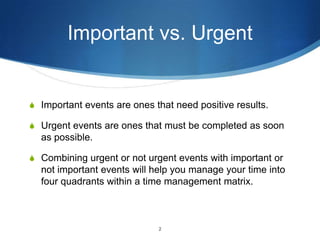
S Important events are ones that need positive results.
S Urgent events are ones that must be completed as soon

as possible.
S Combining urgent or not urgent events with important or

not important events will help you manage your time into
four quadrants within a time management matrix.

2
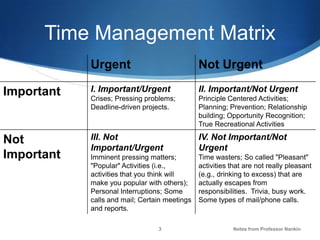
Time Management Matrix
Urgent

Not Urgent

Important

I. Important/Urgent

II. Important/Not Urgent

Crises; Pressing problems;
Deadline-driven projects.

Principle Centered Activities;
Planning; Prevention; Relationship
building; Opportunity Recognition;
True Recreational Activities

Not
Important

III. Not
Important/Urgent

IV. Not Important/Not
Urgent

Imminent pressing matters;
"Popular" Activities (i.e.,
activities that you think will
make you popular with others);
Personal Interruptions; Some
calls and mail; Certain meetings
and reports.

Time wasters; So called "Pleasant"
activities that are not really pleasant
(e.g., drinking to excess) that are
actually escapes from
responsibilities. Trivia, busy work.
Some types of mail/phone calls.

3

Notes from Professor Nankin
Time Management Matrix
Explained
S

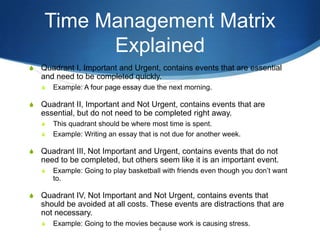
Quadrant I, Important and Urgent, contains events that are essential
and need to be completed quickly.
S

S

Quadrant II, Important and Not Urgent, contains events that are
essential, but do not need to be completed right away.
S
S

S

This quadrant should be where most time is spent.
Example: Writing an essay that is not due for another week.

Quadrant III, Not Important and Urgent, contains events that do not
need to be completed, but others seem like it is an important event.
S

S

Example: A four page essay due the next morning.

Example: Going to play basketball with friends even though you don’t want
to.

Quadrant IV, Not Important and Not Urgent, contains events that
should be avoided at all costs. These events are distractions that are
not necessary.
S

Example: Going to the movies because work is causing stress.
4
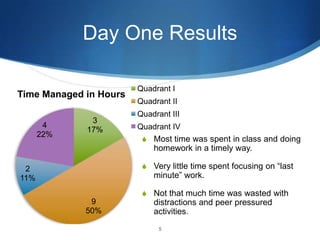
Day One Results
Time Managed in Hours
4
22%

3
17%
3

Quadrant I
Quadrant II
Quadrant III

Quadrant IV
S Most time was spent in class and doing

homework in a timely way.
S Very little time spent focusing on “last

2
11%

minute” work.

S Not that much time was wasted with

9
50%

distractions and peer pressured
activities.
5
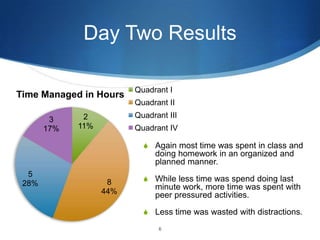
Day Two Results
Time Managed in Hours
3
17%

Quadrant I
Quadrant II
Quadrant III

2
11%

Quadrant IV
S Again most time was spent in class and

doing homework in an organized and
planned manner.
5
28%

8
44%

S While less time was spend doing last

minute work, more time was spent with
peer pressured activities.
S Less time was wasted with distractions.
6
Conclusion
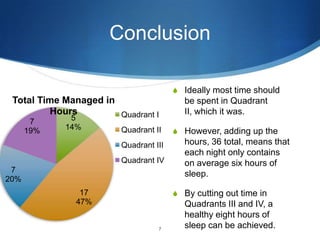
S Ideally most time should

Total Time Managed in
Hours
Quadrant I
5
7
19%

14%

Quadrant II
Quadrant III
Quadrant IV

7
20%

be spent in Quadrant
II, which it was.
S However, adding up the

hours, 36 total, means that
each night only contains
on average six hours of
sleep.
S By cutting out time in

17
47%

7

Quadrants III and IV, a
healthy eight hours of
sleep can be achieved.

Bus time management

  • 1.
    Report and Analysisof Effective Self-Management John Kokolakis October 17th 2013 Practice BUS 150 Section Contemporary Business 106 Professor Nankin S
  • 2.
    Table of Contents SSlide 1 --- Introduction S Slide 2 --- Important vs. Urgent S Slide 3 --- Time Management Matrix S Slide 4 --- Time Management Matrix Explained S Slide 5 --- Day One Results S Slide 6 --- Day Two Results S Slide 7 --- Conclusion
  • 3.
    Introduction S Time Managementis an essential part of everyday life. S When managing your time, it is ideal to make decisions based on what is important along with what is urgent. S There are four different types of events when you base them off of importance and urgency. 1
  • 4.
    Important vs. Urgent SImportant events are ones that need positive results. S Urgent events are ones that must be completed as soon as possible. S Combining urgent or not urgent events with important or not important events will help you manage your time into four quadrants within a time management matrix. 2
  • 5.
    Time Management Matrix Urgent NotUrgent Important I. Important/Urgent II. Important/Not Urgent Crises; Pressing problems; Deadline-driven projects. Principle Centered Activities; Planning; Prevention; Relationship building; Opportunity Recognition; True Recreational Activities Not Important III. Not Important/Urgent IV. Not Important/Not Urgent Imminent pressing matters; "Popular" Activities (i.e., activities that you think will make you popular with others); Personal Interruptions; Some calls and mail; Certain meetings and reports. Time wasters; So called "Pleasant" activities that are not really pleasant (e.g., drinking to excess) that are actually escapes from responsibilities. Trivia, busy work. Some types of mail/phone calls. 3 Notes from Professor Nankin
  • 6.
    Time Management Matrix Explained S QuadrantI, Important and Urgent, contains events that are essential and need to be completed quickly. S S Quadrant II, Important and Not Urgent, contains events that are essential, but do not need to be completed right away. S S S This quadrant should be where most time is spent. Example: Writing an essay that is not due for another week. Quadrant III, Not Important and Urgent, contains events that do not need to be completed, but others seem like it is an important event. S S Example: A four page essay due the next morning. Example: Going to play basketball with friends even though you don’t want to. Quadrant IV, Not Important and Not Urgent, contains events that should be avoided at all costs. These events are distractions that are not necessary. S Example: Going to the movies because work is causing stress. 4
  • 7.
    Day One Results TimeManaged in Hours 4 22% 3 17% 3 Quadrant I Quadrant II Quadrant III Quadrant IV S Most time was spent in class and doing homework in a timely way. S Very little time spent focusing on “last 2 11% minute” work. S Not that much time was wasted with 9 50% distractions and peer pressured activities. 5
  • 8.
    Day Two Results TimeManaged in Hours 3 17% Quadrant I Quadrant II Quadrant III 2 11% Quadrant IV S Again most time was spent in class and doing homework in an organized and planned manner. 5 28% 8 44% S While less time was spend doing last minute work, more time was spent with peer pressured activities. S Less time was wasted with distractions. 6
  • 9.
    Conclusion S Ideally mosttime should Total Time Managed in Hours Quadrant I 5 7 19% 14% Quadrant II Quadrant III Quadrant IV 7 20% be spent in Quadrant II, which it was. S However, adding up the hours, 36 total, means that each night only contains on average six hours of sleep. S By cutting out time in 17 47% 7 Quadrants III and IV, a healthy eight hours of sleep can be achieved.