Local Mode Analysis
D Setiawan
Computational and Theoretical Chemistry Group Workshop
Southern Methodist University
dsetiawan@smu.edu
December 18, 2014
D Setiawan (CATCO Workshop) Local Mode Analysis December 18, 2014 1 / 41
Overview
1 Part I: Local Mode Analysis
2 Part II: Running the Local Mode Program
3 Part III: Bar Diagrams
4 Part IV: Adiabatic Connection Scheme
D Setiawan (CATCO Workshop) Local Mode Analysis December 18, 2014 2 / 41
How to Measure a Chemical Bond Strength?
Bond Dissociation Energy (BDE)?
1532 Current Organic Chemistry, 2010, Vol. 14, No. 15 Cremer and Kraka
to an analysis of the reaction path direction and its curvature [115-
124].
molecules, especially when hetero atoms are involved, these
requirements are seldom fulfilled. However, even if the
Fig. (2). Schematic representation of a Morse potential for the dissociation of the bond AB in HpA BHq. Bond dissociation energy BDE, intrinsic bond
dissociation energy IBDE, fragment stabilisation energy ES=EDR+EGR, density reorganization energy EDR, geometry relaxation energy EGR, and compressibility
limit distance dc are indicated.
D.Cremer & E. Kraka, Curr. Org. Chem., 2010, 14, 1524
D Setiawan (CATCO Workshop) Local Mode Analysis December 18, 2014 3 / 41
How to Measure a Chemical Bond Strength?
A Better Measure: Intrinsic BDE
1532 Current Organic Chemistry, 2010, Vol. 14, No. 15 Cremer and Kraka
to an analysis of the reaction path direction and its curvature [115-
124].
molecules, especially when hetero atoms are involved, these
requirements are seldom fulfilled. However, even if the
requirements would be fulfilled, the bond order defined in this way
Fig. (2). Schematic representation of a Morse potential for the dissociation of the bond AB in HpA BHq. Bond dissociation energy BDE, intrinsic bond
dissociation energy IBDE, fragment stabilisation energy ES=EDR+EGR, density reorganization energy EDR, geometry relaxation energy EGR, and compressibility
limit distance dc are indicated.
D.Cremer & E. Kraka, Curr. Org. Chem., 2010, 14, 1524
D Setiawan (CATCO Workshop) Local Mode Analysis December 18, 2014 4 / 41
Vibrational Spectroscopy: A Tool for Measuring IBDE
Molecular vibrations can probe the strength of chemical bonds
Vibrational frequency and force constant of a stretching vibration is
related to the bond strength
Problem:
Normal vibrational modes are always delocalized as a result of
kinematic coupling (mass-coupling)
e.g. mode-mode couplings among stretching + bending + torsion
modes
Consequences:
Normal modes from IR/Raman spectrums are not useful in describing
chemical bonding
informations are difficult to decipher in terms of internal parameter
modes, e.g. a particular stretching mode
D Setiawan (CATCO Workshop) Local Mode Analysis December 18, 2014 5 / 41
Solution: Local Vibrational Modes
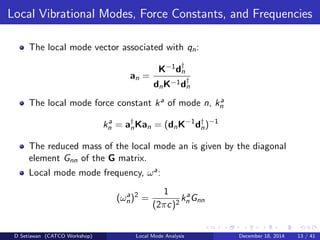
Normal modes are only electronically decoupled and therefore they are
still delocalized & cannot describe an individual (local) bond.
There have been many efforts to derive a “local” vibrational modes
(see D.Cremer & E. Kraka, Curr. Org. Chem., 2010, 14, 1524)
D Setiawan (CATCO Workshop) Local Mode Analysis December 18, 2014 6 / 41
Part I : Local Mode Analysis
D Setiawan (CATCO Workshop) Local Mode Analysis December 18, 2014 7 / 41
Konkoli-Cremer Local Vibrational Modes
Solving mass-decoupled Euler-Lagrange equations, driven by changes
in an associated internal coordinate:
setting all masses equal to zero with the exception of those of the
molecular fragment (e.g., bond AB)
It’s been proved that this is equivalent to requiring the adiabatic
relaxation of the rest of the molecule after displacement of the
specific internal coordinates (e.g., bond AB)
Z. Konkoli & D. Cremer, Int. J. Quant. Chem., 1998, 67, 1
D Setiawan (CATCO Workshop) Local Mode Analysis December 18, 2014 8 / 41
Normal Vibrational Frequencies (1)
Vibrational secular equation expressed in Cartesian coordinates:
Fx
L = MLΛ
Fx
, force constant matrix
L, collections of (re-normalized) normal vibrational eigenvectors, lµ
M, mass matrix
Λ, diagonal matrix with eigenvalues λµ = (2πcω)2
D Setiawan (CATCO Workshop) Local Mode Analysis December 18, 2014 9 / 41
Normal Vibrational Frequencies (2)
Vibrational secular equation expressed in internal coordinates:
Fq
D = G−1
DΛ
Fq
, force constant matrix (in terms of internal coordinates, qn)
D, collections of (re-normalized) normal vibrational eigenvectors, dµ
G, Wilson matrix; gives kinetic energy in terms of internal coordinates
Λ, diagonal matrix with eigenvalues λµ = (2πcω)2
D Setiawan (CATCO Workshop) Local Mode Analysis December 18, 2014 10 / 41
Cartesian & Internal Coordinates
Relationship between L and D:
L = CD
C is pseudo-inverse of B matrix;
B is first derivatives matrix of internal coordinates qn w.r.t. Cartesian
coordinates:
C = M−1
B†
G−1
in which:
Bni =
∂qn(x)
∂xi x=x0
D Setiawan (CATCO Workshop) Local Mode Analysis December 18, 2014 11 / 41
Some Important Relationships...
Normalization Cartesian Internal Equals to:
Coordinates Coordinates
Normalized
˜L†M˜L ˜D†G−1 ˜D I
˜L†Fx˜L ˜D†Fq ˜D Λ
Re-normalized
L†ML D†G−1D MR
L†FxL D†FqD K
K, is the diagonal normal force constant matrix
MR, is the reduced mass matrix, which elements are the
re-normalization constant MR
µ = 1
˜l†
µ
˜lµ
; i.e.
L = ˜L(MR
)
1
2
D Setiawan (CATCO Workshop) Local Mode Analysis December 18, 2014 12 / 41
Local Vibrational Modes, Force Constants, and Frequencies
The local mode vector associated with qn:
an =
K−1d†
n
dnK−1d†
n
The local mode force constant ka of mode n, ka
n
ka
n = a†
nKan = (dnK−1
d†
n)−1
The reduced mass of the local mode an is given by the diagonal
element Gnn of the G matrix.
Local mode mode frequency, ωa:
(ωa
n)2
=
1
(2πc)2
ka
nGnn
D Setiawan (CATCO Workshop) Local Mode Analysis December 18, 2014 13 / 41
Part II: Running the Local Mode Program
D Setiawan (CATCO Workshop) Local Mode Analysis December 18, 2014 14 / 41
Setting-up The Local Mode Program @ SMUHPC-3
Set-up The Local-Mode Program
export PATH=/users/chem/Software/ALM:$PATH
Set-up The Local-Mode Analysis Script
export PATH=/users/chem/Software/Python/bin/python:$PATH
alias alm-analysis=’python /users/chem/Software/ALM-scripts/local mode analysis.py’
D Setiawan (CATCO Workshop) Local Mode Analysis December 18, 2014 15 / 41
Running The Local Mode Program
General Syntax
alm.exe -b <input.alm >output.alm.out
D Setiawan (CATCO Workshop) Local Mode Analysis December 18, 2014 16 / 41
The Local Mode Program: Input Keywords
The manual is available at
SMUHPC:/users/chem/Software/ALM/manual
The example files at:
/users/chem/Software/ALM/CATCO-Workshop/
CONTROL
$contrl
qcprog=”ProgramName”
iprint=2
iredun=1
isymm=1
$end
D Setiawan (CATCO Workshop) Local Mode Analysis December 18, 2014 17 / 41
The Local Mode Program: Input Keywords
DATA
$qcdata
fchk=”filename.type”
$end
LOCAL MODE DESCRIPTIONS
$LocMod $End
2 1 0 0 PP
2 1 5 0 PPH
7 2 1 5 HPPH
D Setiawan (CATCO Workshop) Local Mode Analysis December 18, 2014 18 / 41
Output: Local Mode Frequencies, Force Const., etc.
D Setiawan (CATCO Workshop) Local Mode Analysis December 18, 2014 19 / 41
Output: Normal Mode Decomposition
D Setiawan (CATCO Workshop) Local Mode Analysis December 18, 2014 20 / 41
Part III: Bar Diagrams
D Setiawan (CATCO Workshop) Local Mode Analysis December 18, 2014 21 / 41
Bar Diagrams
Normal Mode Decomposition Bar Diagram:
The decomposition of each normal modes into its local mode
components
Inverted Bar Diagram:
Possible association of local modes to multiple different normal modes
Important Notes: For creating Bar Diagrams and Adiabatic
Connection Scheme (ACS), complete set of (3N-6) internal modes
need to be supplied!
D Setiawan (CATCO Workshop) Local Mode Analysis December 18, 2014 22 / 41
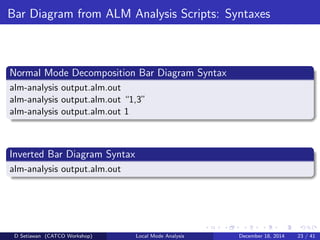
Bar Diagram from ALM Analysis Scripts: Syntaxes
Normal Mode Decomposition Bar Diagram Syntax
alm-analysis output.alm.out
alm-analysis output.alm.out “1,3”
alm-analysis output.alm.out 1
Inverted Bar Diagram Syntax
alm-analysis output.alm.out
D Setiawan (CATCO Workshop) Local Mode Analysis December 18, 2014 23 / 41
Bar Diagram from ALM Analysis Scripts: Output
The numerical argument in the syntax represent the modes to be
highlighted (yellow-colored)
Highlight mode has not yet implemented for the Inverted Bar Diagram
Output: Bar Diagrams (PDF), Normal Modes Decomposition Table
(TeX)
D Setiawan (CATCO Workshop) Local Mode Analysis December 18, 2014 24 / 41
Normal Mode Decomposition Bar Diagram
D Setiawan (CATCO Workshop) Local Mode Analysis December 18, 2014 25 / 41
Normal Mode Decomposition (Highlighted)
D Setiawan (CATCO Workshop) Local Mode Analysis December 18, 2014 26 / 41
Inverted Bar Diagram
D Setiawan (CATCO Workshop) Local Mode Analysis December 18, 2014 27 / 41
Part IV: Adiabatic Connection Scheme
D Setiawan (CATCO Workshop) Local Mode Analysis December 18, 2014 28 / 41
Adiabatic Connection Scheme (ACS)
Demonstrating the relationship of normal and local vibrational modes
Gives information about mass-coupling between local modes
Expressed in Decius’ compliance constants, Γn = 1
ka
n
:
(Γq
)−1 ˜D = G−1 ˜DΛ
G˜R = Γq ˜RΛ
which then matrix Γq
and G can be partitioned into its diagonal and
off-diagonal parts:
(Gd + λGod)˜Rλ = (Γq
d + λΓq
od)˜RλΛλ
The off-diagonal parts can be switched off by choosing scaling factor
λ = 0, thus a local (adiabatic) mode description is given.
D Setiawan (CATCO Workshop) Local Mode Analysis December 18, 2014 29 / 41
ACS from ALM Analysis Scripts: Syntaxes
Adiabatic Connection Scheme Syntax
alm-analysis output.alm.out job-ACSF.dat N
N = number of ACS plots to be made (i.e. division into different
frequency regions), default N = 1
D Setiawan (CATCO Workshop) Local Mode Analysis December 18, 2014 30 / 41
ACS: Lower Frequencies Region
0.0 0.1 0.2 0.3 0.4 0.5 0.6 0.7 0.8 0.9 1.0
Scaling Factor λ
0
150
300
450
600
750
900
1050
1200
LocalModeFrequenicesωa[cm−1
]
NormalModeFrequenciesωµ[cm−1
]
ωa(11),ωa(10),ωa(18)
ωa(8),ωa(9),ωa(1)
ωa(6),ωa(7)
ωa(15),ωa(16),ωa(14),ωa(17)
ωa(12),ωa(13)
ω1(Bu),ω2(Ag),ω3(Au)
ω4(Au),ω5(Bg)
ω6(Ag)
ω7(Bu),ω8(Ag)
ω9(Au),ω10(Bu),ω11(Bg)
ω12(Ag),ω13(Ag)
ω14(Bu)
pnicogen
D Setiawan (CATCO Workshop) Local Mode Analysis December 18, 2014 31 / 41
ACS: High Frequencies Region
0.0 0.1 0.2 0.3 0.4 0.5 0.6 0.7 0.8 0.9 1.0
Scaling Factor λ
2412
2416
2420
2424
2428
2432
2436
2440
2444
LocalModeFrequenicesωa[cm−1
]
NormalModeFrequenciesωµ[cm−1
]
ωa(3),ωa(2),ωa(5),ωa(4)
ω15(Ag)
ω16(Bu)
ω17(Bg)
ω18(Au)
pnicogen
D Setiawan (CATCO Workshop) Local Mode Analysis December 18, 2014 32 / 41
ACS Analysis from the ALM Scripts: Output
Output: ACS Plot(s) (PDF), Normal Modes Decomposition Table
(TeX), ACS Table (TeX)
The job-ACSF.dat file can also be plotted with DataGraph for a
publication-quality plots
D Setiawan (CATCO Workshop) Local Mode Analysis December 18, 2014 33 / 41
ACS DataGraph: Low Frequencies Region
NormalModeFrequenciesωμ[cm-1
]
P1
H7 H5
F3 P2
H6H8
F4
ω1(Bu)
ω2(Ag)ω3(Au)
ω6(Ag)
ω5(Bg)
ω4(Au)
P2 P1
F4-P2 P1
F3-P1 P2
F3-P1 P2-F4
H8-P2 P1
H5-P1 P2
A.C.
LocalModeFrequenciesωa
[cm-1
]
100
200
300
400
500
Scaling Factor λ
0 0.1 0.2 0.3 0.4 0.5 0.6 0.7 0.8 0.9 1.0
D Setiawan (CATCO Workshop) Local Mode Analysis December 18, 2014 34 / 41
ACS DataGraph: Mid Frequencies Region
NormalModeFrequenciesωμ[cm-1
]
P1
H7 H5
F3 P2
H6H8
F4
ω8(Ag)ω7(Bu)
ω9(Au)
ω11(Bg)
ω10(Bu)
ω12(Ag)ω13(Ag)
ω14(Bu)
F4-P2
F3-P1
H-P-F
H-P-H
LocalModeFrequenciesωa
[cm-1
]
800
900
1000
1100
Scaling Factor λ
0 0.1 0.2 0.3 0.4 0.5 0.6 0.7 0.8 0.9 1.0
D Setiawan (CATCO Workshop) Local Mode Analysis December 18, 2014 35 / 41
ACS DataGraph: High Frequencies Region
NormalModeFrequenciesωμ[cm-1
]
P1
H7 H5
F3 P2
H6H8
F4
ω15(Ag)ω16(Bu)
ω18(Au)
ω17(Bg)
H-P
LocalModeFrequenciesωa
[cm-1
]
2420
2430
2440
Scaling Factor λ
0 0.1 0.2 0.3 0.4 0.5 0.6 0.7 0.8 0.9 1.0
D Setiawan (CATCO Workshop) Local Mode Analysis December 18, 2014 36 / 41
Complete Set of Internal Modes
General rules: N bonds, (N-1) bond angles, (N-2) bond dihedrals
We have to account for each unique internal coordinate.
For the high symmetry systems this is easy;
For the low symmetry systems one has to run the job twice or 3
times and replace the coordinates to get all unique force constants.
This can be particularly tedious for ring molecules where we have to
make more than one (extra) run.
D Setiawan (CATCO Workshop) Local Mode Analysis December 18, 2014 37 / 41
Complete Set of Internal Modes
One must not violate some redundancy rules:
In a planar system, we must give angles that add up to 360◦
The third angle must be used in a second run after replacing one of the
previous ones.
The same holds for the 6 angles of a tetrahedral center.
If one needs the 6th
angle, another angle must be replaced by this
angle in a second run.
In 5-ring systems we can only take 2 ring bendings and 2 ring torsions
at a time (N-3) so that the 5th ring bending angle has to be done in a
2nd run.
With curvilinear coordinates this would be straightforward, however
there are no curvilinear coordinates in the force field program yet.
Hence they need all unique bending and torsional constants of the
ring.
D Setiawan (CATCO Workshop) Local Mode Analysis December 18, 2014 38 / 41
Questions?
D Setiawan (CATCO Workshop) Local Mode Analysis December 18, 2014 39 / 41
Exercises
SMUHPC-3:
/users/chem/Software/ALM/CATCO-Workshop/exercises
Comparing the local mode analysis results:
Do local mode analysis for pnicogen dimer calculated at CCSD(T) level
with CFOUR
Do another local mode analysis for pnicogen dimer calculated at DFT
level, corrected with the CCSD(T) frequencies
Compare the two results
Do the local mode analysis (include the ACS plots and Bar Diagrams)
for: Acetic Acid & Maleic Anhydride
C2
C1
H6
H8
H7
O4O3
H5
C5 C4
C2
O1
C3
O6O7
H9 H8
D Setiawan (CATCO Workshop) Local Mode Analysis December 18, 2014 40 / 41
Hints: Input Keywords
DATA, Program=”CFour”
$qcdata
fchk=”CFOUR.out”
$end
Experimental Freq.
$ExpFreq MODE=1 $End
1 78.0408 Bu
2 94.6217 Ag
3 113.7508 Au
D Setiawan (CATCO Workshop) Local Mode Analysis December 18, 2014 41 / 41

Local Vibrational Modes

  • 1.
    Local Mode Analysis DSetiawan Computational and Theoretical Chemistry Group Workshop Southern Methodist University dsetiawan@smu.edu December 18, 2014 D Setiawan (CATCO Workshop) Local Mode Analysis December 18, 2014 1 / 41
  • 2.
    Overview 1 Part I:Local Mode Analysis 2 Part II: Running the Local Mode Program 3 Part III: Bar Diagrams 4 Part IV: Adiabatic Connection Scheme D Setiawan (CATCO Workshop) Local Mode Analysis December 18, 2014 2 / 41
  • 3.
    How to Measurea Chemical Bond Strength? Bond Dissociation Energy (BDE)? 1532 Current Organic Chemistry, 2010, Vol. 14, No. 15 Cremer and Kraka to an analysis of the reaction path direction and its curvature [115- 124]. molecules, especially when hetero atoms are involved, these requirements are seldom fulfilled. However, even if the Fig. (2). Schematic representation of a Morse potential for the dissociation of the bond AB in HpA BHq. Bond dissociation energy BDE, intrinsic bond dissociation energy IBDE, fragment stabilisation energy ES=EDR+EGR, density reorganization energy EDR, geometry relaxation energy EGR, and compressibility limit distance dc are indicated. D.Cremer & E. Kraka, Curr. Org. Chem., 2010, 14, 1524 D Setiawan (CATCO Workshop) Local Mode Analysis December 18, 2014 3 / 41
  • 4.
    How to Measurea Chemical Bond Strength? A Better Measure: Intrinsic BDE 1532 Current Organic Chemistry, 2010, Vol. 14, No. 15 Cremer and Kraka to an analysis of the reaction path direction and its curvature [115- 124]. molecules, especially when hetero atoms are involved, these requirements are seldom fulfilled. However, even if the requirements would be fulfilled, the bond order defined in this way Fig. (2). Schematic representation of a Morse potential for the dissociation of the bond AB in HpA BHq. Bond dissociation energy BDE, intrinsic bond dissociation energy IBDE, fragment stabilisation energy ES=EDR+EGR, density reorganization energy EDR, geometry relaxation energy EGR, and compressibility limit distance dc are indicated. D.Cremer & E. Kraka, Curr. Org. Chem., 2010, 14, 1524 D Setiawan (CATCO Workshop) Local Mode Analysis December 18, 2014 4 / 41
  • 5.
    Vibrational Spectroscopy: ATool for Measuring IBDE Molecular vibrations can probe the strength of chemical bonds Vibrational frequency and force constant of a stretching vibration is related to the bond strength Problem: Normal vibrational modes are always delocalized as a result of kinematic coupling (mass-coupling) e.g. mode-mode couplings among stretching + bending + torsion modes Consequences: Normal modes from IR/Raman spectrums are not useful in describing chemical bonding informations are difficult to decipher in terms of internal parameter modes, e.g. a particular stretching mode D Setiawan (CATCO Workshop) Local Mode Analysis December 18, 2014 5 / 41
  • 6.
    Solution: Local VibrationalModes Normal modes are only electronically decoupled and therefore they are still delocalized & cannot describe an individual (local) bond. There have been many efforts to derive a “local” vibrational modes (see D.Cremer & E. Kraka, Curr. Org. Chem., 2010, 14, 1524) D Setiawan (CATCO Workshop) Local Mode Analysis December 18, 2014 6 / 41
  • 7.
    Part I :Local Mode Analysis D Setiawan (CATCO Workshop) Local Mode Analysis December 18, 2014 7 / 41
  • 8.
    Konkoli-Cremer Local VibrationalModes Solving mass-decoupled Euler-Lagrange equations, driven by changes in an associated internal coordinate: setting all masses equal to zero with the exception of those of the molecular fragment (e.g., bond AB) It’s been proved that this is equivalent to requiring the adiabatic relaxation of the rest of the molecule after displacement of the specific internal coordinates (e.g., bond AB) Z. Konkoli & D. Cremer, Int. J. Quant. Chem., 1998, 67, 1 D Setiawan (CATCO Workshop) Local Mode Analysis December 18, 2014 8 / 41
  • 9.
    Normal Vibrational Frequencies(1) Vibrational secular equation expressed in Cartesian coordinates: Fx L = MLΛ Fx , force constant matrix L, collections of (re-normalized) normal vibrational eigenvectors, lµ M, mass matrix Λ, diagonal matrix with eigenvalues λµ = (2πcω)2 D Setiawan (CATCO Workshop) Local Mode Analysis December 18, 2014 9 / 41
  • 10.
    Normal Vibrational Frequencies(2) Vibrational secular equation expressed in internal coordinates: Fq D = G−1 DΛ Fq , force constant matrix (in terms of internal coordinates, qn) D, collections of (re-normalized) normal vibrational eigenvectors, dµ G, Wilson matrix; gives kinetic energy in terms of internal coordinates Λ, diagonal matrix with eigenvalues λµ = (2πcω)2 D Setiawan (CATCO Workshop) Local Mode Analysis December 18, 2014 10 / 41
  • 11.
    Cartesian & InternalCoordinates Relationship between L and D: L = CD C is pseudo-inverse of B matrix; B is first derivatives matrix of internal coordinates qn w.r.t. Cartesian coordinates: C = M−1 B† G−1 in which: Bni = ∂qn(x) ∂xi x=x0 D Setiawan (CATCO Workshop) Local Mode Analysis December 18, 2014 11 / 41
  • 12.
    Some Important Relationships... NormalizationCartesian Internal Equals to: Coordinates Coordinates Normalized ˜L†M˜L ˜D†G−1 ˜D I ˜L†Fx˜L ˜D†Fq ˜D Λ Re-normalized L†ML D†G−1D MR L†FxL D†FqD K K, is the diagonal normal force constant matrix MR, is the reduced mass matrix, which elements are the re-normalization constant MR µ = 1 ˜l† µ ˜lµ ; i.e. L = ˜L(MR ) 1 2 D Setiawan (CATCO Workshop) Local Mode Analysis December 18, 2014 12 / 41
  • 13.
    Local Vibrational Modes,Force Constants, and Frequencies The local mode vector associated with qn: an = K−1d† n dnK−1d† n The local mode force constant ka of mode n, ka n ka n = a† nKan = (dnK−1 d† n)−1 The reduced mass of the local mode an is given by the diagonal element Gnn of the G matrix. Local mode mode frequency, ωa: (ωa n)2 = 1 (2πc)2 ka nGnn D Setiawan (CATCO Workshop) Local Mode Analysis December 18, 2014 13 / 41
  • 14.
    Part II: Runningthe Local Mode Program D Setiawan (CATCO Workshop) Local Mode Analysis December 18, 2014 14 / 41
  • 15.
    Setting-up The LocalMode Program @ SMUHPC-3 Set-up The Local-Mode Program export PATH=/users/chem/Software/ALM:$PATH Set-up The Local-Mode Analysis Script export PATH=/users/chem/Software/Python/bin/python:$PATH alias alm-analysis=’python /users/chem/Software/ALM-scripts/local mode analysis.py’ D Setiawan (CATCO Workshop) Local Mode Analysis December 18, 2014 15 / 41
  • 16.
    Running The LocalMode Program General Syntax alm.exe -b <input.alm >output.alm.out D Setiawan (CATCO Workshop) Local Mode Analysis December 18, 2014 16 / 41
  • 17.
    The Local ModeProgram: Input Keywords The manual is available at SMUHPC:/users/chem/Software/ALM/manual The example files at: /users/chem/Software/ALM/CATCO-Workshop/ CONTROL $contrl qcprog=”ProgramName” iprint=2 iredun=1 isymm=1 $end D Setiawan (CATCO Workshop) Local Mode Analysis December 18, 2014 17 / 41
  • 18.
    The Local ModeProgram: Input Keywords DATA $qcdata fchk=”filename.type” $end LOCAL MODE DESCRIPTIONS $LocMod $End 2 1 0 0 PP 2 1 5 0 PPH 7 2 1 5 HPPH D Setiawan (CATCO Workshop) Local Mode Analysis December 18, 2014 18 / 41
  • 19.
    Output: Local ModeFrequencies, Force Const., etc. D Setiawan (CATCO Workshop) Local Mode Analysis December 18, 2014 19 / 41
  • 20.
    Output: Normal ModeDecomposition D Setiawan (CATCO Workshop) Local Mode Analysis December 18, 2014 20 / 41
  • 21.
    Part III: BarDiagrams D Setiawan (CATCO Workshop) Local Mode Analysis December 18, 2014 21 / 41
  • 22.
    Bar Diagrams Normal ModeDecomposition Bar Diagram: The decomposition of each normal modes into its local mode components Inverted Bar Diagram: Possible association of local modes to multiple different normal modes Important Notes: For creating Bar Diagrams and Adiabatic Connection Scheme (ACS), complete set of (3N-6) internal modes need to be supplied! D Setiawan (CATCO Workshop) Local Mode Analysis December 18, 2014 22 / 41
  • 23.
    Bar Diagram fromALM Analysis Scripts: Syntaxes Normal Mode Decomposition Bar Diagram Syntax alm-analysis output.alm.out alm-analysis output.alm.out “1,3” alm-analysis output.alm.out 1 Inverted Bar Diagram Syntax alm-analysis output.alm.out D Setiawan (CATCO Workshop) Local Mode Analysis December 18, 2014 23 / 41
  • 24.
    Bar Diagram fromALM Analysis Scripts: Output The numerical argument in the syntax represent the modes to be highlighted (yellow-colored) Highlight mode has not yet implemented for the Inverted Bar Diagram Output: Bar Diagrams (PDF), Normal Modes Decomposition Table (TeX) D Setiawan (CATCO Workshop) Local Mode Analysis December 18, 2014 24 / 41
  • 25.
    Normal Mode DecompositionBar Diagram D Setiawan (CATCO Workshop) Local Mode Analysis December 18, 2014 25 / 41
  • 26.
    Normal Mode Decomposition(Highlighted) D Setiawan (CATCO Workshop) Local Mode Analysis December 18, 2014 26 / 41
  • 27.
    Inverted Bar Diagram DSetiawan (CATCO Workshop) Local Mode Analysis December 18, 2014 27 / 41
  • 28.
    Part IV: AdiabaticConnection Scheme D Setiawan (CATCO Workshop) Local Mode Analysis December 18, 2014 28 / 41
  • 29.
    Adiabatic Connection Scheme(ACS) Demonstrating the relationship of normal and local vibrational modes Gives information about mass-coupling between local modes Expressed in Decius’ compliance constants, Γn = 1 ka n : (Γq )−1 ˜D = G−1 ˜DΛ G˜R = Γq ˜RΛ which then matrix Γq and G can be partitioned into its diagonal and off-diagonal parts: (Gd + λGod)˜Rλ = (Γq d + λΓq od)˜RλΛλ The off-diagonal parts can be switched off by choosing scaling factor λ = 0, thus a local (adiabatic) mode description is given. D Setiawan (CATCO Workshop) Local Mode Analysis December 18, 2014 29 / 41
  • 30.
    ACS from ALMAnalysis Scripts: Syntaxes Adiabatic Connection Scheme Syntax alm-analysis output.alm.out job-ACSF.dat N N = number of ACS plots to be made (i.e. division into different frequency regions), default N = 1 D Setiawan (CATCO Workshop) Local Mode Analysis December 18, 2014 30 / 41
  • 31.
    ACS: Lower FrequenciesRegion 0.0 0.1 0.2 0.3 0.4 0.5 0.6 0.7 0.8 0.9 1.0 Scaling Factor λ 0 150 300 450 600 750 900 1050 1200 LocalModeFrequenicesωa[cm−1 ] NormalModeFrequenciesωµ[cm−1 ] ωa(11),ωa(10),ωa(18) ωa(8),ωa(9),ωa(1) ωa(6),ωa(7) ωa(15),ωa(16),ωa(14),ωa(17) ωa(12),ωa(13) ω1(Bu),ω2(Ag),ω3(Au) ω4(Au),ω5(Bg) ω6(Ag) ω7(Bu),ω8(Ag) ω9(Au),ω10(Bu),ω11(Bg) ω12(Ag),ω13(Ag) ω14(Bu) pnicogen D Setiawan (CATCO Workshop) Local Mode Analysis December 18, 2014 31 / 41
  • 32.
    ACS: High FrequenciesRegion 0.0 0.1 0.2 0.3 0.4 0.5 0.6 0.7 0.8 0.9 1.0 Scaling Factor λ 2412 2416 2420 2424 2428 2432 2436 2440 2444 LocalModeFrequenicesωa[cm−1 ] NormalModeFrequenciesωµ[cm−1 ] ωa(3),ωa(2),ωa(5),ωa(4) ω15(Ag) ω16(Bu) ω17(Bg) ω18(Au) pnicogen D Setiawan (CATCO Workshop) Local Mode Analysis December 18, 2014 32 / 41
  • 33.
    ACS Analysis fromthe ALM Scripts: Output Output: ACS Plot(s) (PDF), Normal Modes Decomposition Table (TeX), ACS Table (TeX) The job-ACSF.dat file can also be plotted with DataGraph for a publication-quality plots D Setiawan (CATCO Workshop) Local Mode Analysis December 18, 2014 33 / 41
  • 34.
    ACS DataGraph: LowFrequencies Region NormalModeFrequenciesωμ[cm-1 ] P1 H7 H5 F3 P2 H6H8 F4 ω1(Bu) ω2(Ag)ω3(Au) ω6(Ag) ω5(Bg) ω4(Au) P2 P1 F4-P2 P1 F3-P1 P2 F3-P1 P2-F4 H8-P2 P1 H5-P1 P2 A.C. LocalModeFrequenciesωa [cm-1 ] 100 200 300 400 500 Scaling Factor λ 0 0.1 0.2 0.3 0.4 0.5 0.6 0.7 0.8 0.9 1.0 D Setiawan (CATCO Workshop) Local Mode Analysis December 18, 2014 34 / 41
  • 35.
    ACS DataGraph: MidFrequencies Region NormalModeFrequenciesωμ[cm-1 ] P1 H7 H5 F3 P2 H6H8 F4 ω8(Ag)ω7(Bu) ω9(Au) ω11(Bg) ω10(Bu) ω12(Ag)ω13(Ag) ω14(Bu) F4-P2 F3-P1 H-P-F H-P-H LocalModeFrequenciesωa [cm-1 ] 800 900 1000 1100 Scaling Factor λ 0 0.1 0.2 0.3 0.4 0.5 0.6 0.7 0.8 0.9 1.0 D Setiawan (CATCO Workshop) Local Mode Analysis December 18, 2014 35 / 41
  • 36.
    ACS DataGraph: HighFrequencies Region NormalModeFrequenciesωμ[cm-1 ] P1 H7 H5 F3 P2 H6H8 F4 ω15(Ag)ω16(Bu) ω18(Au) ω17(Bg) H-P LocalModeFrequenciesωa [cm-1 ] 2420 2430 2440 Scaling Factor λ 0 0.1 0.2 0.3 0.4 0.5 0.6 0.7 0.8 0.9 1.0 D Setiawan (CATCO Workshop) Local Mode Analysis December 18, 2014 36 / 41
  • 37.
    Complete Set ofInternal Modes General rules: N bonds, (N-1) bond angles, (N-2) bond dihedrals We have to account for each unique internal coordinate. For the high symmetry systems this is easy; For the low symmetry systems one has to run the job twice or 3 times and replace the coordinates to get all unique force constants. This can be particularly tedious for ring molecules where we have to make more than one (extra) run. D Setiawan (CATCO Workshop) Local Mode Analysis December 18, 2014 37 / 41
  • 38.
    Complete Set ofInternal Modes One must not violate some redundancy rules: In a planar system, we must give angles that add up to 360◦ The third angle must be used in a second run after replacing one of the previous ones. The same holds for the 6 angles of a tetrahedral center. If one needs the 6th angle, another angle must be replaced by this angle in a second run. In 5-ring systems we can only take 2 ring bendings and 2 ring torsions at a time (N-3) so that the 5th ring bending angle has to be done in a 2nd run. With curvilinear coordinates this would be straightforward, however there are no curvilinear coordinates in the force field program yet. Hence they need all unique bending and torsional constants of the ring. D Setiawan (CATCO Workshop) Local Mode Analysis December 18, 2014 38 / 41
  • 39.
    Questions? D Setiawan (CATCOWorkshop) Local Mode Analysis December 18, 2014 39 / 41
  • 40.
    Exercises SMUHPC-3: /users/chem/Software/ALM/CATCO-Workshop/exercises Comparing the localmode analysis results: Do local mode analysis for pnicogen dimer calculated at CCSD(T) level with CFOUR Do another local mode analysis for pnicogen dimer calculated at DFT level, corrected with the CCSD(T) frequencies Compare the two results Do the local mode analysis (include the ACS plots and Bar Diagrams) for: Acetic Acid & Maleic Anhydride C2 C1 H6 H8 H7 O4O3 H5 C5 C4 C2 O1 C3 O6O7 H9 H8 D Setiawan (CATCO Workshop) Local Mode Analysis December 18, 2014 40 / 41
  • 41.
    Hints: Input Keywords DATA,Program=”CFour” $qcdata fchk=”CFOUR.out” $end Experimental Freq. $ExpFreq MODE=1 $End 1 78.0408 Bu 2 94.6217 Ag 3 113.7508 Au D Setiawan (CATCO Workshop) Local Mode Analysis December 18, 2014 41 / 41