Group 5 Anirudh Vemula Jason Rager Joaquin Hirschfeld Junya Tomoi Olukayode Afolabi Shanyu Lao Pia Yasuko Rask Enron Sutton Bridge Power Project
Agenda Project Background Ownership & Equity Consortium Term sheet & Funding Financial Model Risks & Mitigation Sensitivity Analysis Key Lessons What’s Happened since?
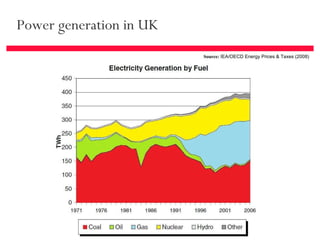
Power generation in UK Source:  IEA/OECD Energy Prices & Taxes (2008)
Traditional Electricity Market
A deregulated electricity market
Setting the Price 24 hours, broken into 48 ½-hours Demand forecasted by National Grid Generators asked how much at what price for each slot Marginal generator decides the price    Rapidly changing and volatile market! Time   10-10.30AM Demand forecast:    10MW Generator Price Amount Total A 0.7 2MW 2MW B  0.8 3MW 5MW C 0.8 5MW 10MW D 0.9     E 0.1     F  0.1     N N    
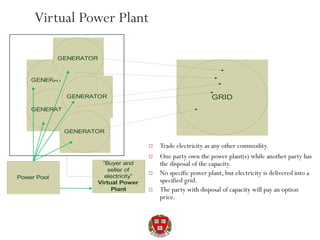
Virtual Power Plant Trade electricity as any other commodity.  One party own the power plant(s) while another party has the disposal of the capacity.  No specific power plant, but electricity is delivered into a specified grid.  The party with disposal of capacity will pay an option price.
The Project
The Project
The Project (cont.)
www.berr.gov.uk/files/file15116.pdf O&M Construction Equity Power Supply
Major stakeholders Eastern   Facing deregulation & regulation More options, Expand business opportunity . Reach its generating capacity restriction by r egulat ion. –Cannot be in Equity Consortium! Enron   High capability of managing risk (ex. derivatives),  More profit, more risk!! GE   Wants to  sell  new turbine s and O&M contractor.
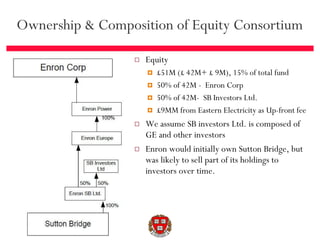
Ownership & Composition of Equity Consortium Equity £51M (£ 42M+ £ 9M), 15% of total fund 50% of 42M -  Enron Corp 50% of 42M-  SB Investors Ltd. £9MM from Eastern Electricity as Up-front fee We assume SB investors Ltd. is composed of  GE and other investors Enron would initially own Sutton Bridge, but was likely to sell part of its holdings to investors over time.
Funding Structure
Debt structure Sterling Bond Dollar Bond Rate BBB Tenor 25 years Total amount £28 6 M Arranger Barclays Merrill Lynch Amount £ 195M £ 9 1 M ($150M) Coupon rate 8.625% 7.97% Issued At 99.523 At  par Others Fully amortizing from 2002 until maturity in 2022 Rule 144A, issued May 1997
Term Sheet/Bond Structure Strengths of Contractual set up Strong Equity Partners: Enron (BBB+) assumes construction, market, gas supply risk GE (AAA) guarantees turbine performance, O&M agreement. CTA covers all fixed and most variable payments until 2014 CCGT replaces coal-fired generation technology
Term Sheet/Bond Structure Strengths of Contractual set up contd: Only 30% debt left during merchant period, potentially unlimited profit for Enron Bond will rank  pari passu  in right of payment with all future  additional senior debts Debt Service Reserve Account Healthy DSCR  & Interest Coverage ratios Swap Agreement mitigate currency risk Results: Both bonds were well oversubscribed
Capacity Tolling Agreements (CTA) Eastern/Enron CTA Enron  / Sutton-Bridge CTA Term 15 Years beginning May 1, 1999 Same Fixed Payments £9M Upfront One-Time £ 68.8M per Annum, Payable on a Daily Basis Actual fixed costs  Variable Payments £ 357.50 per Half-Hour Each Start-up/Shutdown costs Two Half-Hour Periods Eastern will Pay for 15,000 Half-Hour Periods per Year Actual variable costs Maximum Contractual Volume 700MW April to September  735MW October to March Eastern Provides Contractual Capacity for Each Half-Hour Period Eastern Provides an Estimate for Volume of Gas to be Delivered Same capacity
Capacity Tolling Agreements (CTA) Eastern/Enron CTA Enron  / Sutton-Bridge CTA Force Majeure Relieves both parties of their obligations, but only to the extent that the affected party(s) is prevented from complying with their obligations Credit Terms Each company will provide reasonable credit support including a parent company guarantee.
So, What’s in it for Eastern?
What’s in it for Enron? Strengthen its Reputation as an Innovator Further Develop its European Trading Operations Power Plant Enters the Merchant Phase after Expiration of the CTA Unbounded Returns Hedge Risk and Lower Costs through Trading Electricity & Natural Gas Contracts
Assumptions Physical Plant capacity: 790 MW Permitted generating capacity: 700 MW (Apr-Sep) 735 MW (Oct-Mar) Average annual generating capacity (max): 717.5 MW Min. number of operating days: 312.5 days Sales price of electricity (1996) 0.02386 £/kWh Cost of Natural Gas (1996) 1.28 £/MMBTU Escalation rate (assumed) 5% WACC (Calculated) 6.53% Financial model description
Results/Projections
Results/Projections (2) Revenue & EBITDA Profit
Results/Projections (3) Cash Flow & NPV (15yr period) NPV: £  252,466,324.80 300 250 200 150 100 50 0 -50 -100 -150 -200 -250 -300 Terminal value
Gas Purchase &  Electricity Off-take Construction Contract Fluctuating Market Prices Long-term Project Bonds after CTA? CTA period of 15 years? Force Majeure Political Currency & Exchange Rate New Turbine Technology Enron-Sutton Project “ A House of Risk?” Not structured as a traditional IPP, so Enron assumes more risks in expectation of better returns! Legal O & M Risks & Mitigation
Why assume all these risks? Extensive risk mitigation in a traditional IPP leads to a low-risk/low-return investment Development fee (about 4% of total investment) and annuity spread from on-going operations produced acceptable though not exceptional returns. Traditional IPP Structure did not capitalize on Enron's Strengths in trading & risk management In summary, Enron was willing to take  MORE RISK  in exchange for  BIGGER RETURNS
Actual Risks & Mitigation Project Level Risks Cost overrun – Fixed Equipment prices Completion Risks – GE ‘new product' guarantee against completion delays and performance problems. Completion tests verified by an independent consultant Technology – GE to guarantee plant performance for the duration of the life of the project Financial Risks  Exchange rate – SWAPs arrangement, Options Merchant phase risk – Enron to ensure most of project debt is repaid within the 15-year period of  CTA. Enron also to issue long project bonds. (Supported by Enron Treasury Group) O&M Risks GE to operate the plant on a fixed-price management fee ( allowed GE to expand its service operations )
Actual Risks & Mitigation Economic Risks During CTA - Fixed payment by Enron covers all fixed and operating costs. No pool risk.  Supply of Gas at fixed prices After CTA - Most project debt to be repaid during the  CTA phase Market Conditions - Enron traders role in determining operating or dispatch decisions (long & short positions) DSCR
IRR EQ. IRR
Risk Matrix
Risks Classification & Ratings (Sutton Bridge Project) Step 5: Credit Enhancements (10%) Step 4: Force Majeure Risk (10%) Step 3: Institutional Risk (17%) Step 1: Project-Level Risk (20%) Step 2: Sovereign Risk (23%) 30% 15% 20% 10% 25% Total of 80%. We apply a rating of ‘BBB’
Sensitivity Analysis (Project IRR)
 
Sensitivity Analysis (Project IRR cont)
Sensitivity Analysis (Equity IRR)
Sensitivity Analysis (DSCR)
Sensitivity Analysis (DSCR cont)
Key Lessons As one of the earliest virtual power plants it was able to float with no PPA. Innovation in adapting to new opportunity in regards to the new regulations. Securing investment grade rating despite having no Power Purchase Agreement Extensive risk mitigation in a traditional IPP leads to a low-risk/low-return investment
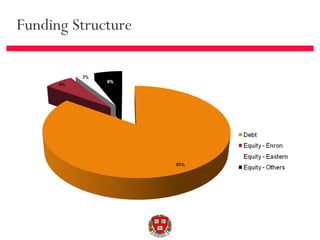
Project Financing was done with   a  great Debt-Equity Ratio. Project enable to unbounded returns with limited loss. Key Lessons   (Millions) Amount  Percent Long Term Debt:     Total  Long Term Debt £286.00  85.%       Equity:     Partners Equity £51.00  15%       Total Capitalization £337.0  100.0%
What Happened Since Enron put Sutton Bridge up for sale in Sept 1999, just four months after it went into operation.  London Electricity, through its affiliate London Power,  agreed to buy Enron's equity interest in Sutton Bridge power station. The pant was purchased for £156million plus working capital balances of £ 22.8 million and assumed  £286 million of debt EDF announced in 2008 that it would sell Sutton Bridge to overcome objections to its takeover of British Energy.
What Happened Since Enron reported earnings of $101 billion in 2000. Enron used accounting techniques to prevent significant losses from appearing on its financial statements. Enron Corporation filed for Bankruptcy on late 2001.
What happened Since Eastern Group is to change its name to TXU Europe following its recent acquisition by Texas Utilities, although the Eastern name will be retained for its UK power distribution and household electricity supply businesses. The Eastern Group, is well on the way to generating 10% of its electricity from renewable sources by the year 2010.
Thank you for your time   Interested in doing business with us? Contact us at: 617-123-1234

Enron Sutton Bridge Power Project

  • 1.
    Group 5 AnirudhVemula Jason Rager Joaquin Hirschfeld Junya Tomoi Olukayode Afolabi Shanyu Lao Pia Yasuko Rask Enron Sutton Bridge Power Project
  • 2.
    Agenda Project BackgroundOwnership & Equity Consortium Term sheet & Funding Financial Model Risks & Mitigation Sensitivity Analysis Key Lessons What’s Happened since?
  • 3.
    Power generation inUK Source: IEA/OECD Energy Prices & Taxes (2008)
  • 4.
  • 5.
  • 6.
    Setting the Price24 hours, broken into 48 ½-hours Demand forecasted by National Grid Generators asked how much at what price for each slot Marginal generator decides the price  Rapidly changing and volatile market! Time   10-10.30AM Demand forecast:   10MW Generator Price Amount Total A 0.7 2MW 2MW B 0.8 3MW 5MW C 0.8 5MW 10MW D 0.9     E 0.1     F 0.1     N N    
  • 7.
    Virtual Power PlantTrade electricity as any other commodity. One party own the power plant(s) while another party has the disposal of the capacity. No specific power plant, but electricity is delivered into a specified grid. The party with disposal of capacity will pay an option price.
  • 8.
  • 9.
  • 10.
  • 11.
  • 12.
    Major stakeholders Eastern Facing deregulation & regulation More options, Expand business opportunity . Reach its generating capacity restriction by r egulat ion. –Cannot be in Equity Consortium! Enron High capability of managing risk (ex. derivatives), More profit, more risk!! GE Wants to sell new turbine s and O&M contractor.
  • 13.
    Ownership & Compositionof Equity Consortium Equity £51M (£ 42M+ £ 9M), 15% of total fund 50% of 42M - Enron Corp 50% of 42M- SB Investors Ltd. £9MM from Eastern Electricity as Up-front fee We assume SB investors Ltd. is composed of GE and other investors Enron would initially own Sutton Bridge, but was likely to sell part of its holdings to investors over time.
  • 14.
  • 15.
    Debt structure SterlingBond Dollar Bond Rate BBB Tenor 25 years Total amount £28 6 M Arranger Barclays Merrill Lynch Amount £ 195M £ 9 1 M ($150M) Coupon rate 8.625% 7.97% Issued At 99.523 At par Others Fully amortizing from 2002 until maturity in 2022 Rule 144A, issued May 1997
  • 16.
    Term Sheet/Bond StructureStrengths of Contractual set up Strong Equity Partners: Enron (BBB+) assumes construction, market, gas supply risk GE (AAA) guarantees turbine performance, O&M agreement. CTA covers all fixed and most variable payments until 2014 CCGT replaces coal-fired generation technology
  • 17.
    Term Sheet/Bond StructureStrengths of Contractual set up contd: Only 30% debt left during merchant period, potentially unlimited profit for Enron Bond will rank pari passu in right of payment with all future additional senior debts Debt Service Reserve Account Healthy DSCR & Interest Coverage ratios Swap Agreement mitigate currency risk Results: Both bonds were well oversubscribed
  • 18.
    Capacity Tolling Agreements(CTA) Eastern/Enron CTA Enron / Sutton-Bridge CTA Term 15 Years beginning May 1, 1999 Same Fixed Payments £9M Upfront One-Time £ 68.8M per Annum, Payable on a Daily Basis Actual fixed costs Variable Payments £ 357.50 per Half-Hour Each Start-up/Shutdown costs Two Half-Hour Periods Eastern will Pay for 15,000 Half-Hour Periods per Year Actual variable costs Maximum Contractual Volume 700MW April to September 735MW October to March Eastern Provides Contractual Capacity for Each Half-Hour Period Eastern Provides an Estimate for Volume of Gas to be Delivered Same capacity
  • 19.
    Capacity Tolling Agreements(CTA) Eastern/Enron CTA Enron / Sutton-Bridge CTA Force Majeure Relieves both parties of their obligations, but only to the extent that the affected party(s) is prevented from complying with their obligations Credit Terms Each company will provide reasonable credit support including a parent company guarantee.
  • 20.
    So, What’s init for Eastern?
  • 21.
    What’s in itfor Enron? Strengthen its Reputation as an Innovator Further Develop its European Trading Operations Power Plant Enters the Merchant Phase after Expiration of the CTA Unbounded Returns Hedge Risk and Lower Costs through Trading Electricity & Natural Gas Contracts
  • 22.
    Assumptions Physical Plantcapacity: 790 MW Permitted generating capacity: 700 MW (Apr-Sep) 735 MW (Oct-Mar) Average annual generating capacity (max): 717.5 MW Min. number of operating days: 312.5 days Sales price of electricity (1996) 0.02386 £/kWh Cost of Natural Gas (1996) 1.28 £/MMBTU Escalation rate (assumed) 5% WACC (Calculated) 6.53% Financial model description
  • 23.
  • 24.
  • 25.
    Results/Projections (3) CashFlow & NPV (15yr period) NPV: £ 252,466,324.80 300 250 200 150 100 50 0 -50 -100 -150 -200 -250 -300 Terminal value
  • 26.
    Gas Purchase & Electricity Off-take Construction Contract Fluctuating Market Prices Long-term Project Bonds after CTA? CTA period of 15 years? Force Majeure Political Currency & Exchange Rate New Turbine Technology Enron-Sutton Project “ A House of Risk?” Not structured as a traditional IPP, so Enron assumes more risks in expectation of better returns! Legal O & M Risks & Mitigation
  • 27.
    Why assume allthese risks? Extensive risk mitigation in a traditional IPP leads to a low-risk/low-return investment Development fee (about 4% of total investment) and annuity spread from on-going operations produced acceptable though not exceptional returns. Traditional IPP Structure did not capitalize on Enron's Strengths in trading & risk management In summary, Enron was willing to take MORE RISK in exchange for BIGGER RETURNS
  • 28.
    Actual Risks &Mitigation Project Level Risks Cost overrun – Fixed Equipment prices Completion Risks – GE ‘new product' guarantee against completion delays and performance problems. Completion tests verified by an independent consultant Technology – GE to guarantee plant performance for the duration of the life of the project Financial Risks Exchange rate – SWAPs arrangement, Options Merchant phase risk – Enron to ensure most of project debt is repaid within the 15-year period of CTA. Enron also to issue long project bonds. (Supported by Enron Treasury Group) O&M Risks GE to operate the plant on a fixed-price management fee ( allowed GE to expand its service operations )
  • 29.
    Actual Risks &Mitigation Economic Risks During CTA - Fixed payment by Enron covers all fixed and operating costs. No pool risk. Supply of Gas at fixed prices After CTA - Most project debt to be repaid during the CTA phase Market Conditions - Enron traders role in determining operating or dispatch decisions (long & short positions) DSCR
  • 30.
  • 31.
  • 32.
    Risks Classification &Ratings (Sutton Bridge Project) Step 5: Credit Enhancements (10%) Step 4: Force Majeure Risk (10%) Step 3: Institutional Risk (17%) Step 1: Project-Level Risk (20%) Step 2: Sovereign Risk (23%) 30% 15% 20% 10% 25% Total of 80%. We apply a rating of ‘BBB’
  • 33.
  • 34.
  • 35.
  • 36.
  • 37.
  • 38.
  • 39.
    Key Lessons Asone of the earliest virtual power plants it was able to float with no PPA. Innovation in adapting to new opportunity in regards to the new regulations. Securing investment grade rating despite having no Power Purchase Agreement Extensive risk mitigation in a traditional IPP leads to a low-risk/low-return investment
  • 40.
    Project Financing wasdone with a great Debt-Equity Ratio. Project enable to unbounded returns with limited loss. Key Lessons   (Millions) Amount Percent Long Term Debt:     Total Long Term Debt £286.00 85.%       Equity:     Partners Equity £51.00 15%       Total Capitalization £337.0 100.0%
  • 41.
    What Happened SinceEnron put Sutton Bridge up for sale in Sept 1999, just four months after it went into operation. London Electricity, through its affiliate London Power, agreed to buy Enron's equity interest in Sutton Bridge power station. The pant was purchased for £156million plus working capital balances of £ 22.8 million and assumed £286 million of debt EDF announced in 2008 that it would sell Sutton Bridge to overcome objections to its takeover of British Energy.
  • 42.
    What Happened SinceEnron reported earnings of $101 billion in 2000. Enron used accounting techniques to prevent significant losses from appearing on its financial statements. Enron Corporation filed for Bankruptcy on late 2001.
  • 43.
    What happened SinceEastern Group is to change its name to TXU Europe following its recent acquisition by Texas Utilities, although the Eastern name will be retained for its UK power distribution and household electricity supply businesses. The Eastern Group, is well on the way to generating 10% of its electricity from renewable sources by the year 2010.
  • 44.
    Thank you foryour time Interested in doing business with us? Contact us at: 617-123-1234

Editor's Notes

  • #6 Privatization and restructuring of the markets in UK – ahead of the EU Competition both vertically and horizontally. Generation (77% concentrated on 3 firms, no 4: Eastern – cannot own any more power generation facilities, Enron – largest non-regulated merchant of power) Transmission (1 company, National Grid) Distribution & Supply (Eastern largest of 12 Regional Electrical Companies appointed, no free choice of supplier for non-industrial customers) Selling to Pool (Clearing House) Enormous new commercial opportunies Separating gas transportation from supply Transportation (Transco) Supply: 50 different Eastern – 2nd largest through take or pay contracts + equity stakes) Enron also take or pay contracts for North Sea
  • #8 Electricity generated anywhere in GB can be used elsewhere in GB to satisfy demand
  • #9 Eastern and Enron pays GAS+Option price and gets the revenue – the pool price – in return.
  • #10 ENRON Link energy infrastructure development to trading, with Sutton Bridge ”shovel ready” Enron exposed to the differences between actual and contracted levels of plant performance. General contractor As a result, the plant would become part of their risk books containing the firm’s long and short positions in gas and power. This organizational structure ensured that the plant would run only when it was optimal to do so, i.e., when the gas input price plus operating expenses were less than pool prices. Like Eastern, Enron saw the deal as a way to further develop its European trading operations and strengthen its reputation as an innovator in the rapidly changing European energy markets. EASTERN Suppliers were limited in ownership of generation – Eastern reached limit  Deliver economics of building new CCGT power plant, without owning plant, i.e. outlet for gas reserves and additional capacity for trading – ”economic ownership instead of legal” Arbitrage between gas and electricity markets