Ethiopian Open Government
Data Initiative
Presented by
Abiyot Bayou (Phd)
abiyot.bayou@mcit.gov.et
Ethiopian Ministry of Communication and Information Technology
E-Government Directorate
December 28, 2015
1
Open data
• is the idea that certain data should be
– freely available
– to everyone
– to use and republish as they wish,
– without restrictions from copyright, patents or
other mechanisms of control.
2
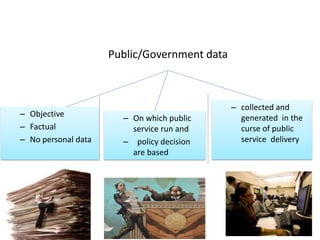
Public/Government data
3
– Objective
– Factual
– No personal data
– On which public
service run and
– policy decision
are based
– collected and
generated in the
curse of public
service delivery
4
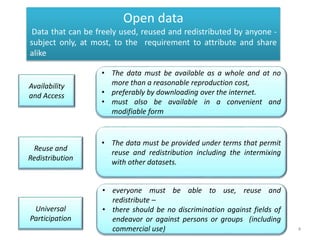
• The data must be available as a whole and at no
more than a reasonable reproduction cost,
• preferably by downloading over the internet.
• must also be available in a convenient and
modifiable form
Availability
and Access
Reuse and
Redistribution
• The data must be provided under terms that permit
reuse and redistribution including the intermixing
with other datasets.
Universal
Participation
• everyone must be able to use, reuse and
redistribute –
• there should be no discrimination against fields of
endeavor or against persons or groups (including
commercial use)
Open data
Data that can be freely used, reused and redistributed by anyone -
subject only, at most, to the requirement to attribute and share
alike
• Open Government
– Government should be
– Transparent:
with information about agency operations and
decisions available to the public online.
– participatory,
tapping the collective expertise of the public in
government decision-making processes.
– collaborative,
using technology to share and cooperate with other
agencies, businesses and nonprofits, and the public at
large.
5
What is Open Government data
• Public data
– help people understand how government works
and how policies are made
• Already available,
– “Open” brings it together in one searchable
website.
• Making this data easily available
– it will be easier for people to make decisions
and suggestions about government policies
based on detailed information.
• Improving the relationship between the
government and its constituents
• Encourage “Government as a platform”,
• Citizens can use open government data to build
their own tools and collaborate directly in the
process of governing
• Promote Data Journalism
Example: The White House
digital government
strategy
– explicitly embraces
releasing open data in
APIs to enable more
accountability, civic utility
and economic value
creation.
6
Benefits of Open Government Data
 Transparency.
 Citizens need to know what their government is doing.
 They need to be able freely to access government data and information and to share that
information with other citizens.
 Sharing and reuse allows analysing and visualising to create more understanding.
 Releasing social and commercial value.
 Data is a key resource for social and commercial activities.
 Governments as one of the largest producers and collectors of data
 Open government data can help drive the creation of innovative business and services that deliver
social and commercial value.
 Participatory governance.
 Directly informed and involved in decision-making
• opportunity to actively participate in governance processes, (Not only Voting)
• able to make better decisions
 Reducing government costs.
 sharing of information within governments in machine-readable interoperable formats,
 Innovative services
7
8
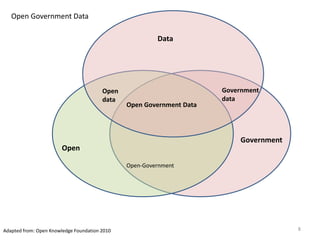
Data
Open
Government
Open-Government
Open
data
Government
data
Open Government Data
Adapted from: Open Knowledge Foundation 2010
Open Government Data
How it helps
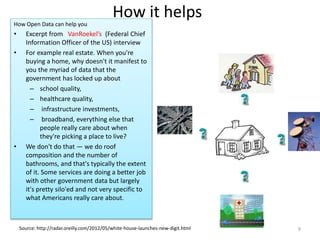
How Open Data can help you
• Excerpt from VanRoekel’s (Federal Chief
Information Officer of the US) interview
• For example real estate. When you're
buying a home, why doesn't it manifest to
you the myriad of data that the
government has locked up about
– school quality,
– healthcare quality,
– infrastructure investments,
– broadband, everything else that
people really care about when
they're picking a place to live?
• We don't do that — we do roof
composition and the number of
bathrooms, and that's typically the extent
of it. Some services are doing a better job
with other government data but largely
it's pretty silo'ed and not very specific to
what Americans really care about.
Source: http://radar.oreilly.com/2012/05/white-house-launches-new-digit.html 9
Open Government Data Principles
Government data shall be considered open if it is made public in a way that complies with
the principles below:
1. Complete All public data is made available. Public data is data that is not subject to
valid privacy, security or privilege limitations.
2. Primary Data is as collected at the source, with the highest possible level of
granularity, not in aggregate or modified forms.
3. Timely Data is made available as quickly as necessary to preserve the value of the
data.
4. Accessible Data is available to the widest range of users for the widest range of
purposes.
5. Machine processable Data is reasonably structured to allow automated processing.
6. Non-discriminatory Data is available to anyone, with no requirement of registration.
7. Non-proprietary Data is available in a format over which no entity has exclusive
control.
8. License-free Data is not subject to any copyright, patent, trademark or trade secret
regulation. Reasonable privacy, security and privilege restrictions may be allowed.
(https://public.resource.org/8_principles.html)
10
Technical & Legal Access to OGD
Technical & Legal access to OGD should,
• Ensure no dependency on the original
provider of the data by using bulk download,.
• Allow anyone else that obtain a copy can
redistribute it.
• Facilitate others to develop their own
services using the data,
11
Technical Access
Formats of Data Sets
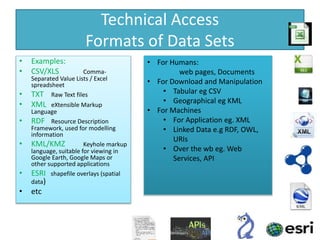
• Examples:
• CSV/XLS Comma-
Separated Value Lists / Excel
spreadsheet
• TXT Raw Text files
• XML eXtensible Markup
Language
• RDF Resource Description
Framework, used for modelling
information
• KML/KMZ Keyhole markup
language, suitable for viewing in
Google Earth, Google Maps or
other supported applications
• ESRI shapefile overlays (spatial
data)
• etc
• For Humans:
web pages, Documents
• For Download and Manipulation
• Tabular eg CSV
• Geographical eg KML
• For Machines
• For Application eg. XML
• Linked Data e.g RDF, OWL,
URIs
• Over the wb eg. Web
Services, API
12
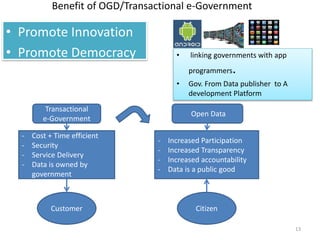
Benefit of OGD/Transactional e-Government
• Promote Innovation
• Promote Democracy
- Cost + Time efficient
- Security
- Service Delivery
- Data is owned by
government
- Increased Participation
- Increased Transparency
- Increased accountability
- Data is a public good
Customer Citizen
Transactional
e-Government
Open Data
• linking governments with app
programmers.
• Gov. From Data publisher to A
development Platform
13
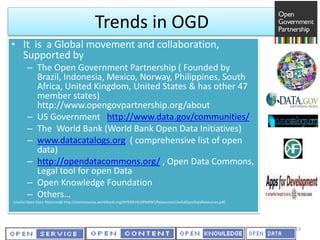
Trends in OGD
• It is a Global movement and collaboration,
Supported by
– The Open Government Partnership ( Founded by
Brazil, Indonesia, Mexico, Norway, Philippines, South
Africa, United Kingdom, United States & has other 47
member states)
http://www.opengovpartnership.org/about
– US Government http://www.data.gov/communities/
– The World Bank (World Bank Open Data Initiatives)
– www.datacatalogs.org ( comprehensive list of open
data)
– http://opendatacommons.org/ , Open Data Commons,
Legal tool for open Data
– Open Knowledge Foundation
– Others…
(Useful Open Data Rsources@ http://siteresources.worldbank.org/INTEDEVELOPMENT/Resources/UsefulOpenDataResources.pdf)
14
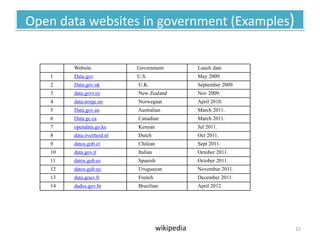
Open data websites in government (Examples)
15
Website Government Lunch date
1 Data.gov U.S. May 2009.
2 Data.gov.uk U.K. September 2009.
3 data.govt.nz New Zealand Nov 2009.
4 data.norge.no Norwegian April 2010.
5 Data.gov.au Australian March 2011.
6 Data.gc.ca Canadian March 2011.
7 opendata.go.ke Kenyan Jul 2011.
8 data.overheid.nl Dutch Oct 2011.
9 datos.gob.cl Chilean Sept 2011.
10 data.gov.it Italian October 2011.
11 datos.gob.es Spanish October 2011.
12 datos.gub.uy Uruguayan November 2011.
13 data.gouv.fr French December 2011.
14 dados.gov.br Brazilian April 2012
wikipedia
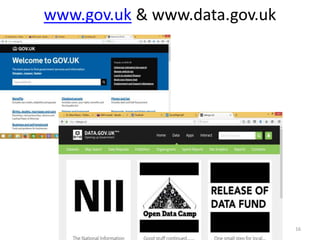
www.gov.uk & www.data.gov.uk
16
17
Ethiopian Open Data Initiative
• Readiness Assessment
18
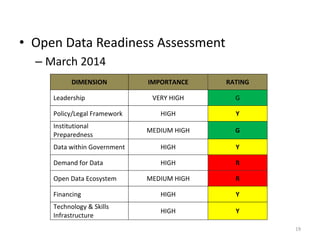
• Open Data Readiness Assessment
– March 2014
19
DIMENSION IMPORTANCE RATING
Leadership VERY HIGH G
Policy/Legal Framework HIGH Y
Institutional
Preparedness
MEDIUM HIGH G
Data within Government HIGH Y
Demand for Data HIGH R
Open Data Ecosystem MEDIUM HIGH R
Financing HIGH Y
Technology & Skills
Infrastructure
HIGH Y
20
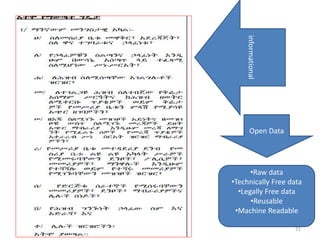
informational
•Raw data
•Technically Free data
•Legally Free data
•Reusable
•Machine Readable
Open Data
21
• Where are we now?
– National Data Set
– Ethiopian Open Data Portal
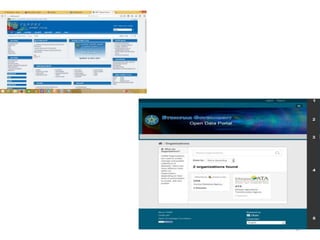
www.data.gov.et
– Mobile App for Government Services
App.gov.et
22
• What we need from You?
– Understand Open Data
– Working Together
23
Thank You!
24

Ethiopian Open Government Data Initiative

  • 1.
    Ethiopian Open Government DataInitiative Presented by Abiyot Bayou (Phd) abiyot.bayou@mcit.gov.et Ethiopian Ministry of Communication and Information Technology E-Government Directorate December 28, 2015 1
  • 2.
    Open data • isthe idea that certain data should be – freely available – to everyone – to use and republish as they wish, – without restrictions from copyright, patents or other mechanisms of control. 2
  • 3.
    Public/Government data 3 – Objective –Factual – No personal data – On which public service run and – policy decision are based – collected and generated in the curse of public service delivery
  • 4.
    4 • The datamust be available as a whole and at no more than a reasonable reproduction cost, • preferably by downloading over the internet. • must also be available in a convenient and modifiable form Availability and Access Reuse and Redistribution • The data must be provided under terms that permit reuse and redistribution including the intermixing with other datasets. Universal Participation • everyone must be able to use, reuse and redistribute – • there should be no discrimination against fields of endeavor or against persons or groups (including commercial use) Open data Data that can be freely used, reused and redistributed by anyone - subject only, at most, to the requirement to attribute and share alike
  • 5.
    • Open Government –Government should be – Transparent: with information about agency operations and decisions available to the public online. – participatory, tapping the collective expertise of the public in government decision-making processes. – collaborative, using technology to share and cooperate with other agencies, businesses and nonprofits, and the public at large. 5
  • 6.
    What is OpenGovernment data • Public data – help people understand how government works and how policies are made • Already available, – “Open” brings it together in one searchable website. • Making this data easily available – it will be easier for people to make decisions and suggestions about government policies based on detailed information. • Improving the relationship between the government and its constituents • Encourage “Government as a platform”, • Citizens can use open government data to build their own tools and collaborate directly in the process of governing • Promote Data Journalism Example: The White House digital government strategy – explicitly embraces releasing open data in APIs to enable more accountability, civic utility and economic value creation. 6
  • 7.
    Benefits of OpenGovernment Data  Transparency.  Citizens need to know what their government is doing.  They need to be able freely to access government data and information and to share that information with other citizens.  Sharing and reuse allows analysing and visualising to create more understanding.  Releasing social and commercial value.  Data is a key resource for social and commercial activities.  Governments as one of the largest producers and collectors of data  Open government data can help drive the creation of innovative business and services that deliver social and commercial value.  Participatory governance.  Directly informed and involved in decision-making • opportunity to actively participate in governance processes, (Not only Voting) • able to make better decisions  Reducing government costs.  sharing of information within governments in machine-readable interoperable formats,  Innovative services 7
  • 8.
  • 9.
    How it helps HowOpen Data can help you • Excerpt from VanRoekel’s (Federal Chief Information Officer of the US) interview • For example real estate. When you're buying a home, why doesn't it manifest to you the myriad of data that the government has locked up about – school quality, – healthcare quality, – infrastructure investments, – broadband, everything else that people really care about when they're picking a place to live? • We don't do that — we do roof composition and the number of bathrooms, and that's typically the extent of it. Some services are doing a better job with other government data but largely it's pretty silo'ed and not very specific to what Americans really care about. Source: http://radar.oreilly.com/2012/05/white-house-launches-new-digit.html 9
  • 10.
    Open Government DataPrinciples Government data shall be considered open if it is made public in a way that complies with the principles below: 1. Complete All public data is made available. Public data is data that is not subject to valid privacy, security or privilege limitations. 2. Primary Data is as collected at the source, with the highest possible level of granularity, not in aggregate or modified forms. 3. Timely Data is made available as quickly as necessary to preserve the value of the data. 4. Accessible Data is available to the widest range of users for the widest range of purposes. 5. Machine processable Data is reasonably structured to allow automated processing. 6. Non-discriminatory Data is available to anyone, with no requirement of registration. 7. Non-proprietary Data is available in a format over which no entity has exclusive control. 8. License-free Data is not subject to any copyright, patent, trademark or trade secret regulation. Reasonable privacy, security and privilege restrictions may be allowed. (https://public.resource.org/8_principles.html) 10
  • 11.
    Technical & LegalAccess to OGD Technical & Legal access to OGD should, • Ensure no dependency on the original provider of the data by using bulk download,. • Allow anyone else that obtain a copy can redistribute it. • Facilitate others to develop their own services using the data, 11
  • 12.
    Technical Access Formats ofData Sets • Examples: • CSV/XLS Comma- Separated Value Lists / Excel spreadsheet • TXT Raw Text files • XML eXtensible Markup Language • RDF Resource Description Framework, used for modelling information • KML/KMZ Keyhole markup language, suitable for viewing in Google Earth, Google Maps or other supported applications • ESRI shapefile overlays (spatial data) • etc • For Humans: web pages, Documents • For Download and Manipulation • Tabular eg CSV • Geographical eg KML • For Machines • For Application eg. XML • Linked Data e.g RDF, OWL, URIs • Over the wb eg. Web Services, API 12
  • 13.
    Benefit of OGD/Transactionale-Government • Promote Innovation • Promote Democracy - Cost + Time efficient - Security - Service Delivery - Data is owned by government - Increased Participation - Increased Transparency - Increased accountability - Data is a public good Customer Citizen Transactional e-Government Open Data • linking governments with app programmers. • Gov. From Data publisher to A development Platform 13
  • 14.
    Trends in OGD •It is a Global movement and collaboration, Supported by – The Open Government Partnership ( Founded by Brazil, Indonesia, Mexico, Norway, Philippines, South Africa, United Kingdom, United States & has other 47 member states) http://www.opengovpartnership.org/about – US Government http://www.data.gov/communities/ – The World Bank (World Bank Open Data Initiatives) – www.datacatalogs.org ( comprehensive list of open data) – http://opendatacommons.org/ , Open Data Commons, Legal tool for open Data – Open Knowledge Foundation – Others… (Useful Open Data Rsources@ http://siteresources.worldbank.org/INTEDEVELOPMENT/Resources/UsefulOpenDataResources.pdf) 14
  • 15.
    Open data websitesin government (Examples) 15 Website Government Lunch date 1 Data.gov U.S. May 2009. 2 Data.gov.uk U.K. September 2009. 3 data.govt.nz New Zealand Nov 2009. 4 data.norge.no Norwegian April 2010. 5 Data.gov.au Australian March 2011. 6 Data.gc.ca Canadian March 2011. 7 opendata.go.ke Kenyan Jul 2011. 8 data.overheid.nl Dutch Oct 2011. 9 datos.gob.cl Chilean Sept 2011. 10 data.gov.it Italian October 2011. 11 datos.gob.es Spanish October 2011. 12 datos.gub.uy Uruguayan November 2011. 13 data.gouv.fr French December 2011. 14 dados.gov.br Brazilian April 2012 wikipedia
  • 16.
  • 17.
  • 18.
    Ethiopian Open DataInitiative • Readiness Assessment 18
  • 19.
    • Open DataReadiness Assessment – March 2014 19 DIMENSION IMPORTANCE RATING Leadership VERY HIGH G Policy/Legal Framework HIGH Y Institutional Preparedness MEDIUM HIGH G Data within Government HIGH Y Demand for Data HIGH R Open Data Ecosystem MEDIUM HIGH R Financing HIGH Y Technology & Skills Infrastructure HIGH Y
  • 20.
  • 21.
    informational •Raw data •Technically Freedata •Legally Free data •Reusable •Machine Readable Open Data 21
  • 22.
    • Where arewe now? – National Data Set – Ethiopian Open Data Portal www.data.gov.et – Mobile App for Government Services App.gov.et 22
  • 23.
    • What weneed from You? – Understand Open Data – Working Together 23
  • 24.