República Bolivariana de Venezuela
Ministerio del Poder Popular para la Educación Superior
Universidad Pedagógica Experimental Libertador
Instituto Pedagógico Barquisimeto “Dr. Luis Beltrán Prieto Figueroa”
Subdirección de Investigación y Postgrado
Autores:
Lcdo. Fernando Lameda
Lcdo. Giovanny Crespo
Lcda. Rosnerys Ferrer
Tutora: Dra. Yenny Rodríguez
Catedra: Ingles Instrumental
CARORA; JULIO 2016
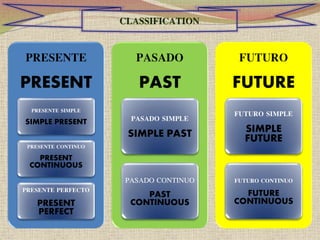
PRESENTE
PRESENT
PRESENTE SIMPLE
SIMPLE PRESENT
PRESENTE CONTINUO
PRESENT
CONTINUOUS
PRESENTE PERFECTO
PRESENT
PERFECT
PASADO
PAST
PASADO SIMPLE
SIMPLE PAST
PASADO CONTINUO
PAST
CONTINUOUS
FUTURO
FUTURE
FUTURO SIMPLE
SIMPLE
FUTURE
FUTURO CONTINUO
FUTURE
CONTINUOUS
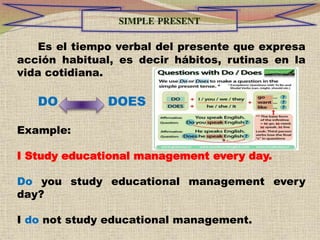
Es el tiempo verbal del presente que expresa
acción habitual, es decir hábitos, rutinas en la
vida cotidiana.
DO DOES
Example:
I Study educational management every day.
Do you study educational management every
day?
I do not study educational management.
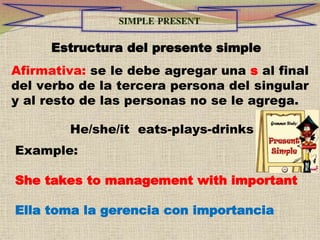
Estructura del presente simple
Afirmativa: se le debe agregar una s al final
del verbo de la tercera persona del singular
y al resto de las personas no se le agrega.
He/she/it eats-plays-drinks
Example:
She takes to management with important
Ella toma la gerencia con importancia
Estructura del presente simple
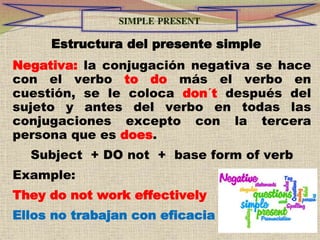
Negativa: la conjugación negativa se hace
con el verbo to do más el verbo en
cuestión, se le coloca don´t después del
sujeto y antes del verbo en todas las
conjugaciones excepto con la tercera
persona que es does.
Subject + DO not + base form of verb
Example:
They do not work effectively
Ellos no trabajan con eficacia
Estructura del presente simple
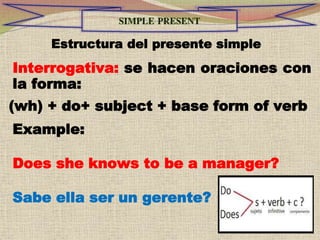
Interrogativa: se hacen oraciones con
la forma:
(wh) + do+ subject + base form of verb
Example:
Does she knows to be a manager?
Sabe ella ser un gerente?
Acción que ocurre en el momento
presente, planes futuros e inmediatos,
acciones monótonas y molestas.
Afirmativa: subject + verb be (am-is-are) in present
+ verb-ing
Example: He is working at the moment
Negativa: subject + verb in present + not + v-ing
Example: They aren”t coming this evening
Interrogativa: (wh) verb be in present+ subject+verb
ing
Example: What are you doing?
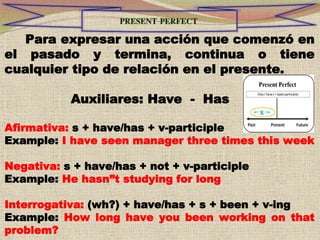
Para expresar una acción que comenzó en
el pasado y termina, continua o tiene
cualquier tipo de relación en el presente.
Auxiliares: Have - Has
Afirmativa: s + have/has + v-participle
Example: I have seen manager three times this week
Negativa: s + have/has + not + v-participle
Example: He hasn”t studying for long
Interrogativa: (wh?) + have/has + s + been + v-ing
Example: How long have you been working on that
problem?
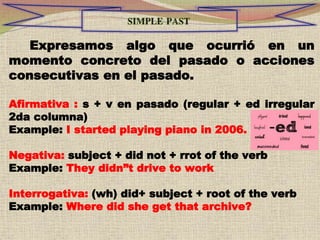
Expresamos algo que ocurrió en un
momento concreto del pasado o acciones
consecutivas en el pasado.
Afirmativa : s + v en pasado (regular + ed irregular
2da columna)
Example: I started playing piano in 2006.
Negativa: subject + did not + rrot of the verb
Example: They didn”t drive to work
Interrogativa: (wh) did+ subject + root of the verb
Example: Where did she get that archive?
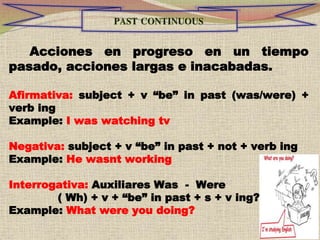
Acciones en progreso en un tiempo
pasado, acciones largas e inacabadas.
Afirmativa: subject + v “be” in past (was/were) +
verb ing
Example: I was watching tv
Negativa: subject + v “be” in past + not + verb ing
Example: He wasnt working
Interrogativa: Auxiliares Was - Were
( Wh) + v + “be” in past + s + v ing?
Example: What were you doing?
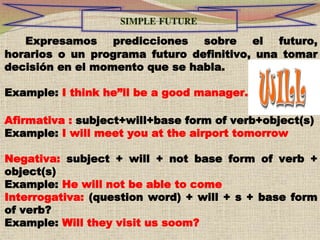
Expresamos predicciones sobre el futuro,
horarios o un programa futuro definitivo, una tomar
decisión en el momento que se habla.
Example: I think he”ll be a good manager.
Afirmativa : subject+will+base form of verb+object(s)
Example: I will meet you at the airport tomorrow
Negativa: subject + will + not base form of verb +
object(s)
Example: He will not be able to come
Interrogativa: (question word) + will + s + base form
of verb?
Example: Will they visit us soom?
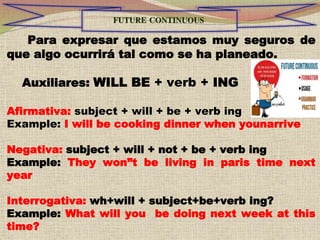
Para expresar que estamos muy seguros de
que algo ocurrirá tal como se ha planeado.
Auxiliares: WILL BE + verb + ING
Afirmativa: subject + will + be + verb ing
Example: I will be cooking dinner when younarrive
Negativa: subject + will + not + be + verb ing
Example: They won”t be living in paris time next
year
Interrogativa: wh+will + subject+be+verb ing?
Example: What will you be doing next week at this
time?
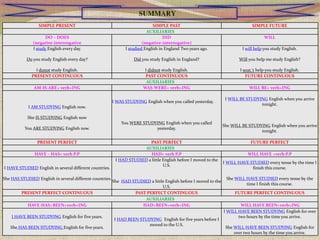
SIMPLE PRESENT SIMPLE PAST SIMPLE FUTURE
AUXILIARIES
DO – DOES
(negative-interrogative
DID
(negative-interrogative)
WILL
I study English every day.
Do you study English every day?
I donot study English.
I studied English in England Two years ago.
Did you study English in England?
I didnot study English.
I will help you study English.
Will you help me study English?
I won´t help you study English.
PRESENT CONTINUOUS PAST CONTINUOUS FUTURE CONTINUOUS
AUXILIARIES
AM-IS-ARE+ verb+ING WAS-WERE+ verb+ING WILL BE+ verb+ING
I AM STUDYING English now.
She IS STUDYING English now
You ARE STUDYING English now.
I WAS STUDYING English when you called yesterday.
You WERE STUDYING English when you called
yesterday.
I WILL BE STUDYING English when you arrive
tonight.
She WILL BE STUDYING English when you arrive
tonight.
PRESENT PERFECT PAST PERFECT FUTURE PERFECT
AUXILIARIES
HAVE – HAS+ verb P.P HAD+ verb P.P WILL HAVE +verb P.P
I HAVE STUDIED English in several different countries.
She HAS STUDIED English in several different countries.
I HAD STUDIED a little English before I moved to the
U.S.
She HAD STUDIED a little English before I moved to the
U.S.
I WILL HAVE STUDIED every tense by the time I
finish this course.
She WILL HAVE STUDIED every tense by the
time I finish this course.
PRESENT PERFECT CONTINUOUS PAST PERFECT CONTINUOUS FUTURE PERFECT CONTINUOUS
AUXILIARIES
HAVE-HAS+BEEN+verb+ING HAD+BEEN+verb+ING WILL HAVE BEEN+verb+ING
I HAVE BEEN STUDYING English for five years.
She HAS BEEN STUDYING English for five years.
I HAD BEEN STUDYING English for five years before I
moved to the U.S.
I WILL HAVE BEEN STUDYING English for over
two hours by the time you arrive.
She WILL HAVE BEEN STUDYING English for
over two hours by the time you arrive.
Tiempos verbales

Tiempos verbales

  • 2.
    República Bolivariana deVenezuela Ministerio del Poder Popular para la Educación Superior Universidad Pedagógica Experimental Libertador Instituto Pedagógico Barquisimeto “Dr. Luis Beltrán Prieto Figueroa” Subdirección de Investigación y Postgrado Autores: Lcdo. Fernando Lameda Lcdo. Giovanny Crespo Lcda. Rosnerys Ferrer Tutora: Dra. Yenny Rodríguez Catedra: Ingles Instrumental CARORA; JULIO 2016
  • 3.
    PRESENTE PRESENT PRESENTE SIMPLE SIMPLE PRESENT PRESENTECONTINUO PRESENT CONTINUOUS PRESENTE PERFECTO PRESENT PERFECT PASADO PAST PASADO SIMPLE SIMPLE PAST PASADO CONTINUO PAST CONTINUOUS FUTURO FUTURE FUTURO SIMPLE SIMPLE FUTURE FUTURO CONTINUO FUTURE CONTINUOUS
  • 4.
    Es el tiempoverbal del presente que expresa acción habitual, es decir hábitos, rutinas en la vida cotidiana. DO DOES Example: I Study educational management every day. Do you study educational management every day? I do not study educational management.
  • 5.
    Estructura del presentesimple Afirmativa: se le debe agregar una s al final del verbo de la tercera persona del singular y al resto de las personas no se le agrega. He/she/it eats-plays-drinks Example: She takes to management with important Ella toma la gerencia con importancia
  • 6.
    Estructura del presentesimple Negativa: la conjugación negativa se hace con el verbo to do más el verbo en cuestión, se le coloca don´t después del sujeto y antes del verbo en todas las conjugaciones excepto con la tercera persona que es does. Subject + DO not + base form of verb Example: They do not work effectively Ellos no trabajan con eficacia
  • 7.
    Estructura del presentesimple Interrogativa: se hacen oraciones con la forma: (wh) + do+ subject + base form of verb Example: Does she knows to be a manager? Sabe ella ser un gerente?
  • 8.
    Acción que ocurreen el momento presente, planes futuros e inmediatos, acciones monótonas y molestas. Afirmativa: subject + verb be (am-is-are) in present + verb-ing Example: He is working at the moment Negativa: subject + verb in present + not + v-ing Example: They aren”t coming this evening Interrogativa: (wh) verb be in present+ subject+verb ing Example: What are you doing?
  • 9.
    Para expresar unaacción que comenzó en el pasado y termina, continua o tiene cualquier tipo de relación en el presente. Auxiliares: Have - Has Afirmativa: s + have/has + v-participle Example: I have seen manager three times this week Negativa: s + have/has + not + v-participle Example: He hasn”t studying for long Interrogativa: (wh?) + have/has + s + been + v-ing Example: How long have you been working on that problem?
  • 10.
    Expresamos algo queocurrió en un momento concreto del pasado o acciones consecutivas en el pasado. Afirmativa : s + v en pasado (regular + ed irregular 2da columna) Example: I started playing piano in 2006. Negativa: subject + did not + rrot of the verb Example: They didn”t drive to work Interrogativa: (wh) did+ subject + root of the verb Example: Where did she get that archive?
  • 11.
    Acciones en progresoen un tiempo pasado, acciones largas e inacabadas. Afirmativa: subject + v “be” in past (was/were) + verb ing Example: I was watching tv Negativa: subject + v “be” in past + not + verb ing Example: He wasnt working Interrogativa: Auxiliares Was - Were ( Wh) + v + “be” in past + s + v ing? Example: What were you doing?
  • 12.
    Expresamos predicciones sobreel futuro, horarios o un programa futuro definitivo, una tomar decisión en el momento que se habla. Example: I think he”ll be a good manager. Afirmativa : subject+will+base form of verb+object(s) Example: I will meet you at the airport tomorrow Negativa: subject + will + not base form of verb + object(s) Example: He will not be able to come Interrogativa: (question word) + will + s + base form of verb? Example: Will they visit us soom?
  • 13.
    Para expresar queestamos muy seguros de que algo ocurrirá tal como se ha planeado. Auxiliares: WILL BE + verb + ING Afirmativa: subject + will + be + verb ing Example: I will be cooking dinner when younarrive Negativa: subject + will + not + be + verb ing Example: They won”t be living in paris time next year Interrogativa: wh+will + subject+be+verb ing? Example: What will you be doing next week at this time?
  • 14.
    SIMPLE PRESENT SIMPLEPAST SIMPLE FUTURE AUXILIARIES DO – DOES (negative-interrogative DID (negative-interrogative) WILL I study English every day. Do you study English every day? I donot study English. I studied English in England Two years ago. Did you study English in England? I didnot study English. I will help you study English. Will you help me study English? I won´t help you study English. PRESENT CONTINUOUS PAST CONTINUOUS FUTURE CONTINUOUS AUXILIARIES AM-IS-ARE+ verb+ING WAS-WERE+ verb+ING WILL BE+ verb+ING I AM STUDYING English now. She IS STUDYING English now You ARE STUDYING English now. I WAS STUDYING English when you called yesterday. You WERE STUDYING English when you called yesterday. I WILL BE STUDYING English when you arrive tonight. She WILL BE STUDYING English when you arrive tonight. PRESENT PERFECT PAST PERFECT FUTURE PERFECT AUXILIARIES HAVE – HAS+ verb P.P HAD+ verb P.P WILL HAVE +verb P.P I HAVE STUDIED English in several different countries. She HAS STUDIED English in several different countries. I HAD STUDIED a little English before I moved to the U.S. She HAD STUDIED a little English before I moved to the U.S. I WILL HAVE STUDIED every tense by the time I finish this course. She WILL HAVE STUDIED every tense by the time I finish this course. PRESENT PERFECT CONTINUOUS PAST PERFECT CONTINUOUS FUTURE PERFECT CONTINUOUS AUXILIARIES HAVE-HAS+BEEN+verb+ING HAD+BEEN+verb+ING WILL HAVE BEEN+verb+ING I HAVE BEEN STUDYING English for five years. She HAS BEEN STUDYING English for five years. I HAD BEEN STUDYING English for five years before I moved to the U.S. I WILL HAVE BEEN STUDYING English for over two hours by the time you arrive. She WILL HAVE BEEN STUDYING English for over two hours by the time you arrive.