Definition Characterized by transient loss of consciousness Due to temporary and self terminating global cereberal hypoperfusion In recent studies, syncope has been shown to account for approximately 1% of ED visits and is the sixth most common cause for hospitalization of patients older than 65 years. Establishing a definitive cause for this common problem in the ED is hampered by its transient and episodic nature and by the fact that the affected patient has usually completely recovered by the time of examination. Moreover, multiple potential causes are present in 18% of patients with syncope.
Causes of Nonsyncopal Attacks (Commonly Misdiagnosed as Syncope) Disorders without any impairment of consciousness Falls   Cataplexy   Drop attacks   Psychogenic pseudosyncope   Transient ischemic attacks of carotid origin Disorders with partial or complete loss of consciousness   Metabolic disorders, including hypoglycemia, hypoxia, hyperventilation with hypocapnia   Epilepsy   Intoxications   Vertebrobasilar transient ischemic attack
Causes of Syncope
Age-Dependent Causes of Syncope Mayo Clinic:  1996-1998 (n=1,291) <65 years n=607  65 years n=684 13% 43% 3% 17% 24% 30% 23% 10% 18% 19% Cardiogenic  Vasovagal  CHS  Undetermined  Other
SYNCOPE:  Natural History Kapoor:  Medicine, 1990 10 20 30 40 50 60 0 1 2 3 4 5 0 1 2 3 4 5 Y ear of follow-up % Cardiogenic Undetermined Noncardiac Mortality Sudden Death
Emergency Department Risk Stratification of Patients With Syncope of Unknown Cause   High-risk group  Intermediate-risk group  Low-risk group  Chest pain  Signs of chronic heart failure Moderate/severe valvular disease History of ventricular arrhythmias Electrocardiographic/cardiac monitor findings of ischemia Prolonged QTc (>500 ms) Trifascicular block or pauses between 2 and 3 s Persistent sinus bradycardia between 40 and 60 beats/min Atrial fibrillation and nonsustained ventricular tachycardia without symptoms Cardiac devices (pacemaker or defibrillator) with dysfunction  Age =50 y With history of CAD, MI, CHF without active symptoms or signs while taking cardiac medications Bundle-branch block or Q wave without acute changes Family history of premature (<50 y), unexplained sudden death Symptoms not consistent with a reflex-mediated or vasovagal cause  Cardiac devices without evidence of dysfunction  Physician’s judgment that suspicion of cardiac syncope is reasonable  Age <50 y With no history of   Cardiovascular disease   Symptoms consistent with reflex-mediated or vasovagal syncope Normal findings on cardiovascular examination Normal electrocardiographic findings
85-year-old patient with valvular heart disease and congestive heart failure.
Atrial tachycardia Generally has an atrial rate 150 to 200 bpm P-wave countour is different than the sinus P wave Each P-wave can conduct to the ventricle as long as atrial rate is not excessive and the AV node is not depressed As atrial rate increases there is increased AV block Can be seen in dig toxicity
51-year-old female with palpitations.  Regular Rate 142 bpm No clear P waves before QRS – Not sinus rhythm Retrograde P-waves, with short RP interval
Mechanism of Reentry An impulse initiated in the SA node passes through both the AV node and the accessory pathway A premature atrial impulse occurs and reaches the accessory pathway when it is refractory, but conduction occurs through the AV node The impulse takes sufficient time to circulate through the AV node to allow the accessory pathway to recover initiating reentry
Mechanisms of Supraventricular Tachycardia AVNRT – the AV node is divided into two pathways and the activation of the atria and ventricle is synchronous so the retrograde P-wave is buried.  Account for 60% of SVT. Usu are 150-200 bpm Orthodromic AVRT –  mechanism seen on previous slide.  Usually, L atrium is the first site retrograde atrial activation. Accounts for 30% of SVT Widened   QRS Antidromic AVRT – activation occurs in the opposite direction resulting in wide complex tachycardia that is indistinguishable from V tach
Regular Rate 166 bpm   No clear P waves before QRS – Not sinus rhythm Wide QRS  160 ms RBBB pattern DDx of regular wide complex tachycardia V. Tach SVT w/ aberrant conduction or preexisting block -  Sinus tachycardia  - A. flutter  - AVRT/AVNRT  - A. tachycardia  Retrograde P-waves associated with the QRS complex
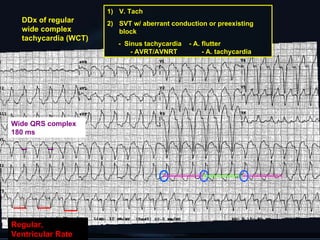
Regular, Ventricular Rate 150 bpm Wide QRS complex 180 ms V. Tach SVT w/ aberrant conduction or preexisting block -  Sinus tachycardia  - A. flutter  - AVRT/AVNRT  - A. tachycardia  DDx of regular wide complex tachycardia (WCT)
A question of aberrancy Occurs when a supraventricular impulse encounters persistant refractoriness in part of the ventricular conduction system  Refractory period   RR interval Aberration can result from a shortened RR interval and refractory period (1) or a lengthened RR interval and refractory period (2) Always initially assume wide QRS is ventricular  80% of WCT are VT Triphasic rsR’ in V1 and qR in V6 favor aberrancy If the QRS morphology is  similar to sinus rhythm, then  WCT unlikely ventricular in origin 1 2
The Thyroid and the Heart
Thyroid Hormone Actions on the Heart Embryolgically the thyroid and the heart share a close relationship Cardiac myocyte cannot convert T3 to T4  Appears that thyroid hormone increases the release of calcium by sarcoplasmic reticulum
Hemodynamic Alterations in Thyroid Disease T3 has direct effects on vascular smooth muscle cells as well increase in NO releases decreases systemic vascular resistance In Hypothyroidism there is an increase in SVR and pts have diastolic hypertension Decrease in SVR decreases MAP which leads to stimulation renin-angiotensin system Leads to an increase in preload  In total, there is an increase in CO CO may more than double in hyperthyroidism and can decrease by 30 to 40% in hypothyroidism
Hyperthyroidism Exercise intolerance as cardiac functional reserve is compromised Palipitations - common for HR>90 bpm Angina due to increase in CO and cardiac contractility leading to ischemia Atrial fibrillation occurs in 2-20 percent of patients Heart failure usually related to rate related phenomenon
Hypothyroidism Bradycardia Increase in SVR  Decrease in CO Increase in LDL More likely to have ischemic cardiomyopathy

Thyroid and the Heart

  • 1.
    Definition Characterized bytransient loss of consciousness Due to temporary and self terminating global cereberal hypoperfusion In recent studies, syncope has been shown to account for approximately 1% of ED visits and is the sixth most common cause for hospitalization of patients older than 65 years. Establishing a definitive cause for this common problem in the ED is hampered by its transient and episodic nature and by the fact that the affected patient has usually completely recovered by the time of examination. Moreover, multiple potential causes are present in 18% of patients with syncope.
  • 2.
    Causes of NonsyncopalAttacks (Commonly Misdiagnosed as Syncope) Disorders without any impairment of consciousness Falls   Cataplexy   Drop attacks   Psychogenic pseudosyncope   Transient ischemic attacks of carotid origin Disorders with partial or complete loss of consciousness   Metabolic disorders, including hypoglycemia, hypoxia, hyperventilation with hypocapnia   Epilepsy   Intoxications   Vertebrobasilar transient ischemic attack
  • 3.
  • 4.
    Age-Dependent Causes ofSyncope Mayo Clinic: 1996-1998 (n=1,291) <65 years n=607  65 years n=684 13% 43% 3% 17% 24% 30% 23% 10% 18% 19% Cardiogenic Vasovagal CHS Undetermined Other
  • 5.
    SYNCOPE: NaturalHistory Kapoor: Medicine, 1990 10 20 30 40 50 60 0 1 2 3 4 5 0 1 2 3 4 5 Y ear of follow-up % Cardiogenic Undetermined Noncardiac Mortality Sudden Death
  • 6.
    Emergency Department RiskStratification of Patients With Syncope of Unknown Cause High-risk group Intermediate-risk group Low-risk group Chest pain Signs of chronic heart failure Moderate/severe valvular disease History of ventricular arrhythmias Electrocardiographic/cardiac monitor findings of ischemia Prolonged QTc (>500 ms) Trifascicular block or pauses between 2 and 3 s Persistent sinus bradycardia between 40 and 60 beats/min Atrial fibrillation and nonsustained ventricular tachycardia without symptoms Cardiac devices (pacemaker or defibrillator) with dysfunction Age =50 y With history of CAD, MI, CHF without active symptoms or signs while taking cardiac medications Bundle-branch block or Q wave without acute changes Family history of premature (<50 y), unexplained sudden death Symptoms not consistent with a reflex-mediated or vasovagal cause Cardiac devices without evidence of dysfunction Physician’s judgment that suspicion of cardiac syncope is reasonable Age <50 y With no history of   Cardiovascular disease   Symptoms consistent with reflex-mediated or vasovagal syncope Normal findings on cardiovascular examination Normal electrocardiographic findings
  • 7.
    85-year-old patient withvalvular heart disease and congestive heart failure.
  • 8.
    Atrial tachycardia Generallyhas an atrial rate 150 to 200 bpm P-wave countour is different than the sinus P wave Each P-wave can conduct to the ventricle as long as atrial rate is not excessive and the AV node is not depressed As atrial rate increases there is increased AV block Can be seen in dig toxicity
  • 9.
    51-year-old female withpalpitations. Regular Rate 142 bpm No clear P waves before QRS – Not sinus rhythm Retrograde P-waves, with short RP interval
  • 10.
    Mechanism of ReentryAn impulse initiated in the SA node passes through both the AV node and the accessory pathway A premature atrial impulse occurs and reaches the accessory pathway when it is refractory, but conduction occurs through the AV node The impulse takes sufficient time to circulate through the AV node to allow the accessory pathway to recover initiating reentry
  • 11.
    Mechanisms of SupraventricularTachycardia AVNRT – the AV node is divided into two pathways and the activation of the atria and ventricle is synchronous so the retrograde P-wave is buried. Account for 60% of SVT. Usu are 150-200 bpm Orthodromic AVRT – mechanism seen on previous slide. Usually, L atrium is the first site retrograde atrial activation. Accounts for 30% of SVT Widened QRS Antidromic AVRT – activation occurs in the opposite direction resulting in wide complex tachycardia that is indistinguishable from V tach
  • 12.
    Regular Rate 166bpm No clear P waves before QRS – Not sinus rhythm Wide QRS 160 ms RBBB pattern DDx of regular wide complex tachycardia V. Tach SVT w/ aberrant conduction or preexisting block - Sinus tachycardia - A. flutter - AVRT/AVNRT - A. tachycardia Retrograde P-waves associated with the QRS complex
  • 13.
    Regular, Ventricular Rate150 bpm Wide QRS complex 180 ms V. Tach SVT w/ aberrant conduction or preexisting block - Sinus tachycardia - A. flutter - AVRT/AVNRT - A. tachycardia DDx of regular wide complex tachycardia (WCT)
  • 14.
    A question ofaberrancy Occurs when a supraventricular impulse encounters persistant refractoriness in part of the ventricular conduction system Refractory period RR interval Aberration can result from a shortened RR interval and refractory period (1) or a lengthened RR interval and refractory period (2) Always initially assume wide QRS is ventricular 80% of WCT are VT Triphasic rsR’ in V1 and qR in V6 favor aberrancy If the QRS morphology is similar to sinus rhythm, then WCT unlikely ventricular in origin 1 2
  • 15.
    The Thyroid andthe Heart
  • 16.
    Thyroid Hormone Actionson the Heart Embryolgically the thyroid and the heart share a close relationship Cardiac myocyte cannot convert T3 to T4 Appears that thyroid hormone increases the release of calcium by sarcoplasmic reticulum
  • 17.
    Hemodynamic Alterations inThyroid Disease T3 has direct effects on vascular smooth muscle cells as well increase in NO releases decreases systemic vascular resistance In Hypothyroidism there is an increase in SVR and pts have diastolic hypertension Decrease in SVR decreases MAP which leads to stimulation renin-angiotensin system Leads to an increase in preload In total, there is an increase in CO CO may more than double in hyperthyroidism and can decrease by 30 to 40% in hypothyroidism
  • 18.
    Hyperthyroidism Exercise intoleranceas cardiac functional reserve is compromised Palipitations - common for HR>90 bpm Angina due to increase in CO and cardiac contractility leading to ischemia Atrial fibrillation occurs in 2-20 percent of patients Heart failure usually related to rate related phenomenon
  • 19.
    Hypothyroidism Bradycardia Increasein SVR Decrease in CO Increase in LDL More likely to have ischemic cardiomyopathy