      
www.jda.com
 Demand     for advanced transportation
  management systems is on the rise
 With mounting pressure on businesses to
  contain costs, address capacity
  constraints, lower their carbon footprints
  and streamline movements, a
  flexible, agile and functionally rich
  transportation management system can
  help support their service goals.
   Pinpointing the optimal solution is challenging and
    complex.
   One factor adding confusion to the search is the manner
    in which vendors use — or overuse —the term
    optimization.
   Optimization techniques are proven to drive the vast
    majority of the business value realized from the use of
    transportation management solutions.
   However, not all optimization strategies are created
    equal and that’s where the confusion lies.
   Vendors too often take a simplified approach and focus
    on just one function to optimize, which can lead to more
    harm than good.
   A comprehensive approach takes many factors into
    consideration.
1.   One size does not fit all.

2.   The details matter.

3.   Concurrency is king.
   For the best possible answer in the shortest amount of
    time, companies must apply both heuristic (experience
    based) and deterministic approaches that use a series of
    logical and common-sense decisions along with network
    constraint considerations.
   Transportation management systems should offer a
    flexible configuration that adapts to each company’s
    unique strategies, as well as network constraints and
    variables.
 Companies   that follow optimization best
 practices constantly monitor and tune
 their strategies to address any changes
 in their network, supply chain, market
 and customer demands. Capacity, for
 example, tends to ebb and flow with
 economic changes, and shippers must
 be prepared to adapt their strategies to
 capitalize on market opportunities.
   Intertwining planning and execution processes makes
    transportation functions unique among other supply
    chain.
   It is critical that all of the details − from network and
    dock scheduling to asset capacity and granularly defined
    rates− are expertly modeled.
   Ensuring accuracy and visibility into all of the details also
    confirms that a company is not missing out on
    opportunities to get the same results at lower overall
    costs.
   A company must also have visibility into the details of the
    load that it is moving. Rather than making assumptions
    that can lead to added costs and stoppages, the
    company needs containerization capabilities to model
    the load at a finer level of granularity.
   Shippers must rely on an optimization engine that
    considers all elements of the problem –
    strategies, details and levels of granularity – at the same
    time in order to produce the best answer.
   A best-practices transportation management system can
    consider all aspects of the problem concurrently
    including rating, routing, scheduling and capacity
    constraints.
   Throughout the process of constantly adjusting and
    incrementally optimizing the orders to be
    executed, shippers must have visibility across time into
    already executed orders. This enables them to
    continually refine any network constraints or carrier
    commitments.
   It also ensures that they have the required resources to
    realize their service goals as efficiently and effectively as
    possible.
   Ambev is a leading Latin American brewer and PepsiCo
    International, Inc.’s bottler outside of the United States.
   Ambev and its subsidiaries produce, distribute and sell
    beer, carbonated soft drinks and other non-alcoholic and
    non-carbonated products in 14 countries.
   Ambev experienced a significant spike in order volume
    across its operating regions, and began to search for
    better transportation solution that could handle
    increasingly complex demands.

   In addition to cost and efficiency concerns, Ambev also
    needed to ensure that customer service levels kept pace
    with increasing demand.
   Ambev sought to improve asset utilization and processes
    while positioning itself for continued future growth.

   Ambev decided to replace its legacy systems with
    industry-leading transportation and logistics
    management technology to better plan and manage its
    transportation network.
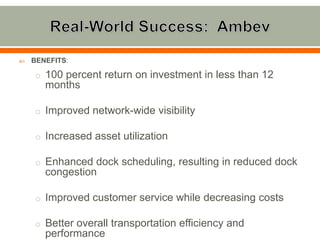
   BENEFITS:

    o 100 percent return on investment in less than 12
       months

    o Improved network-wide visibility

    o Increased asset utilization

    o Enhanced dock scheduling, resulting in reduced dock
       congestion

    o Improved customer service while decreasing costs

    o Better overall transportation efficiency and
       performance
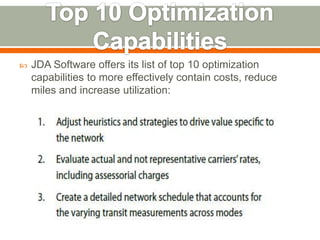
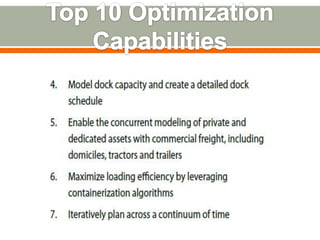
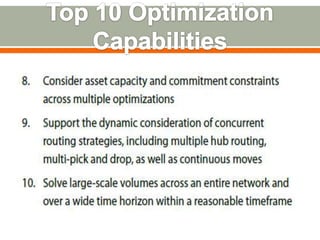
   JDA Software offers its list of top 10 optimization
    capabilities to more effectively contain costs, reduce
    miles and increase utilization:
Three principles of transportation optimization

Three principles of transportation optimization

  • 1.
     www.jda.com
  • 2.
     Demand for advanced transportation management systems is on the rise  With mounting pressure on businesses to contain costs, address capacity constraints, lower their carbon footprints and streamline movements, a flexible, agile and functionally rich transportation management system can help support their service goals.
  • 3.
    Pinpointing the optimal solution is challenging and complex.  One factor adding confusion to the search is the manner in which vendors use — or overuse —the term optimization.  Optimization techniques are proven to drive the vast majority of the business value realized from the use of transportation management solutions.
  • 4.
    However, not all optimization strategies are created equal and that’s where the confusion lies.  Vendors too often take a simplified approach and focus on just one function to optimize, which can lead to more harm than good.  A comprehensive approach takes many factors into consideration.
  • 5.
    1. One size does not fit all. 2. The details matter. 3. Concurrency is king.
  • 6.
    For the best possible answer in the shortest amount of time, companies must apply both heuristic (experience based) and deterministic approaches that use a series of logical and common-sense decisions along with network constraint considerations.  Transportation management systems should offer a flexible configuration that adapts to each company’s unique strategies, as well as network constraints and variables.
  • 7.
     Companies that follow optimization best practices constantly monitor and tune their strategies to address any changes in their network, supply chain, market and customer demands. Capacity, for example, tends to ebb and flow with economic changes, and shippers must be prepared to adapt their strategies to capitalize on market opportunities.
  • 8.
    Intertwining planning and execution processes makes transportation functions unique among other supply chain.  It is critical that all of the details − from network and dock scheduling to asset capacity and granularly defined rates− are expertly modeled.  Ensuring accuracy and visibility into all of the details also confirms that a company is not missing out on opportunities to get the same results at lower overall costs.
  • 9.
    A company must also have visibility into the details of the load that it is moving. Rather than making assumptions that can lead to added costs and stoppages, the company needs containerization capabilities to model the load at a finer level of granularity.
  • 10.
    Shippers must rely on an optimization engine that considers all elements of the problem – strategies, details and levels of granularity – at the same time in order to produce the best answer.  A best-practices transportation management system can consider all aspects of the problem concurrently including rating, routing, scheduling and capacity constraints.
  • 11.
    Throughout the process of constantly adjusting and incrementally optimizing the orders to be executed, shippers must have visibility across time into already executed orders. This enables them to continually refine any network constraints or carrier commitments.  It also ensures that they have the required resources to realize their service goals as efficiently and effectively as possible.
  • 12.
    Ambev is a leading Latin American brewer and PepsiCo International, Inc.’s bottler outside of the United States.  Ambev and its subsidiaries produce, distribute and sell beer, carbonated soft drinks and other non-alcoholic and non-carbonated products in 14 countries.
  • 13.
    Ambev experienced a significant spike in order volume across its operating regions, and began to search for better transportation solution that could handle increasingly complex demands.  In addition to cost and efficiency concerns, Ambev also needed to ensure that customer service levels kept pace with increasing demand.
  • 14.
    Ambev sought to improve asset utilization and processes while positioning itself for continued future growth.  Ambev decided to replace its legacy systems with industry-leading transportation and logistics management technology to better plan and manage its transportation network.
  • 15.
    BENEFITS: o 100 percent return on investment in less than 12 months o Improved network-wide visibility o Increased asset utilization o Enhanced dock scheduling, resulting in reduced dock congestion o Improved customer service while decreasing costs o Better overall transportation efficiency and performance
  • 16.
    JDA Software offers its list of top 10 optimization capabilities to more effectively contain costs, reduce miles and increase utilization: