Transportation Management
System
BALA MURUGAN.T
B.B.A
Ayya Nadar Janaki Ammal College,
Sivakasi.
Meaning
• A transportation management system (TMS) is a
logistics platform that uses technology to help
businesses plan, execute, and optimize the physical
movement of goods, both incoming and outgoing,
and making sure the shipment is compliant, proper
documentation is available. This kind of system is
often part of a larger supply chain management
(SCM) system.
• Sometimes known as a transportation
management solution or transportation
management software, a TMS provides visibility
into day-to-day transportation operations, trade
compliance information and documentation, and
ensuring the timely delivery of freight and goods.
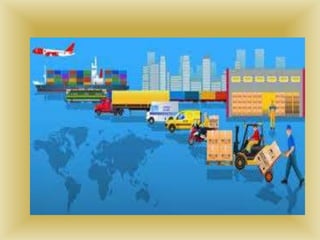
• Transportation management systems also
streamline the shipping process and make it easier
for businesses to manage and optimize their
transportation operations, whether they are by
land, air, or sea.
Importance
• Transportation management systems play a central
role in supply chains, affecting every part of the
process—from planning and procurement to logistics
and lifecycle management.
• The broad and deep visibility afforded by a powerful
system leads to more efficient transportation planning
and execution, which results in higher customer
satisfaction.
• That, in turn, leads to more sales, helping businesses
grow.
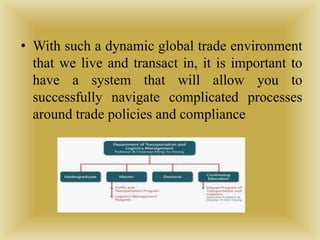
• With such a dynamic global trade environment
that we live and transact in, it is important to
have a system that will allow you to
successfully navigate complicated processes
around trade policies and compliance
Uses of TMS
• Transportation management systems are primarily
used by businesses that need to ship, move, and
receive goods on a regular basis, including:
• Manufacturers
• Distributors
• Ecommerce companies
• Retail businesses
• Companies that provide logistics services, such as
third-party and fourth-party logistics (3PL and 4PL)
companies and logistics service providers (LSPs)
• The primary users are businesses that spend $100
million or more annually on freight, but the
availability of cloud-based TMS solutions has made it
more affordable for smaller businesses to take
advantage of the benefits of incorporating a
transportation management system into their supply
chain.
TMS Offerings
• Businesses can buy a standalone transportation
management system that can be integrated with their
existing cloud or on-premises enterprise resource
planning (ERP) software and SCM solutions.
• Some TMS solutions have trade documentation
capabilities, or you can complement your TMS with a
global trade management (GTM) application.
• Other, typically less feature-rich TMSs, are available
as modules within ERP and SCM suites.
Plan, Execute, and Optimize
• Planning:
A TMS helps the business select the
optimal mode of shipment and the best carrier, based
on cost, efficiency, and distance, including optimizing
multi-leg carrier routes.
A strong TMS can provide visibility into
every stage of the supply chain, and together with
global trade management functionality.
Execution:
• The execution features of transportation management
systems vary widely but can include matching loads
and communicating with carriers, documenting and
tracking shipments, and assisting with freight billing
and settlement.
• Some advanced TMS solutions also provide track
and trace services—enabling real-time information
exchange among carriers, distributors, warehouses,
and customers.
• Such advanced systems may also have the
functionality to handle complex international
logistics, including providing proper import and
export documentation making sure shipments are
trade compliant.
Optimization.
• TMS optimization capacities usually include the
ability to measure and track performance with
reports, dashboards, analytics, and transportation
intelligence.
Benefits of a TMS
• A TMS—and modern transportation management
in general—provides many benefits to businesses.
Some of the top benefits are:
• Reduced costs for the business and the end
customer
• Simplification of supply chain processes across
geographies, modes, and carriers
• Automation of business operations for faster and
more accurate billing and documentation
• Time savings—fewer manual steps result in fewer
delays and faster delivery times
• The ability to track freight, both locally and
globally, on a single platform
• Better import and export compliance minimizing
penalties and shipment delays
• New business insights as better reporting leads to
faster action and process improvement
• The ability to scale the business by meeting and
exceeding customer demands for fast, on-time
shipments
Added Value of a TMS
• A cloud-based transportation management system
delivers many of the same business benefits as other
cloud solutions, including improved economies of
scale, lower total cost of ownership, no upgrade fees,
and a faster return on investment (ROI).
• For IT, a cloud-based TMS provides additional
benefits in the form of faster deployments, fewer
hours needed for training and installation, automatic
updates with the latest features, and improved
security.
Future of TMSs
• Customer expectations keep rising, not only for on-time
deliveries but for two-day and even same-day
deliveries, with real-time updates provided throughout
the shipment process.
• Ever-changing global trade regulations are also forcing
supply chains to innovate to keep pace, often by
investing in a transportation management system.
• Transportation management systems must become
more robust and feature-rich, providing faster responses
to consumers and more detailed information to
businesses.
• Companies can choose to integrate their
transportation and global trade management systems
with emerging technologies to further improve
visibility and offer better customer service.
• Io fleet monitoring: Internet of things (IoT)
devices and sensors make real-time fleet
monitoring commonplace, including in-transit
visibility of driving conditions, routes, and assets.
Companies can lower their fuel and maintenance
costs, as well as reduce delays and improve driver
safety.
• Digital assistants: Digital assistants are often
called chatbots, and offer immediate,
conversational responses to shipment information,
leading to higher customer satisfaction.
• s.
Adaptive intelligence and machine learning:
By applying machine learning to
historical data and trends, transportation
management systems are able to predict transit time
more accurately, plan capacity, identify at-risk
shipments (such as goods that are about to expire
and time- or temperature-sensitive products), and
much more. Enhanced artificial intelligence will also
enable your TMS to provide more accurate and
informed recommendations, such as alternate
delivery routes during high traffic period
• Block chain: Block chains are now being utilized to build
complex integrations among shippers, customers, and
carriers. Applications such as intelligent track and trace
increase transparency and traceability across your supply
chain, but still ensure accurate and secure information.
• Cold chain management: Another block chain solution
available in transportation management systems is cold
chain management, which is useful when different
temperatures need to be maintained at various checkpoints
along the supply chain. For instance, perishable or
temperature sensitive materials and products might need to
be kept at a cool temperature in the truck but a slightly
higher temperature on store shelves. With cold chain
management, the temperature can be monitored across the
supply chain, with real-time information provided to the
business and the regulators at the country of origin.
THANK YOU

Transportation management system by Bala

  • 1.
  • 2.
    Meaning • A transportationmanagement system (TMS) is a logistics platform that uses technology to help businesses plan, execute, and optimize the physical movement of goods, both incoming and outgoing, and making sure the shipment is compliant, proper documentation is available. This kind of system is often part of a larger supply chain management (SCM) system.
  • 4.
    • Sometimes knownas a transportation management solution or transportation management software, a TMS provides visibility into day-to-day transportation operations, trade compliance information and documentation, and ensuring the timely delivery of freight and goods. • Transportation management systems also streamline the shipping process and make it easier for businesses to manage and optimize their transportation operations, whether they are by land, air, or sea.
  • 5.
    Importance • Transportation managementsystems play a central role in supply chains, affecting every part of the process—from planning and procurement to logistics and lifecycle management. • The broad and deep visibility afforded by a powerful system leads to more efficient transportation planning and execution, which results in higher customer satisfaction. • That, in turn, leads to more sales, helping businesses grow.
  • 6.
    • With sucha dynamic global trade environment that we live and transact in, it is important to have a system that will allow you to successfully navigate complicated processes around trade policies and compliance
  • 7.
    Uses of TMS •Transportation management systems are primarily used by businesses that need to ship, move, and receive goods on a regular basis, including: • Manufacturers • Distributors • Ecommerce companies • Retail businesses
  • 8.
    • Companies thatprovide logistics services, such as third-party and fourth-party logistics (3PL and 4PL) companies and logistics service providers (LSPs) • The primary users are businesses that spend $100 million or more annually on freight, but the availability of cloud-based TMS solutions has made it more affordable for smaller businesses to take advantage of the benefits of incorporating a transportation management system into their supply chain.
  • 9.
    TMS Offerings • Businessescan buy a standalone transportation management system that can be integrated with their existing cloud or on-premises enterprise resource planning (ERP) software and SCM solutions. • Some TMS solutions have trade documentation capabilities, or you can complement your TMS with a global trade management (GTM) application. • Other, typically less feature-rich TMSs, are available as modules within ERP and SCM suites.
  • 10.
    Plan, Execute, andOptimize • Planning: A TMS helps the business select the optimal mode of shipment and the best carrier, based on cost, efficiency, and distance, including optimizing multi-leg carrier routes. A strong TMS can provide visibility into every stage of the supply chain, and together with global trade management functionality.
  • 11.
    Execution: • The executionfeatures of transportation management systems vary widely but can include matching loads and communicating with carriers, documenting and tracking shipments, and assisting with freight billing and settlement. • Some advanced TMS solutions also provide track and trace services—enabling real-time information exchange among carriers, distributors, warehouses, and customers.
  • 12.
    • Such advancedsystems may also have the functionality to handle complex international logistics, including providing proper import and export documentation making sure shipments are trade compliant.
  • 13.
    Optimization. • TMS optimizationcapacities usually include the ability to measure and track performance with reports, dashboards, analytics, and transportation intelligence.
  • 14.
    Benefits of aTMS • A TMS—and modern transportation management in general—provides many benefits to businesses. Some of the top benefits are: • Reduced costs for the business and the end customer • Simplification of supply chain processes across geographies, modes, and carriers • Automation of business operations for faster and more accurate billing and documentation
  • 15.
    • Time savings—fewermanual steps result in fewer delays and faster delivery times • The ability to track freight, both locally and globally, on a single platform • Better import and export compliance minimizing penalties and shipment delays • New business insights as better reporting leads to faster action and process improvement • The ability to scale the business by meeting and exceeding customer demands for fast, on-time shipments
  • 16.
    Added Value ofa TMS • A cloud-based transportation management system delivers many of the same business benefits as other cloud solutions, including improved economies of scale, lower total cost of ownership, no upgrade fees, and a faster return on investment (ROI). • For IT, a cloud-based TMS provides additional benefits in the form of faster deployments, fewer hours needed for training and installation, automatic updates with the latest features, and improved security.
  • 17.
    Future of TMSs •Customer expectations keep rising, not only for on-time deliveries but for two-day and even same-day deliveries, with real-time updates provided throughout the shipment process. • Ever-changing global trade regulations are also forcing supply chains to innovate to keep pace, often by investing in a transportation management system. • Transportation management systems must become more robust and feature-rich, providing faster responses to consumers and more detailed information to businesses.
  • 18.
    • Companies canchoose to integrate their transportation and global trade management systems with emerging technologies to further improve visibility and offer better customer service.
  • 19.
    • Io fleetmonitoring: Internet of things (IoT) devices and sensors make real-time fleet monitoring commonplace, including in-transit visibility of driving conditions, routes, and assets. Companies can lower their fuel and maintenance costs, as well as reduce delays and improve driver safety. • Digital assistants: Digital assistants are often called chatbots, and offer immediate, conversational responses to shipment information, leading to higher customer satisfaction. • s.
  • 20.
    Adaptive intelligence andmachine learning: By applying machine learning to historical data and trends, transportation management systems are able to predict transit time more accurately, plan capacity, identify at-risk shipments (such as goods that are about to expire and time- or temperature-sensitive products), and much more. Enhanced artificial intelligence will also enable your TMS to provide more accurate and informed recommendations, such as alternate delivery routes during high traffic period
  • 21.
    • Block chain:Block chains are now being utilized to build complex integrations among shippers, customers, and carriers. Applications such as intelligent track and trace increase transparency and traceability across your supply chain, but still ensure accurate and secure information. • Cold chain management: Another block chain solution available in transportation management systems is cold chain management, which is useful when different temperatures need to be maintained at various checkpoints along the supply chain. For instance, perishable or temperature sensitive materials and products might need to be kept at a cool temperature in the truck but a slightly higher temperature on store shelves. With cold chain management, the temperature can be monitored across the supply chain, with real-time information provided to the business and the regulators at the country of origin.
  • 22.