ENDANGERED AND ENDEMIC
SPECIESOF INDIA:CONSERVATION OF
BIODIVERSITY IN-SITU AND EX-SITU
CONSERVATION
SUBMITTED TO
DR.BEESAM SRINU
ASSISTANT
PROFESSOR AND
HEAD
DEPARTMENT OF VETERINARY PUBLIC HEALTH
SUBMITTED BY
DS.SURESH
WV/2021-39
2.
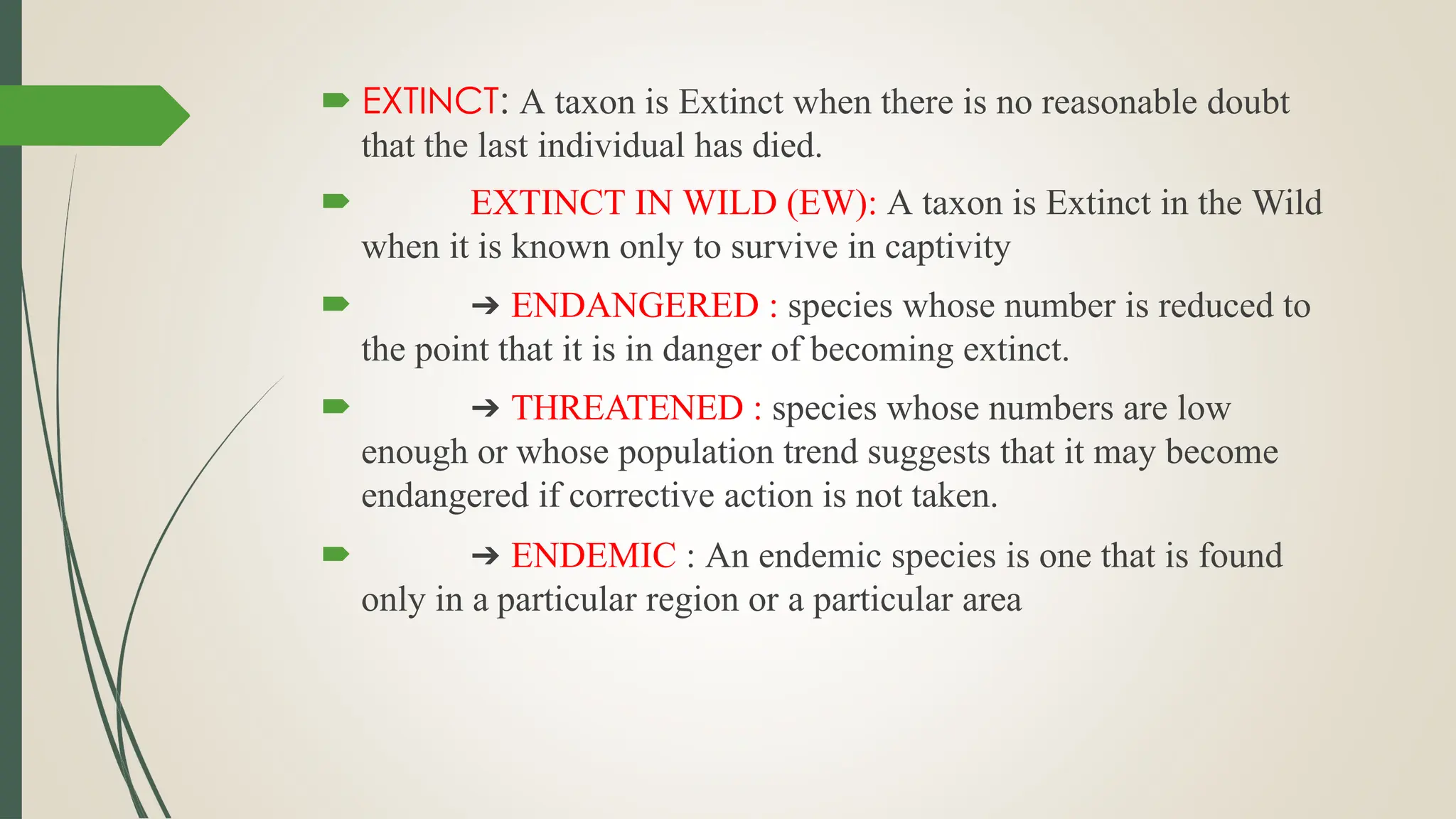
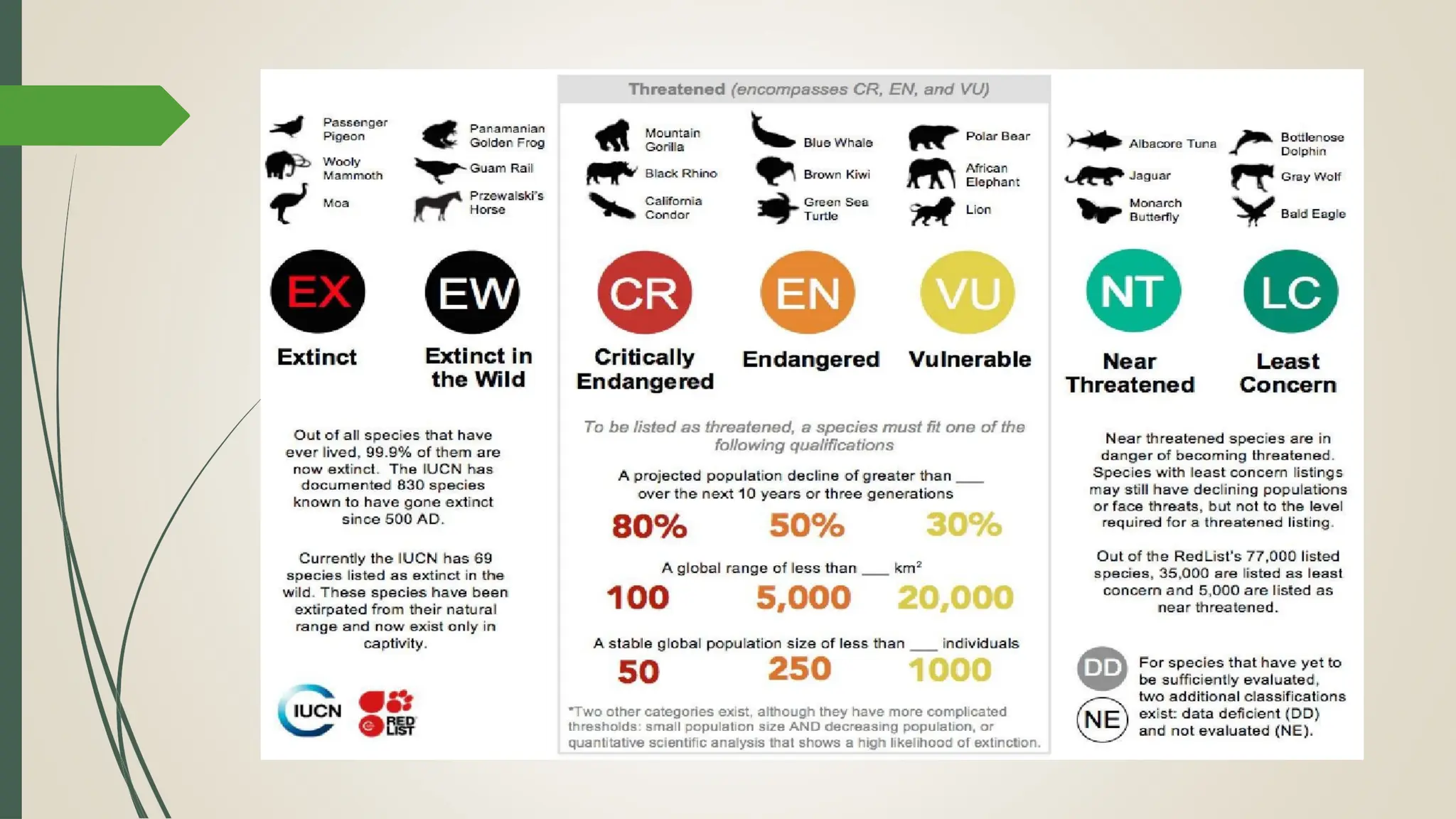
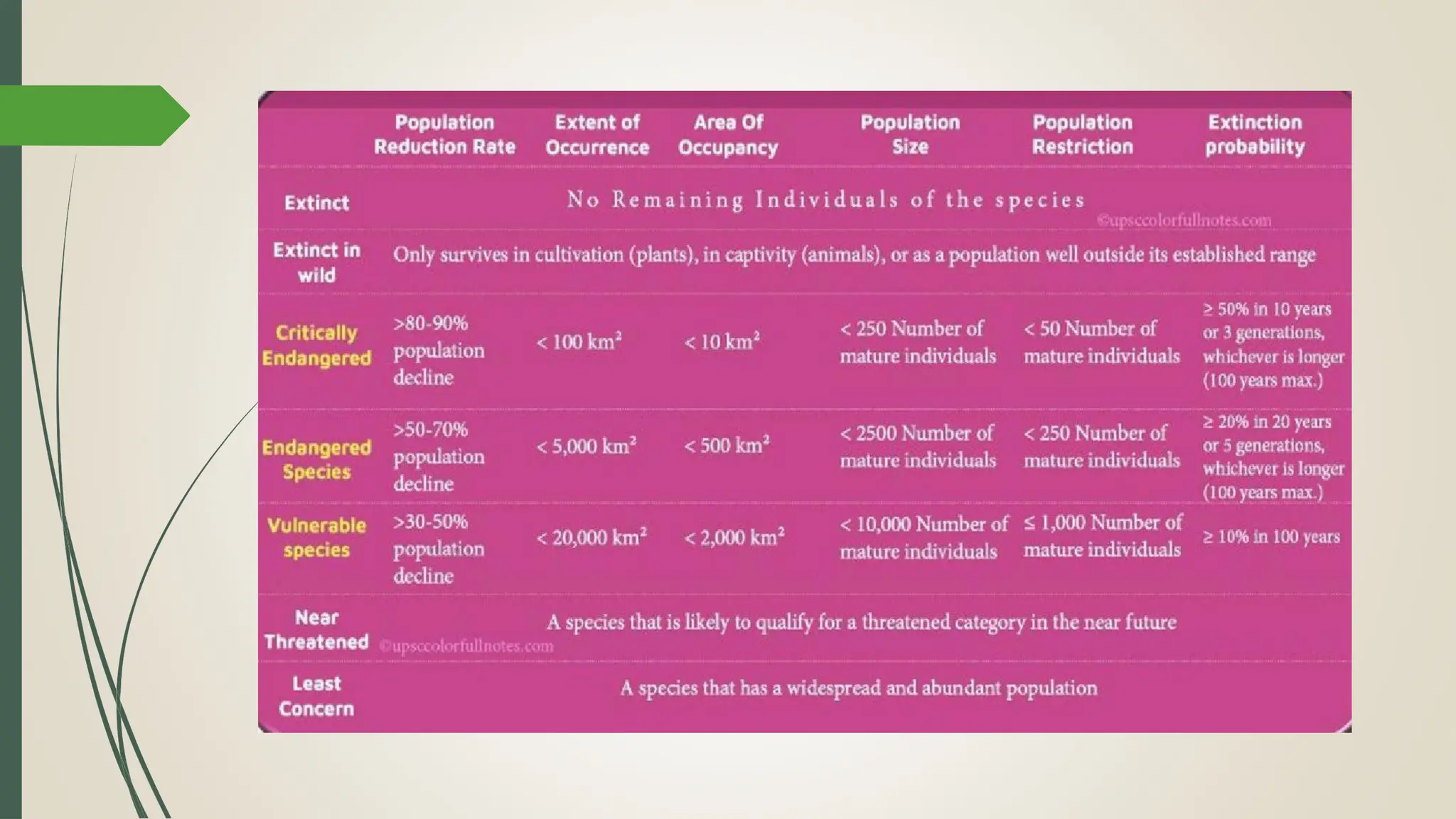
EXTINCT: Ataxon is Extinct when there is no reasonable doubt
that the last individual has died.
EXTINCT IN WILD (EW): A taxon is Extinct in the Wild
when it is known only to survive in captivity
➔ ENDANGERED : species whose number is reduced to
the point that it is in danger of becoming extinct.
➔ THREATENED : species whose numbers are low
enough or whose population trend suggests that it may become
endangered if corrective action is not taken.
➔ ENDEMIC : An endemic species is one that is found
only in a particular region or a particular area
3.
INTRODUCTION
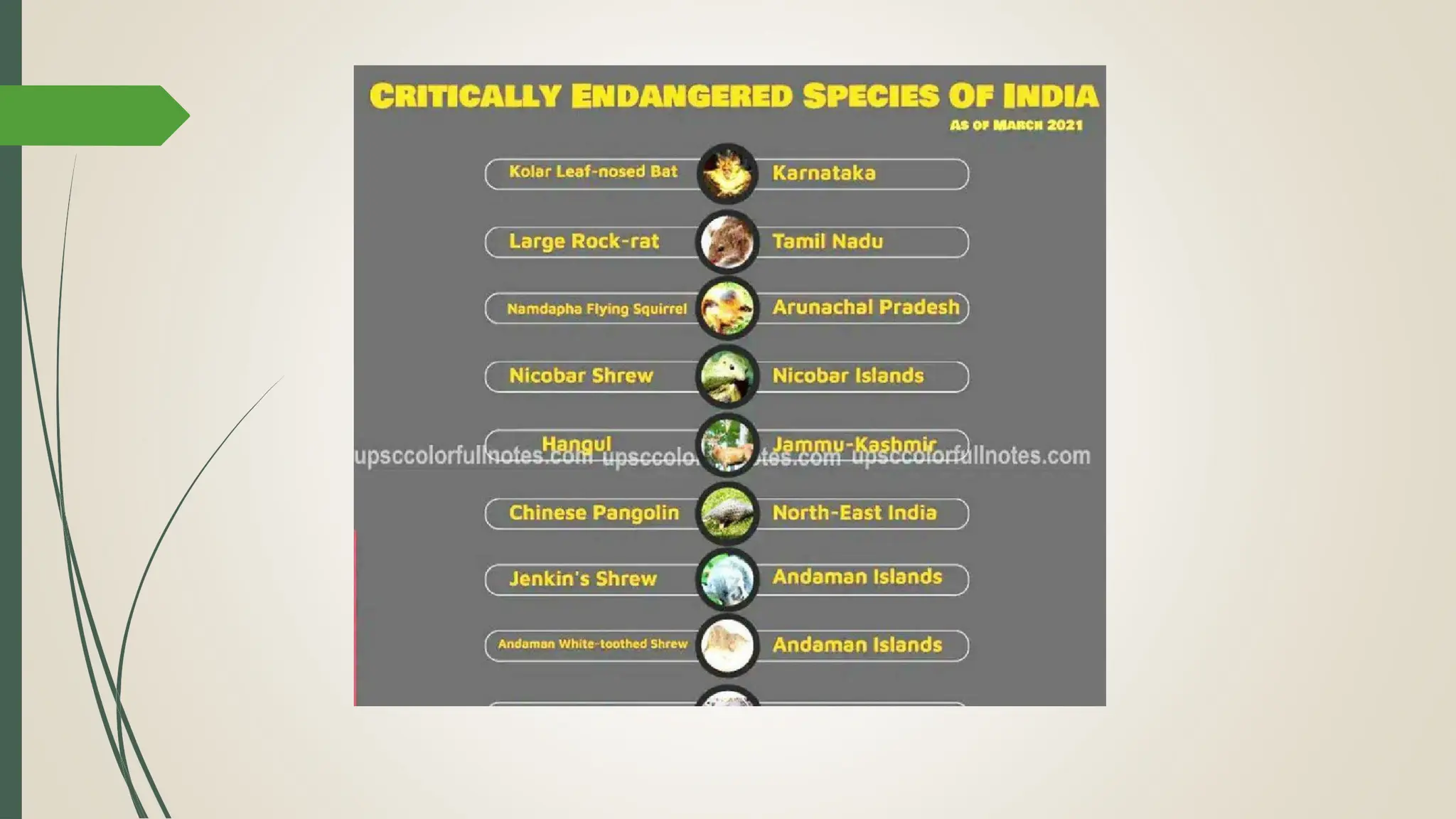
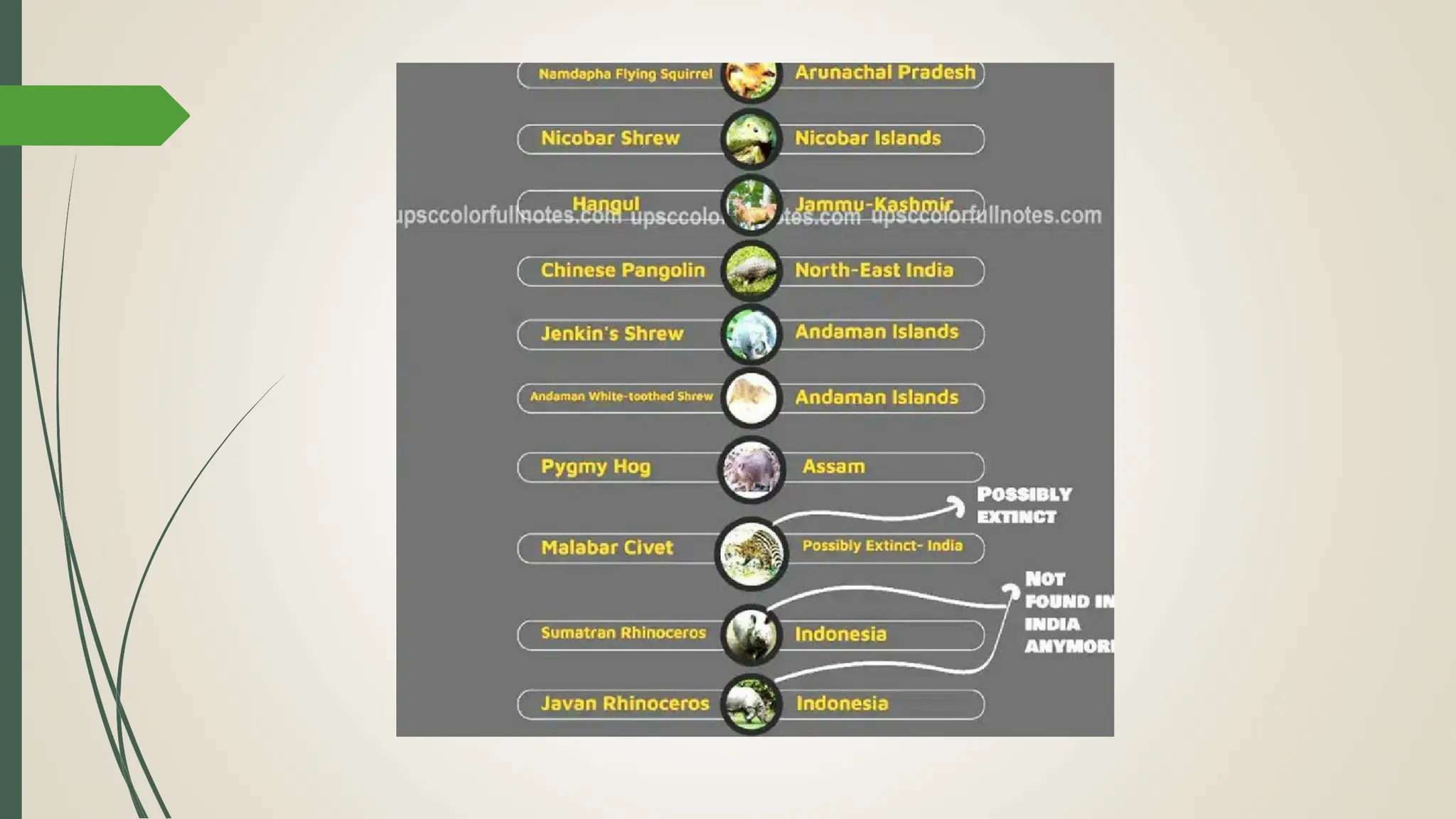
According tothe IUCN RED List 2021, a total of 199 species in India
are considered to be in the severely endangered category .
There were total of 20 species from India that were added to the IUCN
RED List of Critically endangered species in the year 2021.(14 – animal
species and 6-plant species).
The IUCN RED List is updated in 2 rounds:
the 1st round saw addition of 5 species and the 2nd set of updates will be
published on September 4, 2021.
4.
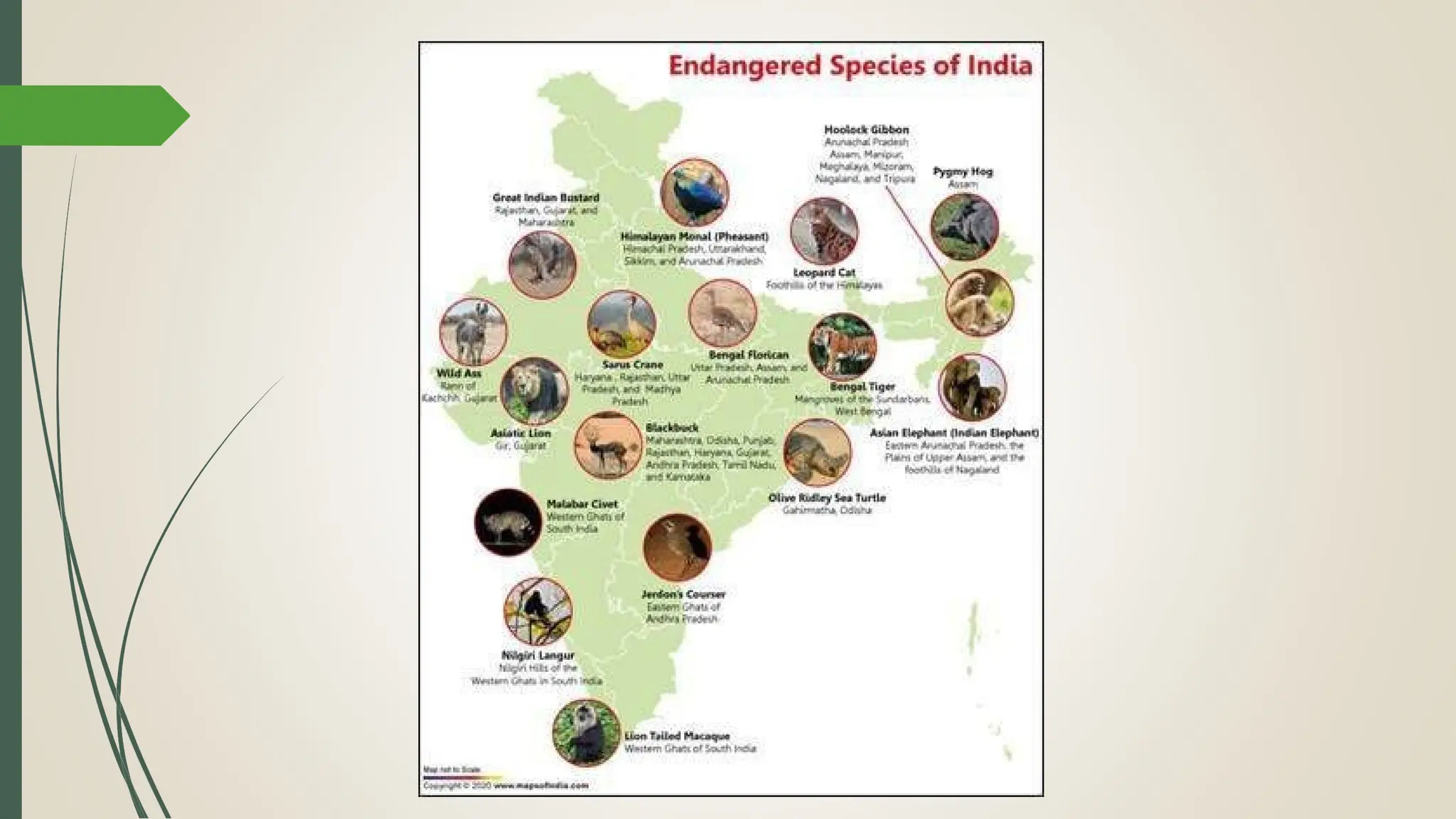
The IUCNRED List of critically endangered species now includes 15
additional species that are found in India .
The names of these 20 Indian species have been categorised as “ Critically
Endangered “ on the IUCN RED List of Threatened Species.
8.
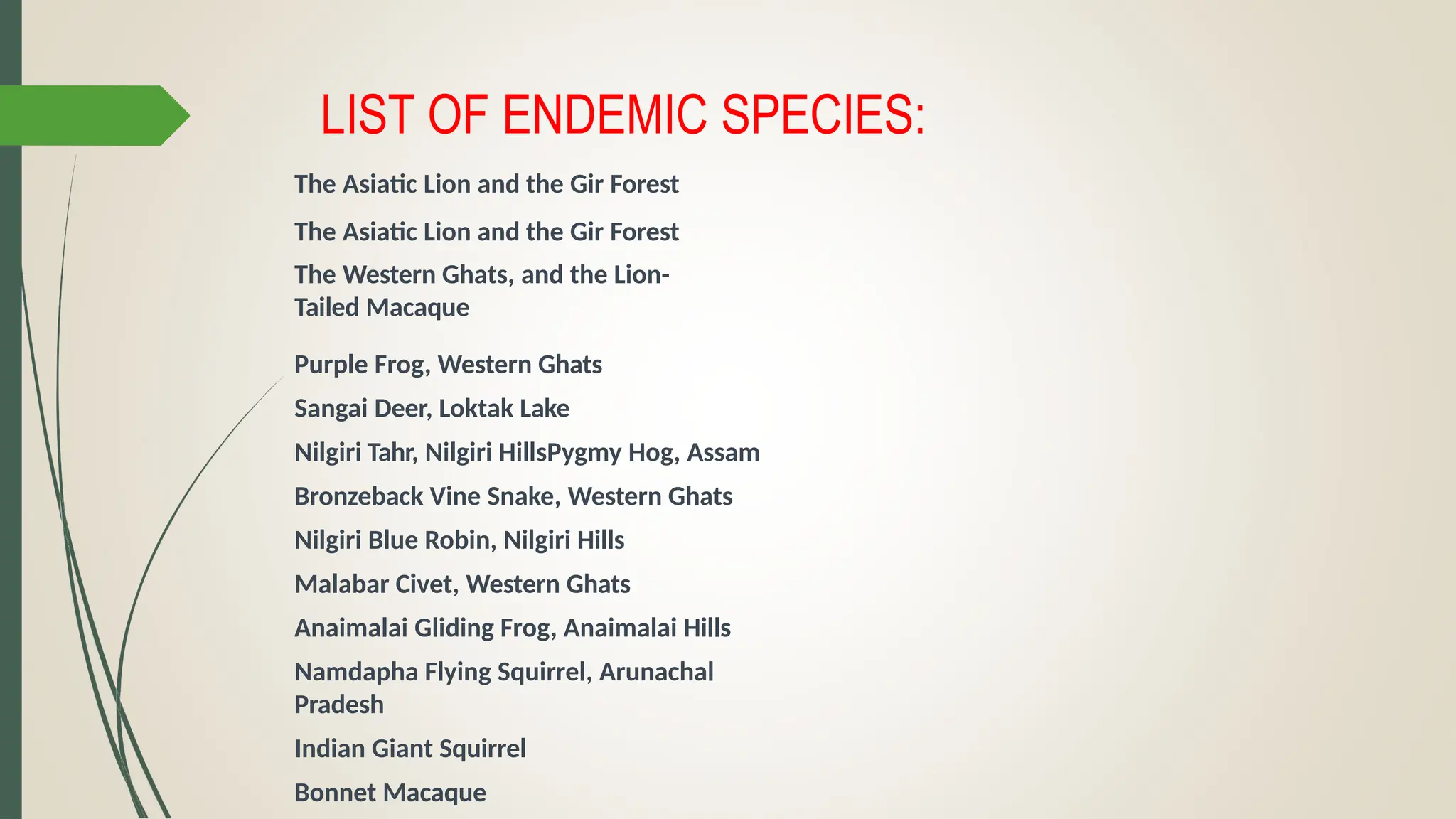
LIST OF ENDEMICSPECIES:
The Asiatic Lion and the Gir Forest
The Asiatic Lion and the Gir Forest
The Western Ghats, and the Lion-
Tailed Macaque
Purple Frog, Western Ghats
Sangai Deer, Loktak Lake
Nilgiri Tahr, Nilgiri HillsPygmy Hog, Assam
Bronzeback Vine Snake, Western Ghats
Nilgiri Blue Robin, Nilgiri Hills
Malabar Civet, Western Ghats
Anaimalai Gliding Frog, Anaimalai Hills
Namdapha Flying Squirrel, Arunachal
Pradesh
Indian Giant Squirrel
Bonnet Macaque
9.
ENDEMIC SPECIES
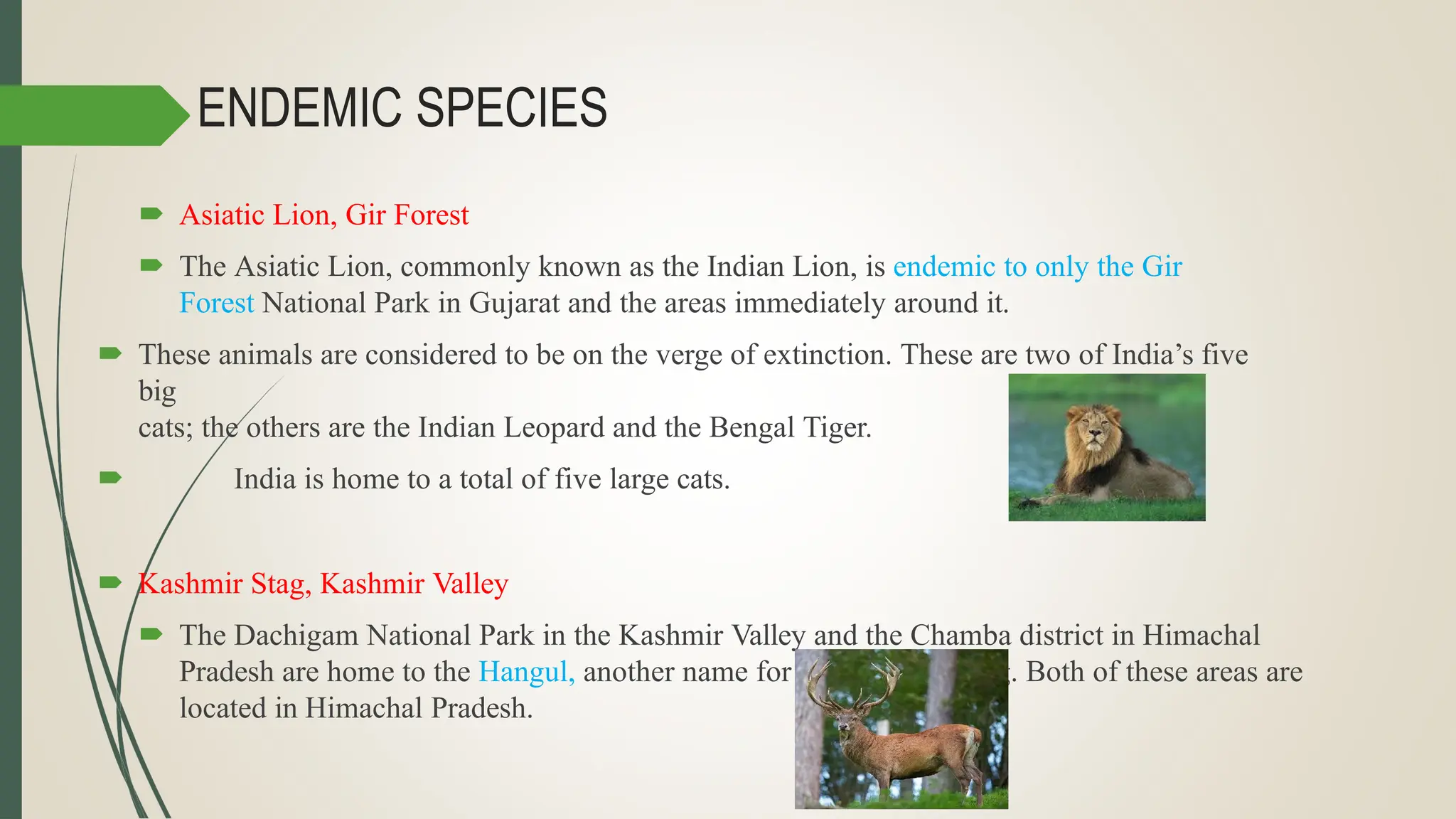
AsiaticLion, Gir Forest
The Asiatic Lion, commonly known as the Indian Lion, is endemic to only the Gir
Forest National Park in Gujarat and the areas immediately around it.
These animals are considered to be on the verge of extinction. These are two of India’s five
big
cats; the others are the Indian Leopard and the Bengal Tiger.
India is home to a total of five large cats.
Kashmir Stag, Kashmir Valley
The Dachigam National Park in the Kashmir Valley and the Chamba district in Himachal
Pradesh are home to the Hangul, another name for the Kashmir Stag. Both of these areas are
located in Himachal Pradesh.
10.
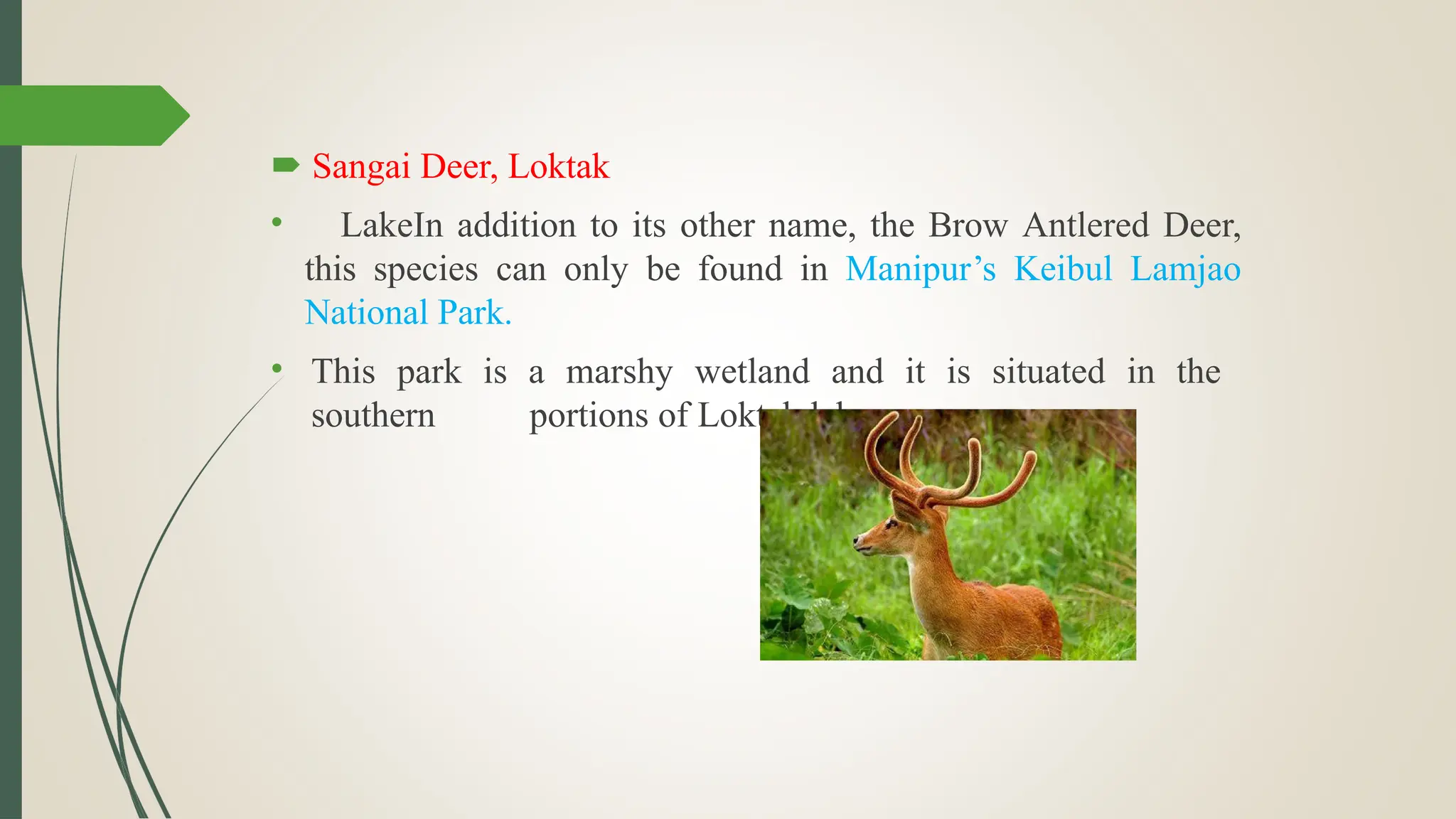
Sangai Deer,Loktak
• LakeIn addition to its other name, the Brow Antlered Deer,
this species can only be found in Manipur’s Keibul Lamjao
National Park.
• This park is a marshy wetland and it is situated in the
southern portions of Loktak lake.
11.
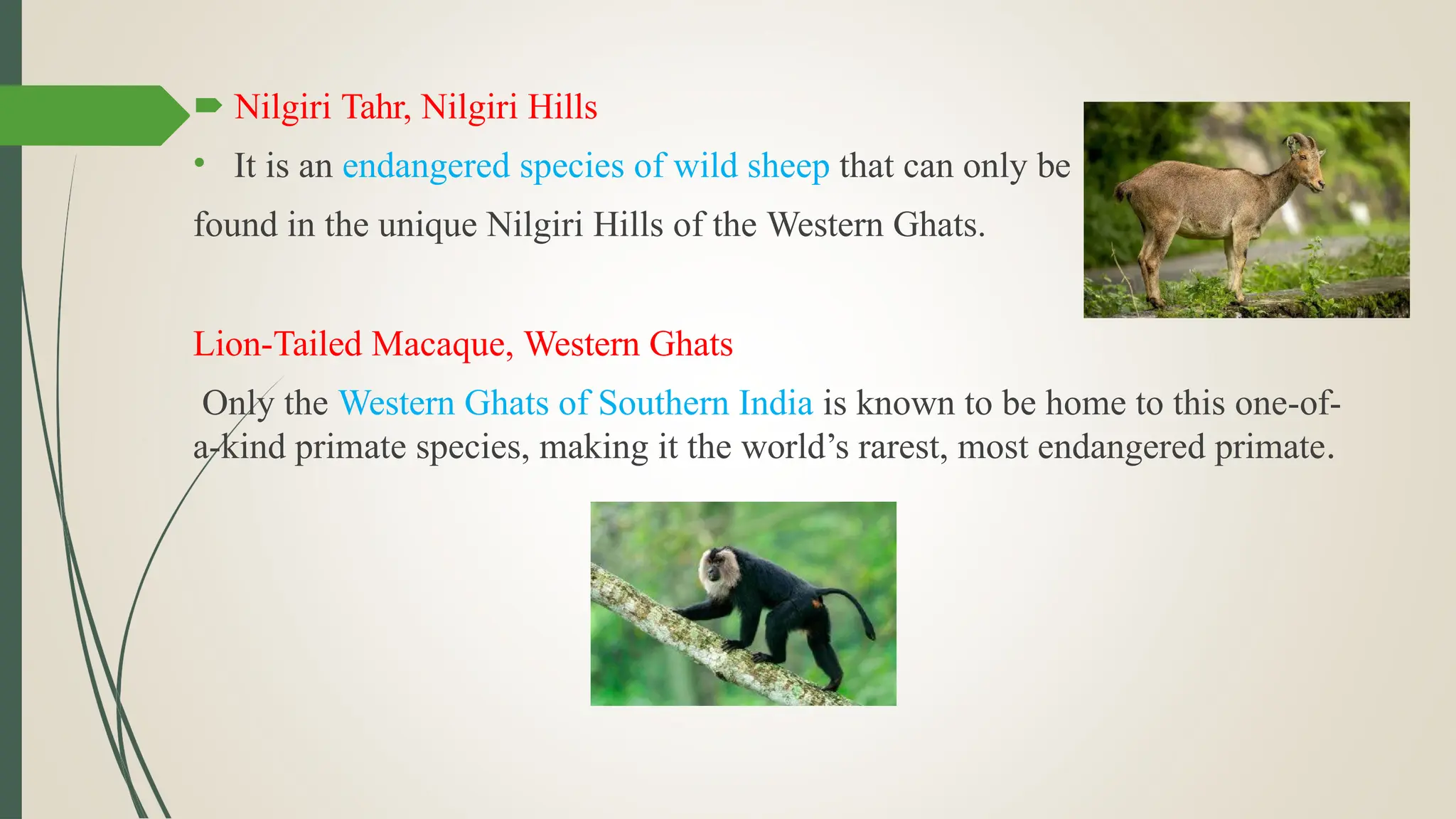
Nilgiri Tahr,Nilgiri Hills
• It is an endangered species of wild sheep that can only be
found in the unique Nilgiri Hills of the Western Ghats.
Lion-Tailed Macaque, Western Ghats
Only the Western Ghats of Southern India is known to be home to this one-of-
a-kind primate species, making it the world’s rarest, most endangered primate.
ENDANGERED SPECIES
Accordingto a 2020 analysis, the sixth mass extinction of
wildlife on Earth is accelerating with more than 500 species of
land animals on the brink of extinction that will likely be lost
within the next two decades.
14.
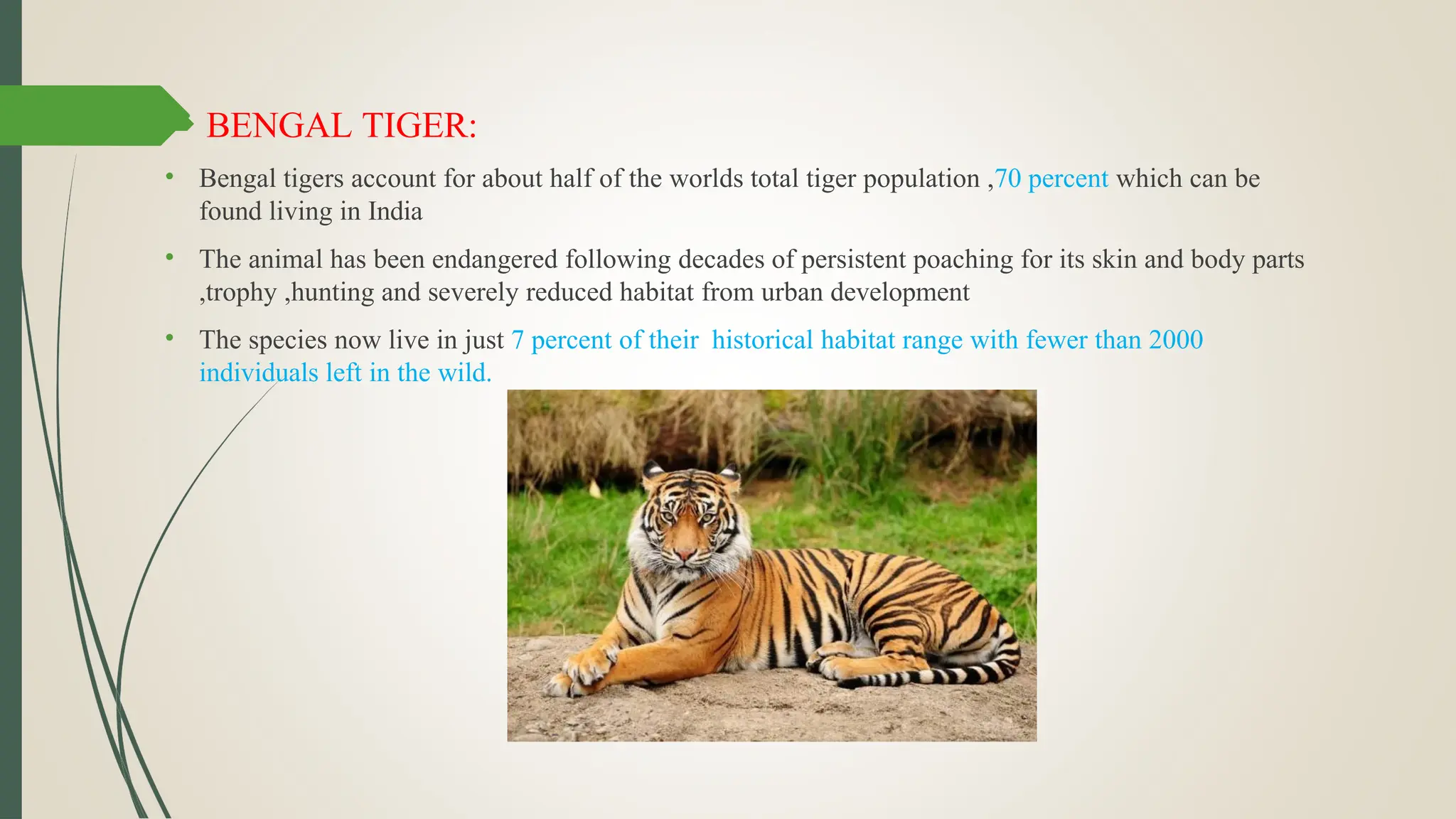
BENGAL TIGER:
•Bengal tigers account for about half of the worlds total tiger population ,70 percent which can be
found living in India
• The animal has been endangered following decades of persistent poaching for its skin and body parts
,trophy ,hunting and severely reduced habitat from urban development
• The species now live in just 7 percent of their historical habitat range with fewer than 2000
individuals left in the wild.
15.
ASIATIC LION
As thename suggest the asiatic lion was historically
native across south west Asia to eastern India
But not the species entire population can only be found in
India and restricted to the Gir national park in Gujarat
.listed as an the endangered species by the international
union for conservation of nature[ICUN]since 2010,the
Asiatic lion only has about 500 -650 individuals left in
the country.
While the animals mostly confined to the Gir forest many
framers still us crude and illegal electrical fences to
protect their crops while lions often get caught up in it
.Likewise nearly 20000 open wells dug by farmers in the
area for irrigation have lead to many accidental
drownings of lions
16.
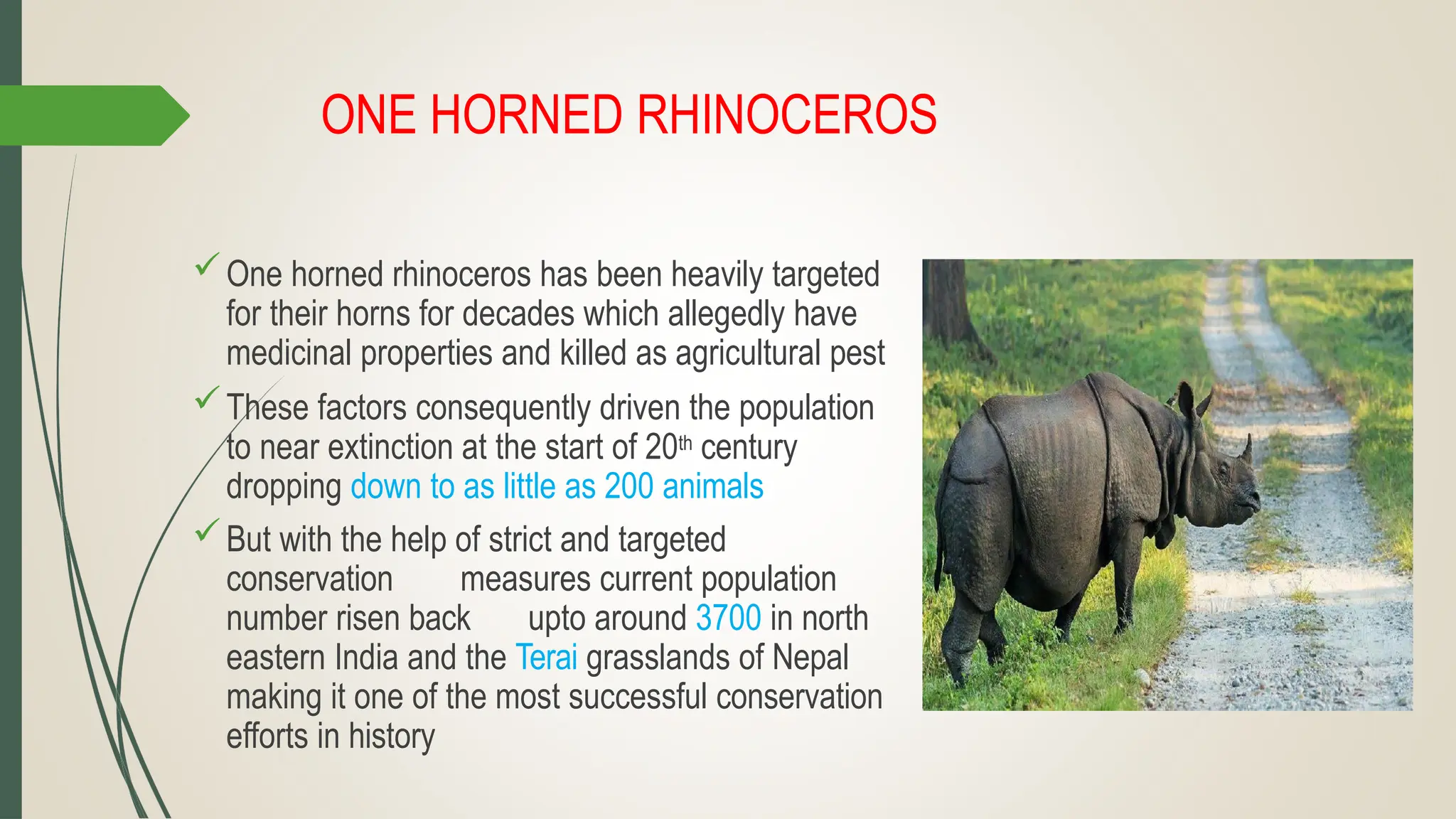
ONE HORNED RHINOCEROS
Onehorned rhinoceros has been heavily targeted
for their horns for decades which allegedly have
medicinal properties and killed as agricultural pest
These factors consequently driven the population
to near extinction at the start of 20th century
dropping down to as little as 200 animals
But with the help of strict and targeted
conservation measures current population
number risen back upto around 3700 in north
eastern India and the Terai grasslands of Nepal
making it one of the most successful conservation
efforts in history
17.
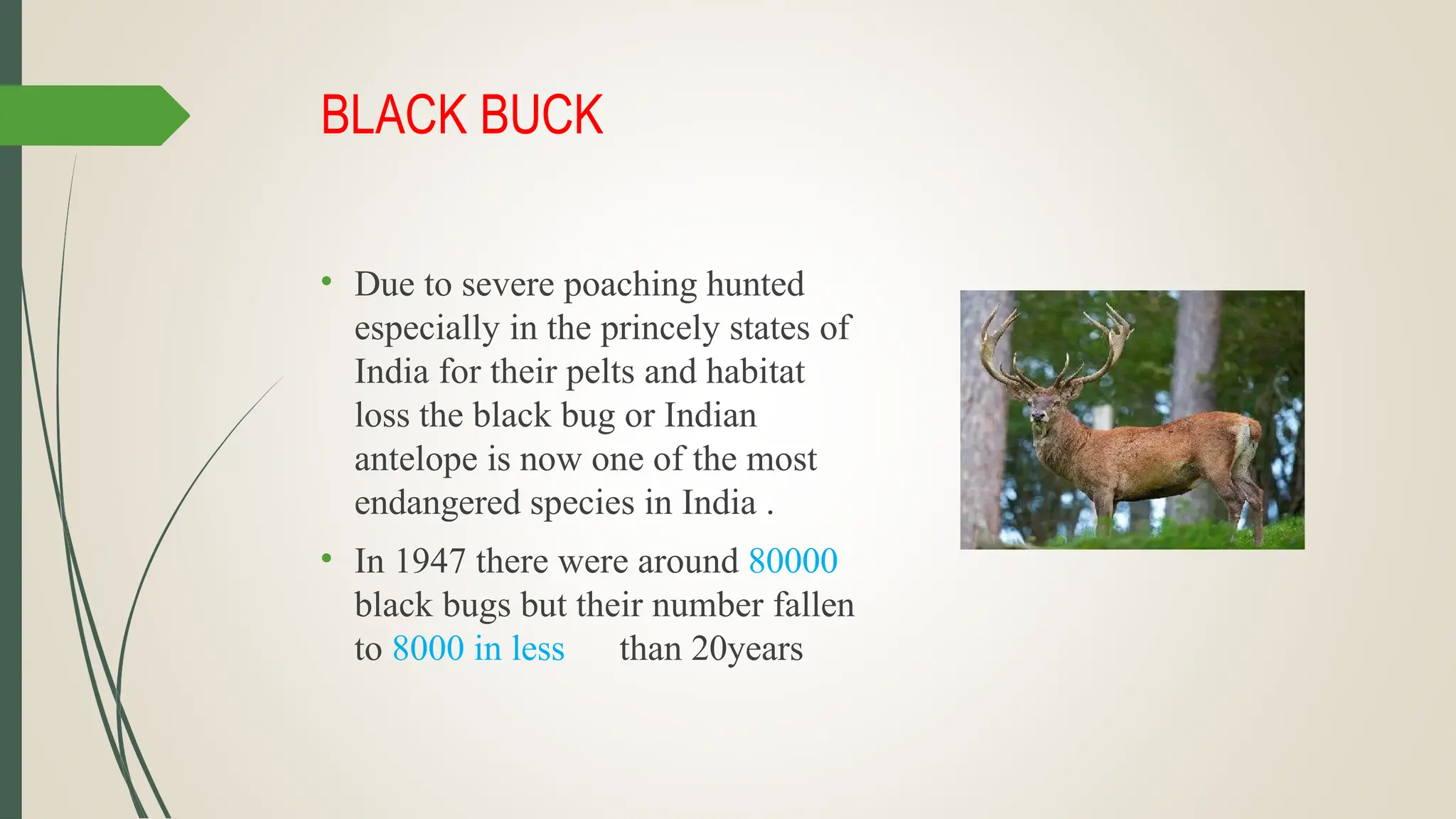
BLACK BUCK
• Dueto severe poaching hunted
especially in the princely states of
India for their pelts and habitat
loss the black bug or Indian
antelope is now one of the most
endangered species in India .
• In 1947 there were around 80000
black bugs but their number fallen
to 8000 in less than 20years
18.
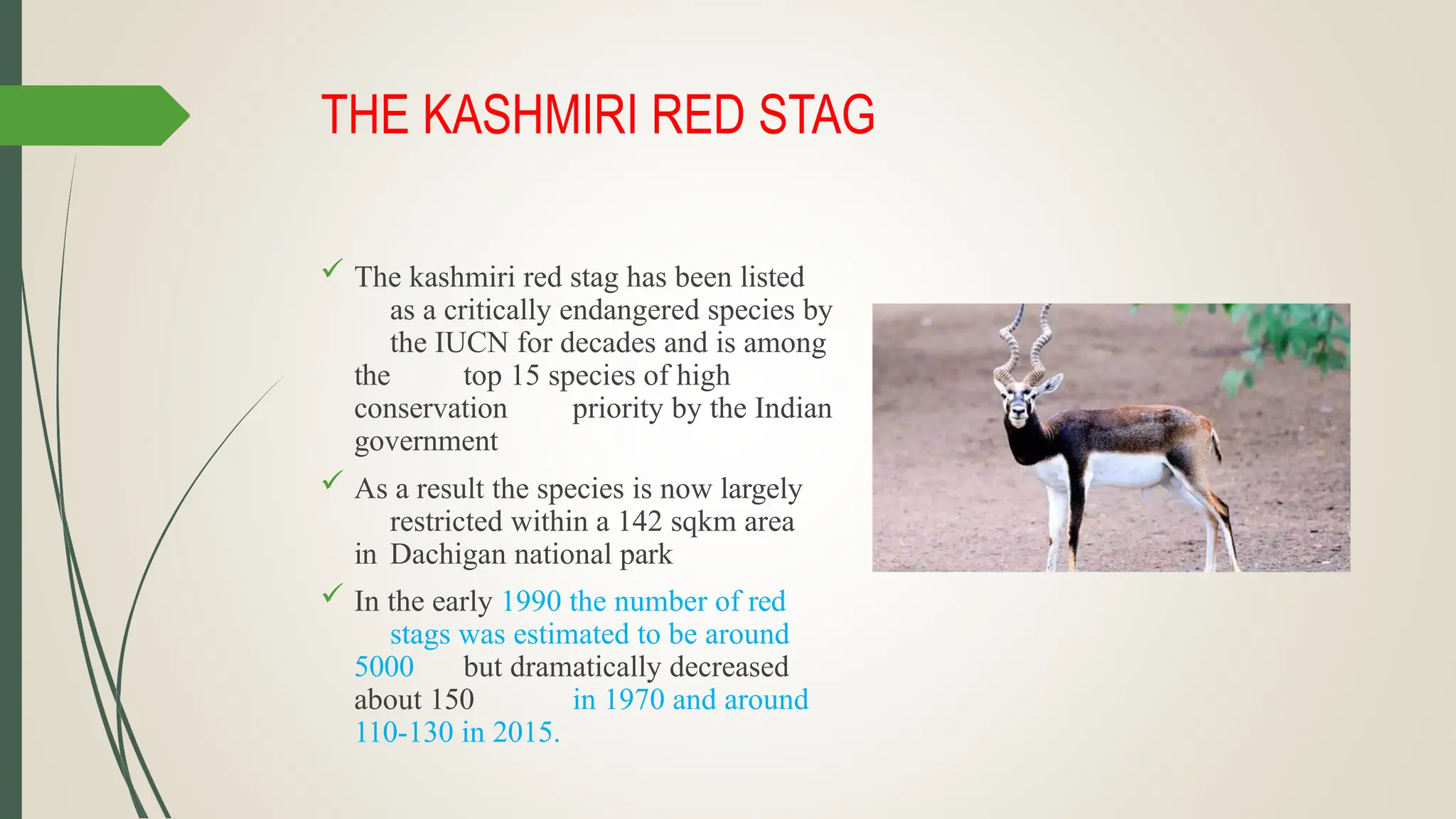
THE KASHMIRI REDSTAG
The kashmiri red stag has been listed
as a critically endangered species by
the IUCN for decades and is among
the top 15 species of high
conservation priority by the Indian
government
As a result the species is now largely
restricted within a 142 sqkm area
in Dachigan national park
In the early 1990 the number of red
stags was estimated to be around
5000 but dramatically decreased
about 150 in 1970 and around
110-130 in 2015.
19.
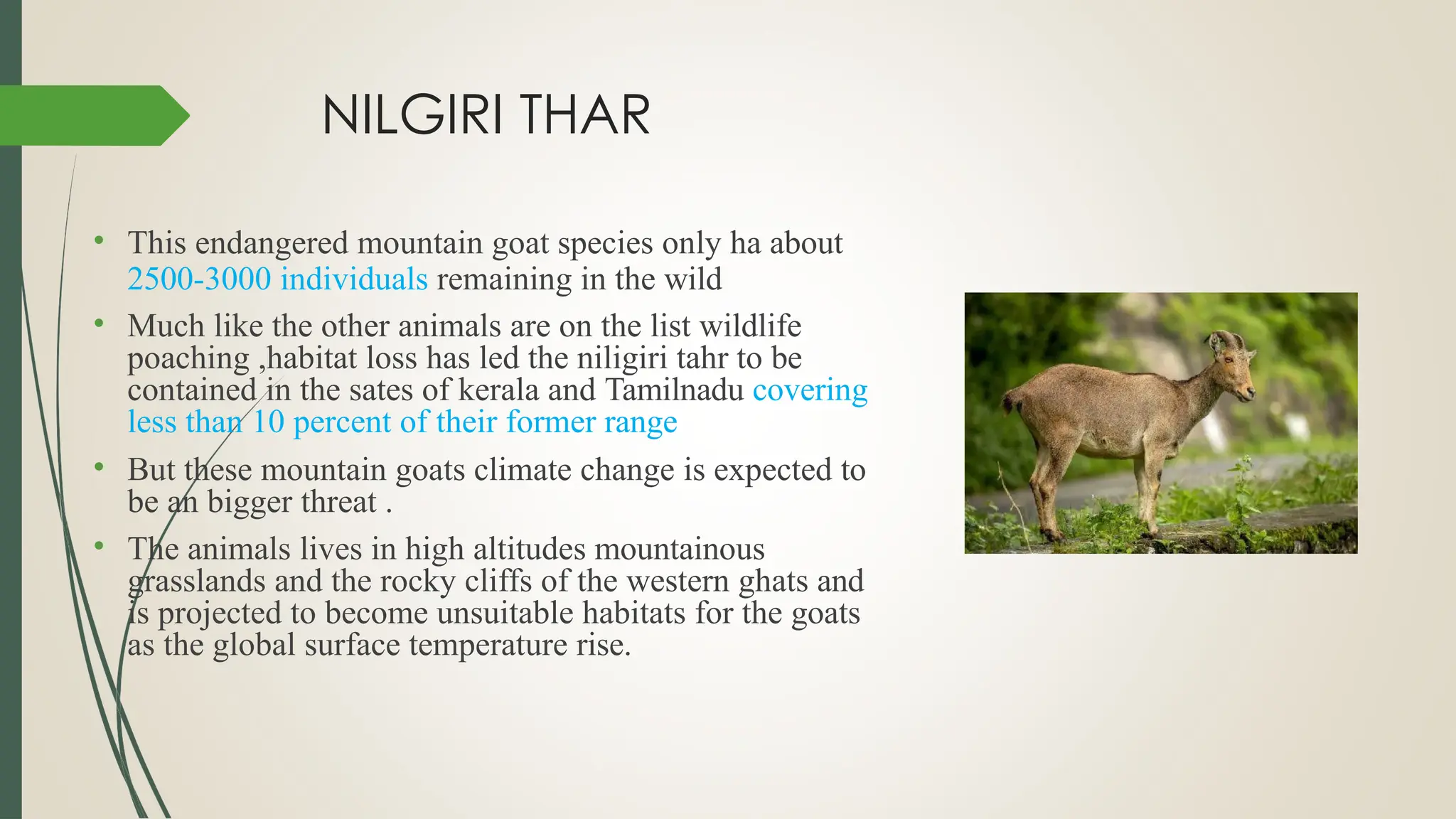
NILGIRI THAR
• Thisendangered mountain goat species only ha about
2500-3000 individuals remaining in the wild
• Much like the other animals are on the list wildlife
poaching ,habitat loss has led the niligiri tahr to be
contained in the sates of kerala and Tamilnadu covering
less than 10 percent of their former range
• But these mountain goats climate change is expected to
be an bigger threat .
• The animals lives in high altitudes mountainous
grasslands and the rocky cliffs of the western ghats and
is projected to become unsuitable habitats for the goats
as the global surface temperature rise.
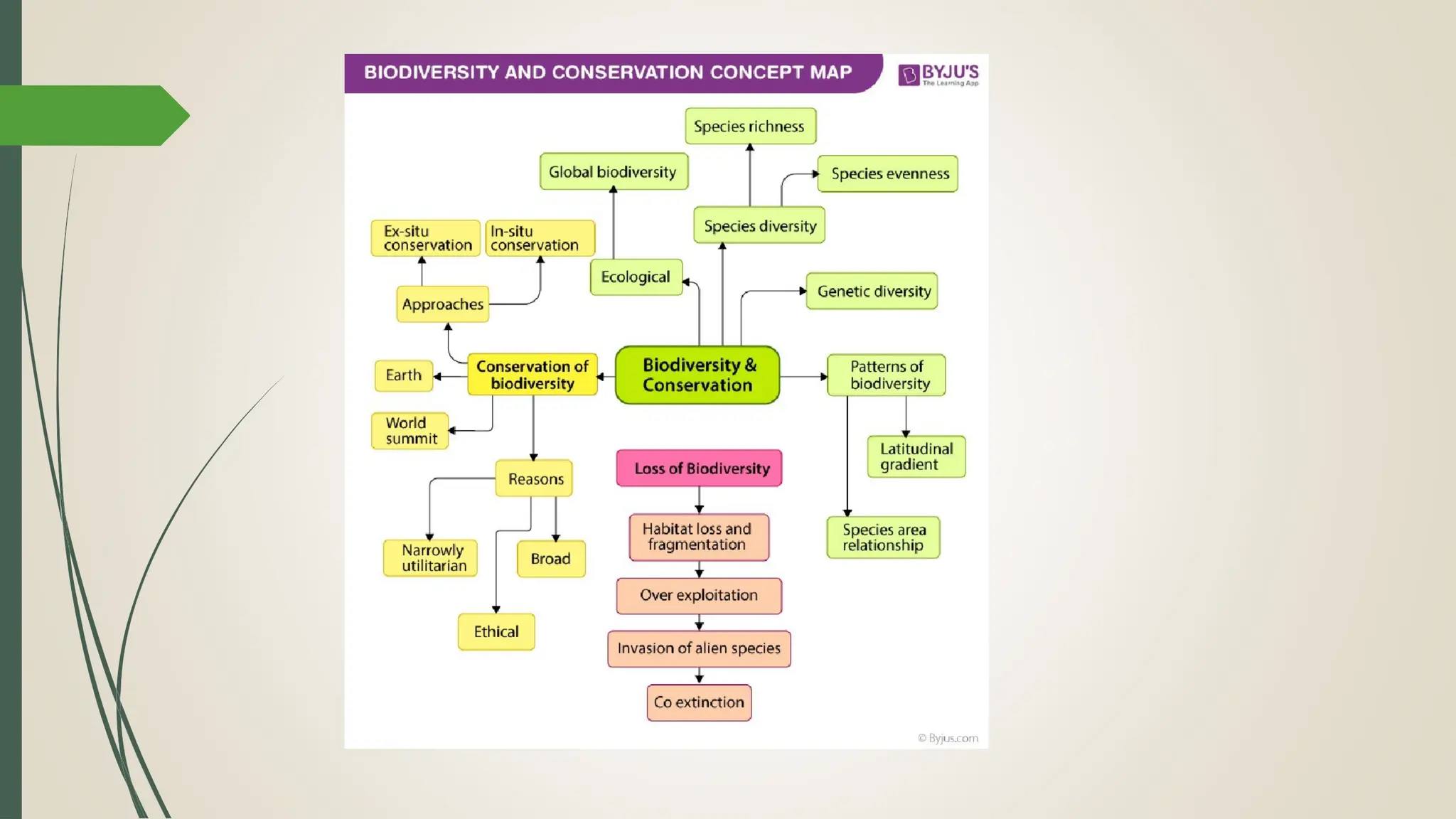
CONSERVATION OF BIODIVERSITY:
Objectives and advantages of biodiversity conservation:
• Conservation of biological diversity leads to conservation essential
ecological diversity to preserve the continuity of food chains
• The genetic diversity of plants and animals is preserved
• It ensures the sustainable utilization of life support systems on earth
• It provides a vast knowledge of potential use to the scientific
community
• A reservoir of wild animals and plants is preserved ,thus
enabling
them to be introduced ,if need be , in the surrounding areas
• Biological diversity provides immediate benefits to the society such as
recreation and tourism
• Biodiversity conservation serves as an insurance policy for the future
26.
Loss ofbiodiversity occurs when either the habitat essential for the survival of a
species is destroyed, or particular species are destroyed.
Extinction of species may also be due to environmental factors like ecological
substitutions, biological factors and pathological causes which can be caused
by nature or man.
Natural causes for the loss of biodiversity
Natural causes include floods, earthquakes, landslides, natural competition
between species, lack of pollination and diseases.
Man-made causes for the loss of biodiversity
Destruction of habitat in the wake of developmental activities like housing,
agriculture, construction of dams, reservoirs, roads, railway tracks, etc.
Pollution, a gift of the industrial revolution can be given the pride of place for
driving a variety of species in air, water and land towards extinction.
28.
• Motorcars, air-conditionersand refrigerators, the three symbols of a modern,
affluent society, have been instrumental in global warming and ozone depletion.
Factories and power stations spewing out poisonous gases and effluents have
fouled up the environment bringing death and disease to many species.
• Oil spills and discharge of sewage have ravaged the oceans and coastal habitats.
A large number of species are threatened by overhunting, poaching and illegal
trade.
• Indiscriminate use of toxic chemicals and pesticides and overexploitation of
wildlife resources for commercial purposes are responsible for the rapid decline
in the number of some species.
• The tiger for instance is hunted for its claws and other parts believed to
be effective cures for various ailments of man.
• Snakes and crocodiles are killed in large numbers for their skin and
minks, sable, ermine, etc., are in demand for the luxury and warmth of
their fur.
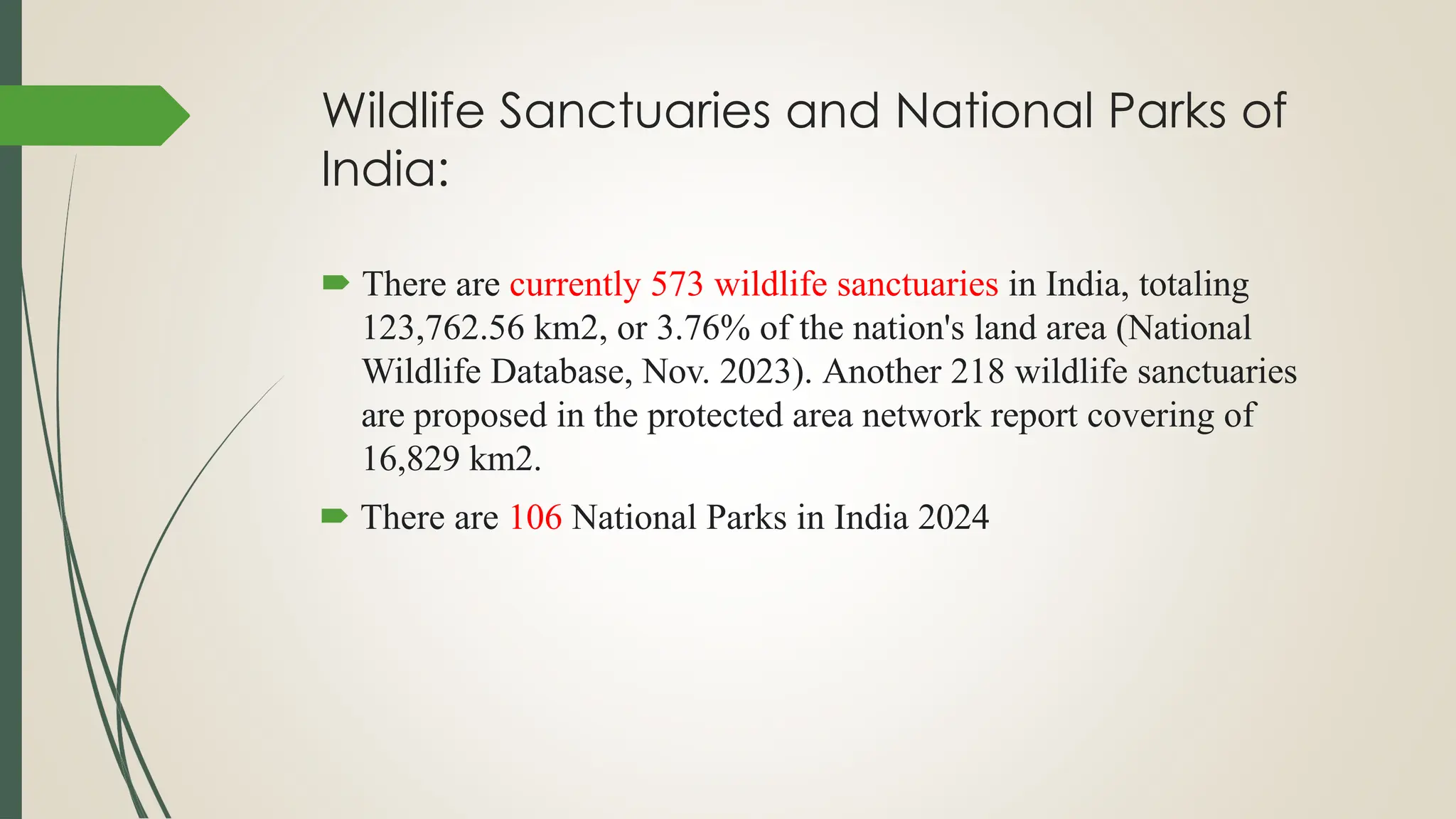
32.
Wildlife Sanctuaries andNational Parks of
India:
There are currently 573 wildlife sanctuaries in India, totaling
123,762.56 km2, or 3.76% of the nation's land area (National
Wildlife Database, Nov. 2023). Another 218 wildlife sanctuaries
are proposed in the protected area network report covering of
16,829 km2.
There are 106 National Parks in India 2024
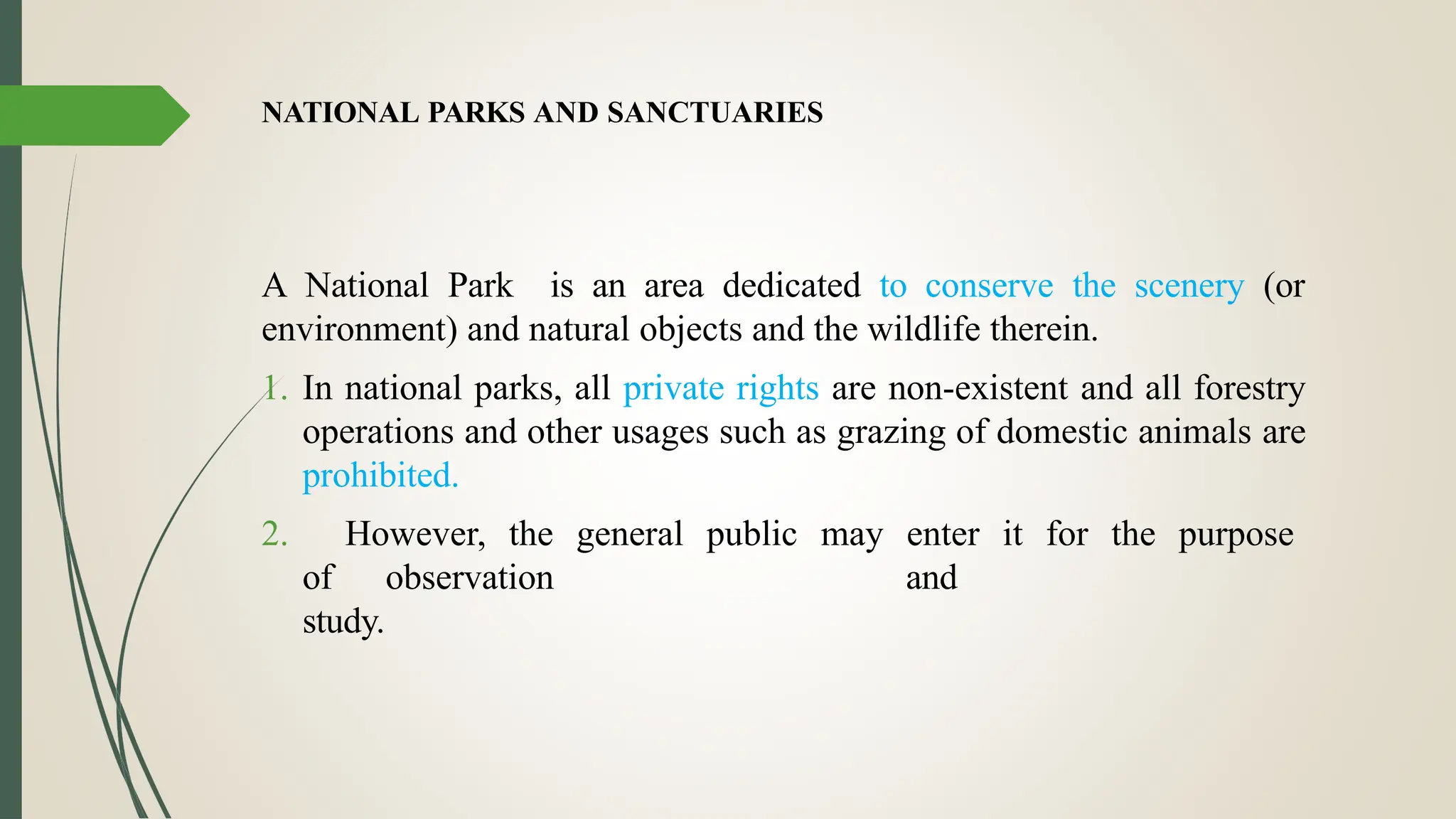
33.
NATIONAL PARKS ANDSANCTUARIES
A National Park is an area dedicated to conserve the scenery (or
environment) and natural objects and the wildlife therein.
1. In national parks, all private rights are non-existent and all forestry
operations and other usages such as grazing of domestic animals are
prohibited.
2. However, the general public may enter it for the purpose
of observation and
study.
34.
A WildlifeSanctuary, similar to national park, is dedicated to
protect the wildlife, but it considers the conservations of species
only and also the boundary of it is not limited by a state
legislation.
Further, in the sanctuary, killing hunting or capturing of any species
of birds and mammals’ is prohibited except by or under the
control of highest authority in the department responsible
for management of that sanctuary.
Private ownership may be allowed to continue in a sanctuary, and
forestry and other usages permitted to the extent that they do
not adversely affect wildlife
35.
Ranthambore National Park
•The first on the list of wildlife sanctuaries in India is Ranthambore
National Park which is one of the largest wildlife sanctuaries in
India apart from being the most renowned national park in northern
India
• Ranthambore was the most ell known national park for observing
Tigers in the wild till about 3 to 4years ago. Since then many
tigers have been killed by poachers.
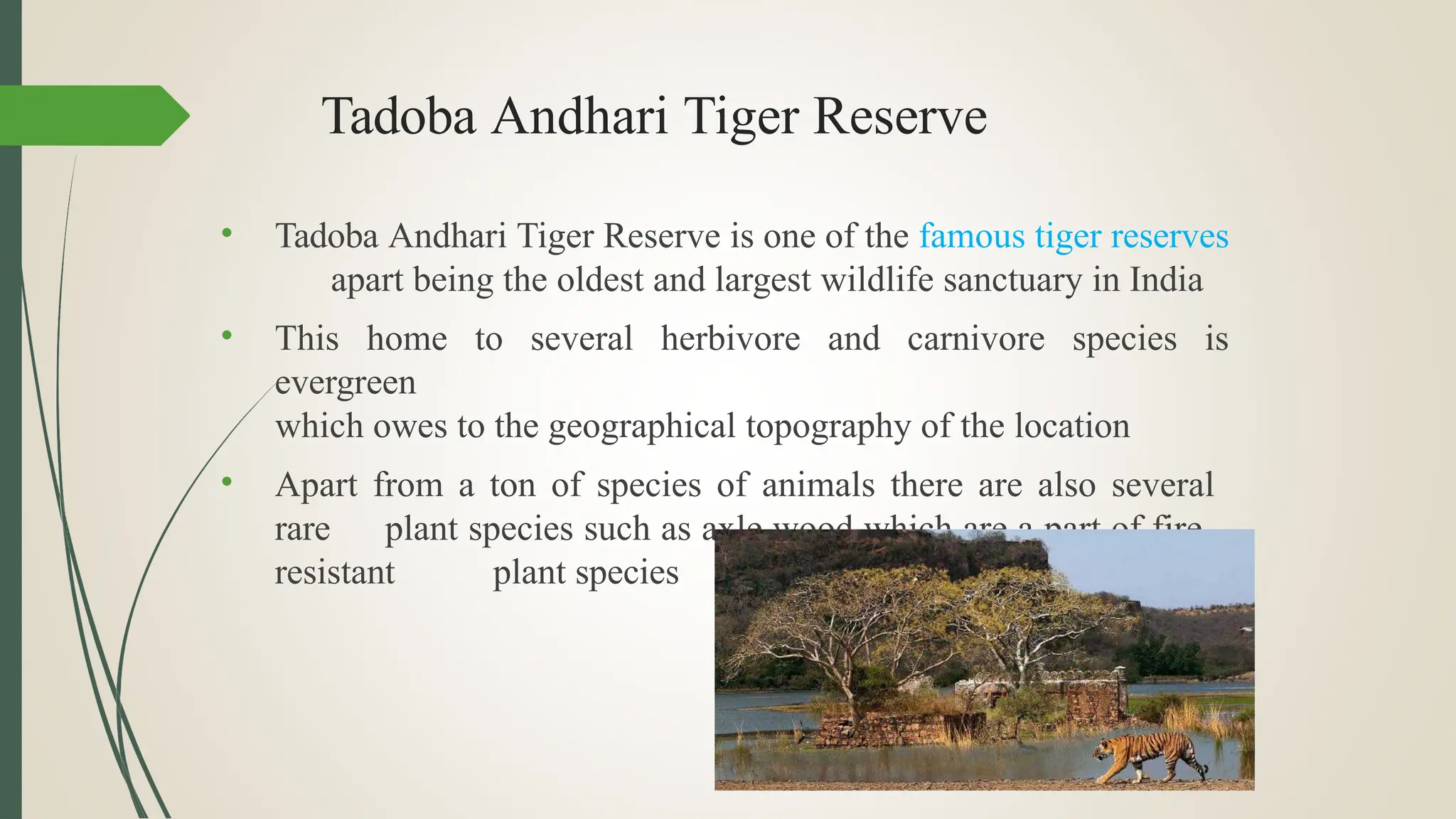
36.
Tadoba Andhari TigerReserve
• Tadoba Andhari Tiger Reserve is one of the famous tiger reserves
apart being the oldest and largest wildlife sanctuary in India
• This home to several herbivore and carnivore species is
evergreen
which owes to the geographical topography of the location
• Apart from a ton of species of animals there are also several
rare plant species such as axle wood which are a part of fire-
resistant plant species
37.
MANAS WILDLIFE AANCTUARY
ManasWildlife Sanctuary listed among the top 10 wildlife
sanctuaries in India gets its name from Mans River that
flows near this sanctuary
Though it might not be one of the largest wildlife
sanctuaries in India , it is still home to project tiger reserve
,biosphere reserve and elephant reserve
It was initially established in the year 1985 and was
declared a World Heritage Site by UNESCO .
38.
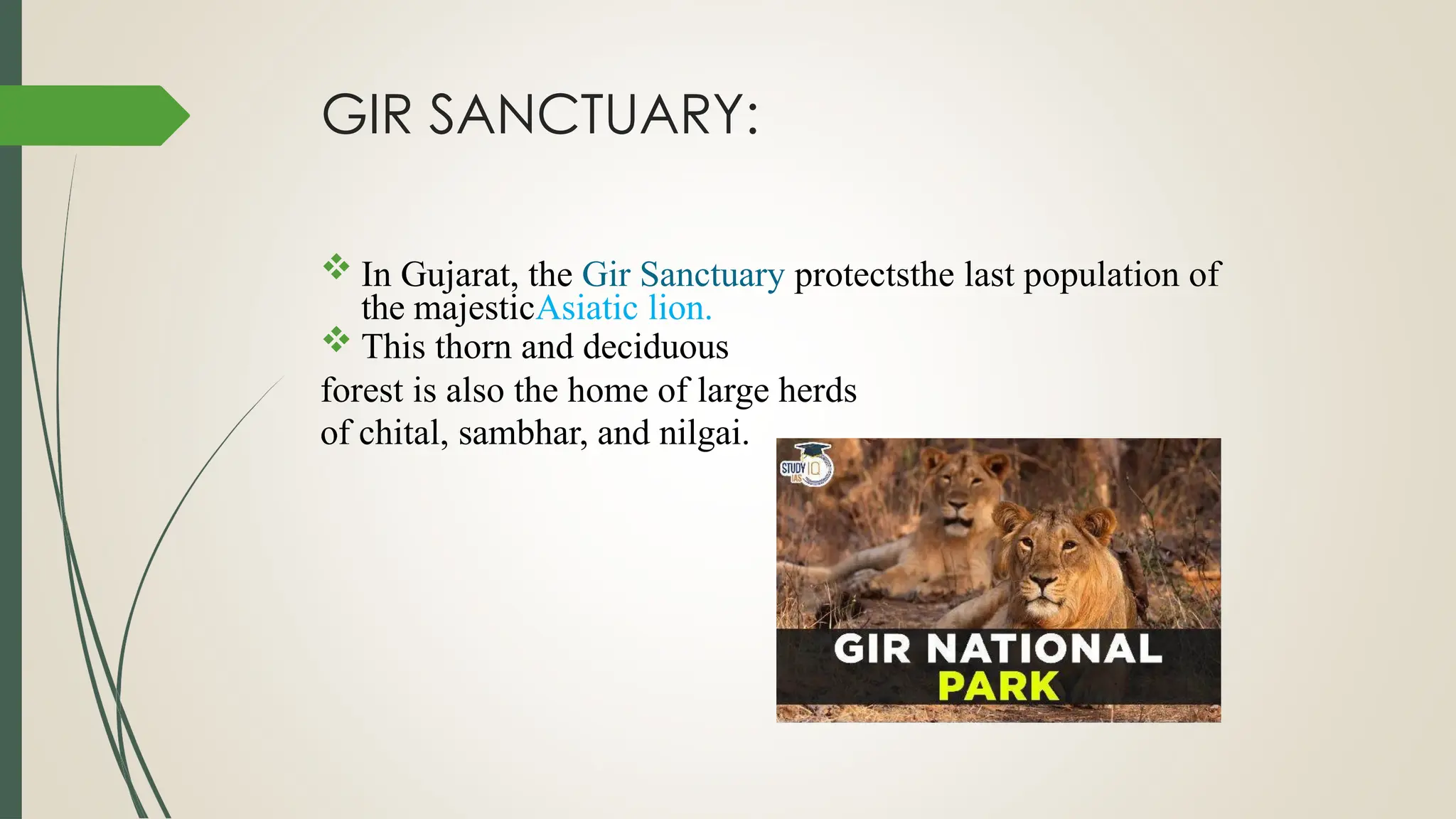
GIR SANCTUARY:
InGujarat, the Gir Sanctuary protectsthe last population of
the majesticAsiatic lion.
This thorn and deciduous
forest is also the home of large herds
of chital, sambhar, and nilgai.
39.
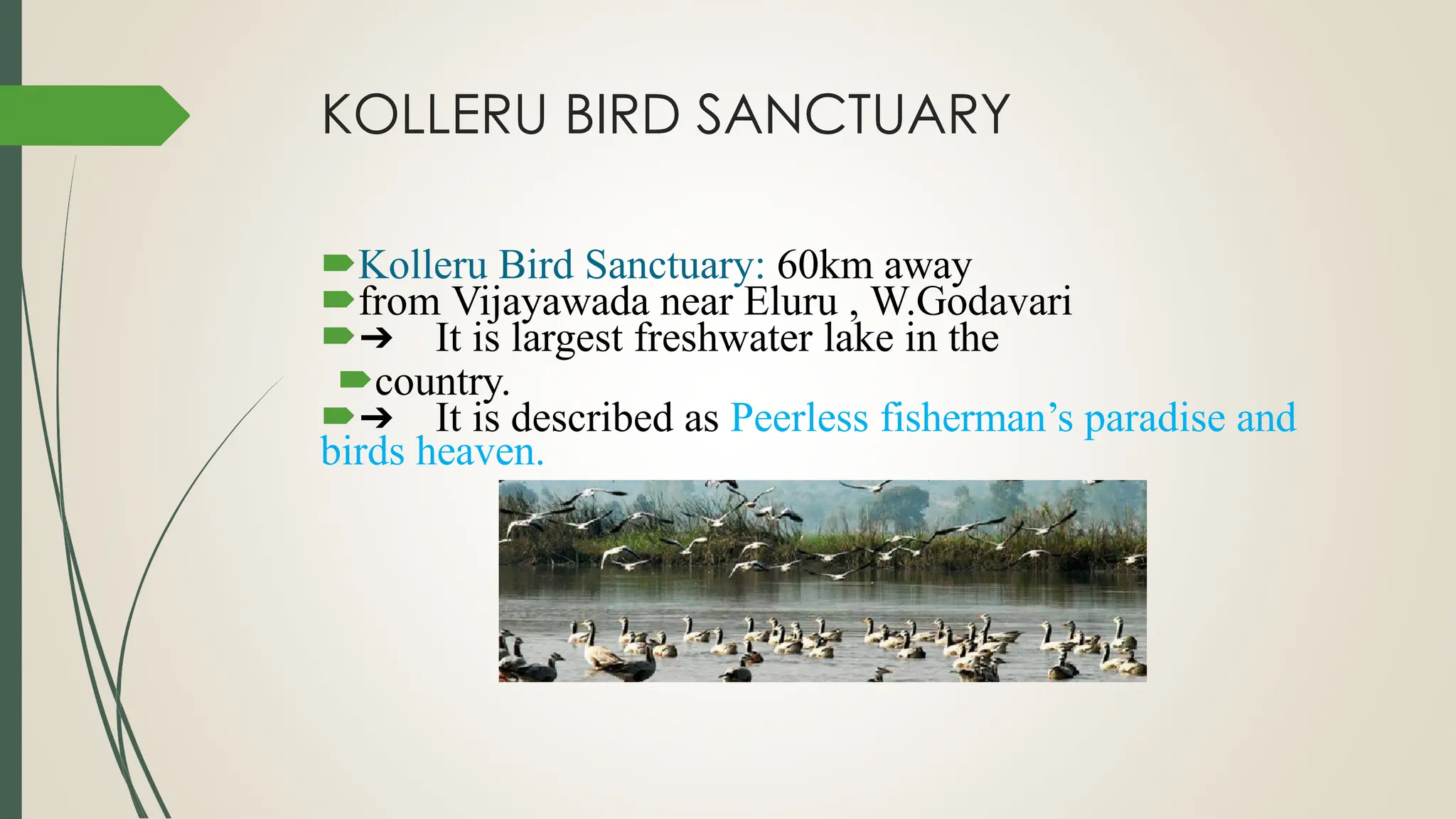
KOLLERU BIRD SANCTUARY
KolleruBird Sanctuary: 60km away
from Vijayawada near Eluru , W.Godavari
➔ It is largest freshwater lake in the
country.
➔ It is described as Peerless fisherman’s paradise and
birds heaven.
40.
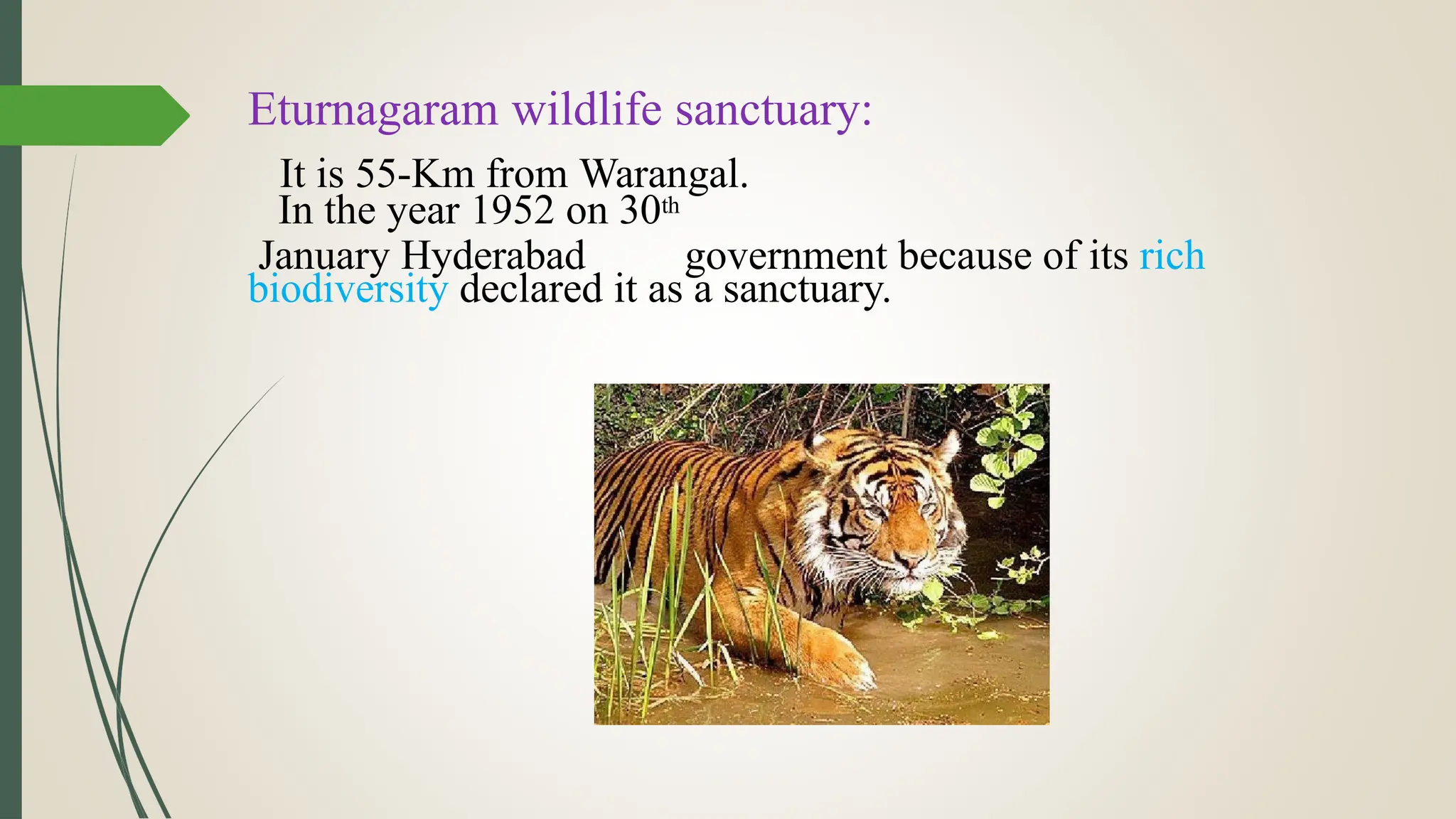
Eturnagaram wildlife sanctuary:
Itis 55-Km from Warangal.
In the year 1952 on 30th
January Hyderabad government because of its rich
biodiversity declared it as a sanctuary.
41.
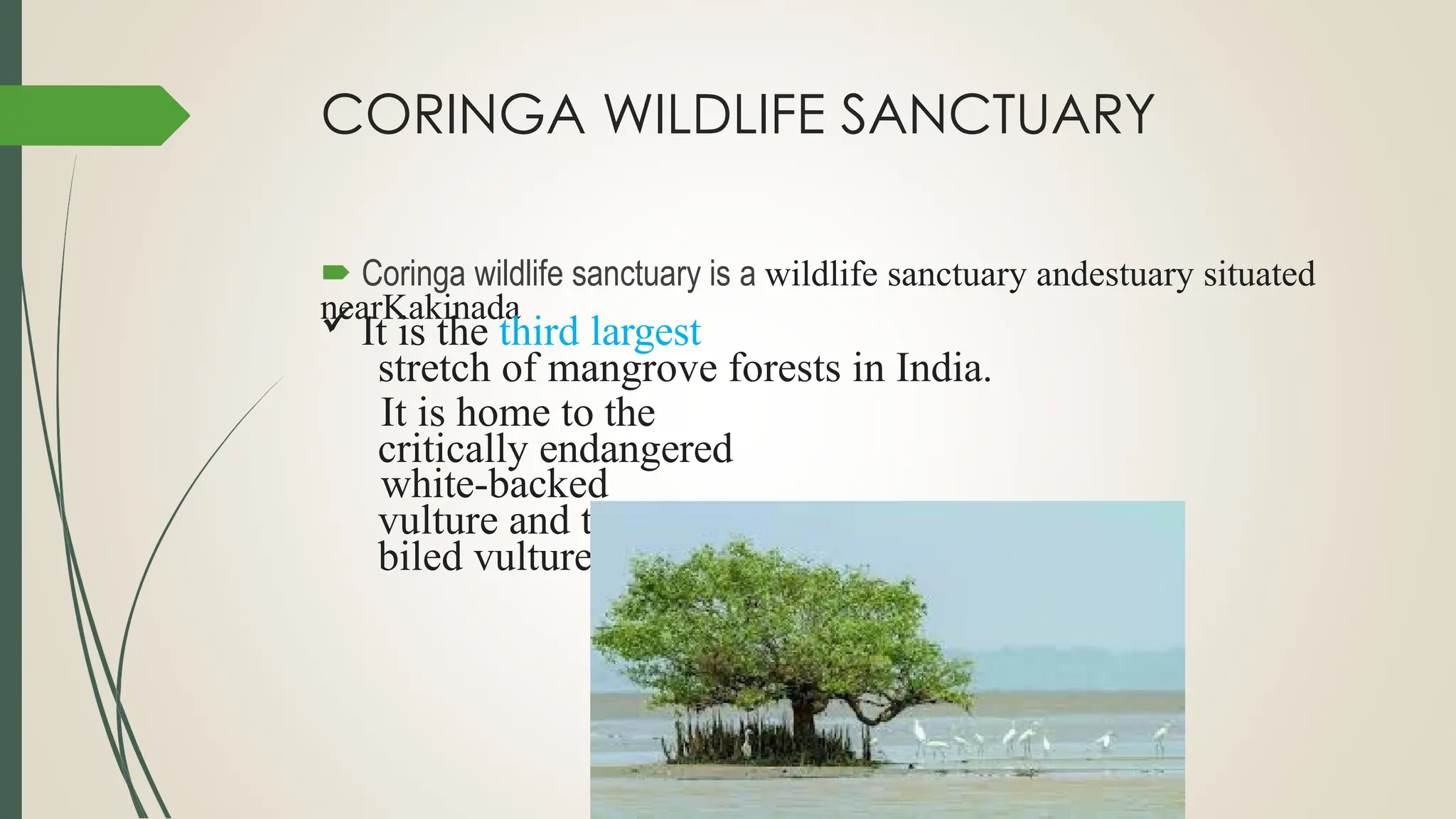
CORINGA WILDLIFE SANCTUARY
Coringa wildlife sanctuary is a wildlife sanctuary andestuary situated
nearKakinada
It is the third largest
stretch of mangrove forests in India.
It is home to the
critically endangered
white-backed
vulture and the long
biled vulture
42.
Nagarjunsagar-Srisailam
Tiger Reserveis the
largest tiger reserve in
India .
The reserve spreads
over five districts, Kurnool,
Prakasam , Guntur, Nalgonda, MBNR
district.
It is the largest
tiger reserve forest in
India
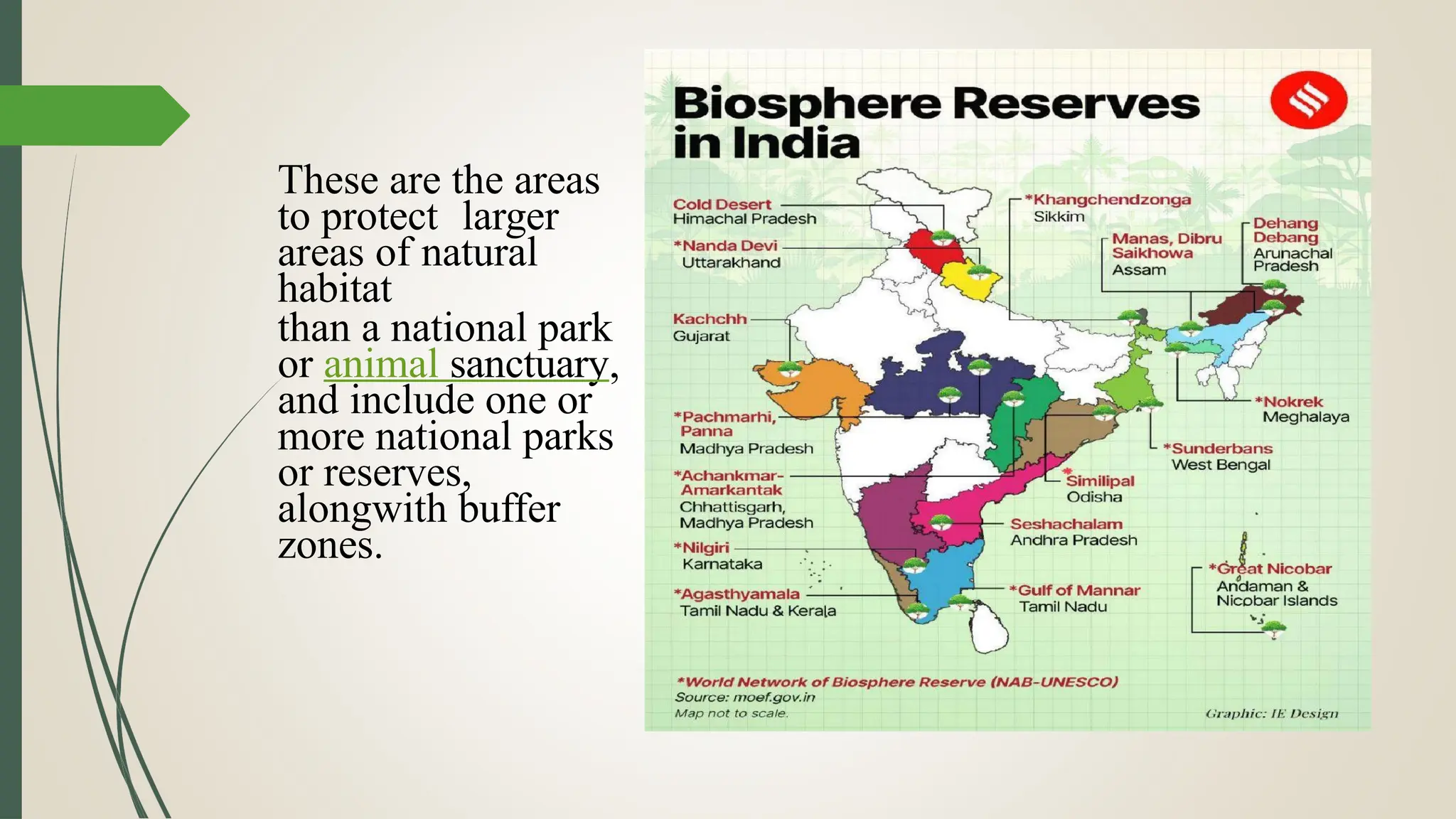
These are theareas
to protect larger
areas of natural
habitat
than a national park
or animal sanctuary,
and include one or
more national parks
or reserves,
alongwith buffer
zones.
46.
12 of 18biosphere reserves based on the Man and the
Biosphere (MAB),UNESCO
What is the International Status of Biosphere Reserve?
• UNESCO has introduced the designation ‘Biosphere Reserve’
for natural areas to minimize conflict between development and
conservation.
Biosphere Reserves are nominated by national government
which meets a minimal set of criteria under the Man and
Biosphere Reserve Program of UNESCO.
• There are currently 738 biosphere reserves in 134 countries,
including 22 transboundary sites.
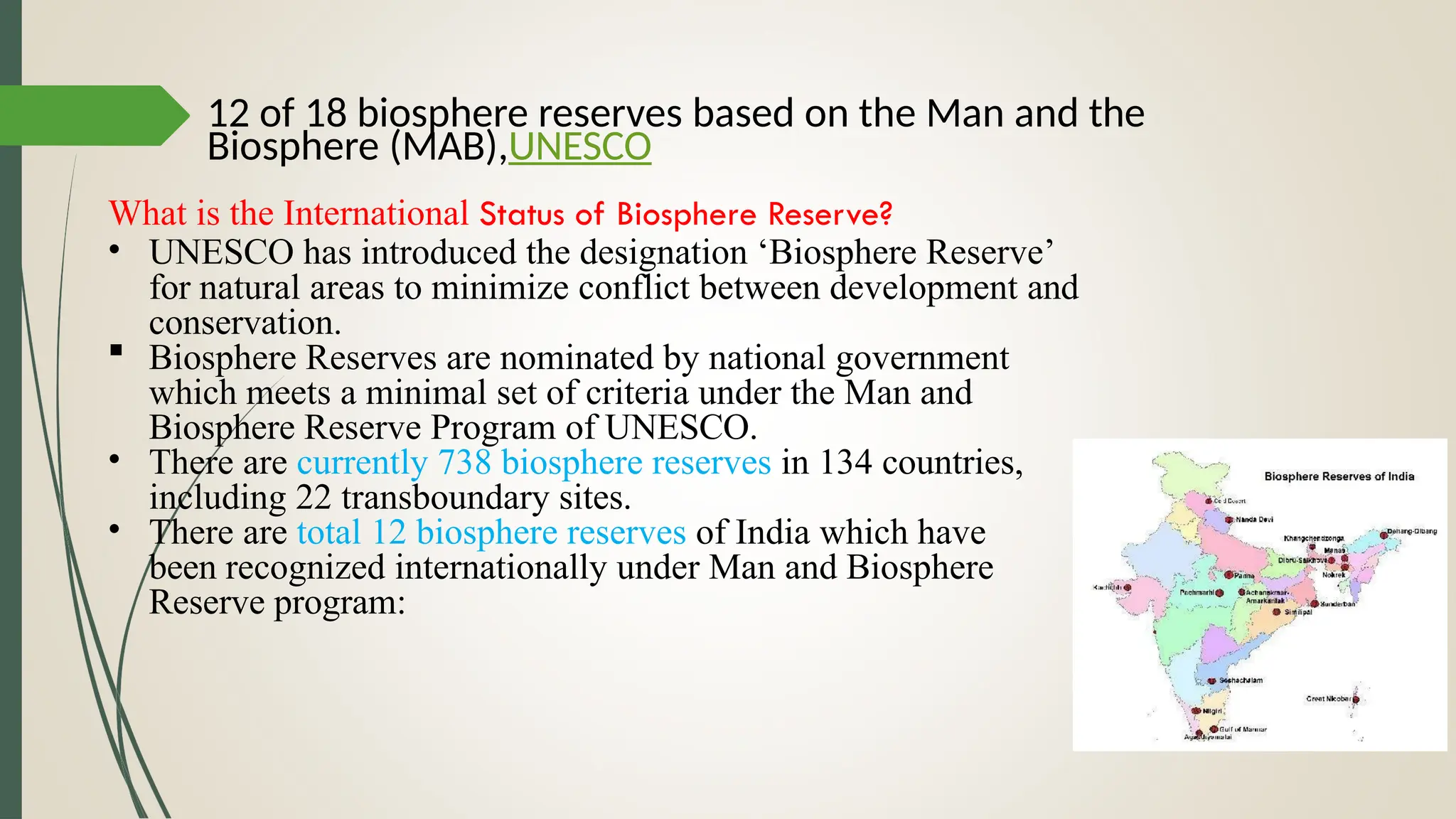
• There are total 12 biosphere reserves of India which have
been recognized internationally under Man and Biosphere
Reserve program:
47.
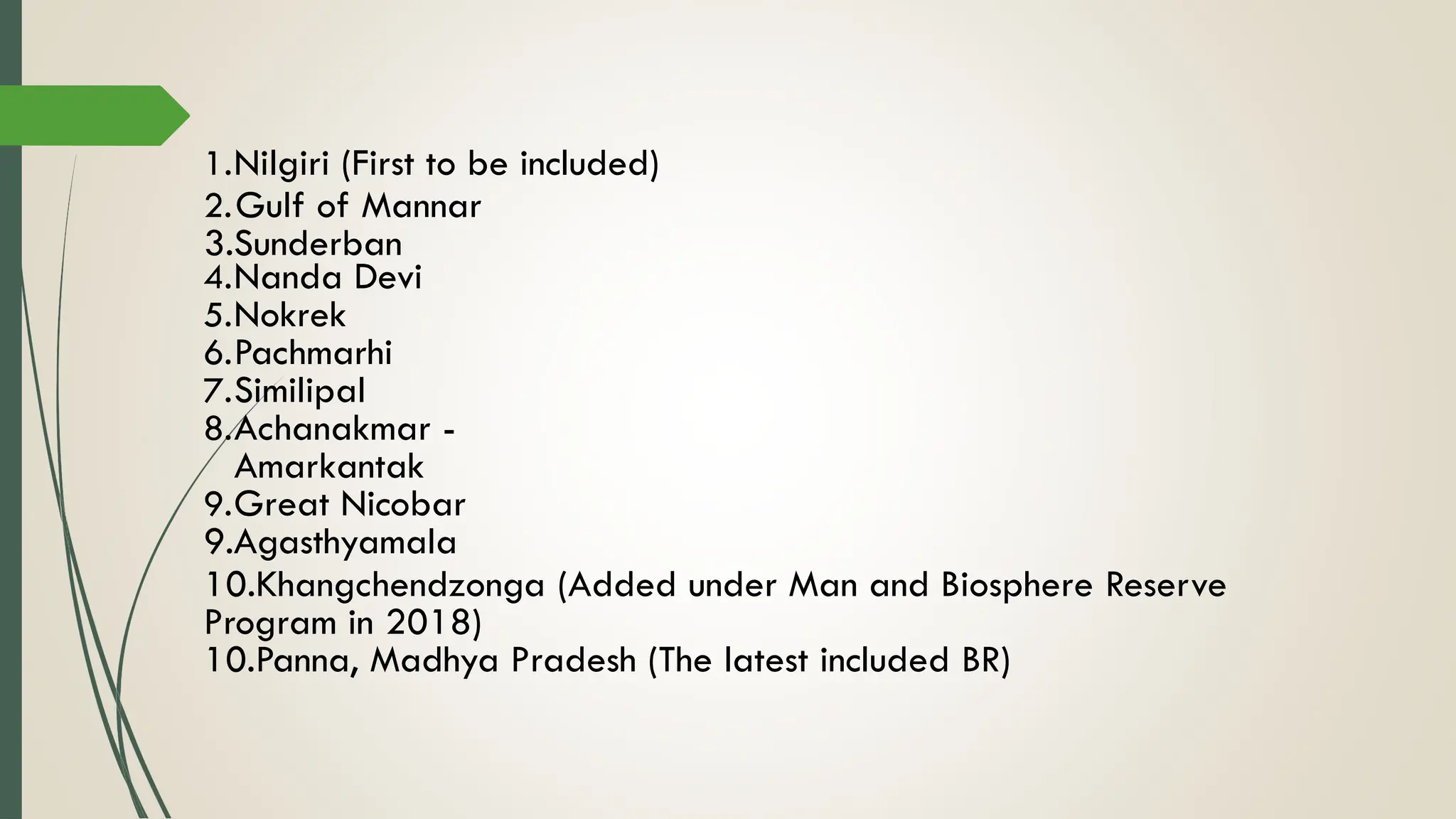
1.Nilgiri (First tobe included)
2.Gulf of Mannar
3.Sunderban
4.Nanda Devi
5.Nokrek
6.Pachmarhi
7.Similipal
8.Achanakmar -
Amarkantak
9.Great Nicobar
9.Agasthyamala
10.Khangchendzonga (Added under Man and Biosphere Reserve
Program in 2018)
10.Panna, Madhya Pradesh (The latest included BR)
48.
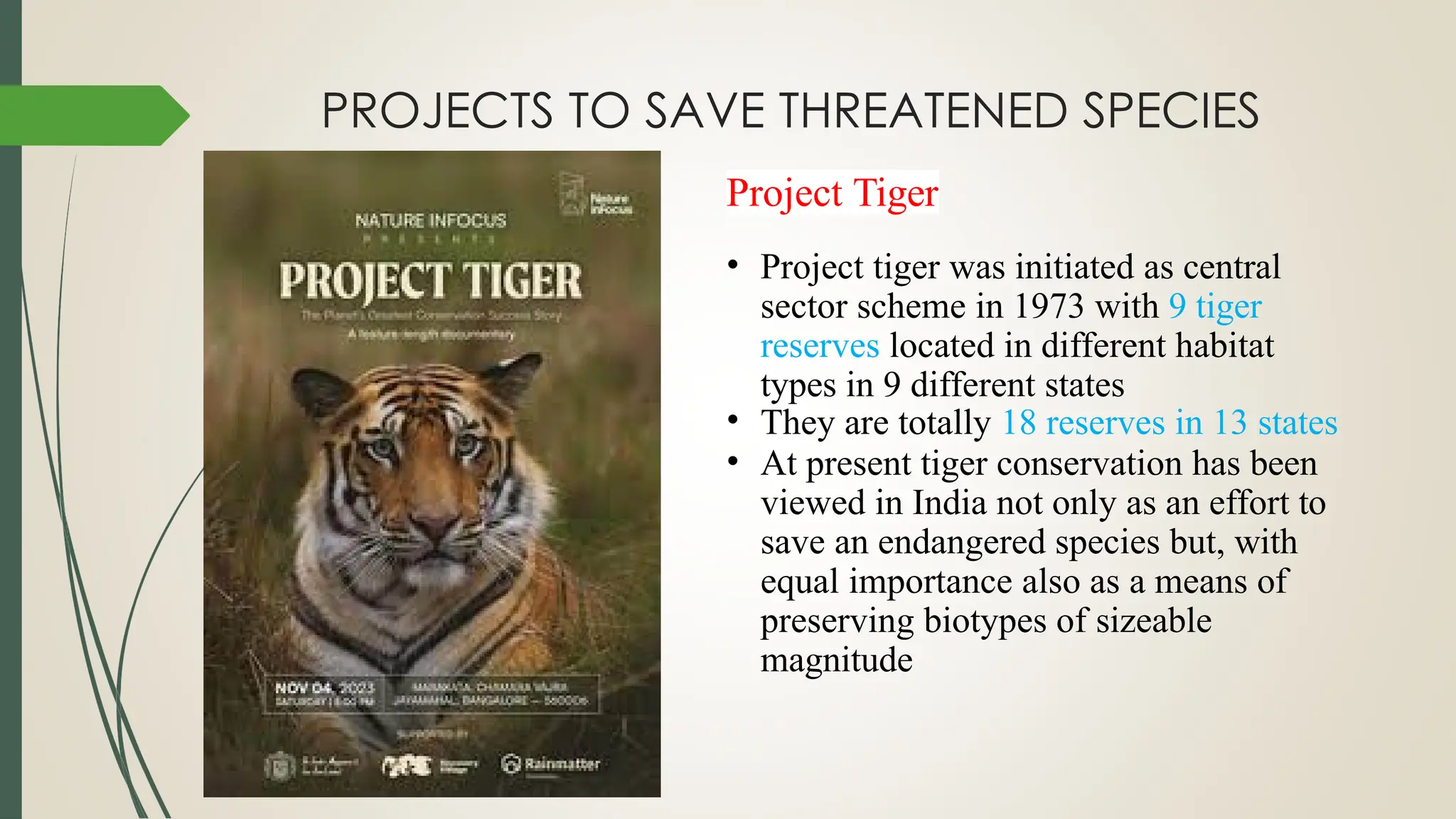
PROJECTS TO SAVETHREATENED SPECIES
Project Tiger
• Project tiger was initiated as central
sector scheme in 1973 with 9 tiger
reserves located in different habitat
types in 9 different states
• They are totally 18 reserves in 13 states
• At present tiger conservation has been
viewed in India not only as an effort to
save an endangered species but, with
equal importance also as a means of
preserving biotypes of sizeable
magnitude
49.
THE CROCODILE BREEDINGPROJECT
The project was started in Orissa and
then extended to several other states
in april1975 with UNDP assistance
The main objective was to protect
the three endangered species of
crocodiles namely-Gavialis
gangeticus , Crocodylus palustris
and the salt water crocodile
,Crocodylus porosus
50.
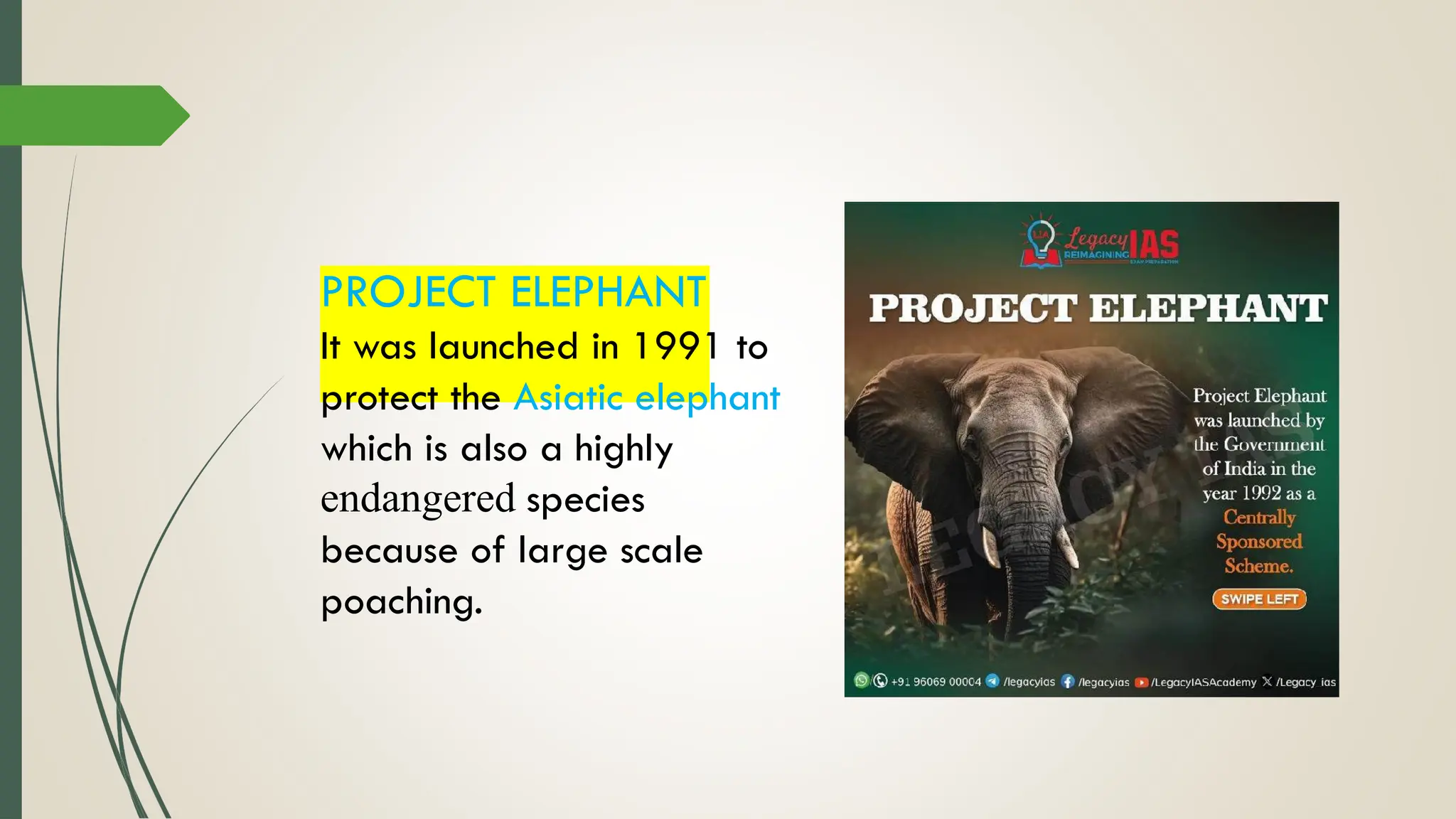
PROJECT ELEPHANT
It waslaunched in 1991 to
protect the Asiatic elephant
which is also a highly
endangered species
because of large scale
poaching.
51.
HIMALAYAN MUSK DEER
PROJECT
Thiswas launched in 1981 to save
the endangered musk deer which is
facing extinction
Captive breeding has good
yielding good results .
52.
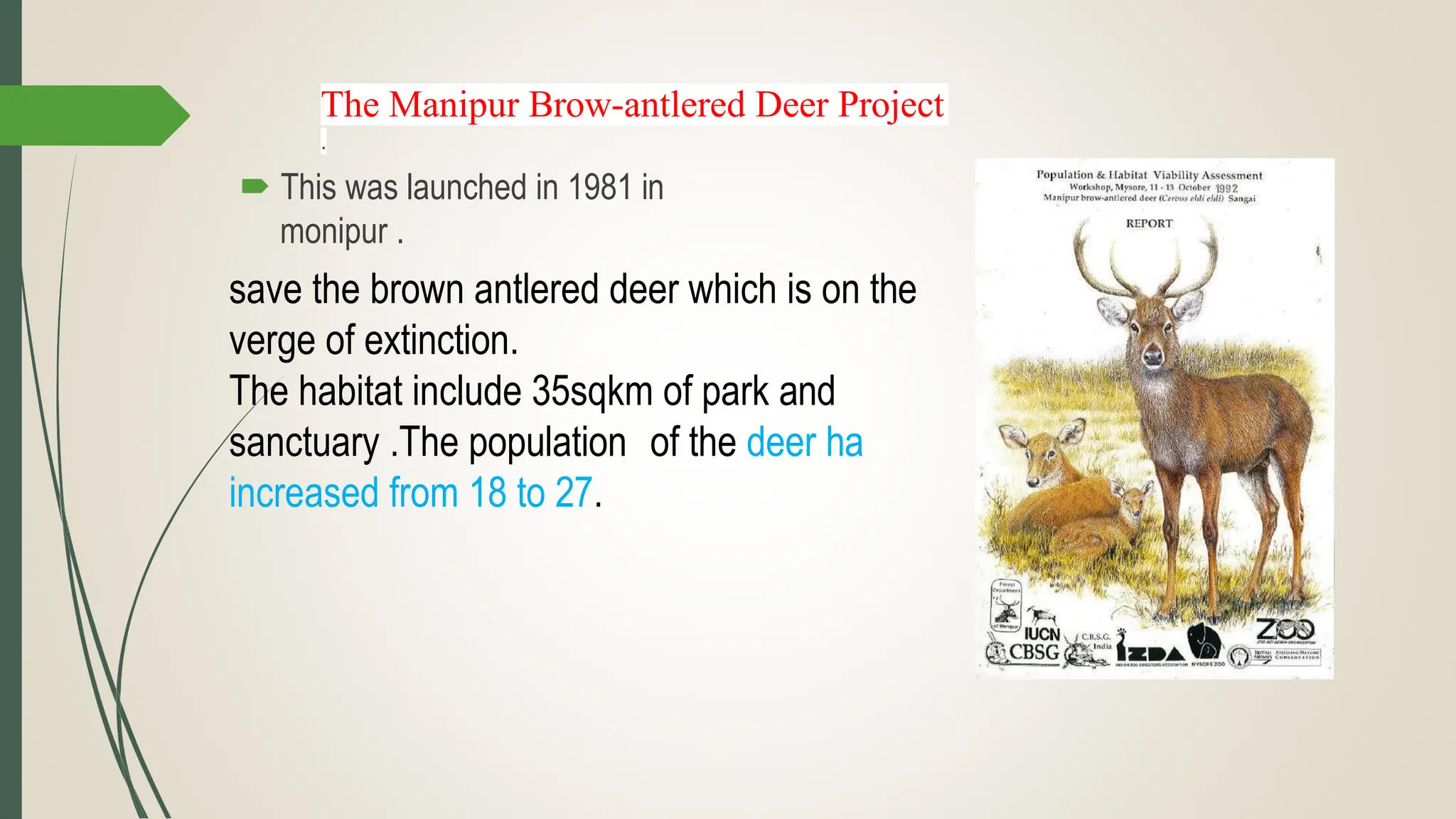
The Manipur Brow-antleredDeer Project
.
This was launched in 1981 in
monipur .
save the brown antlered deer which is on the
verge of extinction.
The habitat include 35sqkm of park and
sanctuary .The population of the deer ha
increased from 18 to 27.
53.
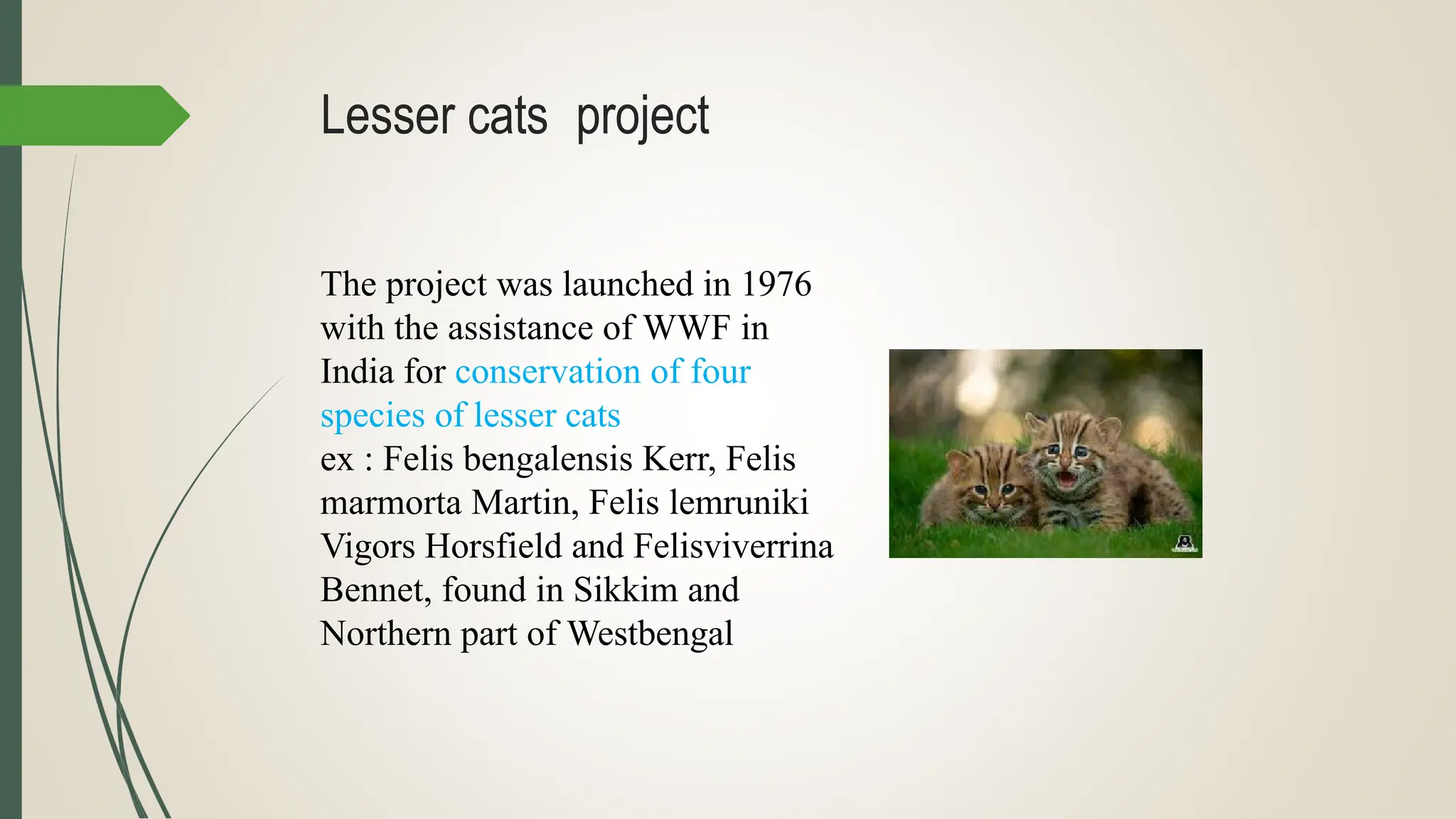
Lesser cats project
Theproject was launched in 1976
with the assistance of WWF in
India for conservation of four
species of lesser cats
ex : Felis bengalensis Kerr, Felis
marmorta Martin, Felis lemruniki
Vigors Horsfield and Felisviverrina
Bennet, found in Sikkim and
Northern part of Westbengal
54.
PROJECT HANGUL
This projectwas launched in
1970 in Kashmir valley to
save the highly endangered
Kashmir stag which is facing
extinction . As a result their
population has increased.
55.
PROJECT
RHINO
It was launchedin 1987 in
Kaziranga Wildlife
Sanctuary in Assam to
save the lesser one horned
rhinoceros from extinction
It covers an area of 430
sq.km. and is the natural of
the dwindling rhino.
56.
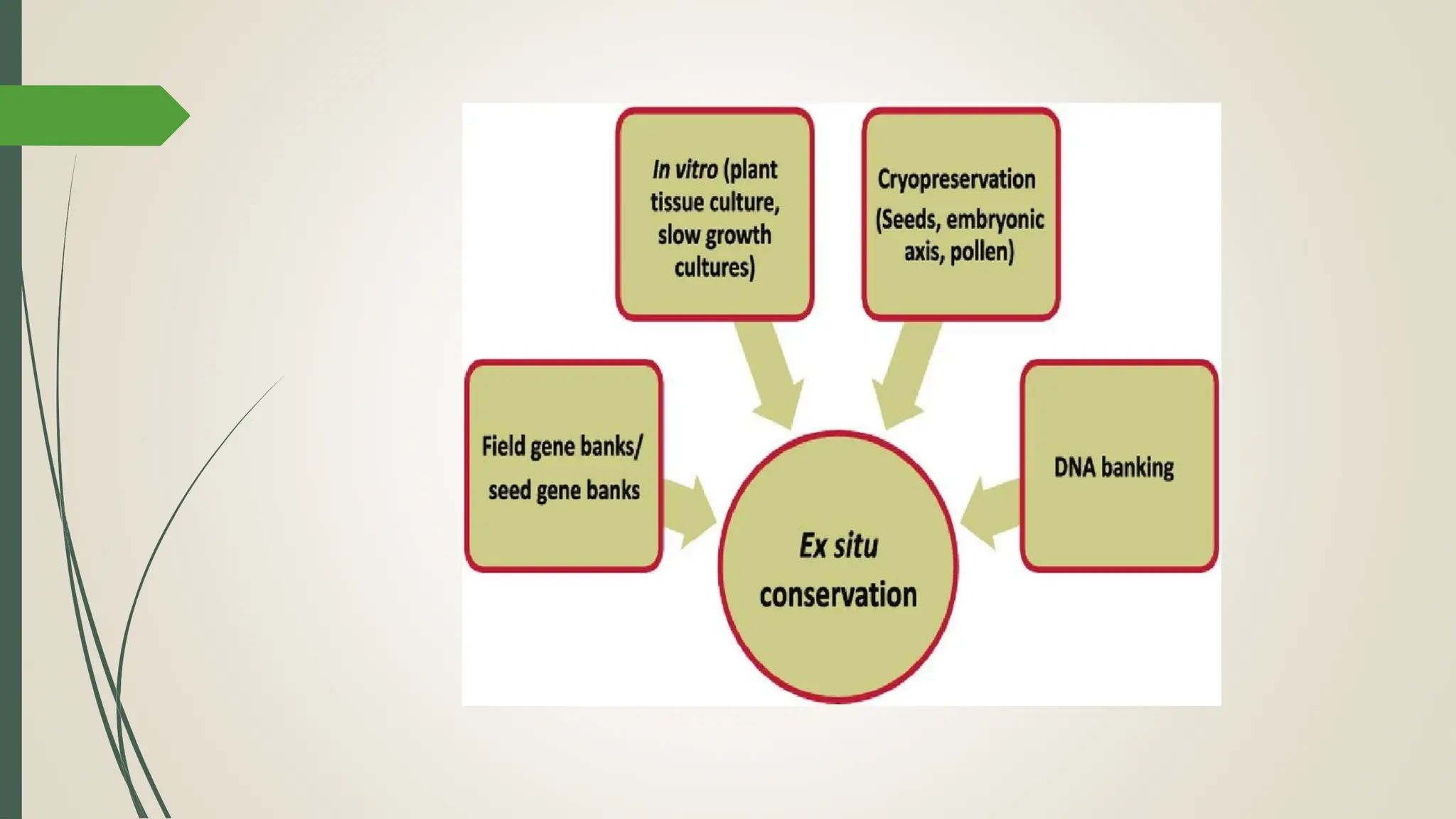
Ex-situ conservation
Techniques foranimals
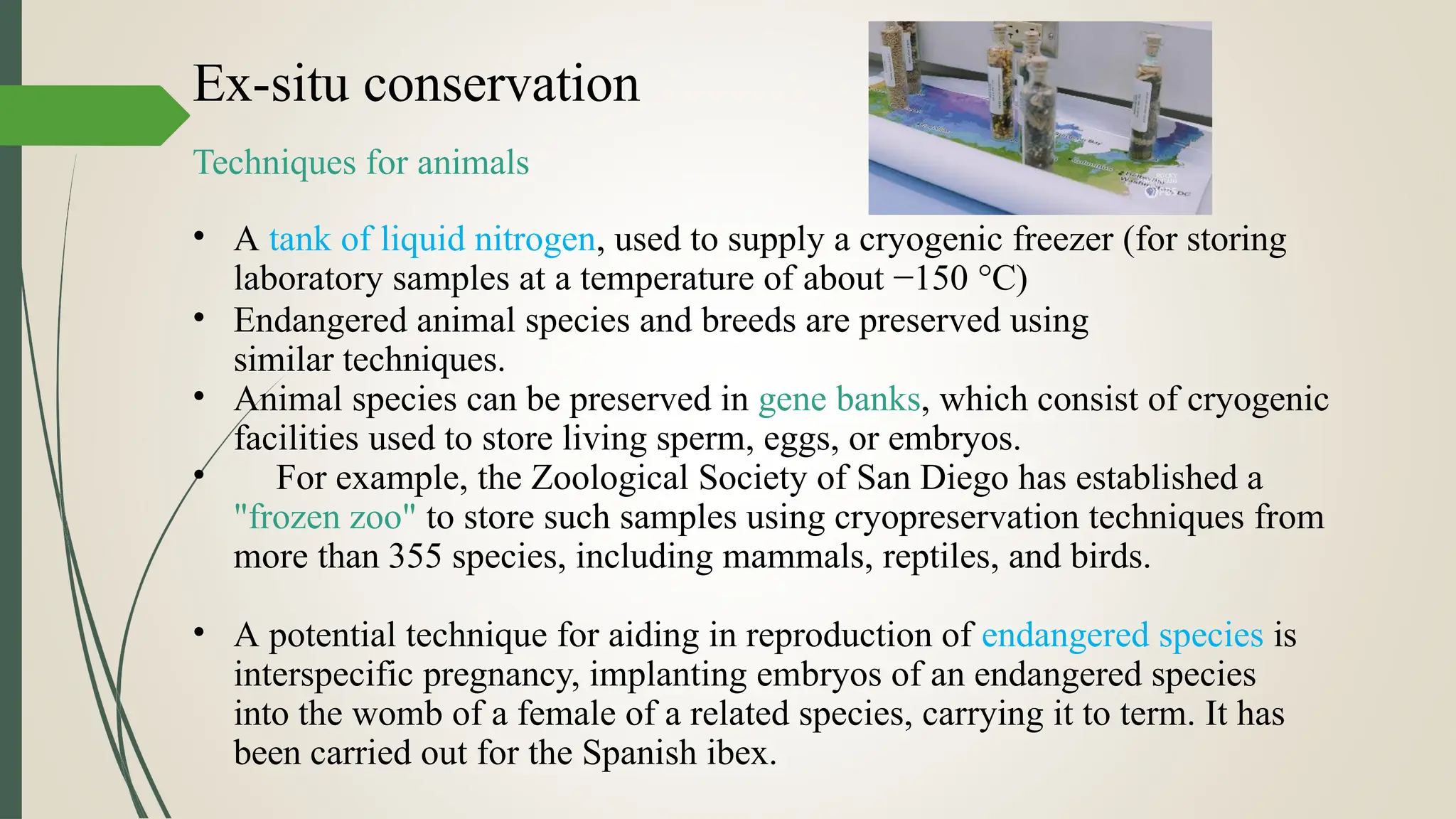
• A tank of liquid nitrogen, used to supply a cryogenic freezer (for storing
laboratory samples at a temperature of about −150 °C)
• Endangered animal species and breeds are preserved using
similar techniques.
• Animal species can be preserved in gene banks, which consist of cryogenic
facilities used to store living sperm, eggs, or embryos.
• For example, the Zoological Society of San Diego has established a
"frozen zoo" to store such samples using cryopreservation techniques from
more than 355 species, including mammals, reptiles, and birds.
• A potential technique for aiding in reproduction of endangered species is
interspecific pregnancy, implanting embryos of an endangered species
into the womb of a female of a related species, carrying it to term. It has
been carried out for the Spanish ibex.
NATIONAL CONSERVATION STRATEGIES
BiologicalDiversity Act - The Biological Diversity Act, 2002 is an Act of
the Parliament of India for conservation of biological diversity in India. To
implement the provisions under the Act, a National Biodiversity Authority
(NBA) was established in 2003 with its headquarters at Chennai.
★ Wildlife (Protection) Act- The Government of India enacted Wildlife
(Protection) Act 1972 with the objective of protecting the wildlife and to
control poaching , smuggling and illegal trade.
★ National Wildlife Action Plan - To conserve the wildlife drafted and
adopted in 1983.
★ Forest Conservation Act - Central Act of Parliament and was passed in
1980 for the conservation of forests. Its aim is to protect the rich
biodiversity and natural heritage and permits only unavoidable use of
forest
land for various developmental purposes
60.
subject.
★ Indian Boardfor Wildlife/National Board for Wildlife: It
was setup in
1952, to advise the Government on matters relating to the
conservation of
Wildlife .This is the highest advisory body to the government
on this
★ Central Zoo Authority: It is a statutory body under the
Ministry of
Environment and Forests. It was established in 1992 through
an amendment in the Wildlife (Protection) Act 1972
![ASIATIC LION
As the name suggest the asiatic lion was historically
native across south west Asia to eastern India
But not the species entire population can only be found in
India and restricted to the Gir national park in Gujarat
.listed as an the endangered species by the international
union for conservation of nature[ICUN]since 2010,the
Asiatic lion only has about 500 -650 individuals left in
the country.
While the animals mostly confined to the Gir forest many
framers still us crude and illegal electrical fences to
protect their crops while lions often get caught up in it
.Likewise nearly 20000 open wells dug by farmers in the
area for irrigation have lead to many accidental
drownings of lions](https://image.slidesharecdn.com/suryavphe-250728065314-4344ef7c/75/public-health-and-epidemiology-presentation-15-2048.jpg)