Mohammad Fheili ⌂⌂⌂   fheilim@jtbbank.com
Threats & Challenges to
Economic Growth: The Banking
Sector
By: Mohammad Fheili
April 25th, 2017 . . . Hilton Metropolitan
Session 02: Private & Public Sectors Challenges & Opportunities
Mohammad Fheili ⌂⌂⌂   fheilim@jtbbank.com
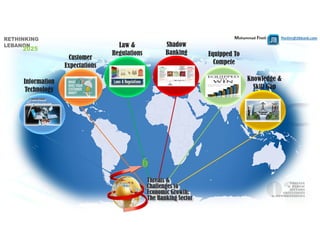
Information
Technology
Customer
Expectations
Law &
Regulations Equipped To
Compete
Knowledge &
Skill Gap
Shadow
Banking
6
Mohammad Fheili ⌂⌂⌂   fheilim@jtbbank.com
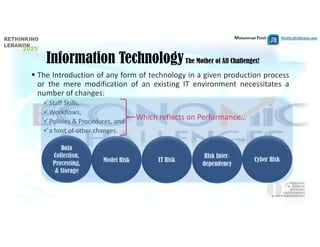
Information TechnologyThe Mother of All Challenges!
 The Introduction of any form of technology in a given production process
or the mere modification of an existing IT environment necessitates a
number of changes:
Staff Skills,
Workflows,
Policies & Procedures, and
a host of other changes.
Which reflects on Performance…
IT RiskModel Risk Cyber Risk
Risk Inter‐
dependency
Data
Collection,
Processing,
& Storage
Mohammad Fheili ⌂⌂⌂   fheilim@jtbbank.com
Between
Humanizing “The Technology’ & Digitizing “The Human-Client!”
IT Altered Our Existence
Digitizing the Client-Bank Relationship
Remains Out-Of-Synch With The Existing
Culture!
Mohammad Fheili ⌂⌂⌂   fheilim@jtbbank.com
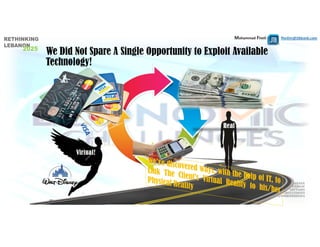
We Did Not Spare A Single Opportunity to Exploit Available
Technology!
Virtual!
Real
Mohammad Fheili ⌂⌂⌂   fheilim@jtbbank.com
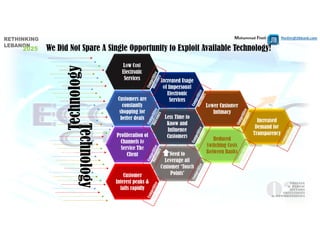
Increased Usage
of Impersonal
Electronic
Services
Low Cost
Electronic
Services
Lower Customer
Intimacy
Reduced
Switching Costs
Between Banks
Customers are
constantly
shopping for
better deals Increased
Demand for
Transparency
Need to
Leverage all
Customer ‘Touch
Points’Customer
Interest peaks &
falls rapidly
Less Time to
Know and
Influence
CustomersProliferation of
Channels to
Service The
Client
TechnologyTechnology
We Did Not Spare A Single Opportunity to Exploit Available Technology!
Mohammad Fheili ⌂⌂⌂   fheilim@jtbbank.com
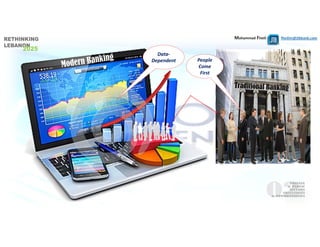
People 
Come 
First
Data‐
Dependent
Mohammad Fheili ⌂⌂⌂   fheilim@jtbbank.com
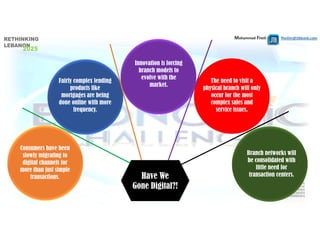
Fairly complex lending
products like
mortgages are being
done online with more
frequency.
Consumers have been
slowly migrating to
digital channels for
more than just simple
transactions.
The need to visit a
physical branch will only
occur for the most
complex sales and
service issues.
Branch networks will
be consolidated with
little need for
transaction centers.
Innovation is forcing
branch models to
evolve with the
market.
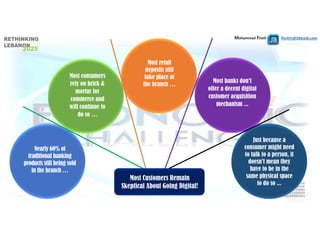
Have We
Gone Digital?!
Mohammad Fheili ⌂⌂⌂   fheilim@jtbbank.com
Most consumers
rely on brick &
mortar for
commerce and
will continue to
do so …
Just because a
consumer might need
to talk to a person, it
doesn’t mean they
have to be in the
same physical space
to do so ...
Nearly 60% of
traditional banking
products still being sold
in the branch …
Most banks don’t
offer a decent digital
customer acquisition
mechanism ...
Most retail
deposits still
take place at
the branch …
Most Customers Remain
Skeptical About Going Digital!
Mohammad Fheili ⌂⌂⌂   fheilim@jtbbank.com
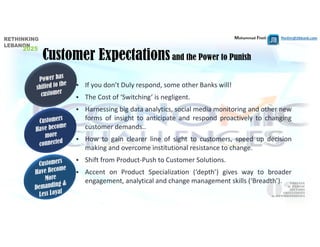
Customer Expectationsand the Power to Punish
 If you don’t Duly respond, some other Banks will!
 The Cost of ‘Switching’ is negligent.
 Harnessing big data analytics, social media monitoring and other new
forms of insight to anticipate and respond proactively to changing
customer demands..
 How to gain clearer line of sight to customers, speed up decision
making and overcome institutional resistance to change.
 Shift from Product‐Push to Customer Solutions.
 Accent on Product Specialization (‘depth’) gives way to broader
engagement, analytical and change management skills (‘Breadth’).
Mohammad Fheili ⌂⌂⌂   fheilim@jtbbank.com
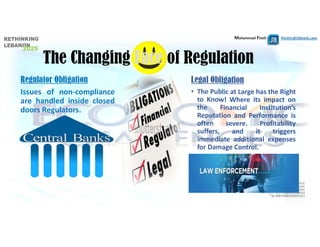
Legal Obligation
• The Public at Large has the Right
to Know! Where its impact on
the Financial Institution’s
Reputation and Performance is
often severe. Profitability
suffers, and it triggers
immediate additional expenses
for Damage Control.
Regulator Obligation
Issues of non‐compliance
are handled inside closed
doors Regulators.
The Changing Face of Regulation
Mohammad Fheili ⌂⌂⌂   fheilim@jtbbank.com
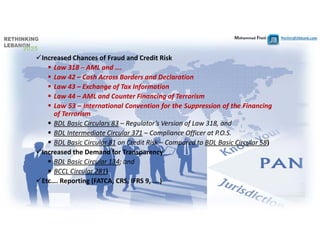
Increased Chances of Fraud and Credit Risk
 Law 318 – AML and ….
 Law 42 – Cash Across Borders and Declaration
 Law 43 – Exchange of Tax Information
 Law 44 – AML and Counter Financing of Terrorism
 Law 53 – International Convention for the Suppression of the Financing
of Terrorism
 BDL Basic Circulars 83 – Regulator’s Version of Law 318, and
 BDL Intermediate Circular 371 – Compliance Officer at P.O.S.
 BDL Basic Circular 81 on Credit Risk – Compared to BDL Basic Circular 58)
Increased the Demand for Transparency
 BDL Basic Circular 134; and
 BCCL Circular 281)
Etc…. Reporting (FATCA, CRS, IFRS 9, ….)
Mohammad Fheili ⌂⌂⌂   fheilim@jtbbank.com
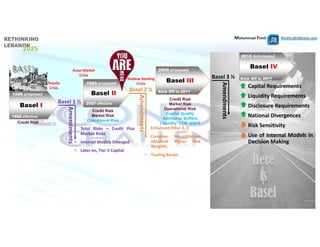
Basel I
Basel II
Credit Risk
Credit Risk
Market Risk
Operational Risk
1986 proposed
1999 proposed
1988 effective
2007 effective
Basel III
Credit Risk
Market Risk
Operational Risk
Capital Quality
Additional Buffers
Liquidity: LCR, NSFR
2009 proposed
Kick Off in 2011
Amendments
Amendments
Basel 2 ½
Basel 1 ½
Amendments 
Basel 3 ½
Basel IV
2015 Anticipated
Kick Off in 20??
• Capital Requirements
• Liquidity Requirements
• Disclosure Requirements
• National Divergences
• Risk Sensitivity
• Use of Internal Models in
Decision Making
• Total Risks = Credit Plus
Market Risks
• Internal Models Emerged
• Later on, Tier 3 Capital
• Enhanced Pillar 2, 3
• Complex Securitization
obtained higher Risk
Weights.
• Trading Books
Tequila 
Crisis 
Asian Market 
Crisis 
Shadow Banking 
Crisis 
Mohammad Fheili ⌂⌂⌂   fheilim@jtbbank.com
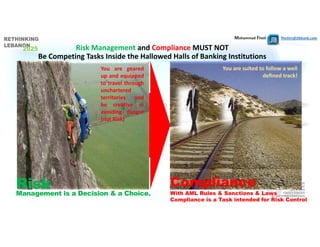
Risk Management and Compliance MUST NOT
Be Competing Tasks Inside the Hallowed Halls of Banking Institutions  
Compliance
With AML Rules & Sanctions & Laws
Compliance is a Task intended for Risk Control
You are suited to follow a well 
defined track!
RiskManagement is a Decision & a Choice.
You are geared
up and equipped
to travel through
unchartered
territories and
be creative in
avoiding danger
(not Risk)
Mohammad Fheili ⌂⌂⌂   fheilim@jtbbank.com
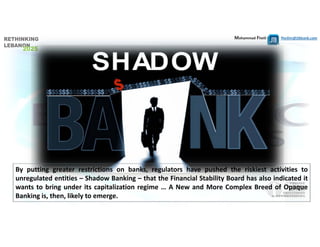
By putting greater restrictions on banks, regulators have pushed the riskiest activities to
unregulated entities – Shadow Banking – that the Financial Stability Board has also indicated it
wants to bring under its capitalization regime … A New and More Complex Breed of Opaque
Banking is, then, likely to emerge.
Mohammad Fheili ⌂⌂⌂   fheilim@jtbbank.com
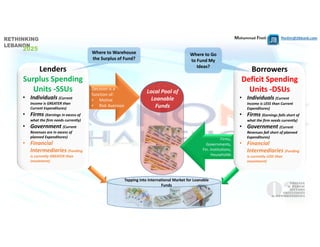
Lenders
Surplus Spending 
Units ‐SSUs
• Individuals (Current 
Income is GREATER than 
Current Expenditures)
• Firms (Earnings in excess of 
what the firm needs currently)
• Government (Current 
Revenues are in excess of 
planned Expenditures)
• Financial 
Intermediaries (Funding 
is currently GREATER than 
investment)
Where to Warehouse 
the Surplus of Fund?
Where to Warehouse 
the Surplus of Fund?
Borrowers
Deficit Spending 
Units ‐DSUs
• Individuals (Current 
Income is LESS than Current 
Expenditures)
• Firms (Earnings falls short of 
what the firm needs currently)
• Government (Current 
Revenues fall short of planned 
Expenditures)
• Financial 
Intermediaries (Funding 
is currently LESS than 
investment)
Where to Go 
to Fund My 
Ideas?
Where to Go 
to Fund My 
Ideas?
Tapping into International Market for Loanable 
Funds 
Local Pool of 
Loanable 
Funds
Decision is a 
function of:
• Motive
• Risk Aversion
Firms, 
Governments, 
Fin. Institutions, 
Households
Mohammad Fheili ⌂⌂⌂   fheilim@jtbbank.com
Borrowers
Deficit Spending 
Units ‐DSUs
• Individuals (Current 
Income is LESS than Current 
Expenditures)
• Firms (Earnings falls short of 
what the firm needs currently)
• Government (Current 
Revenues fall short of planned 
Expenditures)
• Financial 
Intermediaries (Funding 
is currently LESS than 
investment)
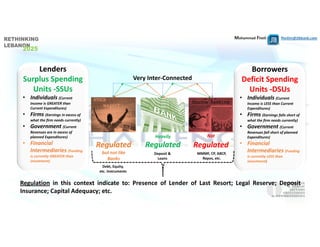
Regulated 
but not like 
Banks
Heavily 
Regulated
Not
Regulated
Regulation in this context indicate to: Presence of Lender of Last Resort; Legal Reserve; Deposit
Insurance; Capital Adequacy; etc.
Debt, Equity, 
etc. Instruments
Deposit & 
Loans
MMMF, CP, ABCP, 
Repos, etc.
Very Inter‐Connected 
Lenders
Surplus Spending 
Units ‐SSUs
• Individuals (Current 
Income is GREATER than 
Current Expenditures)
• Firms (Earnings in excess of 
what the firm needs currently)
• Government (Current 
Revenues are in excess of 
planned Expenditures)
• Financial 
Intermediaries (Funding 
is currently GREATER than 
investment)
Mohammad Fheili ⌂⌂⌂   fheilim@jtbbank.com
Borrowers
Deficit Spending 
Units ‐DSUs
• Individuals (Current 
Income is LESS than Current 
Expenditures)
• Firms (Earnings falls short of 
what the firm needs currently)
• Government (Current 
Revenues fall short of planned 
Expenditures)
• Financial 
Intermediaries (Funding 
is currently LESS than 
investment)
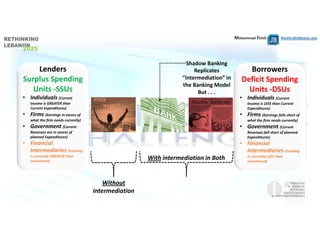
With intermediation in Both
Without
Intermediation
Shadow Banking 
Replicates 
“Intermediation” in 
the Banking Model 
But . . .
Lenders
Surplus Spending 
Units ‐SSUs
• Individuals (Current 
Income is GREATER than 
Current Expenditures)
• Firms (Earnings in excess of 
what the firm needs currently)
• Government (Current 
Revenues are in excess of 
planned Expenditures)
• Financial 
Intermediaries (Funding 
is currently GREATER than 
investment)
Mohammad Fheili ⌂⌂⌂   fheilim@jtbbank.com
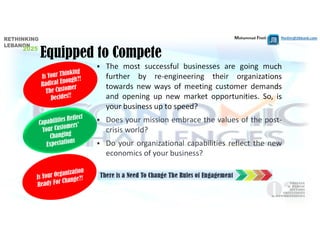
 The most successful businesses are going much
further by re‐engineering their organizations
towards new ways of meeting customer demands
and opening up new market opportunities. So, is
your business up to speed?
 Does your mission embrace the values of the post‐
crisis world?
 Do your organizational capabilities reflect the new
economics of your business?
Equipped to Compete
There is a Need To Change The Rules of Engagement
Mohammad Fheili ⌂⌂⌂   fheilim@jtbbank.com
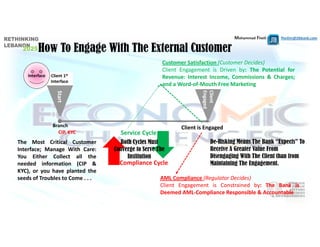
Client is Engaged
Compliance Cycle
Service Cycle
st1Client 
Interface
Start
Interface
Client 
Engaged
CIP, KYC
AML Compliance (Regulator Decides)
Client Engagement is Constrained by: The Bank is
Deemed AML‐Compliance Responsible & Accountable
Customer Satisfaction (Customer Decides)
Client Engagement is Driven by: The Potential for
Revenue: Interest Income, Commissions & Charges;
and a Word‐of‐Mouth Free Marketing
Branch
The Most Critical Customer
Interface; Manage With Care:
You Either Collect all the
needed information (CIP &
KYC), or you have planted the
seeds of Troubles to Come . . .
De-Risking Means The Bank “Expects” To
Receive A Greater Value From
Disengaging With The Client than from
Maintaining The Engagement.
How To Engage With The External Customer
Both Cycles Must
Converge to Serve The
Institution
Mohammad Fheili ⌂⌂⌂   fheilim@jtbbank.com
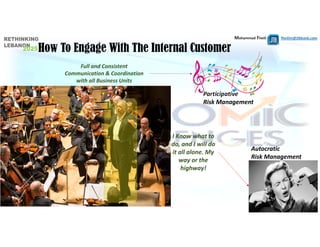
Participative 
Risk Management
Full and Consistent 
Communication & Coordination 
with all Business Units
Autocratic 
Risk Management
I Know what to 
do, and I will do 
it all alone. My 
way or the 
highway! 
How To Engage With The Internal Customer
Mohammad Fheili ⌂⌂⌂   fheilim@jtbbank.com
The Knowledge
& Skill Gap
Success in
Business
College Curriculums Are
Not Up To Par …
College
Education
Growth
Close the Gap
Mohammad Fheili ⌂⌂⌂   fheilim@jtbbank.com
Mohammad Fheili 
“Over 30 years of Experience in Banking. 
mifheili@gmail.com (961) 3 337175  
 Risk & Capacity Building Specialist.
 Trainer in Risk & Compliance
 University Lecturer: Economics, Risk, and
Banking Operations
 Currently serves in the capacity of an Executive
(AGM) at JTB Bank in Lebanon.
Served as:
 Senior Manager & Chief Risk Officer at
Group Fransabank
 Senior Manager at BankMed
 An Economist at the Association of Banks
in Lebanon
 Mohammad received his college education
(undergraduate & graduate) at Louisiana State
University (LSU), and has been teaching
Economics and Finance for over 25 continuous
years at reputable universities in the USA (LSU)
and Lebanon (LAU).
 Finally, Mohammad published over 25 articles, of
those many are in refereed Journals (e.g.,
Journal of Money Laundering & Control; Journal
of Operational Risk; Journal of Law &
Economics; etc.) and Bulletins.”
Mohammad Fheili ⌂⌂⌂   fheilim@jtbbank.com

Threats & Challenges Facing Financial Institutions

  • 1.
    Mohammad Fheili ⌂⌂⌂  fheilim@jtbbank.com Threats & Challenges to Economic Growth: The Banking Sector By: Mohammad Fheili April 25th, 2017 . . . Hilton Metropolitan Session 02: Private & Public Sectors Challenges & Opportunities
  • 2.
    Mohammad Fheili ⌂⌂⌂  fheilim@jtbbank.com Information Technology Customer Expectations Law & Regulations Equipped To Compete Knowledge & Skill Gap Shadow Banking 6
  • 3.
    Mohammad Fheili ⌂⌂⌂  fheilim@jtbbank.com Information TechnologyThe Mother of All Challenges!  The Introduction of any form of technology in a given production process or the mere modification of an existing IT environment necessitates a number of changes: Staff Skills, Workflows, Policies & Procedures, and a host of other changes. Which reflects on Performance… IT RiskModel Risk Cyber Risk Risk Inter‐ dependency Data Collection, Processing, & Storage
  • 4.
    Mohammad Fheili ⌂⌂⌂  fheilim@jtbbank.com Between Humanizing “The Technology’ & Digitizing “The Human-Client!” IT Altered Our Existence Digitizing the Client-Bank Relationship Remains Out-Of-Synch With The Existing Culture!
  • 5.
    Mohammad Fheili ⌂⌂⌂  fheilim@jtbbank.com We Did Not Spare A Single Opportunity to Exploit Available Technology! Virtual! Real
  • 6.
    Mohammad Fheili ⌂⌂⌂  fheilim@jtbbank.com Increased Usage of Impersonal Electronic Services Low Cost Electronic Services Lower Customer Intimacy Reduced Switching Costs Between Banks Customers are constantly shopping for better deals Increased Demand for Transparency Need to Leverage all Customer ‘Touch Points’Customer Interest peaks & falls rapidly Less Time to Know and Influence CustomersProliferation of Channels to Service The Client TechnologyTechnology We Did Not Spare A Single Opportunity to Exploit Available Technology!
  • 7.
    Mohammad Fheili ⌂⌂⌂  fheilim@jtbbank.com People  Come  First Data‐ Dependent
  • 8.
    Mohammad Fheili ⌂⌂⌂  fheilim@jtbbank.com Fairly complex lending products like mortgages are being done online with more frequency. Consumers have been slowly migrating to digital channels for more than just simple transactions. The need to visit a physical branch will only occur for the most complex sales and service issues. Branch networks will be consolidated with little need for transaction centers. Innovation is forcing branch models to evolve with the market. Have We Gone Digital?!
  • 9.
    Mohammad Fheili ⌂⌂⌂  fheilim@jtbbank.com Most consumers rely on brick & mortar for commerce and will continue to do so … Just because a consumer might need to talk to a person, it doesn’t mean they have to be in the same physical space to do so ... Nearly 60% of traditional banking products still being sold in the branch … Most banks don’t offer a decent digital customer acquisition mechanism ... Most retail deposits still take place at the branch … Most Customers Remain Skeptical About Going Digital!
  • 10.
    Mohammad Fheili ⌂⌂⌂  fheilim@jtbbank.com
  • 11.
    Mohammad Fheili ⌂⌂⌂  fheilim@jtbbank.com Customer Expectationsand the Power to Punish  If you don’t Duly respond, some other Banks will!  The Cost of ‘Switching’ is negligent.  Harnessing big data analytics, social media monitoring and other new forms of insight to anticipate and respond proactively to changing customer demands..  How to gain clearer line of sight to customers, speed up decision making and overcome institutional resistance to change.  Shift from Product‐Push to Customer Solutions.  Accent on Product Specialization (‘depth’) gives way to broader engagement, analytical and change management skills (‘Breadth’).
  • 12.
    Mohammad Fheili ⌂⌂⌂  fheilim@jtbbank.com
  • 13.
    Mohammad Fheili ⌂⌂⌂  fheilim@jtbbank.com Legal Obligation • The Public at Large has the Right to Know! Where its impact on the Financial Institution’s Reputation and Performance is often severe. Profitability suffers, and it triggers immediate additional expenses for Damage Control. Regulator Obligation Issues of non‐compliance are handled inside closed doors Regulators. The Changing Face of Regulation
  • 14.
    Mohammad Fheili ⌂⌂⌂  fheilim@jtbbank.com Increased Chances of Fraud and Credit Risk  Law 318 – AML and ….  Law 42 – Cash Across Borders and Declaration  Law 43 – Exchange of Tax Information  Law 44 – AML and Counter Financing of Terrorism  Law 53 – International Convention for the Suppression of the Financing of Terrorism  BDL Basic Circulars 83 – Regulator’s Version of Law 318, and  BDL Intermediate Circular 371 – Compliance Officer at P.O.S.  BDL Basic Circular 81 on Credit Risk – Compared to BDL Basic Circular 58) Increased the Demand for Transparency  BDL Basic Circular 134; and  BCCL Circular 281) Etc…. Reporting (FATCA, CRS, IFRS 9, ….)
  • 15.
    Mohammad Fheili ⌂⌂⌂  fheilim@jtbbank.com Basel I Basel II Credit Risk Credit Risk Market Risk Operational Risk 1986 proposed 1999 proposed 1988 effective 2007 effective Basel III Credit Risk Market Risk Operational Risk Capital Quality Additional Buffers Liquidity: LCR, NSFR 2009 proposed Kick Off in 2011 Amendments Amendments Basel 2 ½ Basel 1 ½ Amendments  Basel 3 ½ Basel IV 2015 Anticipated Kick Off in 20?? • Capital Requirements • Liquidity Requirements • Disclosure Requirements • National Divergences • Risk Sensitivity • Use of Internal Models in Decision Making • Total Risks = Credit Plus Market Risks • Internal Models Emerged • Later on, Tier 3 Capital • Enhanced Pillar 2, 3 • Complex Securitization obtained higher Risk Weights. • Trading Books Tequila  Crisis  Asian Market  Crisis  Shadow Banking  Crisis 
  • 16.
    Mohammad Fheili ⌂⌂⌂  fheilim@jtbbank.com Risk Management and Compliance MUST NOT Be Competing Tasks Inside the Hallowed Halls of Banking Institutions   Compliance With AML Rules & Sanctions & Laws Compliance is a Task intended for Risk Control You are suited to follow a well  defined track! RiskManagement is a Decision & a Choice. You are geared up and equipped to travel through unchartered territories and be creative in avoiding danger (not Risk)
  • 17.
    Mohammad Fheili ⌂⌂⌂  fheilim@jtbbank.com By putting greater restrictions on banks, regulators have pushed the riskiest activities to unregulated entities – Shadow Banking – that the Financial Stability Board has also indicated it wants to bring under its capitalization regime … A New and More Complex Breed of Opaque Banking is, then, likely to emerge.
  • 18.
    Mohammad Fheili ⌂⌂⌂  fheilim@jtbbank.com Lenders Surplus Spending  Units ‐SSUs • Individuals (Current  Income is GREATER than  Current Expenditures) • Firms (Earnings in excess of  what the firm needs currently) • Government (Current  Revenues are in excess of  planned Expenditures) • Financial  Intermediaries (Funding  is currently GREATER than  investment) Where to Warehouse  the Surplus of Fund? Where to Warehouse  the Surplus of Fund? Borrowers Deficit Spending  Units ‐DSUs • Individuals (Current  Income is LESS than Current  Expenditures) • Firms (Earnings falls short of  what the firm needs currently) • Government (Current  Revenues fall short of planned  Expenditures) • Financial  Intermediaries (Funding  is currently LESS than  investment) Where to Go  to Fund My  Ideas? Where to Go  to Fund My  Ideas? Tapping into International Market for Loanable  Funds  Local Pool of  Loanable  Funds Decision is a  function of: • Motive • Risk Aversion Firms,  Governments,  Fin. Institutions,  Households
  • 19.
    Mohammad Fheili ⌂⌂⌂  fheilim@jtbbank.com Borrowers Deficit Spending  Units ‐DSUs • Individuals (Current  Income is LESS than Current  Expenditures) • Firms (Earnings falls short of  what the firm needs currently) • Government (Current  Revenues fall short of planned  Expenditures) • Financial  Intermediaries (Funding  is currently LESS than  investment) Regulated  but not like  Banks Heavily  Regulated Not Regulated Regulation in this context indicate to: Presence of Lender of Last Resort; Legal Reserve; Deposit Insurance; Capital Adequacy; etc. Debt, Equity,  etc. Instruments Deposit &  Loans MMMF, CP, ABCP,  Repos, etc. Very Inter‐Connected  Lenders Surplus Spending  Units ‐SSUs • Individuals (Current  Income is GREATER than  Current Expenditures) • Firms (Earnings in excess of  what the firm needs currently) • Government (Current  Revenues are in excess of  planned Expenditures) • Financial  Intermediaries (Funding  is currently GREATER than  investment)
  • 20.
    Mohammad Fheili ⌂⌂⌂  fheilim@jtbbank.com Borrowers Deficit Spending  Units ‐DSUs • Individuals (Current  Income is LESS than Current  Expenditures) • Firms (Earnings falls short of  what the firm needs currently) • Government (Current  Revenues fall short of planned  Expenditures) • Financial  Intermediaries (Funding  is currently LESS than  investment) With intermediation in Both Without Intermediation Shadow Banking  Replicates  “Intermediation” in  the Banking Model  But . . . Lenders Surplus Spending  Units ‐SSUs • Individuals (Current  Income is GREATER than  Current Expenditures) • Firms (Earnings in excess of  what the firm needs currently) • Government (Current  Revenues are in excess of  planned Expenditures) • Financial  Intermediaries (Funding  is currently GREATER than  investment)
  • 21.
    Mohammad Fheili ⌂⌂⌂  fheilim@jtbbank.com
  • 22.
    Mohammad Fheili ⌂⌂⌂  fheilim@jtbbank.com  The most successful businesses are going much further by re‐engineering their organizations towards new ways of meeting customer demands and opening up new market opportunities. So, is your business up to speed?  Does your mission embrace the values of the post‐ crisis world?  Do your organizational capabilities reflect the new economics of your business? Equipped to Compete There is a Need To Change The Rules of Engagement
  • 23.
    Mohammad Fheili ⌂⌂⌂  fheilim@jtbbank.com Client is Engaged Compliance Cycle Service Cycle st1Client  Interface Start Interface Client  Engaged CIP, KYC AML Compliance (Regulator Decides) Client Engagement is Constrained by: The Bank is Deemed AML‐Compliance Responsible & Accountable Customer Satisfaction (Customer Decides) Client Engagement is Driven by: The Potential for Revenue: Interest Income, Commissions & Charges; and a Word‐of‐Mouth Free Marketing Branch The Most Critical Customer Interface; Manage With Care: You Either Collect all the needed information (CIP & KYC), or you have planted the seeds of Troubles to Come . . . De-Risking Means The Bank “Expects” To Receive A Greater Value From Disengaging With The Client than from Maintaining The Engagement. How To Engage With The External Customer Both Cycles Must Converge to Serve The Institution
  • 24.
    Mohammad Fheili ⌂⌂⌂  fheilim@jtbbank.com Participative  Risk Management Full and Consistent  Communication & Coordination  with all Business Units Autocratic  Risk Management I Know what to  do, and I will do  it all alone. My  way or the  highway!  How To Engage With The Internal Customer
  • 25.
    Mohammad Fheili ⌂⌂⌂  fheilim@jtbbank.com The Knowledge & Skill Gap Success in Business College Curriculums Are Not Up To Par … College Education Growth Close the Gap
  • 26.
    Mohammad Fheili ⌂⌂⌂  fheilim@jtbbank.com Mohammad Fheili  “Over 30 years of Experience in Banking.  mifheili@gmail.com (961) 3 337175    Risk & Capacity Building Specialist.  Trainer in Risk & Compliance  University Lecturer: Economics, Risk, and Banking Operations  Currently serves in the capacity of an Executive (AGM) at JTB Bank in Lebanon. Served as:  Senior Manager & Chief Risk Officer at Group Fransabank  Senior Manager at BankMed  An Economist at the Association of Banks in Lebanon  Mohammad received his college education (undergraduate & graduate) at Louisiana State University (LSU), and has been teaching Economics and Finance for over 25 continuous years at reputable universities in the USA (LSU) and Lebanon (LAU).  Finally, Mohammad published over 25 articles, of those many are in refereed Journals (e.g., Journal of Money Laundering & Control; Journal of Operational Risk; Journal of Law & Economics; etc.) and Bulletins.”
  • 27.
    Mohammad Fheili ⌂⌂⌂  fheilim@jtbbank.com