By Mohammad Ibrahim Fheili / Risk & Capacity Building Specialist, +961 03 33 71 75 & mifheili@gmail.com
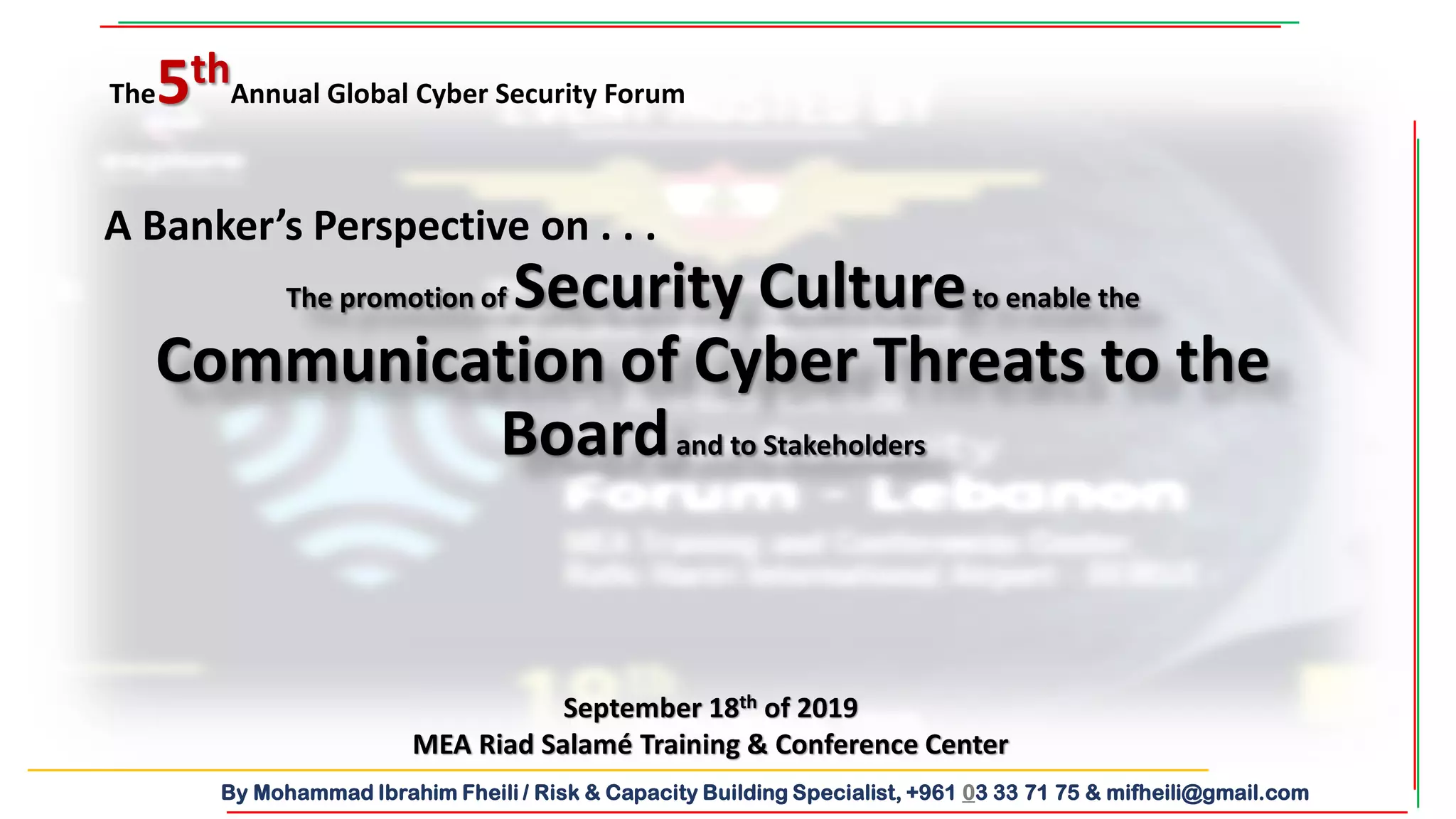
The promotion of Security Cultureto enable the
Communication of Cyber Threats to the
Boardand to Stakeholders
September 18th of 2019
MEA Riad Salamé Training & Conference Center
The5thAnnual Global Cyber Security Forum
A Banker’s Perspective on . . .
By Mohammad Ibrahim Fheili / Risk & Capacity Building Specialist, +961 03 33 71 75 & mifheili@gmail.com
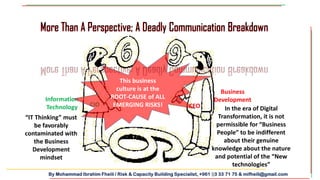
More Than A Perspective; A Deadly Communication Breakdown
CIO CEO
Information
Technology
Business
Development
“IT Thinking” must
be favorably
contaminated with
the Business
Development
mindset
In the era of Digital
Transformation, it is not
permissible for “Business
People” to be indifferent
about their genuine
knowledge about the nature
and potential of the “New
technologies”
This business
culture is at the
ROOT-CAUSE of ALL
EMERGING RISKS!
More Than A Perspective; A Deadly Communication Breakdown
By Mohammad Ibrahim Fheili / Risk & Capacity Building Specialist, +961 03 33 71 75 & mifheili@gmail.com
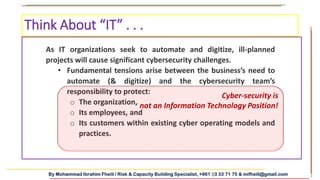
Think About “IT” . . .
As IT organizations seek to automate and digitize, ill-planned
projects will cause significant cybersecurity challenges.
• Fundamental tensions arise between the business’s need to
automate (& digitize) and the cybersecurity team’s
responsibility to protect:
o The organization,
o Its employees, and
o Its customers within existing cyber operating models and
practices.
Cyber-security is
not an Information Technology Position!
By Mohammad Ibrahim Fheili / Risk & Capacity Building Specialist, +961 03 33 71 75 & mifheili@gmail.com
A.I.
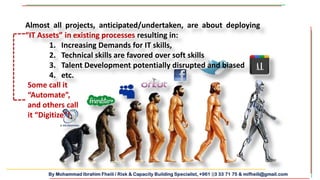
Almost all projects, anticipated/undertaken, are about deploying
“IT Assets” in existing processes resulting in:
1. Increasing Demands for IT skills,
2. Technical skills are favored over soft skills
3. Talent Development potentially disrupted and biased
4. etc.
Some call it
“Automate”,
and others call
it “Digitize”!
“IT Assets” in existing processes
By Mohammad Ibrahim Fheili / Risk & Capacity Building Specialist, +961 03 33 71 75 & mifheili@gmail.com
 The Absence of adequate Technical Skills will:
o Reflect negatively on the success of the majority of projects,
o Introduce an element of heightened Risks in planned projects, and
o Result in misalignment of duties and responsibilities)!
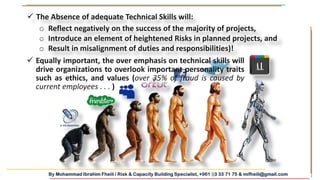
A.I.
 Equally important, the over emphasis on technical skills will
drive organizations to overlook important personality traits
such as ethics, and values (over 35% of fraud is caused by
current employees . . . )
By Mohammad Ibrahim Fheili / Risk & Capacity Building Specialist, +961 03 33 71 75 & mifheili@gmail.com
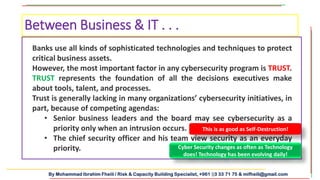
Banks use all kinds of sophisticated technologies and techniques to protect
critical business assets.
However, the most important factor in any cybersecurity program is TRUST.
TRUST represents the foundation of all the decisions executives make
about tools, talent, and processes.
Trust is generally lacking in many organizations’ cybersecurity initiatives, in
part, because of competing agendas:
• Senior business leaders and the board may see cybersecurity as a
priority only when an intrusion occurs.
• The chief security officer and his team view security as an everyday
priority.
Between Business & IT . . .
This is as good as Self-Destruction!
Cyber Security changes as often as Technology
does! Technology has been evolving daily!
By Mohammad Ibrahim Fheili / Risk & Capacity Building Specialist, +961 03 33 71 75 & mifheili@gmail.com
Trust . . .
This lack of TRUST gave rise to common myths about
cybersecurity:
• The types of threats that are most relevant,
• The amount of spending required to protect critical data,
and
• Which data sets are at risk.
Perceptions became facts, trust eroded further, and
cybersecurity programs ended up less successful than they
should be.
By Mohammad Ibrahim Fheili / Risk & Capacity Building Specialist, +961 03 33 71 75 & mifheili@gmail.com
We’ve Been
Growing Apart!
Myths
Reality
By Mohammad Ibrahim Fheili / Risk & Capacity Building Specialist, +961 03 33 71 75 & mifheili@gmail.com
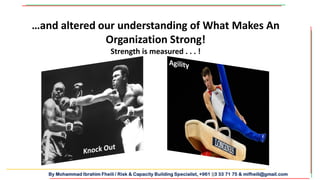
…and altered our understanding of What Makes An
Organization Strong!
Strength is measured . . . !
By Mohammad Ibrahim Fheili / Risk & Capacity Building Specialist, +961 03 33 71 75 & mifheili@gmail.com
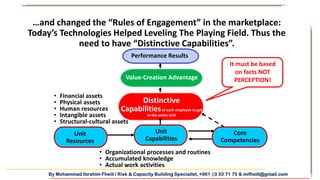
Unit
Resources
• Financial assets
• Physical assets
• Human resources
• Intangible assets
• Structural-cultural assets
• Organizational processes and routines
• Accumulated knowledge
• Actual work activities
Core
Competencies
Distinctive
Capabilitiesof each employee to get
to the entire Unit
Value-Creation Advantage
Performance Results
Unit
Capabilities
It must be based
on facts NOT
PERCEPTION!
…and changed the “Rules of Engagement” in the marketplace:
Today’s Technologies Helped Leveling The Playing Field. Thus the
need to have “Distinctive Capabilities”.
By Mohammad Ibrahim Fheili / Risk & Capacity Building Specialist, +961 03 33 71 75 & mifheili@gmail.com
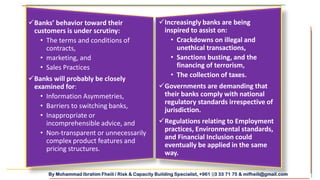
Increasingly banks are being
inspired to assist on:
• Crackdowns on illegal and
unethical transactions,
• Sanctions busting, and the
financing of terrorism,
• The collection of taxes.
Governments are demanding that
their banks comply with national
regulatory standards irrespective of
jurisdiction.
Regulations relating to Employment
practices, Environmental standards,
and Financial Inclusion could
eventually be applied in the same
way.
Banks’ behavior toward their
customers is under scrutiny:
• The terms and conditions of
contracts,
• marketing, and
• Sales Practices
Banks will probably be closely
examined for:
• Information Asymmetries,
• Barriers to switching banks,
• Inappropriate or
incomprehensible advice, and
• Non-transparent or unnecessarily
complex product features and
pricing structures.
By Mohammad Ibrahim Fheili / Risk & Capacity Building Specialist, +961 03 33 71 75 & mifheili@gmail.com
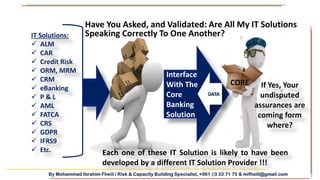
IT Solutions:
 ALM
 CAR
 Credit Risk
 ORM, MRM
 CRM
 eBanking
 P & L
 AML
 FATCA
 CRS
 GDPR
 IFRS9
 Etc.
Interface
With The
Core
Banking
Solution
Each one of these IT Solution is likely to have been
developed by a different IT Solution Provider !!!
Have You Asked, and Validated: Are All My IT Solutions
Speaking Correctly To One Another?
CORE If Yes, Your
undisputed
assurances are
coming form
where?
DATA
By Mohammad Ibrahim Fheili / Risk & Capacity Building Specialist, +961 03 33 71 75 & mifheili@gmail.com
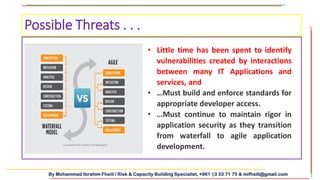
Possible Threats . . .
• Little time has been spent to identify
vulnerabilities created by interactions
between many IT Applications and
services, and
• …Must build and enforce standards for
appropriate developer access.
• …Must continue to maintain rigor in
application security as they transition
from waterfall to agile application
development.
By Mohammad Ibrahim Fheili / Risk & Capacity Building Specialist, +961 03 33 71 75 & mifheili@gmail.com
Pain Points to watch for in Automation &/or Digital Transformation.
1. Model Use and Decision Making
• Failure at the human–machine interface
• Cybersecurity threats
• Slow detection of/response to performance issues
• Technology- environment malfunction
2. Model Implementation
• Insufficient training and skills
• Poor technology- environment design
• Implementation errors
Pain Points . . .
By Mohammad Ibrahim Fheili / Risk & Capacity Building Specialist, +961 03 33 71 75 & mifheili@gmail.com
Pain Points to watch for in Automation &/or Digital Transformation.
3. Model Development
• Model instability or performance degradation
• Biased or discriminatory model outcomes
• Non-representative data
4. Data Management
• Other regulatory noncompliance
• Unsecured “protected” data
• Incomplete or inaccurate data
5. Conceptualization
• Insufficient learning feedback loop
• Potentially unethical use cases
Pain Points . . .
By Mohammad Ibrahim Fheili / Risk & Capacity Building Specialist, +961 03 33 71 75 & mifheili@gmail.com
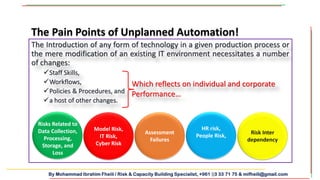
The Pain Points of Unplanned Automation!
The Introduction of any form of technology in a given production process or
the mere modification of an existing IT environment necessitates a number
of changes:
Staff Skills,
Workflows,
Policies & Procedures, and
a host of other changes.
Which reflects on individual and corporate
Performance…
Assessment
Failures
Model Risk,
IT Risk,
Cyber Risk
HR risk,
People Risk,
Risk Inter
dependency
Risks Related to
Data Collection,
Processing,
Storage, and
Loss
By Mohammad Ibrahim Fheili / Risk & Capacity Building Specialist, +961 03 33 71 75 & mifheili@gmail.com
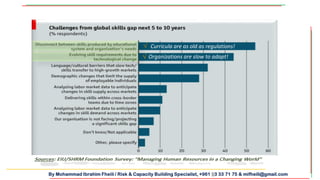
Curricula are as old as regulations!
Organizations are slow to adapt!
By Mohammad Ibrahim Fheili / Risk & Capacity Building Specialist, +961 03 33 71 75 & mifheili@gmail.com
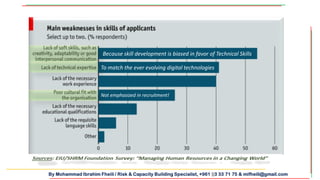
Because skill development is biased in favor of Technical Skills
To match the ever evolving digital technologies
Not emphasized in recruitment!
By Mohammad Ibrahim Fheili / Risk & Capacity Building Specialist, +961 03 33 71 75 & mifheili@gmail.com
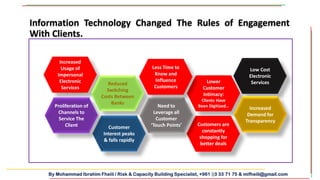
Increased
Usage of
Impersonal
Electronic
Services
Low Cost
Electronic
ServicesLower
Customer
Intimacy:
Clients Have
Been Digitized…
Reduced
Switching
Costs Between
Banks
Customers are
constantly
shopping for
better deals
Increased
Demand for
Transparency
Need to
Leverage all
Customer
‘Touch Points’Customer
Interest peaks
& falls rapidly
Less Time to
Know and
Influence
Customers
Proliferation of
Channels to
Service The
Client
Information Technology Changed The Rules of Engagement
With Clients.
By Mohammad Ibrahim Fheili / Risk & Capacity Building Specialist, +961 03 33 71 75 & mifheili@gmail.com
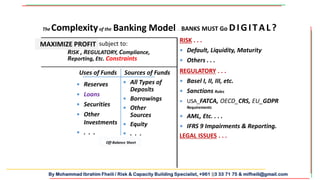
subject to:
RISK , REGULATORY, Compliance,
Reporting, Etc. Constraints
RISK . . .
 Default, Liquidity, Maturity
 Others . . .
REGULATORY . . .
 Basel I, II, III, etc.
 Sanctions Rules
 USA_FATCA, OECD_CRS, EU_GDPR
Requirements
 AML, Etc. . . .
 IFRS 9 Impairments & Reporting.
Uses of Funds Sources of Funds
 Reserves
 Loans
 Securities
 Other
Investments
 . . .
 All Types of
Deposits
 Borrowings
 Other
Sources
 Equity
 . . .
Off-Balance Sheet
LEGAL ISSUES . . .
The Complexityof the … BANKS MUST Go D.I.G.I.T.A.L.?
MAXIMIZE PROFIT
Banking Model
By Mohammad Ibrahim Fheili / Risk & Capacity Building Specialist, +961 03 33 71 75 & mifheili@gmail.com
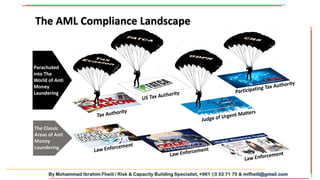
The AML Compliance Landscape
The Classic
Areas of Anti
Money
Laundering
Parachuted
into The
World of Anti
Money
Laundering
By Mohammad Ibrahim Fheili / Risk & Capacity Building Specialist, +961 03 33 71 75 & mifheili@gmail.com
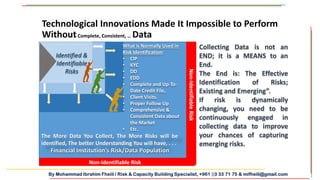
Non-Identifiable Risk
Non-IdentifiableRisk
Financial Institution’s Risk/Data Population
What is Normally Used in
Risk Identification:
• CIP
• KYC
• DD
• EDD
• Complete and Up-To-
Date Credit File,
• Client Visits.
• Proper Follow Up
• Comprehensive &
Consistent Data about
the Market
• Etc.
Identified &
Identifiable
Risks
Collecting Data is not an
END; it is a MEANS to an
End.
The End is: The Effective
Identification of Risks;
Existing and Emerging”.
If risk is dynamically
changing, you need to be
continuously engaged in
collecting data to improve
your chances of capturing
emerging risks.
Technological Innovations Made It Impossible to Perform
WithoutComplete, Consistent, … Data
The More Data You Collect, The More Risks will be
identified, The better Understanding You will have, . . .
By Mohammad Ibrahim Fheili / Risk & Capacity Building Specialist, +961 03 33 71 75 & mifheili@gmail.com
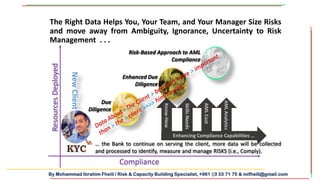
Compliance
ResourcesDeployed
DD
EDD
RBA
… the Bank to continue on serving the client, more data will be collected
and processed to identify, measure and manage RISKS (i.e., Comply).
Due
Diligence
Enhanced Due
Diligence
Risk-Based Approach to AML
Compliance
Enhancing Compliance Capabilities …
AMLCost
SkillsNeeds
Know-How
AMLAnalytics
NewClient
The Right Data Helps You, Your Team, and Your Manager Size Risks
and move away from Ambiguity, Ignorance, Uncertainty to Risk
Management . . .
By Mohammad Ibrahim Fheili / Risk & Capacity Building Specialist, +961 03 33 71 75 & mifheili@gmail.com
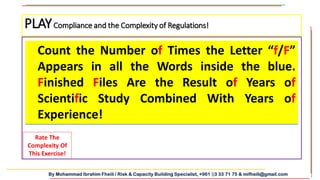
Count the Number of Times the Letter “f/F”
Appears in all the Words inside the blue.
Finished Files Are the Result of Years of
Scientific Study Combined With Years of
Experience!
Count the Number of Times the Letter “f/F”
Appears in all the Words inside the blue.
Finished Files Are the Result of Years of
Scientific Study Combined With Years of
Experience!
Rate The
Complexity Of
This Exercise!
PLAYCompliance and the Complexity of Regulations!
By Mohammad Ibrahim Fheili / Risk & Capacity Building Specialist, +961 03 33 71 75 & mifheili@gmail.com
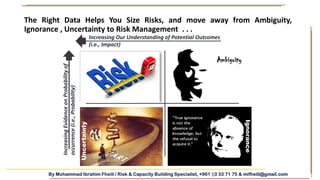
Increasing Our Understanding of Potential Outcomes
(i.e., Impact)
IncreasingEvidenceonProbabilityof
occurrence(i.e.,Probability)
Ambiguity
Uncertainty
Ignorance
The Right Data Helps You Size Risks, and move away from Ambiguity,
Ignorance , Uncertainty to Risk Management . . .
By Mohammad Ibrahim Fheili / Risk & Capacity Building Specialist, +961 03 33 71 75 & mifheili@gmail.com
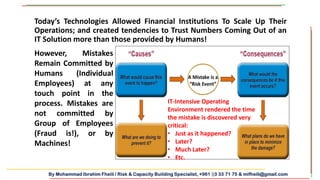
Today’s Technologies Allowed Financial Institutions To Scale Up Their
Operations; and created tendencies to Trust Numbers Coming Out of an
IT Solution more than those provided by Humans!
IT-Intensive Operating
Environment rendered the time
the mistake is discovered very
critical:
• Just as it happened?
• Later?
• Much Later?
• Etc.
However, Mistakes
Remain Committed by
Humans (Individual
Employees) at any
touch point in the
process. Mistakes are
not committed by
Group of Employees
(Fraud is!), or by
Machines!
By Mohammad Ibrahim Fheili / Risk & Capacity Building Specialist, +961 03 33 71 75 & mifheili@gmail.com
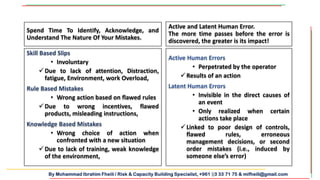
Spend Time To Identify, Acknowledge, and
Understand The Nature Of Your Mistakes.
Skill Based Slips
• Involuntary
Due to lack of attention, Distraction,
fatigue, Environment, work Overload,
Rule Based Mistakes
• Wrong action based on flawed rules
Due to wrong incentives, flawed
products, misleading instructions,
Knowledge Based Mistakes
• Wrong choice of action when
confronted with a new situation
Due to lack of training, weak knowledge
of the environment,
Active Human Errors
• Perpetrated by the operator
Results of an action
Latent Human Errors
• Invisible in the direct causes of
an event
• Only realized when certain
actions take place
Linked to poor design of controls,
flawed rules, erroneous
management decisions, or second
order mistakes (i.e., induced by
someone else’s error)
Active and Latent Human Error.
The more time passes before the error is
discovered, the greater is its impact!
By Mohammad Ibrahim Fheili / Risk & Capacity Building Specialist, +961 03 33 71 75 & mifheili@gmail.com
The Risk
Taker
Oversight
Function
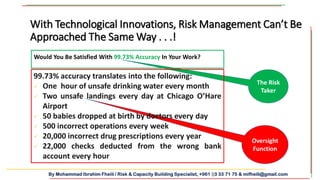
Would You Be Satisfied With 99.73% Accuracy In Your Work?
99.73% accuracy translates into the following:
 One hour of unsafe drinking water every month
 Two unsafe landings every day at Chicago O’Hare
Airport
 50 babies dropped at birth by doctors every day
 500 incorrect operations every week
 20,000 incorrect drug prescriptions every year
 22,000 checks deducted from the wrong bank
account every hour
With Technological Innovations, Risk Management Can’t Be
Approached The Same Way . . .!
By Mohammad Ibrahim Fheili / Risk & Capacity Building Specialist, +961 03 33 71 75 & mifheili@gmail.com
If Cyberrisk is “Colorful”, Cyber-Security
Must Be Black-n-white!
The Language You Need To Effectively
Communicate With The Board of
Directors
By Mohammad Ibrahim Fheili / Risk & Capacity Building Specialist, +961 03 33 71 75 & mifheili@gmail.com
• Cyber security is the state or process of Protecting and
Recovering networks, devices, and programs from any
type of cyber-attack.
• Cyber risk is an issue that exists at the intersection of
Business Risk, Regulation, and Technology.
• Organizations must factor cyber risk into their risk
appetite and explicitly define the level of cyber risk that
they are willing to accept in context of their overall risk
appetite.
Cyber s & r …
By Mohammad Ibrahim Fheili / Risk & Capacity Building Specialist, +961 03 33 71 75 & mifheili@gmail.com
If cybersecurity team is to avoid becoming a barrier to business
development (through digitization, etc.) and instead become its enabler,
it must transform its capabilities along these dimensions:
• Improve Risk Management,
• Apply Quantitative Risk Analytics,
• Build Cybersecurity Directly Into Businesses’ Value Chains,
• Support The Next Generation Of Enterprise-Technology
Platforms.
Cybersecurity and The Business . . .
By Mohammad Ibrahim Fheili / Risk & Capacity Building Specialist, +961 03 33 71 75 & mifheili@gmail.com
Only The Facts . . .
All assets in the organization must be protected the same way.
Not all data are created with equal value.
• A strong cybersecurity strategy provides differentiated
protection of the company’s most important assets,
utilizing a tiered collection of security measures.
• Business and cybersecurity leaders must work together
to identify and protect the “crown jewels”—those
corporate assets that generate the most value for a
company.
By Mohammad Ibrahim Fheili / Risk & Capacity Building Specialist, +961 03 33 71 75 & mifheili@gmail.com
Only The Facts . . .
The more we spend, the more secure we will be!
• There is no direct correlation between spending
on cybersecurity (as a proportion of total IT
spending) and success of a company’s
cybersecurity program.
By Mohammad Ibrahim Fheili / Risk & Capacity Building Specialist, +961 03 33 71 75 & mifheili@gmail.com
Only The Facts . . .
External hackers are the only threat to corporate assets!
• Threats from outsiders are a huge concern for cybersecurity
teams, but there are significant threats inside corporate walls
as well (43% of data breaches are from insiders).
• The very people who are closest to the data can often be a
weak link in a company’s cybersecurity program.
o When they share files over unprotected networks,
o Click on malicious hyperlinks
o Act in ways that open up corporate networks to attack.
By Mohammad Ibrahim Fheili / Risk & Capacity Building Specialist, +961 03 33 71 75 & mifheili@gmail.com
Only The Facts . . .
The more advanced our technology, the more secure we are!
• Most companies are not dealing with military-grade hackers.
• It is true that cybersecurity teams often use powerful,
cutting-edge technologies to protect data and other
corporate assets.
• However, many threats can be mitigated using less-advanced
methods.
• More than 70 percent of global cyberattacks come from
financially motivated criminals who are using technically
simple tactics, such as phishing emails
By Mohammad Ibrahim Fheili / Risk & Capacity Building Specialist, +961 03 33 71 75 & mifheili@gmail.com
Bridge The Gap . . .
Re-educate the C-suite about best practices in cybersecurity spending:
• A tiered approach to cybersecurity may be more effective than blanket
coverage for all.
• The budget cannot grow and shrink depending on whether the
company recently suffered a system intrusion.
• Cybersecurity must be considered a permanent capital expenditure,
and allocations should be prioritized based on a review of the entire
portfolio of initiatives under way.
• Business and technology professionals must work together to manage
the trade-offs associated with cybersecurity.
By Mohammad Ibrahim Fheili / Risk & Capacity Building Specialist, +961 03 33 71 75 & mifheili@gmail.com
Bridge The Gap . . .
Weak communication accounts for much of the lack of trust between
business leaders and members of the cybersecurity Team.
• Finding a common vocabulary is important not just for ensuring
clear communication between the C-suite and the cybersecurity
function but also for raising awareness about potential
cyberthreats and risks among employees throughout the
company.
• Members of the cybersecurity Team should schedule frequent,
regular check-ins with staff at all levels to educate them about
relevant cybersecurity topics.
By Mohammad Ibrahim Fheili / Risk & Capacity Building Specialist, +961 03 33 71 75 & mifheili@gmail.com
Structural hurdles to addressing cybersecurity . . .
 Executives must accept a certain level of cyberattack risk.
o In order to protect themselves without limiting their ability to
innovate, companies have to make sophisticated trade-offs between
risks and customer expectations.
 The implications of cybersecurity are inescapable.
o Cybersecurity touches every business process and function, not only
in operations but also in:
• Customer care, Marketing, and Product development,
• Procurement,
• Human resources, and
• Public affairs.
By Mohammad Ibrahim Fheili / Risk & Capacity Building Specialist, +961 03 33 71 75 & mifheili@gmail.com
Structural hurdles to addressing cybersecurity . . .
Cybersecurity risk is difficult to quantify.
o There’s no single quantitative metric for
cybersecurity, making it much harder to communicate
the urgency to senior managers and Board to engage
them in decisions and oversight.
It’s hard to change user behavior.
o The biggest vulnerability lies not with the hardware
but with the people.
By Mohammad Ibrahim Fheili / Risk & Capacity Building Specialist, +961 03 33 71 75 & mifheili@gmail.com
Companies may well have a state-of-the-art firewall and the latest malware-
detection software. And they might have well-tuned security operations
and incident-response processes.
But
• What about third-party suppliers, which might be the weakest link of
a company’s value chain? Or
• The hotshot design studio that has access to the company’s
intellectual property (IP)?
The entry point for cyber attackers can be as trivial as a Wi-Fi-enabled
camera used to take pictures at a corporate retreat.
Addressing Cybersecurity Value Chain . . .
By Mohammad Ibrahim Fheili / Risk & Capacity Building Specialist, +961 03 33 71 75 & mifheili@gmail.com
 Lack of structure.
o Boards and committees are swamped with
reports, including dozens of key performance
indicators and key risk indicators (KRIs).
o The reports are often poorly structured, however,
with inconsistent and usually too-high levels of
detail.
Many board members are dissatisfied with the reports
they receive.
Fact-Based Cyber Risk Management . . .
By Mohammad Ibrahim Fheili / Risk & Capacity Building Specialist, +961 03 33 71 75 & mifheili@gmail.com
 Lack of clarity.
o Most reporting fails to convey the implications of risk
levels for business processes.
o Board members find these reports off-putting—poorly
written and overloaded with acronyms and technical
shorthand. They consequently struggle to get a sense
of the overall risk status of the organization.
Many Board Members find risk reports too technical.
Fact-Based Cyber Risk Management . . .
By Mohammad Ibrahim Fheili / Risk & Capacity Building Specialist, +961 03 33 71 75 & mifheili@gmail.com
 Lack of consistent real-time data.
o Different groups in the same organization often
use different, potentially conflicting information
to describe or evaluate the same aspects of cyber
risk.
underlying data are often too dated to be of use in
managing quickly evolving cyberthreats.
Fact-Based Cyber Risk Management . . .
By Mohammad Ibrahim Fheili / Risk & Capacity Building Specialist, +961 03 33 71 75 & mifheili@gmail.com
Accurate Risk Sizing is dependent on a few basic inputs:
 A business perspective of the institution’s key assets and
the top risks that could affect them,
 Realistic up-to-date assessments of relevant threats and
threat actors, formulated appropriately,
 A consistent and accurate definition of risk appetite for the
organization as a whole.
A well-prioritized risk profile, efficiently focused on reducing disruption or slowdowns.
Fact-Based Cyber Risk Management . . .
By Mohammad Ibrahim Fheili / Risk & Capacity Building Specialist, +961 03 33 71 75 & mifheili@gmail.com
A DASHBOARD that summarizes the entire risk-management terrain:
o The evolution of the relevant threat landscape and its implications,
o Overview of recent cyberrisk events, incident development, and key
countermeasures taken,
o Top cyberrisk s as defined in cooperation with the business units and
measured through clearly defined key risk indicators
o Risk assessments in light of clearly defined risk appetites, with
recommendations on the assets in need of prioritized attention,
o A detailed plan of the counter-risk initiatives in place, with relevant
accountabilities, implementation status, and actual impact on risk
reduction
Fact-Based Cyber Risk Management . . .
By Mohammad Ibrahim Fheili / Risk & Capacity Building Specialist, +961 03 33 71 75 & mifheili@gmail.com
Cyber Security Risk Management is the process of
managing emerging risks as a result of changes in
the information technology environment. It involves:
• Identifying,
• Assessing, and
• Treating
risks to the confidentiality, integrity, and availability of the
organization's assets.
Thus the importance of Risk Management…
By Mohammad Ibrahim Fheili / Risk & Capacity Building Specialist, +961 03 33 71 75 & mifheili@gmail.com
Risk
Security
Cyber and the Board
of Directors
By Mohammad Ibrahim Fheili / Risk & Capacity Building Specialist, +961 03 33 71 75 & mifheili@gmail.com
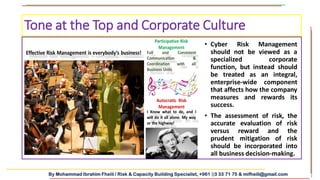
• Cyber Risk Management
should not be viewed as a
specialized corporate
function, but instead should
be treated as an integral,
enterprise-wide component
that affects how the company
measures and rewards its
success.
• The assessment of risk, the
accurate evaluation of risk
versus reward and the
prudent mitigation of risk
should be incorporated into
all business decision-making.
Tone at the Top and Corporate Culture
By Mohammad Ibrahim Fheili / Risk & Capacity Building Specialist, +961 03 33 71 75 & mifheili@gmail.com
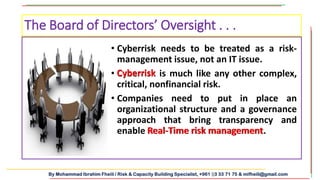
• Cyberrisk needs to be treated as a risk-
management issue, not an IT issue.
• Cyberrisk is much like any other complex,
critical, nonfinancial risk.
• Companies need to put in place an
organizational structure and a governance
approach that bring transparency and
enable Real-Time risk management.
The Board of Directors’ Oversight . . .
Real-Time risk management
Cyberrisk
By Mohammad Ibrahim Fheili / Risk & Capacity Building Specialist, +961 03 33 71 75 & mifheili@gmail.com
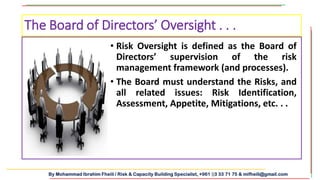
• Risk Oversight is defined as the Board of
Directors’ supervision of the risk
management framework (and processes).
• The Board must understand the Risks, and
all related issues: Risk Identification,
Assessment, Appetite, Mitigations, etc. . .
The Board of Directors’ Oversight . . .
By Mohammad Ibrahim Fheili / Risk & Capacity Building Specialist, +961 03 33 71 75 & mifheili@gmail.com
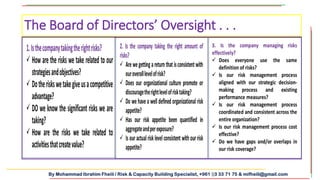
The Board of Directors’ Oversight . . .
By Mohammad Ibrahim Fheili / Risk & Capacity Building Specialist, +961 03 33 71 75 & mifheili@gmail.com
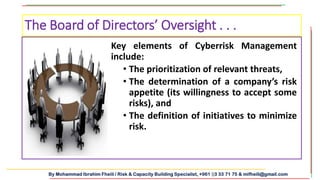
Key elements of Cyberrisk Management
include:
• The prioritization of relevant threats,
• The determination of a company’s risk
appetite (its willingness to accept some
risks), and
• The definition of initiatives to minimize
risk.
The Board of Directors’ Oversight . . .
By Mohammad Ibrahim Fheili / Risk & Capacity Building Specialist, +961 03 33 71 75 & mifheili@gmail.com
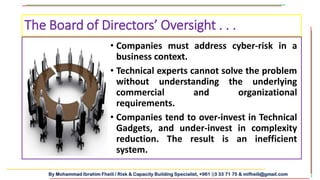
• Companies must address cyber-risk in a
business context.
• Technical experts cannot solve the problem
without understanding the underlying
commercial and organizational
requirements.
• Companies tend to over-invest in Technical
Gadgets, and under-invest in complexity
reduction. The result is an inefficient
system.
The Board of Directors’ Oversight . . .
By Mohammad Ibrahim Fheili / Risk & Capacity Building Specialist, +961 03 33 71 75 & mifheili@gmail.com
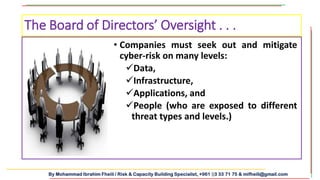
• Companies must seek out and mitigate
cyber-risk on many levels:
Data,
Infrastructure,
Applications, and
People (who are exposed to different
threat types and levels.)
The Board of Directors’ Oversight . . .
By Mohammad Ibrahim Fheili / Risk & Capacity Building Specialist, +961 03 33 71 75 & mifheili@gmail.com
• Cyber-Risk changes as often as
technologies change! We all admit that technologies
[outside] are evolving daily. How is Your Technology [inside]
changing?!
• Risk appetite and Tolerance need to be
high on any Board's agenda and is a core
consideration of an enterprise risk
management approach.
The Board of Directors’ Oversight . . .
By Mohammad Ibrahim Fheili / Risk & Capacity Building Specialist, +961 03 33 71 75 & mifheili@gmail.com
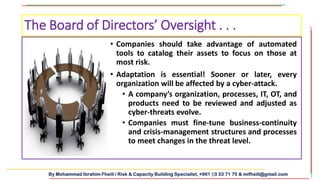
• Companies should take advantage of automated
tools to catalog their assets to focus on those at
most risk.
• Adaptation is essential! Sooner or later, every
organization will be affected by a cyber-attack.
• A company’s organization, processes, IT, OT, and
products need to be reviewed and adjusted as
cyber-threats evolve.
• Companies must fine-tune business-continuity
and crisis-management structures and processes
to meet changes in the threat level.
The Board of Directors’ Oversight . . .
By Mohammad Ibrahim Fheili / Risk & Capacity Building Specialist, +961 03 33 71 75 & mifheili@gmail.com
Cyber Risk Management should be tailored to the specific company, to:
1. Adequately identify the material risks that the company faces in a
timely manner
2. Implement appropriate risk management strategies that are
responsive to the company’s risk profile, business strategies, specific
material risk exposures and risk tolerance thresholds
3. Integrate consideration of risk and risk management into strategy
development and business decision-making throughout the
company
4. Adequately transmit necessary information with respect to material
risks to senior executives and, as appropriate, to the board or
relevant committees.
Recommendations for Improving Risk Oversight
By Mohammad Ibrahim Fheili / Risk & Capacity Building Specialist, +961 03 33 71 75 & mifheili@gmail.com
 Risk & Capacity Building, and Organizational Transformation
Specialist.
 Lecturer in Risk, Risk-Based Performance & Compliance
 University Lecturer: Economics, Risk, and Banking Operations
 Currently serves in the capacity of Chief Consultant with M.I.Fheili
& Associates – Risk, Capacity Building, and Organizational
Transformation Specialists.
Served as:
 Executive (AGM) at JTB Bank
 Senior Manager & Chief Risk Officer at Group Fransabank
 Senior Manager at BankMed
 An Economist at the Association of Banks in Lebanon
 Mohammad received his college education (undergraduate &
graduate) at Louisiana State University (LSU), and has been
teaching Economics and Finance for over 25 continuous years at
reputable universities in the USA (LSU) and Lebanon (LAU).
 Finally, Mohammad published over 25 articles, of those many are
in refereed Journals (e.g., Journal of Money Laundering & Control;
Journal of Operational Risk; Journal of Law & Economics; etc.) and
Bulletins.”

Cyber security; one banker s perspective

  • 1.
    By Mohammad IbrahimFheili / Risk & Capacity Building Specialist, +961 03 33 71 75 & mifheili@gmail.com The promotion of Security Cultureto enable the Communication of Cyber Threats to the Boardand to Stakeholders September 18th of 2019 MEA Riad Salamé Training & Conference Center The5thAnnual Global Cyber Security Forum A Banker’s Perspective on . . .
  • 2.
    By Mohammad IbrahimFheili / Risk & Capacity Building Specialist, +961 03 33 71 75 & mifheili@gmail.com More Than A Perspective; A Deadly Communication Breakdown CIO CEO Information Technology Business Development “IT Thinking” must be favorably contaminated with the Business Development mindset In the era of Digital Transformation, it is not permissible for “Business People” to be indifferent about their genuine knowledge about the nature and potential of the “New technologies” This business culture is at the ROOT-CAUSE of ALL EMERGING RISKS! More Than A Perspective; A Deadly Communication Breakdown
  • 3.
    By Mohammad IbrahimFheili / Risk & Capacity Building Specialist, +961 03 33 71 75 & mifheili@gmail.com Think About “IT” . . . As IT organizations seek to automate and digitize, ill-planned projects will cause significant cybersecurity challenges. • Fundamental tensions arise between the business’s need to automate (& digitize) and the cybersecurity team’s responsibility to protect: o The organization, o Its employees, and o Its customers within existing cyber operating models and practices. Cyber-security is not an Information Technology Position!
  • 4.
    By Mohammad IbrahimFheili / Risk & Capacity Building Specialist, +961 03 33 71 75 & mifheili@gmail.com A.I. Almost all projects, anticipated/undertaken, are about deploying “IT Assets” in existing processes resulting in: 1. Increasing Demands for IT skills, 2. Technical skills are favored over soft skills 3. Talent Development potentially disrupted and biased 4. etc. Some call it “Automate”, and others call it “Digitize”! “IT Assets” in existing processes
  • 5.
    By Mohammad IbrahimFheili / Risk & Capacity Building Specialist, +961 03 33 71 75 & mifheili@gmail.com  The Absence of adequate Technical Skills will: o Reflect negatively on the success of the majority of projects, o Introduce an element of heightened Risks in planned projects, and o Result in misalignment of duties and responsibilities)! A.I.  Equally important, the over emphasis on technical skills will drive organizations to overlook important personality traits such as ethics, and values (over 35% of fraud is caused by current employees . . . )
  • 6.
    By Mohammad IbrahimFheili / Risk & Capacity Building Specialist, +961 03 33 71 75 & mifheili@gmail.com Banks use all kinds of sophisticated technologies and techniques to protect critical business assets. However, the most important factor in any cybersecurity program is TRUST. TRUST represents the foundation of all the decisions executives make about tools, talent, and processes. Trust is generally lacking in many organizations’ cybersecurity initiatives, in part, because of competing agendas: • Senior business leaders and the board may see cybersecurity as a priority only when an intrusion occurs. • The chief security officer and his team view security as an everyday priority. Between Business & IT . . . This is as good as Self-Destruction! Cyber Security changes as often as Technology does! Technology has been evolving daily!
  • 7.
    By Mohammad IbrahimFheili / Risk & Capacity Building Specialist, +961 03 33 71 75 & mifheili@gmail.com Trust . . . This lack of TRUST gave rise to common myths about cybersecurity: • The types of threats that are most relevant, • The amount of spending required to protect critical data, and • Which data sets are at risk. Perceptions became facts, trust eroded further, and cybersecurity programs ended up less successful than they should be.
  • 8.
    By Mohammad IbrahimFheili / Risk & Capacity Building Specialist, +961 03 33 71 75 & mifheili@gmail.com We’ve Been Growing Apart! Myths Reality
  • 9.
    By Mohammad IbrahimFheili / Risk & Capacity Building Specialist, +961 03 33 71 75 & mifheili@gmail.com
  • 10.
    By Mohammad IbrahimFheili / Risk & Capacity Building Specialist, +961 03 33 71 75 & mifheili@gmail.com …and altered our understanding of What Makes An Organization Strong! Strength is measured . . . !
  • 11.
    By Mohammad IbrahimFheili / Risk & Capacity Building Specialist, +961 03 33 71 75 & mifheili@gmail.com Unit Resources • Financial assets • Physical assets • Human resources • Intangible assets • Structural-cultural assets • Organizational processes and routines • Accumulated knowledge • Actual work activities Core Competencies Distinctive Capabilitiesof each employee to get to the entire Unit Value-Creation Advantage Performance Results Unit Capabilities It must be based on facts NOT PERCEPTION! …and changed the “Rules of Engagement” in the marketplace: Today’s Technologies Helped Leveling The Playing Field. Thus the need to have “Distinctive Capabilities”.
  • 12.
    By Mohammad IbrahimFheili / Risk & Capacity Building Specialist, +961 03 33 71 75 & mifheili@gmail.com Increasingly banks are being inspired to assist on: • Crackdowns on illegal and unethical transactions, • Sanctions busting, and the financing of terrorism, • The collection of taxes. Governments are demanding that their banks comply with national regulatory standards irrespective of jurisdiction. Regulations relating to Employment practices, Environmental standards, and Financial Inclusion could eventually be applied in the same way. Banks’ behavior toward their customers is under scrutiny: • The terms and conditions of contracts, • marketing, and • Sales Practices Banks will probably be closely examined for: • Information Asymmetries, • Barriers to switching banks, • Inappropriate or incomprehensible advice, and • Non-transparent or unnecessarily complex product features and pricing structures.
  • 13.
    By Mohammad IbrahimFheili / Risk & Capacity Building Specialist, +961 03 33 71 75 & mifheili@gmail.com
  • 14.
    By Mohammad IbrahimFheili / Risk & Capacity Building Specialist, +961 03 33 71 75 & mifheili@gmail.com IT Solutions:  ALM  CAR  Credit Risk  ORM, MRM  CRM  eBanking  P & L  AML  FATCA  CRS  GDPR  IFRS9  Etc. Interface With The Core Banking Solution Each one of these IT Solution is likely to have been developed by a different IT Solution Provider !!! Have You Asked, and Validated: Are All My IT Solutions Speaking Correctly To One Another? CORE If Yes, Your undisputed assurances are coming form where? DATA
  • 15.
    By Mohammad IbrahimFheili / Risk & Capacity Building Specialist, +961 03 33 71 75 & mifheili@gmail.com Possible Threats . . . • Little time has been spent to identify vulnerabilities created by interactions between many IT Applications and services, and • …Must build and enforce standards for appropriate developer access. • …Must continue to maintain rigor in application security as they transition from waterfall to agile application development.
  • 16.
    By Mohammad IbrahimFheili / Risk & Capacity Building Specialist, +961 03 33 71 75 & mifheili@gmail.com Pain Points to watch for in Automation &/or Digital Transformation. 1. Model Use and Decision Making • Failure at the human–machine interface • Cybersecurity threats • Slow detection of/response to performance issues • Technology- environment malfunction 2. Model Implementation • Insufficient training and skills • Poor technology- environment design • Implementation errors Pain Points . . .
  • 17.
    By Mohammad IbrahimFheili / Risk & Capacity Building Specialist, +961 03 33 71 75 & mifheili@gmail.com Pain Points to watch for in Automation &/or Digital Transformation. 3. Model Development • Model instability or performance degradation • Biased or discriminatory model outcomes • Non-representative data 4. Data Management • Other regulatory noncompliance • Unsecured “protected” data • Incomplete or inaccurate data 5. Conceptualization • Insufficient learning feedback loop • Potentially unethical use cases Pain Points . . .
  • 18.
    By Mohammad IbrahimFheili / Risk & Capacity Building Specialist, +961 03 33 71 75 & mifheili@gmail.com The Pain Points of Unplanned Automation! The Introduction of any form of technology in a given production process or the mere modification of an existing IT environment necessitates a number of changes: Staff Skills, Workflows, Policies & Procedures, and a host of other changes. Which reflects on individual and corporate Performance… Assessment Failures Model Risk, IT Risk, Cyber Risk HR risk, People Risk, Risk Inter dependency Risks Related to Data Collection, Processing, Storage, and Loss
  • 19.
    By Mohammad IbrahimFheili / Risk & Capacity Building Specialist, +961 03 33 71 75 & mifheili@gmail.com Curricula are as old as regulations! Organizations are slow to adapt!
  • 20.
    By Mohammad IbrahimFheili / Risk & Capacity Building Specialist, +961 03 33 71 75 & mifheili@gmail.com Because skill development is biased in favor of Technical Skills To match the ever evolving digital technologies Not emphasized in recruitment!
  • 21.
    By Mohammad IbrahimFheili / Risk & Capacity Building Specialist, +961 03 33 71 75 & mifheili@gmail.com Increased Usage of Impersonal Electronic Services Low Cost Electronic ServicesLower Customer Intimacy: Clients Have Been Digitized… Reduced Switching Costs Between Banks Customers are constantly shopping for better deals Increased Demand for Transparency Need to Leverage all Customer ‘Touch Points’Customer Interest peaks & falls rapidly Less Time to Know and Influence Customers Proliferation of Channels to Service The Client Information Technology Changed The Rules of Engagement With Clients.
  • 22.
    By Mohammad IbrahimFheili / Risk & Capacity Building Specialist, +961 03 33 71 75 & mifheili@gmail.com subject to: RISK , REGULATORY, Compliance, Reporting, Etc. Constraints RISK . . .  Default, Liquidity, Maturity  Others . . . REGULATORY . . .  Basel I, II, III, etc.  Sanctions Rules  USA_FATCA, OECD_CRS, EU_GDPR Requirements  AML, Etc. . . .  IFRS 9 Impairments & Reporting. Uses of Funds Sources of Funds  Reserves  Loans  Securities  Other Investments  . . .  All Types of Deposits  Borrowings  Other Sources  Equity  . . . Off-Balance Sheet LEGAL ISSUES . . . The Complexityof the … BANKS MUST Go D.I.G.I.T.A.L.? MAXIMIZE PROFIT Banking Model
  • 23.
    By Mohammad IbrahimFheili / Risk & Capacity Building Specialist, +961 03 33 71 75 & mifheili@gmail.com The AML Compliance Landscape The Classic Areas of Anti Money Laundering Parachuted into The World of Anti Money Laundering
  • 24.
    By Mohammad IbrahimFheili / Risk & Capacity Building Specialist, +961 03 33 71 75 & mifheili@gmail.com Non-Identifiable Risk Non-IdentifiableRisk Financial Institution’s Risk/Data Population What is Normally Used in Risk Identification: • CIP • KYC • DD • EDD • Complete and Up-To- Date Credit File, • Client Visits. • Proper Follow Up • Comprehensive & Consistent Data about the Market • Etc. Identified & Identifiable Risks Collecting Data is not an END; it is a MEANS to an End. The End is: The Effective Identification of Risks; Existing and Emerging”. If risk is dynamically changing, you need to be continuously engaged in collecting data to improve your chances of capturing emerging risks. Technological Innovations Made It Impossible to Perform WithoutComplete, Consistent, … Data The More Data You Collect, The More Risks will be identified, The better Understanding You will have, . . .
  • 25.
    By Mohammad IbrahimFheili / Risk & Capacity Building Specialist, +961 03 33 71 75 & mifheili@gmail.com Compliance ResourcesDeployed DD EDD RBA … the Bank to continue on serving the client, more data will be collected and processed to identify, measure and manage RISKS (i.e., Comply). Due Diligence Enhanced Due Diligence Risk-Based Approach to AML Compliance Enhancing Compliance Capabilities … AMLCost SkillsNeeds Know-How AMLAnalytics NewClient The Right Data Helps You, Your Team, and Your Manager Size Risks and move away from Ambiguity, Ignorance, Uncertainty to Risk Management . . .
  • 26.
    By Mohammad IbrahimFheili / Risk & Capacity Building Specialist, +961 03 33 71 75 & mifheili@gmail.com Count the Number of Times the Letter “f/F” Appears in all the Words inside the blue. Finished Files Are the Result of Years of Scientific Study Combined With Years of Experience! Count the Number of Times the Letter “f/F” Appears in all the Words inside the blue. Finished Files Are the Result of Years of Scientific Study Combined With Years of Experience! Rate The Complexity Of This Exercise! PLAYCompliance and the Complexity of Regulations!
  • 27.
    By Mohammad IbrahimFheili / Risk & Capacity Building Specialist, +961 03 33 71 75 & mifheili@gmail.com Increasing Our Understanding of Potential Outcomes (i.e., Impact) IncreasingEvidenceonProbabilityof occurrence(i.e.,Probability) Ambiguity Uncertainty Ignorance The Right Data Helps You Size Risks, and move away from Ambiguity, Ignorance , Uncertainty to Risk Management . . .
  • 28.
    By Mohammad IbrahimFheili / Risk & Capacity Building Specialist, +961 03 33 71 75 & mifheili@gmail.com Today’s Technologies Allowed Financial Institutions To Scale Up Their Operations; and created tendencies to Trust Numbers Coming Out of an IT Solution more than those provided by Humans! IT-Intensive Operating Environment rendered the time the mistake is discovered very critical: • Just as it happened? • Later? • Much Later? • Etc. However, Mistakes Remain Committed by Humans (Individual Employees) at any touch point in the process. Mistakes are not committed by Group of Employees (Fraud is!), or by Machines!
  • 29.
    By Mohammad IbrahimFheili / Risk & Capacity Building Specialist, +961 03 33 71 75 & mifheili@gmail.com Spend Time To Identify, Acknowledge, and Understand The Nature Of Your Mistakes. Skill Based Slips • Involuntary Due to lack of attention, Distraction, fatigue, Environment, work Overload, Rule Based Mistakes • Wrong action based on flawed rules Due to wrong incentives, flawed products, misleading instructions, Knowledge Based Mistakes • Wrong choice of action when confronted with a new situation Due to lack of training, weak knowledge of the environment, Active Human Errors • Perpetrated by the operator Results of an action Latent Human Errors • Invisible in the direct causes of an event • Only realized when certain actions take place Linked to poor design of controls, flawed rules, erroneous management decisions, or second order mistakes (i.e., induced by someone else’s error) Active and Latent Human Error. The more time passes before the error is discovered, the greater is its impact!
  • 30.
    By Mohammad IbrahimFheili / Risk & Capacity Building Specialist, +961 03 33 71 75 & mifheili@gmail.com The Risk Taker Oversight Function Would You Be Satisfied With 99.73% Accuracy In Your Work? 99.73% accuracy translates into the following:  One hour of unsafe drinking water every month  Two unsafe landings every day at Chicago O’Hare Airport  50 babies dropped at birth by doctors every day  500 incorrect operations every week  20,000 incorrect drug prescriptions every year  22,000 checks deducted from the wrong bank account every hour With Technological Innovations, Risk Management Can’t Be Approached The Same Way . . .!
  • 31.
    By Mohammad IbrahimFheili / Risk & Capacity Building Specialist, +961 03 33 71 75 & mifheili@gmail.com If Cyberrisk is “Colorful”, Cyber-Security Must Be Black-n-white! The Language You Need To Effectively Communicate With The Board of Directors
  • 32.
    By Mohammad IbrahimFheili / Risk & Capacity Building Specialist, +961 03 33 71 75 & mifheili@gmail.com • Cyber security is the state or process of Protecting and Recovering networks, devices, and programs from any type of cyber-attack. • Cyber risk is an issue that exists at the intersection of Business Risk, Regulation, and Technology. • Organizations must factor cyber risk into their risk appetite and explicitly define the level of cyber risk that they are willing to accept in context of their overall risk appetite. Cyber s & r …
  • 33.
    By Mohammad IbrahimFheili / Risk & Capacity Building Specialist, +961 03 33 71 75 & mifheili@gmail.com If cybersecurity team is to avoid becoming a barrier to business development (through digitization, etc.) and instead become its enabler, it must transform its capabilities along these dimensions: • Improve Risk Management, • Apply Quantitative Risk Analytics, • Build Cybersecurity Directly Into Businesses’ Value Chains, • Support The Next Generation Of Enterprise-Technology Platforms. Cybersecurity and The Business . . .
  • 34.
    By Mohammad IbrahimFheili / Risk & Capacity Building Specialist, +961 03 33 71 75 & mifheili@gmail.com Only The Facts . . . All assets in the organization must be protected the same way. Not all data are created with equal value. • A strong cybersecurity strategy provides differentiated protection of the company’s most important assets, utilizing a tiered collection of security measures. • Business and cybersecurity leaders must work together to identify and protect the “crown jewels”—those corporate assets that generate the most value for a company.
  • 35.
    By Mohammad IbrahimFheili / Risk & Capacity Building Specialist, +961 03 33 71 75 & mifheili@gmail.com Only The Facts . . . The more we spend, the more secure we will be! • There is no direct correlation between spending on cybersecurity (as a proportion of total IT spending) and success of a company’s cybersecurity program.
  • 36.
    By Mohammad IbrahimFheili / Risk & Capacity Building Specialist, +961 03 33 71 75 & mifheili@gmail.com Only The Facts . . . External hackers are the only threat to corporate assets! • Threats from outsiders are a huge concern for cybersecurity teams, but there are significant threats inside corporate walls as well (43% of data breaches are from insiders). • The very people who are closest to the data can often be a weak link in a company’s cybersecurity program. o When they share files over unprotected networks, o Click on malicious hyperlinks o Act in ways that open up corporate networks to attack.
  • 37.
    By Mohammad IbrahimFheili / Risk & Capacity Building Specialist, +961 03 33 71 75 & mifheili@gmail.com Only The Facts . . . The more advanced our technology, the more secure we are! • Most companies are not dealing with military-grade hackers. • It is true that cybersecurity teams often use powerful, cutting-edge technologies to protect data and other corporate assets. • However, many threats can be mitigated using less-advanced methods. • More than 70 percent of global cyberattacks come from financially motivated criminals who are using technically simple tactics, such as phishing emails
  • 38.
    By Mohammad IbrahimFheili / Risk & Capacity Building Specialist, +961 03 33 71 75 & mifheili@gmail.com Bridge The Gap . . . Re-educate the C-suite about best practices in cybersecurity spending: • A tiered approach to cybersecurity may be more effective than blanket coverage for all. • The budget cannot grow and shrink depending on whether the company recently suffered a system intrusion. • Cybersecurity must be considered a permanent capital expenditure, and allocations should be prioritized based on a review of the entire portfolio of initiatives under way. • Business and technology professionals must work together to manage the trade-offs associated with cybersecurity.
  • 39.
    By Mohammad IbrahimFheili / Risk & Capacity Building Specialist, +961 03 33 71 75 & mifheili@gmail.com Bridge The Gap . . . Weak communication accounts for much of the lack of trust between business leaders and members of the cybersecurity Team. • Finding a common vocabulary is important not just for ensuring clear communication between the C-suite and the cybersecurity function but also for raising awareness about potential cyberthreats and risks among employees throughout the company. • Members of the cybersecurity Team should schedule frequent, regular check-ins with staff at all levels to educate them about relevant cybersecurity topics.
  • 40.
    By Mohammad IbrahimFheili / Risk & Capacity Building Specialist, +961 03 33 71 75 & mifheili@gmail.com Structural hurdles to addressing cybersecurity . . .  Executives must accept a certain level of cyberattack risk. o In order to protect themselves without limiting their ability to innovate, companies have to make sophisticated trade-offs between risks and customer expectations.  The implications of cybersecurity are inescapable. o Cybersecurity touches every business process and function, not only in operations but also in: • Customer care, Marketing, and Product development, • Procurement, • Human resources, and • Public affairs.
  • 41.
    By Mohammad IbrahimFheili / Risk & Capacity Building Specialist, +961 03 33 71 75 & mifheili@gmail.com Structural hurdles to addressing cybersecurity . . . Cybersecurity risk is difficult to quantify. o There’s no single quantitative metric for cybersecurity, making it much harder to communicate the urgency to senior managers and Board to engage them in decisions and oversight. It’s hard to change user behavior. o The biggest vulnerability lies not with the hardware but with the people.
  • 42.
    By Mohammad IbrahimFheili / Risk & Capacity Building Specialist, +961 03 33 71 75 & mifheili@gmail.com Companies may well have a state-of-the-art firewall and the latest malware- detection software. And they might have well-tuned security operations and incident-response processes. But • What about third-party suppliers, which might be the weakest link of a company’s value chain? Or • The hotshot design studio that has access to the company’s intellectual property (IP)? The entry point for cyber attackers can be as trivial as a Wi-Fi-enabled camera used to take pictures at a corporate retreat. Addressing Cybersecurity Value Chain . . .
  • 43.
    By Mohammad IbrahimFheili / Risk & Capacity Building Specialist, +961 03 33 71 75 & mifheili@gmail.com  Lack of structure. o Boards and committees are swamped with reports, including dozens of key performance indicators and key risk indicators (KRIs). o The reports are often poorly structured, however, with inconsistent and usually too-high levels of detail. Many board members are dissatisfied with the reports they receive. Fact-Based Cyber Risk Management . . .
  • 44.
    By Mohammad IbrahimFheili / Risk & Capacity Building Specialist, +961 03 33 71 75 & mifheili@gmail.com  Lack of clarity. o Most reporting fails to convey the implications of risk levels for business processes. o Board members find these reports off-putting—poorly written and overloaded with acronyms and technical shorthand. They consequently struggle to get a sense of the overall risk status of the organization. Many Board Members find risk reports too technical. Fact-Based Cyber Risk Management . . .
  • 45.
    By Mohammad IbrahimFheili / Risk & Capacity Building Specialist, +961 03 33 71 75 & mifheili@gmail.com  Lack of consistent real-time data. o Different groups in the same organization often use different, potentially conflicting information to describe or evaluate the same aspects of cyber risk. underlying data are often too dated to be of use in managing quickly evolving cyberthreats. Fact-Based Cyber Risk Management . . .
  • 46.
    By Mohammad IbrahimFheili / Risk & Capacity Building Specialist, +961 03 33 71 75 & mifheili@gmail.com Accurate Risk Sizing is dependent on a few basic inputs:  A business perspective of the institution’s key assets and the top risks that could affect them,  Realistic up-to-date assessments of relevant threats and threat actors, formulated appropriately,  A consistent and accurate definition of risk appetite for the organization as a whole. A well-prioritized risk profile, efficiently focused on reducing disruption or slowdowns. Fact-Based Cyber Risk Management . . .
  • 47.
    By Mohammad IbrahimFheili / Risk & Capacity Building Specialist, +961 03 33 71 75 & mifheili@gmail.com A DASHBOARD that summarizes the entire risk-management terrain: o The evolution of the relevant threat landscape and its implications, o Overview of recent cyberrisk events, incident development, and key countermeasures taken, o Top cyberrisk s as defined in cooperation with the business units and measured through clearly defined key risk indicators o Risk assessments in light of clearly defined risk appetites, with recommendations on the assets in need of prioritized attention, o A detailed plan of the counter-risk initiatives in place, with relevant accountabilities, implementation status, and actual impact on risk reduction Fact-Based Cyber Risk Management . . .
  • 48.
    By Mohammad IbrahimFheili / Risk & Capacity Building Specialist, +961 03 33 71 75 & mifheili@gmail.com Cyber Security Risk Management is the process of managing emerging risks as a result of changes in the information technology environment. It involves: • Identifying, • Assessing, and • Treating risks to the confidentiality, integrity, and availability of the organization's assets. Thus the importance of Risk Management…
  • 49.
    By Mohammad IbrahimFheili / Risk & Capacity Building Specialist, +961 03 33 71 75 & mifheili@gmail.com Risk Security Cyber and the Board of Directors
  • 50.
    By Mohammad IbrahimFheili / Risk & Capacity Building Specialist, +961 03 33 71 75 & mifheili@gmail.com • Cyber Risk Management should not be viewed as a specialized corporate function, but instead should be treated as an integral, enterprise-wide component that affects how the company measures and rewards its success. • The assessment of risk, the accurate evaluation of risk versus reward and the prudent mitigation of risk should be incorporated into all business decision-making. Tone at the Top and Corporate Culture
  • 51.
    By Mohammad IbrahimFheili / Risk & Capacity Building Specialist, +961 03 33 71 75 & mifheili@gmail.com • Cyberrisk needs to be treated as a risk- management issue, not an IT issue. • Cyberrisk is much like any other complex, critical, nonfinancial risk. • Companies need to put in place an organizational structure and a governance approach that bring transparency and enable Real-Time risk management. The Board of Directors’ Oversight . . . Real-Time risk management Cyberrisk
  • 52.
    By Mohammad IbrahimFheili / Risk & Capacity Building Specialist, +961 03 33 71 75 & mifheili@gmail.com • Risk Oversight is defined as the Board of Directors’ supervision of the risk management framework (and processes). • The Board must understand the Risks, and all related issues: Risk Identification, Assessment, Appetite, Mitigations, etc. . . The Board of Directors’ Oversight . . .
  • 53.
    By Mohammad IbrahimFheili / Risk & Capacity Building Specialist, +961 03 33 71 75 & mifheili@gmail.com The Board of Directors’ Oversight . . .
  • 54.
    By Mohammad IbrahimFheili / Risk & Capacity Building Specialist, +961 03 33 71 75 & mifheili@gmail.com Key elements of Cyberrisk Management include: • The prioritization of relevant threats, • The determination of a company’s risk appetite (its willingness to accept some risks), and • The definition of initiatives to minimize risk. The Board of Directors’ Oversight . . .
  • 55.
    By Mohammad IbrahimFheili / Risk & Capacity Building Specialist, +961 03 33 71 75 & mifheili@gmail.com • Companies must address cyber-risk in a business context. • Technical experts cannot solve the problem without understanding the underlying commercial and organizational requirements. • Companies tend to over-invest in Technical Gadgets, and under-invest in complexity reduction. The result is an inefficient system. The Board of Directors’ Oversight . . .
  • 56.
    By Mohammad IbrahimFheili / Risk & Capacity Building Specialist, +961 03 33 71 75 & mifheili@gmail.com • Companies must seek out and mitigate cyber-risk on many levels: Data, Infrastructure, Applications, and People (who are exposed to different threat types and levels.) The Board of Directors’ Oversight . . .
  • 57.
    By Mohammad IbrahimFheili / Risk & Capacity Building Specialist, +961 03 33 71 75 & mifheili@gmail.com • Cyber-Risk changes as often as technologies change! We all admit that technologies [outside] are evolving daily. How is Your Technology [inside] changing?! • Risk appetite and Tolerance need to be high on any Board's agenda and is a core consideration of an enterprise risk management approach. The Board of Directors’ Oversight . . .
  • 58.
    By Mohammad IbrahimFheili / Risk & Capacity Building Specialist, +961 03 33 71 75 & mifheili@gmail.com • Companies should take advantage of automated tools to catalog their assets to focus on those at most risk. • Adaptation is essential! Sooner or later, every organization will be affected by a cyber-attack. • A company’s organization, processes, IT, OT, and products need to be reviewed and adjusted as cyber-threats evolve. • Companies must fine-tune business-continuity and crisis-management structures and processes to meet changes in the threat level. The Board of Directors’ Oversight . . .
  • 59.
    By Mohammad IbrahimFheili / Risk & Capacity Building Specialist, +961 03 33 71 75 & mifheili@gmail.com Cyber Risk Management should be tailored to the specific company, to: 1. Adequately identify the material risks that the company faces in a timely manner 2. Implement appropriate risk management strategies that are responsive to the company’s risk profile, business strategies, specific material risk exposures and risk tolerance thresholds 3. Integrate consideration of risk and risk management into strategy development and business decision-making throughout the company 4. Adequately transmit necessary information with respect to material risks to senior executives and, as appropriate, to the board or relevant committees. Recommendations for Improving Risk Oversight
  • 60.
    By Mohammad IbrahimFheili / Risk & Capacity Building Specialist, +961 03 33 71 75 & mifheili@gmail.com  Risk & Capacity Building, and Organizational Transformation Specialist.  Lecturer in Risk, Risk-Based Performance & Compliance  University Lecturer: Economics, Risk, and Banking Operations  Currently serves in the capacity of Chief Consultant with M.I.Fheili & Associates – Risk, Capacity Building, and Organizational Transformation Specialists. Served as:  Executive (AGM) at JTB Bank  Senior Manager & Chief Risk Officer at Group Fransabank  Senior Manager at BankMed  An Economist at the Association of Banks in Lebanon  Mohammad received his college education (undergraduate & graduate) at Louisiana State University (LSU), and has been teaching Economics and Finance for over 25 continuous years at reputable universities in the USA (LSU) and Lebanon (LAU).  Finally, Mohammad published over 25 articles, of those many are in refereed Journals (e.g., Journal of Money Laundering & Control; Journal of Operational Risk; Journal of Law & Economics; etc.) and Bulletins.”