TRADE FINANCE 
Prof. B. B. Bhattacharyya 
Dean, Banking
Questions 
1. Terms of a sale contract provides 
shipment of goods ‘FOB’. Who will bear 
cost of freight – Seller or Buyer? 
2. ‘A’ in Mumbai sells goods to ‘B’ in 
Kolkata. How will payment be settled? 
3. Who would approach bank for issuing a 
Letter of Credit – Seller or Buyer?
Questions 
4. Name three important documents 
used in Trade Finance. 
5. What is UCPDC? 
6. What is FEDAI? 
7. What is DGFT? 
8. What is Post-Shipment Finance? 
9. What is Buyer’s Credit? 
10.What are risks in Trade Finance?
Trade Transaction consists of 
• Movement of Goods 
• Movement of Documents 
• Movement of Funds
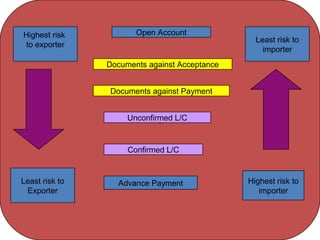
Open Account 
Documents against Payment 
Unconfirmed L/C 
s 
Highest risk 
to exporter 
Documents against Acceptance 
Confirmed L/C 
Advance Payment 
Least risk to 
importer 
Least risk to 
Exporter 
Highest risk to 
importer
International Chamber of 
Commerce 
• Objectives : Promotion of trade and investment, 
opening of markets and free flow of capital 
• Associations with more than 130 countries 
• ICC International Court of Arbitration – the 
world’s leading body for resolving international 
commercial disputes by arbitration.
• UCPDC (originally in 1933 ) and the latest 
one UCPDC 600 effective from 
01.07.2007 
• First nine Incoterms published in 
1936.Incoterms 2000 came into force on 
01.01.2000
Risks in International Trade 
Finance 
• Country Risks– Political Stability, 
Economic Environment, Legal system, 
Forex transactions 
• Forex Risks 
• Commercial Risks – Dependability, Trade 
disputes
Buyer’s Credit 
• Financial arrangement where a Financial 
Institution in the exporter’s country or 
other country extends credit directly or 
indirectly to a foreign buyer to finance 
purchase of goods and services from the 
exporting country.
Various ways of payment in 
international trade 
Clean Payments 
Bills for Collection – D/P, D/A 
Documentary Credit – is a written 
undertaking by the Importer’s Bank on 
behalf of its customer, promising to effect 
payment to exporter upto a stated sum of 
money within a prescribed time limit and 
against stipulated documents.
What is an L/C ? 
LC is an arrangement whereby a bank acting 
at the request of the customer 
undertakes to pay a third party by a 
given date according to agreed 
stipulations and against presentation of 
documents the counter-value of goods 
and services supplied 
BANKS DEAL ONLY IN DOCUMENTS AND NOT IN GOODS
Credit vs. Contracts 
• Credits are separate transactions from the 
sales or other contracts on which they 
may be based and banks are in no way 
concerned with or bound by such 
contracts. An Issuing bank should 
discourage any attempt by the applicant to 
include, as an integral part of the credit, 
copies of the underlying contract.
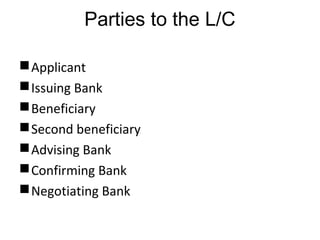
Parties to the L/C 
Applicant 
Issuing Bank 
Beneficiary 
Second beneficiary 
Advising Bank 
Confirming Bank 
Negotiating Bank
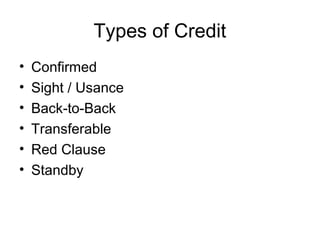
Types of Credit 
• Confirmed 
• Sight / Usance 
• Back-to-Back 
• Transferable 
• Red Clause 
• Standby
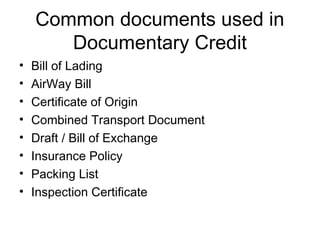
Common documents used in 
Documentary Credit 
• Bill of Lading 
• AirWay Bill 
• Certificate of Origin 
• Combined Transport Document 
• Draft / Bill of Exchange 
• Insurance Policy 
• Packing List 
• Inspection Certificate
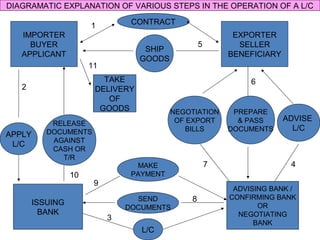
DIAGRAMATIC EXPLANATION OF VARIOUS STEPS IN THE OPERATION OF A L/C 
IMPORTER 
BUYER 
APPLICANT 
CONTRACT 
EXPORTER 
SELLER 
SHIP BENEFICIARY 
GOODS 
TAKE 
DELIVERY 
OF 
GOODS 
APPLY 
L/C 
RELEASE 
DOCUMENTS 
AGAINST 
CASH OR 
T/R 
ISSUING 
BANK 
NEGOTIATION 
OF EXPORT 
BILLS 
6 
PREPARE 
& PASS 
DOCUMENTS 
ADVISE 
L/C 
MAKE 
PAYMENT 
SEND 
DOCUMENTS 
L/C 
ADVISING BANK / 
CONFIRMING BANK 
OR 
NEGOTIATING 
BANK 
1 
5 
11 
2 
10 
7 4 
8 
3 
9
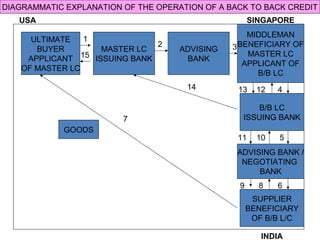
DIAGRAMMATIC EXPLANATION OF THE OPERATION OF A BACK TO BACK CREDIT 
USA SINGAPORE 
ULTIMATE 
BUYER 
APPLICANT 
OF MASTER LC 
MASTER LC 
ISSUING BANK 
ADVISING 
BANK 
MIDDLEMAN 
BENEFICIARY OF 
MASTER LC 
APPLICANT OF 
B/B LC 
B/B LC 
ISSUING BANK 
ADVISING BANK / 
NEGOTIATING 
BANK 
SUPPLIER 
BENEFICIARY 
OF B/B L/C 
1 
15 
2 3 
13 12 4 
11 10 5 
9 8 6 
7 
14 
GOODS 
INDIA
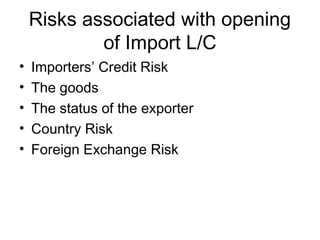
Risks associated with opening 
of Import L/C 
• Importers’ Credit Risk 
• The goods 
• The status of the exporter 
• Country Risk 
• Foreign Exchange Risk
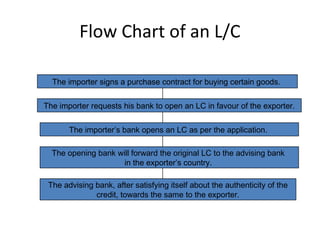
Flow Chart of an L/C 
The importer signs a purchase contract for buying certain goods. 
The importer requests his bank to open an LC in favour of the exporter. 
The importer’s bank opens an LC as per the application. 
The opening bank will forward the original LC to the advising bank 
in the exporter’s country. 
The advising bank, after satisfying itself about the authenticity of the 
credit, towards the same to the exporter.
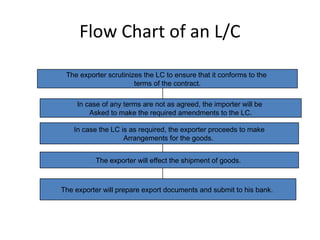
Flow Chart of an L/C 
The exporter scrutinizes the LC to ensure that it conforms to the 
terms of the contract. 
In case of any terms are not as agreed, the importer will be 
Asked to make the required amendments to the LC. 
In case the LC is as required, the exporter proceeds to make 
Arrangements for the goods. 
The exporter will effect the shipment of goods. 
The exporter will prepare export documents and submit to his bank.
Flow Chart of an L/C 
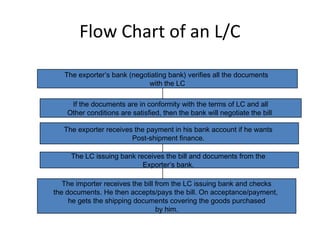
The exporter’s bank (negotiating bank) verifies all the documents 
with the LC 
If the documents are in conformity with the terms of LC and all 
Other conditions are satisfied, then the bank will negotiate the bill 
The exporter receives the payment in his bank account if he wants 
Post-shipment finance. 
The LC issuing bank receives the bill and documents from the 
Exporter’s bank. 
The importer receives the bill from the LC issuing bank and checks 
the documents. He then accepts/pays the bill. On acceptance/payment, 
he gets the shipping documents covering the goods purchased 
by him.
Flow Chart of an L/C 
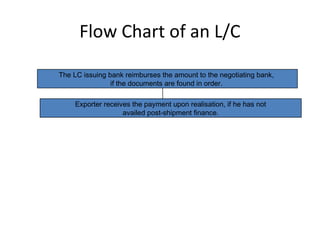
The LC issuing bank reimburses the amount to the negotiating bank, 
if the documents are found in order. 
Exporter receives the payment upon realisation, if he has not 
availed post-shipment finance.
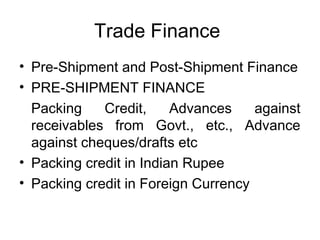
Trade Finance 
• Pre-Shipment and Post-Shipment Finance 
• PRE-SHIPMENT FINANCE 
Packing Credit, Advances against 
receivables from Govt., etc., Advance 
against cheques/drafts etc 
• Packing credit in Indian Rupee 
• Packing credit in Foreign Currency
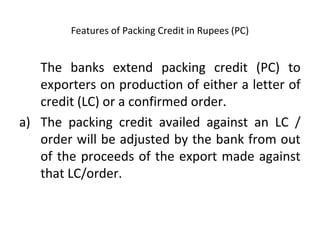
Features of Packing Credit in Rupees (PC) 
The banks extend packing credit (PC) to 
exporters on production of either a letter of 
credit (LC) or a confirmed order. 
a) The packing credit availed against an LC / 
order will be adjusted by the bank from out 
of the proceeds of the export made against 
that LC/order.
Features of Packing Credit in Rupees 
b) Running account facility : This facility granted to 
exporters with goods track record to avail PC 
without lodging an LC/order. The liquidation 
of PCs outstanding in the running account is 
done on a ‘first in first’ basis out. 
c) A packing credit is normally given for a period 
not exceeding 180 days.
Features of Packing Credit in Rupees 
d) PC is granted at a concessional rate of 
interest. The prime lending rate is not 
applicable to export finance. 
e) Refinance can be available by banks from 
the Reserve Bank against the packing credit 
granted to the exporter.
Features of Packing Credit in Rupees 
f) PC is available for both cash exports and 
deemed exports.
Features of Pre-shipment Credit in Foreign 
Currency (PCFC) 
The Foreign Currency loans granted to exporters by 
the banks are known as PCFC. 
a) PCFC is available only for cash exports in foreign 
currency. 
b) The interest rate is less in PCFC, compared to that 
of packing credit in rupees, exporters may not 
prefer PCFC when they expect a fall in the value of 
rupees.
Features of Pre-shipment Credit in Foreign 
Currency (PCFC) 
d) PCFCs can be maintained as running 
accounts. 
e) PCFC is self-liquidating in nature and is 
liquidated by purchasing/ discounting of 
bills. 
f) Refinance from the Reserve Bank is not 
available to banks against PCFC.
Post-Shipment Finance 
Post-shipment credit is defined as any loan or advance 
granted by a bank to an exporter of goods from the 
date of extending the credit after the shipment of 
goods to the date of realisation of the export proceeds. 
Post-shipment finance is extended in the following 
manner :- 
a) Negotiation 
b) Purchase 
c) Discount of export bill under confirmed order/export 
contracts 
d) Advances against export bills sent on collection basis.
Features of Pre-shipment Credit in Foreign 
Currency (PCFC) 
c)For lending under the PCFC scheme, 
banks can use the foreign currency 
balances available with them, in 
Exchange Earners Foreign Currency 
(EEFC) account/Resident Foreign 
Currency (RFC) accounts, Foreign 
Currency Non-resident (FCNR) account, 
Bank’s account etc.
Regulatory Requirements 
• Trade Control Policy 
• Exchange Control Policy 
• UCPDC guidelines 
• ISBP 2002 
• FEDAI Guidelines 
• Bank’s Internal rules and Regulations
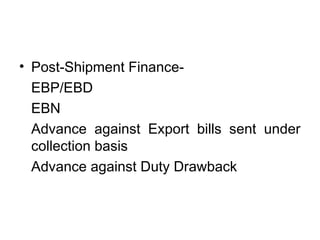
• Post-Shipment Finance- 
EBP/EBD 
EBN 
Advance against Export bills sent under 
collection basis 
Advance against Duty Drawback
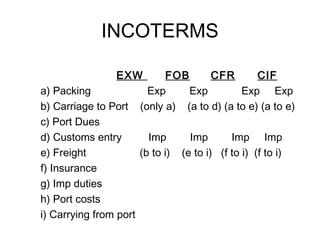
INCOTERMS 
EXW FOB CFR CIF 
a) Packing Exp Exp Exp Exp 
b) Carriage to Port (only a) (a to d) (a to e) (a to e) 
c) Port Dues 
d) Customs entry Imp Imp Imp Imp 
e) Freight (b to i) (e to i) (f to i) (f to i) 
f) Insurance 
g) Imp duties 
h) Port costs 
i) Carrying from port
Thanks

Trade finance 01082914

  • 1.
    TRADE FINANCE Prof.B. B. Bhattacharyya Dean, Banking
  • 2.
    Questions 1. Termsof a sale contract provides shipment of goods ‘FOB’. Who will bear cost of freight – Seller or Buyer? 2. ‘A’ in Mumbai sells goods to ‘B’ in Kolkata. How will payment be settled? 3. Who would approach bank for issuing a Letter of Credit – Seller or Buyer?
  • 3.
    Questions 4. Namethree important documents used in Trade Finance. 5. What is UCPDC? 6. What is FEDAI? 7. What is DGFT? 8. What is Post-Shipment Finance? 9. What is Buyer’s Credit? 10.What are risks in Trade Finance?
  • 4.
    Trade Transaction consistsof • Movement of Goods • Movement of Documents • Movement of Funds
  • 5.
    Open Account Documentsagainst Payment Unconfirmed L/C s Highest risk to exporter Documents against Acceptance Confirmed L/C Advance Payment Least risk to importer Least risk to Exporter Highest risk to importer
  • 6.
    International Chamber of Commerce • Objectives : Promotion of trade and investment, opening of markets and free flow of capital • Associations with more than 130 countries • ICC International Court of Arbitration – the world’s leading body for resolving international commercial disputes by arbitration.
  • 7.
    • UCPDC (originallyin 1933 ) and the latest one UCPDC 600 effective from 01.07.2007 • First nine Incoterms published in 1936.Incoterms 2000 came into force on 01.01.2000
  • 8.
    Risks in InternationalTrade Finance • Country Risks– Political Stability, Economic Environment, Legal system, Forex transactions • Forex Risks • Commercial Risks – Dependability, Trade disputes
  • 9.
    Buyer’s Credit •Financial arrangement where a Financial Institution in the exporter’s country or other country extends credit directly or indirectly to a foreign buyer to finance purchase of goods and services from the exporting country.
  • 10.
    Various ways ofpayment in international trade Clean Payments Bills for Collection – D/P, D/A Documentary Credit – is a written undertaking by the Importer’s Bank on behalf of its customer, promising to effect payment to exporter upto a stated sum of money within a prescribed time limit and against stipulated documents.
  • 11.
    What is anL/C ? LC is an arrangement whereby a bank acting at the request of the customer undertakes to pay a third party by a given date according to agreed stipulations and against presentation of documents the counter-value of goods and services supplied BANKS DEAL ONLY IN DOCUMENTS AND NOT IN GOODS
  • 12.
    Credit vs. Contracts • Credits are separate transactions from the sales or other contracts on which they may be based and banks are in no way concerned with or bound by such contracts. An Issuing bank should discourage any attempt by the applicant to include, as an integral part of the credit, copies of the underlying contract.
  • 13.
    Parties to theL/C Applicant Issuing Bank Beneficiary Second beneficiary Advising Bank Confirming Bank Negotiating Bank
  • 14.
    Types of Credit • Confirmed • Sight / Usance • Back-to-Back • Transferable • Red Clause • Standby
  • 15.
    Common documents usedin Documentary Credit • Bill of Lading • AirWay Bill • Certificate of Origin • Combined Transport Document • Draft / Bill of Exchange • Insurance Policy • Packing List • Inspection Certificate
  • 16.
    DIAGRAMATIC EXPLANATION OFVARIOUS STEPS IN THE OPERATION OF A L/C IMPORTER BUYER APPLICANT CONTRACT EXPORTER SELLER SHIP BENEFICIARY GOODS TAKE DELIVERY OF GOODS APPLY L/C RELEASE DOCUMENTS AGAINST CASH OR T/R ISSUING BANK NEGOTIATION OF EXPORT BILLS 6 PREPARE & PASS DOCUMENTS ADVISE L/C MAKE PAYMENT SEND DOCUMENTS L/C ADVISING BANK / CONFIRMING BANK OR NEGOTIATING BANK 1 5 11 2 10 7 4 8 3 9
  • 17.
    DIAGRAMMATIC EXPLANATION OFTHE OPERATION OF A BACK TO BACK CREDIT USA SINGAPORE ULTIMATE BUYER APPLICANT OF MASTER LC MASTER LC ISSUING BANK ADVISING BANK MIDDLEMAN BENEFICIARY OF MASTER LC APPLICANT OF B/B LC B/B LC ISSUING BANK ADVISING BANK / NEGOTIATING BANK SUPPLIER BENEFICIARY OF B/B L/C 1 15 2 3 13 12 4 11 10 5 9 8 6 7 14 GOODS INDIA
  • 18.
    Risks associated withopening of Import L/C • Importers’ Credit Risk • The goods • The status of the exporter • Country Risk • Foreign Exchange Risk
  • 19.
    Flow Chart ofan L/C The importer signs a purchase contract for buying certain goods. The importer requests his bank to open an LC in favour of the exporter. The importer’s bank opens an LC as per the application. The opening bank will forward the original LC to the advising bank in the exporter’s country. The advising bank, after satisfying itself about the authenticity of the credit, towards the same to the exporter.
  • 20.
    Flow Chart ofan L/C The exporter scrutinizes the LC to ensure that it conforms to the terms of the contract. In case of any terms are not as agreed, the importer will be Asked to make the required amendments to the LC. In case the LC is as required, the exporter proceeds to make Arrangements for the goods. The exporter will effect the shipment of goods. The exporter will prepare export documents and submit to his bank.
  • 21.
    Flow Chart ofan L/C The exporter’s bank (negotiating bank) verifies all the documents with the LC If the documents are in conformity with the terms of LC and all Other conditions are satisfied, then the bank will negotiate the bill The exporter receives the payment in his bank account if he wants Post-shipment finance. The LC issuing bank receives the bill and documents from the Exporter’s bank. The importer receives the bill from the LC issuing bank and checks the documents. He then accepts/pays the bill. On acceptance/payment, he gets the shipping documents covering the goods purchased by him.
  • 22.
    Flow Chart ofan L/C The LC issuing bank reimburses the amount to the negotiating bank, if the documents are found in order. Exporter receives the payment upon realisation, if he has not availed post-shipment finance.
  • 23.
    Trade Finance •Pre-Shipment and Post-Shipment Finance • PRE-SHIPMENT FINANCE Packing Credit, Advances against receivables from Govt., etc., Advance against cheques/drafts etc • Packing credit in Indian Rupee • Packing credit in Foreign Currency
  • 24.
    Features of PackingCredit in Rupees (PC) The banks extend packing credit (PC) to exporters on production of either a letter of credit (LC) or a confirmed order. a) The packing credit availed against an LC / order will be adjusted by the bank from out of the proceeds of the export made against that LC/order.
  • 25.
    Features of PackingCredit in Rupees b) Running account facility : This facility granted to exporters with goods track record to avail PC without lodging an LC/order. The liquidation of PCs outstanding in the running account is done on a ‘first in first’ basis out. c) A packing credit is normally given for a period not exceeding 180 days.
  • 26.
    Features of PackingCredit in Rupees d) PC is granted at a concessional rate of interest. The prime lending rate is not applicable to export finance. e) Refinance can be available by banks from the Reserve Bank against the packing credit granted to the exporter.
  • 27.
    Features of PackingCredit in Rupees f) PC is available for both cash exports and deemed exports.
  • 28.
    Features of Pre-shipmentCredit in Foreign Currency (PCFC) The Foreign Currency loans granted to exporters by the banks are known as PCFC. a) PCFC is available only for cash exports in foreign currency. b) The interest rate is less in PCFC, compared to that of packing credit in rupees, exporters may not prefer PCFC when they expect a fall in the value of rupees.
  • 29.
    Features of Pre-shipmentCredit in Foreign Currency (PCFC) d) PCFCs can be maintained as running accounts. e) PCFC is self-liquidating in nature and is liquidated by purchasing/ discounting of bills. f) Refinance from the Reserve Bank is not available to banks against PCFC.
  • 30.
    Post-Shipment Finance Post-shipmentcredit is defined as any loan or advance granted by a bank to an exporter of goods from the date of extending the credit after the shipment of goods to the date of realisation of the export proceeds. Post-shipment finance is extended in the following manner :- a) Negotiation b) Purchase c) Discount of export bill under confirmed order/export contracts d) Advances against export bills sent on collection basis.
  • 31.
    Features of Pre-shipmentCredit in Foreign Currency (PCFC) c)For lending under the PCFC scheme, banks can use the foreign currency balances available with them, in Exchange Earners Foreign Currency (EEFC) account/Resident Foreign Currency (RFC) accounts, Foreign Currency Non-resident (FCNR) account, Bank’s account etc.
  • 32.
    Regulatory Requirements •Trade Control Policy • Exchange Control Policy • UCPDC guidelines • ISBP 2002 • FEDAI Guidelines • Bank’s Internal rules and Regulations
  • 33.
    • Post-Shipment Finance- EBP/EBD EBN Advance against Export bills sent under collection basis Advance against Duty Drawback
  • 34.
    INCOTERMS EXW FOBCFR CIF a) Packing Exp Exp Exp Exp b) Carriage to Port (only a) (a to d) (a to e) (a to e) c) Port Dues d) Customs entry Imp Imp Imp Imp e) Freight (b to i) (e to i) (f to i) (f to i) f) Insurance g) Imp duties h) Port costs i) Carrying from port
  • 35.