THREAD
MADE BY
POOJA ROY
1
THREAD
 Threading is a facility to allow multiple activities to coexist within a single
process.
 Threads are sometimes referred to as lightweight processes. Like
processes, threads are independent, concurrent paths of execution
through a program, and each thread has its own stack.
2
Why use threads?
•Take advantage of multiprocessor systems
•Simplify modeling
•Perform asynchronous or background processing
3
Life cycle of a Thread (Thread States)
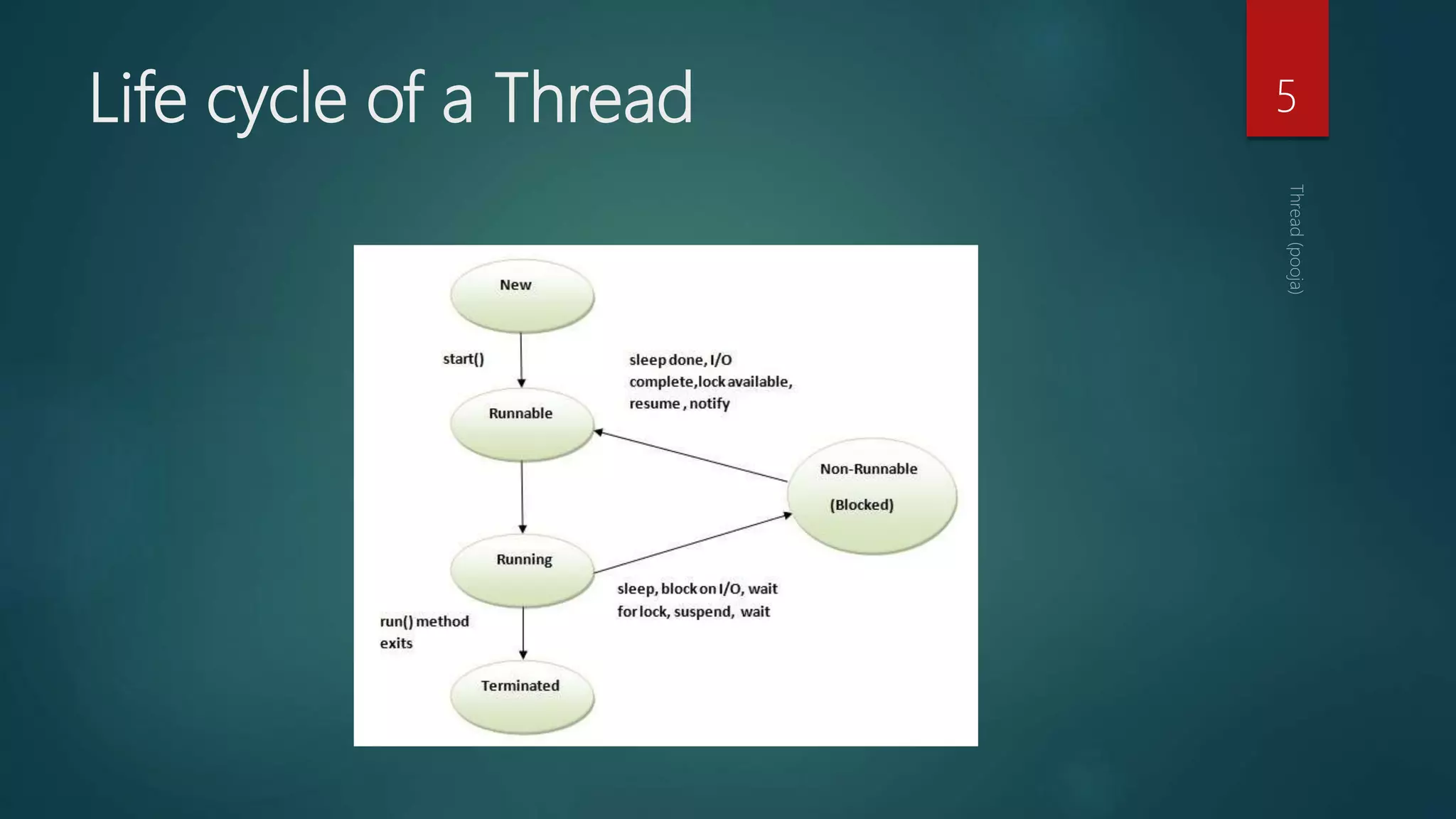
 The life cycle of the thread in java is controlled by JVM. The java thread
states are as follows:
 New
 Runnable
 Running
 Non-Runnable (Blocked)
 Terminated
4
Life cycle of a Thread 5
Life cycle of a Thread
 1) New
 The thread is in new state if you create an instance of Thread class but
before the invocation of start() method.
 2) Runnable
 The thread is in runnable state after invocation of start() method, but the
thread scheduler has not selected it to be the running thread.
 3) Running
 The thread is in running state if the thread scheduler has selected it.
6
Life cycle of a Thread
 4) Non-Runnable (Blocked)
 This is the state when the thread is still alive, but is currently not eligible to
run.
 5) Terminated
 A thread is in terminated or dead state when its run() method exits.
7
Thank you
8

Thread.ppt

  • 1.
  • 2.
    THREAD  Threading isa facility to allow multiple activities to coexist within a single process.  Threads are sometimes referred to as lightweight processes. Like processes, threads are independent, concurrent paths of execution through a program, and each thread has its own stack. 2
  • 3.
    Why use threads? •Takeadvantage of multiprocessor systems •Simplify modeling •Perform asynchronous or background processing 3
  • 4.
    Life cycle ofa Thread (Thread States)  The life cycle of the thread in java is controlled by JVM. The java thread states are as follows:  New  Runnable  Running  Non-Runnable (Blocked)  Terminated 4
  • 5.
    Life cycle ofa Thread 5
  • 6.
    Life cycle ofa Thread  1) New  The thread is in new state if you create an instance of Thread class but before the invocation of start() method.  2) Runnable  The thread is in runnable state after invocation of start() method, but the thread scheduler has not selected it to be the running thread.  3) Running  The thread is in running state if the thread scheduler has selected it. 6
  • 7.
    Life cycle ofa Thread  4) Non-Runnable (Blocked)  This is the state when the thread is still alive, but is currently not eligible to run.  5) Terminated  A thread is in terminated or dead state when its run() method exits. 7
  • 8.