MULTITHREADING
SYNOPSIS:
 MUTITHREADING
 CREATION OFTHREAD
 THREAD LIFE CYCLE
 THREAD PRIORITIESAND SCHEDULING
 THREAD SYNCHRONIZATION
 DAEMONTHREAD
 THREAD GROUPS
 COMMUNICATION OFTHREADS
MULTITHREADING:
 Multithreading is a Java feature that allows
concurrent execution of two or more parts of
a program for maximum utilization of CPU.
Each part of such program is called a thread.
So, threads are light-weight processes within
a process.
CREATION OF THREAD
 Java is inherently multi-threaded. A
single Java program can have many different
threads executing independently and
continuously.Three Java applets on the same
page can run together with each getting
equal time from the CPU with very little extra
effort on the part of the programmer
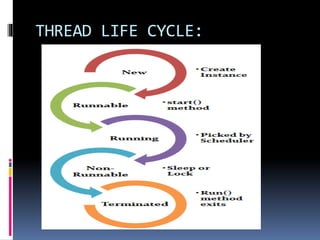
THREAD LIFE CYCLE:
THREAD PRIORITIES AND
SCHEDULING:
 Scheduling of the CPU is fully preemptive. If
a thread with a higher priority than the
currently executing thread needs to execute,
the higher priority thread isimmediately
scheduled.The Java runtime will not preempt
the currently runningthread
for another thread of the same priority.
THREAD SYNCHRONIZATION:
 At times when more than one thread try to
access a shared resource, we need to ensure
that resource will be used by only one thread
at a time.The process by which this is
achieved is called synchronization.
Thesynchronization keyword in java creates
a block of code referred to as critical section.
DAEMON THREAD:
 A daemon thread is a thread that does not
prevent the JVM from exiting when the
program finishes but the thread is still
running. An example for a daemon thread is
the garbage collection.You can use the
setDaemon(boolean) method to change
the Thread daemon properties before
the threadstarts.

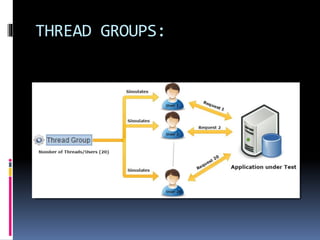
THREAD GROUPS:
COMMUNICATION OF THREAD:
 Inter thread Communication. Java provide
benefits of avoiding thread pooling using
inter-thread communication.The wait(),
notify() and notify all() methods of Object
class are used for this purpose.These method
are implemented as final methods in Object,
so that all classes have them.

Multithreading.

  • 1.
  • 2.
    SYNOPSIS:  MUTITHREADING  CREATIONOFTHREAD  THREAD LIFE CYCLE  THREAD PRIORITIESAND SCHEDULING  THREAD SYNCHRONIZATION  DAEMONTHREAD  THREAD GROUPS  COMMUNICATION OFTHREADS
  • 3.
    MULTITHREADING:  Multithreading isa Java feature that allows concurrent execution of two or more parts of a program for maximum utilization of CPU. Each part of such program is called a thread. So, threads are light-weight processes within a process.
  • 4.
    CREATION OF THREAD Java is inherently multi-threaded. A single Java program can have many different threads executing independently and continuously.Three Java applets on the same page can run together with each getting equal time from the CPU with very little extra effort on the part of the programmer
  • 5.
  • 6.
    THREAD PRIORITIES AND SCHEDULING: Scheduling of the CPU is fully preemptive. If a thread with a higher priority than the currently executing thread needs to execute, the higher priority thread isimmediately scheduled.The Java runtime will not preempt the currently runningthread for another thread of the same priority.
  • 7.
    THREAD SYNCHRONIZATION:  Attimes when more than one thread try to access a shared resource, we need to ensure that resource will be used by only one thread at a time.The process by which this is achieved is called synchronization. Thesynchronization keyword in java creates a block of code referred to as critical section.
  • 8.
    DAEMON THREAD:  Adaemon thread is a thread that does not prevent the JVM from exiting when the program finishes but the thread is still running. An example for a daemon thread is the garbage collection.You can use the setDaemon(boolean) method to change the Thread daemon properties before the threadstarts. 
  • 9.
  • 10.
    COMMUNICATION OF THREAD: Inter thread Communication. Java provide benefits of avoiding thread pooling using inter-thread communication.The wait(), notify() and notify all() methods of Object class are used for this purpose.These method are implemented as final methods in Object, so that all classes have them.