TOPICINCLUDES:
 Introduction to Thread
 Creation of Thread
 Life cycle of Thread
 DeadLock
INTRODUCTIONTO THREAD
• Thread is the basic unit of Java program
execution.
• Thread: It can be called lightweight process
• Thread requires less resources to create and exists in the
process
• Thread shares the process resources
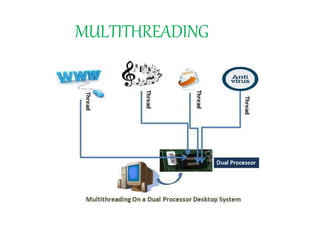
MULTITHREADING
• Multithreading in java is a process of
executing multiple processes simultaneously
• A program is divided into two or more
subprograms, which can be implemented at
the same time in parallel.
• Multiprocessing and multithreading, both are
used to achieve multitasking.
• Java Multithreading is mostly used in games,
animation etc.
MULTITHREADING
MULTITHREADING
ADVANTAGE:
 It doesn't block the user
 can perform many operations together so it
saves time.
 Threads are independent so it doesn't
affect other threads
CREATINGTHREAD
• Threads are implemented in the form of objects.
• The run() and start() are two inbuilt methods
which helps to thread implementation
• The run() method can be initiating with the help
of start() method.
CREATINGTHREAD
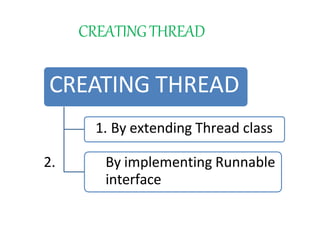
CREATING THREAD
1. By extending Thread class
2. By implementing Runnable
interface
CREATINGTHREAD
1. By Extending Thread class
class Multi extends Thread
{
public void run()
{
System.out.println("thread is running...");
}
public static void main(String args[])
{
Multi t1=new Multi();
t1.start();
}
}
Output: thread is running…
// Extending thread class
// run() method declared
//object initiated
// run() method called through start()
CREATINGTHREAD
2. By implementing Runnable interface
class Multi3 implements Runnable
{
public void run()
{
System.out.println("thread is running...");
}
public static void main(String args[])
{
Multi3 m1=new Multi3();
Thread t1 =new Thread(m1);
t1.start();
} }
// Implementing Runnable interface
// object initiated for class
// object initiated for thread
Output: thread is running…
LIFEcycleof a thread
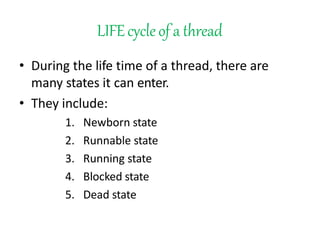
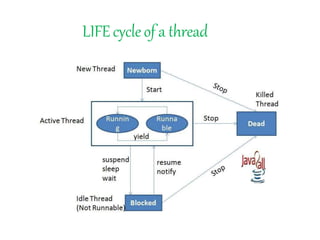
• During the life time of a thread, there are
many states it can enter.
• They include:
1. Newborn state
2. Runnable state
3. Running state
4. Blocked state
5. Dead state
LIFEcycleof a thread
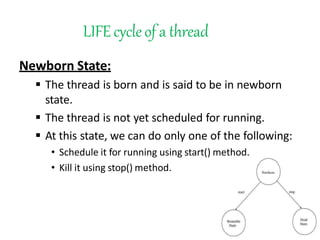
Newborn State:
 The thread is born and is said to be in newborn
state.
 The thread is not yet scheduled for running.
 At this state, we can do only one of the following:
• Schedule it for running using start() method.
• Kill it using stop() method.
LIFEcycleof a thread
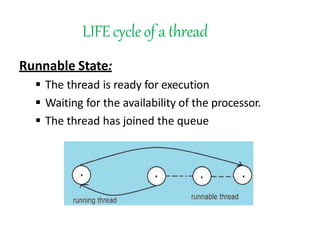
Runnable State:
 The thread is ready for execution
 Waiting for the availability of the processor.
 The thread has joined the queue
LIFEcycleof a thread
Running State:
• Thread is executing
• The processor has given its time to the thread
for its execution.
• The thread runs until it gives up control on its
own or taken over by other threads.
LIFEcycleof a thread
Blocked State:
• A thread is said to be blocked
• It is prevented to entering into the runnable and the
running state.
• This happens when the thread is suspended, sleeping,
or waiting in order to satisfy certain requirements.
• A blocked thread is considered "not runnable" but not
dead and therefore fully qualified to run again.
• This state is achieved when we
Invoke suspend() or sleep() or wait() methods.
LIFEcycleof a thread
Dead State:
• Every thread has a life cycle.
• A running thread ends its life when it has completed
executing its run( ) method. It is a natural death.
• A thread can be killed in born, or in running, or even in
"not runnable" (blocked) condition.
• It is called premature death.
• This state is achieved when we invoke stop() method or
the thread completes it execution.
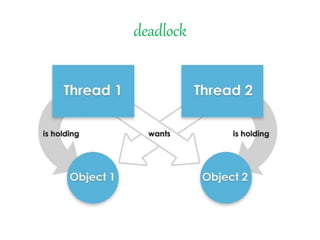
deadlock
• Deadlock describes a situation where two or
more threads are blocked forever, waiting for
each other.
• when two or more threads are waiting to gain
control on a resource.
For example, assume that the thread A must
access Method1 before it can release Method2, but
the thread B cannot release Method1 until it gets
holds of Method2.
deadlock
THANK YOU

Multithreading.pptx

  • 2.
    TOPICINCLUDES:  Introduction toThread  Creation of Thread  Life cycle of Thread  DeadLock
  • 3.
    INTRODUCTIONTO THREAD • Threadis the basic unit of Java program execution. • Thread: It can be called lightweight process • Thread requires less resources to create and exists in the process • Thread shares the process resources
  • 4.
    MULTITHREADING • Multithreading injava is a process of executing multiple processes simultaneously • A program is divided into two or more subprograms, which can be implemented at the same time in parallel. • Multiprocessing and multithreading, both are used to achieve multitasking. • Java Multithreading is mostly used in games, animation etc.
  • 5.
  • 6.
    MULTITHREADING ADVANTAGE:  It doesn'tblock the user  can perform many operations together so it saves time.  Threads are independent so it doesn't affect other threads
  • 7.
    CREATINGTHREAD • Threads areimplemented in the form of objects. • The run() and start() are two inbuilt methods which helps to thread implementation • The run() method can be initiating with the help of start() method.
  • 8.
    CREATINGTHREAD CREATING THREAD 1. Byextending Thread class 2. By implementing Runnable interface
  • 9.
    CREATINGTHREAD 1. By ExtendingThread class class Multi extends Thread { public void run() { System.out.println("thread is running..."); } public static void main(String args[]) { Multi t1=new Multi(); t1.start(); } } Output: thread is running… // Extending thread class // run() method declared //object initiated // run() method called through start()
  • 10.
    CREATINGTHREAD 2. By implementingRunnable interface class Multi3 implements Runnable { public void run() { System.out.println("thread is running..."); } public static void main(String args[]) { Multi3 m1=new Multi3(); Thread t1 =new Thread(m1); t1.start(); } } // Implementing Runnable interface // object initiated for class // object initiated for thread Output: thread is running…
  • 11.
    LIFEcycleof a thread •During the life time of a thread, there are many states it can enter. • They include: 1. Newborn state 2. Runnable state 3. Running state 4. Blocked state 5. Dead state
  • 12.
  • 13.
    LIFEcycleof a thread NewbornState:  The thread is born and is said to be in newborn state.  The thread is not yet scheduled for running.  At this state, we can do only one of the following: • Schedule it for running using start() method. • Kill it using stop() method.
  • 14.
    LIFEcycleof a thread RunnableState:  The thread is ready for execution  Waiting for the availability of the processor.  The thread has joined the queue
  • 15.
    LIFEcycleof a thread RunningState: • Thread is executing • The processor has given its time to the thread for its execution. • The thread runs until it gives up control on its own or taken over by other threads.
  • 16.
    LIFEcycleof a thread BlockedState: • A thread is said to be blocked • It is prevented to entering into the runnable and the running state. • This happens when the thread is suspended, sleeping, or waiting in order to satisfy certain requirements. • A blocked thread is considered "not runnable" but not dead and therefore fully qualified to run again. • This state is achieved when we Invoke suspend() or sleep() or wait() methods.
  • 17.
    LIFEcycleof a thread DeadState: • Every thread has a life cycle. • A running thread ends its life when it has completed executing its run( ) method. It is a natural death. • A thread can be killed in born, or in running, or even in "not runnable" (blocked) condition. • It is called premature death. • This state is achieved when we invoke stop() method or the thread completes it execution.
  • 18.
    deadlock • Deadlock describesa situation where two or more threads are blocked forever, waiting for each other. • when two or more threads are waiting to gain control on a resource. For example, assume that the thread A must access Method1 before it can release Method2, but the thread B cannot release Method1 until it gets holds of Method2.
  • 19.
  • 20.